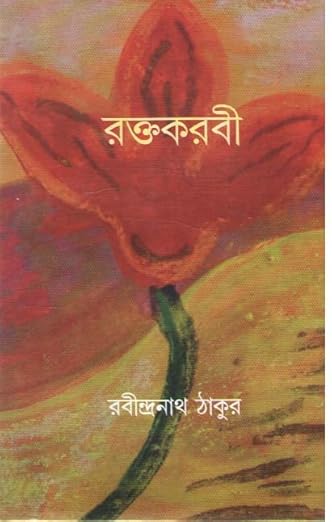
An excerpt from Professor Fakrul Alam’s unpublished translation of Rabindranath Tagore’s Raktakarabi or Red Oleanders (1924) from Bengali: It was first published in Prabasi magazine. This play rebels against totalitarianism.

Introduction
This play is based on truth. However, any reader who turns only to historians to ascertain the authenticity of events is bound to be left unfulfilled by it. Let this suffice then as an explanation: as far as this poet is concerned, they are based fully on truth.
It is possible also that geographers will differ on the play’s actual setting. But everyone knows that the setting is informally known as Lucre Land. Scholars say that the mythical Lucre Land was the site of the gilded throne of Mammon, the God of Wealth. But it will not be right to see this play as one set entirely in a mythical period; it should not be classified as a fable either. The land that it deals with it has in its mines the most precious of minerals. Its discovery led to tunnel-digging. This is why people fondly calls it Lucre Land. We will get acquainted with some of the diggers involved in due course.
No one can expect historians to agree on the real name of the monarch of Lucre Land either. The one thing that I know is that the moniker used for him is “The Dreaded”. In due course it will be clear why this is the name by which he is called.
Outside the king’s palace walls are latticed windows. It is from a room with such windows that The Dreaded One chooses to meet any number of people he wants to talk to. Why he acts so bizarrely is something that we know nothing more about than what becomes apparent from the exchanges taking place between the main characters of this play.
The chieftains who run the kingdom on the king’s behalf are well-suited to carry out their work. They are also supposed to be far-seeing—all of them are members of the King’s inner council. Their carefully taken measures ensure that there are no lapses in the work being done by the diggers. And so this is how Lucre Land has developed steadily. The supervisors, once diggers themselves, have earned on their own merit the titles they now have. Indeed, in efficiency they often surpass the chieftains they once worked for. If the laws governing Lucre Land can be called euphemistically “The Full Moon’s Beams”, the responsibility of enforcing them are entrusted to the supervisors manning what can be called its Department of Disgrace.
In addition, there is the “Holy One”. He always swears by God but lives off what is allotted to him by the chieftains. He is believed to be responsible for a lot of the “good things” that are benefitting Lucre Land.
From time to time, inedible marine animals get stuck in the net of the fishermen casting their nets here. They are of no value though—either as edible creatures or as ones that can be traded for cash. On the contrary, every now and then they leave behind holes in the nets they get entangled in. In a net flung in the course of the plot of the play, however, a girl called Nandini shows up—a girl seemingly destined to tear apart the intricate net that separates the King of Lucre Land from the rest of the world.
As far as we can see at the start of the play, the events it dramatizes take place outside the room with the latticed windows where the king lives. We get to know very little of what is happening inside the palace though.
This play is set in the country called Lucre Land. The workers here are employed to dig gold. Its king remains hidden behind a thick screen. Only one scene of the play, however, is set behind the screen. The remaining scenes all take place outside.


Enter Nandini and Kishore—a young man employed in digging mines
Kishore: Nandini! Nandini! Nandini!
Nandini: Why keep calling my name again and again young man? Do you think I have a hearing problem?
Kishore: I know you have no hearing problem. I keep calling you by your name because I like doing so. Do you need more flowers? If you do, let me go and get some.
Nandini: Go, go back to work. Don’t waste any more time here.
Kishore: What I do all day long is dig for gold. Whenever I can steal some time away from such digging to search for flowers for you. That makes me feel alive.
Nandini: Young man—don’t you know they’ll punish you if they find you not at work?
Kishore: But didn’t you say you really, really want the red oleanders? What delights me is that you can’t find them easily anywhere nearby. I found only one red oleander tree behind the rubbish dumped all over the place and that too after searching hard for it.
Nandini: Show me the place and I’ll go pluck the flowers myself.
Kishore: Please don’t say such a thing again. Don’t be so cruel Nandini! Let the tree remain as my one secret. Bishu sings for you songs he composed himself. From now on, I’ll get you the flowers you want and flowers that I can call my own.
Nandini: But the beastly people of this place keep punishing you. My heart breaks whenever they do so.
Kishore: The pain I endure makes the flowers that blossom even more dearly mine. They are the harvests of my sorrow!
Nandini: But how will I endure the pain and the suffering you have to endure on my account?
Kishore: What pain? That there will come a day when I’ll sacrifice myself fully for you is the thought that comes to my mind again and again.
Nandini: You keep giving me so much. Tell me, what can I give you in return?
Kishore: Make this pledge to me—every morning you’ll take the flowers from me.
Nandini: Fine, I’ll do that. But careful….
Kishore: No way I’m going to restrain myself! No way! I’ll bring you flowers even if I have to face their lashes every day!
Exit Kishore
The Professor Enters
Professor: Nandini! Don’t go; look at me!
Nandini: What for Professor?
Professor: Why do you keep surprising me again and again only to disappear afterwards? Since you succeed in stirring my mind, why don’t you then stir it up fully? Just stay for a minute and let me say a few things to you.
Nandini: Why do you need to talk to me?
Professor: If I’m to talk about what is of importance, just take a look! Our diggers climb up to the top from the tunnel with what they have mined from the heart of the earth and then carry burdens on their head like termites do. All the wealth of Lucre Land comes from that dust-mixed source—gold is the outcome! But beautiful one, you are golden not because of such dust but because of the light you emit. How can only the need for wealth detain you?
Nandini: You keep saying the same thing again and again. What amazes you so whenever you look at me Professor?
Professor: There is nothing surprising about the light that brightens the flower gardens in the morning. The light that comes through cracks in the wall are something else though. In Lucre Land you are that kind of unexpected light! Tell me—what could you for be possibly thinking about as far as this place is concerned?
Nandini: I am amazed to see the whole city’s focus to explore what is underground and all the groping in the dark that goes on. They keep digging in these underground tunnels for treasures that have been fossilising there for ages. These are treasures earth buried there.
Professor: What we do is exhume the corpses of such resources devotedly. We want to tame the ghosts within them. If we can tie the golden lumps up and retain them so that they don’t seem strange, we’ll have the world in our grasp.
Nandini: What is more shocking is that you have your king covered up in a wall made up of weird nets. It is as if you wouldn’t like people to find out that he is human. I feel like either opening the cover of that dark tunnel or flooding it with light. I feel like tearing up such a weird net and rescuing the man trapped inside.
Professor: Just as the ghost of fossilised wealth can be scary, the king we have can terrify us because of the power he has to scare his subjects.
Nandini: Everything you keep saying is so concocted.
Professor: Yes, I’ve made them up for sure. A nude need not be identified; only his tailored clothes will mark him as a king or a beggar! Come to my house—I’ll be delighted to make you wise with words of wisdom.
Nandini: Just as your diggers bury themselves when digging the soil, you seem to be digging deeper and deeper into your books. Why would you waste time on someone like me?
Professor: We are dense, thick-headed creatures, submerged in opaque scholarly work. You are the evening star we see when we have nothing else to do; seeing you makes our wings restless. Come home with me; let me spoil myself for a change.
Nandini: No, not now—I’ve come to see your king seated in his chamber.
Professor: He stays within his latticed wall; he won’t let you in for sure.
Nandini: No wall can block me; I’m here to spend time with your king in his chamber.
Professor: You know what Nandini—I too live inside a wall. I’ve sacrificed a lot of my human side; only my scholarship stirs in me. Just as our king is awesome, I’m an awe-inspiring scholar.
Nandini: You must be joking! You don’t seem frightening at all. Let me ask you this question: If they could bring me here, why didn’t they bring Ranjan to this place as well?
Professor: Their strategy is to tear up everything. In any case, let me say this: why bring your precious soul to a place so full of lifeless treasures?
Nandini: If Ranjan is brought here, their dead hearts will stir again.
Professor: Nandini alone has been enough to strike the chiefs of Lucre Land dumb; imagine what will happen if Ranjan is brought here as well.
Nandini: They have no idea how strange they can be. If God could make them smile, the spell they are in would be broken. Ranjan’s smile is God’s smile!
Professor: The smile of God is like sunlight—it melts ice but doesn’t move boulders. If you want to stir our chieftains, you need to be forceful.
Nandini: Ranjan’s strength is like your Shankhini River. Just like that river, he’ll be all smiles at one moment and a destructive force in another. Professor, let me tell you what has been a secret till now. I’ll be meeting Ranjan later today!
Professor: How do you know this?
Nandini: We’ll meet, for sure we will. The news has come that we’ll be united soon.
Professor: How can such news travel without attracting the attention of the chiefs?
Nandini: They’ll come through the same route that ushers news about spring. It’s touched with the colour of the sky and the lilt of the wind.
Professor: In other words, the colours of the sky lilt the breeze that ushers in spring.
Nandini: When Ranjan comes, I’ll be able to show you how news that has been flying can land on earth.
Professor: Once the subject of conversation turns to Ranjan, there is no stopping Nandini from talking. Never mind! Since I’ve mastered real knowledge, let me enter its depths; I myself don’t dare do anything now.
He comes back after advancing a little.
Nandini, aren’t you frightened at the thought of being in Lucre Land?
Nandini: Why should I be?
Professor: Animals fear solar eclipses but not the round sun. Lucre Land is a place where an eclipse of sorts has taken place. The sun was bitten when it got into a gilded crater during an eclipse. Since it itself wasn’t full, it didn’t want anything else to be fully developed. Let me advise you—don’t hang around this place. When you leave these craters, they will be yawning before us—but I’ll keep insisting—flee! Be happy with Ranjan anywhere else where people don’t shred the borders of Mother Earth’s sari into bits!
He goes some distance and then returns
Professor: Nandini, won’t you give me one of the red oleander flowers you are carrying in your right hand?
Nandini: Why? What do you want to do with it?
Professor: On many occasions it occurred to me that the red oleanders you wear have some significance for you.
Nandini: I have no idea what they could possibly mean.
Professor: Perhaps the Divine Dispenser of your fate does. The red color emits mysterious negative vibes and not only ones that delight.
Nandini: Things that can frighten me?
Professor: God has in this case painted beauty with a brush dipped in blood! I have no clue to what you were scribbling in red as you came. There are malati, mallika, chameli flowers aplenty that you overlooked. What made you pluck flowers only from this particular flowering tree? Know that people only do unthinkingly what they are fated to do.
Nandini: Every now and then Ranjan will fondly call me “Red Oleander”. I don’t know why the thought occurs to me that my Ranjan’s love is of that colour. It’s the colour I wear on my neck, my bosom and my hand.
Professor: So why not offer me a flower only for a while so that I can figure out the essence of that flower?
Nandini: Here, take this one. Ranjan will be here today. I’m so happy that I’ve decided to gift you this red oleander.
The Professor departs.
Gokul, a Tunnel Digger, Enters
Gokul: Turn your face this way for once. I can’t seem to figure you out! Who could you be?
Nandini: I’m exactly what you see. Nothing else! Why do you need to know anything more?
Gokul: Not a good idea to not know. Has the King of this realm summoned you here for any reason?
Nandini: For no good reason!
Gokul: What a thing to say! He is trapping us all. You are the cause of the danger we all are in.
Anyone bewitched by your beautiful face is doomed. Let’s take a look—what is that swinging there where you hair is parting?
Nandini: Red Oleander flowers!
Gokul: What do they signify?
Nandini: Nothing!
Gokul: I don’t believe you at all. You must be up to something. There is bound to be trouble before the day is over. That is why you decked yourself so. What a dreadful trick!
Nandini: What makes you think I’m so terrifying just by looking at me?
Gokul: You remind me of a torch lighted up in many colors. Go and fool innocent ones by telling them— “Take care! Beware!”
Gokul Exits
Nandini is now outside a latticed window
Nandini (Striking the latticed window): Can you hear me?
Voice: I hear you Nanda! But don’t keep calling me again and again; I have no time left, not a bit.
Nandini: I feel very happy today! So happy that I’d like to enter your room.
Voice: No need to come in. If you have anything to say, do so from outside the room.
Nandini: I’ve brought you a garland made of jasmine flowers. It’s covered with lotus leaves.
Voice: Wear it yourself!
Nandini: It doesn’t suit me. I wear red oleander garlands
Voice: I am like a mountain peak. I look best unadorned.
Nandini: From such peaks waterfall stream. A garland will sway in your neck as well. Open the net—I’d like to go in.
Voice: I won’t let you in. Say what you want to now. I don’t have any time to lose.
Nandini: Can you hear any song from where you are?
Voice: What song?
Nandini: A song about the winter month of Poush[1]! A song calling all to harvesting!
Poush calls us all
Come, come away
Its tray is full this day
With harvested crops galore
Come, come away
Don’t you see how the harvested rice’s loveliness mingles with the wintry sky?
In the heady wind
Goddesses work
Across rice fields
All over the land
A golden hue spreads
So good to see. Ah me!
Come outside King! Let me take you to the field.
The sky is happy to hear in fields flutes play.
 Who’d want to stay indoors any longer today?
 Open, open all doors
Voice: I go to work? What work am I good for?
Nandini: Harvesting is much easier than the kind of work you do for Lucre Land.
Voice: The work which seems easy to you is actually hard for me to do. Can a lake dance like the foams of a waterfall?
Nandini: Your strength is truly amazing. The day you let me enter your treasury, I wasn’t a bit startled by your gold piles. What truly fascinated me then is the way you managed to put things into an orderly heap effortlessly despite your immense strength. Nevertheless, I’ll have to say this: can lumped up golden balls respond to the amazing rhythms of your hands as well as a rice field? Tell me O King, aren’t you at all afraid to handle the fossilised resources of the world day after day?
Voice: Why, what is there to fear?
Nandini: The earth bestows on us joyfully things it holds dear. But when even dead bones are snatched away by those who value them merely as precious things what they really do is dig up from the dark depths things a blind giant had cursed. Don’t you see that everyone here is edgy? Either that or they are scared.
Voice: Scared of what?
Nandini: The fear that things will be snatched away and of the killings that might follow.
Voice: I don’t know of any curse involved. What I know is about the power we can evoke. Does my immense strength make you happy Nandini?
Nandini: Very happy indeed. That is why I’ll insist: come out into the light; put your feet on the soil; let earth rejoice.
The light joy brings
Daubs ears of corn with dew
Why not feel the joy of touch?
Nature’s joy knows no bounds
A sight so good to see
—ah me!
[1] Ninth month of the Bengali calendar coincides with December-January of the Gregorian calendar.
.
Fakrul Alam is an academic, translator and writer from Bangladesh. He has translated works of Jibanananda Das and Rabindranath Tagore into English and is the recipient of Bangla Academy Literary Award (2012) for translation and SAARC Literary Award (2012).
.
PLEASE NOTE: ARTICLES CAN ONLY BE REPRODUCED IN OTHER SITES WITH DUE ACKNOWLEDGEMENT TO BORDERLESS JOURNAL
Click here to access the Borderless anthology, Monalisa No Longer Smiles
Click here to access Monalisa No Longer Smiles on Amazon International
 Borderless