Categories
Review

A Memoir À La Carte

Book Review by Bhaskar Parichha

Title: Digesting India: A Travel Writer’s Sub-Continental Adventures with the Tummy (A Memoir À La Carte)

Author: Zac O’Yeah

Publisher: Speaking Tiger Books

Digesting India: A Travel Writer’s Sub-Continental Adventures with the Tummy (A Memoir À La Carte) is a culmination of thirty years of experience with the three things Zac O’Yeah loves most about life — eating, drinking and travelling — that put together a delightful travel-cum-food book. A detective novelist, O’Yeah is the creator of the Majestic Trilogy. He freelanced for the Swedish radio for 25 years before moving to India in 2000. Subsequently, he has written several bestsellers, both fiction and nonfiction. His writings have been part of Hindu Business Line and National Geographic Traveler.

The Scandinavian-Indian novelist takes us on an entertaining and informative journey through the country in this book. We learn about dishes we may not have heard of before, and food habits we may not have known about. The author takes the reader through the pleasures of drinking beer in Bengaluru, drinking toddy in Kerala, and eating boiled vegetables and masala-less curries in Sevagram, Maharashtra, to prepare himself for Rajasthan’s rich red flavours. During his travels, he discovers Goa’s literati culture while sipping cashew fenny. He finds two of his favourite foods, mushrooms and cheese, in Bhutan, and finds out what astronauts eat and drink in space. 

The book is an intriguing and profound story of an avid traveler’s untiring quest for evolving cultural and culinary experiences. It is a fast-paced, exciting book. In a nutshell, it is a very substantial, coconut-sized shell that captures all of India within its dimensions. It is the right place to learn about dishes we might not have heard of before, and food habits we may never have known existed. It is similar to what we experience when accompanying O’Yeah on a ‘spare parts’ tour. This starts in Shivajinagar, Bengaluru’s slaughterhouse area, where the exploration begins.

As he winds his way through India, he shows us the pleasures of drinking beer in Bengaluru (a slang for ‘beer galore’), drinking toddy in Kerala, and eating boiled vegetables and masala-less curries in Sevagram, the Mahatma’s ashram in Maharashtra, to prepare him for the rich red ‘lal maas’ [deer meet] in Rajasthan. During his visit to Goa, he discovers the literati culture of the state while sipping cashew fenny alongside Nobel laureates Orhan Pahmuk and Amitav Ghosh. In a delightful digression, he explores two of his favourite mushrooms and cheese in the Bhutanese dish, shamudatsi, and learns — while still on earth — what astronauts eat, and more importantly, what they consume, in outer space while still on earth.

It takes O’Yeah more than three hundred pages to guide us through India’s diverse food culture, which he explores in a fascinating way over the course of the book. The author combines history, anecdotes, and travel effortlessly. It is a mesmerising narrative that captures the reader’s attention.

He tells us Indian food traditions are no exception to the diversity of cultures in the country. The cuisine is incredibly diverse, with influences from many cultures. He explains how customs and religion are reflected in food. Food culture is incredibly varied, ranging from the spicy, vegetarian dishes of the south to the rich, meaty curries of the north. Many dishes are cooked with a variety of spices, from mild to extremely hot. Rice is a staple in many parts of the country, and chapati, a flatbread, is common.

Indian cuisine is also known for its wide variety of desserts. Sweets are usually made with milk and sugar, and often feature nuts and dried fruit. One of the most popular sweets is non-diary, jalebi, a deep-fried, syrupy dessert. The cuisine also features many savoury dishes. Another favourite is dal, a stew made with lentils or beans, and spices. Samosas are also a favourite snack, usually filled with vegetables and served with chutney.

He contends through his narrative how the country’s culture can also be observed in the process by which people prepare and consume their food. Meals are often served on large plates and eaten with their hands. “Eating off the floor” is a tradition in India that reflects the country’s diversity and history. India has something for everyone, including vegan curries and rich desserts. Whether you’re looking for something spicy or sweet, he concludes, India has a dish to suit every taste.

A thoroughly enjoyable and informative tour through Indian culinary art, Digesting India is the perfect introduction to Indian cuisine. As O’Yeah explores it, he can stomach anything and everything that grows or walks on earth. A delightful romp based on thirty years of understanding India through its food culture.

The book is an engrossing read — it’s like having a multi-course meal full of wonderful discoveries at every turn. There are thousands of interesting, unanticipated facts about local foods and the many places they come from in this book. A virtual adventure awaits you in the book.

.

Bhaskar Parichha is a journalist and author of UnbiasedNo Strings Attached: Writings on Odisha and Biju Patnaik – A Political Biography. He lives in Bhubaneswar and writes bilingually. Besides writing for newspapers, he also reviews books on various media platforms.

.

PLEASE NOTE: ARTICLES CAN ONLY BE REPRODUCED IN OTHER SITES WITH DUE ACKNOWLEDGEMENT TO BORDERLESS JOURNAL

Click here to access the Borderless anthology, Monalisa No Longer Smiles

Click here to access Monalisa No Longer Smiles on Kindle Amazon International
Categories
Excerpt

Tagore’s Last Birthday Celebration

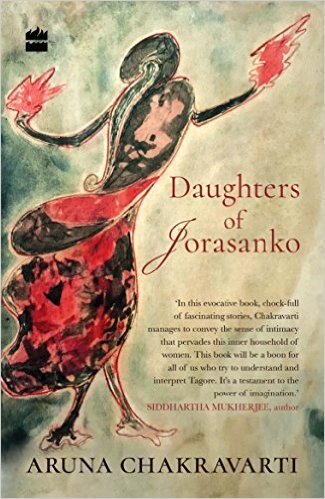
Title: Daughters of Jorasanko

Author: Aruna Chakravarti

Publisher: HarperCollins India

The twenty-fifth day of Baisakh dawned. A hot airless day when not a leaf stirred in the trees and the red earth burned like smouldering coals. Rabindranath was taken to the southern veranda in the morning as usual but he lay in his armchair so listless, so drained of energy, Nandita realized that something was wrong. ‘Let me take you back to bed, Dadamoshai,’ she said. ‘You had better rest the whole day and reserve your strength for the evening. The students have organized a programme for your birthday.’

‘I know.’ Rabindranath nodded. ‘I mustn’t disappoint the children. But I would like to give them something in return. Fetch a pen and paper. Closing his eyes, he sang slowly in an old man’s quavering voice. He nutan/dekha dek aar baar janmer pratham shubhokshan:

Oh ever new! 
Let my eyes behold once more 
the first blessed moment of birth.

Reveal yourself like the sun 
melting the mists that shroud it.

Reveal yourself
tearing in two the arid empty breast. 
Proclaim the victory of life.

Give voice to the voiceless that dwells within you; 
the eternal wonder of the Infinite.

From emerging horizons conches blow; 
resonating in my heart. 
Oh callout to the ever new! 
Twenty-fifth of Baisakh!

Rabindranath lay on his bed all day breathing heavily, the heat sapping his strength. He felt so exhausted that even to lift an arm or keep his eyes open was an effort. He could sense the activity that was going on around him. People were coming from far and near with gifts of flowers and fruit. They begged for a glimpse of him but he, who had never refused to meet anybody in his life, now lacked the energy to do so.

He felt a little better towards the evening when the heat of the day had dissipated and a cool breeze started to blow from the khowai. Then at dusk, Nandita came in. ‘Get up, Dadamoshai,’ she ‘ said brusquely. ‘You’ve rested long enough. Time to get dressed.’

Rabindranath sat up meekly and allowed her to put on him his birthday garments of silk dhuti and chador. He didn’t object even when she adorned his brow with sandal paste and hung a garland of fragrant juin flowers around his neck. But when Protima came in with a bowl of fruit he couldn’t stand the smell. ‘Not now, Bouma.’ He shook his head, ‘I’m not hungry.’

Protima wouldn’t go away. ‘You’ve hardly eaten anything today,’ she said firmly. Have a few pieces of mango. It’s your favourite himsagar. Prashanta brought a basketful.’

Lacking the strength to protest, he put a small piece in his mouth and shuddered with distaste. ‘The good days are gone, Bouma,’ he said sadly. ‘Else why does the king of fruits taste bitter in my mouth?’

‘But even last season you were eating five or six a day!’

‘I know.’ He smiled. ‘That is why I say the good days are gone.’

(Excerpted from Daughters of Jorasanko by Aruna Chakravarti, published by HarperCollins India)

About the Book:

The Tagore household is falling apart. Rabindranath cannot shake off the disquiet in his heart after the death of his wife Mrinalini. Happiness and well-being elude him. His daughters and daughter-in-law struggle hard to cope with incompatible marriages, ill health and the stigma of childlessness. The extended family of Jorasanko is steeped in debt and there is talk of mortgaging one of the houses. Even as Rabindranath deals with his own financial problems and strives hard to keep his dream of Santiniketan alive, news reaches him that he has been awarded the Nobel Prize for literature. Will this be a turning point for the man, his family and their much-celebrated home?
Daughters of Jorasanko, sequel to the bestselling novel, Jorasanko, explores Rabindranath Tagore’s engagement with the freedom movement and his vision for holistic education, brings alive his latter-day muses Ranu Adhikari and Victoria Ocampo and maps the histories of the Tagore women, even as it describes the twilight years in the life of one of the greatest luminaries of our times and the end of an epoch in the history of Bengal.

About the author:

Aruna Chakravarti  has been Principal of a prestigious Women’s College of Delhi University for ten years. She is also a well-known academic, creative writer and translator with seventeen published books on record. They comprise five novels, two books of short stories, two academic works and eight volumes of translation. Her first novel The Inheritors (published by Penguin Random House) was shortlisted for the Commonwealth Writers’ Prize and her second, Jorasanko (published by HarperCollins India)received critical acclaim and also became a best seller. Daughters of Jorasanko, a sequel to Jorasanko, (HarperCollins India) has sold widely and received rave reviews.Her novel Suralakshmi Villa, published by Pan Macmillan Ltd under the Picador imprint, has been adjudged “Novel of the year (India 2020)” by Indian Bibliography published in The Journal of Commonwealth Literature U.K. Her latest work, The Mendicant Prince, a semi-fictional account of the Bhawal legal case, was released by Pan Macmillan Ltd, in July this year to widespread media coverage and acclaim. Her second book of short stories Through a Looking Glass: Stories has just been released by Om International Ltd.

Her translated works include an anthology of songs from Rabindranath Tagore’s Gitabitaan, Sarat Chandra Chattopadhyay’s Srikanta and Sunil Gangopadhyay’s Those Days, First Light and Primal Woman: Stories. Among the various awards she has received are Vaitalik Award, Sahitya Akademi Award and Sarat Puraskar.

She is also a script writer and producer of seven multi- media presentations based on her novels. Comprising dramatised readings interspersed with songs and accompanied by a visual presentation by professional artists and singers, these programmes have been widely acclaimed and performed in many parts of India and abroad.

.

PLEASE NOTE: ARTICLES CAN ONLY BE REPRODUCED IN OTHER SITES WITH DUE ACKNOWLEDGEMENT TO BORDERLESS JOURNAL

Click here to access the Borderless anthology, Monalisa No Longer Smiles

Click here to access Monalisa No Longer Smiles on Kindle Amazon International