And murdered through their masks, as if to sift My trembling from the air; the corridors Grew longer, bending out of shape, and drift Enshrouded every threshold. Through the doors Came whispers, half‑remembered, half‑designed, That pressed like winter’s knuckles on my chest; And still the ward‑lights flickered, re‑aligned To mark the pulse of something unexpressed. I walked as though the floorboards might collapse, Or tilt me toward a darkness I had known, Where every echo tightened into traps And every heartbeat felt no longer owned.
Yet through that trembling hush, a figure stood— A patient, pale as frost upon a blade— Who watched me with a calm misunderstood, As if my fear were something he had made. He raised a hand, then let it fall again, And muttered fragments drifting into sense: That storms of thought could batter any brain, That none were proof against experience. His voice, though cracked, retained a tempered grace, A cadence forged from long‑endured despair; And in the trembling angles of his face I saw a truth too heavy to declare.
For madness, in its quietest disguise, Can settle like a frost upon the bone; It does not always shout, but softly lies In corners where the mind stands most alone. And so I passed him, feeling something shift— A weight that was not his, nor wholly mine— As though the ward itself began to lift Its veil and show the seams beneath design. The nurses moved like shadows on a screen, Their footsteps merging with the humming vents; The world grew thin, translucent, in between The drifting of my fractured sentiments.
And still the year went on, a tightening thread That pulled me through each hour’s unsteady frame; The nights were long, the mornings filled with dread, Yet somewhere in that cycle, something came— A gentler breath, a pause within the storm, A moment where the mind, though bruised, could rest. It did not heal, nor wholly re‑transform, But held itself with slightly steadier chest. And in that pause, I learned to stand again, To walk the ward without the same despair; To see, in every trembling fellow‑patient, A fragile strength that hovered in the air.
So through the endless corridors I moved, Not cured, not whole, but slowly re‑aligned; And though the year remained a thing unloved, It left a quiet scaffold in my mind— A place where all the fractured thoughts could meet, Where shadows softened, though they did not cease; Where every trembling pulse, though incomplete, Could find a moment’s tentative release
Jim Bellamy was born in a storm in 1972. He studied hard and sat entrance exams for Oxford University. Jim has a fine frenzy for poetry and has written in excess of 22,000 poems. Jim adores the art of poetry. He lives for prosody.
.
PLEASE NOTE: ARTICLES CAN ONLY BE REPRODUCED IN OTHER SITES WITH DUE ACKNOWLEDGEMENT TO BORDERLESS JOURNAL
Keith Lyons in conversation with Harry Ricketts, a writer and mentor who found himself across continents and oceans
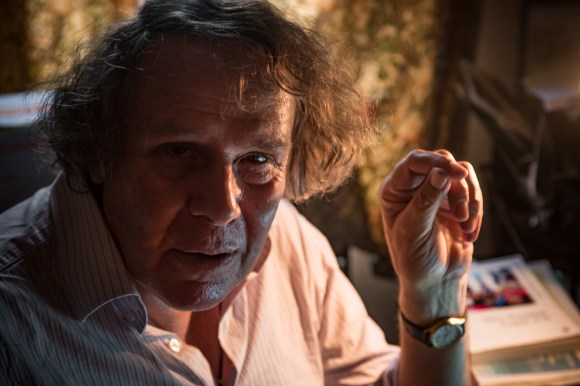
Harry Ricketts has authored thirty books and mentored many writers, including Keith Lyons. Photo Courtesy: Robert Cross
Harry Ricketts is a New Zealand poet, essayist, and literary biographer whose work has gained recognition for its wit, lyricism, and insight into memory, identity, and everyday life. He has published widely across poetry, biography, and literary criticism, and his writing blends formal elegance with accessibility. After studying at Oxford University, he taught in the UK and Hong Kong before moving to New Zealand in the early 1980s. A respected teacher and mentor, Ricketts has shaped both the literary culture of New Zealand and the broader English-language literary world through his poetry, essays, and guidance to emerging writers. His works include a major biography of the British India-born journalist, novelist, poet, and short-story writer Rudyard Kipling, The Unforgiving Minute, Strange Meetings: The Poets of the Great War, and his most recent books, the memoir First Things, and the poetry collection Bonfires on the Ice. His How to Live Elsewhere (2004) is one of twelve titles in the Montana Estates essay series published by Four Winds Press. The press was established by Lloyd Jones to encourage and develop the essay genre in New Zealand. In his essay, Ricketts reflects on his move from England to New Zealand. In this interview, he brings to us not only on his writerly life but also his journey as a mentor for other writers.
KL: Tell us about your early life?
HR: My father was a British army officer, and we moved every two years till I was ten: England, Malaysia, two different parts of England, Hong Kong, England. My first words were probably Malay. From eight to eighteen, I went to boarding schools in England; apart from the cricket and one or two teachers, this was not a positive experience.
KL: How do you think moving around affected you, and your sense of self and being in the world? Does that transience shape your perspective and writing now?
HR: I think constantly moving around gave me a very equivocal sense of belonging anywhere and also a strong sense of needing to adapt (up to a point) to wherever I found myself. I was an only child, and friendship became and remains incredibly important to me. Perhaps this hard-wired sense of temporariness has contributed to my trying to produce as many different kinds of books as possible, but eventually you discover what you can and can’t do: I can’t write novels.
KL: How has your sense of ‘home’ evolved in your work over the years?
HR: As above, but I’ve lived in New Zealand for more than forty years, so that must count for something. My second wife, Belinda, was a Kiwi; for thirty years, she was a lovely person to share the world with. I’d say I like to live slightly at an angle to whatever community I’m in.
KL: How did books and poems come into your life, and what do you think have been influences on your later work?
HR: My mother was a great reader and read me Beatrix Potter, A.A. Milne etc as a child. When I was seven, I had measles and had to stay in bed for a fortnight. I read Arthur Ransome’s Peter Duck and then I couldn’t stop. Books were a protection and a passion at boarding school. As for poetry, at school we had to learn poems by heart which I enjoyed and later recited them in class which was nerve-wracking. When I was fifteen – like many others – I fell in love with Keats, then a few years later it was Sylvia Plath, Ted Hughes, T.S. Eliot, Gerard Manley Hopkins, C.P. Cavafy ….. I was also listening to a lot of music, particularly singer songwriters like Bob Dylan, Leonard Cohen, Richard Thompson, Joni Mitchell.
Everything you read and listen to is an influence. My mind is a lumber-room of things I’ve read and listened to, things other people have said, things that have happened to me and to others, places I’ve been, love and friendship – and all that crops up in my poems in one way or another. Plath and Hughes were a wrong trail. It took me a while to work that out. Well into my twenties, I couldn’t stand Philip Larkin, but not now. I like witty, melancholy poets.
KL: Your first book, People Like Us: Sketches of Hong Kong was published when you were 27. How did that come about.? What satisfaction did you get from seeing your name in print?
HR: People Like Us is a mixture of short stories and song lyrics. Hong Kong, as I experienced it in the 1970s, (still very much a British colony) was a heterogeneous mishmash of styles, and I tried to mimic that mishmash in the pieces I wrote. I was pleased when it got published but it wasn’t much good.
KL: Can you describe your writing space?
HR: I have a small study, but since Belinda died two years ago, I’ve shifted to the kitchen table. She wouldn’t have approved, but the kitchen is light and airy and the stove-top coffee-maker close by.
KL: What is your writing process from start to finish?
HR: I do a lot of drafts. First thoughts can almost always be improved. A friend likes to say, ‘It’s not the writing; it’s the rewriting’, and I agree. But some poems have come quite quickly. When I’m writing prose, I often play music, but not when I’m working on a poem.
KL: What usually sparks a new poem for you: an image, a phrase, or a rhythm?
HR: It can be anything really. I’m usually doing something else entirely – writing an email or some piece of prose or just walking around – and something will interrupt me. It’s often a phrase which for some reason acts like a magnet, attracting another phrase or an images or an idea. It might be something I’m reading; this has happened with English poets like Edward Thomas, Philip Larkin, James Fenton, Hugo Williams and Wendy Cope and New Zealand poets like Bill Manhire, Fleur Adcock and Nick Ascroft. Occasionally, I’ve written a commissioned poem: for a friend’s wedding, say.
KL: How do you balance experimentation with accessibility in your work?
HR: I don’t think like that, but I do try not to repeat myself if I can help it. However, several poems of mine have had successors; so I wrote a poem in the mid-1980s about my six-year-old daughter Jessie called ‘Your Secret Life’, imagining her as a teenager and me waiting up late for her to return home, and my latest collection contains a ‘Your Secret Life 5’, written when she was forty. I’ve found myself writing a few poem-sequences recently, including one about an imaginary New Zealand woman poet. That was quite new for me.
KL: How do your roles as poet, biographer, and critic feed into each other?
HR: Constructively, I hope. I think you can always get prose out of yourself if you sit there long enough (fiction writers might disagree), but not poems. Some initial reverberation/interruption has to happen, some ‘spark’, as you put it. It’s all writing, of course, and writing is a habit. You have to keep doing it, otherwise that part of you switches itself off or attends to other things.
KL: Looking back across more than thirty books, what evolution do you see in your writing life, and what themes do you keep on coming back to?
HR: I think lots of writers (except the very vain ones) suffer from versions of ‘imposter syndrome’ and have problems with their personal myth — that they are a writer. I’ve got a bit more confident that I am a writer and in particular that I can write poems. Getting published helps a lot with the personal myth: something you’ve done is now out in the world. Once you publish a book, though, you lose any control you had over it. People may love it, hate or, worst of all, ignore it. But that’s just the deal.
I prefer the term preoccupations to themes. I’m preoccupied with people, places, trying to make sense of the past, happiness, the role of luck, life’s oddities, incongruities and ambiguities….
KL: You often talk about ‘gaps’, doubt, and ambiguity as central to your work. How do these function in your poetry today?
HR: To measure gaps, to be in doubt, to see the ambiguity in things: that just seems to me to be human. Poems can be acts of discovery or at least partial clarification. They can also simply preserve something: an experience, a moment, a realisation, some sense of those we love.
KL: You describe teaching as a kind of midwifery: helping writers bring out what is already within them. How did you arrive at that approach?
HR: Decades of teaching suggest to me that encouragement is more likely to help someone tell the stories they have it in them to tell rather than giving them a hard time. Writing can be a bit like giving birth and, for some, having support and encouragement is more helpful than trying to do it all on your own. Of course, in the end you do have to do most of it on your own.
KL: What advice did you find yourself giving students most often, and does it still hold true for you?
HR: I have taught poetry courses, but over the last twenty-five years I’ve mostly taught creative non-fiction. I often quote Lytton Strachey’s comment that ‘Discretion is not the better part of biography’ and then add: ‘Nor the better part of autobiography.’ I also suggest that mixed feelings are more interesting to write out of and about than clearcut ones. If you’re writing about someone else, pure admiration tends to produce hagiography, pure dislike a vindictive portrait – all warts, rather than warts and all. Serious doesn’t mean earnest; you can be serious and funny at the same time.
KL: What is the best advice you’ve received as a writer?
HR: The best advice it would have been helpful to be given (but no one did) would have been: ‘Don’t eat your heart out trying to be a kind of writer you aren’t (say, a novelist). Try to find out what kind of writer you are and pursue that as hard as you can.’ Chaucer knew: ‘The lyf so short, the craft so long to lerne.’
KL: Which authors do you most often recommend to students or emerging poets?
HR: I mostly suggest they should read as widely as they can and that they should read as a writer.
KL: What writers are you returning to most these days?
HR: I often go back to Montaigne’s essays and Orwell’s and Virginia Woolf’s. Poets I often reread include: Derek Mahon, Hugo Williams, Thomas Gray, Wendy Cope, Fleur Adcock, Edward Thomas, Andrew Marvell, Seamus Heaney, Lauris Edmond, Anne French, Robert Browning, Thomas Hardy, Philip Larkin …
KL: What responsibilities do reviewers have to writers, and what responsibilities do they have to readers?
HR: Reviewers have an obligation to be fair-minded towards their subject and to write something as worth reading (ie well-written and enjoyable) as any other piece of prose.
KL: How can reviewers give criticism that is honest yet constructive?
HR: They should try to understand what the writer was aiming at (rather than the thing they think the writer should have been aiming at) and judge the work accordingly. This is easier said than done. Writers rarely remember the positives reviewers say, and rarely forget the negatives. Reviewing is hard, if you’re trying to do a good job. In a small country like New Zealand, there’s only one-and-a-half degrees of separation, which makes puffing and pulling your punches a tempting prospect.
KL: What kind of legacy do you hope to leave through your poetry and teaching?
HR: Whatever legacy you might leave (and few writers or teachers in the scale of things leave any) is not up to you. But of course writers hope people will positively remember something they’ve written and that their work will continue to be read after their death. When I think of the teachers who have matter to me, I think of them with immense gratitude and I hope some of my pupils might feel something of that, too.
KL: Is there a question about your work that you wish people asked more often?
HR: Interesting question, but I don’t really have an answer. Perhaps ‘Why, given that you also write plenty of poems in free verse, do you still think that there are possibilities in fixed poetic forms like the sonnet, villanelle and triolet?’ I could talk about that for a long time.
KL: If your life was a movie, what would the audience be screaming out to you now?
HR: Keep going! Well, I’d like to think they might.
KL: What’s next for you? What are you working on now?
HR: I’m threequarters of the way through a second volume of memoirs and about to write about a particularly difficult part of my life. I want to finish that and then a third volume, if I can. And write more poems.
*This interview has been conducted through emails.
Keith Lyons (keithlyons.net) is an award-winning writer and creative writing mentor originally from New Zealand who has spent a quarter of his existence living and working in Asia including southwest China, Myanmar and Bali. His Venn diagram of happiness features the aroma of freshly-roasted coffee, the negative ions of the natural world including moving water, and connecting with others in meaningful ways. A Contributing Editor on Borderless journal’sEditorial Board, his work has appeared in Borderless since its early days, and his writing featured in the anthology Monalisa No Longer Smiles.
.
PLEASE NOTE: ARTICLES CAN ONLY BE REPRODUCED IN OTHER SITES WITH DUE ACKNOWLEDGEMENT TO BORDERLESS JOURNAL
When oceans take to dry whatever the madman's rib, Through the hollows of time, where shadows pose, We shall levitate across the Rose, so glib.
The stars, they flicker, on this darkling crib, As night's embrace cloaks the world's woes, When oceans take to dry whatever the madman's rib.
Beneath the moon's pale gaze, we'll imbibe the fib, Of a world turned upside down, where chaos grows, We shall levitate across the Rose, so glib.
The madman laughs, his mind a twisted ad-lib, While the sea's heart beats, slow and morose, When oceans take to dry whatever the madman's rib.
In this dance macabre, no need to transcribe, The silent whispers of ghosts in throes, We shall levitate across the Rose, so glib.
So let the waters rise, no need to bribe, The fates that spin the end's close, When oceans take to dry whatever the madman's rib, We shall levitate across the Rose, so glib.
FOR WHEN THE ACRID MOONSTONES GROAN ACROSS GAS
For when the acrid moonstones groan across gas, In twilight's veil, the sirens wipe away. Beneath the stars, where shadows dare not pass.
The madcap dance, where spirits raise their glass, To toast the dark, where light has lost its sway. For when the acrid moonstones groan across gas.
The night's embrace, a chilling, cold morass, Where echoes of the lost in silence pray. Beneath the stars, where shadows dare not pass.
The moon's pale gaze, on fields of withered grass, A serenade for souls led far astray. For when the acrid moonstones groan across gas.
In dreams we find the gates of alabaster brass, Where time's cruel hand can never hold its sway. Beneath the stars, where shadows dare not pass.
Jim Bellamy was born in a storm in 1972. He studied hard and sat entrance exams for Oxford University. Jim has a fine frenzy for poetry and has written in excess of 22,000 poems. Jim adores the art of poetry. He lives for prosody.
.
PLEASE NOTE: ARTICLES CAN ONLY BE REPRODUCED IN OTHER SITES WITH DUE ACKNOWLEDGEMENT TO BORDERLESS JOURNAL
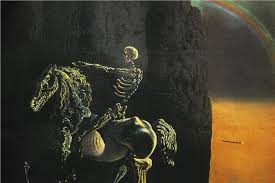
Horseman of Death by Salvador Dali (1904-1989). From Public Domain
DO NOT SPEAK FOR OLD STAVED MEN

Do not speak for old staved men whose faces glint like tyres,
In the twilight of their years, they hum a tune so grim.
Their stories told in whispers, kindling ancient fires.

Beneath the moon, their silhouettes like church spires,
Stand testament to lives lived on the brim.
Do not speak for old staved men whose faces glint like tyres.

With every wrinkle, a saga that never tires,
Eyes that sparkle with memories, vivid and dim.
Their stories told in whispers, kindling ancient fires.

They laugh with the madness that freedom acquires,
Dancing to the wind's capricious whim.
Do not speak for old staved men whose faces glint like tyres.

In the hush of night, their spirit aspires,
To cast off the shadows, stark and slim.
Their stories told in whispers, kindling ancient fires.

So let them be, these merry old sires,
As they sip the stars, on the world's rim.
Do not speak for old staved men whose faces glint like tyres,
Their stories told in whispers, kindling ancient fires.


IF AT FIRST DEATH'S WORLD IS ROUND

If at first death's world is round, take heed,
Where shadows dance and silent whispers play,
A routed cock will sing for prayer indeed.

In twilight's grasp, where heartbeats intercede,
And stars above in quiet judgment sway,
If at first death's world is round, take heed.

The moon's pale light, on which dark dreams will feed,
A canvas vast, where lost souls might stray,
A routed cock will sing for prayer indeed.

Through time's thin veil, where ancient fates are freed,
The echoes of the past are not held at bay,
If at first death's world is round, take heed.

In madness' grip, where sanity will bleed,
And reason's voice is oft led far astray,
A routed cock will sing for prayer indeed.

So listen close, for it's the earth's own creed,
In life's grand play, we all must find our way,
If at first death's world is round, take heed,
A routed cock will sing for prayer indeed.


OH, WHAT NOW FOR THE FORGETMENOT MEN

Oh, what now for the forgetmenot men,
In a world where fathers jack all pleasure?
Their laughs echo, "Ha ha," and then?

They dance in boots of heavy leaden,
Stomping on dreams with no measure.
Oh, what now for the forgetmenot men?

With every chortle, they count to ten,
A madcap rhythm to their leisure.
Their laughs echo, "Ha ha," and then?

They sip on the nectar of a pen,
Ink-stained lips betray their treasure.
Oh, what now for the forgetmenot men?

In absurdity's grip, beyond our ken,
They find in oddity their true pleasure.
Their laughs echo, "Ha ha," and then?

So raise your glass to the when,
To the forgetmenots, in all their splendour.
Oh, what now for the forgetmenot men,
Their laughs echo, "Ha ha," and then?


O, WHENCE VENAL BODIES BREAK AND SPURN

O, whence venal bodies break and spurn,
In twilight's sickly, dolorous embrace,
What now for death but a new day made up from sickness?

The stars above in cold judgement turn,
As shadows cast by the moon's pale face,
O, whence venal bodies break and spurn.

The raven's call, a direful mourn,
Echoes through the void of this haunted place,
What now for death but a new day made up from sickness?

Beneath the earth, where the lost sojourn,
Lies the heart's desire without a trace,
O, whence venal bodies break and spurn.

A dance macabre, the world does churn,
Absurd the stage, life's fleeting race,
What now for death but a new day made up from sickness?

So sing the dirge, as the candle burns,
And time erodes all but disgrace,
O, whence venal bodies break and spurn,
What now for death but a new day made up from sickness
Jim Bellamy was born in a storm in 1972. He studied hard and sat entrance exams for Oxford University. Jim has a fine frenzy for poetry and has written in excess of 22,000 poems. Jim adores the art of poetry. He lives for prosody.
.
PLEASE NOTE: ARTICLES CAN ONLY BE REPRODUCED IN OTHER SITES WITH DUE ACKNOWLEDGEMENT TO BORDERLESS JOURNAL
O, once upon a mind in a dinner-strangled sea, Where pans clatter in the deep and the starving dare to dream, The rich feast on echoes of silent pleas.
In the cruel ballet of the haves and have-nots, we see The absurd dance of fortune's cruel extreme, O, once upon a mind in a dinner-strangled sea.
The banquet hall roars with gilded glee, While outside, hollow eyes of the hungry gleam, The rich feast on echoes of silent pleas.
"Feed us," cry the poor, "from tyranny free," But the wealthy's ears are stuffed with the cream, O, once upon a mind in a dinner-strangled sea.
The tables turn, yet no one flees, The starving serve, their spirits teem, The rich feast on echoes of silent pleas.
So dare the starving feed the rich? A twisted decree, In this dark, absurdist, cruel scheme, O, once upon a mind in a dinner-strangled sea, The rich feast on echoes of silent pleas.
O, WHEN ME AND MY DEAD LOVER
O, when me and my dead lover come glowering from mirrors, In the hush of night, our whispers dance in a spectral swell, Perhaps a keen dream will make us well.
Through the glass, our silent ballet conjures fears, Yet in this madcap song, our hearts rebel, O, when me and my dead lover come glowering from mirrors.
The world sleeps, but in our realm, time nears, To the rhythm of eternity, our souls compel, Perhaps a keen dream will make us well.
In the silvered pane, the past appears, And we waltz in the moon's soft pastel, O, when me and my dead lover come glowering from mirrors.
With every gaze, the boundary clears, In dreams, the living and the lost meld, Perhaps a keen dream will make us well.
So let the morning wait, as dawn nears, For in this mirror's depth, our love we'll tell, O, when me and my dead lover come glowering from mirrors, Perhaps a keen dream will make us well.
DO NOT GO ASIDE THE DARK TILL DEATH DAWNS ON MADMEN
Do not go aside the dark till death dawns on madmen, Where shadows weave the tales of silent might. Hold fast to dreams, where day's bright beams are spavine.
The gentle hum of life, a soft-spun cadence, Whispers through the void, a beacon's light. Do not go aside the dark till death dawns on madmen.
In twilight's grasp, where thoughts of lore are laden, Seek not the comfort of the fleeing night. Hold fast to dreams, where day's bright beams are spavine.
Through tempest's roar and peace the heart does harden, Stand firm against the tide, with all your might. Do not go aside the dark till death dawns on madmen.
With every dusk, let not your spirit sadden, For morrow's morn will chase the starless plight. Hold fast to dreams, where day's bright beams are spavine.
So here, my friend, as fates and time do bargain, Embrace the dusk, till dawn's forgiving light. Do not go aside the dark till death dawns on madmen, Hold fast to dreams, where day's bright beams are spavine.
Jim Bellamy was born in a storm in 1972. He studied hard and sat entrance exams for Oxford University. Jim has a fine frenzy for poetry and has written in excess of 22,000 poems. Jim adores the art of poetry. He lives for prosody.
.
PLEASE NOTE: ARTICLES CAN ONLY BE REPRODUCED IN OTHER SITES WITH DUE ACKNOWLEDGEMENT TO BORDERLESS JOURNAL
HOW NOW DO DEAD KINGS LAUGH WHILE STRICKEN BY RED RAIN
(a villanelle that doubles as a song)

In twilight's hush, where shadows softly sway,
How now do dead kids laugh while stricken by red rain?
Their echoes drift, as if they still had play.

The crimson drops like petals fall, betray
The innocence that once danced on this plain.
In twilight's hush, where shadows softly sway,

The laughter's gone, yet memories stay,
A haunting tune, a bittersweet refrain.
How now do dead kids laugh while stricken by red rain?

They ran with joy, not knowing of dismay,
Nor thought their laughter would become such pain.
In twilight's hush, where shadows softly sway,

The sky weeps blood, the earth cannot contain
The sorrow of the young ones we've slain.
How now do dead kids laugh while stricken by red rain?

So hear their mirth, in ghostly disarray,
A chilling laughter, under skies arcane.
In twilight's hush, where shadows softly sway,
How now do dead kids laugh while stricken by red rain?


WHERE ONCE BLUE MIDNIGHT BURNS

Where once blue midnight burns, what then for babes midscream?
In dreams, they clutch at stars now far beyond their gleam.
The night's cold lullaby, where shadows dance unseen.

The moon, a silent witness to the quiet, keening theme,
Whispers through the willows, a soft and silver stream.
Where once blue midnight burns, what then for babes midscream?

The sky, a tapestry of wishes and of dream,
Holds tight the secrets of the heart, a vault supreme.
The night's cold lullaby, where shadows dance unseen.

What tales will be told of the light that once did beam,
When innocence was cradled in the arms of esteem?
Where once blue midnight burns, what then for babes midscream?

The stars, like sentinels, their steady gazes deem
To guard the slumbering youth from the world's harsh regime.
The night's cold lullaby, where shadows dance unseen.

So sing the babes a song of time, a flowing ream,
And rock them gently 'neath the midnight's azure seam.
Where once blue midnight burns, what then for babes midscream?
The night's cold lullaby, where shadows dance unseen.


TODAY, ALL SWEETHEARTS

Today, all sweethearts will blossom in a glass cage,
Where whispers cling like ivy to the walls.
That gaols all fevers under vows, sage.

In crystal confines, love's eternal stage,
Each heartbeat etched upon the pane, it calls.
Today, all sweethearts will blossom in a glass cage.

With every breath, they sketch a new page,
Inked with passion, as twilight softly falls.
That gaols all fevers under vows, sage.

Their touch, through glass, a timeless adage,
A dance of shadows, love's tender brawls.
Today, all sweethearts will blossom in a glass cage.

And though the world may change, turn, and age,
Their sealed ardor never stalls.
That gaols all fevers under vows, sage.

So let the lovers their pure wars wage,
For in this prison, love enthralls.
Today, all sweethearts will blossom in a glass cage,
That gaols all fevers under vows, sage.
Jim Bellamy was born in a storm in 1972. He studied hard and sat entrance exams for Oxford University. Jim has a fine frenzy for poetry and has written in excess of 22,000 poems. Jim adores the art of poetry. He lives for prosody.
.
PLEASE NOTE: ARTICLES CAN ONLY BE REPRODUCED IN OTHER SITES WITH DUE ACKNOWLEDGEMENT TO BORDERLESS JOURNAL
I know the site of that hidden mind It is sidling and empty, a farcical bent Sliding up the clock. I ride minds behind The towers, the towering wheel and flowers Dropped in a vase of the heroine's smile.
My hypnotic illusion is not cowed. Aligning my head, the skies, the one Bay of the evening chorus, above The serviette of gears I make my single Shimmering of hand into hand. The Sun moves below the eye, a Beautiful rivering Of a beautiful consternation.
Resentful of the world, the underglassed Tauntening of jade, the mind Tightens its grip on the reprobate And moves sloanes out to sea. Most beautiful is the singlet, the Wondrous land of films and spheres;
Next, the spider spinning Its gossamer voyage of praise. The eye is unperfected; lies Days deep beneath the dial. I Kiss my girl, yet here the sense is no-one's, nobody's, vile.
Jim Bellamy was born in a storm in 1972. He studied hard and sat entrance exams for Oxford University. Jim has a fine frenzy for poetry and has written in excess of 22,000 poems. Jim adores the art of poetry. He lives for prosody.
.
PLEASE NOTE: ARTICLES CAN ONLY BE REPRODUCED IN OTHER SITES WITH DUE ACKNOWLEDGEMENT TO BORDERLESS JOURNAL
The Post Office by Tagore was written, translated and performed in multiple languages throughout Europe. Rakhi Dalalrevisits the original translation done by Devabrata Mukherjee in 1912.
Title: The Post Office
Author: Rabindranath Tagore
Translator: Devabrata Mukherjee
Publisher: Niyogi Books
Dakghar was written in Bengali by Rabindranath Tagore in 1911. Devabrata Mukherjee, an Oxford University student at the time, translated the play into English in 1912. It was first published in London by Cuala Press in 1914 with an introduction by W.B.Yeats. He, along with Lady Gregory, had also directed its first staging in English in 1913 by the Abbey Theatre in Dublin. The production then transferred to the Court Theatre, London, later the same year before the Bengali original was staged at Tagore’s Jorasanko theatre in Calcutta in 1917.
This play was translated into French by André Gide and was read on the radio the night before Paris fell to the Nazis. During World War II, there were 105 performances of The Post Office in concentration camps in Germany. Perhaps one of the most noteworthy was its staging by Janusz Korczak, a Polish-Jewish educator who ran a Jewish orphanage in a ghetto in Warsaw. It was there that the play was organised for children just a few weeks before they, as well as Korczak, were deported to the concentration camps of Treblinka.
The story revolves around a young child Amal, an orphan adopted by his Uncle Madhav, who suffers from an ailment. On the instruction of the physician treating him, he is restricted within the house and is not allowed to go outside. In his quest to explore the world beyond the confines of his home, he sits near a window facing a road and talks to people passing-by. He becomes fascinated by the newly constructed post office near his window and imagines receiving letters from the king. The play presents a vivid picture of Amal, his longings, his ideas of life and the limitations that he faces.
Nirmal Kanti Bhattacharjee, in the introduction to this edition, quotes the bard from the letter he wrote to Andrews in 1921 where he says, “Amal represents the man who has received the call of the open road – he seeks freedom from the comfortable enclosure of habits sanctioned by the prudent and from the walls of rigid opinion built for him by the respectable.”
The narrative traverses through the realms of a mind born free, eager to understand and appreciate the beauty of the natural world and, yet with time, constrained by the ideas fostered as acceptable by societal norms. Amal would rather venture outside and hop like a squirrel than sit at home, toiling at books which his Uncle thinks makes a man learn. He would rather cross mountains and go farther to seek work than be disheartened by their imposing structure. To his Uncle, the hills are barriers whereas to Amal, they are the hands of earth raised into the sky, beckoning people from far off.
The play also explores the nature of human dealings with outsiders, the usual conventions of a society while dealing with persons we may only come across as strangers and seem to emphasise upon the virtue of the sense of fraternity which the otherwise busier life tends to disregard. Amal meets a dairyman, a watchman, a flower gathering girl, a gaffer and a headman while sitting at his window and leaves an impression on each of them. He endears as a persona in harmony with nature as well as in his interactions with other people through his life so that the journey becomes more joyous for everyone.
This play is written in two acts. In the first act, Amal wishes to discover the world outside his restrictions while sitting at his window. In the second act his condition worsens, and he is confined to his bed where he spends his time waiting for the postman to deliver a letter from King. And finally, he sinks into his last sleep.
In its October issue of 1914, The Times Literary Supplement wrote: “This is the first impression that the play gives, as a play should: an impression of actuality, complete within the limits of human life as seen and heard in a real world.” The second act may be seen as a wait for the messenger of God/death which delivers the final fate for Amal. W.B. Yeats says that the “play conveys to the right audience an emotion of gentleness and peace” which is epitomised by Amal’s character.
This play translated by Mukherjee more than a hundred years ago continues to touch hearts to this date. Given our present context, impaired by the excessive capitalistic tendencies of the age, marred by wars, blurred by frenzies of hatred seeping into the fabric of societies, this comes as a gentle reminder of the necessity to live in peace, to approach nature and humans, even strangers, with compassion and to show more consideration in our dealings with them. It helps us understand that a mind that can live in harmony with nature and with humankind, can eventually embrace the final call in tranquillity.
The Post Office is a splendid play written with a poetic cadence which has elements of tragedy and yet manages to leave the reader with a sense of serenity that seems to be the writer’s message for a life to live in harmony with nature, with humankind and with oneself.
.
Rakhi Dalal is an educator by profession. When not working, she can usually be found reading books or writing about reading them. She writes at https://rakhidalal.blogspot.com/ .
.
PLEASE NOTE: ARTICLES CAN ONLY BE REPRODUCED IN OTHER SITES WITH DUE ACKNOWLEDGEMENT TO BORDERLESS JOURNAL.



 Borderless