Categories
Stories

Nico returns to Burgaz

By Paul Mirabile

Nico hurried off the steamer at Burgaz Island, oblivious of the swarming passengers disembarking and embarking. How long had it been since he had stepped foot on the island of his grandfather’s birth: twelve … thirteen years ? He made a bee-line for the central plaza. There he still stood, Saït Faïk, ever so thoughtful, leaning against that eternal tree. Nico approached the Turkish poet –Grandpa would have been so delighted to be here with us again. I’m sure he would have asked you about the talking seaweed and weeping mussels, Nico mused.

Vasiliki had passed away six years ago, a natural death, probably in his sleep. The old fisherman had asked Nico to have him buried between his wife, Nefeli, and daughter, Myrto, which he dutifully accomplished. Since the adolescent was the sole inheritor, he sold his grandfather’s little house for a good price, which permitted him to live comfortably in Athens while completing his university studies. Indeed, because he was parentless, and because his grades in grammar school were excellent, Nico had qualified for a scholarship. The ambitious student, thus, enjoyed financial ease to continue studying several more years for his doctorate. He excelled in Greek language and literature, French and English philology, in European History. At nights he read and spoke Turkish with several Turkish friends, for the vision of returning to Burgaz stole upon him like those perfumed nights on Burgaz with his grandfather as they contemplated the star-studded sky. That seemed so long ago …

Once his doctoral thesis defended, Nico left Greece and set off for Burgaz, off on an adventure. Poetry had been a major part of his thesis, and he had written quite a few poems, contributing to the university Literary Club’s weekly journal. Some of his poems and short stories caught the eye of an editor in Athens who had them published in a widespread monthly magazine. Soon he was invited to poetry readings and story-telling jousts, and because of these eventful evenings his circle of readers widened like concentric ripples in a pool of water after a rock had been thrown in …

The young poet left Athens not knowing exactly what Destiny held for him … nor what drove him so powerfully to return to the island. Was it because of his love for his grandfather ? His fascination for Saït Faïk? Or both? Saïk’s provided him with inexhaustible inspiration. Perhaps, too, it was the mystery of Burgaz of which his grandfather had so oftentimes spoke. Yes. It might have been that.

The horse-drawn carriage pulled up in front of the long flight of stairs to Zorba’s ‘humble’ home. Nico paid and began to ascend the worn-out mossy steps. Nothing had changed as the fretted gable slowly loomed in front of him. The perfumed scent of azaleas, roses, honeysuckles and pomegranate stirred distant memories. He had written to Zorba about his project to spend some time on Burgaz, and the good merchant, although away for several months in the United States on business, insisted that the young poet stay as long as he wished in his ‘humble’ home. He would be greeted and well-fed by his trusty maid, Zelda.

On hearing carriage bells Zelda rushed out, waiting for the ascending Nico arms akimbo. He dropped his knapsack, shoulder-bag and hugged the good woman. Speaking Greek had been her wont when Nico accompanied his grandfather years ago, but now, since the young man had decided to sojourn in Burgaz, she spoke to him in Turkish. Zelda was pleasantly surprised to hear him reply quite readily in Turkish. In fact, Zelda would prove an excellent tutor for Nico. Her grammar was excellent and her accent easy to understand.

So, after a solid diner, exhausted after a long day of travelling, Nico once again trudged up the steps of the floating stairway, the tinkling sound of the fountain below tickling his ears, opened the door to the room he knew so well with its frescoed ceiling of Greek heroes and large bay window looking out upon the darkened forests and the Marmara Sea. He washed and before drifting off to sleep, read a few chapters from Homer’s Odeyssus, which he always carried with him when ‘on the road’, and several paragraphs from Saït Faïk’s Son Kuşlar (Last Birds), underlining the words he couldn’t understand.

Up early the next morning, Zelda had prepared a breakfast of black olives, goat’s cheese, hard-boiled eggs, bread, butter, rose jam and black tea. She had gone to the local market (it was Tuesday) and would not be back before eleven.

Dressed lightly — the weather was very warm,  Nico sauntered down the same long and winding path through the wooded slope that led to the stony beach, hoping Abi Din Bey would still be serving grilled-cheese sandwiches, and spouting poetry for his customers. How the brisk island breeze of the sea swept away the cobs of lingering doubt in Nico’s mind as he descended — doubts that had tortured him because his grandfather would no longer be at his side, physically. Yet, when he stepped upon the beach these doubts evaporated. Vasiliki was there and would always be there. He spotted several fishing boats out at sea. Had Nico built a new boat with the help of his grandfather? Indeed he had. It was the biggest and most beautiful of all his boats! Much bigger than the Nefeli which was still in route towards China. But this wonderful boat would not be launched into the leaden seas: it lay housed in a small museum in Hydra where it can be admired by both the young and the old. In fact, Nico even won an award for that marvellous construction. He had named her Myrto in memory of his grandfather’s daughter. The tombstone engraver, on Nico’s behest, carved the silhouette of his boat on Vasiliki’s gravestone.

Abi Din Bey’s welcoming gate had been sealed! The homely front gardens lay desolate, the trees devoid of fruit, clusters of weed and couch grass grew wild. The poet’s house, albeit perfectly intact, exhaled an odour of negligence. Nico stared at this bleak scene, his heart growing heavy. It had never occurred to him that Abi Din Bey would not come rushing out to greet him. That this solitary man was mortal like all other human beings … like his grandfather. He felt like a child who believes his or her parents immortal out of love for them.

From behind a middle-aged man walked  up to him: “Abi Din died about ten or eleven years ago,” he began in a soft voice in broken Turkish. “He has no inheritors, so his house stands derelict and abandoned.”

Nico, snapped out of his despondency, eyed the stranger with mixed emotions. “What of his poetry?”

“Abi Din’s life of a poet held absolutely no interest for most who prefer to live in a cloud of unknowing. Abi Din Bey wrote some excellent poems, but alas no one had ears to listen to them.”

“We listened to them,” remonstrated Nico, though rather lamely.

“I know you did, you and your grandfather, Vasiliki.”

Nico reeled back as if struck by a blow. “How do you know … Who are you?”

“Oh, who I am makes no difference to anyone. But if you insist. I am the pilgrim of the heart, I voyage throughout the world admiring its marvels, an idler preaching the blessings of uselessness. Abi Din was one of those marvels, one of those brilliantly elevated idlers.” With those words, the stranger turned to leave.

Nico caught him by an arm: “Sir, where is the old man who piled up stones on the beach ? I haven’t seen him.”

“Nor will you ever see him again. Gone too, and some say that he recited several passages from Saït Faïk’s Son Kuşlar on his dying breath. Have you read Saït Faïk?”

Overcome by all these converging threads of some hidden or latent fabric beyond his grasp or comprehension, Nico could only stutter: “Well … yes … in fact…”

The other interrupted: “Listen, if you want to pay respects towards Abi Din and Saït, you should buy his house. It’s not very expensive.”

“But you …” The unnamed pilgrim put up a hand.

“I have no possessions. That is my first life principle. I idle my way through countries, people and books like a phantom. You buy it, my friend. Buy it before either Time brings about its ruin or the Burgaz municipality its demolition. For now, there are no plans to do either. It’s a mystery why that quaint house has not caught the eye of some eager artist.”  And he gave Nico a wink.

“Mystery?” A sudden bout of remorse paralysed Nico. Had his grandfather not spoken of a mystery on Burgaz?

“Yes, mystery! Isn’t that why you’ve returned?” With that last question left unanswered by a flummoxed Nico, the pilgrim strolled away along the beach, chanting some sea-faring tune.

When Nico came to his senses he literally jumped for joy. he would buy Abi Din’s house, settle on Burgaz and pursue his artistic life simply, wholeheartedly. He could become a resident of Turkey merely by depositing enough money in the Osmanlı Bankası[1]. The anonymous figure of the pilgrim had since vanished into a haze of blue. Nico ran up the winding path to Zorba’s home, where Zelda had been preparing lunch. Excitedly he explained his project. She thought it a smashing idea, and promised to help him with the paper work. They ate, had their coffee, and at two o’clock walked to the crossroads, hailed a carriage and rode to the Town Hall, a majestic, white-washed villa near the centre of town.

On the way, Nico asked Zelda whether or not she knew of a middle-aged man who walked about the island, idling his way here and there. Zelda giggled: “Oh yes, him. The Turks call him Mister başı boş [2]and the Greeks tempelis[3].”

“But he’s far from empty-headed,” remonstrated Nico.

“I’m sure he isn’t, that’s why I call him ‘aylak‘.”

“I don’t know the word.”

“Someone who idles about without any definite destination.” Nico nodded, puzzled none the less at these attributes of a person who seemed quite ‘full-headed’ to him …

The irksome formalities to purchase Abi Din’s house would fill a book. Suffice it to report that in two weeks the house belonged to Nico, once he had deposited enough money in the bank, and of course, bought the house in cash …

Although Nico now spent most of his time in his acquired house, he always ate lunch with Zelda at Zorba’s house, and sometimes dinner. It must be recorded here that Nico was better versed in writing stories than in culinary skills.

Every morning after breakfasting, Nico would roam the hilltops of Burgaz sauntering cheerfully along the dirt paths, jotting down in his little notebook details that caught his eye or thoughts that scudded across his mind. The island air intoxicated him as he conjured up characters and events for future stories or poems.

On Sundays, Nico would attend services at St John’s Greek cathedral, there mingling with the small community members who had taken a liking to this young man, calling him their ‘island writer’! He became a novelty for the islanders, who invited him dine or to read his creations. Meanwhile, several of Nico’s short stories and poems were being published in Athens by his editor and were read by the Greek community in Burgaz. Nico even attempted to write poems and stories in Turkish which Zelda not only corrected, but suggested a more fitting word or subtle syntax structure.

Once a month, Nico took the steamer to Heybeliada, or in Greek, Chalki[4], the third of the four Princess Islands where he was fortunate enough to consult the books at the library of the massive Greek Theological Centre, opened in 1844 for seminarists but closed by the Turkish authorities in 1971. Although prohibited, Nico’s reputation, which had spread to all the islands, allowed him to study at the library, the second largest religious library in the western world, several million tomes behind the Vatican’s. The young artist even managed to work two days a week there. How he managed that remains a mystery.

Once or twice a month, accompanied by Zelda, Nico would go to Büyükada (Big Island) called ‘Prinkipo’ in Greek because it is the largest island of the four, and stroll along a tarred road to contemplate the largest wooden building in Europe, a former Greek orphanage, built by the French in 1898. The Greeks bought it and children who had lost their parents were lodged here until its forced closing in 1964. This eerie-looking structure remained intact. Surrounded by high barb-wire fencing and guarded by savage dogs, no one could enter it. Every time Nico stood before this ominous edifice, he thought of his grandfather who had salvaged him from such a parentless fate. Perhaps, the children here were well taken care of…

One day as Nico sauntered along one of the myriad paths in the wooded hills of Burgaz he came face to face with the idling pilgrim. So delighted was Nico to meet this eccentric character that he began to pour out all the good news that had occurred to him since their last encounter many months ago. The other smiled kindly: “No need to repeat what many have already told me,” he stated indifferently. “Nothing on Burgaz goes unnoticed, especially novelties such as yourself. I wouldn’t want to puff up your pride, but some have considered you as a new Saït Faïk.”

Nico stared at the pilgrim disconcertedly. “I can assure you, my dear friend, that you have made quite a reputation for yourself on Burgaz. And who knows, you may be able to solve the mystery of which your grandfather so often spoke.” Baffled, Nico remained speechless. The other took his arm and they strolled together downwards into the sinking sun.

Nico could not contain his surprise: “How could you know about …”

“About Vasiliki’s mystery? Ah, that would entail hours of explanation, Nico. For now let us discuss your writings, for the intention behind those writings may have given you the key to unlock the mystery.”

The pilgrim paused sniffing the pine- and spruce-scented air. “You know, many writers have lost touch with reality, or have been completely overwhelmed by it. They seem incapable of telling a story, transmitting the joys and sorrows of their characters whose traits lie deep in their own hearts, imprisoned like birds in a cage, fluttering frantically, unable to express the Truth of what lies beneath the masks and costumes. Saït Faïk, Edgar Poe, Dino Buzzati[5], Guy de Maupassant[6], Somerset Maugham, Katherine Mansfield all drew their inspiration from fragments of a separate reality, the glints of a deflected flood of light, the shards of a broken vase to disclose the experiences of their characters, to bestow upon their readers the amalgamated emotions that flew freely from their hearts. Their stories and poems are not talk-of-the-day productions. They were derived from the unlocking of the cage, the flight outwards into the battlefield between joy and sorrow. You would think that their eyes were turned both inwards and outwards at the same time. There is something powerful, even sacred, if I may use that word, in their narrated experiences, which does not necessarily entail the use of I, nor does it insinuate a ‘message’ to be harnassed or brought into line by the opinionated or bigoted. The syntax rhythms and word combinations expose  the élan or the coming and going between the inward and the outward regard … I discern in your regard that inward and outward alternating vision, the aura that enhaloes your stories and poems. But mind you, this is only an idler’s perception.”

“What do you mean by aura?” Nico, crimsoning under the weight of so many complex compliments, managed to ask, almost out of breath.

“The halo of tradition that all sincere writing bears,” came the succinct reply. “A poem or a short-story, as in your case, bears an aura familiar to the reader, yet whose tale and expression of this tale transports him or her to strange, unfamiliar places. This is especially noticeable in your Turkish writings, an uncanny concoction of familiarity and eeriness. Perhaps it’s due to Zelda’s mixed origins.”

Nico stopped in his tracks, a blank look on his face. “Yes, Zelda, who, when we cross paths, addresses me as the ‘aylak‘. Her father was a remarkable writer and professor of philosophy in Greece and in Turkey. She inherited much of his wisdom as well as her mother’s strong character.” Nico stood stunned by this revelation.

“Zelda is only …”

“Only what, my friend ? Zorba’s maid or servant ? Ah ! I see you haven’t delved deep enough into the hearts of those who are very close to you. I’ve noted, too, that you have never written one line or verse about your deceased grandfather.”

Nico, stung to the quick by the very truth of that remark, bowed his head. He felt a surging wave of shame, and on this billowing wave rode an undulating image of a squealing seal that he and his grandfather had admired on their fishing adventure — an image gradually over-shadowed by another, more fuzzy, the stiffening body of a seagull on a pebbly shore near the mouth of a cavern.

The mild voice of his companion brought back these troubling scenes: “When all is said and done you will surely open wider the cage and let fly the encaged birds towards brighter poetic heights. Heights that perhaps you have yet to imagine.” With those comforting but enigmatic words the pilgrim turned to leave. He halted and asked: “Tell me, have you been to Granada?”

“Granada, Spain? No I haven’t, why?”

“You look like someone I met there.” The idler disappeared downwards into the crimson glint of sunset.

Nico ran back to Zorba’s house, undecided whether to speak to Zelda about her family. He never dreamed of broaching the subject to her as she herself had never bought up.

When the young writer had lumbered up those mossy steps he found Zelda seated on an armchair in the corner of the dining room, a shadow of gloom etched on her face. Her eyes were red. Wordlessly, she handed him a letter. It was written in faulty Greek, addressed to Zelda from an associate of Zorba’s in New York. A moment later Nico looked at Zelda with deep compassion. Zorba had died of a heart attack. His body would be sent to Burgaz for burial, accompanied by several of his associates who intended to buy his house.

“What will happen to me?” were Zelda’s first strained words. “I refuse to live in the same house with strangers even if they are Zorba’s associates.”

“Have you any family, Zelda? Anywhere to go? Anyone to help you financially?” She nodded in the negative to all these questions.

Nico sat down beside her: “Listen Zelda, come live with me, it’s a bit cramped, but at least you will have a roof over your head, food on the table, and a good friend who will always be at your side.”

Zelda dried her eyes and stared at Nico in embarrassment.

“I’m old enough to be your mother,” she said faintly.

“Exactly!” responded Nico excitedly. “You shall be the mother I hardly ever knew, in the same way that the presence of Abi Din in his house has been the father I hardly ever knew. How my grandfather would rejoice at that family reunion, however surreal, if I may say so.” Zelda smiled.

And with that acquiescing smile the two orphaned destinies appeared to converge into one …  

[1]        The biggest bank of Turkey at the time of Nico’s arrival specializing in international transactions. (Ottoman Bank).

[2] Empty-headed

[3] Lazy bones

[4]        ‘Chalki’ in Greek means ‘copper’. The Ancient and Byzantine Greeks excavated copper on this island.

[5]        Italian short-story writer ‘(1906-1972).

[6]        French short-story writer.(1850-1893)

Paul Mirabile is a retired professor of philology now living in France. He has published mostly academic works centred on philology, history, pedagogy and religion. He has also published stories of his travels throughout Asia, where he spent thirty years.

.

PLEASE NOTE: ARTICLES CAN ONLY BE REPRODUCED IN OTHER SITES WITH DUE ACKNOWLEDGEMENT TO BORDERLESS JOURNAL

Click here to access the Borderless anthology, Monalisa No Longer Smiles

Click here to access Monalisa No Longer Smiles on Kindle Amazon International

Categories
Essay

A Turkish Adventure with Sait Faik

Narrative by Paul Mirabile with photographs by Françoise Mirabile.

The Treewood sculpture by Çağdaş Ercelik of Sait Faik greets the visitor at the Burgaz docks on his or her arrival.

To have sojourned on Burgaz Island was such a marvellous experience. This experience resulted from the fact that I worked twelve years in Istanbul and had rented a small flat on the island from an Armenian woman whose daughter had been a student of mine at University.

I rented the small, rooftop flat for about five or six years. Then I met one of the protagonists of my story, Abi Din Bey, a Turkish Alevite[1] who had been living on Burgaz since the 1940s in his two room wooden dwelling on the beach, opposite Yassi (Flat) Island and Sivri ( Pointed ) Island in the Marmara Sea, which he and his brother had built. He sold coffee or tea with little cakes or grilled cheese sandwiches to infrequent visitors, hikers or swimmers who happened to stumble across his home on the beachhead. That was in fact how he made his living. We got to know one another well, and soon he offered to rent me the smaller room of his lodgings whenever I arrived on the island for week-ends or for the longer holidays at a much more advantageous price than my flat in the village. I took him up on it without a second thought …

Abi Din Bey’s front gardens, peppered with shady fruit trees, under which he had placed long or square tables with benches or chairs for the occasional visitors, touched the stony beach. From those gardens one had a wide open view of the Sea of Marmara. It was truly a place of magic ! In the mornings we would take our coffee or tea in the gardens and contemplate those placid waters lapping the pebbly strand, a slight breeze coming in from the North, the sky and the sea, enamel blue. Hikers or visitors would stop in after eleven, and he would serve them cold beverages and grilled cheese toast, which he prepared in his kitchenette. I would help him on the week-ends when students arrived with their tents to stay on for a day or two on in the wooded areas.

Marmara Sea seen from Abi Din Bey’s front gardens. Pointed (Sivri) and Flat (Yassi) Islands can be seen in the background

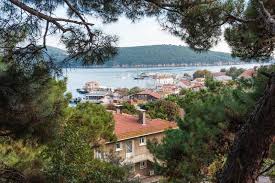
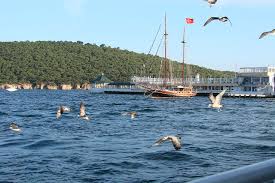
Burgaz, the second of the four Princes’ Islands of the Sea of Marmara, known to the Greeks as Antigone, was as popular if not more than the first island Kınalada (Prōtē), the third, Heybeliada (Halki) and the largest Büyükada (Prinkēpos). Their Greek names fell out of use after the Greek-Turkish War in 1921, and following the founding of the Turkish Republic in 1923. Burgaz was a world of poetry, in rhythm wth the movements of steamers coming and going, lapping waves and rough winds … screaming seagulls, the long solitary walks up into the hilly woods and along the sandless beaches, by the evening strolls amongst the white-washed nineteenth century wooden Ottoman-era mansions of Burgaz village, whose fretted pitches mounted from the cornice to the high gabled roofs of the façade. Bougainvillaea and wisteria of bright blues, purples and whites overflowed from the cast-iron balconied façades. Neatly kept gardens hugged the quiet lanes and streets fringed with mimosas and pomegranate trees, pricked here and there with aging trees, one of which near the House of the Alevites, was said to be over six-hundred years of age.

Indeed, life on Burgaz contrasts so starkly with that of Istanbul: no vehicles, no mass movements of people rushing to and from work, no tram, metro or train ; a world of enchantment and marvels, of monasteries, churches and cathedrals, of dancing boats at the piers, of leather-faced fisherman casting nets or having tea; of forested hills, rocky cliffs, of bougainvillea sagging in great clusters and copses of cypress … of crimson sunsets dipping into the Marmara. Truly, Burgaz is ideal for the painter’s palette …

How I inhaled and exhaled those wonderful visions as I made my way down upon the winding path towards Abidin Bey’s home — splashes of roses, honeysuckles and oleanders blazing orange and crimson through the deep forest greens. And as I did, the voice of my foremost protagonist, the hero of this story, Sait Faik Abasıyanık[2], would implore me to reanimate his presence on this island paradise, to hearken to and bring forth, as if snatched up in some dreamy reminiscence of poetic éclat, that forlorn, melancholic voice:

 Several late evenings I would sit

And write stories ;

Like a madman !

Whilst I wrote the story

The people in my head

Would go out to fish. [3]

Yes, that Sait Faik voice, elliptic, forlorn and melancholic, as if he solicited an unaffected sincere souvenir of his masterful art: the Art of Poetics … of the short-story, a palatable keepsake of his short-lived grandeur :

The wind that bears the salt to the shore,

I hear the swimming of the fish

I listen to the seaweed talking amongst themselves,

To the mussels weeping.

There is a wing of love, it is red

it is pierced,

blood flows,

There is a wing

Poison greenish. [4]

So many journeys into the past borne by that doleful voice of the solitary poet and story-teller of fishermen, wood-choppers, street vendors, birds, steamers, cafés; of motley dressed street children, long, starry nights meditating the brushing waves of the Marmara Sea along the indented coasts of Burgaz … of insular Freedom …

What exactly is insular Freedom? A land free of noisome noise; the islanders hear only the laughing seagull in flight, the chants of fishermen repairing their nets, the brays of donkeys, the wheedling of jays and the coarse hawking of merchants on market days, the neighs and snorts of work-horses, the cock-a’doodle doos of roosters at the break of dawn.

A land where the naked eye embraces gold-gilded sunrises and dragon-red sunsets at the not so distant point where the azures of the sky touch those of the briny sea.

A land of a myriad flowery perfumed fragrances, free from the toxic fumes of vehicle emission, from chemical discharge and human waste. A land of powerful telluric forces where the islanders’ footfalls tread dirt tracks, sandy or stony beachheads, soft, leafy trails; where he or she communes with the trees, the sea, tastes the salty air free of pollution. Even the taste of Burgaz coffee smacks of that island brew, a nice commingling of robust richness and timeless tincture! Freedom which releases all the senses from their ensnared urban uniformity, their artificial, conventional urbanity of foot-shuffling routine and tiresome ennui …

So I descended and descended towards Abi Din Bey’s strand home, winding steeply in zig-zag fashion, alive to that distant but clear, impelling voice:

 Late evening comes

Whilst everyone quits their work.

Amongst the clustering clusters at the tram

A lovely child’s face smiles.

Unchaste, late evening comes.

How I seize it I know not

Preparing to love my beloved

At sixteen years of age

To hold her hand in mine

For a good twenty-four hours

Desiring to hear one warm word … [5]

When reading or listening to these verses I experienced a veil of despondency, a dash of fury that underscores a struggle of consciousness, of surpassing vanity as the principal motivation of solitude within an island envelope. The consciousness may be called nostalgia; that is, suffering of and from a past, familiar lieu, a stead-sickness of some remote time within the fantastic unfolding of a man’s former existences. And yet, these former existences may not be as remote as I believed. So I continued to lend an ear as I approached the beachcomber’s humble abode:

My whistling at the stern of the steamer,

My song upon the rainy bridge

Are but a pretext to approach you,

Otherwise my darling, not to forget you,

It is evident that only after you

The lies that have been imparted to humankind

It is evident that after you, only

The emptiness of all things

Together with you, the cups are to be filled

The wines with you, revelled

The cigars with you, smoked

The hearths with you, aflame

The meals with you, eaten. [6]

Ah, Sait, you have been my faithful road companion ; the herald of the short story, of the furtive glimpse, of the snap-shot of possible realities which have been the ardent desire of our existential Way … the Flame of Life …

Here, at long last, Abi Din Bey has come to greet me at his welcoming gate — a hearty greeting indeed. Abi Din Bey towers over me in all his nobleness; he is a descendent of the great Ali, fourth Caliph of the Sunna, first Imam of the Shia.[7] He took great pleasure and pride in showing me his genealogical tree finely printed out on vellum in triptych form as he had done in the past every time  I visited him. He had it done by specialists at the Vatican for a meagre fee. He never fully explained why he had it done at the Vatican.

Noble, humble, ascetic and combative like his distant descendant, he stands erect for his advanced age (perhaps eighty), and remarkably lucid when discussing religious matters and Sufi poets. He was well versed in Ali’s conquests as well as Sait Faik Abasıyanık’s life and personality, whom he knew personally in his younger days. How many nights under a speckless sky did my friend and host narrate Saik’s life to me, abridged of course, and oftentimes modified to enfold the atmosphere of that night’s solicitude, the turbulence of the waves pounding the jutting rocks, the scrapings of the pines against the rising cliffs that arched over his diminutive home.

It was the month of May in the year 2006. The mimosas were in full bloom as we sat in his front gardens, breathing in the fresh balmy air of the calm, morning sea. The fragrance of rose attar mounted from the morning dew which clung to the garden trees like hoarfrost. The tea, too, had a fresh taste to it. Abi Din Bey looked out upon the cool blues of the late morning sky and waters :

“Sait was a rebel !” he began abruptly in his deep, coarse voice. “You know, he didn’t look to transform the world like some revolutionary, he wanted to be as useless as possible to the whims and caprices of our political and economic decision-makers, to the ideological escapades of social redeemers or misfits so as to accomplish his own destiny for the benefit of all Humanity.”

“Is that why he wrote ‘The Useless Man’?” I ventured, a lovely short story that I had translated several years back.

“Yes, for the whole of Humanity,” he continued excitedly as if not hearing my rhetorical question. “That may sound strange because he lived such a hermit’s life, a socially useless life, especially here on Burgaz. However, if you’ve noticed, and I’m sure you have noticed, he always wrote ‘on the road’ : at the docks waiting for the steamers, on the steamers, in cafés, whilst strolling about the island plunged in his world of creative imagination … even when fishing or rowing. He loved to stroll up the dirt tracks into the forested hills and visit the Greek priest on Hristo’s Hill in his chapel.

“Nothing revolutionary. No message to peddle or to plead, only the solemn and sober cheerfulness of his flamboyant and oftentimes eccentric character which he consciously or unconsciously weaved into his short stories and poetry. His voice was not the authoritative, pompous voice booming from above, but the unfettered voice of pure simplicity, describing simple gestures, simple acts, simple conversations, freed from conventional social and literary shackles. A rebel is neither serf nor master: he is absolutely free from social rank and class …”

Abi Din Bey paused to take a sip of tea. This man, too, lived an unfettered, unconventional life in his two-room cabin on the pebbly strand of Burgaz, alone, besides the occasional visitor. But he was no rebel ; his parents had long since been deceased, and since he had never married had no children. His only brother died many years ago of alcohol in middle age. And so there we sat, alone, the sun rising high on the wooded hills of the Kalpazankaya peninsula bay, Abi Din Bey spinning his own tale of Sait, a timeless reminiscence where story-telling reveals not only the pleasures of listening, of sharing, but more important still, the essence of identification with the Other of that story …

“You know, he hadn’t always lived on Burgaz; he had his schooling in Bursa, where he lodged at a boarding school for boys. His father wished him to be a merchant or a diplomat, but this lifestyle suited him not. Deep in his heart, Sait yearned to be a wandering, carefree writer who observes the details of life that wheel and whirl around him. It was in High School where he wrote his first story ‘The Silken Handkerchief‘ (Ipekli Mendil). It aroused much interest from his literature teacher who encouraged him to work harder to flesh out his ideas, rear in his galloping imagination. His father, on the other hand, disliked the route his son was taking, so he promptly sent him to Switzerland in 1931, I think, to study economics. Unstable as he was, the agitated student dropped his studies and left for France, exploring its towns and literature, especially those short stories of Maupassant, the finest of the French short-story writers, which he read in the original, as he developed a solid base in that language. Finally in 1935, he returned to Istanbul via Marseilles by ship, and there took up different employments, ignoring his father’s growing obsessions about lumber merchant opportunities. He even taught Turkish at an Armenian School for orphans …He translated, too. Since he excelled in French, he translated André Gide’s books for the literary journal Varlık (Existence). Translation served as an exercise in style and intellectual perspicacity for his own writings, which by the way, were gaining more and more attention within the small literary cliques of Istanbul.”

Abi Din Bey stopped for a moment to gather his thoughts. This was not the first time he was narrating Sait Faik’s story to me (and assuredly to others), with of course the usual modifications. I noted, however, that his memory seemed to wane and to compensate for its loses and lapses, he filled in the gaps with judgemental remarks. Oddly enough, his attitude towards Sait became more and more distant, almost academic, as if Sait’s person, long since passed, betrayed Abi Din Bey’s own anguish of passing … His relation to Sait had been casual, not intimate ; yet, there were moments when recounting the events of Sait’s life that Abi Din Bey gave the impression that he was reliving his own past, concomitantly with Sait’s ! This might have explained the urgency in his voice, often broken, the lapses and chronological errors. Did he already know that he would be expropriated in the not so distant future? I cannot say …

“He never earned a great deal of money from his stories, although they were quickly catching the eye of important literary critics and publishing firms. It was his father’s money that provided his bread, tea … and alcohol. More and more collections of his narratives poured out from his energetic pen, written in every possible place on every possible situation that he experienced. How many I cannot say or remember … I haven’t read them all …”

I interrupted to refresh his memory, “Semaver (The Sarmovar), Lüzsüz Adam (The Useless Man), Alemdağ’da Var Bir Yılan (There’s a Snake on Alemdağ), Son Kuşlar (The Last Birds), Az Şekerli (A Wee bit of Sugar), Havuz Başı (At the Poolside), Mahalle Kahvesi (The Neighbourhood Café), Şahmedan (The Pile Driver).”

“Yes! Yes, so many stories in those collections!”

“There are twenty or so in each collection,” I added quickly. 

“Have you read them all?”

The question posed so bluntly caught me off guard. I shook my head : “No, perhaps twenty or thirty. I’ve only translated seven or eight of them.”

“Yes, seven or eight,” he echoed in a flat voice, gazing dreamily out to sea beyond his front garden fence. A few young people were strolling amongst the smooth rocks jutting into the sea.

“You know, Abi Din Bey, his stories are not easy to translate,” I rejoined, observing that my loquacious host remained unusually silent. “His vocabulary jumps from Ottoman word-hoards to Burgaz jargon ; from street talk to poetic solipsism. His syntax, so elliptic at times, coils like a snake on the branch of a tree on others ; to follow this coiling I had to slither like a snake.” Abi Din Bey broke into a wide grin : he enjoyed simile and metaphor. “Saik Fait’s reasoning defies Cartesian logic with his uncanny sounding rhythms and odd visual associations ; he had such an eye for details.” I pursued after Abi Din Bey had withdrawn into his cabin to procure a few cakes and returned to our table. “I’m sure I have done violence to the English language with my translations. Then again, my approach to translation has always been a Poetics one ; that is, a unique adventure by which Sait’s enonciations and utterances, his ‘style’ of writing if you like, are ‘transferred’ to my poetic expression in English. Poetics in translation is not one of language to language, but discourse to discourse …” Abi Din Bey nodded kindly in my direction. He knew nothing about translation, but had been grateful to me for having translated his deceased brother’s poems, a marginal poet amongst the plethora of Turkish poetic writers[8]. Yet, Abi Din Bey refused that I seek out a publisher for them; his brother’s tragic death would not be flaunted and besmirched publicly by the blood-thirsty horde of scandalmongers who called themselves literary critics. His poetry, whatever its worth, translated or not, would remain a ‘family affair’ … which it did … Abi Din Bey poured out some more tea, then resumed his reminiscing. He was drifting into his favourite souvenirs, those to which, I am sure, he identified himself: “Many so-called critics despised Sait. Not his stories but his way of living ! They trumped up intrigues against him, accused him of political incorrectness, of social disorder. But this man never advocated any political ideology, nor did he mingle with criminals, as some imbeciles claimed. How the mediocre can conjure up calamitous falsehoods through jealousy, malice and hate. He reacted badly to these accusations and insinuations, withdrawing from the world’s fair ; it was also then that he began to drink very heavily and lead a very unproductive life.

“His father died, and Sait, fed up with all that puerile scandal-mongering, left for Burgaz, where he inherited his mother’s lovely two-storey house near the Greek Cathedral of Saint John. A whole new existential vista opened up for him on his island retreat, far from vanity and pseudo-intellectualism. On Burgaz, he regained that the freedom of the beachcomber, that artful notion of being humane to all living creatures, confronting Nature’s formidable forces, interlacing his childhood dreams and fantasies with natural surroundings. He explored the psychic of individuals of meagre living and of strenuous trades. Sait Faik’s daily existence transpired on the pages of his stories : modest or tragic family events, streets filled with vendors or motley children, fishing expeditions, prawn catching at midnight, flocks of seagulls on the wing and shoals of fish frolicking in gay abandon. He recorded the voices that echoed off the walls of cafés filled with fisherman, spoons tinkling in their glasses, the crisp sounds of cards shuffled or dominoes tumbling. His was an unaffected world of banal circumstances acted out in harmony or disharmony with roaming wildlife, teeming vegetation or simple, working people.

“Sometimes I met him at his favourite café, which no longer exists. There we chatted and chatted for hours; I know he was using me as his first reader, narrating details of his day’s activities, and those of the islanders.

Sait Faik’s house and Gardens on Burgaz facing the façade of Saint John’s Cathedral

“You know at that time very little Turkish was spoken on Burgaz ; many of the inhabitants spoke Greek, Armenian or Jewish-Spanish. Sait savoured these foreign sounds, so exotic to his ears since he none of these languages. But he listened as if he understood them perfectly. Anyway, we would meet every now and then, stroll about or just have tea or coffee in the village. He led a simple, hermit’s life.”

“Like yours?” I put in slyly.

He turned a bit red, the limpidity of his eyes losing their usual sunset softness. He rubbed his arching nose: “Perhaps. But I never wrote a sentence or verse in my life ; that was my brother’s destiny. And please, don’t publish those poems of his that you translated,” he admonished me in a colourless voice. 

I promised not to do so for the hundredth time. Abi Din Bey, relieved for the hundredth time, resumed rather pedantically: “Sait rubbed shoulders with people of whom he had ignored the very existence, whether in Bursa or in Istanbul, and by all this rubbing, however awkward or uncouth, he came to realise that his Destiny was one of Freedom, a philosophy of Life, an Art of Existence that he gradually cultivated here on Burgaz, and which blossomed out into the most beautiful bouquet of literary flowers.”

“Yes, Abi Din Bey,” I began slowly, pleased at my host’s sudden poetic élan.  “A Destiny of a sovereign being who regards each and every being as equal in value. An equality of value that can be gauged not particularly by choice of theme, but rather in the glimpses of detail that strikes the ear and eye: a miaowing cat, a reduplicated adjective or noun, the howling wind or soft breeze, a bright scarf on a darkening day, a bird hopping among the trees or on the wing ; details that play not a major role in the setting of his stories but should not be regarded as mere rhetorical artifice. They produce not a ‘local atmosphere’ but generate an intensity to his oftentimes plotless narratives or actionless plots. In fact, they rhythm the levels of narrative threads that weave the dramaless narrations no matter how insignificant or banal. I have never experienced a climax or a ‘dénouement‘ in any of his stories.”

 Abi Din Bey agreed, then added: “Unlike most Turkish writing, Saik’s stories are written in plain language, they carry no overweening pomposity.” (Here I refrained from objecting : Orhan Pamuk[9] does not write in any overweening, bombastic language !). “They are unburdened by bloated images. His choice of vocabulary captures the accents of Greek, Armenian, Jew and Turk of Burgaz and Istanbul at that time. You noticed, of course, that there are no proverbs in his writings, so salient in Turkish literature ?” I of course had noted. And it is true that Sait shied away from the Persian and Arabic influences in Turkish literature, still read in modern or contemporary Turkish writers. “You know why?” I did, but shrugged my shoulders ; I preferred to hear his opinion on the subject. “Because proverbs are associated now with the Ottoman aristocratic literati, the çelebi we call them, now with the folk sayings of the Anatolian Turkish villagers. Sait created a new form of writing in Turkish …”

“On the road writing or insular writing?” I chanced. He took out a handkerchief and wiped the perspiration from his large forehead. I wasn’t sure whether he subscribed to my viewpoint or simply ignored it. “Sait was not a writer who sought desperately to compose a great œuvre, but one who arranged movement by movement the myriad glimpses of human reality. There lies his universality!”

There followed a profound silence between us. The waves broke against the rocks. The pines scraped against the flat roof of his abode. The seagulls screamed. Abi Din Bey scratched the remaining white bristles on his round head then spoke in a half whisper:“He was such a mild-mannered man, so gentle, so attentive to others, never intrusive, only curious of life’s gifts to mankind.” He shook his big head sadly: “Can you imagine, the literati of Istanbul dared call him a tramp and a vagrant!”

“They were devoured by jealousy, Abi Din Bey. The majority of those critics hardly ever wrote one sentence that could rival with Sait’s whimsical seizing of gestures and conversations, his alacrity and precision in story-plot and transition. Had any one of them ever traced a vision of the world where animals commingle with humans, children with adults, elders with youngsters? Ostriches and seagulls are compared to human beings; he even compares himself to an ostrich! Had any one of them ever composed homespun characters who express their inner world of trials and tribulations without the narrator meddling in their affairs, however tragic or exuberant? Had any one of them ever experienced the insular life as a source of narrative inspiration, then externalise it, touching the sensitive notes on the scale of universality? His was the open, horizonless, borderless life, in spite of an existence as a ‘recluse’. Instead of sentences written at a desk and smelling of the oil lamp, his literary creations exude the aroma of cypress and spruce, the fragrance of the salty sea, of the fisherman’s catch and the common man’s labouring moils. The rusticity of his new life on Burgaz was in no way condescending, nor the parenthetical plunge of a dilettante.” I concluded.

“Sait never caroused with the literary lackeys and scribblers during his short life.” Abi Din Bey stated emphatically with a bit of harshness in his tone. “He told me that he had found comfort and inspiration here on Burgaz, and that we were all children of a timeless present … of a past fallen into oblivion.”

“So true,” I rejoined immediately. “The writer explores the many levels of reality which diverge and converge as silently and indiscreetly as dreams, phantasies and musings cohere with daily mundane events. Does this not mark the novelty of the modern short story, of which Sait was one of the initiators, artisans and masters ?”

“I shall not object to that!” he laughed. “He even won a prize for his stories, but I have forgotten the name.”

“The Mark Twain Prize,” I reminded him. “In 1953. I remember it because it was the year of my birth.”

“Mark Twain … an American short-story writer, I think? Yes. How tragic, he died a year later of cirrohis, like my brother … They both drank too much rakı[10] … Horrible stuff ! It has killed off many excellent Turkish poets. His doctor, the good Selahatin Hanın, warned him about his heavy drinking, but the doctor, too, would indulge in bouts of boozing with Sait! What a shame … You know, we would sometimes meet. He would chat about the events of the island, his writing, or this or that. Then he would just get up and leave, stroll slowly along the beach, stop to converse with a visitor or an islander. He was not a man who impressed you by his stature or knowledge or personality; he would just carry on a conversation whilst dreamily looking out to sea, or follow the flight of the seagulls. He never invited me to his home, although I visited it when it became a museum. What a shame …”

With those words said in a broken voice lacking in resonance, Abi Din Bey stood and with a half smile trudged languidly into his lodging to retire for an afternoon nap ; the heat was becoming unbearable. I observed him disappear into his room. I noted that his footfalls had lost that former blithe spring to them, and his hunched back seemed more and more enshrouded in a halo of solitude … of quiet resignation. I turned my attention to the sheen of the sea growing bluer and bluer, the seagulls plunging downwards to fetch their silvery prey. Tonight would be my last night on Burgaz. The next afternoon I had classes at the university …

In fact, it would be my last night spent with Abi Din Bey. For little did I know that in a few months I would begin a three-year teaching sojourn in Siberia. And when I did return to Istanbul, take the boat to Burgaz and amble down that old and winding path to my friend’s humble home nothing appeared to have changed : the steep path, the dense, leafy vegetation, the briny fragrance of the sea, the laughing seagulls. Yet upon reaching the welcoming gate it had been sealed shut by order of the municipality! The shutters of his home were closed. The tables and chairs in his garden overturned and strewn about. The plants and trees unattended … lifeless. The barefoot islander who, for some unknown reason, would pile up the stones on the beachhead every day into huge cairns here and there, strolled over and informed me that the authorities had expropriated the ‘old man’s’ property, which forced him to leave Burgaz. Apparently he died of loneliness and of a broken heart. So said the bare-footed stone cairn piler of Burgaz …

Abi Din Bey was the last descendant of the great Ali ibn Abi Talib, and the last person to have personally known Sait Faik Abasıyanık, one of the finest short story writers of the twentieth century … 

Portrait of Sait Faik Abasıyanık by Sabri Erat Siyavuşgil hung in Sait’s Burgaz museum-home

[1]  Alevites are a branch of Muslim Shias who settled in Anatolia Turkey during the Middle Ages.

[2] Turkish writer, 18 November 1906 – 11 May 1954

[3]    From the poem ‘Once’ (Bir Zamanlar).

[4]    From the poem ‘Red Green’ (Kırmızı Yeşil).

[5]    From the poem ‘Despair’ (Yeis).

[6]    From the poem ‘Letter I'( (Mektup I).

[7]    Ali ibn Abi Talib was Mohammad’s son-in-law, having married Fatima, the Prophet’s only daughter.

[8]        Ali Ekbar Aksu, and his collection of poems ‘Bir Göz Orda Bir Göz Burda‘ (A Glance There A Glance Here) and ‘Ya Arif Kul Ya Boş Çul‘ ( Ether a Wise Servant Or an Empty Moneybags).

[9]    Turkish novel writer who won the Nobel Price for literature in 2006.

[10]      A strong alcoholic beverage commonly referred to as arrack in English.

Paul Mirabile is a retired professor of philology now living in France. He has published mostly academic works centred on philology, history, pedagogy and religion. He has also published stories of his travels throughout Asia, where he spent thirty years.

.

PLEASE NOTE: ARTICLES CAN ONLY BE REPRODUCED IN OTHER SITES WITH DUE ACKNOWLEDGEMENT TO BORDERLESS JOURNAL

Categories
Review

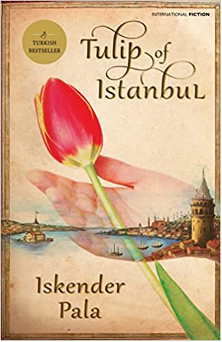
Tulip of Istanbul by Iskendar Pala

Book Review by Gracy Samjetsabam

Title: Tulip of Istanbul

Author: Iskender Pala

Translator: Ruth Whitehouse

Publisher: Niyogi Books

Tulip of Istanbul was originally written in Turkish in 2009, is a historical novel by Iskender Pala. The translation to English by Ruth Whitehouse and its publication by Niyogi Books in December 2021 has put it within the reach of the larger community of Anglophone readers.

Iskender Pala is a professor of Turkish (Ottoman) Divan Literature, an author, and a columnist. He is a recipient of the Turkish Writer’s Association Prize (1989), The Turkish Language Foundation (1990), The Turkish Writer’s Association Essay Prize (1996), and was honoured with The Presidential Culture and Arts Grand Award in literature in 2013. He has been conferred the title of “The People’s Poet” by popular vote in Usak, Turkey. Ruth Whitehouse is a scholar of Modern Turkish Literature and translator with multiple translations from Turkish.

Tulip of Istanbul , a fictionalised historical romance, is a murder mystery that is woven to highlight the period that followed the Treaty of Passarowitz in 1718. The story spans 1729 to 1730. Also known as the Tulip Age, this was a time when the glory of the peaceful period since the 1718 treaty was interrupted by an outbreak of a public revolt that showed resentment to over-indulgence and wastage, leading to social and economic downfall. The book has 66 brief chapters that seek to answer a question that is set as the title of each chapter. In the ‘Preface’, the author claims he wrote the book under the influence of a handwritten anthology of Turkish poetry by an anonymous compiler from an “Auction of Stamp Collections and Old Books” outside Istanbul’s Marmara Hotel. Impressed by the book, he wanted to showcase part of the Ottoman history as a storyteller. Thus was born the One Murder, Sixty-six Questions in Turkish translated as the Tulip of Istanbul.

The ‘Prologue’ reveals that “truth must not remain concealed” and so, the story is told two weeks after the October Revolution that deposed Sultan Ahmet III and slayed his son-in-law Grand Vizier Ibrahim Pasha of Nevsehir. The book opens with the question, “Is There No Limit to Self-Sacrifice?” The mysterious murder of Naksigul, the bride with heavenly beauty on the first night of the wedding, left the husband, Falco, distraught and deranged. The death of his wife had him thrown to prison as the prime suspect. Naksigul was holding a rare and beautiful purple twin bud tulip when she died. Two lovers were brought together by fate when Falco escaped the jailors. They jointly set out to solve the mystery.

In the story, Pala beautifully alludes to the rich culture and history of Istanbul. He manages to introduce the readers to the ninth-century music therapy called “Farabi”; historical figures who visited the empire of the time, the poet Nedim, the painter Van Mour and dignitary Lady Wortley Montagu; and to the Empire’s culture of maintaining insane asylums, prisons, lodges, and coffee houses. The narrative is interestingly infused with plots that are a story-within-a-story about the social life of the Ottoman Empire, the accounts behind the architectural beauties of the walled city of Istanbul, the picturesque sunsets of the Turkish straits be it by the Bosporus or sea of Marmara, the magnificent domed mosques, and palaces with fashionable gardens.

The action peaks to an important juncture at the house and garden of the most coveted tulip cultivator Hafiz Celebi. In the story, Pala includes mesmerising tales on the nomenclature, symbols, and meanings of the “Tulip” flower, which metaphorically and literally relate to the flourishing business, architectural beauty, and exchange of politics, art, and aesthetics of the Empire with the countries like Iran, Austria, Holland or Crimea. Through the story, Pala aptly accommodates how the Horticulturist community indirectly played a role in the policies and well-being of the state. Tulips are strewn through the story binding it into a poetic whole. Pala mentions the upgrade in information sharing with the coming of the first printing press in Turkey and succeeds in connecting it to the ongoing social unrest and the gruesome revolt that ensued in the Tulip Era. The mystery livens up till the end of the story where love guides and transforms, its own meaning and the seeker.

The language used by the translator in the story aids in understanding the appreciation for elegance and perfection in the art and aesthetics of the Ottoman Empire. Tulip of Istanbul is a potent read with a capacity to broaden the perspective about a culture one knows less about, a perfect springtime read. Changing seasons and social change serve as the backdrop to the dreamlike story filled with intrigues of royal secrets and suspense wreaths with those that pursued power alongside those that pursued love.

.

Gracy Samjetsabam teaches English Literature and Communication Skills at Manipal Institute of Technology, MAHE, Manipal. She is also a freelance writer and copy editor. Her interest is in Indian English Writings, Comparative Literature, Gender Studies, Culture Studies, and World Literature. 

.

PLEASE NOTE: ARTICLES CAN ONLY BE REPRODUCED IN OTHER SITES WITH DUE ACKNOWLEDGEMENT TO BORDERLESS JOURNAL