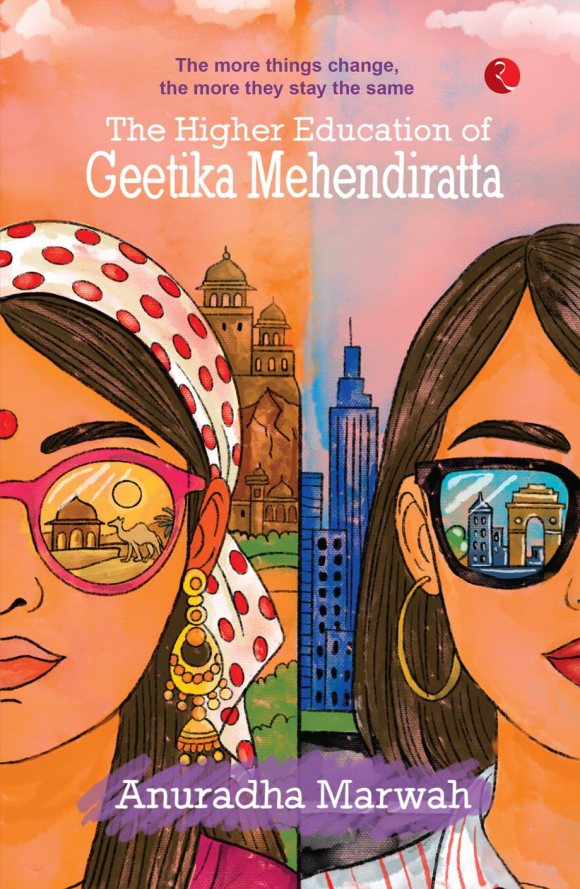
Title: The Higher Education of Geetika Mehendiratta
Author: Anuradha Marwah
Publisher: Rupa Publications
Boyfriend
There is communication because there is no communication, thundered the supervisor in a sudden spurt of lucidity.
Three dark heads bent obediently over the notebook to glean these pearls of wisdom.
‘When I say cat, you may think of a black cat, a white cat, a fat cat, a thin cat…’
I wondered where to put this in. I was going to write a dissertation on A House for Mr Biswas by V.S. Naipaul, I had decided last night. At what point should I bring in the feline? This brand new structuralist approach… For the past twenty minutes, this impressive lady from Sorbonne had only spoken about the difficulty in identifying cats. I had even drawn one in my notebook. Structuralism had spread far and wide, she had told us; it had reached Cornell, where a professor had simplified it at once for the simple non-European brain. Only Americans are capable of such simplifications, she had added laughingly.
Cornell, America… Vinita.
Vinita had changed so much. She now had a baby girl. She did all the household chores herself, she had told me. She had become plump. Her breasts had lost their upright quality; she had even started applying a lot of make-up—bright lipstick, mascara and eyeshadow.
She wouldn’t know about American universities though—that wasn’t the America she had gone to. She had gone to drudgery and loneliness… No servants to chat with all day long.
In Ratish’s house, there were servants… Lakshmi said Ratish was far too predictable. She said I was predictable too. That I would get married in a hotel, watched by a whole lot of people I didn’t know; that I would have two easy deliveries and be pleasantly miserable all my life. She even predicted I would get fat.
When I told her I wasn’t predictable and would make her sit up one day, she began singing ‘Girls Just Want to Have Fun’.
Every discourse has a mediatory role as an instrument of change.
Who would mediate between my estranged parents and me?
Which discourse—the discourse of commitment or the discourse of tradition? Lakshmi or Ratish?
Ratish had come to Desertvadi to say that he loved me. Mummy had said it was absolutely dreadful the way I could never make up my mind about boys. She had cried. Andy had cried too; Papa was the only one who hadn’t. And then, suddenly, there had been a letter from the university saying I had cleared the written exams for the MPhil programme, would I appear for an interview?
I was where I wanted to be, for the first time in life, although the umbilical cord of parental expectations was yet to be cut… Ratish said he valued family and respected my parents, and that I should be gentle with them… Cruel to be kind, kind to the potential children in my womb. What if there weren’t any? What if I couldn’t have any? So much of our planning would go haywire, Ratish. I would have been cruel for nothing.
There would be nothing to do except cry or make a phone call to your office… No patter of little feet. What would I do with you then?
Tonight, we are going for a party, I will ask you then.
Words are either arbitrary or associational.
Is that a word, ‘associational’, or was it coined in Sorbonne this very summer? Lakshmi says it would be better to check the professor’s antecedents; perhaps she is not from Sorbonne at all.
Lakshmi looks down on our department anyway.
Economics people have this strange nose-in-the-air attitude towards languages. Our department was housed in the School of Languages, so everybody thought it was a Linguistics department… But we were doing literature, three of us. One was from Utkal University, Orissa; another from Ramakrishna Mission, Pondicherry; and I, from Rajasthan University.
I was disappointed that there was nobody from Lutyenabad in our course. All Lutyenabad students went to the Capital University because all the jobs were there. I had heard that there was a danger of never landing a job in Lutyenabad after doing an MPhil from Jana University.
So Andy, your curse may yet materialize—if I don’t have children and I don’t get a job. You had said as much, hadn’t you?
‘You will never be happy, Geetika, never… Don’t think you can find happiness by wrecking mine.’
But what could I do, Andy?
‘Geeti, my mother wants us to marry,’ you had said.
‘But Andy, my parents do not want me to marry yet.’
‘Look, the situation is getting very difficult for me. My parents are rather worried about the fact that your parents have not made any overtures to them.’
‘Why don’t you explain to them—’
‘I have done enough explaining. Your brother got married without even calling his parents for the wedding…’
‘What does Bhaiya have to do with this?’
‘Geeti, I can understand my parents… They didn’t question my decision to marry you. Surely, they are entitled to some sort of say in my affairs.’
‘I am not saying they are not…but Andy, what am I to do?’
You could never answer that one, could you, Andy? It just went on and on—your duty towards your parents, the obduracy of mine. I was tempted, sorely tempted, to just tell my parents that I was marrying you that very day but Ratish’s card saved me.
It came by the evening post the day you left Desertvadi after extracting a promise from me that I would speak to my parents. It was a lovely card; it said: ‘I can’t forget you, little one’.
It became easier to write that letter to you, dear Andy… It became easier to tell you, when you came running after receiving that letter, that it won’t work… But it wasn’t easy dealing with the lava of your frustrated anger as it burnt down my unsuspecting ears whenever I picked up the phone for months after that.
‘You bitch, you found somebody else at the Sportsaid, didn’t you? Don’t think you can ever be happy with him…’
Discourse becomes necessary because of the ambiguity inherent in the nature of language.
But I understood even what you didn’t say… I knew that I had wronged you, Andy. I did not cry as much as you did; I would have to make up for it. I had always appeased the gods by crying… This time, I slipped up…
About the Book: Desertvadi, Rajasthan, is a retirees’ paradise, but for a young girl like Geetika it is a claustrophobic trap. Academically gifted and sexually curious, she feels suffocated by small-town mediocrity and dreams of faraway lands and liberated lives – the kind that fill the pages of her beloved novels.
So, when an opportunity to study in the big, bustling Lutyenabad presents itself, Geetika leaps at it, eager to get away from her parents and the miasma of chronic boredom that envelops Desertvadi. Soon cosmopolitan life begins to feel like a snug fit especially when her new boyfriend, a famously fine catch, offers her the many luxuries of a conventional marriage.
But life in a metro impacts her in ways she never expected. Her aspirations inflate, her tastes evolve, and her ambitions solidify. As her boundaries expand uncontrollably and the daydreams she was escaping to inevitably shatter, Geetika is compelled to face some tough questions.
Published in 1993, The Higher Education of Geetika Mehendiratta was one of India’s earliest campus novels. Republished for a new generation, this is a bold and intimate coming-of-age tale – unafraid of its hunger and unashamed of its heat.
About the Author: Anuradha Marwah is a professor, playwright, and novelist. Her wide-ranging publications also include poems, essays, articles and reviews.Aunties of Vasant Kunj, her fourth novel was published in 2024 to immense acclaim. Anuradha lives in Vasant Kunj, surrounded by a community of trees and cats.
You are the fragrance of rocks, the lamentation of each flower, the unbearable heat of the moon, the icy coolness of the blazing sun, the language of my letters to myself, the smile with which all despair is borne, the millenniums of waiting without a wink of sleep, the ultimate futility of all rebellion, the exquisite idol made of aspirations, the green yesterdays of deserts, the monsoon in an apparel of leaves and flowers, the illuminated pathway from the clay to the farthest planet, the fantastic time that's half-day and half-night, the eternity of the sea's brief silence, the solace-filled conclusion of incomplete dreams, the dishevelled moment of an awakening with a start, the reluctant star in the sky brightening at dawn, the unspoken sentences at farewell, the restless wind sentenced to solitary confinement, the body of fog seated on a throne, the reflection asleep on the river's abysmal bed, the undiscovered mine of the most precious jewel, the outlines of lunacy engraved in space, and the untold story of lightning. You have, my dearest, always suffered all my inadequacies with a smile. I know I am not destined to bring you back once you've left. All I can do hereafter, till the last day of my life, is to collect the fragments of what you are and try to piece them together.
Sri Radha Canto 19
Come, take half of the remainder of my life, but fill every moment of the half that is mine with your infatuation. Was the bargain unfair? Then leave me with a single moment and take away the rest of my life, but like the sky, fill the whole space above that moment.
No, not like the sky. Come closer and become the cloud over my past, present and future so that, when I touched myself, I would touch the monsoon of your body. Your sighs would breathe the gale spewed by the despair of a distant ocean and, when I smile and touch myself, the gale would cease.
My lifetime, unconcerned with its nearing death, would everyday renew its pilgrimage to the early years of your youth. You would exist as a mass of blue carved by my command, or as the blue of all my known, partly known and unknown desires. Since I always dress in blue, you too must be blue. How can you have any other colour when it would break my heart if you had any other hue other than blue?
Was the bargain unfair? Then come, take away even that single moment. But do not bend down, look straight into my eyes. Meet the impudent traveller who has passed through hell after hell and, at the end of the very last hell, stands under a kadamba tree and awaits your coming.
Sri Radha Canto 25
It was a bad day yesterday. My husband dragged me by the hair and knocked my head against the wall several times, and insisted that I come out with the true account of where I had spent the previous night. It hurt for some time, but when he began an inspection of my body, I could not hold back my laughter.
God, I said to myself, what an imbecile I have for a husband! He is looking for proof of my infidelity in the body and at daytime too!
Sri Radha Canto 61
Reports of your passing away have reached us here.
Don’t count me among your widows or among those who carry your body in procession.
Your body, mercifully, Is far, far away.
In the parting of my hair, the vermilion mark is brighter than ever. Now stop joking, become the bridegroom, and come.
I wear the bride’s heavy silk and gold. My bangles tinkle And snub all sandals.
You no longer are anyone’s father, son, husband. You are the pure naughtiness of our last night together, the voice that teases me, and the touch that breaks the virginity of my loneliness. Just when I would stop crying, you will arrive and tickle my lifeless longing into unrestrained laughter.
When they deposit your body on the pyre, all that you ever meant to them will be consumed by flames. They would return home and, a few days later, would fill your absence with thoughts of you and a thousand other things.
My joy today is uncontrollable. If you had not died for them, you would not have become entirely mine.
Since everyone believes you are dead, my journey to the riverbank will now be without fear. All claims to you are now void, Except mine. They will forget I was ever there Or even know how I held on To your glamour-doll shoulders.
I fold up Under your common hand of desire As you disable my jelly-limbs Filling my spaces Beyond all that exists Or does not exist.
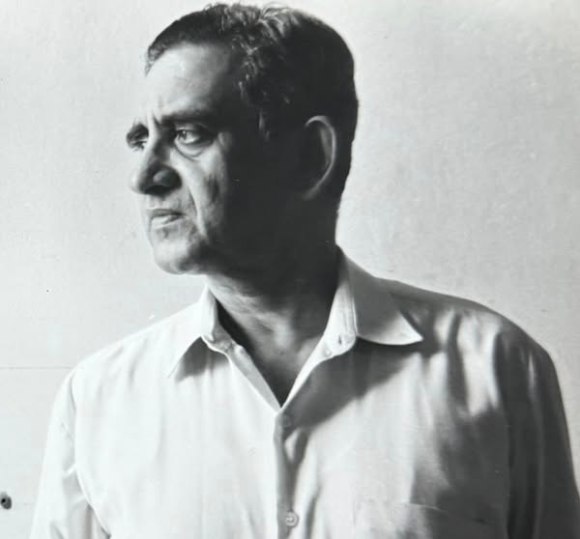
Ramakanta Rath is one of the most renowned modernist poets in the Odia literature. The quest for the mystical, the riddles of life and death, the inner solitude of individual selves, and subservience to material needs and carnal desires are among this philosopher-poet’s favourite themes. His poetry betrays a sense of pessimism along with counter-aesthetics, and he steadfastly refuses to put on the garb of a preacher of goodness and absolute beauty. His poetry is full of melancholy and laments the inevitability of death and the resultant feeling of futility. The poetic expressions found in his creations carry a distinct sign of symbolic annotations to spiritual and metaphysical contents of life. Often transcending beyond ordinary human capabilities, the poet reaches the higher territories of sharp intellectualism.
The contents have varied from a modernist interpretation of ancient Sanskrit literature protagonist Radha in the poem “Sri Radha” to the ever-present and enthralling death-consciousness espoused in “Saptama Ritu” (The Seventh Season). Some of his other major poetry collections include Kete Dinara (Of a Long ,Long Time), Aneka Kothari (Many Rooms), Sandigdha Mrigaya (Suspicious Hunting), Sachitra Andhara (Picturesque Darkness), and Sri Palataka (Mr. Escapist).
Ramakanta Rath was born in Cuttack, Orissa (India) on 13th December 1934 and passed way on 15th March 2025.
He obtained his MA in English Literature from Ravenshaw College, Orissa. He joined the Indian Administrative Service in 1957 but continued his writing career. He retired as Chief Secretary Orissa after holding several important posts in the Central Government such as Secretary to the Government of India. He received the Sahitya Akademi Award in 1977, Saraswati Samman in 1992, Bishuva Samman in 1990 and India’s 3rd highest civilian honour, the Padma Bhushan in 2006. He was the Vice President of the Sahitya Academy of India from 1993 to 1998 and the President of the Sahitya Akademi of India from 1998 to 2003, New Delhi. In February 2009 he was awarded a fellowship by the Central Sahitya Akademi.
These cantos have been excerpted from Ramakanta Rath’s own translation of his long Odiya poem, “Sri Radha”, by his son, Pinaki Rath.
.
PLEASE NOTE: ARTICLES CAN ONLY BE REPRODUCED IN OTHER SITES WITH DUE ACKNOWLEDGEMENT TO BORDERLESS JOURNAL.
Raja O Praja, an essay by Tagore, has been translated from Bengali as The King and His Subjects by Professor Himadri Lahiri. It formed the lead essay in his book of the same name published in 1908.
Translator’s Introduction: Rabindranath Tagore’s essay “Raja O Proja” was first published in the well-known Bengali periodical Sadhana (Sravana, 1301/1894). It is anthologised in Rabindra Rachanabali (Sulabh Sanskaran) 5th volume (Visva-Bharati, Pous 1394): pp. 727-31. Tagore unravels the nature of the relationship between the colonial masters and the subjugated subject people. Much before Edward Said, Tagore examined how the colonial masters resorted to the practice of stereotyping, a strategy that denies human qualities to the colonised and renders them inferior and uncivilised. Set against the contemporary political background, the essay provides an incisive analysis of the behaviour patterns of both the British colonial government and the subjugated Indian population. It should be considered a significant contribution to the study of colonialism.
The King and his Subjects
When the British civilian, Radice Sahib1, insulted and persecuted a certain zamindar in Orissa by violating laws, Lieutenant-Governor MacDonnell2subjected the offender to a one-year-punishment.
If we reflect on this incident, it should not have surprised us. In reality, however, this act of justice was incredibly startling to the general public. This explains why some naive individuals expressed their unusual delight.
Shortly afterwards, when MacDonnell Sahib was duly replaced by Elliott Sahib3, the latter freed Radice from the punishment by illegally reversing his predecessor’s order and even promoted him to a higher post. Now the same naive people have started expressing their profound sorrows.
The task is accomplished by the will of the master. Only the master knows why he [i.e. Elliott] violated the rule; we are left desperately groping in the dark. It may be that one civilian protected the prestige of another. But the decision was surely inappropriate – this incident dented MacDonnell Sahib’s prestige, and even that of the government.
In course of their conjectures, people are providing different theories; all of these may turn out to be incorrect. On the whole, it may be said that only the government knows the ins and outs of its own policies; we are merely blind puppets being controlled by these policies.
Hence, it is my opinion that driven by our delusions, we instinctively express our happiness and sadness at the moral and immoral decisions of the people at the helm of affairs. Where everything is done at the master’s will, where our good fortune or bad depends greatly on the character and whim of a particular person, there we should consider both the auspicious and the inauspicious, the moral and the immoral as merely momentary, accidental episodes. What MacDonnell Sahib did was the result of his own will, and what Elliott Sahib did was also produced by his own caprice; we are merely ruses.
Even then, we cannot help feeling distressed or shocked by the appalling events or delight at their praise. But we should always remember the specific instances that will make us happy and contribute to our people’s glory.
This can be achieved only when all the common people develop so intense a sense of conscience and alertness that we can feel the pain together in the face of insult and injustice, and also when the government absorbs into its own system an obligation to respect the conscience of the people; only then can we genuinely rejoice.
Usually, our moral conscience, our understanding of our work culture, and our apprehension of vilification all combine to guide us to the path of duties. The principles of responsibilities of our governments are largely determined by moral conscience and work culture. Their connection with the subject people’s ideology of good and evil is very weak.
It is universally known that when conscience comes into conflict with work culture, the latter sometimes prevails. During this conflict, the moral compass of those individuals not involved in the conflict can help reinforce one’s own conscience. When we will find the subject people’s criticism being appropriately reflected in the government’s activities, we will express our happiness.
In the absence of the subject people’s criticism, the sense of moral duty of the British in India imperceptibly slackens and degenerates to such a level that their moral ideals begin to radically differ in nature from those of the native British. For this reason, we find on the one hand, the Englishmen in India hate us, and on the other, they express their utmost intolerance towards their own countrymen’s opinions, as if both were alien to them.
There might be several reasons for this. One reason is that due to the remote location of their country, the British in India forget how social criticism typically motivates or impacts actions of their own countrymen. In addition to this, the Englishman’s relationship with us is primarily based on selfish interest as they do not share any emotional bond that stems from nation-based kinship. Hence, for various reasons, it becomes challenging for the British in India to maintain the same purity of selfless duties towards their subjects. Consequently, a distinct and specific code of duty begins to develop for the colonials in India – this arises from various factors such as their self-interest and pride of power, the moral conscience of the weak, subjugated nation, and the complexities involved in administering a foreign country. The English of England sometimes fail to recognise this distinct code of duty.
Certain talented Englishmen with exposure to colonial India have taken upon themselves the responsibility of effectively introducing this unique object [i.e., this new ideology of difference] in England. By virtue of their talent, they are demonstrating that this new object has its own unique appeal.
Rudyard Kipling’s name may be cited as an instance. He has exemplary power. By invoking that power, he has created in the English imagination an image of the Orient as a cattle pen. He is trying to convince the native Englishmen that the Indian government is, indeed, a circus company. He is skillfully orchestrating our actions as a performance of strange and spectacular animals of various species before the civilised world, implying once the spectators take off their steady gaze, all the animals could immediately spring upon them. The animals are to be observed with intense curiosity, they will have to be kept under control with the proper combination of fear of the whip and temptation of pieces of bone. Of course, certain doses of compassion for animals are also required. But if you raise here issues of principles, love, and civilisation, it will be difficult to keep the circus going, and it will also be dangerous for the proprietors.
The image of strong human animals being controlled solely by willpower and compelled to dance at the mere gesture of the master’s finger is likely to fascinate the English as a curious spectacle of entertainment. This generates in them an interest in the uniqueness of the human animal and also a racial pride. There is also a profound satisfaction in being able to control someone who embodies an imminent threat, and this seems delightful to the inherent nature of the English people.
On another front, the number of Anglo-Indian team members is also increasing day by day. Anglo-Indian literature too is gaining popularity. The influence of Anglo-Indians is gradually finding roots in the English soil, spreading its branches all around. In this context, it should be mentioned for the sake of justice that many Anglo-Indians, after retiring from their assignments in India, have displayed extreme benevolence towards the helpless Indians.
For all these reasons, many native English people are sceptical about whether it would be a quixotic stupidity for them to discharge to the oriental animals those duties usually reserved for themselves, whether this act of showing equality will reveal the civilised islanders’ intellectual narrowness and inexperience, and whether this would also harm animals of various species. English philosophers such as Herbert Spencer believe that it is not only inevitable that moral ideals vary according to the standard of civilisation but also necessary according to the norms of evolution.
The truth of these opinions will be judged on some other occasion. For the time being, I can only say that its (i.e., the practice of treating Indians unequally) consequences are very painful for us. Apprehending an uprising after noticing some posters on trees in the state of Bihar, opinions have been expressed in several English newspapers that a genuine union of love is never possible between Oriental and Occidental races. The former has to be subjugated forcibly by means of fear of threats. All these, it seems, are being expressed more openly these days than ever before.
Our opinion is that even if we admit that the principles of duty in freedom-loving Europe may not be suitable for application in every corner of the ever-subjugated Orient, it is indeed an unrealistic dream for them to maintain the usual rhythm of the Oriental life here for the simple reason that our king is a European. If our country were free, the monarchy that would have evolved in the natural process in this Oriental space would surely have been different in multiple aspects. It may be that, from one perspective, the king’s excessive power would have appeared greater than it is now. Similarly, from another perspective, the subjects, by limiting the king’s authority, would have channelised their own desires in various forms and through multiple avenues. Natural compatibility can be best expressed through natural means. Howsoever they may want, the English cannot achieve that (artificially) just through policy making.
Hence, the Englishmen can behave with us just in the way they do; if they willingly distort it, that will amount to misbehaviour, it will never become an Indian behaviour. They can break their own ideal, but in its stead what will they build and how? However, the English, fallen from their ever-familiar native ideal, may turn out to be big, ferocious animals. From the hints of cruelty, laced with aggression of power, that we can trace in the works of authors like Rudyard Kipling, it seems that man often wishes to jump into the primitive barbarity of wild nature of the forest by ripping through the fine, hundred-threaded strong net of civilisation. On their arrival in India, the Anglo-Indians taste the exquisite wine of power that may create this overwhelming intoxication. The natural, spontaneous embodiment of masculinity in the writings of these loveless, difficult, power-boasting talented men has a kind of extreme fascination. That is literature for the English but for us, it is indeed a recipe for death.
Secondly, the way authors in their contemporary novels represent the Orient as appearing mysterious to the Occident is largely fictitious. There are numerous intersections between us. The similarities of the heart are often overshadowed by external differences. Modern writers tend to apply colour to, and even exaggerate, the unfamiliarity of these external features to please the readers; they do not try to unearth the similarities lying deep within, neither are they capable of doing that.
The significance of making all these statements is simply this: the idea that European values are exclusively meant for Europe is gradually spreading not only in India but also in England. Indians are supposedly so different a race that the civilised values are not completely applicable to them.
Under such circumstances, if our ethical values become strong, the policy of governance cannot go off the right track. When the English are conscious of the fact that their actions are being closely watched by the entire Indian population, they will not be able to do anything by completely disregarding India.
Recently, some evidence of this is being noticed. When India witnesses some misdeeds committed by the English, she begins to call for justice in her own feeble voice, invoking civilisational and moral values. This naturally angers the colonials, but at the same time, they are forced to remain somewhat vigilant.
Even then, full results are yet to be seen. The British consider it an admission of their weakness to adhere to codes of values that exhibit respect towards us all the time and under all circumstances. They find it insulting and harmful if one of them commits a crime against us and is punished by the law. They fear that Indians will perceive it as curtailment of power.
It is impossible for us to identify the nature of thoughts of government officials. However, I feel the untimely promotion of Radice Sahib can be linked to the above policy. This suspicion is reinforced specially when such an event is found to have occurred repeatedly. The government is, as if, silently declaring, it is your audacity to expect an English official to be humiliated for harassing and insulting one of you. Even if we have to violate conventions and neglect the rules of governance to crush that audacity, it will be desirable. The English race is greater than the norms of ethics, they are beyond the jurisdiction of justice!
For the sake of truth, it has to be admitted that the government tends to keep not only the English but also its own employees a notch above the rule of justice. This has been observed in one or two contemporary incidents. In the Baladhan4 murder case, all those involved, right from the English judge to the Bengali police personnel who were openly blamed in the judgement of the High Court, have been rewarded and encouraged by the colonial Bengal government.
We are individuals outside the realm of politics, we are not familiar with its internal complexities. There might be a hidden motive behind it [the government’s decision]. The authorities may believe that the local judge in the Baladhan case did not issue an incorrect ruling – around five to seven individuals should have been hanged in some manner. They might have nurtured a biased opinion that the incident in reality happened despite the lack of concrete judicial evidence, and that only the local judge could have determined the truth which was inaccessible to the High Court judge.
We want to say that openly rewarding, instead of punishing, individuals who have been publicly condemned by the highest court of the country, who have been proven guilty in the eyes of the public, amounts to the disregard of the moral judgment of the public. Everyone’s told we do not feel the need to offer any explanation to you about our duties. The government is not bothered about whether you praise or criticise it – our government is strong enough to withstand such scrutiny!
The governor who demolishes the anguish and moral judgement of the subjects under his shoes, and drowns their feeble, insecure voices beneath the marching sounds of their feet, is indeed a strong ruler in Anglo-India!
It is unnecessary to disclose whether this highlights their power or reveals our utmost weakness. This insolent disregard of the government suggests that, in its view, the moral judgement of the Indians is not strong enough to evoke a feeling of embarrassment in them. Instead, this unapologetic recklessness seems to them as the manifestation of a genuine power over an ever-oppressed nation.
If we can really convince the agents of the government that we do not consider the violation of ethics as bravado, that injustice, however powerful it may appear, is held as equally despicable and reprehensible in our Oriental system of judgement, and that the lack of courage to dispense justice everywhere firmly and impartially is also considered by us as a sign of weakness, only then the English would be forced to respect our norms of duties. The reason is that they will be able to discover the correspondence between our ideal and their own.
When we forget the bitter lessons of our prolonged subjugation, when we decide not to consider the injustice of the powerful as the manifestation of divine will — something that must be endured in silence — when we consider attempts at the redressal of injustice, even if it fails, as our duty, and when for these reasons, we stop being averse to sacrifice ourselves and bear pains, only then the days of true happiness will bloom. At that point, the sense of justice of the British government will never be derailed by any selfish policy and eccentricity of any individual; it will stand like a resolute mountain firmly based on the foundation of the subjects’ hearts. At that time, good gestures of the government will not accidentally be showered on our bowed heads like momentary favours; we will, on the contrary, accrue them as respect. What we are getting as alms today will be received as our rights.
Questions can be raised – offering advice is easy, but what about the solution? To that, we may retort that no proper bliss can be achieved by clever strategies alone; for that we have to pay the entire price due to it. All of us must strive to our utmost potential, proper lessons should be imparted to siblings and children in every household, a strong ideal of justice needs to be established in both the family and society, and careful attention must be paid to one’s own behaviour. Like all good advice, this too is easier to hear, difficult to implement, and is indeed age-old. However, there is no new, short-cut or hidden path other than this long, open, and ancient highway.
Translator’s Notes:
1. Mr. C.A. Radice belonged to the Indian Civil Service cadre during the late nineteenth and early twentieth century. He was posted as an Assistant Magistrate and Collector in Murshidabad in 1890 and was “vested with third class powers” (Appt. File 5C—4. Proceedings B. 1—3, Ja. 1890). He was ‘degraded’ for “prosecuting Babu Radha Shyam Nissanta Mahapatra, zaminder of pargana Balinkandi in the district of Balasore” [Judl. File J-1P—113(1-21), Proceedings 134-55, Aug. 1893]. Radice’s ‘reversion’ to 2nd grade became effective in February 1895. [(Appt., File 6C—8(3.8). Proceedings B. 716-21, Feb. 1895)]. The translator of this essay traced these pieces of information in the entry on “Radice, C.A. Mr., I.C.S.—” pp. 1126-1128. Kindly see: https://sadte.wb.gov.in/uploads/pdf/D12/D1224.pdf
2. Antony Patrick MacDonnell (1844–1925) joined the Indian Civil Service in 1865. He was the Lieutenant-Governor of Bengal during the period 1893-1895. MacDonnell was respected as an expert on the Indian land reformation and famine relief. “His sharp temper and unwillingness to tolerate inefficient subordinates earned him the nickname ‘the Bengal Tiger.’” Kindly see the entry on “MacDonnell, Antony Patrick” contributed by Patrick Maume, in Dictionary of Irish Biography. https://www.dib.ie/biography/macdonnell-antony-patrick-a5180.
3. Sir Charles Alfred Elliott (1835-1911) was the Lieutenant-Governor of Bengal during the period 1890-1893. Tagore’s reference to MacDonnell being replaced by Eliott is confusing because Eliott indeed preceded MacDonnell, and did not succeed him.
4. Tagore refers to an incident which is popularly known as “Baladhan Murder Case.” It took place in Baladhan Tea Garden in the Cachar district of Assam on 11 April, 1893. Several persons barged into the manager’s bungalow in the tea garden at night and killed the manager (Mr. Cockburn) and the chowkidar and seriously wounded Mr. Cockburn’s Indian paramour named Sadi. Money and other valuables were looted. Later six Manipuris and a Gurkha were arrested. They were tried by the sessions judge John Clark (and a panel of three Indian assessors) at Sylhet who sentenced four of the accused to death. Babu Kamini Kumar Chanda took up the case to Calcutta High Court which acquitted all the accused (Sanajoba 234). “On December 11, 1893, Calcutta High Court Judges Ameer Ali and H.T. Prinsep acquitted all of the prisoners on account of the many ‘irregularities’ and ‘illegalities’ committed during the police investigation and trial, as well as the lack of corroborating evidence” (Kolsky 145).
See pp.142-48 [in Chapter 4 titled “One scale of justice for the planter and another for the coolie”: law and violence on the Assam tea plantations” (pp. 142-184)] in the book Colonial Justice in British India edited by Elizabeth Kolsky (Cambridge University Press, 2010) and p. 234 of Th. Babachandra Singh’s chapter “The Manipuris in the Politics of Assam” (pp. 213-36) included in the book Manipur, Past and Present: The Heritage and Ordeals of a Civilization, Volume 4 (Pan-Manipuris in Asia and Autochthones), edited by Naorem Sanajaoba, Mittal Publications, 2005. (Google book link: https://books.google.co.in/books?id=CzSQKVmveUC&printsec=copyright&redir_esc=y#v=onepage&q&f=false)
.
Himadri Lahiri retired as Professor of English, the University of Burdwan, West Bengal, India. He is currently teaching English at Netaji Subhas Open University, Kolkata.
PLEASE NOTE: ARTICLES CAN ONLY BE REPRODUCED IN OTHER SITES WITH DUE ACKNOWLEDGEMENT TO BORDERLESS JOURNAL
Our Tanda


Our tanda is a bird’s nest
our homes: broken refuges
and our lives are feathers
swirling in the air.

The moon and the sun
hatch time so long as they wish
and flee, leaving folds,
on the lips of time.

Mirrors raise our hopes
showing ourselves
break our knuckles quietly
shatter into fragments and prick hearts.

Goats, cows, buffaloes, sheep and hearts,
all dig out rivers of forests with desires
as kids draw winged horses on the black of night
with fingers
dreaming of sugary peppermints or custard blobs.

Mothers sing lullabies,
oil-lamps
embellishing the night
to sleep.

Fathers guard homes
one eye on the house
the other eye on the field
with their heads out of their windows
they turn into flaming torches.

The ippa flowers grieve
releasing inebriety
listening to the story of our tanda.


Chakmak


	I

There were a few chakmak
at the window, ants and insects wandered
among them.

Whenever I visit the window,
I licked the chakmak,
no sweetness touched my heart,
nor did smell hit my nostril,
though they look like candy jellies.

I picked them
and threw them out of the window.

Daada picked them up,
took them again into the house
and placed them at the sill.
I thought of doing the same again.
He taunted our hen indirectly —
I could understand that the hen was me.

I thought the mysterious relationship
of our folk remains untold,
hid in the skulls
about chakmak.


	II

One day when daadi was busy
in stitching her tukri
she kept the chakmak beside her
sharpening the needle on a chakmak.

I sat beside her staring at the chakmak —
darkness and light played about,
I was astonished by the sharp light
emitting from them.

The beads were placed in front of daadi
on a piece of cloth for stitching them on her tukri,
they stopped singing and rolling,
were trying to peep into daadi's honey eyes.

The needle writing the joy of tukri on the chakmak,
white stains swelled out from the black chakmak
when accidentally her sweat fell on it.

She saw me and asked me to sit beside her,
started narrating the tales of chakmak,
as I continued staring at them.


	III

Birth after the water broke —
you crept out of your mother's womb
with stains of the eternal world
giving her womb to rest from the eternal sea.

This black stone gave you the world,
cut your umbilical cord
but it suffered by your birth,
fevered, it one day burnt our hut.

At the age of two
when the moon was peeping into the rice
squeezed in my hand with milk,
my hand filled with moonlit serpents crawling down
that trembled in my blood tunnels.

Your daada sang a song —
the red stones brought joy to earth,
consoling the hard skin of daada's hand,
illuminating his loneliness

Then you got an invitation to the wonderland,
and there you slept in the bed of the red stone's reflection.

At the age of five,
we were summoned by the monsoon and started migrating.
We were stuck in the forest
you weeping of darkness and hunger,
in the fierce night.

Flesh-coloured stones devoured the darkness,
sprinkled its hunger on your fear
and roasted a few onions for you.

At the age of eight,
you were anxious about seeing the lunar eclipse —
the milk stone dragged the sky in its reflection.

She kept on stitching her tukri.
I was plunged into gazing at the chakmak,
my heart sensed something strange strange is about to happen.


	IV

I picked the chakmak into my palm.
The curves in the palms and lines on the chakmak
are trying to mate, and the curiosity in me reached my neck.
A cleft appeared in the chakmak.
I checked others for any more.

After a few minutes,
a butterfly soars from stone,
a man falls from its wing.
I take him in my hand,
he turns into a flute
made of animal bone.
I train my ear to hear him.

A voice from the bone flute starts talking
from the rusted past,
how we vanished from our identities,
how we were sheltered in the tortoise shells
and hung on horns of deers.

The world is trying to heap the chakmak together,
ransack our tribe for stones
and change the tanda into a haat
of banjara tribes.

The chakmak in the haat were ready to burst
with chronicles untold.
You gather the people.
The flute disappears.
I try fabricating the remaining tale.
Courtesy: Chakmak, art by Ramavath Sreenivas Nayak
Canvassing the Lives of Banjaras
By Surya Dhananjay
Banjara is an indigenous ethnic tribe of India. Banjara were historically nomads and later established settlements called tanda. Generally known as Gor-Banjara, they are also called Lambadis in Telangana, or Banjaras collectively across India. However, they are known by different names in various parts of the country, including Banjara, Gor, Gorya, Tanda, Laman, Lambadi, Sugali, Labhan, Labhana, Baladiya, Ladniya, Adavi, Banjari, Gypsy, Kora and Gormati, among others. The other names also indicate synonyms and signify the principal nature — wandering of Banjaras in various parts of the country.
Banjaras generally suffix Nayak with their names, along with other surnames such as Jadhav, Rathod and Pawar. Nayak was a title given by the local kings, Britishers and Mughals, as the Banjaras were warrior transporters, who transported essential commodities, such as salt, food grains (as well as weapons) on ladenis, bullock caravans for their armies. The titles were bestowed in appreciation of their honesty and hard work. Over time, the title has become the traditional name of many of the Banjaras.
The word Banjara is derived from the Sanskrit word Vana Chara — wanderer of the jungle. The word Lambani or Lamani, by which our community is also known, is derived from the Sanskrit word lavana (salt), which was the principal product the community transported across the country. Their moving assemblage on a pack of oxen was named tanda by the European traveller Peter Mundy in 1632 AD.
Historically, they were the original inhabitants of Rajputana, Rajasthan, and professional cattle breeders and transported these essentials to different parts of the region, using crucial transport routes. They are known to have invented Laman Margass1.
They then migrated to North India, East Asia and Europe in the ancient periods and to Central India and South India in the medieval periods along with the armies of Mughals from thirteenth to eighteenth century.
Banjaras lost their livelihood during British rule when the railways and roadways were constructed and they became the victims of predatory capitalism. Banjaras who were uprooted by the British government from their transportation profession were forced to indulge in petty crimes for their livelihood, which invited the wrath of the British and brought them under the ambit of the Criminal Tribes Act of 1871. Later, abandoning their traditional Ladeni profession, they settled wherever their Ladenis had halted in the colonial period and established their tandas, dwellings.
Traditionally, Banjaras depended on the pack of bullocks and bullock carts, called balder bandi in their Gorboli, for carrying out their ladenis and the cattle and oxen only were their properties for the ages, on which they built their livelihood through centuries. Many generations of Banjaras have taken birth on the balder bandi and have used it as shelter too.
Their language is called Gorboli, an Indo-Aryan language in addition to their own culture and traditions.
Gorboli has no script, it is either written in Devanagari script or the script of the local language, such as Hindi, Marathi, Telugu and Kannada, etc.
Most of their populations are concentrated in Maharashtra, Karnataka, Telangana, Andhra Pradesh, Bihar, Madhya Pradesh, Gujarat, Tamil Nadu, Himachal Pradesh, Orissa and West Bengal.
As such the local languages have much impact on their language, the words of which have found their way into Gorboli.
Owing to the fact that it is a dialect, the Banjaras do not have much written literature either. However, they keep their songs, lyrics, and literature alive orally. As there is no written literature available to the outer society about Banjaras, the chances of knowing their history, sentiments, culture and traditions are meagre.
Banjaras show a unique lifestyle, holding steadfast to their ancient dress code, perhaps the most colourful and elaborate of any tribal group in India.
The versatile and colourful Banjaras are found to be interspersed amidst tribal and non-tribal populations and yet tenaciously maintain their cultural and ethnic identity. Their dress and decoration and social practices have remained almost unchanged through the ages despite the habitation shift from northwest India to across India. Banjaras are a strong and virile race with tall stature and fair complexion.
The Banjara women’s dress and jewellery are auspicious and the whole outfit consists of elaborately embroidered and studded phetya or ghagro (skirt), kaacnhli or kaali (blouse), tukri and ghunghto (veil stitched in patches of cloth of various colours along with mirrors of different shapes, cowries and beads).
Women also wear baliya, bangles made of ivory to save their lives from wild animals. They wear many ornaments like topli, hanslo, rapiyar haar, wankdi, kasse, ghughara and phula pawla, which weigh nearly 20 kgs or more.
Banjara men (maati mankya) wear turban on their heads, a few wear babli (earrings) on the top of the right ear, kameez (white shirt) and dhoti, kolda (silver fat ring wrapped to wrist) in turban they hide chutta (cigar), tobacco, beedi leaves, cotton and chakmak (flint stone), etc.
Tattoos on their body parts define philosophies and memories of childhood. The main intention of tattoos is to sell them and buy food after death in heaven or hell. They make sacrifices to the earth and stones because they believe that God is in nature.
Banjaras have their own culture and traditions that reflect their life and beauty. Banjaras celebrate the festival of Goddess Seethla Matha (starting at the time of the rainy season to save us and our cattle from seasonal disease and for good yield) at the end of the rainy season.
They celebrate Teej Festival, a celebration of wheatgrass grown for nine days in bamboo baskets by maiden girls to get married to a good groom in the presence of Goddess Jagdamba,
Baar Nikler/ Baarand khayer is a feast in the forest, exposing the love towards nature that protects them.
Historically they had a big struggle to settle down since they led a nomadic life for centuries. During difficult times, they ate grass and clay. Their regular diet consists of grass poppies, leafy boiled dough-made baatis (chapattis), bran, maize, jowar, deer, pigeon, rabbit, fish, hen, turkey, peacock, tortoise, turtle, porcupine, goat, sheep, radish, raw onions, wild onions, green chilli, roasted potatoes, red clay, black clay, tamarind sprouts, rela pulu (golden shower flower as used to make curry) and monitor lizard.
Few folks sell their children, lands, traditional dress, ornaments and even wombs and many girls and women are known to have faced human trafficking. Many people have slaved as daily labours, women were sexually exploited, many of their tandas were wiped out and they have been killed.
Though The Constitution of India had provided many rights to the tribes, the provisions are unknown to these people who lead their lives as daily labourers, selling firewood and children for food, becoming street vendors, roadside chapati-makers and the like. People who do not know this stare at them. A small percentage of people use the reservation benefits, and most of them are subject to discrimination and exploitation.
As such, not much is spoken about in media channels and newspapers about the atrocities of land evictions and exploitations of Banjaras. This still happens throughout the country.
Only a few scholars have written books and presented papers on their lives. Few non-fiction collections have been published in Telugu, Kannada and Hindi languages. But no creative literature has been produced from the community.
This effort of bringing out the poetic illustration of the life of Banjaras is made by Ramesh Karthik Nayak, a young member of the Banjara community.
He hails from the small, remote village of VV Nagar Tanda of Jakranpally Mandal of Nizamabad District. He has published a poetry book, Balder Bandi (Ox Cart) and a short story collection, Dhaavlo (Mourning Song), canvassing the life of Banjaras in Telugu.
Both books have been received well by the literary world and have since opened the doors to Banjara literature. Within a short span, he has been able to bring before us this wonderful poetic format, which shows his interest in bringing out the historical, cultural, traditional and contemporary issues of Banjaras before the world.
I believe that he is like a popular flower called kesula (moduga puvvu in Telugu), which is seen brightly among all the trees in a jungle.
According to my knowledge, this is the first poetry collection written on the lives of Banjaras in the English language which brings out the rawness of Banjara’s lives and the poems are brilliantly written. It is a rare drop of honey from a kesula flower, in which the lives of Banjaras are carved transparently.
I believe that each poem of this collection is a chakmak, flint stone, which ignites many endless thoughts in the reader. I hope that this poetic creation of Ramesh Karthik Nayak will also definitely be received in a big way by all the literary minds. I hope this introduction about Banjara tribes will help you understand the tribal communities a little.
Finally, without going into the depth of his poems, I would like to quote a few lines from his poem ‘Tanda’:
Our tanda is a bird’s nest
our homes: broken refuges
and our lives are feathers
swirling in the air.
In this poem Ramesh has carved the picture of the status of the lives of Banjara tribes in the present-day context and earlier days. Banjara lives are indeed shattering day by day.
Courtesy: Chakmak, art by Ramavath Sreenivas Nayak
About the Book
Ramesh Karthik Nayak’s poems are marked by rich imagery, poignant stanzas, and moving stories about his people. I enjoyed reading his poems. — Hansda Sowvendra Shekhar
Ramesh Karthik Nayak distills all the pains and fears of his tribe to create a poetry of intense suffering and profound communion with nature. There is something primal, elemental, about his poetry that helps the reader distinguish it from the dominantly urban Indian English poetry. The poet brings a fresh voice, a new tone, and timbre seldom seen in traditional English poetry in the country, without making his poetry less sophisticated. — K Satchidanandan
Through his poems, Ramesh Karthik Nayak presents the celebratory life of the Banjara people; at the same time, he questions his existence. The questions he poses to us are both poignant and plausible. The poet expresses the truth with spontaneity and ferocity that if we are untouchables then, from nature to your vitality to your body, everything in this world has been touched by us. — Sukirtharani
Ramesh Karthik Nayak’s poems represent the dimensionalisation of Indian poetry in English. It’s appalling to think that a mature collection of poetry from a tribal/nomadic tribe poet had to wait for so long after Maucauley’s initiatives. Anchored in his cultural inheritance, Nayak documents with elan his dreams for the future. — Chandramohan S
About the Author
Ramesh Karthik Nayak is a Banjara (nomadic aboriginal community in South Asia) bilingual poet and short story writer from India. He Writes in Telugu and English. He is one of the first writers to depict the lifestyle of the Banjara tribe in literature. His writings have appeared in Poetry at Sangam, Indian Periodical, Live Wire, Outlook India, Nether Quarterly, and Borderless Journal and his story, “The Story of Birth was published in Exchanges: Journal of Literary Translation, University of IOWA. He was thrice shortlisted for the Sahitya Akademi Yuva Puraskar in Telugu.
Chakmak is his first collection of poems in English.
The poet can be reached at rameshkarthik225@gmail.com


 Borderless