Categories
Notes from Japan

The Cat Stationmaster of Kishi

Narrative and photographs by Suzanne Kamata

My daughter Lilia and I were in Wakayama Station, on our way to see the cat station master in the small town of Kishi. Because Lilia uses a wheelchair, we had to ask for assistance getting on and off the train.

“What time are you coming back?” a Japan Railways employee asked. They would have to prepare for our return later in the day.

“We want to come back on the Tamaden,” I said, referring to a train with a cat theme. I had taken a photo of the train schedule, and I opened my phone to check the time. It was now about twelve-thirty. Although there were trains every thirty minutes – the Animal Train, the Plum Train, the Cha Train – the Tama Train (aka Tamaden) only ran from Kishi twice a day. The next would be at 2:38, which wouldn’t give us much time to see everything. We didn’t want to rush. The final one would be at five fifteen.

“Five fifteen,” I said.

The man gave me a dubious look. “There isn’t very much to do in Kishi,” he said. “There’s nothing there. Are you sure you want to stay that long?”

What about the café? The museum? The shrine? The cat? We had come all this way, and we would only be there for a couple of hours. If we ran out of things to do, we could go for a walk. It was a lovely day, after all.

“You want to ride on the Tama Train, don’t you?” I asked Lilia.

“Yes,” she replied.

“What if we change our minds and want to come back early?” I asked the JR attendant.

He told me that would be difficult.

“Okay, then. Five fifteen.”

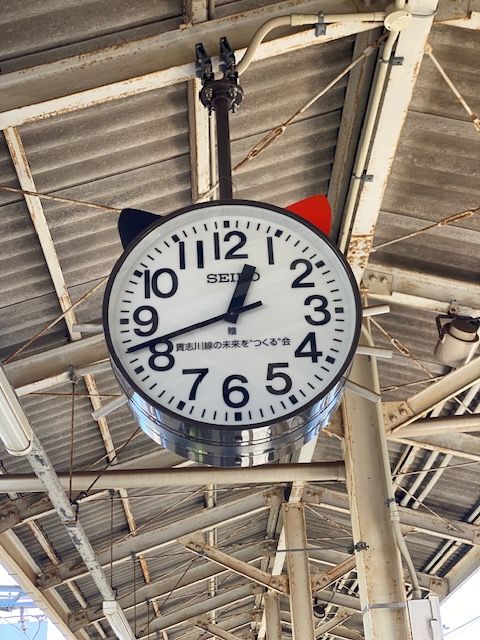
After showing our tickets, we were given Wakayama Electric Railway Kishigawa Line postcards. On the platform, there was a rubber stamp featuring a cartoonish Tama, with Wakayama Castle, and citrus fruits in the background. Little blank books meant for collecting stamps from various places were sold in gift shops. We didn’t have such books, so we stamped our postcards. A clock with cat ears – one black, one brown, like a calico – hung overhead.
I deduced that the train on the tracks, decorated with colored hearts, illustrations of dogs and cats, and the letters JSPCA, was the Animal Train. Other than the banners featuring cats clutching flowers and a white dog holding a bone, the inside of the car was ordinary. Like most Japanese trains, it was clean, with plush benches along each side, and an orange ticket dispenser at the entrance and exit.

Lilia marveled at how empty the train was. Now that she lived in Osaka, she had become a city girl, used to being squished between passengers on her morning and evening commutes. I was pretty sure that most of the people getting on board were tourists on their way to see Tama.
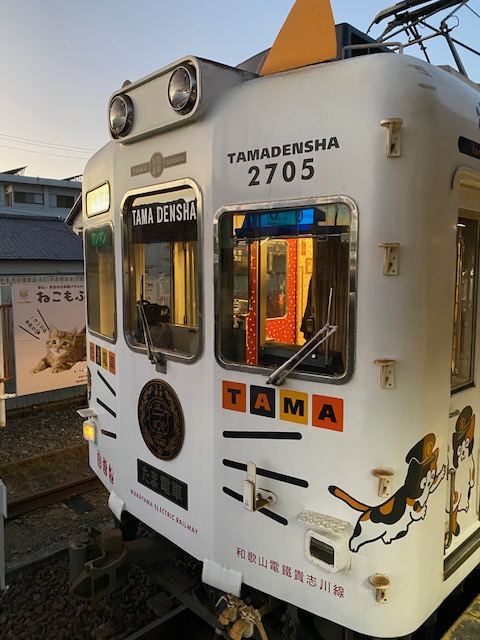
During the thirty-minute ride, the train swayed on the tracks, past rice paddies, and orange orchards.

“Maybe in the future they will make it easier for people in wheelchairs to visit,” I said.

Lilia frowned and made the sign for money. Yes, it might cost a lot to add an elevator in the station, but was it really too much to ask?

At the end of our journey, which was also the end of the line, a young man wearing white gloves laid out the ramp. Again, we conferred about what time we would go back. He gave me a paper schedule, folded into the size of a credit card, and showed me the phone number at the bottom.

“If you change your mind about what time you want to go back, just call this number,” he said.

“Thank you.” I looked around. We were indeed in the middle of nowhere. Yes, there were many houses, but I could already tell that the station itself was quite small, and, as the attendants in Wakayama had said, there weren’t any shops and restaurants around. But there were quite a few people, many from abroad. I saw a young woman in a pink hijab, and a group of Chinese tourists.

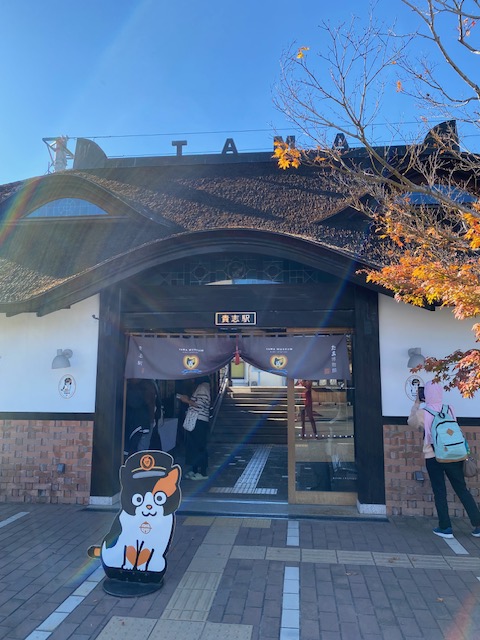
We paused before the shrine to the original cat station master, Tama, on the platform, then went down a ramp, and to the front of the station. By now, we were hungry. But first, the cat.

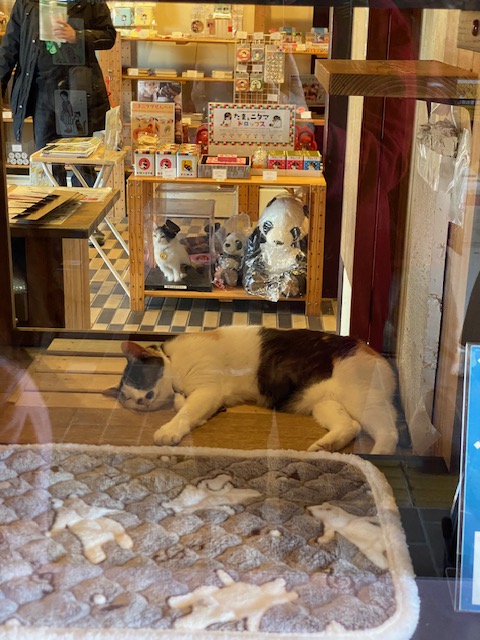
On this day, Yontama, a calico like her predecessor, was in a little room behind glass at the side of the station. She was napping on the wooden floor, next to a soft, plush mat. Many people were taking photos of her, but no one was bothering her. She wasn’t wearing the hat or suit of a stationmaster or doing anything special. She looked – and I say this with love – like an ordinary cat.

To the left of the window stood a fortune dispenser. Lilia dropped a hundred-yen coin into the box and extracted a rolled-up piece of paper. She unfurled it and showed it to me: “Very happy!”

“Great!” I gestured to the café behind us. “Now let’s go eat.”
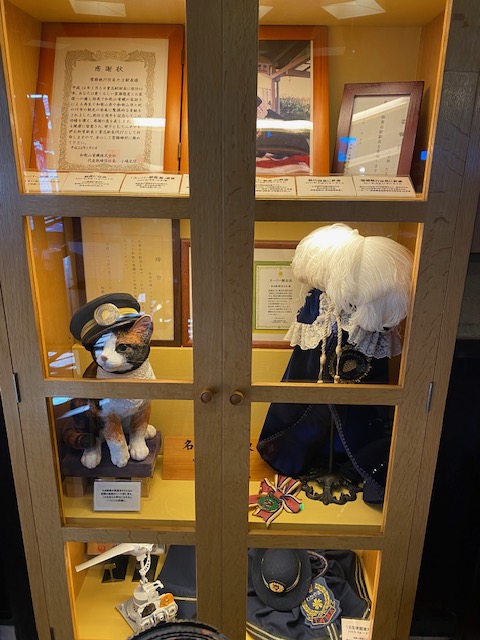
We entered the Tama Café, which also seemed to function as the museum. The original cat station master’s hat, decorated with a strawberry emblem, a lace-trimmed blue velvet cloak worn by Tama, and various framed documents were displayed in a glass-fronted cabinet.

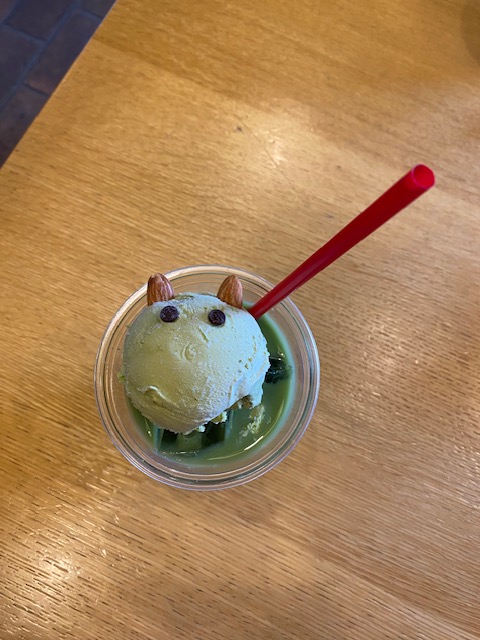
I ordered two Hot Cat Sets for us — fish sausages on hot dog buns, strawberry sodas, and cookie wafers printed with Tama’s image. We topped that off with green tea floats, with a scoop of green tea ice cream with almond ears and chocolate chip eyes.

After we had finished our meal, we visited the gift shop next door. From there, we could see Yontama from a different angle. She was awake but still lolling about. I bought little Yontama towels, which are always used in Japan for blotting your hands dry after washing them in public places. Then I paid for a fortune of my own. “Very happy,” it said. I wondered if all of the fortunes in the box were exactly the same.

Across the street was a tourist information center. Despite the JR employees’ skepticism, the people of Kinokawa City had taken the time to consider ways to occupy and engage the many visitors who would come to see the cats. Brochures in many languages were arranged in a rack. I plucked a few and discovered that a beautiful park dating back to the medieval period was within walking distance. The region also produced a lot of fruit, such as strawberries, figs, and oranges.

“Shall we go for a walk?” I asked Lilia.

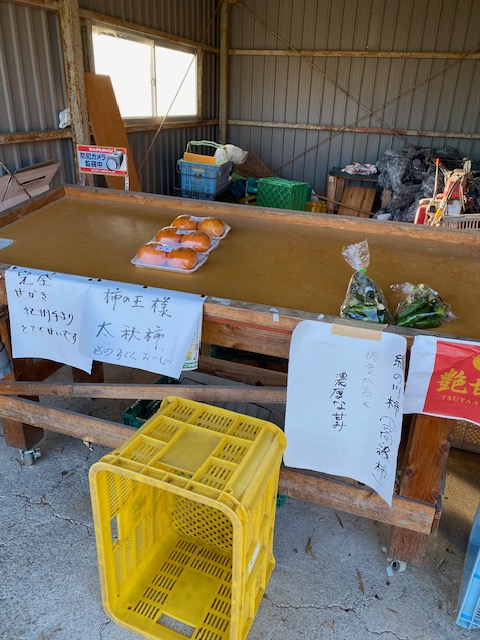
She nodded. Using a map app on my phone, we set out for Hiraike Park Land. Part of the walk was uphill. Although Lilia’s wheelchair was electric-assisted, she still had to turn the wheels. Her arms started to get tired, so I helped her out for some of the way. We passed fields of cabbages, rice paddies, and groves of lemons, oranges, and figs. Unattended farm stands offered clear plastic bags of freshly picked persimmons and citrus fruits at bargain prices, much cheaper that those sold at the supermarket back home.
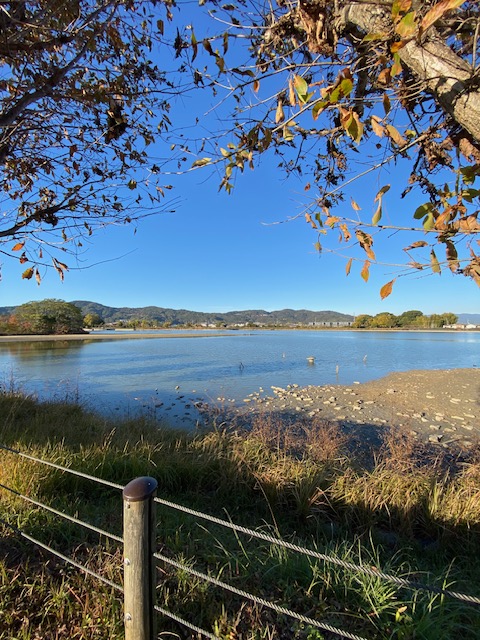
We finally arrived at the park. We stopped to observe the ducks and herons, the placid blue pond. According to the map, some ancient burial mounds, made distinctive by their key-holed shape, were nearby. I thought that we might be in danger of exhausting the wheelchair’s battery, however, so we didn’t go in search of them.

On the way back to the station, I stopped at one of the farm stands, put a couple of coins in the money box, and bought a bag of oranges. I would take it back as a souvenir for my husband and me to enjoy.

At one point, Lilia stopped, threw back her head and looked at the sky. “Ao,” she said in Japanese, drawing her fingers across her cheek in the sign for “blue.” She signed that there were no clouds. Indeed, it was a perfect autumn day.

When we were almost to the station, Lilia spotted a general store. She wanted to go inside, so we did. The lone woman behind the counter did not greet us, as is customary in Japan. I wondered if she was put off at the sight of a couple of foreigners. Of course, my daughter is half-Japanese, and has spent her entire life in Japan, but when she is with me, people assume that she is from abroad.
At the front of the store, school uniforms were displayed on mannequins Further inside, various goods were haphazardly arranged – a rack of flannel shirts, a shelf of liquor bottles, snacks for kids dropping in after school. It looked like the aftermath of a rummage sale. When Lilia started down a narrow aisle in her wheelchair, the woman drew in her breath. I could sense her fretting behind us, but she didn’t say anything. What must it be like for these country people to deal with the many foreigners traipsing through their small town? I was reminded of how people in Tokushima, where I live now, used to literally tremble when they saw my foreign face and thought that they might have to speak English.

Lilia decided to buy a packet of shrimp chips. The woman took her money, thanked her, and we got out of her hair.

Back at the station, we returned to the gift shop. Although Yontama was on the clock until four, and it was past four thirty, she was still relaxing in her little room. She probably didn’t mind. No one was tapping on the glass or otherwise harassing her. She had a good view of tourists buying cat themed T-shirts, cookies, and keychains. Lilia bought an ema, a small wooden plaque on which she would write a wish, and appeal to the cat deity, Tama Daimyojin.

We went onto the platform, and I tied Lilia’s ema onto a wooden board, along with wooden plaques inscribed by people from all over the world: “Wishing happiness and peace to animals all around the world.” “May all the strays and rescues get a good and loving home.” “May Pomelo, Walnut, and I live a long healthy life together.”

Dusk was already falling. The platform began to fill with other visitors, who apparently had the same desire to ride the Tama Train as we did. A young Chinese woman with flowing bleached-blonde hair in Lolita-meets-Little-Bo-Peep fashion – bonnet, and a tiered plaid dress with frills, eyelet, and ribbons — posed while her friends took photos. I wanted to take her picture, too, and post it on my Instagram account. She probably wouldn’t have minded, because she seemed to be some kind of influencer, but my daughter frowned and shook her head when I indicated my intentions.

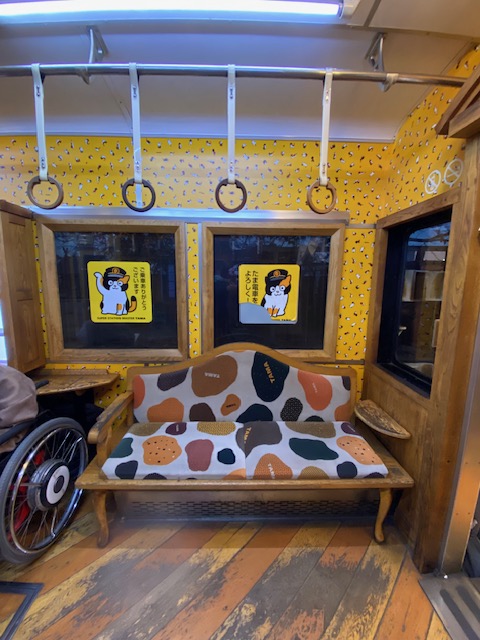
As the train finally approached, everyone tried to get the best spot on the platform for the best shot. The front of the train was painted with a cat’s face. The windows served as eyes, and just below were a nose and whiskers. Cat’s ears were affixed to the top of the car. Pawprints and a cartoon version of Tama in various poses illustrated the sides. Inside, passengers could sit on colorful Tama-themed sofas.

Our friend from earlier showed up with a ramp, and helped us get onto the car with a space for wheelchair users. Lilia was delighted to find a bookshelf stocked with cat-related manga in the car. I handed her a stack of them to read over the duration of the train ride.

Although many of those onboard were obviously tourists, like the young Chinese women continuing their photo shoot, I realised that this train was also used by the residents of the towns on the Kitagawa Line. Observing a man in a business suit who appeared to be among them, I wondered what it was like for him to share his commute with eccentric travelers. I suppose it would be entertaining. At any rate, I couldn’t help but be impressed by this small town’s ability to create a new identity for itself and capitalize on it.

We returned to Wakayama Station tired but satisfied at having completed our mission. When I reached home, my cats were there to meet me, yowling and needy.

.

Suzanne Kamata was born and raised in Grand Haven, Michigan. She now lives in Japan with her husband and two children. Her short stories, essays, articles and book reviews have appeared in over 100 publications. Her work has been nominated for the Pushcart Prize five times, and received a Special Mention in 2006. She is also a two-time winner of the All Nippon Airways/Wingspan Fiction Contest, winner of the Paris Book Festival, and winner of a SCBWI Magazine Merit Award.

PLEASE NOTE: ARTICLES CAN ONLY BE REPRODUCED IN OTHER SITES WITH DUE ACKNOWLEDGEMENT TO BORDERLESS JOURNAL

Click here to access the Borderless anthology, Monalisa No Longer Smiles

Click here to access Monalisa No Longer Smiles on Amazon International

Categories
Notes from Japan

Return to Naoshima

Narratives and photographs by Suzanne Kamata

Several years ago, I published a short book, A Girls’ Guide to the Islands (Gemma Open Door, 2017) about traveling amongst the islands of Japan’s Inland Sea with my daughter, who is deaf and uses a wheelchair. One of the islands that we visited was Naoshima, the site of several art museums, including the Chichu Art Museum, which houses five paintings from Claude Monet’s Water Lilies series. In addition to writing about our responses to the various artworks, I touched upon the difficulties and differences in traveling with a wheelchair user. For one thing, the ferry which conveyed us from Takamatsu City to the island, did not have an elevator to the upper decks. While others got out of their vehicles to take in the scenery from above decks, my daughter and I spent the crossing in my car.

Shortly after this trip, I received a grant from the Sustainable Arts Foundation for a longer book about traveling with my daughter, which became the award-winning Squeaky Wheels: Travels with My Daughter by Train, Plane, Metro, Tuk-tuk, and Wheelchair (Wyatt-Mackenzie Publishing, 2019). A slightly different variation of our trip to Naoshima appears in that book.

Although I loved our time on the island, and had not yet visited all the museums and installations, I had not been back since that trip with my daughter. I finally had a chance to revisit last month when I learned that the couple who had administered the grant that had made my book possible would be visiting Naoshima. I arranged to meet with them on my way back from Kyoto, where I was going to attend a book launch. Unfortunately, I wouldn’t be going with my daughter this time. She is now an adult living in Osaka, and it takes a bit of effort to coordinate our schedules. Nevertheless, I figured I could scout out the situation before planning our next mother-daughter adventure.

Although on previous visits, I had taken a ferry from Takamatsu, on the island of Shikoku, this time I took the shinkansen, Japan’s high speed bullet train, from Kyoto to Okayama, where I spent the night in a hotel. The next morning, I easily found the stop for the bus bound for the ferry terminal. Almost everyone in the queue was foreign. As far as I could tell, most of them were from Europe.

No doubt some had timed their visit with the Setouchi Trienalle, an art festival which takes place mainly in the ports and amongst eleven islands every three years. Japan, in general, has seen a huge surge in tourism over recent years due to the weak yen and governmental efforts to promote inbound tourism. While this has been good for Japan’s economy, it has driven prices up for local residents. It also means that public transportation is often crowded.

When we arrived at the ferry terminal, I purchased my ticket and joined the tail end of a very long line. Luckily, I was able to board the ferry and find a seat. I was pleasantly surprised to find the ferry had been upgraded since my last visit. Not only was it appointed with plush seats facing the water, but also there was now an elevator!

About twenty minutes later, we arrived at Minoura Port. Armies of English-speaking guides were readily available. I quickly found my way to the bus stop and onto the bus that would take me to the recently opened Naoshima New Museum of Art. I had just enough time before meeting my benefactors to check it out and have lunch.

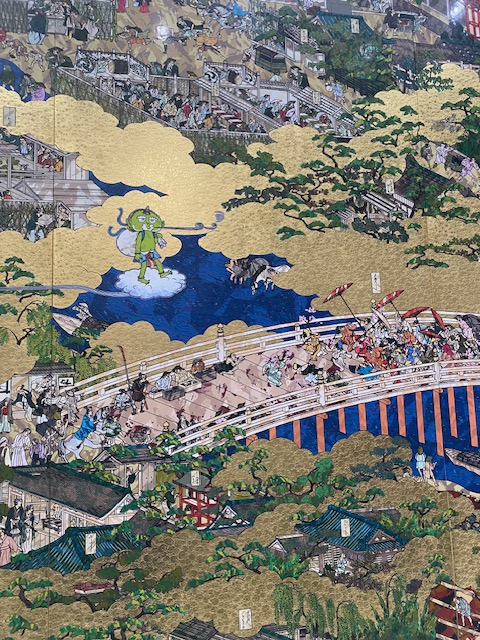
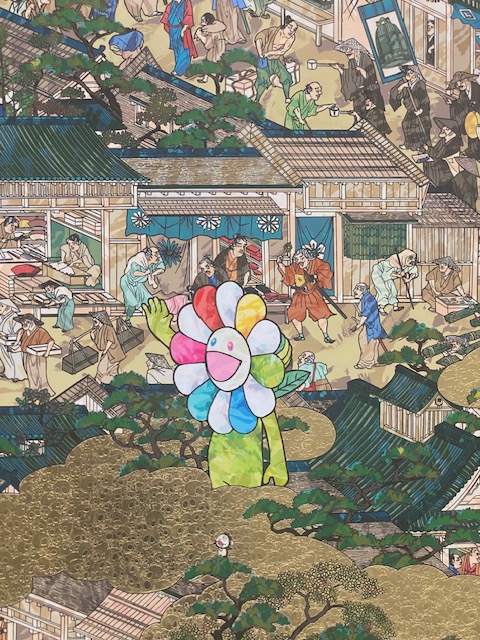
The inaugural exhibition featured the work of twelve artists and groups, including Takashi Murakami, who has achieved worldwide fame. His cartoonish characters appear on coveted Louis Vuitton bags. He also designed a special shirt, printed with cherry blossoms, for fans of the Los Angeles Dodgers. His work on display, a 13-meter-wide painting, is modeled after a 17th century folding screen titled Scenes In and Around Kyoto by Iwasa Matabei. Murakami’s rendition portrays scenes of everyday life in early modern Kyoto. But look closely, and you will find some of his iconic original characters!

Another impressive exhibit, Head On, by Cai Guo-Qiang, features lifelike wolves running toward and colliding with a glass wall. According to the exhibit brochure, the wall “symbolizes the intangible yet deeply felt ideological and cultural divisions between people and communities.”

After going through the exhibits, and vowing to return with my daughter, I popped into the museum café for a quick lunch. The dining area was in open air, with a view of the sea and the islands beyond. I ordered pumpkin toast, perhaps Naoshima’s answer to America’s ubiquitous avocado toast, and a nod to the famous Yayoi Kusama pumpkin sculptures which grace the island.

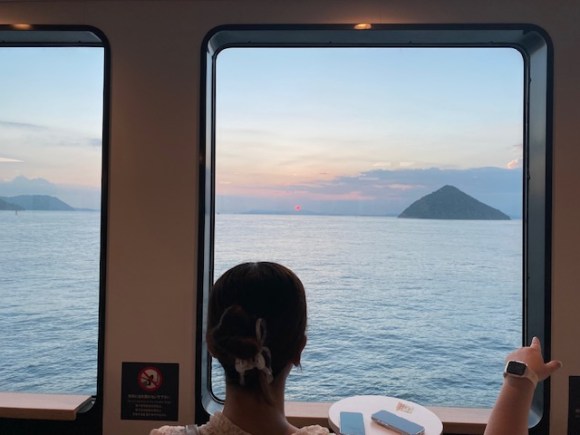
Finally, I took another bus and went to meet my friends. They are no longer awarding grants to parent artists, having shifted their focus to indigenous groups, however, I will remain forever grateful for their support. We met and had a drink near the Benesse House Park, just outside the Terrace, where my daughter and I had dined several years ago. Then it was time for me to head to the ferry terminal and back to Takamatsu, where I would catch a bus. I happened to cross at sunset – a final blast of beauty before returning home.

Suzanne Kamata was born and raised in Grand Haven, Michigan. She now lives in Japan with her husband and two children. Her short stories, essays, articles and book reviews have appeared in over 100 publications. Her work has been nominated for the Pushcart Prize five times, and received a Special Mention in 2006. She is also a two-time winner of the All Nippon Airways/Wingspan Fiction Contest, winner of the Paris Book Festival, and winner of a SCBWI Magazine Merit Award.

PLEASE NOTE: ARTICLES CAN ONLY BE REPRODUCED IN OTHER SITES WITH DUE ACKNOWLEDGEMENT TO BORDERLESS JOURNAL

Click here to access the Borderless anthology, Monalisa No Longer Smiles

Click here to access Monalisa No Longer Smiles on Amazon International

Categories
Notes from Japan

DIY Dining in Japan

By Suzanne Kamata

“Do you want to go out to eat?” my Japanese husband asks.

“Sure,” I say. After all, I’m feeling tired from a long day at work. It’ll be nice to relax while someone other than me deals with meal preparation.

We get into the car. “So what kind of restaurant shall we go to?”

I put in a vote for a nearby Indian restaurant. Or the pork cutlet place. Or the Taiwanese restaurant, or even Sushiro, where small plates are delivered by conveyor belt. But my husband wants to go to Yaki-Niku King, an all-you-can-eat grilled meat restaurant, where you have to eat a lot to get your money’s worth, and you have to cook the food yourself.

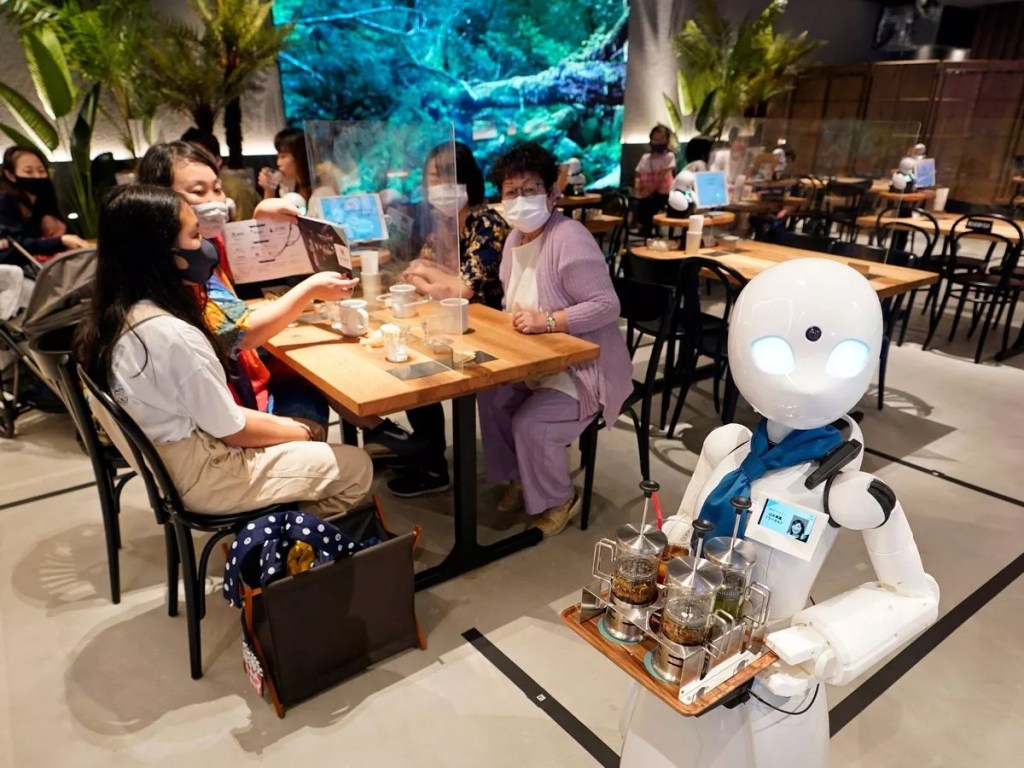
When we arrive at the restaurant, we are ushered to a grill and the server cranks up the heat. My husband grabs the tablet and orders the first round of meat. A few minutes later, a robot delivers a plate of raw cow tongues. I sigh, take up my chopsticks, and lay them on the grill.

During my North American childhood, family dinners out were a treat, especially for my mother. If we were eating in a restaurant, she – and the rest of us – didn’t have to cook or clean up. Back in the kitchen, professionals prepared our meals, another person brought them to us, and we left without tidying up after ourselves. Forgive me for my entitlement, but that was the busboy’s job.

Dining out in Japan is a slightly different experience. As the primary cook in our family, I was always slightly dismayed when, on the rare occasions we ate out, my family chose DIY dining. Although I enjoy dishes such as okonomiyaki and shabu shabu – the savory pancakes filled with vegetables, meat, and cheese, and the thinly sliced beef dipped into boiling broth – we could not sit back and bask in the attentions of the wait staff. We had to cook the meal ourselves.

For my husband and kids, who didn’t spend a lot of time in the kitchen, this might have been fun. I’m sure it was also educational. Now that our kids live on their own, they can cook for themselves.

From a culinary perspective, preparing our food as we ate insured that our meal hadn’t been microwaved or sitting under a heat lamp for ten minutes. Everything was freshly prepared. The first time I went to this kind of Japanese restaurant, I, too, thought it was fun, but sometimes I don’t want to worry about whether or not my food is sufficiently fried – or overcooked.

Nevertheless, as the robot brings us plate after plate of meat, I duly add it to the grill. At one point, my husband accidentally cranks up the heat too much, and flames shoot up at the center of the table. Nevertheless, not wanting to waste, we divvy up the charred morsels and dig in. When our stomachs are full, we stack plate upon plate, arrange the glasses neatly, and wipe the table, just as I now do even after eating out in America.

Suzanne Kamata was born and raised in Grand Haven, Michigan. She now lives in Japan with her husband and two children. Her short stories, essays, articles and book reviews have appeared in over 100 publications. Her work has been nominated for the Pushcart Prize five times, and received a Special Mention in 2006. She is also a two-time winner of the All Nippon Airways/Wingspan Fiction Contest, winner of the Paris Book Festival, and winner of a SCBWI Magazine Merit Award.

PLEASE NOTE: ARTICLES CAN ONLY BE REPRODUCED IN OTHER SITES WITH DUE ACKNOWLEDGEMENT TO BORDERLESS JOURNAL

Click here to access the Borderless anthology, Monalisa No Longer Smiles

Click here to access Monalisa No Longer Smiles on Amazon International
Categories
Notes from Japan

Contending with a Complicated History

Photographs and narrative by Suzanne Kamata

I felt some trepidation as I prepared to enter the United States from Japan. It would be my first time to return to my native country since the new administration took office. Rumour had it that immigration officials would check my phone for leftist activity on social networks (they didn’t). I’d heard about books being banned, libraries and museums being closed, and the words “diversity,” “equity,” and “inclusion” being suddenly prohibited in government documents.

My parents, originally from Michigan, in the North, live in South Carolina. This is where the Civil War began in 1861 when state legislators voted to secede from the union. They wanted to preserve slavery and allow its expansion into western territories. South Carolina and six other Southern states formed what was called the Confederacy.

The Confederate flag, a symbol, for many, of an ugly past, was first flown from a flagpole in front of the capitol building in 1961, in commemoration of the hundredth anniversary of the Civil War. It remained flying in protest of the Civil Rights movement, and was only taken down in 2017, after a twenty-one-year-old white supremacist entered a historically black church in Charleston and opened fire on a prayer group. He killed nine people and injured one. Now the flag is on display in a special room at the State Museum.

My visit to South Carolina coincided with a visit from my son, a student of history with a keen interest in politics. My dad thought it might be fun to take his grandson to the Statehouse for a tour. My son was enthusiastic about this idea. I went along, too, with some reservations.

We drove into the city of Columbia and parked in a public lot at the back of the Statehouse. As we entered the grounds, we came upon a statue of Strom Thurmond. He was a teacher, a lawyer, and a highly decorated soldier. He served as governor of South Carolina from 1947-1951, and as senator for 47 years after that, right up until his death at the age of 100. Until very recently, he held the record for the longest filibuster, which is a tactic used to delay voting upon a contentious bill. Basically, a senator takes the floor and keeps talking for as long as he possibly can. In August of 1957, Strom Thurmond gave a speech lasting 24 hours and 18 minutes in opposition to a law promoting civil rights. After his death, it was revealed that he had fathered a child with his family’s 16-year-old African American maid. Of course, that is not inscribed on the plaque at the base of the statue.

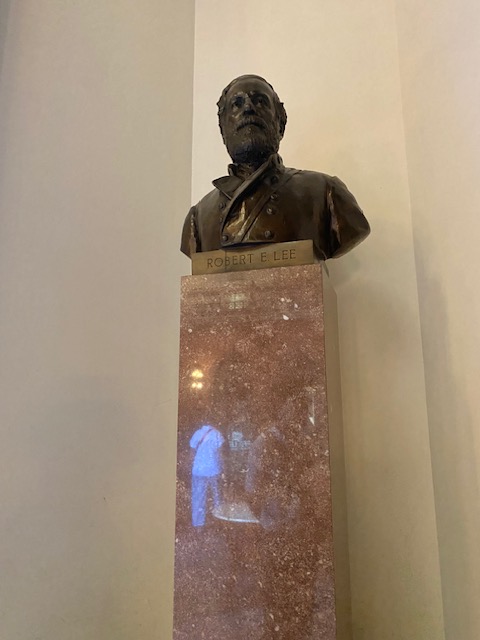
To be honest, I had expected to see this statue, as well as other monuments devoted to Confederate generals and segregationists. But I was pleasantly surprised to find a new monument commemorating the accomplishments of South Carolinian African Americans.

We went inside the building and were ushered to a room off to the side for a short film before the tour began. I noted that the film was narrated by a young African American man, which seemed like a nod to diversity, equity and inclusion. He mentioned, perhaps with false pride, that Strom Thurmond held the record for longest filibuster in the history of the United States. Nevertheless, I was glad to see that the film highlighted the achievements of women and minorities, such as South Carolina’s first – and so far, only – female governor, Nikki Haley, the one who ordered that the Confederate flag be removed from state grounds.

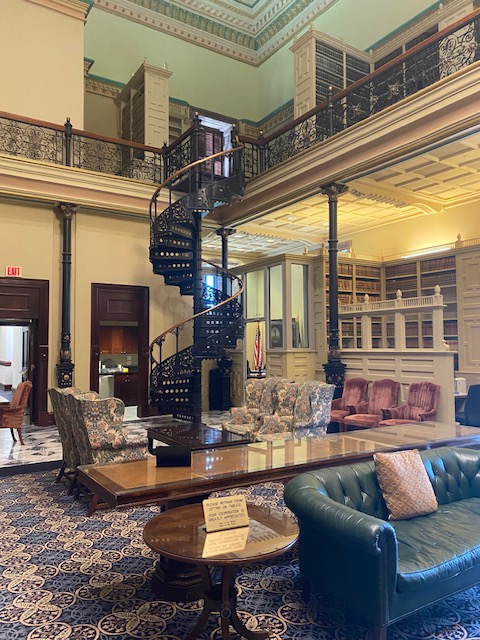
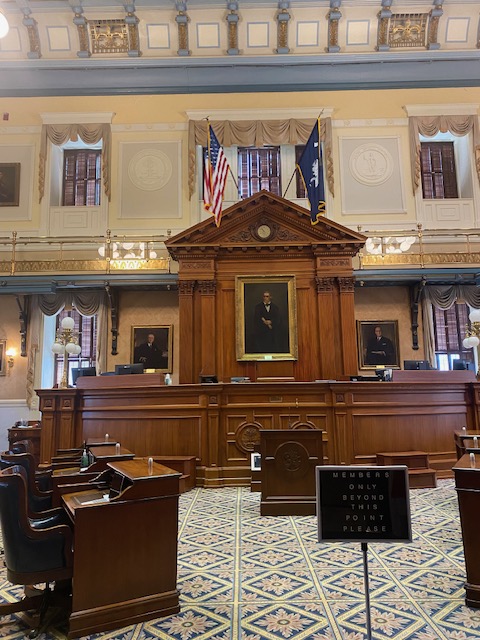
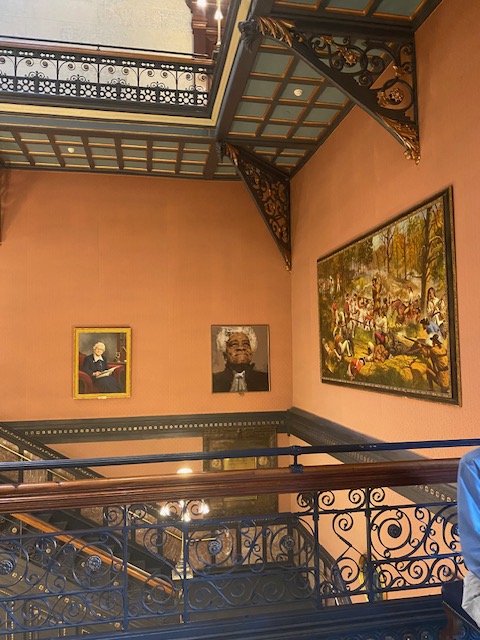
During the rest of the tour, I breathed a bit easier, admiring the intricate ironwork on the stair railings, and the stained glass above the chambers. I enjoyed hearing that Magdalen Feline, a woman goldsmith had crafted the symbolic mace, which is placed in a rack at the front of the Speaker’s podium when the House of Representatives is in session. And I was pleased to see a portrait of African American educator, philanthropist, and civil rights activist Mary McLeod Bethune (1875-1955) prominently displayed.

South Carolina is a complicated state, and this is an increasingly complicated world. However, going on this tour gave me hope that my fellow Americans might get back to celebrating diversity, equity, and inclusion, and all of the best parts of human nature.

Suzanne Kamata was born and raised in Grand Haven, Michigan. She now lives in Japan with her husband and two children. Her short stories, essays, articles and book reviews have appeared in over 100 publications. Her work has been nominated for the Pushcart Prize five times, and received a Special Mention in 2006. She is also a two-time winner of the All Nippon Airways/Wingspan Fiction Contest, winner of the Paris Book Festival, and winner of a SCBWI Magazine Merit Award.

PLEASE NOTE: ARTICLES CAN ONLY BE REPRODUCED IN OTHER SITES WITH DUE ACKNOWLEDGEMENT TO BORDERLESS JOURNAL

Click here to access the Borderless anthology, Monalisa No Longer Smiles

Click here to access Monalisa No Longer Smiles on Amazon International
Categories
Poetry

Speaking in Palindromes

By Dustin P Brown

The wind is an old friend.
We meet on Wednesday afternoons
to catch up over a coffee.

Some days she’s late, held up
by work in the Gulf Coast
or Ireland, somewhere more interesting
than the corn-plained fields of southern Michigan.

I never mind
because her stories about
broken quartz shattered
into a thousand stars
against limestone cliffs
remind me that even
destruction can be beautiful.

This week, I tell her
over the hushed babble of
other café-goers
about my cat’s death.
She promises to scatter its ashes
over ancient pine forests in the
upper peninsula. She pays

for my coffee. She offers two
kisses on each cheek
and a sincere ciao before
returning to the world. It’d be nice

to be able to do the same.


Dustin P Brown is a US-born, Spain-based author of poetry, prose, and the occasional drama. His work has appeared in other journals like Lit Shark and Bacopa Literary Review

.

PLEASE NOTE: ARTICLES CAN ONLY BE REPRODUCED IN OTHER SITES WITH DUE ACKNOWLEDGEMENT TO BORDERLESS JOURNAL

Click here to access the Borderless anthology, Monalisa No Longer Smiles

Click here to access Monalisa No Longer Smiles on Amazon International

Categories
Notes from Japan

American Wife

Suzanne Kamata shares a story from 1999, set during Obon or the Festival of Bon, a Japanese Buddhist custom that honors the spirits of one’s ancestors.

My husband is dancing.

The name of the dance is “Awa Odori,” “Awa” being the ancient name for Tokushima, where we live now, and “odori” being Japanese for “dance.” Its origins are unclear. Some say fertility rites, others claim it is a celebration of a good harvest.

My husband is thinking about none of these things as he dances with his friends of fifteen years. No doubt he is drunk on beer and fellow feeling, absorbed in the revelry of this annual festival.

I am at home alone in our apartment.

I could have gone, too, but I declined by way of protest. I’m demonstrating because while I am welcome to, indeed expected to, celebrate Japanese holidays, my own country’s holidays go ignored. When I’d wanted to do something special a month ago in observance of the Fourth of July, Jun had refused. “This is Japan,” he’d said, as if that would explain everything.

When I married Jun, I’d had a concept of international marriage as the combining of two cultures, not the elimination of one. True, I’d expected compromises, but on both sides, not just mine.

This time, however, I’m not giving in. I’m not going to budge. I didn’t go with him to visit his ancestors’ graves, and I am not going to don a cotton yukata[1] and dance in the streets to flute and drum. If he won’t see me halfway on Thanksgiving, Christmas, and Independence Day, then I’ll just sit this one out.

.

During Obon, the whole family usually gathers at some point. I’ll admit that I did go along with Jun to his parents’ house where his sister Yukiko and her family, his aunts and uncles and cousins, and his grandmother were assembled.

Uncle Takahiro said, “Hello. How are you?” in English, and everyone laughed as if he’d just told a joke.

I answered politely in Japanese, then my husband’s sister pushed her three-year-old toward me. “Go ahead. Say it, Mari-chan,” she said, beaming with motherly pride.

Dutifully, Mari recited the litany of English words that she had learned since I last saw her: “Horse. Cow. Pig.”

Yukiko looked to me expectantly, and I indulged her with words of praise for her daughter.

I can see it now. Yukiko will be the worst kind of “education mama,” as they call mothers who obsess over their children’s school performances.

“They’re teaching English at Mari-chan’s nursery school now,” Yukiko told me. “A foreigner comes once a week.”

Then, unbidden, Mari launched into a song. It was “Eensy Weensy Spider,” complete with gestures. Though she garbled some of the words, she earned a hearty round of applause from the adults.

.

Even after all this time, Jun’s relatives still don’t know how to talk to me. I make them uncomfortable, and sometimes I feel that I should apologise for being there, or better yet, just disappear. They have never tried to talk to me about everyday things like popular TV shows, bargain sales at Sogo, the big department store in town, or new recipes. When conversation is flagging, someone usually says to me, “Don’t you miss your home? Isn’t it hard being so far away?”

“It’ll be different after you have children,” my friend Maki said. “They’ll accept you then.”

Maybe so, but it looks like children are a long way off for Jun and me. Although we have been married for seven years, we have no kids. Mari was born just nine months after Yukiko and her husband were married. Their second baby – a boy – came along a year later.

We want children. We have even tried. I know that there’s nothing wrong with my body because I’ve been to specialists all over town, but Jun doesn’t seem interested in getting checked himself.

His mother would never believe there was a problem with her son. I’ve heard her whispering with Jun’s grandmother. “It’s because she’s American.”

Jun’s grandmother, who doesn’t know any better, nodded her head and said, “Ahh, yes. I’ve heard that gaijin don’t keep the baby in the womb as long as we Japanese do. Gaijin and Japanese can’t make babies together.”

And Jun’s mother, who should know better, nodded her head and said, “Yes, yes. You may be right.”

My mother-in-law also tells Jun’s grandmother that I’m a lazy wife. She tells the story in a whisper loud enough for me to hear that sometimes when she drops by our apartment, Jun is loading the clothes into the washing machine! Another time, he was standing at the stove with an apron on, cooking dinner!

“He should have married a Japanese woman,” Jun’s grandmother says. “A Japanese woman would take care of him.”

.

Jun and I sleep together in the same bed. His sister sleeps apart from her husband, in another room entirely, with her two children. His parents sleep in the same room, but one of them sleeps in a bed, the other in a futon spread on the floor.

Just before we got married, we bought furniture for our apartment. At that time, Jun suggested getting separate beds. He said that it was practical. With two beds, there would be no tussling over sheets, no accidental kicking in the night. I cried because whenever I had thought about marriage, I’d had an image of us sleeping in each other’s arms, breathing in unison.

Finally, we got one bed, a “wide double” that we cover with a double wedding ring quilt. It’s true that sometimes one of us winds up wrapped in all the sheets while the other one nearly freezes, and sometimes I find myself pinned into an uncomfortable position by Jun’s heavy limbs, but I don’t care. For me, one of the great joys of this life is waking up close to him, close enough to kiss him and run my hand over his bare chest.

.

Jun likes carpet and sofas and colonial style houses. I have always admired the simplicity of tatami mats and just a few cushions to sit on, rooms enclosed by sliding paper doors. My ideal room is an empty one, totally void of any unnecessary object. From studying home decorating magazines while in the US, I’d come to believe that in Japan this minimalism was typical. When I got here, I found that that wasn’t true at all. Tiny spaces were crammed with every imaginable appliance, Western furniture, and tacky knickknacks from other people’s vacations.

Jun likes to live in the Western mode. Like most people of his generation, he rejects tradition, or says he does. He sometimes rejects Japan, but he will never leave this place.

He watches CNN via satellite, eats popcorn and s’mores and coleslaw. He sleeps in a bed and sits on a sofa and he’s married to me, an American.

Sometimes, when he’s tired or angry, he forgets that this is an international marriage. He says, “Why can’t you be more Japanese?”

I look at myself in the mirror and see what others see: my blonde hair, blue eyes, and white skin. I can’t help but laugh. “Because I’m not Japanese,” I say. Even if I changed my citizenship, changed my name, and acted exactly like a Japanese woman, people would still look at me and say “foreigner.” Even if I dyed my hair black, got a tan, wore contact lenses, and had plastic surgery, they would still be able to tell the difference.

At times like these, I look at Jun and say, “If you wanted a Japanese wife, then why did you marry me?”

And he always replies in the same way. “Because I love you.”

.

My friends Maki didn’t marry for love. She chose her husband in the same way that I chose a college, poring over applications and photos. She invited me to help her pick one out. I was puzzled by this process. I watched the reject pile become higher and higher and I felt sorry for all those men whom Maki didn’t want to meet.

“This one’s too short,” she said, tossing an application aside.

The next one she picked up went into the “no” stack as well. “He’s handsome, but I don’t want to marry a farmer. Farmers’ wives have to work in the field all the time.” She wrinkled her nose and studied her manicured fingernails. Her hand had never known hard work.

The few who went into the other pile had good jobs with decent salaries, respectable families, and compatible hobbies.

At first, I imagined that all of those men were clamouring to marry Maki, but then she told me she’d never met any of them. The profiles had been passed along by a matchmaker. Those men were probably going through pictures of women, too, picking and choosing, making little stacks.

I thought about all the things that had made me fall in love with Jun – things that you can’t tell from a photo or a piece of paper, like the sound of his voice and the sweet strawberry taste of his mouth. I asked her if any of that mattered.

“You fall in love after you get married,” Maki said. “You Americans think that life is like a fairy tale, and then you get a divorce when you find out you were wrong.”

Maki has been married for two years and has one child. She is still waiting to fall in love with her salaryman husband. She doesn’t complain, though. He works for a good company, and she can stay home with their baby or go shopping whenever she feels like it. Sometimes she whispers to me about the possibility of having an affair with an American man.

I have known Maki for four years. When I met her, she was working for a travel agency and struggling to master English. I gave her private lessons which eventually metamorphosed into coffee klatches and late nights in discos. She is sometimes irreverent and wild and I can’t help but like her.

I can hear the chang-cha-chang-cha-chang of the festival music, a rhythm that never ceases or alters during the dance. I can picture the scene in my mind. The women are in yukata with hats that look like straw paper-plate holders folded over their heads. They wear white socks with the big toe separate, and geta, those wooden sandals. The men don’t wear any kind of shoes, just the tabi – the white socks, that will become soiled from the streets. They wear white shorts and the happi coats that brush over their hips. They tie bands of cloth called hachimaki around their foreheads.

The women dance upright, their hands grasping at the air above their heads as if they are picking invisible fruit. With each step, they bend a knee and touch a toe to the pavement, the thong driving between the toes and causing pain.

The men’s dance is freer and sometimes women deflect and join them. They dance bent over, arms and legs flailing. Their movements become wilder as the evening wears on. The dancers become more drunk, the music continues as before. Chang-cha-chang-cha-chang.

.

When I was a kid, we used to have big family picnics on the Fourth of July. My uncles and father and older male cousins played horseshoes, then later everyone would join in a game of volleyball. There was always too much food, and after gorging on fried chicken, potato salad, chocolate cake, and watermelon, we would hold our bulging bellies in agony. Then some of the adults would lie down and take naps while my cousins and I poked around in the creek, catching frogs and other slimy creatures.

As soon as dusk fell, and sometimes before, we would light sparklers under the close supervision of an adult. We waved them in the air, describing circles with crackling sparks, our faces full of glee.

Later, we’d all climb into my uncle’s station wagon and drive to the riverside to watch the real fireworks. Before the display began, the American flag was raised in a glaring spotlight and “The Star Spangled Banner” blasted out of loudspeakers. We all sang along, impatient for the show to begin. It always started out with small single-coloured bursts, like chrysanthemums or weeping willows in the sky. Then the fireworks got bigger, turning to rainbow blossoms worthy of our wonder. The adults oohed and ahhed and we said, “Wow! Look that that!” The very last was red, white and blue, and image of the flag we’d sung to earlier. Its shape hung in the sky for just a moment before falling like fairy raindrops.

During Obon, there are fireworks, too, but when I see them it’s not the same. I feel a tightening in my chest and the tears well up behind my eyes.

I go to a store nearby, one of the few businesses open during the holidays. The woman at the cash register greets me and smiles when I walk in the door. I wonder if she’d rather be dancing, and if she has been left behind while her husband parades in the streets.

.

I pick up a set of sparklers which are on sale and put them in a basket. I add a cellophane-wrapped wedge of watermelon. This one-piece costs more than the huge oval melons you can buy roadside where I come from. Into the basket also goes a package of frozen microwavable fried chicken and canned potato salad.

I pay for everything and go back to the apartment to prepare my feast. Night has already fallen. By the light of the overhanging kitchen lamp, I eat my chicken and potato salad. It’s the best meal I’ve had in a long time.

Later, when the dishes are done and drying on the rack, I take the package of sparklers and a box of matches onto the balcony. I light them one by one and watch them burn brightly in the darkness. I draw figure eights in the night air, write my name, etch zigzags of light.

When I’m finished, I lean over the railing and start to sing. I belt out “The Star Spangled Banner,” “America, the Beautiful,” and “I’m a Yankee Doodle Dandy.” My voice is so loud that a dog starts to howl.

I feel better. I go back into the apartment and push the kitchen table to one side. With my back straight and my elbows bent, I reach up as if I am about to pick an apple from a tree. There is a smile on my face as I start to dance. Chang-cha-chang-cha-chang.

Dance for Obon Festival by
Takahashi Hiroaki (Japan, 1871-1945). From Public Domain

[1] A casual, unlined cotton kimono

Suzanne Kamata was born and raised in Grand Haven, Michigan. She now lives in Japan with her husband and two children. Her short stories, essays, articles and book reviews have appeared in over 100 publications. Her work has been nominated for the Pushcart Prize five times, and received a Special Mention in 2006. She is also a two-time winner of the All Nippon Airways/Wingspan Fiction Contest, winner of the Paris Book Festival, and winner of a SCBWI Magazine Merit Award.

PLEASE NOTE: ARTICLES CAN ONLY BE REPRODUCED IN OTHER SITES WITH DUE ACKNOWLEDGEMENT TO BORDERLESS JOURNAL

Click here to access the Borderless anthology, Monalisa No Longer Smiles

Click here to access Monalisa No Longer Smiles on Amazon International
Categories
Notes from Japan

Summer Vacation in Japan: Beetle Keeping and Idea Banks

By Suzanne Kamata

Growing up as an American, school vacations were a time of freedom. I could play or watch TV or do nothing as much as I wanted. In fact, my brother and I had so many idle hours, we sometimes got bored and looked forward to going back to school.

Here in Japan, the breaks between semesters are busy. My kids were sent home for the school holidays with reams of worksheets, charts for keeping track of toothbrushing and chores, and a calligraphy assignment. Sometimes they would have to take care of the class pet for a week or so.

When my daughter was in kindergarten, she volunteered to take care of the class stag beetle during the first few weeks of summer vacation. She was supposed to feed it and moisten the soil with water from time to time. I guess we were supposed to change the soil, but no one said anything about that, and I didn’t get around to buying any.

My daughter was quite enthusiastic for the first few days, remembering to feed it the smelly jelly even when I forgot. But then, it crawled out of the plastic box once and she was freaked out. She said she wanted to give it to her grandmother. Since then, she had fallen in love with the kindergarten’s hamsters and had decided that she wanted one of those. 

I’d been feeding the beetle and sprinkling water on the soil. Up until the last night, I heard it scrabbling around. But one morning, when I checked on it, the jelly was uneaten, and the beetle was belly up in the box. Nothing happened when I tapped the box. I was pretty sure it was dead.

My daughter was supposed to take it back to school the following day for the hand-off to her classmate. I figured they’d be having a beetle burial instead. But we went out for a while, and when we came back, the beetle had moved! Phew! I reached in and turned it over so it could burrow into the dirt. We never kept a beetle as a pet again.

In addition to pet care, there was also, typically, a craft assignment. For instance, every summer, as part of her elementary school homework, my daughter was required to make a bank. I wondered why she had to make the same thing, year after year? What were we supposed to do with all of those banks? Was some sort of lesson in money management embedded in the task? She was supposed to come up with an original design, and the result was entered in a contest. Of course, as the head teacher reminded us parents, the kids needed help.

At the beginning of summer, I would try to think of ideas. Maybe a papier mache rabbit? Or some kind of house constructed from all of the popsicle sticks we’d accumulated over the past couple of months? At the end of the vacation, with only a few days left to go, I would be casting about for something quick and easy that we hadn’t done before.

We’d stop by the bookstore to look for a craft book. At the beginning of school breaks, there were oodles of such books on display – books intended to give parents and kids inspiration for how to while the days away. Just before school started, they would be gone. In Japan, everything has its season.

My son went to a different school which had different requirements. The kids made banks only once, in first grade, many of them using ready-made kits. One summer, my son was supposed to paint a picture on the theme of “freedom.” I was thinking doves, or maybe of people of many colors holding hands, but he needs to come up with the idea on his own. I tried to help him out a bit. “What do you think of when you hear the word ‘freedom’?” I asked. My son said, “Getting out of jail.”

Now that my kids are out of school, my idea of freedom is not having to nag them to finish their homework, or fill out their charts, or feed the class beetle – or, especially, to come up with an idea for their summer crafts.

From Public Domain

Suzanne Kamata was born and raised in Grand Haven, Michigan. She now lives in Japan with her husband and two children. Her short stories, essays, articles and book reviews have appeared in over 100 publications. Her work has been nominated for the Pushcart Prize five times, and received a Special Mention in 2006. She is also a two-time winner of the All Nippon Airways/Wingspan Fiction Contest, winner of the Paris Book Festival, and winner of a SCBWI Magazine Merit Award.

PLEASE NOTE: ARTICLES CAN ONLY BE REPRODUCED IN OTHER SITES WITH DUE ACKNOWLEDGEMENT TO BORDERLESS JOURNAL

Click here to access the Borderless anthology, Monalisa No Longer Smiles

Click here to access Monalisa No Longer Smiles on Amazon International

Categories
Notes from Japan

Feeling Anxious in Happy Village

Narratives and photographs by Suzanne Kamata

A few weeks ago, my daughter invited me to go on an outing with her and her helper. My daughter, who is deaf and uses a wheelchair, lives in a group home in Osaka. She is becoming more and more independent, but she does have kind people around her to give her support, including a helper who is also deaf and uses Japanese Sign Language.

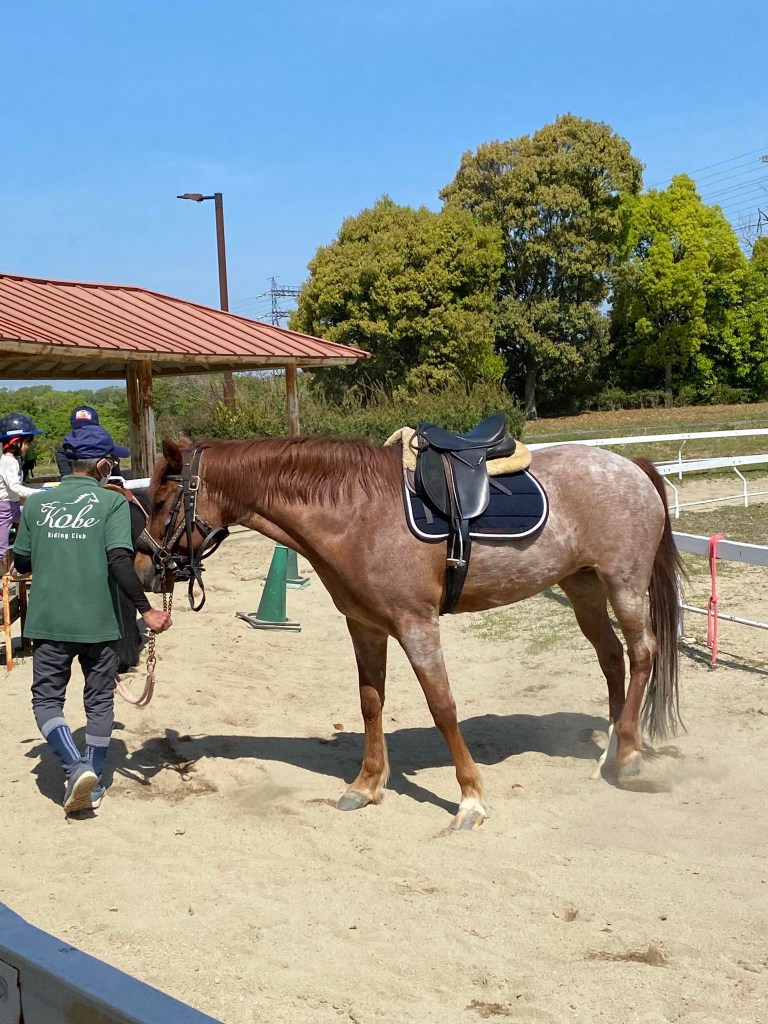
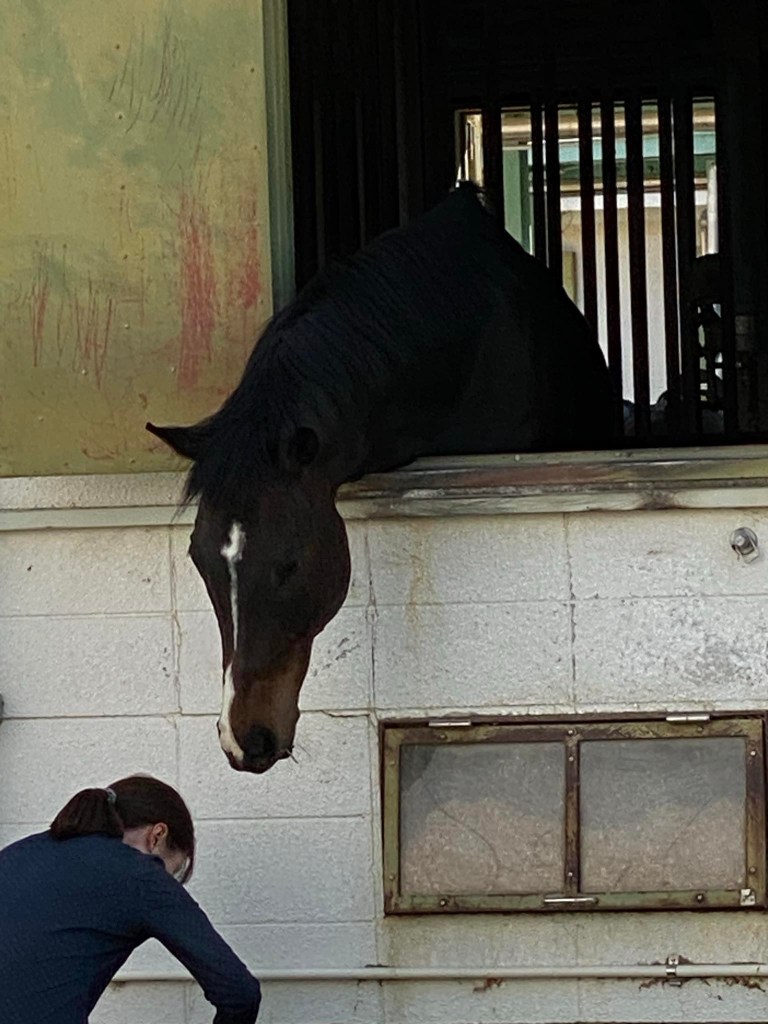
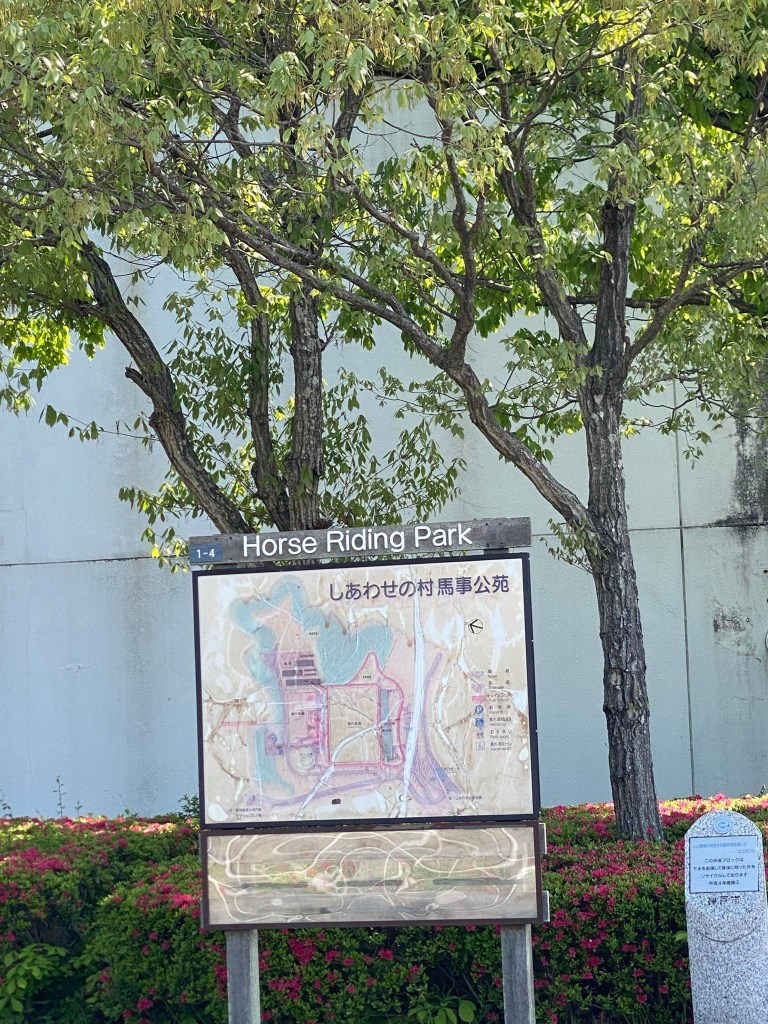
Actually, my daughter invited our entire family to accompany her and her helper on a weekend to Happy Village, a recreational facility in Kobe especially for persons with disabilities. We had visited the onsite stables years ago, and our twins had ridden around a ring on ponies. Having such pleasant memories of the place, I looked forward to visiting again.

My husband declined due to a golf tournament, and my son, who had just entered college as a graduate student, was concerned that he would have too much homework. My daughter informed me that her brother would meet us for a meal.

Although I was looking forward to seeing my daughter and getting to know her helper, I did have a few concerns. For one, I don’t have the confidence to drive in the megapolises of Japan. Kobe, for example, is a confusing city with many ramps, overpasses, and one-way streets, not to mention the traffic. I knew that Happy Village was on the outskirts, however, and I thought that maybe I could get myself there by car. I could have gone by bus or train, but it would have taken me two or three times as long to get there.

In addition, I was a bit worried about communication. I can converse with my daughter, more or less, in Japanese Sign Language, but my signing is not perfect. Since leaving home, my daughter’s vocabulary has expanded, and her signing has sped up. When among fluent JSL users, I can’t always follow the flurry of their fingers. Nevertheless, I know that my daughter often struggles to keep up with what hearing people are saying, and I thought it would be a valuable experience.

A couple days before, my daughter sent me a Google Maps link to the restaurant where we would meet. We would have a meal and then proceed to Happy Village. On the day of, I packed a bag, filled my car with gas, and set out. I had no idea what we would be doing. On trips with my husband, every hour was pre-planned. I thought it would be nice to just go with the flow. I was looking forward to seeing my two kids.

I managed to arrive at the restaurant with ten minutes to spare. I staked out a table and sat down to wait. While perusing my phone, I came across a link that I thought would interest my son. I sent it to him. He replied with a laughing emoji, followed by “Are you coming to Kobe tomorrow?”

A cold sweat broke out over me. “Tomorrow? I thought it was today.”

“She told me tomorrow,” he texted back.

“Oh, no.” I quickly scrolled through our communications and confirmed that we were indeed meeting him the following day. It was now ten minutes after the time I had agreed to rendezvous with my daughter at this restaurant. Or so I thought. Was I supposed to meet her tomorrow? Would I have to find a hotel for the night?

Panicking, I sent my daughter a text and a photo of the restaurant. “I’m here!”

She texted back that they would be a little late, and that there would be six of them.

Six! I had thought that there would only be the three of us. Now I was feeling really intimidated. I am an introvert, and I know my limits. The more people there are around me, the more I retreat into myself. Plus, there was the issue of communication.

Finally, my daughter and her entourage arrived. I met her helper, the helper’s husband, the helper’s twin sister, an older woman with cropped hair and rainbow socks, and a young man about my daughter’s age. We got down to the business of ordering food via the tablet on the table, and sorting our basic facts, such as my age, and that we would be meeting my son the following day at Sannomiya Station.

Sannomiya Station! That was in a busy district in the heart of Kobe. I hadn’t known that we were actually going into the city. I managed to sign that I was scared of driving in such an unfamiliar place. I was beginning to realise that I should have pried more details about this trip out of my daughter beforehand.

Three hours later, I followed the others in my car to Happy Village. My daughter and I were in one room, the others in their own rooms. By this time, my social battery was waning. I was ready to take a bath and curl up in bed with a book. My daughter, who is an extrovert, went down the hall for a couple more hours of JSL conversation and cake with her friends.

The next morning, we checked out of the hotel and stopped by the stables. Just as before, children rode ponies around the ring. My daughter zoomed around in her wheelchair, and the rest of us tried to keep up.

Next, we dropped by the helper’s apartment. I was invited to leave my car in the parking garage, and ride in the car with the others, for which I was very grateful. As we headed toward Kobe, I noted how quiet it was inside the car. No one tried to talk or sign. It would have been dangerous for the driver to take his hands off the wheel to form words, or to look away from the road for too long.

We finally connected with my son, and went to a restaurant. Because there were so many of us, we split up. My kids and I sat at one table, and the others sat at another. I brought my son up in English, and it remains our lingua franca. After my son and daughter exchanged a few words in sign language, my son and I talked a bit about the recent political situation in the United States. Although my daughter was curious, I couldn’t quite explain to her what we were talking about in JSL. I encouraged her to write notes to her brother. They communicated by pen and paper for a while.

After lunch, my son went back to his apartment to prepare a PowerPoint for his class the next day. The rest of us wandered around the city, window-shopping, until it was time for me to leave. My daughter wasn’t ready to go home, so the helper’s husband offered to give me a ride back to my car.

On the way, he said, “When you were talking to your son, your daughter didn’t understand.”

“That’s true,” I conceded. “We were speaking in English.” Although I had wanted to bring up my daughter in English, circumstances made it too difficult. Yet, my son was the only one in our family that I could freely communicate with in my native language.

“I felt sorry for her,” the helper’s husband continued.

I nodded. I had an idea of how my daughter felt. Although I had lived in Japan for many years, I often didn’t fully understand what people were saying around me.

He activated an app on his smartphone, which was affixed to the dashboard, which rendered spoken words into text. He suggested that my daughter could use such an app. I tried to explain that she already knew how to use the app, but for some reason she hadn’t tried to employ it in the restaurant.

I guess I could have been offended by his words, but instead I was moved. I was happy that my daughter was surrounded by people who cared so much about her, who were looking out for her best interests. How wonderful that she had finally found her tribe.

Suzanne Kamata was born and raised in Grand Haven, Michigan. She now lives in Japan with her husband and two children. Her short stories, essays, articles and book reviews have appeared in over 100 publications. Her work has been nominated for the Pushcart Prize five times, and received a Special Mention in 2006. She is also a two-time winner of the All Nippon Airways/Wingspan Fiction Contest, winner of the Paris Book Festival, and winner of a SCBWI Magazine Merit Award.

PLEASE NOTE: ARTICLES CAN ONLY BE REPRODUCED IN OTHER SITES WITH DUE ACKNOWLEDGEMENT TO BORDERLESS JOURNAL

Click here to access the Borderless anthology, Monalisa No Longer Smiles

Click here to access Monalisa No Longer Smiles on Amazon International

Categories
Notes from Japan

On Safari in South Africa

Photographs and Narrative by Suzanne Kamata

On our third morning in the Lowveld, my travel companion and I woke up at 4:00 A.M. for our third game drive in Kruger National Park. We’d signed up for this over a year ago when we first booked ourselves on this group tour. We didn’t know then that it would be raining.

The other ten members of our group had chosen other options. Some were planning to hang out at the lodge, probably anticipating a day of lounging by the pool while kudu and impalas lingered nearby nibbling grass. Another cohort had signed up for a different sightseeing tour, involving waterfalls, with a later starting time. My friend and I were here, however, for the animals.

She and I had first met in Japan. We’d lived in the same town. Our kids had gone to the same schools, and we’d taught at the same universities. When she had moved back to Australia, we’d remained in touch. Both of us loved to travel, and both had dreamed of going on safari in Africa. Neither of us knew of anyone else who shared the same dream, so we vowed to go together. I had imagined that it would be years before I would be able to afford such a trip, but a little over a year ago, she’d come across a great deal. And now here we were, in South Africa.

Half-asleep, we quickly dressed, stuffed our sack-breakfasts into our backpacks, and stumbled out the heavy wooden door into the still dark morning. A light rain was falling. Although signs warned of roaming wild animals, and we’d seen plenty, it seemed safe to walk up to the office building to find our driver. His Toyota safari truck was already parked outside. After a few minutes, he appeared, and we climbed into the back middle seats of the open-sided truck, hoping to stay clear of the rain.

Our driver and guide, a local who drove 20-40 kilometers per hour over the speed limit and doled out one interesting animal fact per sighting, handed us lined ponchos to keep us warm on the forty-minute drive to the park. Then we zoomed off, passing pecan and macadamia groves, on the way to Numbi Gate. People were already waiting at bus stops along the way, probably on their way to work.

As the sky gradually lightened, we could make out the names of the shops along the road: Dragon Flame Car Wash, No Error Driving School, Drama’s Sneaker Wash, God is Able Beauty Salon, and an alarming number of small businesses offering funeral services.

When we finally reached the entrance to the game park, the guide parked and got out to register. Although the parking area had been crowded the previous two days, on this morning, we were the only ones there.

We had seen quite a few animals over the past two days, including elephants, giraffes, zebras, a rare white rhino, and a mama lion and cubs, albeit from a distance. We rattled off our wish list to the guide.

“A hippo out of the water,” my friend said. “And a male lion.”

I had been lucky enough to see both on a previous trip to Rwanda, but I had yet to see a leopard, one of the so-called “big five,” or a cheetah.

“When is the last time you saw a leopard or a cheetah?” I asked.

“I saw a leopard a week ago,” he said. “And a cheetah yesterday.”

He warned us, however, that because of the rain, we might not see anything at all. The animals might be seeking shelter. We understood and accepted that.

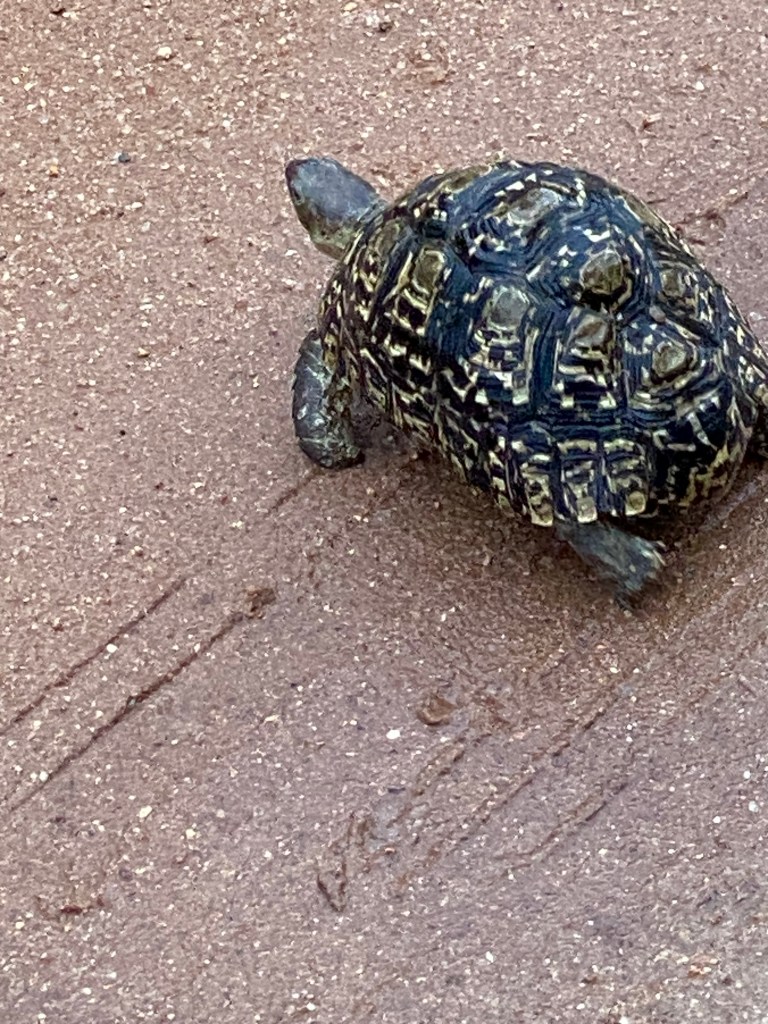
A few minutes into our drive, he braked the truck and pointed out a turtle making its way across the road. Understanding that this might be our biggest sighting of the day, I took a video of the creature with my smartphone. Soon after, we spotted some impalas. Although we’d seen so many the two days before that the guide no longer stopped for them, on this morning, we gave them our full attention.

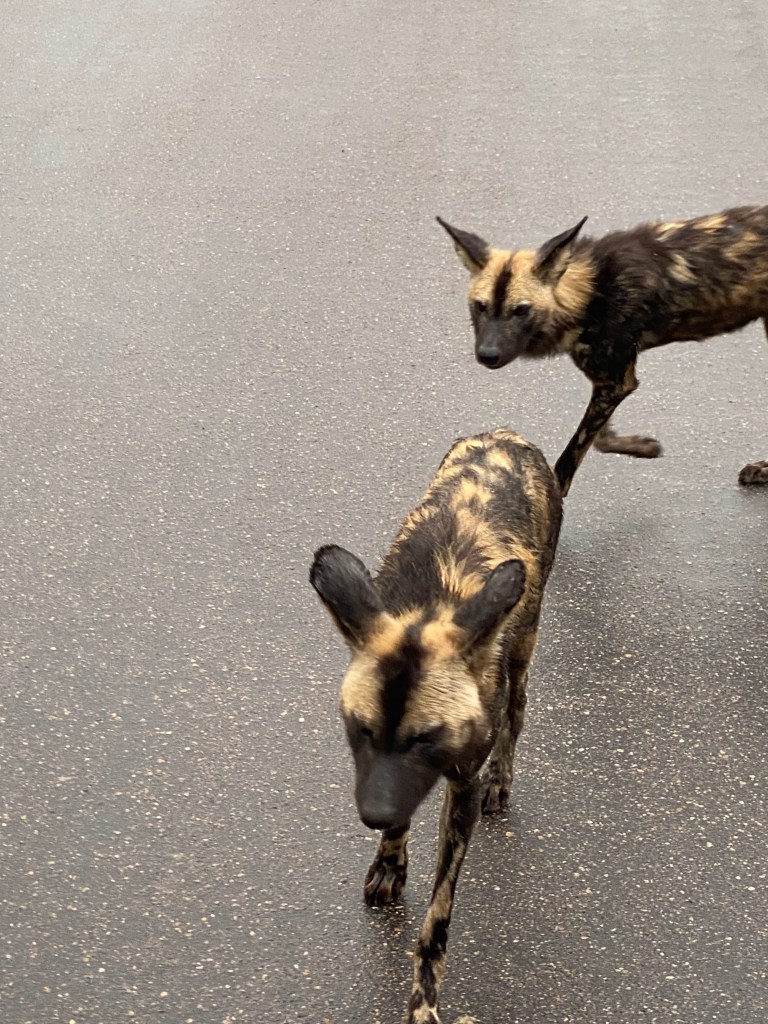
And then we saw something unusual—a pack of African wild dogs alongside and in the middle of the road. I had never seen canines with such colouring. Their fur was brown and black, almost tortoiseshell. These dogs were featured on a signboard at the park entrance indicating the day’s sightings.

“There are only about 150 of these dogs in the park,” our guide told us. He mentioned that they were expert hunters, that they attacked in groups. Since Kruger National Park is vast, with an area of 19,485 square kilometers, much of the terrain being well away from the road, I realized how lucky we were to see these dogs. They trotted along, sniffing at the road, mindless of the truck slowly following them.

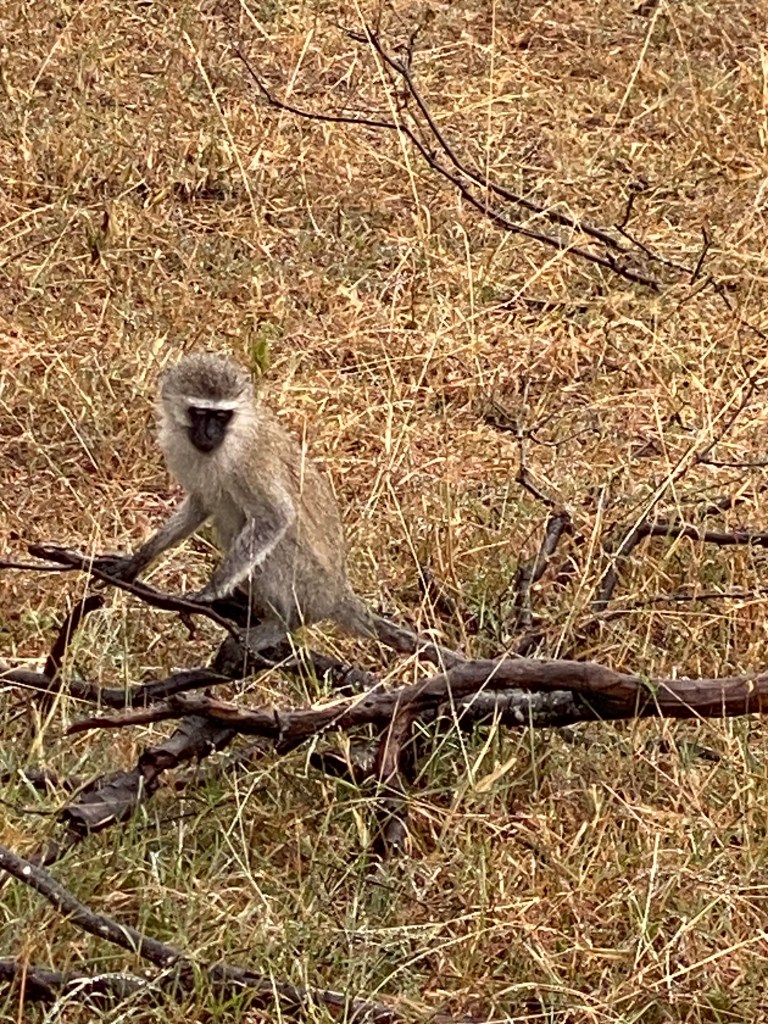
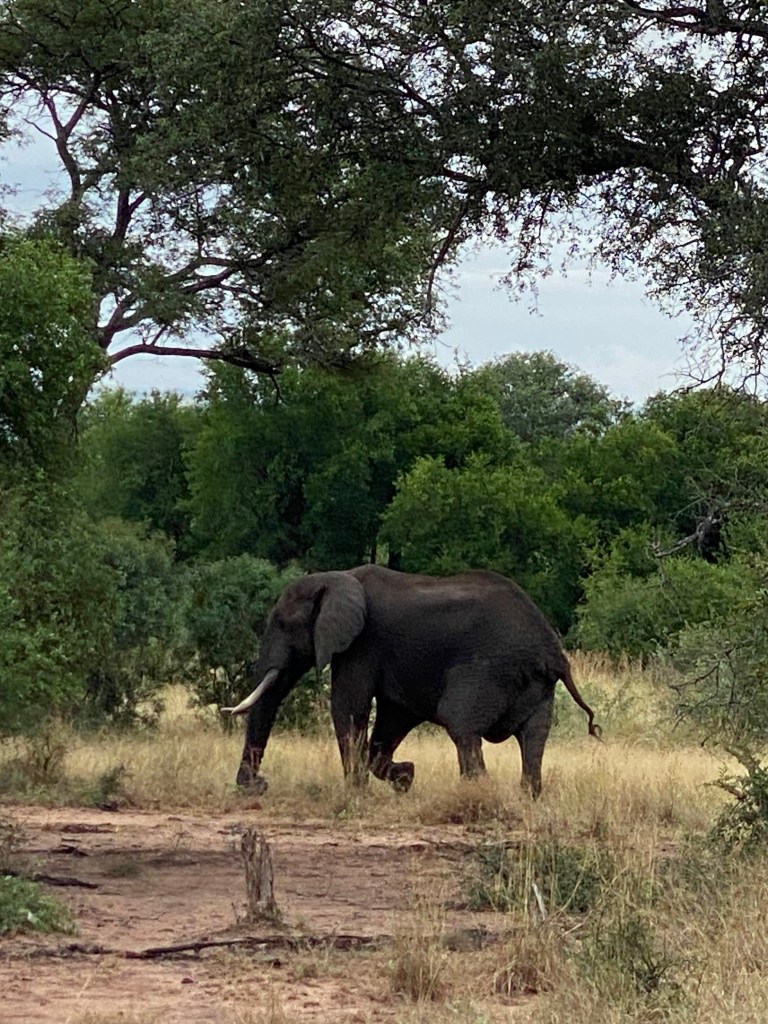
By this time, the rain had let up. Although we did not manage to see any hippos out of the water (they mostly come out at night to eat grass), we did see a herd of wildebeest, some vervet monkeys, an elephant, a water buffalo, baboons, and a Martial eagle perched on a high bare branch. And then our guide got a message on his phone and said, “From now, we’re not stopping for anything. Someone has spotted some cheetahs.”

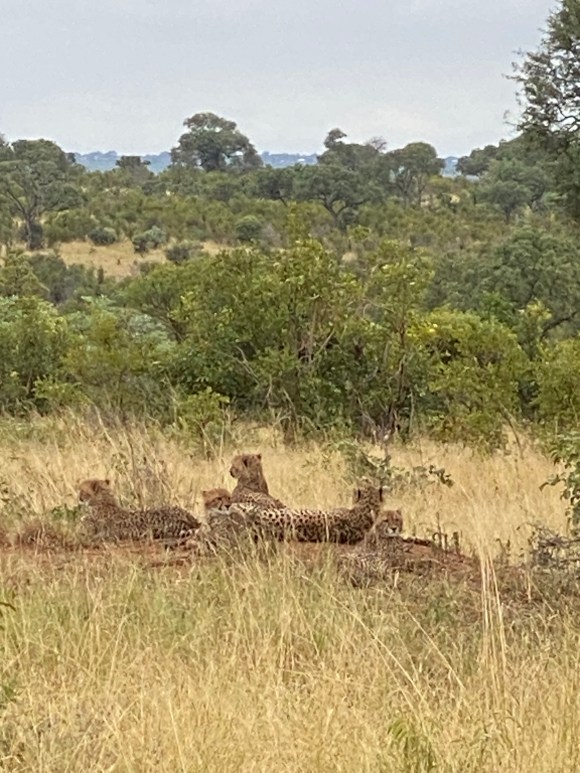
As he sped ahead, we crossed our fingers and readied our cameras. I expected the cheetahs to be far off in the distance, where they wouldn’t be scared off by the sound of cars, as the lions were. Why else would they stay in one place long enough for us to reach them? As it turned out, however, five cheetah cubs were gathered together, sitting still, gazing intently into the bush. They were near the road, only about fifty meters away.

“They’re waiting for their mother,” the guide said. “Maybe she will come back while we are waiting.”

My friend and I took turns admiring them through binoculars. How patiently they watched the impalas nearby. How diligently they groomed themselves. They were gorgeous, leaving us breathless.

We waited awhile, but there were others eager to see them, so our guide suggested it was time to move on. “Are you happy?” he asked us.

“Yes, very,” we both said. 

Later, as we returned to the lodge, we thought about how jealous the rest of the group would be when they heard about the cheetahs. The rain started to fall again.

Suzanne Kamata was born and raised in Grand Haven, Michigan. She now lives in Japan with her husband and two children. Her short stories, essays, articles and book reviews have appeared in over 100 publications. Her work has been nominated for the Pushcart Prize five times, and received a Special Mention in 2006. She is also a two-time winner of the All Nippon Airways/Wingspan Fiction Contest, winner of the Paris Book Festival, and winner of a SCBWI Magazine Merit Award.

PLEASE NOTE: ARTICLES CAN ONLY BE REPRODUCED IN OTHER SITES WITH DUE ACKNOWLEDGEMENT TO BORDERLESS JOURNAL

Click here to access the Borderless anthology, Monalisa No Longer Smiles

Click here to access Monalisa No Longer Smiles on Amazon International
Categories
Notes from Japan

Finding Inspiration in Shikoku’s Iya Valley

Photographs and narrative by Suzanne Kamata

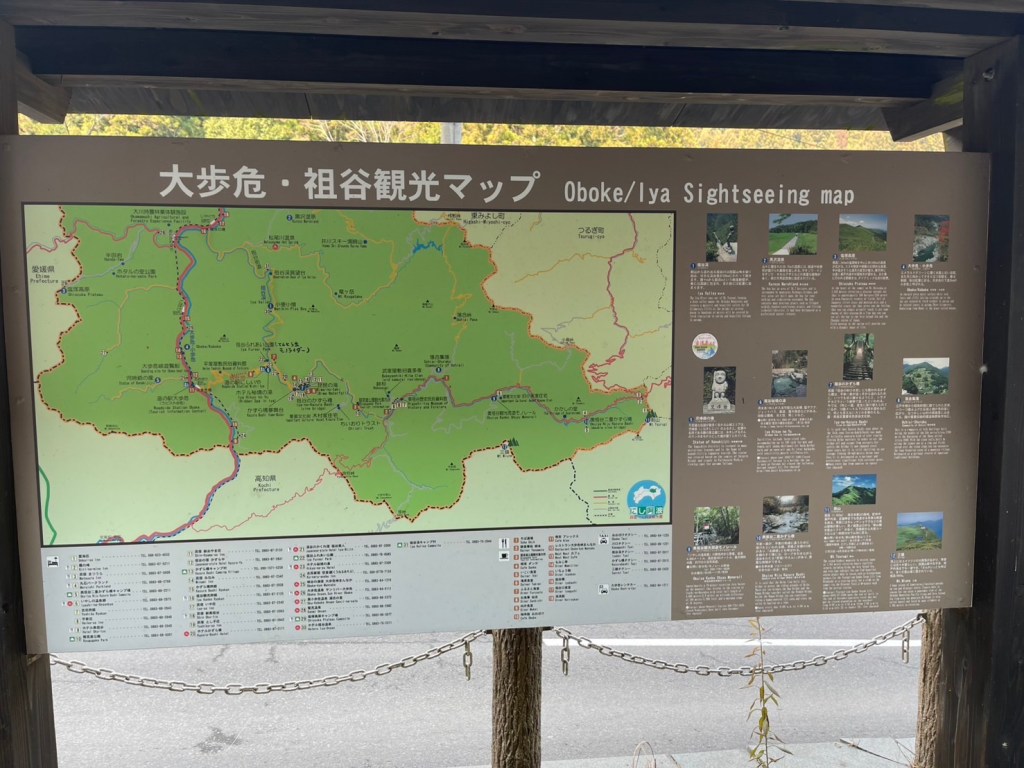
When I first arrived in Japan over thirty-five years ago, one of the first places that I visited was the Iya Valley, deep in the interior of Tokushima Prefecture. It wasn’t easy to get there then, and it’s not easy now. From Tokushima, there are no trains – only very occasional buses, or you can brave the narrow, twisty mountain roads sans guardrails and drive on your own. At the time I visited, I recall no restaurants or hotels, but apparently some abandoned houses have been refurbished as high-end inns.

The Iya Valley attracts adventurous travelers who are up for white-water rafting on the river that cuts through the Oboke Gorge. Another thrill that can be had is crossing Iya Kazurabashi, the swaying vine bridge that spans the gorge. I crossed the bridge on that first visit years ago, and I remember clinging to the rope railings while taking careful steps, my heart hammering all the while.

The vine bridge is periodically reconstructed, but the original was said to have been created by aristocrats who had fled the capital of Kyoto. The Heike clan, who have been immortalised in the Japanese literary classic Heike Monogatari, were defeated by the Minamoto clan in the Genpei War (1180–1185) at the end of the Heian Period. They found the wilds of Shikoku to be the perfect hideout. Their descendants continue to live in the area.

I found this story incredibly fascinating. As a university student, I had been captivated by descriptions of Heian court life – the ladies-in-waiting in their layered brocade kimono, lover’s messages exchanged in the form of poetry. As anyone who has seen the recent miniseries Shogun has noted, ancient Japan was filled with aesthetic delights. Imagine going from a wooden house with fragrant tatami mats, sliding paper doors, and an ornamental garden to an untamed mountain, probably teeming with wild boar and monkeys.

I was inspired by this place to write the short story “Down the Mountain,” which appears in my newly published collection River of Dolls and Other Stories. I blended ancient history with the Japanese folktale “Kaguyahime,” or “The Moon Princess.” I was also influenced by reports that I had read of the forced sterilisation of Japanese women who were mentally ill. The story begins like this:

You say that you want to leave this mountain, daughter, and I know that your will is strong. For you, there is not enough of life in selling fish-on-a-stick or serving noodles to strangers. You look at the swaying vine bridge and see a magnet for tourists, those busloads of people who come up from the city, filling the valley with sounds of laughter and loud voices. I will not stand in your way, but before you go, there are some things that you must know.

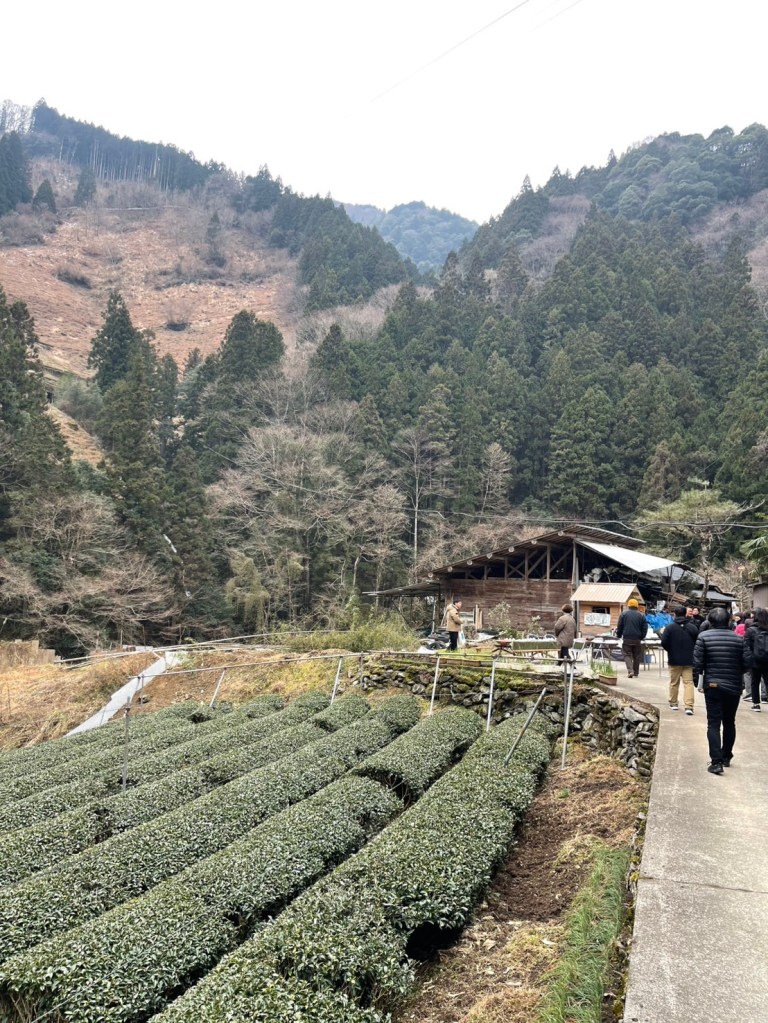
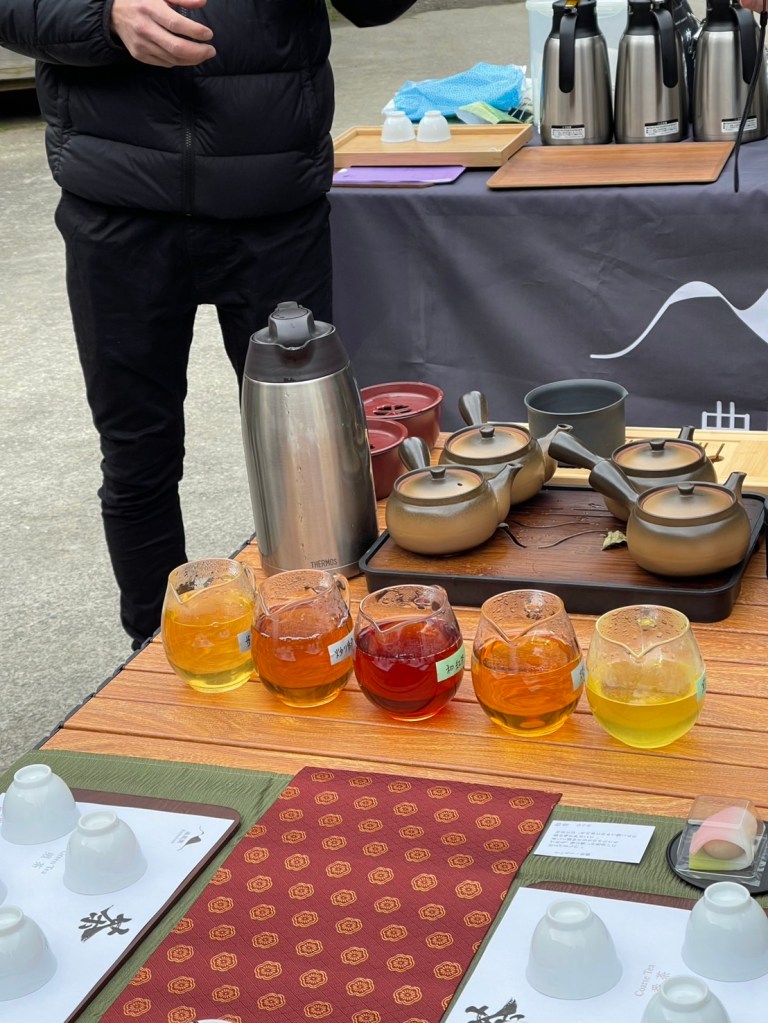
Last week my husband, who is newly retired, took a trip to the Iya Valley as a tour-guide-in-training. While I was at work, he crossed the bridge and was treated to thick udon noodles in broth and a sampling of teas grown on the mountain. A local woman sang a traditional song to the group of visitors.

“Have you ever been to Iya?” he asked me when he’d returned home.

“Yes,” I told him. “Long ago. As a matter of fact, I even wrote a story about it.”

Suzanne Kamata was born and raised in Grand Haven, Michigan. She now lives in Japan with her husband and two children. Her short stories, essays, articles and book reviews have appeared in over 100 publications. Her work has been nominated for the Pushcart Prize five times, and received a Special Mention in 2006. She is also a two-time winner of the All Nippon Airways/Wingspan Fiction Contest, winner of the Paris Book Festival, and winner of a SCBWI Magazine Merit Award.

PLEASE NOTE: ARTICLES CAN ONLY BE REPRODUCED IN OTHER SITES WITH DUE ACKNOWLEDGEMENT TO BORDERLESS JOURNAL

Click here to access the Borderless anthology, Monalisa No Longer Smiles

Click here to access Monalisa No Longer Smiles on Amazon International