Sharifa panicked briefly, looked around for Rhys, saw him near a row of tiny trains further inside the shop and waved at him to come to her. He didn’t see her, and the skinny boy wearing black nail polish was now waving the card right in her face. She frowned and said, “Sorry. I’ll get my husband.”
The punk whose name tag said Gee, shrugged and swept aside the scarves and tote bags Sharifa had placed on the counter and picked up the book he’d been reading.
“Rhys!” Sharifa tapped him on the arm, and he turned, smiling. “Something’s wrong with this card. Can I have yours?”
Later, bags tucked under the wrought iron table at the café they found around the corner, they sipped their coffees and tried not to grimace.
Rhys took off his windcheater and dropped it on the empty chair beside him. “Americans are coffee drinkers, right? How come this stuff tastes so horrible?”
“Maybe we don’t know where to find the best coffee in town. We should stalk those snappy office goers and see where they get theirs.”
They laughed and Rhys brought up the declined card again. She knew it bothered him even though her ANZ card was still working. She rarely used it because of the $2000 limit. But they’d used it to pay for the watery coffees and the horse carriage ride through Central Park earlier, and she knew there was enough to cover them for a week, if needed.
“Give us a look at that card.” Rhys put his hand over hers.
She sighed and placed it on the table.
“Shari. Love. This isn’t your card.”
“What do you mean? Of course it’s my card. I’ve been using it in Vegas casinos, for crying out loud.”
“Look.”
He was right. The name on the card said Sabiha Evans, not Sharifa Evans, but the signature was hers. Her writing. It didn’t make sense.
Sharifa withdrew her hand from his. “No, before you ask, I haven’t left it lying around, haven’t picked up someone else’s by mistake. You know me, Rhys. Paranoid from way back. I grew up in a country where you assume you’re going to be robbed, so I never take chances. This is seriously weird.”
“I know love.” Rhys’s hand covered hers again and he shook his head. “It’s the name that worries me. And that signature. It’s yours. How can this happen?’ And who’s this woman? Got a sister you haven’t told me about?”
“Yeah right. Also married to someone called Evans.” Sharifa tried not to sound annoyed. “This isn’t my fault.”
“Never said it was.”
They were meeting friends at a waterfront restaurant in New Rochelle, and arrived ahead of time, barely speaking to each other. An early thunderstorm prevented them from walking around the neighbourhood, and now they checked their phones, avoiding eye contact.
“Please …,” started Sharifa, wondering what she was pleading about, and Rhys looked back, nodding.
“I won’t say anything.”
“Thanks. I mean, maybe we can mention it?”
Mark and Andy were strolling towards them, hand in hand, and they both got up and hugged them, waving towards the table they’d booked.
“It is bizarre.” agreed Andy, looking at the card Sharifa had placed between them. “Spooky, almost. Have you gone to the Embassy? I mean, this could be fraud on a grand scale and you’re just at the start of your holiday. You don’t want to be aiding and abetting crime.”
“Andy.” Mark laughed. “Stop scaring them. Yes, it’s weird and we are in New York, but it doesn’t need to be quite so dramatic. Ring the bank and cancel the card. You have others?”
“Yes,” said Rhys. “Mine is fine. It’s Shari’s that’s gone whacko.”
.
Andy and Mark insisted on driving them to their tiny hotel room in midtown Manhattan, where they’d spend the rest of the week. Promising to update their friends on The Great Card Saga, they fell asleep almost immediately, Sharifa dreaming of kittens walking on windowsills.
The man from the bank was not helpful. Despite Sharifa repeating her name and date of birth and typing her password on the link that was sent, the outcome was the same. There was no record of her ever having an account with them. Yes, they had Rhys, but not her. No, they couldn’t cancel a card that was never issued to her. Cutting up the card into little strips seemed to be the only option until they returned to Australia.
.
A week after they got home, Sharifa stared at the envelope from the bank before ripping it open. Inside, a letter informing her that her replacement card was enclosed and that she should change the password at her nearest branch. A new card, with a blank signature strip, in the name of Sabiha Evans.
Rashida Murphy is a writer living in Perth, Western Australia. She is the author of a novel and a collection of short stories. Her novella titled Old Ghosts is forthcoming next year.
.
PLEASE NOTE: ARTICLES CAN ONLY BE REPRODUCED IN OTHER SITES WITH DUE ACKNOWLEDGEMENT TO BORDERLESS JOURNAL
“Keep off my emotional lawn,” young Dorothy Carmody snapped, fourteen years young. “You’re trampling on my rhododendrons.”
“Geez, Dory.”
“Adventure. Need some ASAP, you know how it is.”
“Sure.”
And then a new girl, a transfer, came sashaying along the school corridor, her skirt whipping up a storm of self-assurance — Constance Harrington, known to the hoi polloi simply as Connie. And the moment Dory laid eyes on her, she knew. Here was a partner in crime. Here was a throw caution to the wind cohort, someone who wouldn’t back down from the prospect of adventure.
It was the very same week she had met Connie that she discovered a pack of cards buried in a pile of leaves beside her verandah. In the smoky autumn air, choked with swirling leaves, on her way up the walk she caught a glimpse of something out of the corner of her eye. She thought it was a discarded pack of cigarettes, but the colour of it seemed odd. It was a deck of cards, and hardly your run of the mill playing cards. These cards were mini works of medieval art, in vivid colours.
“What’s that?” her mother asked. “My guess, tarot cards.”
She thumbed through the cards and found herself in a strange world populated by cups and knights, pages, swords, pentacles, and collapsing towers. What in the world, she wondered, or perhaps out of it. Here were unusual cards that seemed culled from the mists of time. Runes from the leaf piles of autumn.
As she fingered each card, it seemed to speak of faraway places. The meanings, she felt, would instinctively reveal themselves to her. She would look them up on her laptop, but she knew no amount of research was a substitute for what she might intuit and how she might construe the meanings for herself. Spunky was funky that way.
Now young mistress Carmody needed to share her newfound treasure, even before absorbing the meanings of these odd cards. She retreated to her room and called Connie. “You know anything about the tarot?” she asked.
“Oh! billy clubs and chopsticks,” Connie retorted.
“Come on, Connie, don’t give me the stonewall treatment. I’m staring right here at a pack of tarot cards — they’re shaking in my hands, as though they want to speak.”
“I’m tone deaf, Dory, tired and tone deaf. Too many idiots got on my nerves today,” Connie said.
“Connie, I’m serious. These are hot, and there’s adventure here. Emergency confab — third period study hall. Tomorrow. In the stacks.”
“If you insist,” Connie sighed.
The study hall was sprinkled largely with numbskulls or brainy types toiling quietly in their heads. But there were tall metal racks of books, a modest library. And you could enjoy a bit of secrecy there. Dory slyly slipped the pack of tarot cards into Connie’s hands.
“Rider deck,” Connie said, to inquisitive eyes. “Yup.” “Well?”
Connie plucked a card at random from the deck. Wheel of Fortune.
Suspicious looks were exchanged and shoulders shrugged. “So?” Dory said.
And suddenly the room began to spin, and her eyes were tiny pinwheels. She felt a whirlwind coming on, a sweeping blur. “Con — ?”
“Grab my hand,” Connie said, and they were both caught up, heads spinning in a kind of wild vertigo.
When they regained their composure and the seeming gale had subsided, they were no longer in the school library. They were on some deserted beach in the tropics, complete with palm trees, and water as pale green, clear and pristine as all of creation. Waves rolled and crested, lapping the sands, and they were shoeless, and the heat stung their toes. They looked left, they looked right. The beach was deserted. Sure enough, they were alone.
“Our own private Idaho,” Connie joked. “Spunky Dory, what have you done?”
“No,” Dory said. “We’re dreaming. Snap your fingers, come on.”
Thumb and fingers snapped, but the portrait of paradise did not morph one iota.
“Now, Miss Thirst-For-Adventure, how do you propose we get back?”
“Who needs back? We’ve hit it, Con. Paradise. Park ourselves down in the palm shade and chill, Con, chill. Unless you’d prefer our private limousine.”
Dory pointed. There was a leaky old wooden rowboat at water’s edge tethered by a long rope that extended around the trunk of one of the palm trees.
“No,” Connie said. “We’re in Never Never Land, and that old boat is going to take us where?”
“Over the rainbow, beyond the blue horizon, take your pick.”
“And here they come,” Connie said, as out of the trees poured what appeared to be natives of some sort, and their cries shattered the bliss, not to mention the spears they were jostling in their hands. Had Connie’s imagination done a back flip?
“The cards, the cards,” she said, and she rubbed the Wheel of Fortune card, frantically rubbed and rubbed.
“Dor– ?” she said, terrified, and just as grass skirts, spears and painted warrior faces were all but upon them, angry ones at that, they felt their heads begin to spin dizzily again, and trees and sand and ocean swirl madly around them and they clung to each other and in what seemed like hours but was only an instant, they were back among the library stacks.
“No,” Connie shook her head. “No way.”
“Yeah,” Dory said. “Oh yeah. And we chickened out.”
“We sure as suds did, and not a moment too soon. What did we have for lunch today anyway, was it spiked? I mean, did we just — “
“Yeah, we just…”
“And you wanted us to, well, indulge our just, is that the just of it?”
“Where is your sense of adventure?”
“I think I left it in algebra class. Assuming we weren’t having one big hallucination, what just happened?”
“That’s what we’re gonna to find out.”
“Look, we are gonna be late for fourth period.”
“Saturday, Connie. My basement. Word of honour?”
“Dory, you’re crazy. No way.”
“Come on — besties?”
Reluctantly, Connie nodded: “Okay, besties. As in, it was the bestie of times, it was the worstie of times. You’re gonna get us in a mess, Dory, I just know it.”
Had they imagined this? Had the cards transported them to a temporary Shangri-la, an island paradise, or had too much cramming for school fried their innocent, developing, and surely hyperactive brains?
Those cards had some very strange pictures, and paradise island may or may not have been a figment of their imaginations run wild. But what if they dared investigate the rest of those cards, because Connie suspected that was the plan. She shuddered to think.
Saturday came, as it always does, with its wonderful sense of liberation and kick around freedom, and after lunch in the kitchen of Dory’s home, with the two girls munching on sandwiches, Dory gave the nod.
Connie was apprehensive, but down into the darkened depths of the cellar they went. The air was cool and a bit stale, and small windows didn’t admit much outside light. There was an old workbench there, and a cold room where her father stored paints and tools. They sat side by side on the workbench, and Dory fanned out the pack of tarot cards in front of them.
“Here’s the deal,” Dory told her friend. “There are twenty-two major arcana and fifty-six minor arcana cards. Fifty added to six reduces to eleven. That led me to eleven minor cards and twenty-two major.”
“I think you’re confusing me with key signatures.”
“Well, those are supposedly special numbers. You’ll have to do your own research there. Eleven and twenty-two. Back to the main game. The major arcana — that’s the twenty-two — are sort of major changes in your life, and the minor ones are day to day activity. Still with me?”
Connie was growing impatient.
“The cards with pictures of cups — well, the cups represent feelings. The swords represent actions. The pentacles, those gold coins, the five- figured ones, represent the material aspects of life — like work and business. And finally, there are wands, and those express action, passion and energy. Get the picture?”
“Pictures, Dory dearest. A passel of confusion. And what about that wheel card?”
“The Wheel of Fortune, the destiny card. There are also court cards — king, queen, knight and page.”
“Couldn’t we try something less precarious, like say gin rummy or hearts or something? Dory, lead us not into temptation.”
“I’ll shuffle, you get to make the pick.”
How lucky could a girl get, Connie thought to herself. Oh boy, here we go again.
Dory worked the deck, the cards crunching as she shuffled and cut, shuffled and cut. She was waiting perhaps for one of the cards to spring unbidden from the pack, for fate to play its hand. And wouldn’t you know, a card flopped out.
“Kismet, Connie.”
“Yep, that’s what my friends call me, good old ‘Kismet Connie.’ Never met a kiss I didn’t like. Or was that kiss, bat my eyes.”
The card that had flopped out was in fact the eight of pentacles, depicting a relatively young fellow in Renaissance squire’s costume seated at a workbench, wearing what appeared to be a doublet and red tights. He was intently using a mallet and chisel to hammer gold coins. There were five-pointed pentacles stamped on the coins, eight in all. He seemed amiable enough.
“Everything up to date in Kansas City?” Connie kidded. “Watcha got there, pentacle fellow?”
Just as quickly, the card seemed to respond, and Connie and Dory felt the whirlwind coming, the dizziness, and the wild spinning sensation. The room was going round and round, and where it’d stop nobody knew — like some kind roulette wheel spun by the hand of fate.
“Me and my big mouth,” Connie said, as the girls sought refuge by clinging to each other. “And to think, instead of this I could have been out there shopping for basics.”
Fate seemed to murmur: Fly me to the moon and let me play among the stars. . . Their heads spun and spun, the girls clung and clung, you really had to be there, and the scene around them was changing, and as they became lucid again, the spinning sensation had stopped. Lucid, in point of fact, now in a medieval workshop, just like the one depicted in the tarot card, as before them a lad was busy with hammer, chiselling away at his coins.
Connie leaned to her friend — “Thanks, pal. Thanks a ham sandwich.”
“Look at this, we’re in a medieval workroom or something. Come on, tell me you’re not digging this.”
“You want the long version or the short? Dory, you’ve done it again, and dragged me in a windstorm with you. When oh when will I ever learn?”
Dory gestured her friend in the direction of the busily hammering boy.
“You first,” Connie said. “Con?”
“I get it. I get the dirty assignments. Okay, little miss wizardry, I shall be so bold. As always, you are pushing the envelope. I won’t even ask where we are, but I’m guessing we made a wrong turn somewhere at Camelot.”
The young man seemed oblivious to their presence, as though they weren’t even there.
“Uh, excuse us, medieval person,” Connie said, “I believe we took a wrong turn at a traffic stop in the village. Yes, we are obviously from another time warp and out of our depth, so to speak. Think fish out of water. Twenty-first century hussies. Whatever you want but get us back to where we once belonged. You get the gist, even if gist wasn’t even a word that had been invented during the Middle Ages, Renaissance, what have you.”
“I like that,” Dory said. “Middle Ages!”
“Hey, I’m cutting edge,” came the sarcastic tone of Connie’s voice.
“Are you here for the coins?” he asked. Yes, the ‘he’ at the workbench who was pounding away at just such coins.
“No, we’re here to pick up the laundry,” Connie joked. “Actually, we’re sort of not here at all, imagine us as shadows, will-o’-the-wisps, ghosts. What we really could use is a lift somewhere, preferably back to the twenty-first century. I hear the distinct sound of reality calling. You got a spare oxcart or something?”
“One,” he said. “I will part with but one.”
“Oxcart or coin?” Connie couldn’t resist.
“Here, take it.” He handed them a gold coin.
“For good fortune.”
“Good fortune we could use,” Connie said. “And a couple of airline tickets outta here fast.”
Let’s face it, who could look a gift coin in the mouth, even if it was a medieval mouth?
Dory appropriated the coin, and the moment she touched it — uh-oh, spinning heads and flying saucers, whipping winds and wildebeests, and in what seemed two shakes of a lamb’s tail, they found themselves back in Le Present Age, also known as the here and now — yes, down in Dory’s dank basement.
It was still there in the palm of her hand, the gold coin, albeit it had somehow dwindled in size. It was now the regular size coin rather than the giant medieval family variety. But it did glitter and come to tell it was actually made of gold, as Dory found out later when she consulted a local precious metals dealer.
“And now,” Connie said, “can we do some clothes shopping and give that pack of cards a big hearty heave-ho where it belongs?”
“Aw Con.”
“Aw nothing. Ditch them. Dory, forgive me, but time machines are sooo yesterday.”
“Connie, Connie, Connie,” Dory muttered, shaking her head. She knew she could pretend to accede to Connie’s wishes, but she also knew she was going to hide that magical little deck of cards somewhere in her bureau drawer, for another day. If you couldn’t look a gift coin in the mouth, you sure couldn’t look a gift adventure, not with life being as humdrum as it was.
“Loosen up, Con,” she winked. “Yeah, yeah. Don’t say it.”
Dory smiled ear to ear. “Girls just wanna have fun.”
Ronald V. Micci, a native New Yorker, is a prolific author of plays, screenplays, novels, and short stories, both comedic and serious, many available for perusal on the Booksie, Simply Scripts and Amazon websites. A published playwright (Brooklyn/Heuer Publishers), former magazine editor and advertising proof reader, his one-act plays have been staged in Manhattan and throughout the country.
.
PLEASE NOTE: ARTICLES CAN ONLY BE REPRODUCED IN OTHER SITES WITH DUE ACKNOWLEDGEMENT TO BORDERLESS JOURNAL
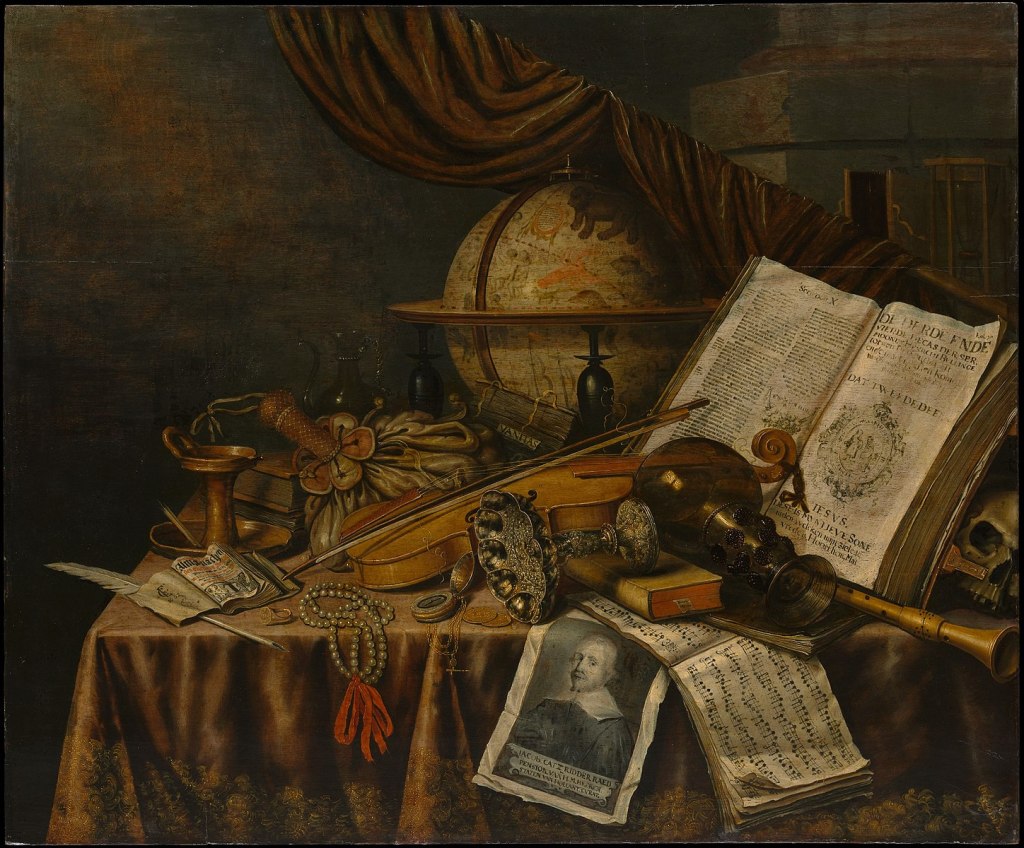
Vanitas Still Life, painting by Evert Collier(1640 –1708). Courtesy: Creative Commons
Back home in Madrid, having abandoned Adamov Plut to his posthumous fate, I was a bit surprised that neither the New York Times nor the Washington Post reported anything about the murder, not even a paragraph, or as the French so imagitively put it, an entre-filet ! I soon realised, due to this journalistic silence, that the time had come for me to give a full account of my relation to Mr Plut ; that the time had come for me to expose, publicly, by way of this revelation, his ‘mysterious murder’.
My information is of the surest sources for the simple reason that it was I who had Mr Plut murdered ! Yes, I ! And for reasons that shall be shortly disclosed. A mysterious man he might have been; however, his methods of acquiring priceless books and other inestimable valuables can hardly be called mysterious: Mr Plut was a vulgar thief, a scoundrel, an ingenious trickster whose singular flair caused much grief to many individuals, enraged those whose trust had been flouted.
It was in Istanbul, where I was invited to sojourn with an Armenian merchant, that I witnessed Mr Plut’s dupery. And if my naive friend fell for his crooked smile, I certainly didn’t swallow his high tale of returning to pay him for the two illuminated manuscripts my friend had graciously offered the blighter on condition that he be held accountable for them. His thick, coarse lips translated a smile that held contempt and disdain towards those who trusted him. So infuriated and insulted did I feel on behalf of my friend that that I reacted on a lightning urge and decided to follow him. I said nothing of this to my disbelieving companion, but left immediately in pursuit of my game — and game it was — for I, to tell the truth, had nothing more substantial to do at the moment and felt disposed for a good hunt.
I said that Mr Plut was a genius. Yes, in his own way. However, genius has its limitations. His arrogance and haughtiness knew no bounds, although he knew that his foul doings had attracted the attention of police and Interpol. Some may surmise that a certain paranoia drove him to invent individuals tracking him down like a wild boar or moose. No, no one was tracking him down except me, and that as subtlety as possible. In Uzbekistan, I actually chatted with him over a cup of coffee on two occasions disguised as a professor of Slavic philology, dressed in a quilted chapan robe and silk embroidered tubeteyka cap. There we sat in Samarkand, sipping our thick beverages in the vaulted bazaar at one of the storied cafés that dot the town. He was all smiles, obsequious and gold-toothed. I had the impression that I was dealing with a child or a mentally-dwarfed man whose sense of reality lacked all discernment or sagacity. I concluded that he had come into quite a bit of money, and never having had to work for a livelihood, traipsed about the world at his leisure, buying or stealing books, cheating people out of their invaluable collections. So self-indulgent and confident was he that he never saw through my masquerade as we conversed in broken Russian.
It was at that café where I learned about his fabulous treasure, as he called his book hoard. Only an idiot would have divulged this information to a perfect stranger, but as I said, Mr Plut’s contemptible demeanour caused him to fall into the most infantile traps. Traps that I began laying out for him, and that would lead to his downfall. For I had begun to design my own plan to relieve the rogue of his fabulous possessions, all the more so since he also let slip that his parents had passed away, and he had inherited the house. How I would make his treasure mine and ‘disinherit’ the owner still remained vague in my mind.
We departed as ‘friends’, as two strangers seeking an answer to the mystery of their existence. Or so I made him believe. Mr Plut appeared to me a dying species, a worldly aesthete, in spite of his extreme vulgarity and ponderous gait, whose debonair demeanour masked a loathing for his victims, a bent for the lowest duplicity, a gratification in spinning the most treacherous stratagems in order to allay his desire to prevail.
Mr Plut slipped out of Uzbekistan without my knowing it. He probably used his Russian passport, one of the four of five in his possession. I felt a twinge of misgiving. Had the fat fellow got on to me? After many enquiries, I finally discovered that he had crossed into China at the Xinjiang border, and was hastening towards the Yunnan. Why ? I hadn’t the faintest idea …
His brief sojourn in the town of Lijiang enabled me to catch up with him. My Chinese was fluent enough not only to query his whereabouts in that lovely town, but more important still, to learn of his new ‘purchases’, once I had questioned the director of the Dongba Museum of Culture. Mr Plut had planned to gone there to acquire several Naxi pictographic sacred books, which he did from a rather corrupt priest with whom he had been corresponding for some time, using a special code so as not to be unmasked by the Chinese authorities of the Centre. The director only learned of this a week after the unlawful negotiations had occurred, and three or four very valuable Dongba liturgical books had been stolen. It goes without saying that the rapacious priest was severely punished.
I immediately left Lijiang much to my displeasure for it was indeed a quiet, pleasant place, and set out in hot pursuit of the marauder. I followed his all too familiar scent through Nepal into North-western India to the Zanskar region where he put up for a while at the Phuktal Gompa[1], a strange spot to make a halt. But a perfect hideout to gain time in order for planning his next move, whilst at the same time inveigling in the most repulsive manner his generous hosts.
The monastery is nestled in the most remotest of valleys, ensconced within a cliff of tuft of fairy chimneys, crags and honey-combed spires which bulge black and red against the background of sandy, dazzling ash and cinerous tones of hemp. I had trekked there from Lamayuru in twenty days, and as I was to learn, Mr Plut had arrived there three days ahead of me, but by way of Padum. To gain the main entrance of the gompa, the pilgrim had to climb a steep path, keeping his or her right shoulder to the seventeen chortens[2] that mark the steep climb towards the vaulted entrance. I had shaved my head, grown a long beard and donned a woollen chuba tightened around my waist with a long colourful sash. It kept me warm, for in spite of it being Summer, the nights were very cold, and my cell had only a small wood-burning stove to keep me warm.
I spent three weeks at the monastery, sleeping on a ratten matting, eating skieu, tsampa and chappatti, drinking steaming salt-buttered tea off a chopsey — a low, small table — reading or gazing out of the little window that offered me a full view of the dusty, treeless courtyard below, where monks would mutter their mantras, and beyond into soundless nights whose stars were generally veiled.
Without Mr Plut’s slightest suspicions, I assisted at all the ceremonies, mornings and evenings, even vigils, while in the afternoon, I would venture out into the monastic complex, twisting and turning in the warren of lanes, under the low archways and high ladders, at times pursuing my promenades upon the rather precipitous mountain paths. As to Mr Plut, he hardly left his cell, and when we did cross paths, he most probably took me for a Buddhist pilgrim. Once or twice I sat near him in the prayer hall in the meditation grotto, but he never attempted to communicate with me, albeit he did not seem very deep in prayer or contemplation. He was probably scheming his next miserable move. His face had become terribly pale and flabby. His darting, black eyes seemed to have sunk deeper into their sockets. Unable to sit cross-legged on the low benches at the back of the prayer hall, he sat ‘western style’, staring off into the clusters of chanting monks, tilting his huge, bobbing head every so often to the banging drums, blowing ox-horns and tinkling triangles. Observing him from afar, I sought to sound his soul, to wring out his innermost thoughts, to extract from his evident lassitude and apathy his flight from both his victims and himself. But Mr Plut was a sphinx. Would he rise out of his own ashes when his hour came ?
I left the good monks three days after his departure, a hasty one indeed. And they were furious! The scoundrel had stolen several pustuks[3] and thangkas, and failed to pay for the prayer masks that he ‘purchased’. They implored me to find the culprit, inform the police and recover their stolen property. It was perhaps the beseeching words of the infuriated monks, after having received such incomparable hospitality from them, that my plans to have the thief killed began to germinate ! The theft was not only gratuitous, it exposed the very ugliness of the man’s heart, blackened by greed, cynicism and remorselessness. It would only be a matter of time before he tasted a soupçon of his own medicine.
Meanwhile the cat would play with the mouse, a rather fat mouse at that ! I boarded the cargo ship that took the fugitive from Karachi to Oakland via Japan. On the long, monotonous voyage across the Pacific, my ominous shadow crossed his at the most unsuspecting moments. Attired as a Pashtun merchant, bearded, long-haired and turbaned, Mr Plut sensed an onerous presence whenever he laboriously carried his huge body across the decks. How many times had my eyes penetrated his anguish, his torment, his pangs, not of compunction, but of incomprehension. He scented a sleepless menace pressing him. Fear inflamed his dark, beady, mirthless eyes like the burning incision of the trenchant knife.
Oakland … Sacramento … Reno … Tombstone … Boulder … Santa Fe … Saint Louis … Chicago … New Orleans … Birmingham … Miami … Atlanta and finally New York. Yes, New York, where the curtains would finally fall on this tragic fat figure. Where upon the stage of 8 million walk-ons, and against the backdrop of the grottiest of hotels, the last act of Mr Plut’s abominable performance would be played out.
His infatuation with Louis Wolfson amused me, as well as his grandiose project to write twelve stories in twelve different languages signed by twelve different authors. I found all this quite pompous and pathetic. A real exercise in self-indulgence to say the least. All this information I culled when I ‘accidentally’ met him in the ill-lit corridor of that hotel on Water street in downtown Manhattan. In New York, I played the role of a French researcher in mediaeval literature, a field that he completely ignored, in spite of possessing several manuscripts of Anglo-Norman stamp, apparently purchased (so he said ?) from a London book-seller. I pretended to be interested, taking the opportunity to study him closely. Besides, he was such an inveterate liar how could one believe anything he said ? He lied to curry favour and win confidence, only to swindle and steal from the naive and simple-hearted. Better to observe his eyes, his gestures, his bouncing from one tongue to another. These were all genuine signs of his distorted psychological make-up. To play my part well, I sported an immaculate white suit, orange tie, a pair of silver-rimmed glasses and spanking new alligator shoes. I had shaved my beard and moustache and had my hair cut very short, leaving a few gossamer wisps which touched the tips of my ears and fell bouncily on my forehead.
Every day I followed his Humpty Dumpty gait as he waddled to and from the public library, in and out of Central Park. And it was there, in Central Park, that I noted two blond-haired rough fellows slouching on a bench, eating the remains of fried chips or chicken sandwiches, cursing and making gross signs at the passers-by, drinking beer and spitting. They were seated at the same bench daily — the bench that Mr Plut walked by every day. They seemed to know him because they would hoot at him, call him names and ask for money. Fatso passed by without even a glance at them.
One Saturday, I decided to approach the two ruffians. They sized me up with obvious contempt, and made it perfectly clear that I was intruding on their ‘territory’. I sat down none the less, and exposed my scheme to be rid of Mr Plut once and for all, explaining how the culprit had cheated and robbed so many people. The two burly blokes, former marines in the Green Beret (or so they vaunted!) listened attentively as I unfolded my plan: Three thousand dollars for each if they would simply walk up to his room in the early morning hours, the night porter always being asleep, knock at his door and kill him, however, without any blood shed or theft of his belongings. It must be a murder without reason, without any sign of bestial violence. One of them suggested strangulation. Yes, excellent idea. It would thus be a ‘clean’ murder.
And so it was, very professional at that I must say. They were paid off, as agreed. And I left New York two days later, as planned, a very satisfied man indeed …
This all happened five years ago. Now … well, here is where my account ends and my confession begins. For you see, Mr Plut was never really murdered ! Those two ‘ruffians’ were in fact F.B.I. agents who had been trailing me since disembarking in California. To tell the truth, Interpol and local police had been following me since the Istanbul affair. How and why they began doing so I cannot say. During my trial neither the judge nor the prosecuting attorney afforded any information as how the F.B.I. learnt of my scheme, nor why they had decided, at one point in time, to cooperate with Plut. What was I convicted of ? What was my indictment ? As to my appointed lawyer, a young short-sighted clerk more than a seasoned lawyer, who could be easily cajoled by the ‘evidence’ against me, pliantly manipulated by the prosecutor, after he had taken the floor and had made an absolute fool of himself. He let out a sigh of relief when the judge pronounced a sentence of fifteen years instead of twenty-five! The wigged judge, a grotesque figure studded with huge warts, yawned throughout my lawyer’s deplorable speech for the defense, as well as during my feeble plea. There was no jury either to lament or to applaud his verdict. It was a trial held at ‘huis clos’[4], military style. I buried my face in my hands. As expected, my lawyer made no effort to appeal.
Had Plut sensed my innermost aversion towards him ? Or seen through my many disguises ? He was a clever man, and probably had hired detectives to learn why I was following him. The hotel room murder was staged. Plut lay recumbent on the floor, waiting for me to steal his papers so that I would be indicted for premeditated murder (although there was no murder!), of paying off hoodlums to commit this murder (although they were F.B.I. agents!) and the theft, which indeed it was (but fifteen years for that?) of his household papers, keys, and other official documents concerning his inheritance … and that vile short story of his.
So here I sit in my rancid smelling cell in Madrid, having been arrested at the aeroport on my arrival some five years ago, writing out this confession. I do not to repent mind you, I have no intention of atoning for my doings, nor avowing my sins. These words wrenched from my pen seek to vent the animosity and hatred I harbour towards that fat impostor who had the cheek to write me a letter from the Seychelles revealing how he had got on to me since Uzbekistan, and how our little cat and mouse game had amused him greatly : “You thought me a fool, deary, but I sawthrough your pusillanimous scheme in Samarkand ; that was some outfit, but you forgot the galoshes ! Not to mention your pilgrim weeds at Phuktal which truly charmed me, and your blazing orange tie in New York. Come, come, what French professor would ever sport an orange tie with a badly tailored, cheap white suit ?” The vicious irony underlining these sentences, along with a soupçon of cynicism caused me to gag. The blighter added in a post-script that he had sold all his books for a fabulous sum of money, and had retired from the world’s wearisome fair. In the envelope I found a photo of him sipping coconut juice, lying on the golden sands of a crescent-shaped beach under groves of swaying palm trees and an indigo blue sky. I laughed bitterly, and yet, in spite of my nettled nerves, pinned up the blasted photo in my lonely cell, a sort of souvenir of our enshrouded relationship …
One day at the prison library, browsing idly through a dull, detective story, I thought of Plut’s or Hilarius Eremita’s story The Enchanted Garden, which I had taken and read to amuse myself on the aeroplane to Buenos Aires. Had anyone ever published such ridiculous trash? To my horror, the answer came three days later whilst I rummaged through a new batch of literary magazines, some of which contained short stories in English, French and German. And there it was — The Enchanted Garden, by Hilarius Eremita, Plut’s pen name. I couldn’t believe my eyes — someone had published that rubbish ! Plut indeed had the last laugh, adding insult to injury, salt to my festering wounds.
I savagely tore out the pages of his story from the magazine, went to the toilet, ripped them into tiny pieces and flushed the filth down the bowl. So much for hiss ‘first of the twelve’ ! I shan’t be punished for it, no inmate in this prison reads any language besides Spanish, and that with a dictionary … I’m sure it was Plut who sent me that magazine to drive the knife deeper into my wounded pride. The miserable rat !
So here I sit at my iron table, staring at Plut’s photo as he sips his coconut drink under the blue skies and swaying palm trees whilst I sip my wretched thin noodle soup with strips of hard, nervy beef under a cracked, peeling, dirty grey prison ceiling …
[2] The Tibetan word for stûpa, a Buddist shrine which initially housed the relics of the Buddha.
[3] Books used for Buddhist ceremonies written in Tibetan.
[4] Behind closed door without any public participation or observers. It is a French legal term.
Paul Mirabile is a retired professor of philology now living in France. He has published mostly academic works centred on philology, history, pedagogy and religion. He has also published stories of his travels throughout Asia, where he spent thirty years.
.
PLEASE NOTE: ARTICLES CAN ONLY BE REPRODUCED IN OTHER SITES WITH DUE ACKNOWLEDGEMENT TO BORDERLESS JOURNAL



 Borderless