Categories
Poetry

Postcards from the Ledge

By Rhys Hughes

  Prologue.
There are fourteen mountains
on the surface of the Earth
higher than eight-thousand metres
and recently it was found
by observers on the ground
they have all been sending postcards
to the Royal Geographical Society
but no one knows why…
Courtesy: Creative Commons
     Mount Everest.
You say I am the tallest but that’s not
quite true: I am just
more obviously tall than you
and everyone else you know.
There is a mountain under the sea,
Mauna Kea by name
who is rather taller than me, 10,200
metres high as a matter
of fact: it’s just a question of tact that
she doesn’t loudly dispute
my claim to fame (and yes,
she’s a lady). And on the planet Mars
stands Olympus Mons,
highest mountain in our solar-system.

Courtesy: Creative Commons
     K2.
I am not quite as lofty
as my brother
Mount Everest (see above)
but he’s a softy
when compared to me in terms
of difficulty of climb.
Mountaineers drop from fright
on my slopes as well
as from physical exhaustion.
This is a warning, just a friendly
caution. Don’t sleigh
on my white suede snows. You
can do anything but
sleigh off my white suede snows.
Courtesy: Creative Commons
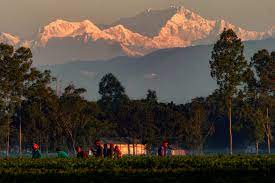
     Kangchenjunga.
I invoke hunger in the bellies
of those who try
to get to my summit. A fellow
named Crowley tried it
back in 1905 and he survived
while others of his team
were avalanched into oblivion.
He was snacking
at the time in his tent on mints
and thus was born
his insistence that life is sweet.
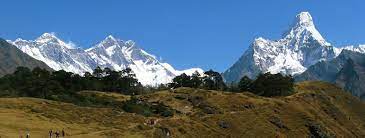
Courtesy: Creative Commons
    Lhotse.
I am the least prominent
of the eight-thousanders
despite the awfully vertiginous
vertical relief of my
South and Northeast Faces.
I wouldn’t really mind
swapping places with one of my
sheerer fellows but I’m
reluctant to make the offer.
Should I stoop so low?
Courtesy: Creative Commons
    Makalu. 
I look like a pyramid, they say,
but the comparison
offends me most painfully.
I am millions of years old,
the pyramids, a few thousand.
It should be the other way
around, visitors to Egypt ought to gasp
and cry: the pyramids look rather
like Makalu. Now that’s
the analogy that ought to apply.
Courtesy: Creative Commons
     Cho Oyu.
My name in Tibetan means
Turquoise Goddess
and although I am modest
I am pleased with the appellation.
It seems I am the easiest
of the eight-thousanders to climb
but I don’t regard that
as a disadvantage. Why be macho
in the clouds? If you love
Cho Oyu, she will be kind to you.
Climb me and you’ll return
like a human boomerang
for I have the lowest death-summit
ratio among the gang.
Courtesy: Creative Commons
    Dhaulagiri.
I dazzle the eyes with my gleaming
backside, and startle
the minds of those who slide down
my beauteous slopes.
I hope and pray for a climber today
to do something silly
such as roll down Dhaulagiri all the
way to the bottom
after the snapping of his ropes: yes,
to my shining base.
It’s not a race, as such, because there
can never be a winner,
just a mess like a yeti’s dog’s dinner.
Courtesy: Creative Commons
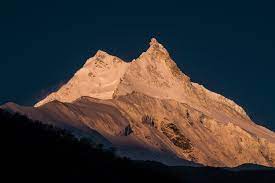
     Manaslu.
A serrated wall of ice hanging
on the horizon like a bandsaw
nailed to a door.
That is how I am described by
those who wish
to ride my teeth: climb up one
side and perch
on my summit and you’ll find
my mind is pure
enough for gentler metaphors.
I am not a tool, rarely the fool
who tries to fix
my own position in the scheme
of things. In the
valley below me snow leopards
prowl and growl
and so do you, softly, dreaming.
Courtesy: Creative Commons
     Nanga Parbat.
When rats desert a sinking ship
they expect it to really
sink, not merely plunge its prow
for a quick drink
and then right itself again. That
hurts, a betrayal
of the laws of disaster. And the
mice called climbers
who scurried
on my broad flanks when I sank
into the spray
of my own blown snows, crying
avalanche! surely
thought I had drowned for good
in that illusory sea.
But as you can see: I’m still here.

Courtesy: Creative Commons
     Annapurna.
Now we come to the real test.
I was the first eight-thousander
to be climbed.
Does that make me the easiest?
Well, no. In fact
I am the most dangerous of the
fourteen. My fatality
rate is twenty-five times as high 
as that of Miss Cho Oyu
and my slopes are littered with
those who have
found their literal ever rest here.
Get it? My propensity for
making puns wasn’t mentioned
in Maurice Herzog’s
classic book about the first ascent
of me. I wonder why?
I took all his toes and most of his
fingers with the aid
of frostbite: a remarkable feat for
him, paid for with
both of his own astonishing feet. 

Courtesy: Creative Commons
     Gasherbrum I.
I have a brother who you will meet
below, but in the meantime
you ought to know
that my eternal
snows glow
brightly
across the region that is my home,
and this is why
I am mystified as to
the origin of my nickname:
the Hidden Peak. It’s inaccurate
to my mind. Am I really
so hard to find?
Courtesy: Creative Commons
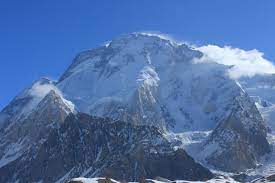
     Broad Peak.
My name is a physical descriptor
but my views
are broad too: I don’t care who or
what climbs me.
I welcome diversity. 
On July 23rd, 2016, a Frenchman
by the name of
Antoine Girard piloted a paraglider
over my head.
That’s a type of lightweight plane,
but I didn’t complain.
I never lodge objections with God.
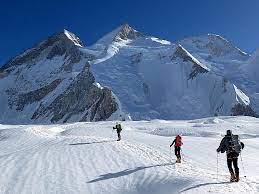
Courtesy: Creative Commons
     Gasherbrum II.
You have already met my brother a short
distance above.
He is above in height
as well as in his location in this poem. I
look up to him in
everything, true, but he isn’t what I want
to talk about today.
No, I wish to briefly mention the Duke of
the Abruzzi and
also a certain Vittorio Sella,
the former a brave aristocrat and intrepid
mountain explorer,
the latter the greatest photographer of high
peaks who ever held
a camera. Climbers wear trousers but their
breath comes in pants:
this pair arrived to reconnoitre me in 1909
and I was flattered,
at least to the greatest extent that any giant
is flattered by ants.

Courtesy: Creative Commons
     Shishapangma.
I was the last of the eight-thousanders
to be scaled, not because
I’m any harder to climb than I am to rhyme
but thanks to logistical
and political considerations. Less of that!
I wish to share with you
a little snippet that I find pleasant to think
about. When Tintin
was in Tibet, he travelled
with Captain Haddock towards me, looking
for a crashed plane. I
don’t recall either of them,
but I have been told their journey was true,
although they knew me
back then by my Sanskrit name, Gosainthan.

     Epilogue.
Mountains rise and fall
like empires or supposedly solid walls.
Postcards are more
ephemeral than either,
especially when written in verse.
That’s the curse of time.
But the Royal Geographical Society
is never averse
to receiving them from
any interesting global feature that cares
to write a few lines.

Rhys Hughes has lived in many countries. He graduated as an engineer but currently works as a tutor of mathematics. Since his first book was published in 1995 he has had fifty other books published and his work has been translated into ten languages.

.

PLEASE NOTE: ARTICLES CAN ONLY BE REPRODUCED IN OTHER SITES WITH DUE ACKNOWLEDGEMENT TO BORDERLESS JOURNAL

Click here to access the Borderless anthology, Monalisa No Longer Smiles

Click here to access Monalisa No Longer Smiles on Kindle Amazon International

Categories
Essay

A Salute to Ashutosh Bodhe

A tribute from Ravi Shankar to a fellow trekker & a recap of their adventures in the Himalayas

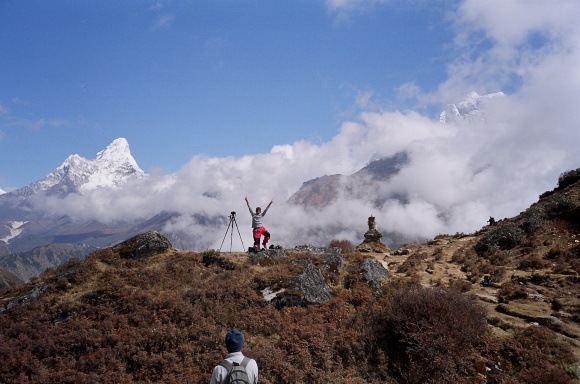
Ama Dulam and Lohtse peaks on the way to Everest. Photo courtesy: Ravi Shankar

A very fit and energetic person strode into my office. My good friend, Varun, accompanied and introduced him as a newly joined faculty member in the Physiology department at the Manipal College of Medical Sciences (MCOMS), Pokhara. My friend always called himself Ashutosh though he quickly became famous at MCOMS by his surname Bodhe.

Bodhe was always in perpetual motion. During our five years of close interactions, I rarely saw him sitting quietly in one place. He was a member of the college mess but rarely ate from there. I sometimes saw him around 2 or 3 pm having noodles and eggs from the private food stall located within the mess. He was fond of repairing things. He could put back together nearly everything — except maybe, broken hearts. His tool kit consisted of a soldering iron, screwdriver, screws, insulation tape, clamps, and a multimeter; rather strange appurtenances for a doctor.   

During my conversations with him, I came to know that he had always wanted to be an engineer and had secured admission into a premier engineering college in Mumbai, India. He also later qualified for admission to the medical course and his family insisted that he switch over to medicine. He would walk around the city of Pokhara, Nepal at strange times of the day and night. He would walk from the lakeside to the college campus after 10 pm. This seemed strange in a city that usually goes to sleep by nine.  

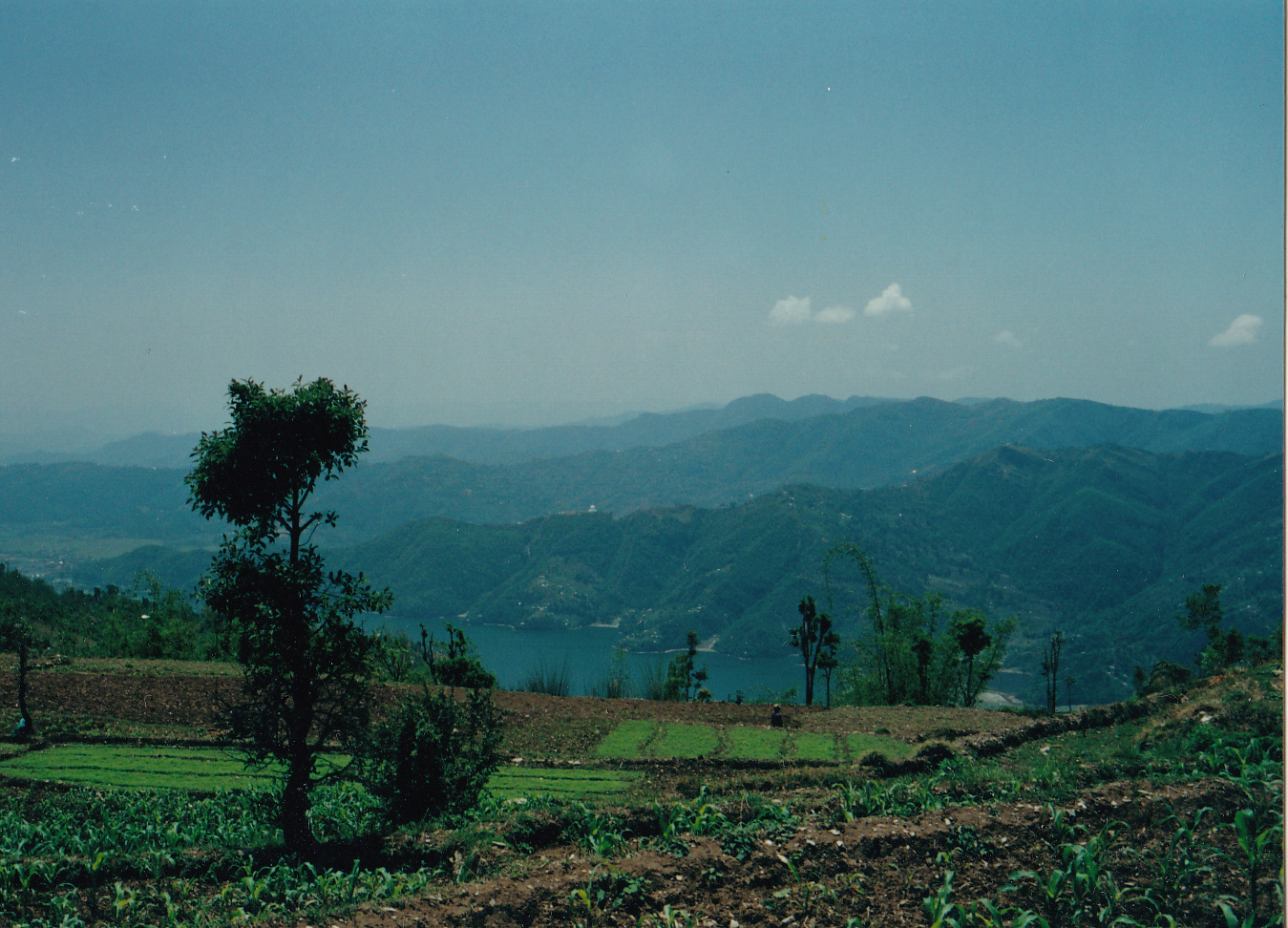
The hill overlooking the Fewa Lake. Photo Courtesy: Ravi Shankar

Bodhe, on occasions, also joined us on day hikes in the Pokhara valley. Pokhara is a trekker’s paradise. The walk up to the Shanti Stupa on the hill slopes overlooking the Fewa lake can be a good Saturday morning activity. Rowboats are available on the shore of Fewa Lake and are mainly used to visit the Tal Barahi temple located on an island in the middle of the lake. The stupa was built by a Japanese monk with the help of locals in the early 1970s. The stupa stands on Anadu hill in the onomatopoeic village of Pumdi Bhumdi and is a good hour’s climb. After the visit, you can climb down to Damside, continue to Lakeside, and return after a delicious lunch.

Boats on the shore of the Fewa Lake. Photo Courtesy: Ravi Shankar

Occasionally, Bodhe would join us on our Saturday walks to Lakeside. The walk would take about 90 minutes. We continued along the lake to a ‘Korean[1]’ restaurant. The restaurant constituted of small huts by the side of the lake with tables and chairs. It was a magnificent location for a feast! We used to have Nepali daal bhaat tarkari maasu (lentil curry, rice, vegetables and meat, usually chicken). In many Nepalese restaurants, food is usually prepared fresh after you order. The food takes around an hour to be prepared. This leaves plenty of time for conversation. The food by the lake was always fresh and piping hot. The country chicken was beautifully spiced, and the green leafy vegetables were perfect.

 Our other go-to place for lunch on Saturdays (the weekly off in Nepal) was the Pokhara Thakali Kitchen. Thakalis are originally from the Thak Khola (the upper Kali Gandaki River) around the Nigiri Himals to the north of Pokhara. They are successful businessmen and run some of the best hotels and restaurants in the country. I simply loved their rich, thick green daal and their potatoes fried in ghiu (clarified butter). The other specialty was dhido (a thick paste) made from either corn or buckwheat flour.

Bodhe, me, and a group of students hiked to the Everest Base Camp and Kala Pathar. We flew to Lukla (from Kathmandu) and the Tenzing Hillary airport at around 2800 m. This is one of the most dangerous airports in the world and accidents were not uncommon. The runway was only around 600 m and then it is a steep drop to the river below. We had lunch at a lodge in Lukla while we waited for our porters. Most hikers spent the first night on the trail at the settlement of Phakding. The first thing we noticed was that the Everest region was much colder than the Annapurna trekking region just north of Pokhara. A large portion of the hike is at heights of over 3000 m.

The peak autumn trekking season was underway and there were large groups of hikers on the trail. We were racing against each other to find a place for the night. Those were the days before online booking and land telephone and internet access were still not available in Khumbu.

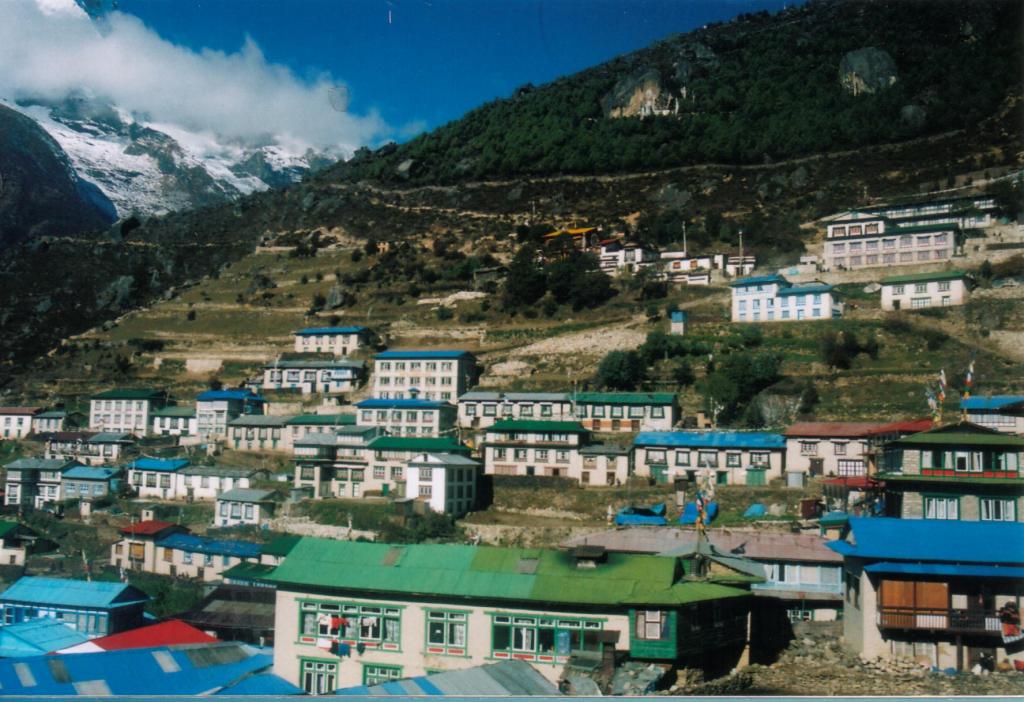
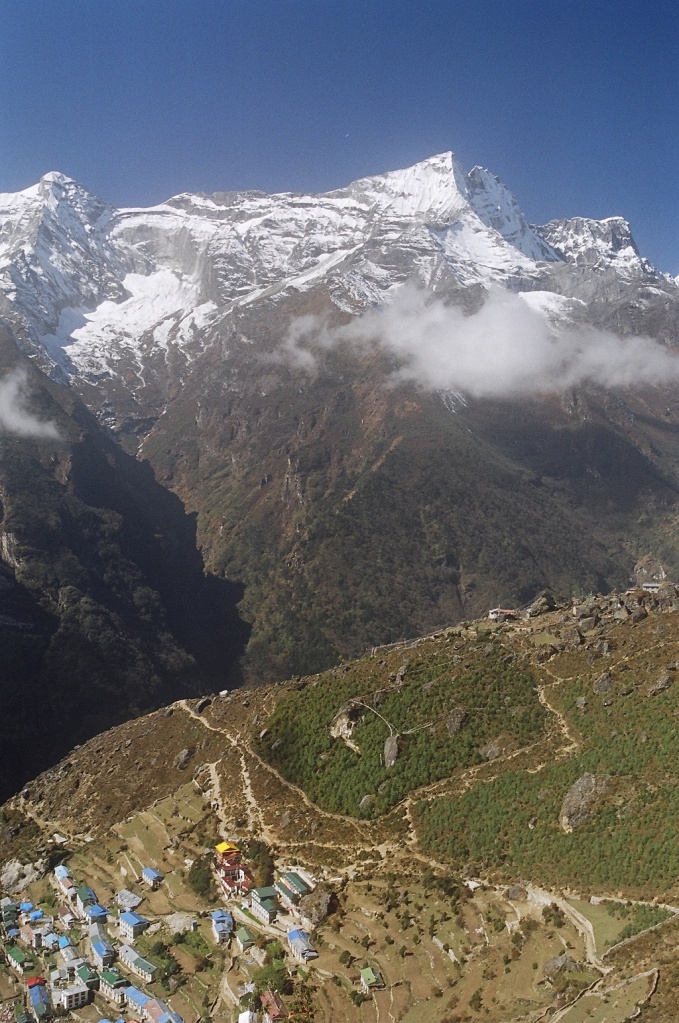
Namche Bazaar, the ‘Sherpa Capital’[2] was packed with tourists, and we were lucky to find rooms at a small lodge. The next morning dawned clear and frosty and the views of the Himals were spectacular. Bodhe, while chewing tobacco, was busy clicking photos and we were dancing vigorously to various songs. He really liked the song Kaanta laga[3]. He would reminisce about the wild morning and mention the ruckus we had created, chewing his usual wad of tobacco for he seemed addicted to the stuff.

Bodhe was a man with tremendous energy and a useful person to have on a long trek. He was impulsive and a practical joker but a kind soul with the energy to get going when the going becomes tough. He sprinted uphill on hikes and then climbed a tree or went off sprinting into the bushes. He did not reach a lodge or a settlement early as he was easily diverted by wayside attractions. He was fascinated by the term boche which stands for a flat land seen from a hilltop. In a very rugged and mountainous landscape, flat land is a coveted commodity. There are many boches in the Everest region – Pangboche, Deboche, Dingboche, Pheriche Tengboche among others.

We eventually reached the settlement of Gorak Shep at 5300 m. The weather was cloudy and freezing. The temperature was well below zero. We were shivering under our quilts in the lodge. It was the eve of Kojagiri Purnima[4], and the moon was beginning to rise. Bodhe motivated a group of students to carry and pitch a tent on the slopes of Kala Pathar (Black Stone) in the freezing cold. They donned all the winter clothing they had and spent the night on the rock photographing the world’s highest mountains in moonlight. The cold chilled their marrows and sleep was out of the question. They arrived around eight the next morning with wild stories of their hair-raising night.

We eventually returned to Lukla and reconfirmed our flight tickets for the following morning. Our flight was scheduled for eleven am and the last night at the lodge was a wild one. Bodhe was in full form and we were all relieved that the trek was over, and we were flying back to Pokhara. It was raining heavily the next morning and our flight was repeatedly delayed. Flights to and from Lukla are notoriously fickle. We were the last flight to take off as rainy weather closed in.

It was a long drive in the rain from Kathmandu to Pokhara. Clouds and mist draped the hills. Soon after reaching the hostel, one of the students who had joined us on the trek mentioned that the next day was a holiday as the roof of the Manipal Teaching Hospital had collapsed. We chided him for his fertile imagination but slowly realised that he was telling the truth. The hospital roof had collapsed that afternoon killing a few patients in the waiting area and seriously injuring a few others.

We hiked with Bodhe, some other faculty, and a few postgraduate students to the village of Ghandruk. Ghandruk (also called Ghandrung) is the second largest Gurung[5] village in Nepal. The hike was along a rocky riverbank and then through stone staircases. The sun was up full force and our trek to the village was hot. Mule trains raised dust clouds as they move up and down the trail. The village is the headquarters of the Annapurna Conservation Area Project (ACAP). There are several excellent lodges in the village and the Annapurna South and Hiunchuli Himals can be viewed from there. One of the finest lodges in the village was the Himalaya lodge, a Kerr and Downey resort located at the top of the village. The lodge was an additional twenty-minute hike, but it is well worth the effort. The views are stupendous and the rooms beautiful. They provide down jackets and slippers for the comfort of their guests. There was a good porch and a magnificent lawn in front. Bodhe absolutely loved this place.  

Sadly, Bodhe never stayed in touch after he left Pokhara. There were rumours of him working in the Caribbean, in Mauritius, and in different places in India. In a circuitous fashion, I came to know about his death last year. We do not know the details yet. Looking back on his life, I am reminded of so many unfulfilled promises. The man had a first-rate intellect and boundless energy. He could have achieved much only if he had been able to focus and channel his God-given gifts. But, he lived his life in his own terms. Dear friend, I sincerely hope you are finally at peace. Ashutosh Bodhe – tujhe salaam[6]!       


Bodhe

[1] The restaurant mainly catered to Korean tourists and used to serve primarily Korean food but also cooked Nepalese dal bhaat

[2] Most Sherpas are from the Namche region

[3] A thorn has pricked me

[4] Fullmoon in October – supposed to be auspicious

[5] An ethnic group that lives in the foothills of the Annapurna range and one of the groups recruited as Gorkha soldiers

[6] A salute to Ashutosh Bodhe

Dr. P Ravi Shankar is a faculty member at the IMU Centre for Education (ICE), International Medical University, Kuala Lumpur, Malaysia. He enjoys traveling and is a creative writer and photographer.

.

PLEASE NOTE: ARTICLES CAN ONLY BE REPRODUCED IN OTHER SITES WITH DUE ACKNOWLEDGEMENT TO BORDERLESS JOURNAL