Categories
Review

Reclaiming the Forgotten History of a Pioneer

Book Review by Bhaskar Parichha
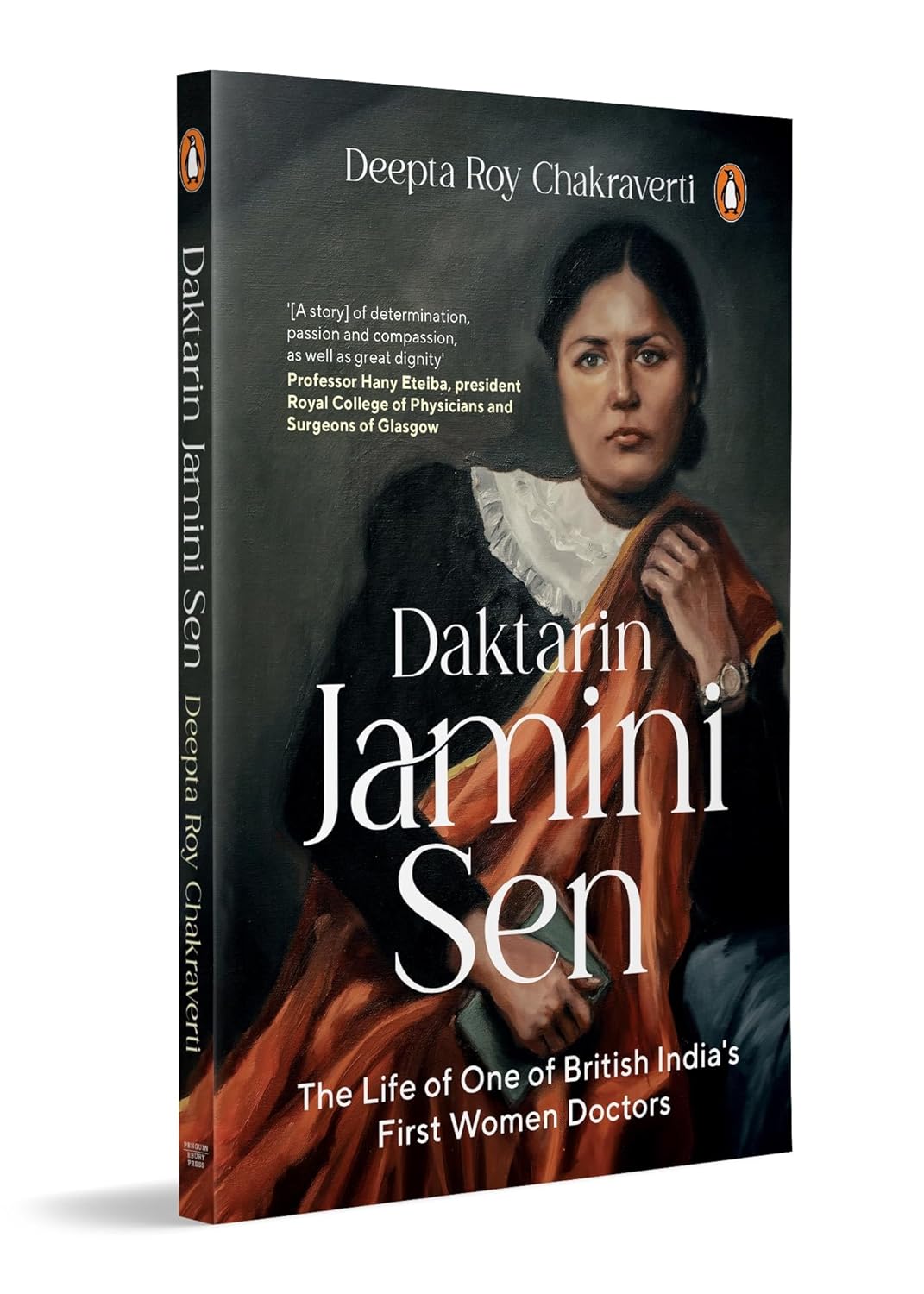
Title: Daktarin Jamini Sen: The Life of British India’s First Woman Doctor

Author: Deepta Roy Chakraverti

Publisher: Penguin/ EBURY PRESS

History often celebrates great events, revolutions, and institutions, yet it frequently overlooks individuals whose quiet determination helped shape the modern world.

Deepta Roy Chakraverti’s biography, Daktarin Jamini Sen: The Life of British India’s First Woman Doctor, seeks to restore one such remarkable figure to her rightful place in history. Through meticulous research and deeply personal storytelling, the book brings to light the life of a pioneering physician who challenged conventions, crossed borders, and carved a path for women in medicine at a time when such ambitions were rare.

Jamini Sen (1871- 1933) was among the earliest women doctors of British India and the first woman to become a Fellow of the Royal College of Physicians and Surgeons of Glasgow. In the late nineteenth and early twentieth centuries, when the world of medicine was overwhelmingly dominated by men, her achievement was nothing short of extraordinary. To study medicine, it required courage and determination; to excel in it and gain international recognition demanded a resilience that few possessed.

Chakraverti’s book traces Jamini Sen’s journey from the changing social landscape of Bengal to the complex and often dramatic world of royal Nepal. Born in a time when child marriage, strict gender roles, and social conservatism defined the lives of many women, Jamini’s life unfolded against the backdrop of a society in transition. The opening chapters evoke a Bengal negotiating between tradition and reform—where ideas of modern education, nationalism, and social change were beginning to challenge entrenched customs.

It was in this milieu that Jamini took her first steps toward a career in medicine. The path was far from easy. As a woman entering a profession dominated by men, she encountered skepticism, resistance, and prejudice. Yet the biography portrays her not as a passive victim of circumstance but as a determined individual driven by conviction and intellectual curiosity. Her pursuit of medical knowledge reflects both personal ambition and a broader spirit of reform that characterized parts of Indian society during the late colonial period.

One of the most fascinating phases of Jamini Sen’s career unfolded in Nepal. She was invited to serve as physician to the royal family during the reign of Prithvi Bir Bikram Shah. Nepal at that time was a kingdom cautiously opening its doors to modern influences, and Jamini’s presence there represented an important step in introducing modern medical practices to the royal court.

Serving in the palace required far more than medical skill. Court life was shaped by hierarchy, intrigue, and political sensitivities. Yet Jamini’s professionalism, discretion, and quiet confidence earned her the trust of the king and the respect of those around her. The biography suggests that her friendship with Prithvi Bir Bikram Shah was marked by mutual regard, and that she played a role in supporting his aspirations for a more modern Nepal.

But the story of Jamini Sen is not merely one of professional success. The book also reveals the personal costs that often accompany pioneering lives. Loss, loneliness, and emotional hardship form a recurring undercurrent in her journey. She endured the deaths of loved ones and navigated difficult relationships yet remained steadfast in her commitment to her work and her ideals.

Chakraverti’s narrative emphasises that Jamini’s resilience was rooted not only in determination but also in faith and introspection. Moments of spiritual reflection and philosophical questioning appear throughout the narrative, suggesting that her inner life was as complex as her public career. This dimension of the biography adds depth to the portrait of a woman who was not simply a medical pioneer but also a thoughtful and introspective individual.

The author’s own connection to the story lends the book a distinctive emotional resonance. Deepta Roy Chakraverti is the last of Jamini Sen’s descendants through the line of Jamini’s niece, Roma Sen Chakraverti. A lawyer educated at King’s College London with a first degree in mathematics from University of Delhi, Deepta writes not only as a historian but also as a custodian of family memory.

In the prologue, she reflects on the idea that our ancestors live within us—not only through blood and lineage but also through memory and spirit. Her decision to write about Jamini Sen arose from a growing sense of injustice. Why had a woman of such accomplishment been largely forgotten? Why had her life been reduced to little more than a historical footnote?

That question became the driving force behind the book. What began as a short story gradually expanded into a blog and finally into a full-length biography. Along the way, Chakraverti discovered family heirlooms, letters, and personal belongings passed down through generations—small fragments of the past that helped reconstruct Jamini’s life.

The author also drew upon anecdotes preserved in family memory and earlier Bengali writings by her great-aunt, Kamini Roy, which provided valuable insights into Jamini’s character and experiences. These sources give the narrative an intimate quality rarely found in conventional historical biographies.

Structured across twenty-five chapters, the book moves through the many stages of Jamini’s life—from her childhood in a changing Bengal to her years in Nepal, her struggles and triumphs in medicine, and the legacy she left behind. The chapter titles themselves hint at the drama and complexity of her life: ‘A Woman in a Man’s World’, ‘The Fight to Wield the Scalpel and Stethoscope’, and ‘Becoming British India’s Saree Wali Daktarin Sahib’.

A foreword by Hany Eteiba, President of the Royal College of Physicians and Surgeons of Glasgow, adds an important institutional recognition of Jamini Sen’s achievements. It situates her story within the broader history of global medicine and acknowledges the significance of her pioneering role.

Daktarin Jamini Sen is more than a biography. It is an act of historical recovery—a reminder that many women who challenged social boundaries and advanced professional fields were gradually erased from public memory. By reconstructing Jamini Sen’s life, Deepta Roy Chakraverti restores one such figure to the narrative of South Asian history.

Jamini Sen emerges from these pages as a courageous, intelligent, and deeply human figure—a woman who carried both the stethoscope and the burden of breaking barriers. Her story reminds us that the progress of society often begins with individuals who refuse to accept the limitations imposed upon them.

In telling that story, this book ensures that Jamini Sen will no longer remain a forgotten pioneer.

.

Bhaskar Parichha is a journalist and author of Cyclones in Odisha: Landfall, Wreckage and ResilienceUnbiasedNo Strings Attached: Writings on Odisha and Biju Patnaik – A Political Biography. He lives in Bhubaneswar and writes bilingually. Besides writing for newspapers, he also reviews books on various media platforms.

PLEASE NOTE: ARTICLES CAN ONLY BE REPRODUCED IN OTHER SITES WITH DUE ACKNOWLEDGEMENT TO BORDERLESS JOURNAL

Click here to access the Borderless anthology, Monalisa No Longer Smiles

Click here to access Monalisa No Longer Smiles on Amazon International

Categories
Conversation

‘Home has been a Process of Lifelong Search’

In Conversation with Kirpal Singh

Dr Kirpal Singh

 “Singapore is intimately linked with home and, yet for me, home has always been a process of lifelong search. Partly because of the early months of my birth. The record says I was born in March 1949, but the time was not certain as I do not have a birth certificate. My father forgot to register my birth,” reminisces Dr Kirpal Singh, an internationally recognised scholar. Born in the Straits Settlement of Singapore, before the island emerged as an independent entity, he has lived through much of history. He tells a story of multi-racial, multi-cultural growth that the island afforded him.  

His father, he tells us, was “well known throughout Malaya — Jeswant Singh nicknamed as ‘Just One’ — a boxer who would knock people down with his left hook. In 1954, he left boxing when he killed someone during a match.” His mother, a Jewish Scot who he cannot recollect, he tells us, “ might have been David Marshall’s sister according to my stepsister but no one else has said that.”  Marshall[1] was the first Chief Minister of Singapore from 1955 to 1956 and then Singapore’s Ambassador to France, Portugal, Spain, and Switzerland 1978 to 1993. He is the founder of the Worker’s Party. His parents had emigrated from Baghdad to Singapore in 1908 according to current resources.

How did Singh’s parents come to be in Singapore? Were they immigrants or colonials?

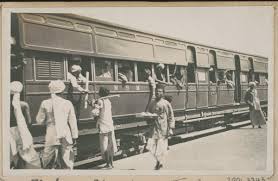
He responds with what he knows: “My grandfather and grandmother came to Singapore on board a ship in 1900. They left Jullunder, Punjab, in 1899. By the time they reached Singapore, it was the end of 1900. They left to seek their fortune. They were from the farming community. My grandfather was only sixteen and my grandmother was about twelve. They were in transit in Penang for six months. They came to Singapore in 1901. Actually, it was all Malaya — Singapore was part of the Straits Settlement. They came to Singapore by train. Trains were just starting out. It was around August 1901.

Trains in Malaya

“My uncle was conceived during this journey. They halted in Singapore for only two or three weeks. My grandfather’s cousin was in Perak[2], in Malaya. So, he wanted to be with his cousin. His cousin had cattle. Most of the Sikhs were cattle farmers. They settled in Pahang[3], an area which eventually became a nuclear dump[4] for Australia. It is closed to public now. There was a stone that proclaimed the land was a nuclear dump when I went with my son a few years ago.

“My father moved to Singapore as his prospects were better here as a boxer. This is where he met my mother. I was born here. He actually met mum because my mother’s two brothers had invited her to come from Glasgow. My mother is Scottish, from an industrial background. Her brothers came to the Far East to make money.  She finished her school leaving exams and came to visit her brothers during her vacation. She would go with her bothers to watch boxing, where she saw my father, the champ. She was only fifteen or sixteen. The next thing the brothers knew was she was pregnant with me.”

Jeswant Singh was popular with colonials. Kirpal Singh tells us: “Some Europeans saw him box and offered him a job then in the Base Ordinance Depot. This was the British Military camps in the Far East. There were three bases in Singapore: the naval base, Kranji and one in the South. He worked there for thirty years and retired after that. In 1972[5], after the final British withdrawal from Singapore, dad’s formal employment status ended. After that he just did odd jobs, ending up as a security guard, looking after the factories in Jurong, earning about two to three hundred dollars a month.”

Kirpal Singh spent his childhood with his grandmother and uncle. Before he started schooling, his father left him with his grandmother and divorced his mother in favour of a new bride. Dr Singh tells us the story of how he returned to Singapore: “I was basically in Perak with my grandmother. My uncle, who was the first Sikh to become a Christian in Southeast Asia, left home because his father gave him a beating for changing his religion. My uncle was an Anglican. His conversion saved him from the Great Depression as the clergy was very well looked after. From 1929 to 1933, the church looked after him because he was the priest in Seramban. My father was still young. My uncle was born in 1911 and my dad in 1923. My grandmother bore eighteen children. Five of the infants passed away before they were one month old. But thirteen survived. She passed away at 95… I knew when I left for my doctorate programme in Adelaide that that was the last time I would see her. I had a hunch and was crying on the plane. Six weeks later, I got a letter with the news of her death.”

He adds: “Dad was in not in a position to look after me. The responsibility fell on his brother William. His full name was William Massa Singh s/o Deva Singh. He had studied at the Ipoh Chinese school, topped the school, eventually worked as an insurance agent. He was very good in English. The principal of his school, a New Zealander, arranged for my uncle to move to Singapore. Then my father moved there too. Singapore was the metropolis even then. It was the centre of English education. Penang was the other one. In 1956, I was sent to Singapore from Perak on a train — a one-and-a-half-day journey to my uncle.”

His grandmother joined them within a few months as his uncle was, he says, “more interested in aiding Lee Kuan Yew get rid of the colonials. Lee Kuan Yew was a self-made man. He met Goh Keng Swee[6] and Rajaratnam[7] as students in England. They became buddies and wanted to move out of colonial rule and be independent.”

Then, how did a young child survive? Dr Singh tells us: “I used to earn my pocket money from age five six by watering gardens. I have had very interesting experiences. When I was in primary two, I used to give tuition to primary one students. With enough gumption, you can survive in this world.”

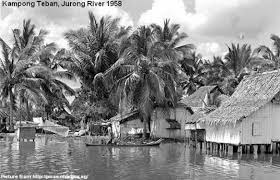
“I grew up with my uncle’s wards, who were brought home to be educated. There was even one who was a Chinese-Japanese mix. So, I grew up being familiar cross-cultural marriages and in a multicultural home. I grew up in the kampong with a Chinese boy and we became friends from the age of seven-and-a-half when we were in primary two. His name is Tan Jwee Song — I call him Jwee, ‘my good saint’.  He told me after O-levels he would support me to study further and took to teaching. At that time, you could become a teacher after completing your O level. I joined Raffles late during my time in high school because it was too expensive for me. I taught in night classes started by Lee Kuan Yew and studied. I owed Jwee $80,000 dollars and I wanted to pay his widow back — but she would not accept it. When I graduated in 1973 with an honours’ degree, I was $44 thousand in debt. Then, I was given a scholarship.”

And slowly, Kirpal Singh came to his own. When television came into being, he tells us: “I was often on TV in 1970s — days of early television — debates and interviews as a guest.” Kirpal Singh grew into an intellectual of repute as he worked and studied with the support of the many races and many people who, often like him, were migrants to Singapore.

As time moves forward, these stories — that are almost as natural as the sand, the wind and the sea — ask to be caught in words and stored for posterity, stories from life that show how narrow borders drawn by human constructs cannot come in the way of those with ‘gumption’.

(Written by Mitali Chakravarty based on a face to face conversation with Kirpal Singh. Published with permission of Kirpal Singh)

[1] https://www.roots.gov.sg/stories-landing/stories/david-marshall/story

[2] Now in Malaysia

[3] Now in Malaysia

[4] https://buletinonlines.net/v7/index.php/lynas-radioactive-waste-to-be-dumped-in-pahang-tax-free-while-australia-gets-a18-million-in-taxes-2/

[5] The British armed forces were scheduled to withdraw from Singapore by 1971. https://eresources.nlb.gov.sg/infopedia/articles/SIP_1001_2009-02-10.html#:~:text=On%2018%20July%201967%2C%20Britain,Singapore%27s%20defence%20and%20economic%20security.

[6] Deputy Prime Minister of Singapore, 1973-1980, one of the founding members of the ruling PAP (People’s Action Party) https://www.roots.gov.sg/stories-landing/stories/goh-keng-swee/story

[7] Deputy Prime Minister of Singapore from 1980 to 1985, one of the founding members of the ruling PAP https://www.roots.gov.sg/stories-landing/stories/sinnathamby-rajaratnam/story

PLEASE NOTE: ARTICLES CAN ONLY BE REPRODUCED IN OTHER SITES WITH DUE ACKNOWLEDGEMENT TO BORDERLESS JOURNAL. 

Click here to access the Borderless anthology, Monalisa No Longer Smiles

Click here to access Monalisa No Longer Smiles on Kindle Amazon Internation