Categories
Musings

Migrating to Myself from Kolkata to Singapore

By Asad Latif

Sir Stamford Raffles (1781-1826). Courtesy: Creative Commons

May I be so bold as to claim that I travelled in the footsteps of Sir Stamford Raffles? That agent of the East Indian Company’s visit to Calcutta (as it was known then, and for much later, till it resumed the phonetic spelling of its original name), led him to set up Singapore as an English trading settlement in 1819. “Footsteps” would be the wrong metaphor, of course. “Seasteps” would have been accurate, since Raffles travelled to Calcutta by sea and arrived water-borne to Singapura (as it was known then). In my case, however, I arrived in Singapore sky-borne, in an aircraft that conveyed me from what was then home to what would become home. Footsteps, seasteps or airsteps, I arrived in Singapore. The year was 1984. I was 27.

Today, at 65, I remember my passage from back home to this home as if it occurred yesterday. I had worked in Hong Kong briefly in 1984 and had been exposed to life in a successful British colony that was in the throes of its return to Chinese rule. Singapore was different. It had merged with the Malaysian Federation in 1963, had separated from it in 1965, and had gone on to carve out an extremely successful space for itself in the international sphere.

Prime Minister Lee Kuan Yew was a household word in Singapore. Not everyone loved him, but no one could deny his singular agency in having created a magnificent city-state that could sustain its independence in spite of its lack of natural resources. To arrive in Singapore was to embrace the possibilities of time.

Calcutta, too, was a historical city par excellence, but its rundown buildings and potholed streets, to say nothing of its potbellied children living on homeless streets, belied the promise of the future. To arrive in Singapore, it appeared, was to have exchanged failure for success.

That was an illusion, of course. All expatriates suffer from a global disease: They latch on to what they love in their countries of arrival by trying to erase what had loved them in their countries of departure. Take the potholed streets of Calcutta, for example. They had conveyed me to College Street on that glad day in 1974 when I joined the English Department of Presidency College. Without that first footfall in the corridors of the greats, I might never have come to Singapore, never got my Chevening Scholarship to Cambridge, my father’s university, and never won the Fulbright to Harvard. The potholes of Calcutta are not as numerous as the culturally blind allege them to be. Nevertheless, they led me on the way to be myself, wherever on earth I would ultimately be.

The way I see it, no matter how far or close wanderings might lead, one migrates ultimately to oneself. Hence, when I left my Calcutta for what would become my Singapore, I did no more than search for a version of my selfhood that would extend my material and imaginative boundaries. In the course of my journey, I discovered that the only borders lie within, borders between being and becoming. In the process of becoming by winnowing the unwanted aspects of being, one returns to a renewed if only autumnal sense of being. Time passes. One passes with it, letting go of the distant past as much as one does the receding immediate past. To live is to gather the passage of time within oneself, hoping that all borders will merge into a lasting apprehension of oneself in the expanding fullness of a single world.  

Calcutta and Singapore are two sides of me. These two great imperial cities have outlived their provenance. Calcutta was once the capital city of colonial India: Today it remains the nation’s cultural capital but political power resides in Delhi (naturally) and there are at least two economic capitals, Mumbai and Chennai. This is why I, along with many of my hapless fellow-Bengalis, suffer from an incurable cultural fetish for the past. That was when the Almighty spoke Bengali – He appears to be switching increasingly to Hindi – and was busy creating top-class poets and formidable social reformers in Bengal. The divine supply of poets and composers has not ebbed but the demand-side having moved to Mumbai, many of the best composers have shifted there and to make a name for themselves. Never mind. Their names remain Bengali, and their fame spreads the vintage mystique of Calcutta like a lingering perfume in India and beyond. I feel happy for the Calcutta part of me.

Singapore, a great trading post, is a now a city-state. Statehood has allowed the nascent nationalism of the colonial era to flourish and grow into a genuine sense of political self. Sovereign Singapore was not expected to survive, but it has done so with a definitiveness that makes the prognoses of the 1960s laughable today.  The national self-confidence of Singapore gives me confidence in my decision to take up Singapore citizenship in 1999. It had not been an easy decision, but I took it when I realised that I would be giving up my Indian citizenship but not my Indian-ness. My Singapore Identity Card records my race as Indian. I could keep the Calcutta part of me intact while adding to it a new Singaporean me.

So, yes, I am grateful that Raffles travelled to Calcutta to set up Singapore. Obviously, he did not do so with my fortunes in mind, but the umbilical connection that he created between the two great port cities has made it easier for me to migrate from India to Singapore. Ultimately, I have done nothing more than migrate to me.  

    .


 Asad Latif is a Singapore-based journalist. He can be contacted at badiarghat@borderlesssg1

PLEASE NOTE: ARTICLES CAN ONLY BE REPRODUCED IN OTHER SITES WITH DUE ACKNOWLEDGEMENT TO BORDERLESS JOURNAL. 

Click here to access the Borderless anthology, Monalisa No Longer Smiles

Click here to access Monalisa No Longer Smiles on Kindle Amazon International
Categories
Tagore Translations

The Funeral: A skit by Rabindranath

Translated from Bengali by Somdatta Mandal, this satirical skit[1] was part of Hasyakoutuk (1914) or Humour by Tagore

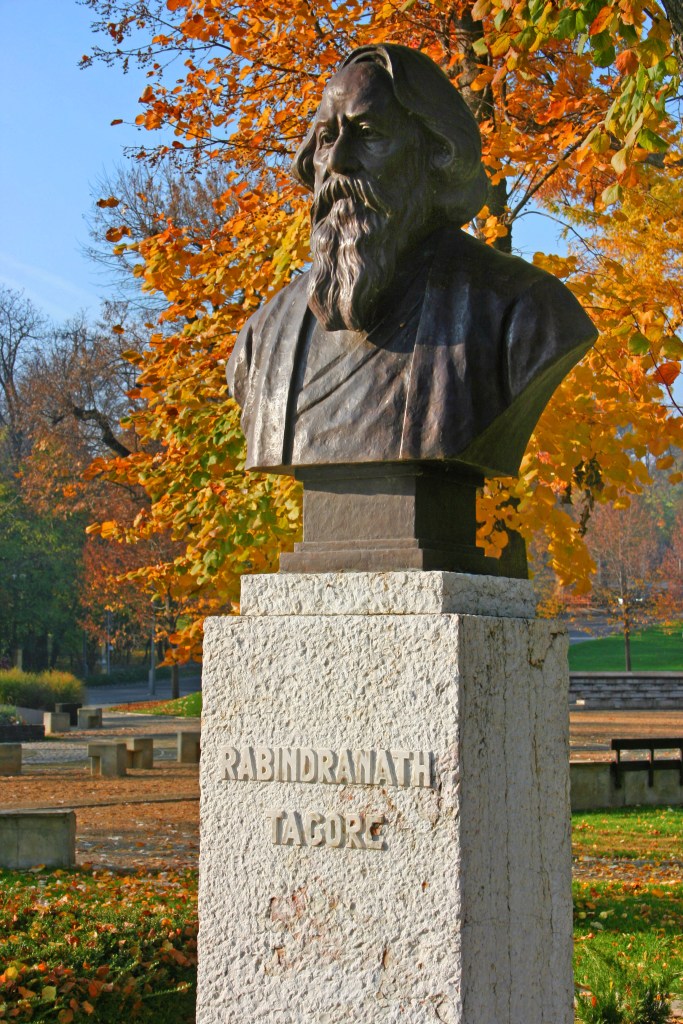
Rabindranth’s bust in  Hungary, Balatonfüred, Tagore promenade

Scene One

Ray Krishnakishore Bahadur is lying on his deathbed. His three sons Chandrakishore, Nandakishore and Indrakishore are busy consulting each other. A doctor is present. The women are close to tears.

Chandra: Who are the people we should write to?

Indra: Write to Sir Reynolds.

Krishna: (With great difficulty) What will you write, son?

Nanda: The news of your death.

Krishna: But I am not yet dead, son.

Indra: You might not die right now, but we have to fix a time for the event and write that down…

Chandra: We should collect the condolence letters from all the Englishmen here and get them published in newspapers. No point in publishing them when all the excitement is gone!

Krishna: Patience boys; let me die first.

Nanda: We can’t wait, father. Let’s make a list of the letters to be sent to the people in Shimla and Darjeeling. Come on, let’s get all the names down.

Chandra: The Governor, Sir Ilbert, Sir Wilson, Beresford, Macaulay, Peacock –

Krishna: Boys, what names are you chanting so close to my ears? Chant God’s name instead. When the time comes, He is the only one who can save us! Hari –

Indra: Yes, good thing that you reminded us, we forgot to include Sir Harrison.

Krishna: My sons, say Ram, Ram –

Nanda: Really, I had forgotten about Sir Ramsey.

Krishna: Narayan, Narayan!

Chandra: Nanda, write down the name of Sir Noran also.

Enter Skandakishore.

Skanda: So, you people seem so relaxed! You still haven’t done the real thing!

Chandra: And what is that?

Skanda: We have to inform in advance all the people who will be part of the procession going to the funeral ghat.

Krishna: Sons, which one do you consider the real thing? First, I’ll have to die, only then –-

Chandra: No worries on that account. Doctor!

Doctor: Yes sir!

Chandra: How much time is left for father to go? When do the public have to be here?

Doctor: Perhaps–

The women start wailing.

Skanda: (Disgusted) Ma, will you stop it? You’re creating quite a scene!  It’s better to sort out everything in advance. When doctor?

Doctor: Most likely this night at—

The women start wailing again.

Nanda: This is a huge problem! You shouldn’t disturb us during work. What do you think your crying will accomplish? We are planning to publish condolence letters sent by important Englishmen in newspapers.

The women are sent out.

Skanda: Doctor, what do you think?

Doctor: From what I can see I think he will expire around four a.m.

Chandra: Then there is no time – Nanda, go quickly, get the slips printed at once right in front of your eyes.

Doctor: But first mustn’t the medicine—

Skanda: Look here! Your medicine shop will not run away. On the other hand, we’ll be in trouble if the print ring shop shuts down.

Doctor: Sir, the patient might not —

Chandra: That is why you must hurry. For who knows what might happen if the slips are printed before the patient —

Nanda: Here I go.

Skanda: Write down that the procession will begin at eight tomorrow.

 Scene Two

Skanda: What, doctor? It’s already seven now instead of four.

Doctor: (Apologetically) Yes, yes, amazing the pulse is still strong.

Chandra: You are a fine one doctor to have got us into this mess!

Nanda: Everything went wrong when I was late in bringing the medicine. In fact, dad began to recover as soon as the doctor’s medicine was stopped.

Krishna: All this time you were so very cheerful, why is everyone looking so glum all of a sudden? I am feeling fine now.

Skanda: We aren’t feeling that great. We had already finalized all preparations to go to the funeral pyre.

Krishna: Is that so? I guess I should have died.

Doctor: (Feeling irritated) Do one thing and that will solve all problems.

Indra: What?

Skanda: What?

Chandra: What?

Nanda: What?

Doctor: Instead of him why don’t one of you die when the time is ripe.


Scene Three

A lot of people have assembled in the outer house.

Kanai: Hello, It’s already eight thirty. Why are you all late?

Chandra: Please sit down. Have some tobacco.

Kanai: I’ve been [chewing] tobacco from the morning!

Bolai: Where is everybody? I can’t see signs of any arrangements being made.

Chandra: Everything is ready – it’s not our fault – now only—

Ramtaran: Hey, Chandra, we shouldn’t waste any more time.

Chandra: Don’t I understand that – but—

Harihar: What is causing the delay? We’ll be late for office, what’s the matter?

Indrakishore enters.

Indra: Don’t be impatient. We are almost ready. In the meantime, why don’t you read the condolence letters?

He distributes them.

This is from Lambert, this from Harrison, this is Sir James’s—

Skandakishore enters.

Skanda: Here take them. In the meantime, read the obituary notices on father in the newspapers. Here is The Statesman, here The Englishman.

Madhusudan: (To Yadav) Isn’t this typical? Bengalis won’t ever learn what punctuality is all about.

Indra: You’re absolutely right. They will die and yet never learn to be punctual.

The guests shed tears reading the newspapers and the condolence messages.

Radhamohan:  (in tears) Oh God, the poor man’s friend!

Nayanchand:   Alas! To think that even such a good man has his share of troubles.

Nabadwipchandra: (in a deep breath) Lord! Everything is your will!

Rasik:‘The lotus that blooms in the heart’ – I’m forgetting what comes after that –

                        ‘The lotus that blooms in the heart

                        Has been plucked untimely

                        The lotus heart sinks in the sea of sorrow!’

This is exactly the case here. The lotus heart in the sea of sorrow. How sad! Add esquire. O tempora! O mores[2]!

Tarkabagish[3]: Challchittang challadbittang, challajiwan – The mind is inconsistent, wealth is transitory and one’s life is perishable. Oh how sad!

Nyayabagish[4]: Yadupathe kri gata mathurapuri, raghupate – Where is the city of Mathura that belonged to the Lord of the Yadavas (i.e. Krishna), to the Lord of the Raghus (i.e. Rama Chandra)? (chokes)

Dukhiram: Oh Krishnakishore Bahadur, where have you gone?

 A faint voice can be heard from within:  I am here. Please, don’t shout.  


[1] [Translated from “Antyashti-Satkar” in the Hasyakoutuk series Bhadra 1293 B.S. by Somdatta Mandal].

[2] “Oh the times! Oh the customs!” – Latin phrase, first recorded to have been spoken by Cicero

[3] Bengali title given to an expert debator

[4] Bengali title given to a legal expert

Somdatta Mandal is a former Professor of English and ex-Chairperson, Department of English, Visva-Bharati, Santiniketan, India. A recipient of several prestigious fellowships like the Fulbright Research and Teaching Fellowships, British Council Charles Wallace Trust Fellowship, Rockefeller Residency at Bellagio, Italy, Salzburg Seminar and Shastri Indo-Canadian Faculty Enrichment Fellowship, she has been published widely both nationally and internationally. She has also an award from Sahitya Akademi for the All India Indian Literature Golden Jubilee (1957-2007) Literary Translation Competition in the Fiction category for translating short stories series ‘Lalu’ by Sarat Chandra Chattopadhyaya.

.

PLEASE NOTE: ARTICLES CAN ONLY BE REPRODUCED IN OTHER SITES WITH DUE ACKNOWLEDGEMENT TO BORDERLESS JOURNAL

Categories
Author Page

Somdatta Mandal

Somdatta Mandal is a former Professor of English and ex-Chairperson, Department of English, Visva-Bharati, Santiniketan, India. A recipient of several prestigious fellowships like the Fulbright Research and Teaching Fellowships, British Council Charles Wallace Trust Fellowship, Rockefeller Residency at Bellagio, Italy, Salzburg Seminar and Shastri Indo-Canadian Faculty Enrichment Fellowship, she has been published widely both nationally and internationally. She has also an award from Sahitya Akademi for the All India Indian Literature Golden Jubilee (1957-2007) Literary Translation Competition in the Fiction category for translating short stories series ‘Lalu’ by Sarat Chandra Chattopadhyaya.

Interview

Where the Whole World Meets in a Single Nest

In Conversation with Somdatta Mandal, a translator, scholar and writer who has much to say on the state of Santiniketan, Tagore, women’s writing on travel and more. Click here to read.

Translations

Baraf Pora (Snowfall) 

This narrative gives a glimpse of Tagore’s first experience of snowfall in Brighton and published in the Tagore family journal, Balak (Children), has been translated by Somdatta Mandal . Click here to read.

 Himalaya Jatra ( A trip to Himalayas) 

This narrative about Tagore’s first trip to Himalayas and beyond with his father, has been translated from his Jibon Smriti (1911, Reminiscenses) by Somdatta Mandal. Click here to read.

Travels of Debendranath Tagore 

These are travel narratives by Debendranath Tagore, father of Rabindranath Tagore, translated from Bengali by Somdatta Mandal. Click here to read.

Travels & Holidays: Humour from Rabindranath

Translated from the original Bengali by Somdatta Mandal, these are Tagore’s essays and letters laced with humour. Click here to read.

Letters from Japan, Europe & America

An excerpt from letters written by Tagore from Kobi & Rani, translated by Somdatta Mandal. Click here to read.

Letters from Tagore

An excerpt from Kobi’ and ‘Rani’: Memoirs and Correspondences of Nirmalkumari Mahalanobis and Rabindranath Tagore, translated by Somdatta Mandal, showcasing Tagore’s introduction and letters. Click here to read.

A Bengali Lady in England by Krishnabhabini Das

An excerpt from Somdatta Mandal’s translation of A Bengali Lady in England by Krishnabhabini Das (1885). Click here to read.

Playlets by Rabindranath Tagore 

Two skits that reveal the lighter side of the poet. They have been translated from Bengali by Somdatta Mandal. Click here to read.

The Ordeal of Fame

A humorous skit by Rabindranath, translated by Somdatta Mandal. Click here to read.

The Funeral

A satirical skit by Tagore, translated by Somdatta Mandal. Click here to read. 

Tagore’s Gleanings of the Road

Book excerpt brilliantly translated by Somdatta Mandal. Click here to read.

The Welcome

A skit by Tagore, has been translated by Somdatta Mandal. Click here to read.

 The Treatment of an Ailment

A humorous skit has been translated by Somdatta Mandal. Click here to read.

Essay

Bengaliness and Recent Trends in Indian English Poetry: Some Random Thoughts

Somdatta Mandal browses over multiple Bengali poets who write in English. Click here to read.

Book reviews

Somdatta Mandal reviews Wooden Cow by T. Janakiraman, translated from Tamil by Lakshmi Kannan. Click here to read.

Himadri Lahiri reviews Somdatta Mandal’s ‘Kobi’ and ‘Rani’: Memoirs and Correspondences of Nirmalkumari Mahalanobis and Rabindranath Tagore. Click here to read.

A review by Meenakshi Malhotra of Somdatta Mandal’s The Last Days of Rabindranath Tagore in Memoirs, a translation from a conglomeration of writings from all the Maestro’s caregivers. Click hereto read.

Somdatta Mandal has reviewed BM Zuhara’s The Dreams of a Mappila Girl: A Memoir, translated from Malayalam by Fehmida Zakir. Click here to read. 

Somdatta Mandal has reviewed Shehan Karunatilaka’s The Birth Lottery and Other Surprises. Click here to read. 

Somdatta Mandal reviews  The Shaping of Modern Calcutta: The Lottery Committee Years, 1817 – 1830by Ranabir Ray Chaudhury. Click here to read.

Somdatta Mandal reviews Priya Hajela’s Ladies Tailor: A novel. Click here to read. 

Somdatta Mandal reviews Sudeshna Guha’s A History of India Through 75 Objects. Click here to read. 

Somdatta Mandal reviews Baba Padmanji’s Yamuna’s Journey, translated from Marathi by Deepra Dandekar. Click here to read.

Somdatta Mandal reviews Chitra Banerjee Divakaruni’s Independence. Click here to read.

Somdatta Mandal reviews KR Meera’s Jezebel translated from Malayalam by Abhirami Girija Sriram and K. S. Bijukumar. Click here to read.

Somdatta Mandal reviews Behind Latticed Marble: Inner Worlds of Women by Jyotirmoyee Devi Sen, translated from Bengali by Apala G. Egan. Click here to read.

Somdatta Mandal reviews The Past is Never Dead: A Novel by Ujjal Dosanjh. Click here to read.

Somdatta Mandal reviews Amitav Ghosh’s Smoke and Ashes: A Writer’s Journey Through Opium’s Hidden Histories. Click here to read.

Somdatta Mandal reviews Begum Hazrat Mahal: Warrior Queen of Awadh by Malathi Ramachandran. Click here to read.

Somdatta Mandal reviews Usha Priyamvada’s Won’t You Stay, Radhika?, translated from Hindi by Daisy Rockwell. Click here to read.

Somdatta Mandal reviews Ali Akbar Natiq’s Naulakhi Kothi, translated from Urdu by Naima Rashid. Clickhere to read.

Somdatta Mandal reviews Indian Christmas: Essays, MemoirsHymns, an anthology edited by Jerry Pinto and Madhulika Liddle. Click here to read.

Somdatta Mandal reviews Sudha Murty’s Common Yet Uncommon: 14 Memorable Stories from Daily Life. Click here to read.

Somdatta Mandal reviews The History Teacher of Lahore: A Novel by Tahira Naqvi. Click here to review.

Somdatta Mandal reviews Ilse Kohler-Rollefson’s Camel Karma: Twenty Years Among India’s Camel Nomads. Click here to read.

Somdatta Mandal reviews Radha Chakravarty’s translation of Selected Essays: Kazi Nazrul Islam. Click here to read.

Somdatta Mandal reviews Maya Nagari: Bombay-Mumbai A City in Stories, edited by Shanta Gokhaleand Jerry Pinto. Click here to read.

Somdatta Mandal reviews Knife:  Meditations After an Attempted Murder by Salman Rushdie. Click here to read.

Somdatta Mandal reviews Upamanyu Chatterjee’sLorenzo Searches for the Meaning of Life. Click hereto read.

Somdatta Mandal reviews Karan Mujoo’s This Our Paradise: A Novel. Click here to read.

Somdatta Mandal reviews Ammar Kalia’s A Person Is a Prayer. Click here to read.