
Categories
Stories

The Useless Idler

By Paul Mirabile

Alhambra Palace, Spain. From Public Domain

No one knew his name nor wished to know it. Only his face attracted those who came into contact with him. So it was said. A face whose huge, glowing eyes were turned both inwards and outwards, simultaneously. A face whose florid complexion, cheery and unfurrowed, bespoke a life of leisure, albeit not one of procrastination; a life of ease, but not sloth. In short, a life of early, unfought for independence.

I met my nameless stranger one fine autumn day in the Andalucian town of Granada, Spain, where he had been residing for several months, visiting the Alhambra Palace every day during those months. We had met in a small, non-distinct eatery, and he was very willing to converse with anyone who had leisure to tete a tete. We fell into lively conversation. Taken aback by his daily visits to the remarkable Palace, I enquired why he spent so many hours there.

“The Palace was built as a sign of religious, political and cultural power,” he began, munching energetically on his paella of rabbit. “But since 1492, that sign has been condemned to utter uselessness, reduced to a mere tourist attraction, however noteworthy. It has become completely useless since its mediaeval abandonment  because it’s been drained of its original value.” Here he paused, I imagine, for me to intercede. I didn’t …

“You see, this is what attracts me most to the Alhambra; its utter uselessness for our world today. I do not consider mass tourism as an instrument of usefulness.” I kept silent to goad him on, for the turn of conversation piqued my curiosity.  “The Alhambra epitomises all that I have spent my own life experiencing, consciously: the pleasures of uselessness.”

“Is uselessness a pleasure?” I nettled with a sunny smile.

“That depends upon whom it has been bestowed, sir. That depends for whom it has benefitted. The circumstances of my life and will to understand and decipher them, have conspired to draw me now into and outside of myself. My own self has become as useless as the objects that I set my eyes on each and every day as I saunter through the streets, gardens or palaces of wherever I happen to be. I have realised that such an absorption into social uselessness, and thus distance from social use, has constituted my raison d’être. And there lies the pleasure: this mode of existence is a project of life; a pure project of pleasurable uselessness to society and to myself.” His face, alit with integrity, bent low to attack the chorizos cooked in white wine sauce.

“When did you begin experimenting your project?” I asked, sipping my sangria.

“I would formulate it differently: When did uselessness experiment me!” he mumbled, his mouth full of chorizo. “It all began in Africa some thirty or forty years back, during my youthful days wandering through the Sahara desert en route to Timbucktoo. The Blue Men of the Sahara appeared absolutely useless to anyone or anything that we Europeans would call useful.”

“Such as?”

“Well, a roof over one’s head, a shower every hour, a steady, well-paid job, a car and such things … what we Europeans would term as useful, conditioned to adhere to the philosophy of infinite progress; to infinite social and political usefulness. All the Blue Men seemed to require were a few hours of sleep, food, water and the desire to procreate. Needs that all mankind need so as to account for our very presence on Earth. I lived in the desert for over a year, and little by little discovered that this lifestyle suited a possibility of existence, a life not of a desert-nomad mind you, but one of a useless idler, which as time went by, proved possible, be it in the cities of Europe and Asia or in their countryside towns and villages.”

“As I understand it, social success has no meaning for you at all?”

“Not at all. Success only invites humiliation or cruel jealousy, and the pursuit of wealth is a path marked by ruthlessness. I earn my living simply to eat, to dress according to the climate, to have a roof over my head when needed.”

“But a roof over one’s head could be expensive…” I intervened.

“I spend most of my nights out under the stars when the weather is warm. With the coming of winter, I seek refuge in Catholic missions, poor men’s shelters or in the numerous Salvation Army shelters. Any asylum that will not turn me down. As far as any permanent residence, I have taken up lodgings in the homes of generous people for a meagre fee, or have laboured on farms for my food and bed. Do not confuse uselessness with doing nothing. I’m no couch potato; I have done many things, but they do not fit into our social machine of imposed well-being. My life may appear negative to those who hold me in contempt, but my usefulness is as useful to mankind as it is to myself. Don’t forget what one Belgium writer once wrote: ‘It is thanks to a certain number of men who seem useless that there will always be a certain number of useful men.’”

“Who wrote that?”

“I forgot. But what difference does it make?” He wiped his mouth delicately, smacking his lips. He proceeded: “I imagine you probably believe me to be a social parasite or a social zero as Balzac once wrote, useless even as a human being. But read Friedrich Nietzsche on this point,” and he quoted: “’The value of a human being does not lie in his usefulnes; for it would continue to exist even if there were nobody to whom he could be useful.’”

“Quite an imposing thought,” I acknowledged, sitting back. “But you must admit that you have been useful to the kind people who hire you on or who lodge you, even for a small fee.”

He snorted: “Perhaps. But I cannot speak on their behalf, only mine.” I noted that he wiggled out of that one quite ingeniously. His face shone with a strange light. An aura of mystery gradually covered it like a gossamer veil. The light suddenly went out.

“I’m sure your effort to separate yourself from the social body must be a terrible struggle,” I pursued without irony. “I believe that to be estranged from the social body is commensurate with  being estranged from one’s own self. Am I right in assuming this?” 

“Perhaps, but not from the individuals of those societies. I am not a misantrope. This being said, solitude, fasts and meditation have prepared me for outer trials and tribulations, which I believe, without vanity, to have overcome.” He began picking his teeth with a very long fingernail.

“And God?” I rebounded, eyeing him steadily. His lips broke into an artful grin.

“He has been my only Friend since the beginning, sir. And why is that? Because we have been useless to each other since our initial communion.” He stood, evidently undesirous to develop this rather paradoxical statement. I let it drop …

We slipped outside and my nameless companion suggested that we have a quick jaunt through the ‘Arab Market’ in Zacaten. Indeed, the weather was warm, that Autumn weather which I have always found so stimulating in Granada; Granada, perched high in her mountainous refuge like an eagle in her lofty nest. My strolling companion strolled into my reverie.

“Look at the sky, a bluish turquoise which reminds me so much of the domes of the mosques in Bukhara, Uzbekistan. That turquoise which solicits silence and contemplation.”

“So you’ve visited Uzbekistan?”

“More than visited, my friend. I lived there for five years studying under the spiritual guidance of the Nakishbendi Brotherhood, a Sunna movement founded by the Shah Nakishbend, and which has survived the anti-religious crusade of the Soviet Union. With those kind and learned monks I learnt the virtues and powers of silence, contemplation, discipline, simplicity and periodical talks.”

“In what language did you speak to them?” I ventured, a bit intrigued by this singular experience.

“In Uzbek, of course!” he responded dryly. “I also learned to read Arabic.”

“But are silence and talks not contradictory?”

“Not at all, sir. Clusters of roses certainly grow silently, but good soil, air and pure water are needed for their basic growth. If accompanied by a soft, melodious voice, they grow better. Roses heed to that voice as silence heeds to constructive talks. It was during the alternating passages of silence and talks that our spiritual guides opened our eyes and senses to the uselessness of worldly matters, and since then, this uselessness has become my second nature, even my first! Mind you, this discovery has nothing to do either with self-love or atomistic individualism. As I said, I have relations with people, albeit brief; and although I keep aloof from community aggregation and national gatherings, I have never spend my life gloating in an ivory tower. No sir, I live for wanderlust not social or individual hubris! The lust for wandering … And when one wanders one cannot but converge with people, learn from them. This does not necessarily mean that I derive an extraordinary pleasure from communicating with them. To tell the truth, I prefer my own company, if I may say so …”

“But you surely feel a responsibility towards others?” I pursued, more and more fascinated by this nameless chap, who by now had led me into a marvellous little garden out of whose spouting fountain splashed tinkling sprays here and there.

“Responsibility?” he chortled, as we sat down enjoying the perfumed scents of honeysuckles and roses. “Responsibility is only towards oneself. My words or gestures will be felt by others. Would you harm or humiliate your fellow man? Uselessness does not mean selfishness or egoism. In fact, it disciplines you to an awareness of others, an awareness those who whole-heartedly believe in social relevance will never come to understand for they must belong to a community, club or ideology in order to give pride and reason to their usefulness. They discredit the experience of uselessness. Don’t get me wrong, I do not live in a fantasy world like those who tout infinite progress or community spirit. These are abstract schemas for me. My Way is to strive to overcome anger, hate and jealousy within my own sphere of existence. This entails peeling away the veils that dim the lucidity of reality; my reality of being useless to the devastating machine of the useful well-being of mankind.”

“I would then conclude that your manner of living may be called cynical or indifferent?”

He was mortified by my question. “Cynical? A cynic questions then condemns derisively the circumstances that emerge before him or her; I neither question nor condemn. I simply carry on from place to place, experimenting novel circumstances, accepting them as if they had always been mine. Indifference? Well, if you mean stepping back and out of the world’s commerce, and not to take either that commerce or oneself seriously, then I am indifferent. The crisis of many individuals today is that they take themselves much too seriously, much more seriously than the seriousness of their work or vocations. And when this self-seriousness is struck down or dethroned a dreadful sense of uselessness seizes them, causing depression, or worse, suicide. My uselessness to myself and to others is more serious than myself. I am in the world but not of it!”

As we sat in silence, I gradually felt myself transported to another dimension of time and space. Scenes of my own life flashed before my eyes, lively colourful scenes and gloomy ones. I could not resolve whether this nameless fellow fascinated or revolted me. My own life had been ensnared in a web of social irresponsibility and imposed representations. I had become one of the many cogs in the slow and steady vast social wheel that turns and churns, and I sensed that mine had become worn-out and useless. I had so yearned to be of some use to society … But now? Yes, now? How could I restore my previous enthusiasm that had long been abandoned? I had to admit, though, that this man’s experiments heightened my ardour to … to do what? Was he sent to me like some mentor? He suddenly stood and bid me a good day with a whimsical smile, as though he had been reading my thoughts.

Before leaving, however, he said: “Tomorrow I shall have a walk in the gardens of the Alhambra. Please join me, I’m sure we have much to discuss. Meanwhile, let silence be your companion until that walk.” And he disappeared into the milling crowd.

Waking early the next morning, I resolved to meet my new and somewhat eccentric companion at the beginning of the long avenue that leads to the Gate of Justice. An avenue lined with sentinels of cypress and other trees, within whose morning freshness ran a warren of narrow paths.

We met at precisely eight o’clock. With a sort of fraternal benevolence, he took my arm and we strolled upwards past the Gate of Justice, the pompous palace of King Carlos the Fifth, paid our tickets and entered the palace proper, almost religiously, under the storied vaulted corridors, by the pencilled ornaments and tiled walls of arabesque blue, over the smooth, shiny marbled floors.

“Have you read Washington Irving?” he asked in a quavering voice, as if not to disturb the mediaeval palace denizens.

“Yes, a marvellous story-teller and keen observer,” I replied softly.

“You know he led a life of ridiculous usefulness until sojourning within the walls of this soporific fairyland. Gradually Irving fell under the pleasant and industrious spell of uselessness.”

I stopped walking.

“How so? That’s contradictory!”

“Is it?” he beamed, smiling that wide, wicked, whimsical smile. “Yet so it was. He learnt through daily experience that this whole palace of enchantment lies under the layers of absolute uselessness. Layers and layers of poetry, conversation, lyrical jousts and insignificant gestures which disappeared as quickly as they were conceived. Nothing! Nothing remains of that imagined uselessness. And that is precisely why he wrote his Tales of the Alhambra[1] ; it was out of the need to express his useless life within these lyrical stones.”

My sauntering companion fell silent. Only our footfalls could be heard weaving in and out of the slender colonnades, intermingling with the chanting fountains. The blue ceramic shone on the walls like a mirror reflecting the azure …

“I see your point, I think. Before dusk, at times I watch the sun glide from East to West over the Palace walls, the dark greys slipping into ochre reds, soon to be daubed, as the sun sets, by the overglow tones of chestnut, roan and dun.”

“Yes!” he whispered excitedly. “That is perfect uselessness. It serves absolutely no purpose to anyone … even to yourself. For, unlike Irving, who snapped his experiment in uselessness,  succumbing to the desire of writing it down for all and sundry to share, I presume that in your case you have no urgency to express any posthumous glory?”

I shook my head thoughtfully, then asked: “You don’t feel the desire to keep a diary?”

“Write? A diary? What for — to satisfy my blotted ego seeking a useful outlet? These are vain insinuations, my good friend. No, it is quite enough to feast my sovereign eyes, to feed my independent emotions on this marvellous honeycomb frostwork and these fine, mullioned windows[2]. These artifices are as useless as the ephemeral poetry and conversations that rang euphoniously within the hallowed halls and courts. And indeed, why should we, mere strangers to this mediaeval marvel, impose an artificial usefulness to it all? Why should we break into lyrical extravagances of the budding rose or the flight of the owl? Into flights of phantasy poeticising upon the Towers above us where verses of love spilled forth their honied fragrances into a void of mute forgetfulness? None of that for me, sir. Within these courts and gardens I have come to the inevitable conclusion that my Destiny lies in perfect uselessness; namely, in my refusal to reanimate the beauty or the ugliness that has crossed my path for the past fifty years in Asia, Europe, the Americas and Africa. I decline to spoil the uselessness of beauty and ugliness, to encumber my spirit and soul by searching for a ‘proper use’ for such human emotions and achievements.”

We had walked through the remarkable Court of Lions and were now entering the gardens of Lindaraxa, Sultan Boadil’s[3] wife. We sat down inhaling the gay scents of roses, oranges and lemons.

He sniffed the air, then murmured: ”A vague of indescribable awe was creeping over me,” here hepaused, lifting his eyes upwards: ”Everything began to be affected by the working of my mind, the whispers of the wind among the citron-trees beneath my window had something sinister…” My companion had chanted this broken sentence in a sort of drawn-out litany. “Yes, something sinister, indeed,” he ruminated to himself. “That point of inspiration led Irving from absolute uselessness to the search for putting uselessness to use. I enjoy reading Irving, but will never convert a ‘something sinister’ to a million-copy, world-wide read book.”

The sun rose higher and higher coating the pink tongues of dawn with a purplish blue. I turned to him: “Still, I cannot see how we as humans can escape from being useful Beings!” He looked at me, his facial features had suddenly hardened, or perhaps it was due to the effects of the shadows off the sun-lit fruit trees.

“Does my speaking to you now fulfil an emotional need? Was our conversation a psychological issue to such a profound hoarding of uselessness?” I asked.

He laughed so loud that a few puffy-eyed guards turned their heads in our direction. “Dear fellow, you have hardly understood our morning jaunt. We are simply idling our time away as uselessly as possible, as useless as a leaf dropping from that citron-tree, as a person who labours all his life to survive, a hermit in his remote cave, a desert-dweller, a traveller without name or record. How many of those intrepid souls took refuge in monasteries of the East and there left no trace of their earthly footfalls? They experienced true uselessness …”

“Even to God towards whom they must have addressed their prayers?” I enquired. He raised a quizzical eyebrow.

“That is neither for you nor me to answer, my friend.” He stood, shook my hand and left the gardens back through the Palace halls.

I felt a bit put out by his prompt and unexpected departure. It were as if he had abandoned me to unravel that last enigmatic thought of his. A silly feeling of course, but one that clung to me like the scents of the roses, oranges and lemons. My mind slowly became dull, my body numb. Had the nameless wanderer put me under a magical spell? The redolence and balminess of the gardens added to my discomfiture. At the same time, however, I understood that idleness is not a state or a condition which I could bear or champion as he does. I rose, heavily. Enough of this palatial beguiling and futile jaunting. That man, whoever he is, taught me a sound lesson: a person is born into our world to accomplish a particular use, one that is his or hers alone. There is no doubt in my mind about this.

I dragged myself from the gardens back to my hotel in the Old Market at Zacatin, an effort that enlisted all my emotional and physical strength.

I must confess that during the following days, in spite of my firm resolution towards usefulness, I idled my time away seeking out that nameless idler, tramping from street to street, garden to garden, restaurant to restaurant. Every morning I rose early and scoured the halls, courts and gardens of the Alhambra.

He had vanished into thin air, as the saying goes …

*

A few years later back in Amsterdam, my eye caught sight of a book entitled The Denizen of the Underworld : The Art of Uselessness. I bought it out of some urgent curiosity that I could and still not explain rationally. The first sentences read : ”I am without shame, without guilt, without bad conscious. I truly prefer my cave swimming with mermaids, dwarves labouring at the furnaces, fairies hunting out medicinal plants. Here I breathe the air of pure uselessness, shielded against the charm and seduction of use.”

The author of the book had an odd name — Vigilius de Silentio — a name that might have fitted the face of my nameless companion whom I had met so many years ago in Granada. On second thoughts, though, that name could have fitted any face.

To tell the truth, the book bored me to death …                   

.

[1]        Washington Irving, edition Edilux, Granada, Spain.    

[2]        A vertical element made of wood or stone that divides a window in two. It is applied in Islamic and Armenian architecture.

[3]        The last Sultan of Muslim Spain, exiled to North Africa.

Paul Mirabile is a retired professor of philology now living in France. He has published mostly academic works centred on philology, history, pedagogy and religion. He has also published stories of his travels throughout Asia, where he spent thirty years.

.

PLEASE NOTE: ARTICLES CAN ONLY BE REPRODUCED IN OTHER SITES WITH DUE ACKNOWLEDGEMENT TO BORDERLESS JOURNAL

Click here to access the Borderless anthology, Monalisa No Longer Smiles

Click here to access Monalisa No Longer Smiles on Kindle Amazon International
Categories
Essay

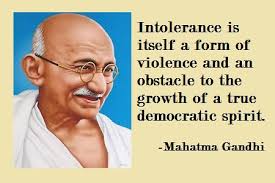
What Gandhi Teaches Me

By Candice Louisa Daquin

Generally, a Westerner shouldn’t try to dabble in writing about Indian great men because it’s that kind of appropriate-ism that caused so much misunderstanding and damage to begin with. The idea the West had all the answers, which clearly it does not. The idea someone whose country used to be a colonialist-force, had the right anymore to discuss countries that were colonized, can smack deeply of appropriate-ism or worse.  However, there are also ways we can appreciate what we know and transmit that without being patronizing or culturally insensitive.

I choose to consider Gandhi and his impact on the world, to remain in the middle ground. Neither applauding Gandhi without reservation, nor ignoring his incredible impact and influence on India and beyond. I don’t always do this, in the case of someone like Woody Allen or Charles Bukowski (hardly comparable) I cut them off immediately because despite being talented, their talent simply doesn’t measure against the harm they caused. With someone like Friedrich Nietzsche I would say, he has some brilliant perspectives, but his over-all views were too harmful for me to support him. Revisionist thinking is necessary, but sometimes like anything else, it can go too far and condemn significant people based on modern thinking that doesn’t take into account the mores of the time.

One of the hardest things in the world is when your heroes appear to fall. But in this case, there is so much positive about Gandhi I believe (and this is a personal belief), that his goodness encourages us to retain his relevance and enduring impact.

Firstly, Satyagraha – belief in using truth to resist evils with non-violence. Not the same as simply ‘truth’ or ‘verité’ as I would say in French. But more the ideal of believing in truth rather than being deceived or unable to believe. This is not just valuing truth, but believing in truth and thus, through that belief, knowing what is true (and reasonably, what is not).

I find this very interesting because whilst we all ‘think’ we know truth, obviously most of us do not. When does opinion and truth come together? Really holding an opinion has nothing to do with truth but with multiple versions of truth, how do we ever know which one is right? This is a discussion I have had many times in my life with friends of differing views. For a time, I wanted to be a Christian because I needed to believe in something and so many whom I knew were Christian would try to persuade me that was the ‘right’ (true) path. I was not convinced, despite my own attempts to be and it did not strike me as ‘truthful’ or ‘the truth.’ But the question is if people ‘doubt’ another’s truth then where does that end up?

I think of what Gandhi might have said; that truth is beyond conjecture, difference and trying to be ‘right’ the truth is there all along, it is immutable, transformative and fluid at the same time. And by truth he is not speaking purely of a particular faith, or a particular creed, but a universal truth. That is pretty esoteric for Westerners, I think overall Western thinking is prescribed, it feels comfortable having absolutes to follow and only demurs when it’s considered socially ‘trendy’ to disagree. While there may appear to be diverse thinking in the West, I would say it’s no more diverse than closed societies like China, the propaganda is just less obvious. After all, it’s not a societal dictate that has people unquestioning, it’s the mandate of the individual which links with the concept of  Swaraj – self-rule which ultimately led to home rule, the idea that led to an independent India.

If I think of his ideals today, how many of us believe in truth by considering how this lies within us and then without us. Isn’t it more common for us to be spoon fed a ‘truism’ from our respective societies, and even if we question that truth, we do so with groupthink, subscribing to a ‘truth’ without considering what believing in truth means in relation to ultimate truth? Thus, without individual self-policing (or by proxy, the questioning of something outside ourselves) and perhaps by being so busy, we take the easy road because to question everything can be an exhausting enterprise, and as Marx would say, we’re distracted by how busy we are in the machine of work. Leading to at times, mass delusion, or mass indifference, but definitely not an understanding or questioning of how to cultivate a belief in truth.

In fact, how important is truth to us? We bandy around the words, paying lip service to the idea, but without going further to consider the idea at a more personal and then social level. Truly believing in truth would be almost like letting go of everything and beginning over (as one could say Gandhi did) and as you rebuild, doing so with belief in truth in a pure sense of the word. I believe in truth and therefore reject attempts of subterfuge in favour of increasing my belief in the existence of truth. In many ways this is like believing in God without it becoming all about the details (scripture, deity, icons etc). It seems to have a lot in common with the pure heart of Buddhism too,

This leads to another principal of Gandhi’s — simplicity. Simplicity of an idea clears the clutter to reach at the truth. That simple. Practice simplicity and you will see more clearly. How many of us truly practice simplicity? I may try, but I fail, as most of us do, with this increasingly complicated pull and push of modern society, where I might rail against absurdities because I’ve been sucked into thinking they matter. Maybe some of us don’t have the luxury of opting out and going back to basics, maybe our lives are too interwoven with an unnecessarily complicated society that ‘demands’ we brush our hair, shine our shoes, iron our clothes, wipe our faces and face the world a certain way.

The perennial question has always been: is this the only way to live? And as we lose more and more of our simplicity, we may no longer care about other options, in favour of following the status quo. Furthermore, we may believe a complicated life with stress and demands, is the only way we can live, the only way things can work. I would think Gandhi could see, by giving things up, you gain more than by taking on more, and whilst his message may seem inapplicable to many, we can all learn something by doing less, wanting less, needing less.

After all, we cannot take what we accumulate with us, so the ideals of physical wealth seem less important than spiritual health. Many of us may brag about the car we drive, the house or neighborhood we live in, where our kids go to school or university, what they do for a living and so it goes on. Even in India, this is true, as the upper and middle classes seek to emulate what they have seen dominate the rest of the world and define themselves by those status markers that mean so much (and conversely, may mean so little). It is easy to get caught up in it.

I was never an acolyte of the materialistic world, but like most people, I had my insecurities and wanted to jump through  few hoops that I felt defined you as a success in society. When I became sick, it really showed me in a shocking way, how little those things mattered. I recall one day in hospital, my hair matted from throwing up, I just reached for my ponytail and cut half of it off. I had always been vain of my hair as it was thick and long and yet, it felt absurd to hold onto something for vanities sake when I was so sick and bereft of any normalcy. Likewise, when I went out into the common area of the hospital, I saw people sicker than me, and as we talked, I saw they were friendly irrespective of my not wearing make-up, or shoes (!) and in a gown with a green face. They saw ‘me’ and it felt like being a child again, liked for being ‘me’ instead of the ‘me’ I had become used to showing the world which was a counterfeit version. This principle then applies also to the notion of truth, and self-policing. Without an inflexible doctrine like religions, Gandhi’s philosophy was free to consider the whole rather than the individual steps toward being whole.

9/11 has just passed here in America my adopted country, and at its 20-year anniversary there has been much made of our withdrawal from Afghanistan, the country America invaded after 9/11 for sheltering the terrorists who were involved in the murder of so many people. Whether you are a Democrat, or Republican, many Americans believed someone had to pay for the atrocities committed on American soil. I recall at the time understanding both perspectives: the felt need for revenge or justice, and also, the need to lean towards understanding the how and the why of the incident to prevent it from recurring again.

When America withdrew from its longest and unsuccessful war against the Taliban, only to find the Taliban and Isis took over Afghanistan as if America had never been there, it did strike many as being a truly futile war (and we can argue, all wars are futile to some degree). How blatant was the takeover of a country America had wrongly thought was tamed from its former ‘enemies’.  Over time, it had just felt a lot like other wars (Vietnam etc.) where so much death, destruction and expense wrought no change, certainly not as Americans had visualised. Furthermore, did the taxpayer really want to leave behind US$ 2.26 trillion of their hard-earned money to equip Afghanistan? Yet that is exactly what happened along with the providing a free access to the very latest technology in the abandoned US embassy.

Why doesn’t America learn this lesson? That going to war doesn’t really change the ideology of an invaded country, that small bandit terror cells continue to thrive and even increase, because the promotion of American ideals isn’t always universal or accepted, and promoting them whilst invading a country, breeds as much resentment as it does thankfulness. By this I am not suggesting everything America did was negative, they truly tried to help the Afghani people, but at what cost? And did it work? I would say it did not. That’s perhaps because it is not the role of any one nation to police another or dictate to another.

But what do you do if you are a military person, and your country is attacked? It’s hard to imagine sitting there and debating how to have a non-violent discussion with the enemy. Yet that is exactly what Gandhi is most famous for. Satyagraha may seem a very outdated term, or it may appeal as a modern notion, either way it’s so laden with symbolism we hardly understand its core anymore. On the one hand, there is the Old-Testament idea of ‘an eye for an eye’ and then as Gandhi followed ‘An eye for an eye leaves the whole world blind’.

Personally, I find truth in both, maybe truth can have a duality or not be as black and white as we often want it to be, but either way, non-violence is erasing the option for any kind of vengeance or payback, not an easy thing to accomplish when your enemy is being deeply unfair, as was the case with Gandhi watching the treatment of Indians in South Africa and then again with the colonial invading forces of the British in India. Gandhi founded the Natal Indian Congress in 1894, where he campaigned for the rights of indentured labourers in South Africa and protested against the system of requiring passes for Indians. Gandhi went on to organise the local Indian community, of all income brackets, into a passive resistance against this inequality. With these early eye-openers, Gandhi began his first experiences of community building into protest, utilizing peaceful means, against entrenched inequality and racism.

But every situation is different and 9/11 did not happen out of the blue, it came about as a result of decades of fighting between Christian and Muslim extremists on both sides. It also came about because the West wanted the Muslim world to accept some things, they found unacceptable. When asked why he caused the 9/11 attacks, Osama Bin Laden said because Saudi Arabia, his homeland, was in bed with America in going after Saddam Husain and others in Iraq. Why did he find this so offensive? In part because he didn’t like American military in his country, especially women soldiers. His brand of extremist Islam did not believe women equal to men and found that an abomination.

What is ironic about this extremist thinking, which can be found in all faiths, is how hypocritical those who believe it seem to be. All the terrorists who came to America to attack on 9/11 visited brothels and took full advantage of the Western ‘evils’ they preached against. They would argue that they had no respect for those people because they were ‘evil’ – in essence justifying their behavior based on a greater sin. But who are we to dictate who is more ‘sinful’ than another, and surely, if we believe in truth, we don’t break it when tempted by the very thing we condemn? Going back to Gandhi’s ideal of belief in truth, one who does, would not be hypocritical.

Yet so many humans are. Some people who condemn homosexuals have secretly practiced homosexuality. People who condemn women might be profiting from their exploitation. Those kinds of hypocrites negate the truth of their original argument. If we simplify the argument, we have no legs to stand on. Oppression of others goes against all religions but is practiced by all religions. I think Gandhi saw this palpably and was trying to redirect us to see how absurd this was. And what greater way than to practice non-violence against a violent oppressor? It literally was an act of faith, and incorporated belief in truth, and political self-policing. Is this not the ultimate reality? ‘Ahimsa’ isn’t just ‘non-violence’ because no one principle exists in isolation from ‘other’ in this case, love. Without love there is no mercy, there is no wish for non-violence. It is the connection between the intension and the outcome that produces Gandhi’s ‘Ahimsa’ (non-violence).

If all life is one, then all violence perpetrated against self or other is experienced as a whole, the welfare of human beings at the core. The very opposite of the competitive consumerism of Capitalism, which America is known for. And with this, Gandhi predicted the future, a practical need to eat less meat, (vegetarianism) or to respect life (by not consuming animals or exposing animals to suffering) relating back to the idea all living things are connected. I recall as a child being deeply impressed with this concept and it was one reason I myself became a vegetarian at a very young age. To many in the West, vegetarianism is considered the purview of the privileged, and I now understand that, because if you live a very simple life, it’s often very hard to be vegetarian and consume enough calories. To an extent, being vegetarian is abstinence. Many people with eating disorders become vegetarian or vegan as a form of orthorexia. Many middle-class kids have the ‘fad’ of vegetarianism. But the core behind Gandhi’s form vegetarianism or veganism is more in line with Hindu/Buddhist perspectives of respecting living things and causing no suffering.

The hardest principle of Gandhism I have encountered is faith. For some, this is the easiest as they already possess faith, as Gandhi did. He said: “I must confess that the observance of the law of continence is impossible without a living faith in God, which is living Truth. It is the fashion nowadays to dismiss God altogether and insist on the possibility of reaching the highest kind of life without the necessity of a living faith in a living God. I must confess my inability to drive the truth of the law home to those who have no faith in and no need for a Power infinitely higher than themselves. My own experience has led me to the knowledge that fullest life is impossible without an immovable belief in a living law in obedience to which the whole universe moves.” But unlike the shaming faith separating gender and men and women, Gandhi didn’t impose those divisions: “It is not woman whose touch defiles man, but he is often himself too impure to touch her ……” As a woman who disliked the inferior status given women in most mainstream religions, I found Gandhi’s perspective on this, refreshing and egalitarian. I cannot speak on faith as I do not possess it adequately, but I can see its place in Gandhi’s principles and understand it didn’t come to him all at once, but through the experience in part of the other values he lived with. They built into on one another and are interconnected.

Gandhi’s belief included celibacy. “Brahmacharya … means control in thought, word and action, of all the senses at all times and in all places.” The conclusion in some ways to the fulfilment of all the other principles. Those who find ways to condemn Gandhi, point to the potential for scandal by Gandhi’s relationship with Sarla Devi Chaudharani, daughter of Rabindranath Tagore’s elder sister owing to materials where Gandhi called Sarla Devi his ‘spiritual wife’. Yet in Gandhi’s letters to his friends, Gandhi explained that he called Sarla Devi his ‘spiritual wife’ because theirs’ was a ‘wedding based on knowledge.’ Why this matters, is Brahmacharya is related to celibacy and people often question whether any man is capable of celibacy or whether it was just the outward appearance of.

Personally, I’m not sure it’s as important as others feel it is, to discern whether Gandhi remained celibate, because I do not place importance on celibacy, but I understand if you are literally reading Gandhi, you would hope he did what he said he did. I wonder why this matters so much and why sex with a woman (or man) would be such an issue for those who love Gandhi (or for that matter Jesus, because many thought, he had a wife and this idea alone, scandalized others). Perhaps when it doesn’t matter if a spiritual leader has sex or not, we’ll really be free of all shame attached to sexual relations. Although for Gandhi it was more about control over impulses that could sway him from his path. Gandhi wrote in a letter on the subject; “I have reached a definition of a spiritual marriage. It is the partnership between two people of the opposite sex where the physical is wholly absent. It is therefore possible between brother and sister, father and daughter. It is possible only between two brahmacharis in thought, word and deed.”

I understand for him, perhaps passion was an inflammation of sense and morality, and this would distract him. Gandhi was thought to have developed his perspectives on carnal passions by concluding a person cannot selflessly serve humanity without accepting poverty and chastity. This seems an enduring theme among many holy men and I’m not one to dispute it, although I think it’s different for a woman. When Gandhi said: “physical union for the sake of carnal satisfaction is reversion to animality,” he may have set himself up to be perceived as unrealistically idealist and unrealistically puritanical.

On the other hand, like anything, we have to take the influences of the time-period into account; what Gandhi was responding to, what he witnessed, what he saw occur, how those played into his striving for inner-strength. I see it like trying to translate what a great painter meant by their painting, hundreds of years later. Ultimately, we do, but that painter if alive today, may say; ‘oh no you got it all wrong.’ So, when people point to the strange things Gandhi did in his Brahmacharya experiments, they could be very right, or it could be one piece of a much larger puzzle. We are all twisted by our life experiences, but we expect Gandhi to be free of this, even as he said he wasn’t. Perhaps the shame of not being with his father during his last moments as he went to his bedroom to have sex with his wife, was among some of the reasons he embraced Brahmacharya, Gandhi was after-all, human.

Trying to understand the motives of someone born in another era involves taking into account their worldview as influenced by that era. Gandhi was from a middle-class family, and we know those born into higher classes are often received differently to those from other classes. This isn’t right, but it’s the way the world has operated and blaming the person born into that family is blaming the wrong person. It is the system that perpetuates this, just as now, most ‘notable’ people come from some degree of privilege than obscurity (with significant exceptions). Gandhi was a product of that privilege but that’s not quite the same as being privileged in thought. Likewise, it’s easy to say, he got married at 13 and had 4 kids, so it was relatively easy to become celibate, but without experiencing that personally, that’s an assumption based on reaction, not fact.

I can understand the unease of revisiting historically important figures, the desire to applaud them but also the need to criticize their failings. I think if Gandhi were alive today, he would say ‘have at it’ and be open to criticism, although possibly he would find today’s world untenable, for who really knows how a historical figure would greet the future? We become the future by evolving. Only 20 years ago, the idea of gay-marriage would be abhorrent to most, so much transforms with acceptance and shifting of ideas. Some of that actually comes from thinkers like Gandhi who perhaps paved the way in some form, for the future, even if that future is quick to criticize him. But just as we must respect our grandparents view things differently from us, often through no fault or hate on their part but their upbringing, we cannot always realistically expect people, however smart, to transform on par with our own insights; that’s just not realistic or how we work as humans.

Either way, whether you are successful in incorporating the principles of Gandhi-ism in your life, or not, value lies in taking a leaf out of some of his philosophies. I don’t agree with everything I have read of Gandhi’s beliefs, but he was the first one to say, we contradict ourselves, as we grow, and nothing we do is set in stone. He was continually questioning and evolving, and that to me seems far more realistic than to be a static deity demanding fealty without question.

I remember buying my Goddaughter the kids book; The Lion The Witch and The Wardrobe and worrying that her generation may not find it as bewitching as mine did. Some things don’t age well. Others endure. But on average, there are always parts that last the test of time. Instead of being precious about Gandhi, we should be open to questioning his perspectives without rancor, because he would have wanted us to. At the same time, dismissing him because he held some views that at the time were considered normal but are now unfashionable, is to dismiss the value he brought to the table when we discuss faith and philosophy. If we demand perfection, we’ll not find anyone to be inspired by, at the same time it is not wrong to want to redefine norms as we evolve as a society, just the way Gandhi hoped we would.

Candice Louisa Daquin is a Psychotherapist and Editor, having worked in Europe, Canada and the USA. Daquins own work is also published widely, she has written five books of poetry, the last published by Finishing Line Press called Pinch the Lock. Her website is www thefeatheredsleep.com

.

PLEASE NOTE: ARTICLES CAN ONLY BE REPRODUCED IN OTHER SITES WITH DUE ACKNOWLEDGEMENT TO BORDERLESS JOURNAL.

Categories
Essay

Reflecting the Madness and Chaos Within

Over 150 Authors and Artists from five continents, wrote on mental illness. Candice Louisa Daquin, a psychotherapist and writer and editor, tells us why this is important for healing

A watercolor of King Lear and the Fool from Act III, Scene ii. Courtesy: Creative Commons

When Indie Blu(e) put feelers out about creating an anthology based on mental illness, the passionate reception galvanized our belief it was a necessary subject. However, a few expressed concerns that an anthology about mental illness, would be ‘depressing’ and they wondered ‘who would want to read about mental illness?’ It is this perspective, acting like a fog, that separates those inflicted with mental illness from those who are not.  

Such responses exacerbate feelings of isolation, unworthiness, and loneliness that many with mental illness already have. Through The Looking Glass, a metaphor from Alice in Wonderland, evokes this common feeling of separation, as poetry and prose has long had a tradition of doing. For many, this lack of understanding may be the tipping point leading to a premature death. If there is one reason to embrace mental illness in an anthology of art and poetry, it is to speak for, speak with and represent those who would be otherwise denied. To continue a tradition of poets and artists elucidating on the subject of suffering mentally: 

“I felt a Funeral, in my Brain, 

And Mourners to and fro

Kept treading – treading – till it seemed

That Sense was breaking through”

(I felt a Funeral in my Brain, Emily Dickinson)

If you Google ‘what causes depression?’ among the top ten searches will be ‘free yourself of depression’ and ‘depression is a choice’. As long as we blame the sufferer, the malady will become more entrenched. Mental illness is the only malady, aside from lung cancer caused by smoking, that we actively blame the sufferer for inflicting on himself.  We bandy around terms like ‘chemical imbalance’ and ‘deficit of proteins in the brain caused by trauma’ but nobody really knows what ‘causes’ depression because like most disease, depression is epigenetic, hereditary and mal-chance and so many things we do not understand.

Depression can be a learned behavior, it can be transmitted through a virus, be the result of a series of debilitating personal events, or because you have stomach problems, and the serotonin and other chemicals are not manufactured in sufficient quantity. Depression can be the result of faulty mood regulation by the brain, genetic vulnerability, dementia, old-age, youth, hormones, drugs, eating disorders and sexual abuse. Or, depression can be caused by absolutely nothing! Usually it’s more than one thing, deeply complex and difficult to replicate in a laboratory setting.

As long as we as a society utilize words like ‘snap out of it’ and ‘be strong like …’ we will entirely miss the point. Not one person living chooses to be depressed, it is not a simple matter of one chemical being too low and another too high that can be ‘fixed’ with a pill or an adjusted attitude to life. We must distinguish between sadness, melancholy, situational sorrow, grieving, bouts of misery, feeling sorry for oneself, and medically defined depression.

The latter is a mental illness, it doesn’t mean you’re delusional or mad or unreliable, in fact depression strikes all but typically the more intelligent are more prone to it. One could argue, depression is a disease of insight and awareness of our ‘unbearable lightness of being.’ For some it manifests in childhood, others not until they’re elderly. All forms of depression are legitimate, and should not be shamed, rebuked, repulsed, diminished or ignored.

Whilst there is sense in saying we should not obsess over the subject, to the exclusion of efforts to brighten one’s life, by whatever means possible, we should equally not ignore those who are desperately struggling and usually without a single person to help them.

If your neighbor had cancer, you would not shame him for his ‘weaknesses tell him he was making a ‘bad choice’ and ask him to ‘get over it’ so why should you ever think it’s acceptable to do that for depression? Just as we are re-writing language for Trans Generations to be inclusive and supportive of insight and change, we should reconsider how we talk about depression. As long as we perceive depression to be a ‘bad attitude’ or ‘personality deficit’ or believe if Oprah could ‘get over it’ so could you, we condemn those who have obviously tried hard to do just that. They might feel it is their fault if they have not ‘succeeded’.

Encouraging someone to do things that help them when they are depressed, believing for some there is an end to their depression, those are all positive actions. We should take our depressed friends out for walks, to remind them there is joy in the world even when they are not able to see it, through no fault of their own. But we should also be careful that our well-intentioned prescriptivism does not become dogmatic and suggest the individual isn’t doing all they can. If they’re not (doing all they can), it may be that’s all they can do for now. Equally if you really believe someone isn’t doing enough, you can suggest things you feel might help without seeming accusatory.

From inception, we at Indie Blu(e) sought to offer a platform for those who might otherwise find no platform. Artists have historically endured mental illness in higher numbers than average. Reasons abound but there is no final analysis, it is thought whatever spurs creativity, may equally make certain illnesses more likely, just as left-handed-people are often more creative, perhaps it is about what parts of the brain are utilized and how. 

No one group of people, based on gender, ethnicity, culture, doesn’t suffer from mental illness. Varied cultures have sought to shame others.

Likewise, mental illness has long been thought to affect women more than men and is tied inexorably with ‘hysteria’ (hyster/womb, the once-thought seat of mental illness in women).  However, in The Noonday Demon: An Atlas of Depression, Andrew Solomon has said: “If one discounts depression triggered by anxiety about offspring, the rate of depression for men and women appears to equalize”, especially, with women seeking mental health counseling in higher numbers because of cultural approbation toward men owning any perceived vulnerability. This is further proven by the higher rate of completed suicide and ‘accidents’ among men, pointing to a social cause rather than one gender suffering more than the other. 

With the stigma of mental illness well entrenched in most societies, and not likely to be eliminated, despite best efforts, the only course of action must be in continued awareness. The more we are aware and exposed to diversity, the more accepting we ultimately become, or so sociologists tell us. If there is any truth to this idea of ‘acceptance by exposure’ then being a vehicle of awareness is how to eventually overcome prejudice and bigotry. Solomon tells us: “The insistence on normality, the belief in an inner logic in the face of unmistakable abnormality, is endemic to depression.” These kinds of ‘certitudes’ can be the triggers that push someone suffering from moderate mental illness, to a breakdown. It is the lack of support, empathy or compassion that acts as a sharp rebuke to those who need the very opposite. 

For those suffering from the myriad of mental illnesses that exist; stigma and shame are daily companions. While logically we know people never ‘choose’ mental illnesses, a societal prejudice can be deeply engrained, making it a greater challenge than ever not to blame oneself. How often have we heard the sayings: “If I could beat it, then I think anyone can and they’re not trying hard enough if they still suffer,” or something to that effect? How often do pronouncements like: “They don’t seem to be able to get themselves together,” or similar, indite people who are sick, when we would rarely use those same pronouncements on those with physical ailments?

In ‘The Will To Power’, Friedrich Nietzsche tells us: “(the mentally ill) represent the same ills. Health and sickness are not essentially different, as the ancient physicians and some practitioners even today suppose. I fact, there are only differences in degree between these two kinds of existence: the exaggeration, the disproportion, the nonharmony of the normal phenomena constitute the pathological state.”

Our penchant for judging, putting ourselves above others, ridiculing and labeling, seems boundless, and causes those who are already struggling to stay afloat, further grief. Why we feel the need to do these things, is too long a consideration for this foreword, but suffice to say, the more we put others down, the better we seem to feel about ourselves, if history is anything to go by. In many ways then, prejudice against the mentally ill, is not dissimilar to racism, homophobia or sexism. It shares that delight in rebuking someone else for who they are, and a relish in implying the accuser is of superior stock. When we look at it like that, it seems quite pathetic, and obvious, but when it’s subtly employed in modes of speech, everyday considerations and overall responses, it can be insidious and incredibly damaging. This could be a reaction from people who are unable to process the condition. They attack, as a form of unconscious self-defense. 

In Psychology and Freudian Theory, Paul Kline says: “When we speak of defenses, we actually mean whole ways of perceiving reality such that important attitudes, for example prejudices and sexual views, are affected.”

When I trained as a psychotherapist, I wanted to ensure children and adults who were depressed had someone to go talk to, rather than fall into despair. Sadly, I found in the profession, such a high rate of ‘burn out’ that I could understand why therapists seemed so disinterested, uninvested and fatigued. If you see 12 clients a day, each for an hour and then have to write long notes and take phone calls, you simply cannot give enough of yourself to be competent.  Psychotherapists have a duty through their profession to ‘nonmaleficence (do not harm) and beneficence (promote good) but psychotherapists are only human and possess human flaws, including their own prejudices and biases. When you combine those with an unrealistic workload, you may find psychotherapy doesn’t work as well in practice as it should, which is a pity, considering how necessary it remains. 

Even in countries where insurance companies do not dictate how we label people, in order to be reimbursed, there are too many sick people for too few therapists and the patients really suffer a lack of quality care. One could argue this is an improvement from the days of mass mental institutions or even, the ‘care in the community’ model, that fell flat on its face and led to mass homelessness. One could also argue, what other way realistically exists? But we seem to find the money for other things, just not mental health, so the real issue is priorities. Mental health, despite its terrible fallout, has never been a priority and it doesn’t matter how many mentally ill mass shooters there are, it never seems to significantly alter policy or be considered important enough to truly invest in. Easier to dose with pills that are supposed to be short-term and have long-term side-effects. 

Instead, stereotypes abound, and few people outwardly admit to being mentally ill for fear of condemnation or it is affecting their job or right to keep their children. Draconian as that might seem, without sufficient protections in place, mentally ill people have fewer rights than anyone else. This ‘going underground’ response means those in need, are even less likely to receive it and the sheer cost means those with serious mental disorders, are often unable to earn enough to pay for treatment. Whilst this echoes modern medicine and the health industry at large, mental illness has more in common with chronic illness, the kind that are invisible, or misunderstood, like Chronic Lyme and Fibromyalgia. The same brutal disregard for the suffering of these individuals is shared by those with chronic mental illnesses, they are an inconvenience at best, in societies that prize profit above all else. 

In Owning Your Own Shadow: Understanding the dark side of the psyche, Robert A. Johnson contends: “The balance of light and dark is ultimately possible – and bearable. All nature lives in polarity – light and dark, creation and destruction, up and down, male and female. It is not surprising that we find the same basic laws functioning in our psychological structure.”

When reading submissions, we realized, even among mental health professionals, there is so much disagreement, and implied judgement. When someone talks of ‘those who can fight their way out of it’ they imply, those who cannot, are weaker. I’m sure that is not what is meant but language is so crucial when considering impression. Just as with racism, how we speak, indicates our biases and level of empathy. If we want to be non-judging, we should start with reworking how we speak about mental illness and consider how many times those suffering have been humiliated and judged by our lack of care in how we refer to their problem.

This is no less true in poetry, and some of those poems not selected for the anthology, whilst good and raw, had components within them that could have been misconstrued. This means even those who suffer mental illness may inadvertently judge themselves and others, through learned behaviors and language. One of the most judging people I spoke to about this anthology was an acquaintance with Bipolar 1 disease. Ironic yes, but not entirely surprising when you consider how we often emulate what has been done to us, so if we were judged our entire lives, we do it in turn.

Others would argue, what’s the harm in holding an opinion? When dealing with vulnerable populations who are trying to be treated equally and not labeled or dismissed, we must consider the importance of how we express ourselves. Of course, we’re all entitled to hold an opinion, but hate and prejudice are different, and judging is a form of prejudice that can act like a slow cancer. We should ask ourselves instead, why we feel the need to judge others when they are not like us, rather than consider how they are like us, or what we can do to help them? Why is claiming to be stronger than someone else, such a ‘thing’ in our society? Why do we relish putting others down?

When we learn to stop doing that, we may reach Psychologist Abraham Maslow’s highest level in his Hierarchy Of Needs, that of self-actualization, where we no longer live based on basic needs (physiological, safety, self-esteem) and begin to consider what we can do for others. If we don’t wish to do this, at least we could do no harm. When considering harm, we should bear in mind, words do not seem as apparently harmful as actions, but putting someone who is already struggling down, could be the last straw. Would any of us want to push someone over the edge just because we can?

Indie Blu(e) has published anthologies in response to the #metoo movement, LGBTQ equality and other socially minded subjects and with 2021 emerging from a year of hell, we saw how those with chronic mental and physical illnesses suffered silently without recourse. The umbrella of ‘art’ is one means by which, we have as humans have always expressed ourselves best. Art has led to societal change, acceptance, tolerance, elucidation. Art can heal, art has power. 

It is our hope mental illness will one day be seen for what it is, an unavoidable malady that people try their entire lives to overcome. We have seen some of the best creative expression come from those suffering from mental illness and without mentally ill people, our world would be bland indeed. Mentally ill people are not typically mass shooters; they are creative, expressive, intelligent, and incredibly strong. A collection of work celebrating the talent of those who suffer from mental illness, seemed to be a necessary way to begin to shift old prejudices and shine light through the looking glass. 

Candice Louisa Daquin is a Psychotherapist, LPC/NBCC. She is a Senior Editor at Indie Blu(e) Publishing & Co-Editor of their anthology exploring madness, Through The Looking Glass.

.

PLEASE NOTE: ARTICLES CAN ONLY BE REPRODUCED IN OTHER SITES WITH DUE ACKNOWLEDGEMENT TO BORDERLESS JOURNAL