Categories
Review

In the Footsteps of the Man Who Walked From England to India in 1613

Book Review by Rakhi Dalal
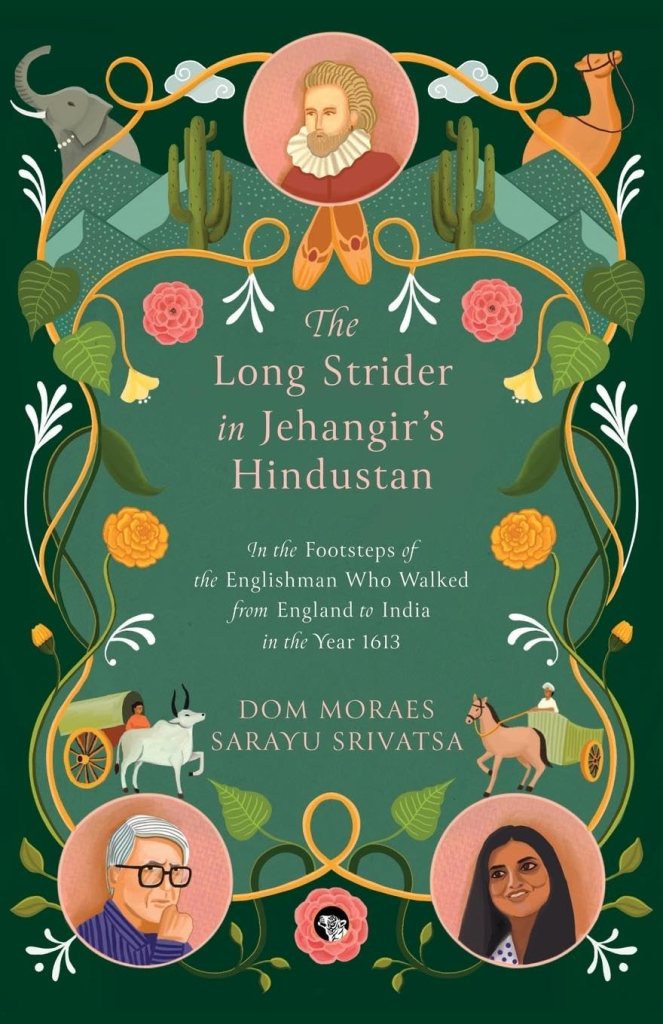
Book Title: The Long Strider in Jehangir’s Hindustan: In the Footsteps of the Englishman Who Walked From England to India in the Year 1613

Authors: Dom Moraes and Sarayu Srivatsa

Publisher: Speaking Tiger Books

During the years, in the early seventeenth century, when East India Company began a search for the possibilities of trade with India via sea route, Thomas Coryate of the village Odcombe in Somerset, England, made an ambitious plan to travel to the Indies, as he called it, on foot. This wasn’t his first undertaking. Having travelled across Europe on foot before, writing a travelogue Crudities on his experience which brought him some fame, he now wished to travel to a place no Englishmen had gone before. Motivated by the thought of gaining more fame with this venture so as to win the affection of Lady Ann Harcourt of Prince Henry’s Court, even the idea of traversing 5000 miles on foot as compared to 1975 miles that he did in Europe did not dissuade him.   

Known as ‘the long strider’, in 1612, Coryate set for his journey to the Indies from London. And in year 1999, more than three hundred years later, his journey and subsequent struggles, somehow inspired Dom Moraes to traverse the same route to correlate Coryate’s experience in the now altered places and its people. Coryate travelled alone, Moraes took the journey with Sarayu Srivatsa, the co-author of this book.

Dom Moraes, poet, novelist and columnist, is seen as a foundational figure in Indian English Literature. He published nearly thirty books in his lifetime. In 1958, at the age of twenty, he won the prestigious Hawthornden Prize for poetry. He was awarded the Sahitya Akademi Award for English in 1994. The Long Strider in Jehangir’s Hindustan was first published in the year 2003. Moraes passed away in 2004.

Sarayu Srivatsa, trained as an architect and city planner at the Madras and Tokyo universities, was a professor of architecture at Bombay University. Her book, Where the Streets Lead, published in 1997 had won the JIIA Award. She also co-authored two books with Dom Moraes: The Long Strider, and Out of God’s Oven (shortlisted for the Kiriyama Prize). Her first novel, The Last Pretence, was longlisted for the Man Asian Literary Prize, and upon its release in the UK (under the title If You Look For Me, I am Not Here), was also included on The Guardian’s Not the Booker Prize longlist.

Srivatsa, who travelled with Moraes to all the places Coryate passed through, writes diary chapters coextending the same routes subsequently. So, each fictive reconstruction of a period and place of Coryate’s travel by Moraes is followed by a diary chapter for the same place by Srivatsa. In that sense the book becomes part biographical fiction and part memoir. 

Coryate, son of a Vicar and dwarfish in stature, was seized by this desire to gain fame and respect. What desire seized the imagination of Moraes, eludes this reader. It, however, doesn’t escape the notice that both the writers shared somewhat similar plight towards the end.

Some of Coryate’s writing during the period did not survive as it was destroyed by Richard Steele, but the rest was sent to England and was posthumously published in an anthology in 1625. Basing his research on such sources, after extensive three years of investigation, Moraes managed to create an account of Coryate’s demeanour, his lived life in a new land with diverse people and customs at different places which he found both shocking and fascinating.  Coryate found the people of India loud and violent but he was also touched by their generosity and kindness. He witnessed the disagreements between Hindus and Muslims, the caste system where the upper caste oppressed the people from lower caste, sati, and the ways of Buddhist monks, Sikhs, pundits of Benaras and Aghoris[1], the lifestyle of Jehangir and the city of Agra before Taj Mahal. He was fortunate to have an audience with Jehangir, the main reason of his travel, but he failed in securing his patronage or enough money to continue to China which he had been his original intent.

In Moraes’ writing, the era comes alive. Vivid imagery and description makes the struggles and sufferings of Coryate palpable on one hand and on the other offer a view on the unfolding of history in a country where these many hundred years later, the echoes of a past similar to the present can be heard. In the preface, Moraes posits one of the reasons to take on the book — to compare the India then with the country during his times. As the reader proceeds with the story, the comparison becomes apparent in Moraes’ construction vis-a-vis Srivatsa’s entries.

Towards the end, an ailing Coryate succumbed to his illness and his body was buried somewhere near the dock at Surat. He could not make a journey home in 1615, but in 2003 a brick from his supposed tomb was sent back to the church in Odcombe by Srivatsa where a ninety six year old vicar waited patiently for the only famous man from Odcombe to return home. The epilogue by Srivatsa gives an account of Moraes’ own struggle with cancer and his demise in 2004, a year after the book was published. It is but right that the soil from his grave in Mumbai also found a resting place in Odcombe.    

[1] Devotees of Shiva

Rakhi Dalal writes from a small city in Haryana, India. Her work has appeared in Kitaab, Scroll, Borderless Journal, Nether Quarterly, Aainanagar, Hakara Journal, Bound, Parcham and Usawa Literary Review

.

PLEASE NOTE: ARTICLES CAN ONLY BE REPRODUCED IN OTHER SITES WITH DUE ACKNOWLEDGEMENT TO BORDERLESS JOURNAL

Click here to access the Borderless anthology, Monalisa No Longer Smiles

Click here to access Monalisa No Longer Smiles on Kindle Amazon International

Categories
Excerpt

Whispers of the Heart

Title: Whispers of the Heart – Not Just A Surgeon: An Autobiography

Author: Dr Ratna Magotra

Publisher: Konark Publishers

A noteworthy incident occurred at Northcote Nursing Home that garnered attention in my favour. Dr L.H. Hiranandani (widely known as LH), was an acclaimed head and neck surgeon. He was known internationally for his expertise in performing radical neck resections and for the remarkable speed with which he conducted surgeries. He wielded significant influence in both medical and social circles, and routinely performed surgeries on his private patients at Northcote.

One day, a highly distinguished lawyer from Madras (Chennai) underwent a neck cancer operation at Northcote, with me assisting LH during the procedure. As was his practice, LH completed the surgery swiftly and left for his clinic. Meanwhile, the patient had been transferred to his private room, while I was tending to my remaining duties on the floor. As part of my routine, I made rounds to check on the patients who had undergone surgery.

Upon entering the lawyer’s room, I was taken aback by the sight of him struggling to breathe. His hand felt cold and clammy, and his pulse was feeble. Although he remained conscious, he appeared extremely restless even as I tried to reassure him. It became evident that he was choking, and I realised that unless something was done, his life would slip away. Unfortunately, I was uncertain about the specific course of action needed to save him. While the nurse had attempted suction and increased the oxygen supply through a face mask, these measures appeared ineffective. The patient’s breathing grew shallower, and his lips and nails began to turn blue. It became increasingly obvious to me that blood clots were obstructing his airway, and simply increasing oxygen flow would not suffice. Private patients received distinct treatment compared to those in public hospitals. In this setting, resident doctors were not authorised to make decisions independently and were required to follow the consultant’s instructions.

Unfortunately, I couldn’t afford the delay involved in contacting the consultant, as the process would have entailed routing the call through the telephone exchange, involving operators at both ends and resulting in a significant loss of valuable time.

I recalled reading about tracheostomy (creating an opening in the windpipe) during my undergraduate studies, though I had never witnessed the procedure being done (ENT surgeons usually performed tracheostomies). Acting on instinct and without hesitation, I reached for a scalpel from the emergency tray and made a decisive incision in the middle of the patient’s neck. There were substantial blood clots surrounding and compressing the trachea. As soon as this pressure was released, there was a dramatic transformation in the patient’s condition, and his breathing improved considerably. I carefully removed the blood clots both from within and around the trachea using suction before inserting a tracheostomy tube. To my immense relief, there was significant improvement, and the patient’s lips and nails regained their natural colour. He was soon breathing comfortably, and so was I. Assured of his well-being, I promptly requested blood from the blood bank and decided it was time to inform LH, the operating surgeon.

The patient had stabilised, narrowly escaping from the clutches of death. Now, I had to confront the repercussions of my actions because I had essentially performed a minor operation without obtaining permission from the consultant. Additionally, I had neither informed the patient’s family about the procedure, nor had I obtained their written consent. The list of mistakes was growing longer, and LH’s reputation in the city was significant enough to potentially impact my future prospects in Bombay.

In the midst of this emotional turmoil, I made a call to LH. His clinic was situated near the Regal Theatre, in close proximity to Northcote. He arrived swiftly at the hospital. LH was known for his predilection for taking the stairs rather than the elevator, and I could distinctly hear his brisk footsteps and booming voice as he inquired, ‘What happened? Who did this?’ I, as the sole resident doctor and with no alibi, not that any was necessary, stood there, anxious and unsure of what would transpire next.

When LH entered the room, the lawyer, now fully conscious and aware of the ordeal he had gone through, managed a weak smile. I expected LH to explode, and I stood there with a numb mind, waiting for the inevitable. To my astonishment, LH rushed towards me and, to my surprise and that of others, nurses and hospital personnel gathered there, embraced me in his characteristic, effusive manner. He repeatedly and profusely thanked me for displaying presence of mind during the crisis, which could have cost the lawyer his life. He appreciated that his patient had been saved. Overwhelmed with relief, I could have collapsed, but there was still work to be done.

The patient was swiftly transported to the OR, where we located and ligated the bleeding vessel responsible for the incident. We also revised and secured the tracheostomy, this time by a qualified ENT surgeon, LH himself. Subsequently, the patient was shifted to his room. As he was leaving, LH discreetly handed me an envelope in my hands containing crisp currency notes. Sentimental as I was, I left the envelope and its contents untouched for several years. I knew that two lives had been saved that day!

Word of the incident spread quickly to Nair Hospital, where LH held an honorary professorship in ENT surgery. Several consultants from Nair Hospital, who regularly operated at Northcote, inundated me with congratulations. I had every reason to be pleased. The incident had generated immense goodwill.

(This excerpt from Dr Ratna Magotra’s ‘Whispers of the Heart – Not Just A Surgeon: An Autobiography’ has been published with permission from Konark Publishers, New Delhi)

About the Book

This book provides a captivating glimpse into the journey of a cardiac surgeon, illuminating the story of a small-town girl who, as an outsider, struggled to get a foothold in an intensely competitive field. Her eventual triumph serves as a poignant representation of an earlier generation of Indians post-Independence, showcasing their resilience through both triumphs and tribulations.

Throughout the narrative, the author shares her personal philosophy on the practice of medicine and addresses the evolving landscape of societal norms, encouraging readers to pause and reflect. While she doesn’t make exceptions for being a female cardiac surgeon in a predominantly male speciality, her narrative serves as a powerful source of motivation for women aspiring to break barriers in any field.

This book also sheds light on the transformation of healthcare in contemporary India, with the author playing a significant role in its development. Additionally, it delves into facets of her life beyond the medical realm, including her enriching travels and impactful social activism.

About the Author

After completing her MBBS at Lady Hardinge Medical College in New Delhi, Dr Ratna Magotra pursued Master’s degrees in general surgery and cardiothoracic surgery from Bombay University (now known as University of Mumbai) while working at BYL Nair Hospital in the city. She further honed her skills through training at Guy’s Hospital in the UK and the Texas Heart Institute in Houston, USA.

Dr Magotra’s illustrious career led her to become a professor and head of the Cardiovascular and Thoracic Surgery Department at the prestigious GS Medical College and King Edward Memorial Hospital in Mumbai. Despite her demanding role, she remained committed to issues beyond medicine, both as a department head and as a practising paediatric cardiac surgeon. Her outstanding contributions to the field have earned her numerous accolades, including the Lifetime Achievement Award from the Indian Association of Cardiovascular-Thoracic Surgeons in 2017, a testament to her exceptional expertise.

PLEASE NOTE: ARTICLES CAN ONLY BE REPRODUCED IN OTHER SITES WITH DUE ACKNOWLEDGEMENT TO BORDERLESS JOURNAL