Categories
Tribute

Five Spices of Screen-writing

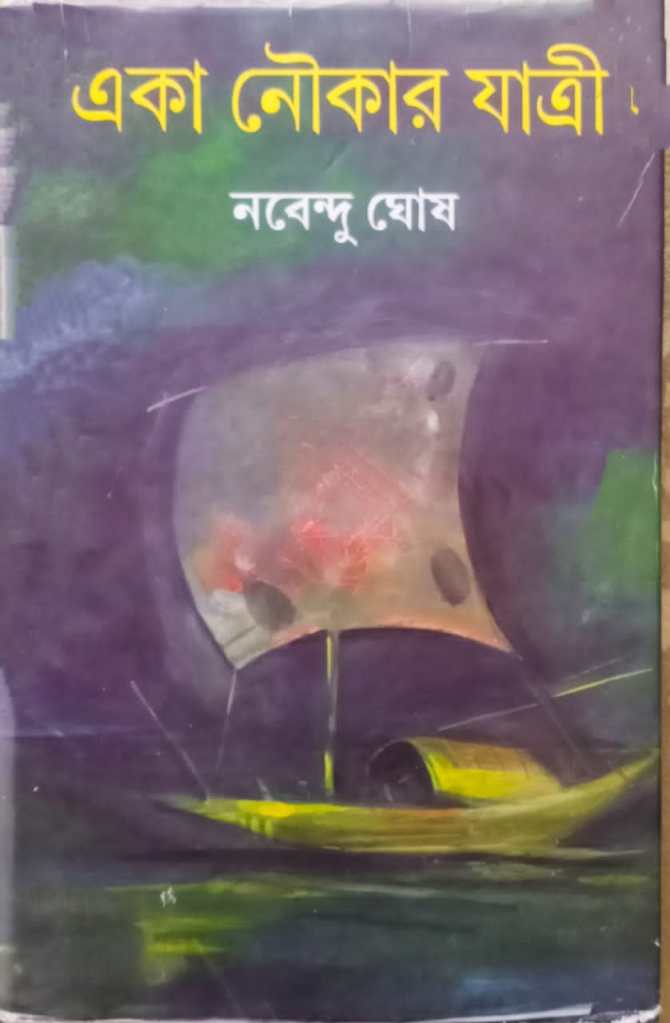
From Nabendu Ghosh’s autobiography, Eka Naukar Jatri / Journey of a Lonesome Boat, translated by Dipankar Ghosh, post scripted by Ratnottama Sengupta
By now it had become common knowledge in the Bombay film community that Bimal Roy had brought along a “writer” with his group, and apparently he was quite a decent writer. Just as, at one time, Urdu writer Sadat Hasan Manto had come to Bombay Talkies, and Urdu writer Krishan Chander too had come on the scene. There was a feeling that there might be a chance of acquiring a decent storyline from Nabendu Ghosh. Naturally, for a while quite a few producers and film directors contacted me. Story sessions were held at Van Vihar, or at the offices of the producers concerned. but there seemed to be a lack of appreciation from these people to stories that came from the mind of an alumni of the Progressive Writers Association. They were all of the opinion, “The idea is great Ghosh Babu, but it is too idealistic. Dada we want to make movies with Dev Anand and Geeta Bali, accompanied by Johnny Walker and Yakub (comedians of the time). Please tell us stories where we can incorporate them, rather than literary stories.”

Realisation soon dawned on me that the Hindi ‘filmy kahani’ was a different genre of stories. What kind of stories? In short, stories that would be appreciated by 90 percent of viewers from different states, with different tastes, all over India. Hence even a highly educated producer like S Mukherji heard the story of Baap Beti and said: “It’s a nice story but I won’t make it – I’m a businessman”! In other words the businessman had a different slant on dramatic arts: they might well say that “Bicycle Thieves is a great film but an undoable story, I’m a businessman.”

Later, on one occasion I had asked Mr Mukherjee, “You said ‘No’ to Baap Beti, yet you wanted to film the literary story, Mrit Pradip. Why was that?” Mr Mukherjee laughed. “If there is an indication of high literary merit in a story then it might well be conducive to our business, and might turn a ‘hit’ picture into a superhit.” I asked, “Does that mean a ‘hit’ is quantifiable?” 

“Of course it is!” he replied. “Just as any tasty dish needs some specific spices to make it tasty.” 

“But what about the healthiness of the dish? Isn’t that a consideration?” 

“Nabendu Babu, I am not into the medical business.” 

“Does it follow that you will cater to the mass’s addiction for entertainment without upholding the essential ideals of life?”

“I do that Nabendu Babu but in very low doses,” said S.Mukherjee. “I follow the principles of dramatic arts as laid down in Natya Shastra but I don’t profess to be a saintly sadhu. I am a very ordinary person in pursuit of happiness.”

He guffawed loudly for a bit. Then he said, “The spices I need for my ‘cinema-dish’ are these. First, the story: usually should be about love. Second: five or six memorable ‘love scenes’ or warm situations, full of fun, lovers tiffs, misunderstanding, separation and reunion. Third: obstacles to love, by a person, family or enemy. That contributes to tension or anxiety. Fourth: four to five moments of suspense: some conspiracy, someone chasing the lovers, trying to kill them. Fifth: comic moments, not mildly humorous but uproariously funny so that people roll around in bouts of laughter. Sixth: moments of tear-jerking sadness. Seventh: Fight scenes, each being individual in itself. Eighth: five to six melodious songs, of  which two or three should be such that even persons with no music sense can sing them. Ninth: appropriate selection of actors and actresses. Tenth: a good director and a good music director. Finally: the right planetary configuration for audience’s applause.” Mr Mukherjee laughed out loud.

His words got entrenched in my mind. The successful ‘formula’ for a Hindi film! In other words it was the formula of a Hindi village Nautanki, no different from the Jatra formula of rural Bengal. Of a hundred films made by that formula, even if two managed to enlighten the mind or uplift the spirit, that would be an icing on the golden cake – “sone pe suhaga”. And if there was no icing, the gold that clinked in would be good enough gain, and two and a half hours will pass away in laughter and tears, in suspense and romance, with joyous humming of a few bars of melody as viewers return home to deep slumber, dreaming of the handsome features of a hero or heroine that will tickle their fancy and prove the worth of the newly invented form of art – cinema. In particular, the magic of Hindi movies.

Therefore, I decided to write or adapt stories and ideas to comply with the mandates of the Formula. Whatever good ideas came along, whether in five pages or five hundred, I would fit into two and a half hours, either by extending or shortening in a fast flowing format that would leave the viewer wondering what’s next at every turn. In other words, I would write screenplays of a different kind.

And since I was unable to uphold the higher ideals of literature on the silver screen, I would compensate for it by writing for literature. I would thereby absolve myself of my sense of guilt.

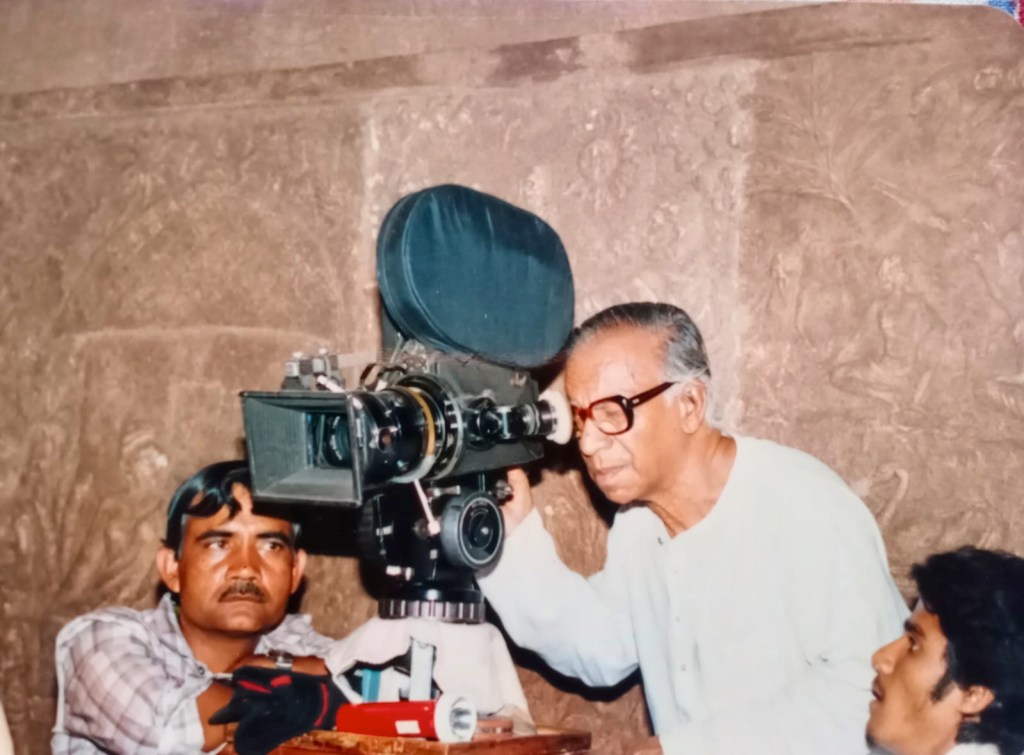
Photo provided by Ratnottama Sengupta

Ratnottama Sengupta’s post-script:

In 1952, when Nabendu Ghosh was narrating his story, Baap Beti, Sashadhar Mukherjee (1909-1990) was a highly successful producer who had set up Filmistan Studios in 1943 along with his brother-in-law, the legendary actor Ashok Kumar; Rai Bahadur Chunilal, father of music director Madan Mohan; and Gyan Mukherjee, director of the superhit Kismet. These personalities had broken away from Bombay Talkies after the death of its founder, Himanshu Rai. 

Later in the 1950s, S Mukherjee independently started Filmalaya, noted for films like Dil Deke Dekho (1959), Love in Simla (1960), Ek Musafir Ek Hasina (1962) and Leader (1964). He is also recognised as the patriarch of the distinguished Mukherjee clan of Bollywood that boasts actors like Joy Mukherjee, Deb Mukherjee, Tanuja, Kajol, and Rani Mukherjee.

And Baap Beti? It got made into a film produced by another highly successful producer of the times, S H Munshi. Directed by celluloid master Bimal Roy, it had brought a host of child artistes who went on to become big names of the Hindi screen: Tabassum (1944-2022), who passed away in November; Asha Parekh (2 October 1942), who was bestowed with the Dadasaheb Phalke Award last year, and Naaz (1944-1995),  besides Ranjan (1918-1983), the swashbuckling actor from the South.

As he writes in his autobiography, after this conversation Nabendu Ghosh took a conscious decision to write his own realisations as literature, and to adapt stories by other writers for the screen. That is why we find that less than 10 per cent of the films he scripted are from his own stories. But some major directors did draw upon his stories – as Bimal Roy did for Baap Beti; Gyan Mukherjee for Shatranj (1956), Satyen Bose for Jyot Jale (1973), Mohan Sehgal for Raja Jani (1972) and Ajoy Kar for Kayahiner Kahini (1973). Only one classic that used his story but did not credit it to Nabendu Ghosh was Guru Dutt’s Kaagaz Ke Phool (1959).

Nabendu Ghosh with his son, Dipankar Ghosh, & daughter, Ratnottama Sengupta

Nabendu Ghosh’s (1917-2007) oeuvre of work includes thirty novels and fifteen collections of short stories. He was a renowned scriptwriter and director. He penned cinematic classics such as Devdas, Bandini, Sujata, Parineeta, Majhli Didi and Abhimaan. And, as part of a team of iconic film directors and actors, he was instrumental in shaping an entire age of Indian cinema. He was the recipient of numerous literary and film awards, including the Bankim Puraskar, the Bibhuti Bhushan Sahitya Arghya, the Filmfare Best Screenplay Award and the National Film Award for Best First Film of a Director.

Dipankar Ghosh (1944-2020) qualified as a physician from Kolkata in 1969 and worked as a surgical specialist after he emigrated to the UK in 1971.  But perhaps being the son of Nabendu Ghosh, he had always nursed his literary side and, post retirement, he took to pursuing his interest in translation.

.

PLEASE NOTE: ARTICLES CAN ONLY BE REPRODUCED IN OTHER SITES WITH DUE ACKNOWLEDGEMENT TO BORDERLESS JOURNAL

Click here to access the Borderless anthology, Monalisa No Longer Smiles
Categories
Review

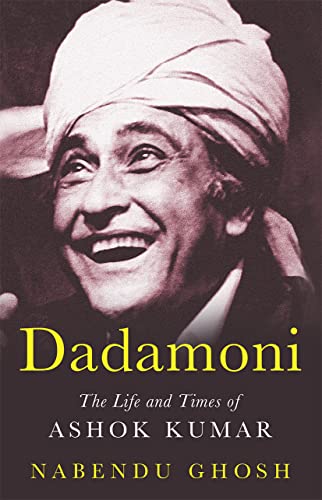
The Life and Times of Ashok Kumar by Nabendu Ghosh

Reviewed by Indrasish Banerjee

Title: Dadamoni: The Life and Times of Ashok Kumar

Author: Nabendu Ghosh

Publisher: Speaking Tiger Books

Dadamoni: The Life and Times of Ashok Kumar by Nabendu Ghosh (1917-2007) is a reflection on the Hindi film industry as much as it’s a biography of the legendary actor.  An eminent scriptwriter in Bollywood and director, Ghosh was an award-winning Bengali writer whose oeuvre of work includes thirty novels and fifteen collections of short stories. As a script writer, he wrote the scripts in Hindi for iconic films like Devdas, Bandini, Sujata, Parineeta and many more.

Ashok Kumar (1911-2001) was a part of both the small and the big screen in India while he lived. Was Ashok Kumar a star? What was his position in the Hindi film industry? When did he become a character actor? Was he a good actor? These questions are very easy to answer about others but when it comes to ‘Dadamoni’, as he was fondly called, the answers become nebulous.

Ashok Kumar started his career in the early 1930s which makes him senior to stars like Raj Kapoor, Dilip Kumar and Dev Anand who made their debuts and attained stardom when Ashok Kumar was already a reigning star. Ghosh knew Ashok Kumar personally for many years. And the personal touch comes through in many places – through anecdotes and because of the regard that shines through the narrative. The jokes that Ashok Kumar cracked from time to time, the things the thespian told the author, all find place in the book. There is also a visible attempt to protect Dadamoni’s reputation against any allegation of vices generally attributed to stars. Ghosh, who had gone to Bombay as part of Bimal Roy’s team, constantly tries to establish Dadamoni as a gentle, thoughtful and educated person.

But this gentle, thoughtful and educated person didn’t have it easy in the world of films. Ashok Kumar had a shaky start. A shy and retiring person, he had gone to Bombay while studying to become a lawyer in Calcutta — to become a director. The ambition was idealistically driven – films, a new medium then, could be a means of educating people. But fate intervened. The person supposed to play the hero’s role in Achhut Kanya (Untouchable Maiden, 1936) had gone missing and the search for a replacement was on.

One day, Ashok Kumar, an employee of Bombay Talkies then, discovered the owner of the studio, Himanshu Rai, quizzically looking at him. Rai had found the replacement for the hero of Achhut Kanya. But for the hero, it was beyond belief that he could act in a movie. The most endearing part of the book is how this diffident hero finds his footing in the industry becoming its earliest and biggest star. And the most poignant part is the gradual decline and death of the studio system even as its product – Ashok Kumar – rose to new heights.

As the narrative draws to a close, one is left wondering what is Ashok Kumar’s position in the legion of Bollywood stars? This has been answered exhaustively in the ‘Afterword’ by Ratnottama Sengupta, eminent film critic and Ghosh’s daughter, who brings in not only personal lore but also her own experience. She tells us Ashok Kumar served “as a textbook for actors wanting to perfect characterisations, voice control, timing, gestures postures” and that he transformed “the acting style in Indian cinema from theatrical to naturalistic – which is still the cinema language worldwide.”

Naming him the “Elder brother of the industry”, Sengupta asserts, “I’d say he is the one personality who symbolises Indian cinema’s journey from Bombay Talkies to Bollywood.” She brings in his stories of interactions with film stars, his hits and directorial ventures, his launching of major actors and his deep links with them, including his acclaimed brother, Kishore Kumar, with more anecdotes from multiple eminent actors like Shammi Kapoor, Moushumi Chatterjee, David Lean and his associates and family ties that stretch to embrace actors from different religion and race. Bharti Jaffrey, Ashok Kumar’s daughter, who has written a heartfelt forward for this edition, is married to actor Saeed Jaffrey’s elder brother.

What makes this book unique is that Ghosh wrote this book in English himself and it has been republished posthumously[1] with the addition of a forward and an exhaustive afterword by the well-known daughters of the two film icons. It also has classic photographs of Ashok Kumar. Both the emotionally charged forward by award-winning actress Bharti Jaffrey, and the afterword by Sengupta, a national film award-winning journalist, explore further the enigma that was Ashok Kumar. By the end of the ‘Afterword’, one realises how deeply tied and organic are the Bollywood families and how much they do to try and create bridges and close gaps – the Ashok Kumar Foundation being one such effort. The whole package – the forward, the narrative, the photographs and the afterword — leaves one spellbound.  

CLICK HERE TO READ THE BOOK EXCERPT


[1] First published in 1995 by Harper Collins – mentioned in the ‘Preface’ written by Ghosh in 1995 and reproduced in this edition published by Speaking Tiger Books.

.

Indrasish Banerjee has been writing and publishing his works for quite some time. He has published in Indian dailies like Hindustan Times and Pioneer, and Café Dissensus, a literary magazine. Indrasish is also a book reviewer with Readsy Discovery. Indrasish stays and works in Bangalore, India. 

.

PLEASE NOTE: ARTICLES CAN ONLY BE REPRODUCED IN OTHER SITES WITH DUE ACKNOWLEDGEMENT TO BORDERLESS JOURNAL

Categories
Excerpt

Wordsmith Sarat Chandra and Tell-tale Ashok Kumar

Title: Dadamoni: The Life and Times of Ashok Kumar

Author: Nabendu Ghosh

Publisher: Speaking Tiger Books

Wordsmith Sarat and Tell-tale Ashok 

The child Ashok Kumar was highly imaginative and could tell stories to his maternal grandfather, Raja Shib Chandra.

‘Come on boy, tell me a new story,’ the Raja would demand with a smile.

The five-year-old great grandson would gravely start, ‘You see great grandpa, yesterday I was walking through the jungle –‘

The Raja narrowed his eyes, ‘At what time?’ he interrupted.

The boy did not lose his nerve. ‘Yesterday, when you were having a nap after your lunch,’ he kept up the grave tone.

‘And where was the jungle?’ the Raja quipped. 

The boy smiled, ‘On the bank of the Ganga.’

‘Carry on,’ said the Raja.

‘As I walked through the jungle,’ little Ashok went on, ‘there were birds chirping and peacocks dancing. I was feeling fine when suddenly I heard a tiger roar. I stopped. The birds stopped chirping, the peacocks flew fast and in panic. I turned around. And there it was standing, the tiger. It was a huge tiger, snarling at me and thrashing its tail on the ground…

‘Trembling in fear, I broke into a run. The tiger roared and sprang at me. I ran and ran hard. The tiger chased me. It almost reached me, it would soon fall upon me, grab me, swallow me. What shall I do? Oh, how shall I save myself? I prayed for wings and they sprang out of my two shoulders and I flew upward through the trees and escaped in the air. The tiger roared and roared and roared on…’

Little Ashok looked at the Raja for a due appreciation.

But the Raja looked at him with disbelief in his eyes and asked, ‘So you can grow wings out of your shoulders?’

The boy stared at him and nodded, ‘Yes, I can.’

‘Show me,’ the Raja demanded.

Undaunted, the boy said, ‘You become a tiger and I will show you my wings.’

The Raja roared with laughter. ‘Bravo my little one, bravo!’ he conceded. 

Two servants peeped in at this moment on hearing the Raja’s laughter. The Raja beckoned one of them in.

‘Jagai, go to Upen Ganguly’s house and house and call that dark chap – you know –‘ Raja Shib Chandra ordered.

‘Yes, master.’

Soon a young man came there. He was dark but attractive, with handsome features and exceptionally bright, penetrating eyes.

The Raja welcomed him, ‘Come here, my lad. Do you know my great grandson, Ashok?’

‘No sir – but now I will know him,’ the dark young man smiled at little Ashok and added, ‘Ashok is the name of an Emperor.’

The little boy smiled back at the compliment.

Shib Chandra said to the young man, ‘Look here, my great grandson is no less than you — he can also tell stories. Tell him a story Ashok.’

Before starting to narrate a story Ashok looked at the young man and asked, ‘Have you ever eaten silver rice and fried silver parval?’

‘I will eat them when I find them.’

Many many years later when the cinema houses displayed a ‘House Full’ board everytime an Ashok Kumar film was released, New Theatres of Calcutta invited the actor to join the concern. It had earned the reputation of producing quality films — and to this day the name remains nonpareil in the history of Indian cinema.

Ashok Kumar agreed to meet them to discuss the matter. When he met Birendra Nath Sircar, the managing director, in his office there were some other directors and a dark man with silvery hair and sharp burning eyes.

Mr Sircar introduced the gentleman in dhoti-kurta by saying, ‘Mr Ganguly, he is our pride — Shri Sarat Chandra Chatterjee, the great novelist.’

Startled, Ashok Kumar turned towards the legend and bowed low.

Sarat Chandra smilingly asked, ‘Do you remember me?’

Ashok shook his head, ‘No sir — sorry.’

Sarat Chandra laughed and said, ‘Try and you will remember that you used to narrate stories to me — of silver made rice and fried silver parval.’

And the scene came back to Ashok Kumar. So, he used to narrate to this great magician — story writer Sarat Chandra!

Every one had a hearty laugh when Sarat Chandra narrated the story from the past. In his tum Ashok Kumar narrated how Sarat Chandra’s uncle, the writer Upen Ganguly, would regretfully say, ‘This chap, my nephew Sarat, does nothing! I am worried about him.’ This unleashed another round of laughter.

Ashok Kumar finally acted in only one film, Samar. He did not join New Theatres. It was Bombay Talkies that had groomed him and made him what he was. He would never leave Bombay Talkies.

(But, in 1953, after Bombay Talkies closed its shutter for good, he bought the rights to Parineeta. It was the first film of Ashok Kumar Productions.) 

(Excerpted from Dadamoni: The Life and Times of Ashok Kumar, Speaking Tiger Books 2022)

 About the Book:

Ashok Kumar (1911–2001), fondly known as Dadamoni, is one of the great icons of Hindi cinema. This warm, intimate biography traces his remarkable journey, from reluctant actor to Bollywood’s first superstar and, in his later years, a much-loved presence on national television.

Born in Bhagalpur (then in the Bengal Presidency), Ashok Kumar was enthralled by the ‘bioscope’ as a child. In his twenties, he quit his law studies and came to Bombay to become a film director. But life—rather, Himanshu Rai, the founder of Bombay Talkies—had different plans for him. Despite the director’s reservations, he was cast in the lead role opposite Devika Rani in the 1936 film Jeevan Naiyya when the original hero went missing. The same year, Ashok Kumar was paired with Devika Rani again in Achhut Kanya, which was a blockbuster. The transformation of the accidental hero into a charismatic star-actor had begun. Over the next six decades, he proved himself to be a master of the craft, playing cop and thief; genial grandfather and sly matchmaker; villain and hero; heartbroken lover and suave rake with equal ease in numerous films, including Kismet, Mahal, Parineeta, Kanoon, Gumrah, Chalti Ka Naam Gaadi, Aashirwad, Mamta, Jewel Thief, Khoobsurat and Khatta Meetha. But as Nabendu Ghosh writes, Ashok Kumar’s world was much larger—he was also a charming conversationalist, mentor, homeopath, astrologer, painter, linguist, limericist and, above all, loyal friend and devoted husband and father. This book is also a mini-history of the early decades of Bombay’s Hindustani cinema, and its pages are rich with little anecdotes featuring legends like—besides Devika Rani—Saadat Hasan Manto, Sashadhar Mukherjee, Leela Chitnis, Dilip Kumar, Dev Anand, Meena Kumari and B.R. Chopra. Sarojini Naidu and Jawaharlal Nehru make brief appearances too, as does Morarji Desai.

For anyone interested in the Hindi cinema of yesteryears—in its cosmopolitanism, camaraderie and charm—this thoroughly engaging book is a must-read.

About the Author:

 Nabendu Ghosh (1917–2007) was a dancer, novelist, short-story writer, film director, actor and screenwriter. His oeuvre of work includes thirty novels and fifteen collections of short stories, including That Bird Called Happiness: Stories and Mistress of Melodies, edited by Ratnottama Sengupta. As scriptwriter, he penned cinematic classics such as Devdas, Bandini, Sujata, Parineeta, Majhli Didi and Abhimaan.

Click here to read the review

PLEASE NOTE: ARTICLES CAN ONLY BE REPRODUCED IN OTHER SITES WITH DUE ACKNOWLEDGEMENT TO BORDERLESS JOURNAL