As the author of Jorasanko and Daughters of Jorasanko, which map the life of the greatest visionaries of the world, Aruna Chakravarti gives us a brief summation of the genius of Rabindranath Tagore.
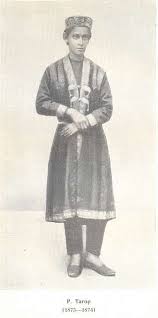
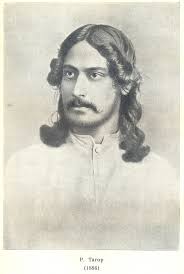
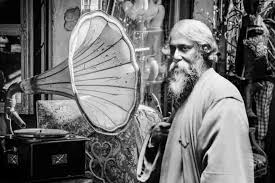
Young Tagore in 1870sTagore in 1886Photos from Public Domain
Rabindranath Tagore was born in 1861 in the throes of the Bengal Renaissance. A unique movement which took place during the latter half of the nineteenth century, it saw the germination and the slow stirring into life of a social and religious consciousness and the emergence of a middle class that idealised British rule and used its support to usher in considerable social change. The revolutionising of values and the social, political and literary awakening that followed gradually came to encompass the whole of India.
The Bengal Renaissance, like its European counterpart, swung precariously for a while, between two worlds. One old, decrepit and dying by degrees — the other struggling to be born. A host of great personalities emerged during this time; household names to this day.
All were protagonists engaged in battle. Some to keep alive and perpetuate the old; some to hasten its death and bring about the birth of the new. Needless to say, it was the latter who prevailed. Bengal saw an upsurge of activity, the like of which had never been seen before, in fields as diverse from each other as politics and religion to literature and the performing arts. In this, Bengal’s close contact with the British served as a catalyst.
Yet the same movement, in its latter years, saw the first stirrings of resentment against British domination. India’s acceptance of English education and her faith in the scientific discoveries of the West was countered by a new revivalism. An assertion of political independence and the growth of a nationalist consciousness. A need for introspection became the call of the hour. Rabindranath was among the first to articulate this need. In an essay, entitled Byadhi-o-pratikar[1]written in the early years of the twentieth century Rabindranath expressed his doubts regarding the changed Indian psyche wrought by the West. Reflecting on the French Revolution, the efforts to abolish slavery and the upsurge of literary activity in Europe he wrote: “Western civilisation seemed to proclaim an inclusiveness for all humanity irrespective of race and colour. We were spell bound by Europe. We contrasted the generosity of that civilisation with the narrow mindedness of our own and applauded the West.” He goes on to say, however, that the scales had fallen from the nation’s eyes. The supposedly Western ideal had failed Indians. European education and adoption of its values hadn’t helped them to achieve equality with the white race.
Thus, the movement came full circle. Rabindranath had not been part of it from its inception. Yet, if one were to look for and identify a single persona in whom the entire Bengal Renaissance may be said to be epitomised, it would, without doubt, be the persona of Rabindranath Tagore.
Poet, playwright, novelist, painter, composer, educationist, nationalist and internationalist, Rabindranath was not only a myriad minded genius but a Renaissance Man in the truest sense of the word. In fact, the dawn or awakening of Rabindranath’s creative inspiration is synonymous with the awakening of a whole nation.
The cultural identity of India and the place in it of religion, caste, class and gender which much of Rabindranath’s prose and poetry explores, continue to retain their relevance even today, a hundred years later, in a post-colonial time frame. His novels offer masterly insights and analyses of the complexities of Indian life with its teeming contradictions; its rootedness in tradition as well its ability to assimilate and accommodate change.
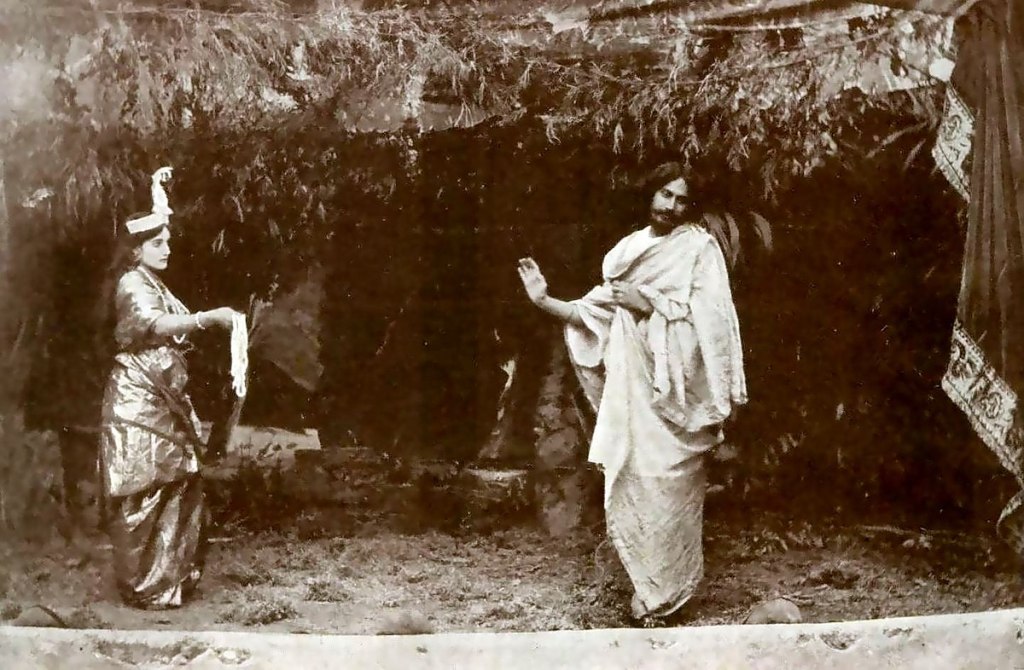
Rabindranath Tagore and Pratibha Devi (his neice) performing in his dance-drama, Valmiki-Pratibha (The Genius of Valmiki) 1881. Photo from Public Domain
Rabindranath, however, is best known as a poet. His poetry, drawn from ancient cultural memory as well as the immediate present, is in a class of its own. For there is a third dimension to it. He not only wrote of what he saw and remembered but what he saw only in his mind — a world that lay a vast space away from reality. ” There are two kinds of reality in the world,” Rabindranath said[2] of his paintings. “One of them is true; the other truer.” He could have said this of his poetry too. The real and surreal quality of his images in the vast span of his poems and lyrics; their indefinable nuances and evocative power are comparable to the works of the great Impressionists.
Interestingly, Rabindranath arrived at the canvas through his poetry. The calligraphic erasures and corrections with which he embellished many of his poems became sketches of a special kind. “I try to make my corrections dance,” he said[3] once, “connect them in a rhythmic relationship and transform accumulation into adornment.”
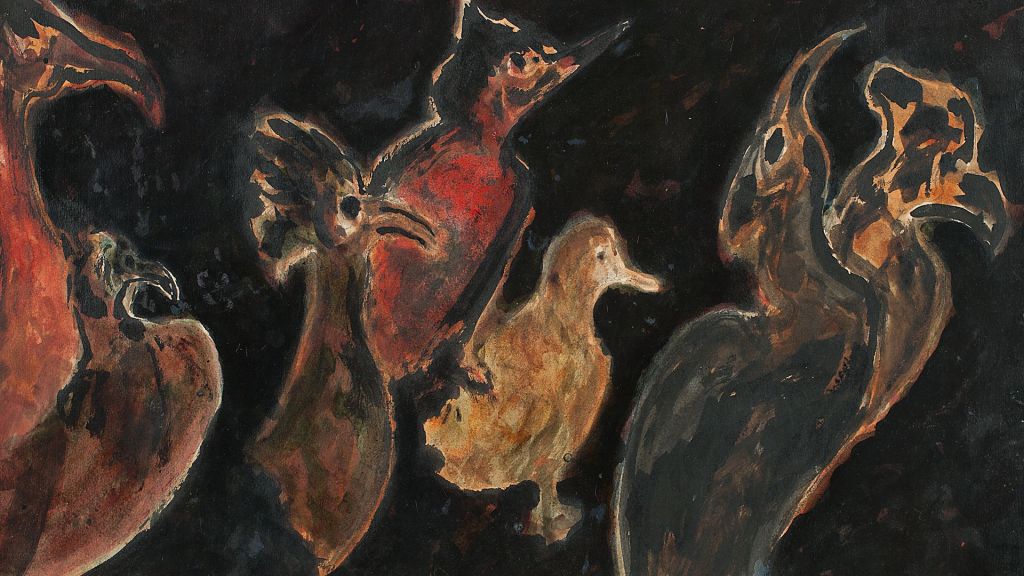
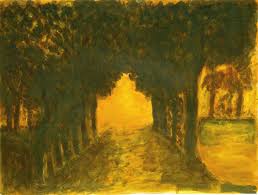
Later, in the last thirteen years of his life he threw himself into frenzied bouts of painting leaving behind more than two thousand and five hundred art works. Strange, haunting faces with eyes that look deep into one’s soul; surreal landscapes the like of which were never seen this side of the horizon; trees and flowers painted in violent colours that erupt from the artist’s palette in volcanic bursts — his paintings, as an artist once said, reflect “emotions recollected more in turmoil than in tranquillity.”
Art of Rabindranath Tagore. Photos from Public Domain
Yet, though famed the world over for his poetry and painting, it is as a music maker that Rabindranath has stayed entrenched in the hearts of his own people. His songs, loved and sung by generations of Bengalis, range in theme from celebrations of nature and yearning for freedom to love of God and Man. They convey the poet’s profound philosophy of life, his deep faith in humanity and his sensitive exploration of the Universe, often touching on the quest of the unattainable. Rabindranath once said that, though he could not predict how future generations would receive the rest of his work, he was confident that his songs would live. The increasing popularity of Rabindra Sangeet, both in India and abroad, bears ample testimony to the fact that his prophecy was based on a certainty born out of self-knowledge. Vast and varied though his genius was — music was its mainspring. He wrote of his songs: “I feel as if music wells up from within some unconscious depth of my mind; that is why it has a certain completeness.”
[2] Quoted from Tagore’s Galpa Salpa (Conversations) by Soumendranath Bandopadhyay in Expressionism and Rabindranath
[3] Quoted in An Artist in Life by Niharranjan Ray
Aruna Chakravartihas been the principal of a prestigious women’s college of Delhi University for ten years. She is also a well-known academic, creative writer and translator with fourteen published books on record. Her novels Jorasanko, Daughters of Jorasanko, The Inheritors, Suralakshmi Villa have sold widely and received rave reviews. The Mendicant Prince and her short story collection, Through a Looking Glass, are her most recent books. She has also received awards such as the Vaitalik Award, Sahitya Akademi Award and Sarat Puraskar for her translations.
.
PLEASE NOTE: ARTICLES CAN ONLY BE REPRODUCED IN OTHER SITES WITH DUE ACKNOWLEDGEMENT TO BORDERLESS JOURNAL
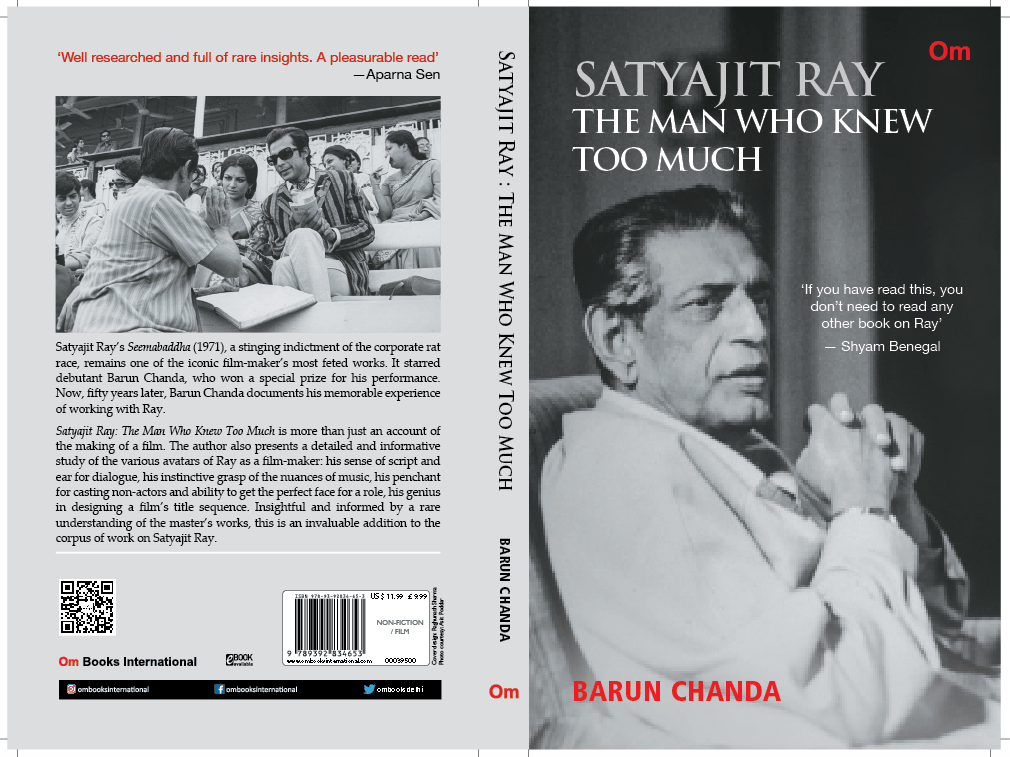
In conversation with Barun Chanda, an actor who started his career as the protagonist of a Satyajit Ray film and now is a bi-lingual writer of fiction and more recently, a non-fiction published by Om Books International, Satyajit Ray:The Man Who Knew Too Much
“[O]ne would like to remember Ray as one of the last truly great renaissance men of Bengal, moulded much in the tradition of Tagore, in the sense that his genius manifested itself in manifold directions: film-making, photography, writing, composing poetry, limericks, music, designing, drawing, developing new typefaces, you name it.
“For a long time, he was also our most distinguished cultural ambassador to the world.”
This perhaps is the one of the most apt descriptions of a man whose films were legendary in our lifetime and a part of the concluding chapter in The Man Who Knew Too Much by Barun Chanda. The book is an exhaustive account of Ray and his major films, how he made the films, what were the influences he had, how he directed the films and how versatile he was. Chanda is clearly impacted by this giant of Bengal renaissance, which started with Raja Ram Mohan Roy in the eighteenth century and encompassed Tagore.
The book is as much a memoir by Chanda about Satyajit Ray as it is a narrative about his films. Structured unusually, this non-fiction has an introduction sandwiched between two sections, the first being Chanda’s own interaction with Ray as a hero of his award-winning film, Seemabadha[1](1971), and the making of the movie; the second being the narrative that covers the titular content (borrowed from Alfred Hitchcock’s famous 1956 thriller), The Man Who Knew Too Much, about the genius of Ray as a filmmaker. Chanda shows us how Ray was truly unique and very gifted. He would remember all the dialogues and be intent on being involved with every part of film making, from costumes to camera, lighting and makeup — which is probably why his films had a unique touch so much so that he has to date been the only Indian filmmaker to win an honorary Oscar which Hollywood actress Audrey Hepburn, collected for him as he lay sick in bed (1992) breathing his last, saying: “Dear Satyajit Ray, I am proud and privileged to have been allowed to represent our industry in paying tribute to you as an artist and as a man. For everything you represent I send you my gratitude and love.”
And this note has been quoted by Chanda to bring out the uniqueness of a man who counted luminaries like Arthur C Clarke, Jean Renoir, de Sica, Kurusawa, Cartier-Bresson among his friends. He has unveiled the unique persona further. “As Ray was wont to say, everything that he had done earlier in his career, helped prepare him to be a complete filmmaker. His sense of framing stemmed from his knowledge of still photography. His deep love of Western and Indian classical music helped shape him as a music director. His sense of art direction came from his earlier stint at D.J. Keymer. His power of illustration helped him design the sets of Hirak Rajar Deshe[2]and Shatranj ke Khilari[3], both marvellous instances of art direction. And a combination of these two factors facilitated his making of some of the most original and impressive cinema posters ever.”
Chanda goes on to describe the full genius of Ray’s film making which even stretched to scripts, songs — both the lyrics and music often, and of course his ability to visualise the whole movie beforehand. Ray is quoted as having said: “I have the whole thing in my head at all times. The whole sweep of the film.”
Interspersed with anecdotes about the films, the text highlights the eternal relevance of some of the dialogues and lyrics that Ray wrote himself. For example, listening carefully to the lyrics of ‘Ore Baba Dekho Cheye[4]’ (Goopy Gyne Bagha Byne, 1969), one could see it as a comment from a current pacifist in today’s war-torn world. This book actually seems like an eye opener not only to understand Ray’s films, but also to find out what the world needs from the media, an important comment in times of false news and sensationalism.
However, the book is not all adulation. It is also a critique of the persona of a visionary who could risk all for realising his vision. Chanda tells us how to attain perfection, Ray could risk necks: “There was an element in Ray bordering on ruthlessness. To get a certain effect on the screen he wasn’t averse to taking risks, at times to dangerous levels.”
New perspectives are brought in from unpublished interviews: “In an unpublished Bengali interview of Ray which is in the possession of Abhijit Dasgupta, one-time chief of Doordarshan, Kolkata, when asked about his film Sadgati[5], the maestro is quoted to have said: ‘One needed to make a film on this story immediately. As a Marxist, Mrinal Sen would have probably made it differently, more angry … Had this film been angrier I’m not sure it would have served the purpose any better. I don’t think display of anger alone can lead to much of an achievement. To my mind a truly politically angry film hasn’t been made so far. Until now what has been done is to shoot at safe targets. It hasn’t made any difference to establishments in any way. If one were to achieve this kind of a thing, I would sooner be a political worker than a filmmaker.’”
While looking at the maestro through an objective lens, Chanda finds it hard not to express his affection for the giant who impacted not just him but a whole generation of movie goers, film personnel and the world. His last sentence says it all:
“As far as I’m concerned, he [Ray] is always present. Not past. Not even past perfect.”
Chanda, a man who started his life working in the same advertising agency as Ray and dreaming of being an actor, with four books and multiple films under his belt, himself mesmerised audiences as a protagonist in Ray’s award-winning film and then suddenly withdrew from the industry for two decades. Why would he do that? Let us find out more about him and Ray in this interview.
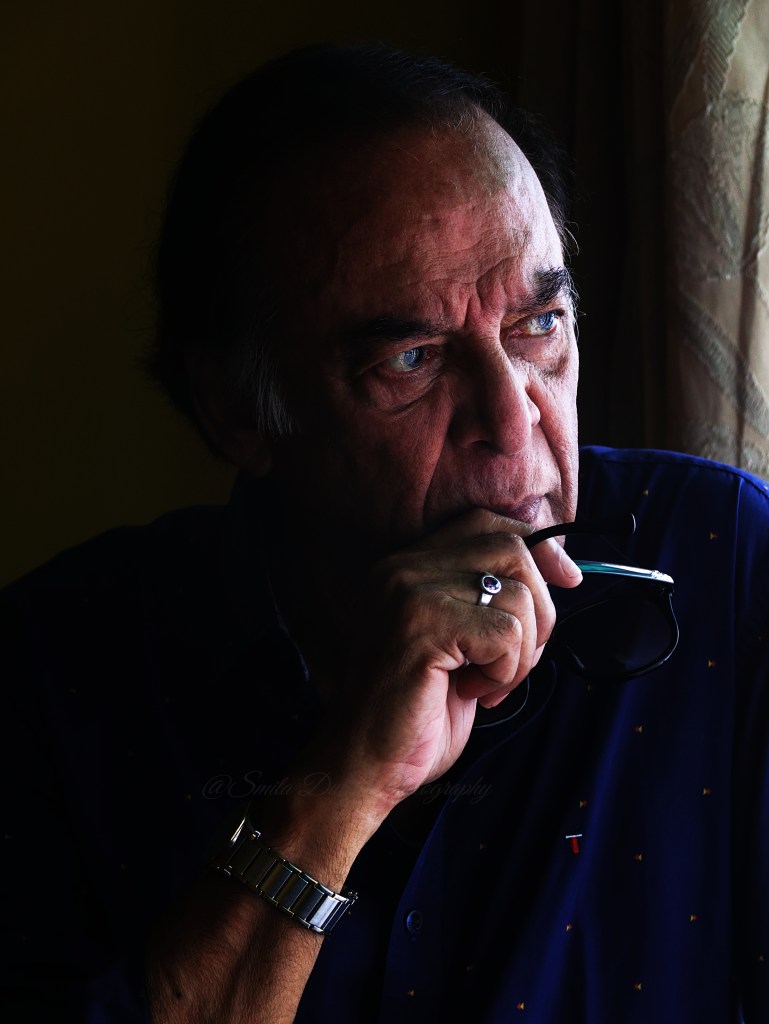
Barun Chanda
First of all, let me tell you I am very honoured to be interviewing a Ray hero from a film I have watched multiple times. So, tell me, why did you act only in one Ray film, have a hiatus of twenty years and then go back to acting with Hirer Angti[6] in 1992, the year Ray died. Did it have anything to do with Satyajit Ray’s presence or influence?
No. I’ll tell you what – after Seemabadha, I got a cluster of film offers, nine-ten offers and I did not accept anyone of them because they did not seem to be significant enough. I wasn’t interested in making money out of films or becoming a film star. I was interested in acting in good films. If they came my way, I would do. If they didn’t come my way, I wouldn’t. I would go back to my profession which is advertising. I was very happy there.
So, these offers that came didn’t quite satisfy me. And Manikda[7] did not call me back again for whatever reasons. The other significant filmmakers like Tapan Sinha, Mrinal Sen and Ritwick Ghatak – they did not call me. I suppose I was branded as a capitalist actor. Or Imperialistic actor! I suppose it became ingrained in their mind I was an executive and nothing else. They felt they could not bend me into the roles in their film. A pity!
Is this your first non- fiction? What led you to think of writing a book on Satyajit Ray?
Yes, it is my first non-fiction. I had harboured this thought for a long-long time but there is a natural reluctance about writing anything. I am, by and large, a lazy person and there were a whole lot of things that were pretty personal, and I thought, you know, let it be stored in my mind. Maybe, I could narrate to my close friends’ circle certain stories and certain things that happened between me and him. But not for everyone. Even in this book, I have not mentioned a whole lot of things that are too personal, which he confided to me in good understanding that I will not tell another. I won’t speak about it.
Then the centenary year came, and many asked me why I did not write my out my memories. Shantanu Ray Chaudhuri was one of them. He said the time is right and you have such wonderful anecdotes and experience, put it down for posterity. When I did the first part, I realised it could not just be my experiences but also something larger – in the sense what kind of a man was he in real life.
I was also dissatisfied with the books I have been reading about Ray and his works — starting with Marie Seton[8], who was supposed to be a gospel on Ray. I found it was a narration of his films in chronological order and what she thought of them. It was film-based assessment, not of the man himself or his qualities separated from the films. So, I decided to explore his persona. This book is quite different from any written on him. I have sections on music, editing with a whole lot of films but not in a chronological order. That is passé. The second part started with what has not been done. As I progressed, newer sections dawned on me – a whole lot of sections I have not used. I wanted a chapter on “The Rise and Fall of the Ray Empire” – but then thought I’d rather not finally. It would have been terrific, but I did not, perhaps want to spoil the public feeling about Ray. I did not want to criticise. I did do a chapter though — “Director or dictator”.
Absolutely. Your book is dispassionate but has no scandals or any unfair criticism. In fact, it seems to be based on not just your memories but also many interviews and lot of research. Can you tell us what went into the making of this book in this context? What kind of research and who all did you interview? How much time went into the making of the book?
I used Ray’s experiences with actors who are no longer alive – like Chabbi Biswas or Tulsi Chakraborty. I have used Aloknanda Roy who happened to work with Chabbi Babu in Kanchenjunga[9]. I used the living actors. I did not interview Soumitra Chatterjee – I know his feelings on Ray. So, I did not interview him separately. But there is a lot in the book about how Soumitra da perceived Ray or his equation with Ray.
The book worked well for me – I would have gone to a madhouse but for this book. You have to believe me. For it helped my sanity, writing this book during the Covid period[10]. The eighteen months—closer to two years. I could really concentrate on something as I am an outgoing person – not that I am a club person – but I would like to meet my friends, lead an active life. Suddenly, I felt imprisoned – it was like house imprisonment. So, I turned my attention to writing this book and whatever I could get out of YouTube, whole lot of other’s books, Ray’s interviews. One gentleman, Abhijit Dasgupta, who was the head of Kolkata Doordarshan, had conducted an interview. He gave me part of it which I found very intimate. You could do a book on Ray and Mrinal Sen dispassionately –Mrinal’s films would be of historical importance but not of relevance otherwise whereas Manikda’s films can be watched again and again because it touches your heart.
That is so true. Your book is structurally unusual with an introduction in the middle of two parts. Why did you follow such an unconventional format? Do you feel it helped your presentation in any way?
Yes. Because I was writing a different book. No one has written a biography in two parts. In a way it is not a biography, but it is trying to understand and appreciate Ray as a filmmaker. That’s what the book is.
I was in an advantageous position to write on Ray. Actually, Dhritiman Chatterjee could have done the same. I admire Dhriti for his thinking, but I guess there is an innate laziness. He did interview Manikda but I do not know where the tapes are.
I felt the way I did it was the right way. The book came naturally to me. For somethings, I went out of my way — like the titling.
To this date, no Indian director has made a film where the title is relevant to the film. The film follows from the title. The thought is not there. But it is there in the West. That is why you have people like Saul Bass. Ray wanted to do things himself – that might have been why he did the titling too. He would draw and present to the art director who would work further on it. I should have had a whole lot of drawings in this book, but it was not readily available.
I continue to feel I could embellish certain chapters, especially on music. Debojyoti Mishra, a film music director, has written a book in Bengali which actually traces from where Ray has borrowed what piece of Western Classical music. It is not unlike Tagore – there are analogies in the use of music between the two.
Ray spent a few years in Santiniketan when he was young, I think around 1940. Was he impacted by Tagore? Can you tell us about it? Did he meet Tagore or have any conversation with him as it was a year before Rabindranath passed on?
He did not actively seek out Rabi Thakur. He was a very shy person. There is no mention anywhere in his writings about seeking out Tagore, knowing very well Tagore held his father and grandfather in great esteem. His mom knew Tagore well. But he never sought him out. It is rather difficult to understand why he did not utilise the time speaking with Tagore. Maybe, Tagore was inaccessible. I could have asked him, but I never did. I do not know why I never asked.
Why would you borrow from Alfred Hitchcock to name probably one of the last of the Bengal renaissance men? Can you please elaborate?
I thought that the title was absolutely apt. As a director he knew more than any director did. It described him to perfection. He would draw, give music and work with his basic idea with the rest of the team.
What would you say is Ray’s most major contribution to the world?
The brilliance of Ray’s portrayal of the village was outstanding. You watch the film and think you cannot improve on it. And Ray knew it and has said it.
Does Ray continue to impact current trends in cinema?
Ray was a classicist. The film making style has moved away from that. He would not move the camera unless it became imperative to his film. But now, cameras are handheld, and they have fast shooting. Film making has transformed with the emergence of the web series. Shooting has become so much easier and quick, though they work very hard. There is something more raw about web series. The feature film is more stately, more crafted. Films have enough time. You cannot get a good film if the actors are not brilliant. You cannot shoot a good film in ten or twelve days as they do for web series. That is not physically possible. In the West, they take eighty to ninety days to shoot a film.
Ray wrote many novels on Feluda and Professor Sonkhu. Yet made few films on them. He made films of others’ books rather than his own. Can you tell us why?
Maybe, the writing part started late in his life. It was propelled by his need to feed Sandesh[11] and he had to supply stories to Desh[12] — one per year, for the puja[13]special. His writing came as an offshoot – it was an accident. But the preparation was there – if you read his scripts or lyrics, they are fantastic. The scripts he wrote were brilliant. There is much to admire and respect about him. He was a writer too.
You are known to be a writer too. Are your books impacted by your association with Ray?
What I learnt from him was how to write dialogues. The publisher of my Bengali books, Tridib Chatterjee, said he found my dialogues “smart”. Ray’s writing was very tight. I tighten my descriptions. I do not expect the readers to read a book like Tom Jones[14].
Can you tell us about your other books? Coke (2011) interestingly, is available in both Bengali and English. So, which came first — the Bengali book or the English? Are they both your handiwork? Tell us a bit about your novels?
I wrote it in Bengali first and then wrote it in English later. Actually, it was not a direct translation. I write in both the languages. Another one which is in English is Murder in the Monastery. The second edition is being brought out by Rupa, should be available on Amazon soon hopefully. Post-Covid, people have gone into hibernation. So, many have complained they cannot get it.
I have two books in English, Coke and Murder in the Monastery. The others are in Bengali.
Which genre is preferable to you — murder, mystery thrillers or non-fiction like this one?
I get my high writing fiction, especially crime.
Are you giving us any new books in the near future?
Yes, a collection of short stories in Bengali, probably after the pujas. I have created a character called Avinash Roy. He is learned and intelligent but not overtly brilliant like Sherlock Holmes. My favourite character [fictional] among detectives is that of Inspector Morse – I have seen the TV series but not read the books. He was very human. Absolutely brilliant. But coming back to my current book, it is also facing delays, but I am hoping it will be out this October.
Thank you for giving us your time and answering our questions
 Borderless