Categories
Excerpt

Lovingly Together until the End

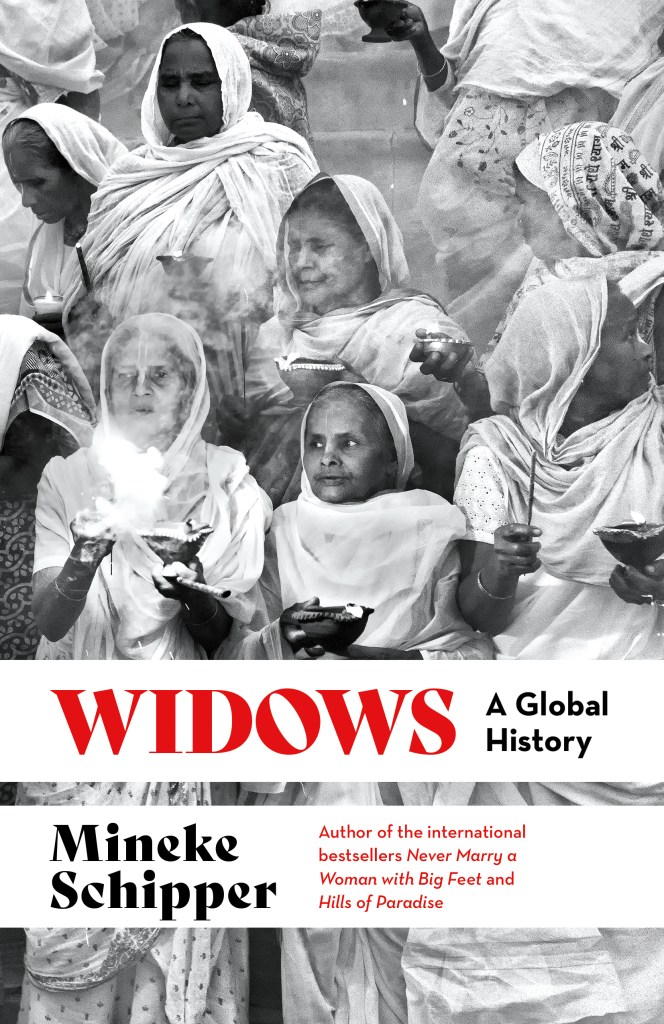
Title: Widows: A Global History

Author: Mineke Schipper

Publisher: Speaking Tiger Books

Lovingly together until the end

Long, long ago, Zeus descended to the place where two trees are wrapped in a loving embrace: an oak and a linden tree amid an undulating landscape, their entwined branches a testimony to undying love. ‘I have seen them with my very eyes’ is how the narrator begins the story about how the gods can decide our fate, which was recorded by Ovid in his Metamorphoses.

The story goes as follows: one day Zeus, king of the gods, disguised himself as a mortal and descended to Earth, accompanied by his son, Hermes. They knocked at every door they found in search of a place to rest, but none of the homes they visited welcomed them in. They finally reached the tumble-down cottage belonging to Baucis and Philemon, an old couple who, in spite of their poverty, were perfectly content with their lot, and welcomed the pair with open arms, generously providing them with all the fruit, nuts, figs and dates they had to hand. They were even prepared to kill their goose, but the bird escaped its fate and found safety between the two gods. Hermes and Zeus explained to the couple who they were and why they were going to destroy this godless part of the world: ‘Only the two of you will be allowed to escape this disaster’.

Leaning on their staffs, the old couple followed the gods to the top of a hill, from which they looked back to see all the land in the valley flooded and sinking into a muddy bog, apart from their own cottage, which had been turned into a glistening temple with marble floors and columns. Zeus granted the couple a wish, and they did not need too long to think about their reply: they wished to become priest and priestess of the new temple and, most beautifully of all, they both wanted to die at the same time at the end of their lives. Both wishes were granted.

One day, after a long and fortunate life, the pair stood at the bottom of the marble steps leading up to the temple. All of a sudden bark began to cover their bodies and legs and their arms began to sprout leaves. They shared one final word of farewell as the leafy canopy started to engulf their faces. In an act of tenderness, they stretched out their branches longingly towards one another, and to this day continue to whisper to each other through the rustle of the leaves.

Living on together in human form after death is another comforting solution in stories the world over. No surprise therefore that storytellers have always wondered how Adam and Eve, the first humans according to Judaism, Christianity and Islam, met their end. The holy books of these three religious traditions all begin with the pair living in Paradise, with the Bible even stating that Adam was 930 years old when he died, but the details of their deaths are conspicuous by their absence.

Eve’s widowhood is not dealt with at all in the Bible, yet oral traditions do discuss it, as storytellers tend to have free rein. In one early Christian story, on his deathbed Adam confronts Eve with the most wicked accusation; during that emotional moment, he forces her to once again explain to their children and grandchildren (and all of his progeny) that it is through her that death came into the world. No surprise therefore that, after Adam’s death, Eve wallows in the mud, grief-stricken and despondent, imploring God’s mercy for her unending guilt, until she dares to gaze upwards, where the most incredible spectacle unfolds before her eyes: angels float in the sky, obscuring the vaults of heaven with their swinging incense burners, as the body of Adam is brought to Heaven on a chariot of light drawn by four shining eagles.

Further details about the now widowed Eve are absent, but in one optimistic Islamic story from Yemen, upon their deaths the angel Gabriel comes to Earth to collect both Adam and Eve to take them back to the Garden of Eden. As they arrive, the gates of Heaven swing open, and they are greeted with ‘Peace be with you and welcome back’. These words are spoken by Ridwan, the same gatekeeper who at the start of their earthly lives had slammed the gates of heaven behind the pair as they left. Upon their return they must undergo a ritual purification: first they are handed a golden cup with water from the well of purity, followed by another golden cup filled with water from the fountain of eternal youth.3 Together till the end, from their expulsion from Paradise to their return.

One goes, the other remains

In the harsh reality of life, this narrative works slightly differently, the question being ‘which of the two of us will be the first to go?’ This pressing question inevitably arises among people who are in love and happy with one another. In fairy tales, couples live long and happy lives, and at weddings you will often hear a variant of the adage ‘may you live long and well’. At weddings in India’s eastern state of Assam, you will hear the words ‘may the kinowari (bindi) never disappear from your forehead’. This symbol of marital bliss is used to wish brides a marriage that lasts a lifetime, with those who become widows no longer being permitted to wear it.

‘May a God-blessed wife go with her husband to his grave’ is a popular Arabic wish for women, as what could be more beautiful than dying together on the same day?

(Extracted from Widows: A Global History by Mineke Schipper. Published by Speaking Tiger Books, 2024)

About the Book

Widows have always far outnumbered widowers (who quickly remarry, usually younger women). War, hunting and the uncertainties of long travel ensured that most husbands died before their wives did. Mineke Schipper’s cultural history of widows examines how these husband-less women have, throughout history and mythology, been portrayed as helpless damsels, easy pickings for men outside the family or clan, or as cunning witches who are suspected of murder. In every case, the motive has been to exclude them and control them. Schipper traverses the world, travelling across time, to collect and analyse stories about widows and their treatment—the loss of status they face after their husband’s death; the harsh rituals of mourning they are forced to perform; the often brutal controls on attire, mobility and sexuality that they must submit to. It is a global legacy of cruelty and shame—as also, occasionally, of resilience and defiance—that has rarely been studied as deeply and thoroughly as in this extraordinary work. Widows draws upon sources from Ancient Egypt and Greece, medieval India and modern-day Europe, Africa and the Americas—examining folk and real-life stories of communities in Fiji, Papua New Guinea, Ghana, China, France, and several other countries and regions, as also stories and images from comics and fashion magazines.

Impressively researched and entertainingly narrated, this book—its information made distinctive by Schipper’s sharp insight and her humour—is an important document that helps us understand our past and, through it, our present.

About the Author

Mineke Schipper is Emeritus Professor of Intercultural Literary Studies at the University of Leiden, The Netherlands, with visiting professorships in Nigeria, Kenya, Zimbabwe, Burkina Faso and China. She is the author of Never Marry a Woman with Big Feet (Eureka Prize for Non-fiction), Naked or Covered and Hills of Paradise.

.

PLEASE NOTE: ARTICLES CAN ONLY BE REPRODUCED IN OTHER SITES WITH DUE ACKNOWLEDGEMENT TO BORDERLESS JOURNAL. 

Click here to access the Borderless anthology, Monalisa No Longer Smiles

Click here to access Monalisa No Longer Smiles on Kindle Amazon International
Categories
Poetry

The Village Huckster

By Shamik Banerjee

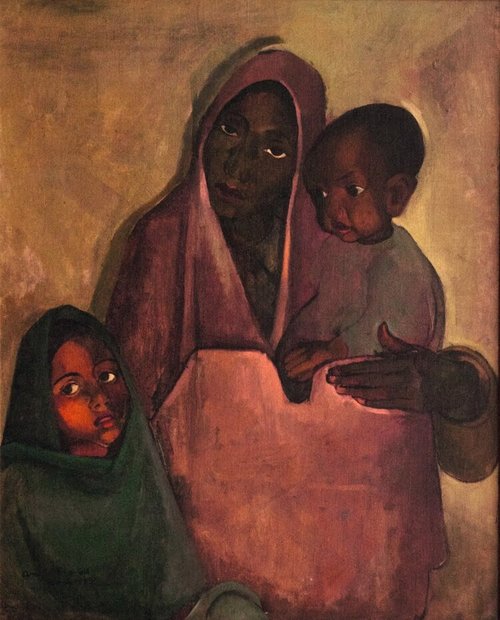
Painting by Amrita Shergill (1913-1941)

THE VILLAGE HUCKSTER

Upon the tracks of Assam's soggy soil,
She peddles from one doorstep to another.
Carrying a sling bag, she begins to toil.
Her scraggy feet -- all varicosed together.
Today, I saw her in a floundering state,
Submerged in sweat, shod in half-tattered shoes,
And haggling for the dairy in her crate --
Enslaved by mugginess -- to earn for two.
She halted at a nearby marsh with trees,
Reposed, and smeared some poultice on a heel,
Then toiled some more until the day's release
To have enough for one full, proper meal
And rest at last when all her tasks were done
While caring for her seven-year-old son.

Shamik Banerjee is a poet from Assam. He lives with his parents. Some of his latest poems have appeared in The Dirigible Balloon, New English Review, The Society of Classical Poets, and The Hypertexts.

.

PLEASE NOTE: ARTICLES CAN ONLY BE REPRODUCED IN OTHER SITES WITH DUE ACKNOWLEDGEMENT TO BORDERLESS JOURNAL

Click here to access the Borderless anthology, Monalisa No Longer Smiles

Click here to access Monalisa No Longer Smiles on Kindle Amazon International

Categories
Poetry

Poetry by Shamik Banerjee

TO MR. BANERJEE (SENIOR)

Without black tea, his mornings never start.
The newspaper should be upon his bed;
Not finding it will make his eyes all red.
As if examining a piece of art,
He reads each page. Loud oohs such as 'My heart!',
'Another swindle!', or 'So many dead!',
Are heard as if the earth's weight’s on his head.
Harrumphing, he jumps to the Cultures part.
A pensioner today, back in those days,
He was a banker. Now, he saunters, plays
Carom with me, or spends the noontimes planting
Camellias —- a work he finds enchanting.
At times, he sits before some dusty files,
Puts on the glasses, thumbs through them, and smiles.

Shamik Banerjee resides in Assam with his parents. Some of his recent works will appear in York Literary Review, Willow Review, Thimble Lit and Modern Reformation — to name a few.

PLEASE NOTE: ARTICLES CAN ONLY BE REPRODUCED IN OTHER SITES WITH DUE ACKNOWLEDGEMENT TO BORDERLESS JOURNAL

Click here to access the Borderless anthology, Monalisa No Longer Smiles

Click here to access Monalisa No Longer Smiles on Kindle Amazon International

Categories
Slices from Life

Heatwave & Tagore

Once more, Ratnottama Sengupta explores the contemporariness of Tagore ….

The continuing heatwave in Kolkata that has defied the geographical reality of Kaal Baisakhi — the norwester that brings relief to sun-scorched beings — prompted me to continuously hum this Tagore song in Brindavani Sarang Raag, written in 1922.

Darun Agni Baaney Re... 
(Shafts of Fire)


Shafts of fire pour thirst on us --
Sleepless nights, long scorching days,
No respite in sight!
On withered branches,
A listless dove wails
Droopy doleful notes...
No fear, no scare,
My gaze is fixed on the sky,
For you will come in the
Form of a storm,
And shower rain on scorched souls.

And as I kept singing the song first penned in Santiniketan, I marvelled at the creativity of the giant whose words are true to this very day, more than 100 years later!

Kaal Baisakhi, the nor’wester known in Assam as bordoisila, is a localised rainfall and thunderstorm event which occurs in the Indian states of West Bengal, Bihar, Jharkhand, Odisha, Tripura, and Assam as well as in Bangladesh during the summer month of Baisakh (April 15-May 14). This first month of the Bengali calendar also saw the birth of Rabindranath Tagore. These storms generally occur in the afternoon or just before sunset, when thick dark black clouds appear over the sky and then bring gale-speed wind with torrential rain, often with hail, but spanning only a short period of time.

Kalbaisakhi

Tagore’s love for Nature had compelled him to set up in Santiniketan open air classrooms, where students would learn sitting on the ground in the bower, under trees where birds would chirp and gentle breeze would caress their tired brows.

And, his involvement also expressed itself in the 293 songs he wrote in the segment titled Prakriti (nature) Parjaay. There are songs about nature in general. But he himself further classified the songs under subsections — Upa parjaay — that focus on the six seasons: grishma (summer), barsha (Monsoon), sharat( early autumn), hemanta (late autumn or early winter), sheet (winter), basanta (spring). 

Tagore clearly was taken up by the wild beauty of monsoon with its dark clouds and thunderous showers. For, he wrote 150 songs on the drops of nectar from the heavens, while summer elicited a tenth of this number! If this is half the number celebrating sharat, the festive season of Durga Puja, it is thrice the number dedicated to hemanta, the confluence of autumn and winter.

I take heart in the fact that Grishma subsection includes Chokkhe aamar trishna, Ogo trishna aamar bakkho jurey… [1]

Thirst fills my eyes, Dear, 
Thirsty is my heart too...
I'm a rain-starved day of Baisakh
Burnt by the sun, heat stroked.
There's a storm brewing
In the ovenated air..
It sweeps my mind into the distance.
It rips me of my veil.
The blossom that lit up the garden
Has withered and fallen.
Who has reined in the stream
Imprisoned in heartless stone
At the peak of suffering?

And then, when it rained? The torrents poured balm on the angry burns. The fleet-footed lightning seared the heart of the cloud-covered darkness and extracted the nectar-like flow…

It assured us that no hardship lasts forever. It reiterated faith in the eternal words, “This too shall pass!” And, for me? It confirmed Tagore’s words that “You will come in the form of a storm and shower rain on scorched souls…”

Tagore lives on, 163 years after he came. In his words. In his imagery. In his empathy with every human situation…

[1] Thirst fills my eyes, Dear, /Thirsty is my heart too…

Ratnottama Sengupta, formerly Arts Editor of The Times of India, teaches mass communication and film appreciation, curates film festivals and art exhibitions, and translates and write books. She has been a member of CBFC, served on the National Film Awards jury and has herself won a National Award. 

.

PLEASE NOTE: ARTICLES CAN ONLY BE REPRODUCED IN OTHER SITES WITH DUE ACKNOWLEDGEMENT TO BORDERLESS JOURNAL

Click here to access the Borderless anthology, Monalisa No Longer Smiles

Click here to access Monalisa No Longer Smiles on Amazon International

Categories
Poetry

Testimony of a War-Seized House

By Shamik Banerjee

Before the bombings, I was not aware
That homes, like humans, could get orphaned too.
Built by a wealthy merchant's wealthy heir,
I've held this ground since 1992.

I've witnessed nicety, hope during pain,
Devoutness, goodwill, and pragmatic views
In those five souls I roofed, who once sustained
Me with dense quicksets, sconces, and bright hues.

They say love's sown with hopes of its return,
But I had failed to be a loyal friend
That ill-starred night, when swiftly, turn by turn,
Those cruel projectiles brought my family's end.

The lattices (my forearms) crumpled first,
And then the heavy gambrel roof (my head)
Fell on my sleeping members as the burst
Of asphalt shingles claimed them on their beds.

But greater is my guilt from treachery;
For now, I'm slave to foes, who triumph, shout
On my own land, spit at our dignity.
Oh, how I strongly wish to drive them out!

Shamik Banerjee is a poet from India. He resides in Assam with his parents and works for a local firm. His poems have appeared in Fevers of the Mind, Lothlorien Poetry Journal, and Westward Quarterly, among others, and some of his poems are forthcoming in Willow Review and Ekstasis, to name a few.

.

PLEASE NOTE: ARTICLES CAN ONLY BE REPRODUCED IN OTHER SITES WITH DUE ACKNOWLEDGEMENT TO BORDERLESS JOURNAL

Click here to access the Borderless anthology, Monalisa No Longer Smiles

Click here to access Monalisa No Longer Smiles on Kindle Amazon International

Categories
Poetry

Why the Rivers Run Black

By Suzanne AH

A SONNET TO MAKE A WISH 

I am a conflicted woman, my love.
I understand as strongly as I wish.
I understand there’s no world without war,
Only wish for a sliver of a niche.
I understand why the rivers run black,
Why smoked skies once blue, sends no more relish,
Why that man on the pavement sleeps hungry
While kings at feasts seldom touch their plenty.
I know why there’s no joy without sorrow.
All want more. They may beg, steal or borrow.
Everywhere I see, ladders of deceit.
Climb darling climb, in this farce you’re to fit.
Someday our love may cease, I understand.
Wish till the end, I am holding your hand

Suzanne AH is an aspiring writer from Assam with a passion for words.

PLEASE NOTE: ARTICLES CAN ONLY BE REPRODUCED IN OTHER SITES WITH DUE ACKNOWLEDGEMENT TO BORDERLESS JOURNAL

Click here to access the Borderless anthology, Monalisa No Longer Smiles

Click here to access Monalisa No Longer Smiles on Kindle Amazon International

Categories
Excerpt

Stories of Children Rescued From Slavery by Nobel Laureate Kailash Satyarthi

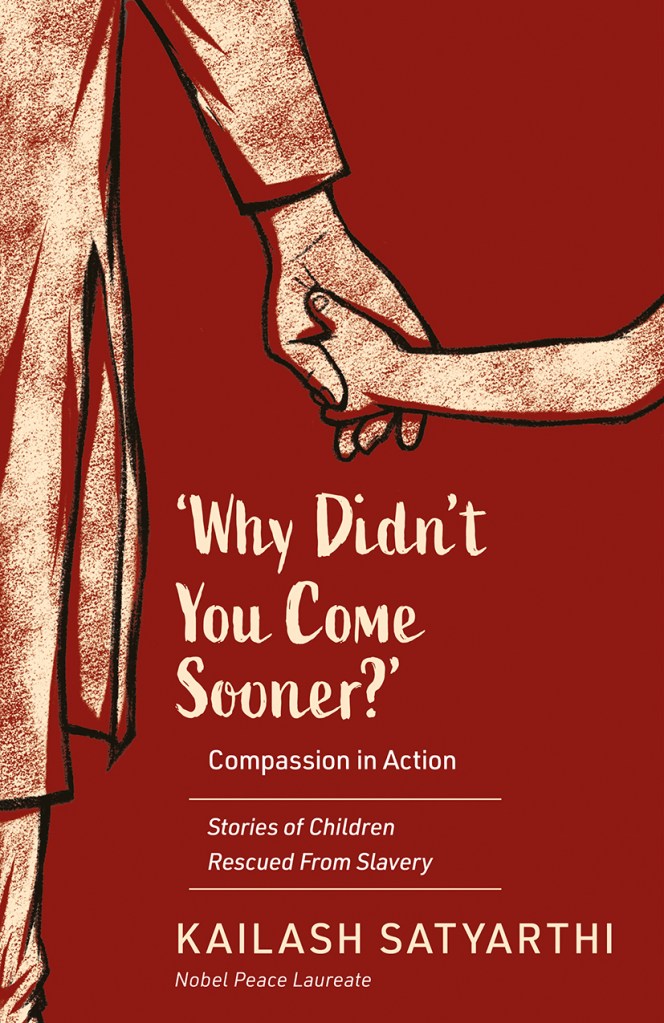
Title: Why Didn’t You Come Sooner? Compassion In Action— Stories of Children Rescued From Slavery

Author: Kailash Satyarthi

Publisher: Speaking Tiger Books

I seated a few of the children in my car, and drove away as fast as I could. The truck with the men and women followed me. The clothes of the children who sat with me in the car were tattered and torn. The wounds on their flesh could be seen through the holes in their clothes. Every such wound is a blot on human civilization. The frightened little girls were trying to hide their bellies and chests by hugging their knees. They simply could not make sense of all that had happened since morning. I made tentative attempts to talk to them. I tried explaining to them that they were now free from bonded labour and were being taken to a secure place. But they had never known freedom, or safety. How could they understand what I was trying to tell them? Maybe they assumed I was their new owner.

Just then, I remembered that there were some bananas lying in the back of the car. I asked the children on the back seat to distribute them among themselves. I thought they must be hungry, and might feel better after eating something. But no one picked up the bananas.

‘Go on, child. Pick up that bunch of bananas and pass it on,’ I gently repeated myself.

One of the children gave it to the child sitting in front. An emaciated girl and a little boy were seated next to me. I told them to pass on the fruit to everyone in the back and keep one each for themselves. The girl looked curiously at the bunch as she turned it around in her hands. Then she looked at the other children.

‘I’ve never seen an onion like this one,’ she said.

Her little companion also touched the fruit gingerly and innocently added, ‘Yes, this is not even a potato.’

I was speechless to say the least. These children had never seen anything apart from onions and potatoes. They had definitely never chanced upon bananas before. Upon further cajoling, some of them started chewing on the bananas. But they were trying to eat the fruit without peeling it. Some tried to swallow it while others were trying to hide it in their palms after having spat it out. My imprudence had for a moment pushed me back a few thousand years. The difference between an unpeeled banana and a peeled one was the distance between slavery and freedom. I quickly tried to rectify my error and taught them how to peel a banana and consume it. Most of them tasted the sweetness of the fruit and probably relished it too.

They began sharing this new experience among themselves in their dialect. I was feeling their joy too. Just then, the little girl sitting next to me tapped me on the shoulder and almost screamed.

‘Why didn’t you come sooner?’

I instantly turned to face her. Her innocent, tear-filled eyes and pained voice laced with anger pierced my heart. I could tell that these words had risen from the depths of her heart, where they lay suffocating for years.

Her younger brother had passed away for lack of availability of medicine. Once, the quarry owners had beaten up her father and uncle and branded them with burning cigarettes. They had raised their voice against the sexual exploitation of the women and tried to escape. Even the tiny hands of the children, when wounded, were never tended. They couldn’t even manage to get bits of cloth to tie around their wounds. This little girl had survived the entirety of hell in the eight years of her life. This was probably the first time that she could bring herself to trust someone enough to mouth the words, ‘Why didn’t you come sooner?’

That challenging question deepened the restlessness and anger that the issue of child slavery aroused in me. The child who posed this question was none other than Devli. She had put it to me, but it is one that needs to be answered by every person who speaks of faith, law, the Constitution, human rights, freedom, childhood, humanity, equality and justice. That question is as pertinent today as it was on that day all those years ago.

According to an estimate, there are around five million labourers employed in stone quarries in India. Hundreds of thousands among them are child labourers. Contractors and their agents pay tiny advances to impoverished families in backward areas and get them to come to the quarries on some false pretext or another. This is the organized crime of human trafficking that is often dressed up as migration or displacement. Usually, there is no record of workers in the quarries. In other words, children like Devli and her parents do not exist anywhere in legal terms.

To break up the stone, deep holes are drilled in it with powerful machines by skilled or semi-skilled workers which are then detonated with the use of gunpowder. The large rocks that are exposed after the explosion are broken down into smaller stones by adult men and women as well as children. The smaller children are engaged in removing the soil before the detonation takes place as well as removing the small stone chips after. Death is far from uncommon among these unskilled labourers who often get buried under the rocks thrown up by the explosions or when a quarry, unsteady from the shock, caves in.

(Excerpted from Why Didn’t You Come Sooner?: Compassion In Action—Stories of Children Rescued From Slavery by Kailash Satyarthi. Published by Speaking Tiger Books, 2023)

About the Book:

The work of rescuing children from slavery is not for the faint of heart, as the twelve gut-wrenching accounts in this book will show. Harder still is to give them their life back, after they’ve been kidnapped, trafficked, sold, abused and made to work in horrific conditions, often for as long as they can remember. Pradeep was offered up for human sacrifice by his family, thought to be a bad omen; Devli was a third-generation slave in a stone quarry in Haryana, who had never seen a banana before her rescue; Ashraf, a domestic child labourer at a senior civil servant’s house, was starved and scalded as punishment; Sahiba was trafficked from Assam to be someone’s wife against her will; Kalu was abducted and made to weave carpets all day long, his injuries cauterized with phosphorus scraped off matchsticks; Bhavna was trapped in a circus, sexually abused for years by her owners; Rakesh was worked in the fields all year round like cattle, and spent the nights locked up with them in the stable; Sabo was born to labourers at a brick kiln, and never knew life outside it; and Manan lived his childhood mining mica in the forests of Jharkhand, barely given time to even mourn his friend who got buried when the mine caved in. Kailash Satyarthi’s own life and mission were entwined with the journeys of these children. Having lived through unspeakable trauma, they had lost faith in humanity. But behind their reticence, behind their scraggy limbs and calloused hands and feet, hope still endured. This book tells the story of their shared struggle for justice and dignity—from the raid and rescue operations of Satyarthi’s Bachpan Bachao Andolan, to international campaigns for child rights. It is a testament both to the courage of the human spirit and to the power of compassion.

About the Author:

Kailash Satyarthi (b. 11 January 1954) is one of the most well-known child rights activists in the world. He has led many national and international campaigns to protect child rights and promote their education over four decades and rescued countless children from slavery. He is a recipient of the Nobel Peace Prize, among many other human rights awards.

.

PLEASE NOTE: ARTICLES CAN ONLY BE REPRODUCED IN OTHER SITES WITH DUE ACKNOWLEDGEMENT TO BORDERLESS JOURNAL

Categories
Review

Writing South Asia in the American South

Book Review by Gemini Wahaaj

Title: South to South: Writing South Asia in the American South

Editor: Khem K. Aryal

Publisher: Texas Review Press

Taken together, the stories and essays in the new anthology edited by Khem K. Aryal South to South, Writing South Asia in the American South, offer an intimate, richly articulated expression of what it means to live in the American South as a South Asian immigrant. Several stories construct the enduring feeling of loss, both for new immigrants and old. Sixteen authors have been featured. Some have dealt with the issue through fiction and some, through non-fiction.

In “The Immigrant”, a short story by Chaitali Sen, a young immigrant man Dhruv tries to compose a letter to his parents describing his new life in America but fails to find the language. While dining next to the hotel where he is staying during  a work trip, Dhruv is upset by the disappearance of a small boy and the fruitless search of the distraught parents, which reminds him of his own state in America, where he seems to have lost his way. In “Pine” by Hasantika Sirisena, a young Sri Lankan mother of two small children tries to hold on to her customs from home. Her husband walks out on her in a bid to make a new, successful life in America, unburdened by the trappings of culture and religion. She seems in danger of losing her two children also, who are more interested in Christmas trees than the rituals she wants to share with them. In a startling turn of events, she comes to terms with her own uprooting with touching courage.

Several stories remind us of the remarkable flexibility of South Asian immigrants, who transform themselves and become new people after putting down roots in a new place. One such story is Aruni Kashyap’s “Nafisa Ali’s Life, Love, and Friendships Before and After the Travel Ban”, about a young married woman from the war-torn region of Assam, whose mother and husband in India constantly worry about her safety. Nafisa lives next door to a couple as different from her as possible; they do not work, they drink and they have public sex – yet, Nafisa feels drawn to them as she embraces her new relationships and identity in America to escape her traumatic past. In “Nature Exchange”, Sindhya Bhanoo tells the story of a South Asian woman married to a white man whose relationship with her husband comes to an end when their son dies in an all too typical American phenomenon, a school shooting.

Repeatedly, we see immigrant women in a state of extreme desolation and isolation, left to their own devices to find meaning afresh in a foreign land. Whether they feel their children moving away from them or they literally lose a child, children seem to act as an anchor for the immigrant mother, but in each story, this most intimate of relationships only proves transitory. There are also contradictions. Whereas Sirisena’s story shows a man more willing to assimilate and adapt to America, in Kashyap’s story, the husband, sitting in India, draws easy conclusions about America (denouncing drinking, dancing, and their anti-immigration status), whereas the wife in America, tired of the stresses of living in a war-torn country, finds respite from her homeland’s history of trauma by partying with her office mates and Southern neighbors.

Parallel themes run through the entries. Both stories and essays articulate the craving for tea, one aspect of their identity that South Asians have carried overseas. Also poignant are tales of the early days of migration and the transformation people undergo over the years. Jaya Wagle writes of having an arranged marriage and making the long journey by plane with the man she marries to another country. The whole experience of her new marriage seems as unknown, fragmented, and mysterious as the new country to which they have come. The essay is poignant for the specificity of haunting details, and the transformation of an immigrant evident over the years.

But what makes these South Asian immigrant experiences uniquely southern? One pattern apparent through all the stories is the lack of public transport and public space. The new immigrants in these essays and stories are in cars and Ubers, tucked away in suburban houses or secluded apartments in small towns, the lack of public community accentuating their isolation. Added to this physical landscape is the South Asian immigrant’s alienation from the politics of the region.

The essays, compared to the stories, seem more concerned about identity and more strident about equating immigrant identity with patriotism and allegiance to the Democratic Party. In “Gettysburg”, Kirtan Nautiyal writes about playing the game Sid Meier’s Gettysburg based on the battle of Gettysburg, admiring Union army heroes, imbibing American history in school, and watching the film Gettysburg, wanting to prove himself an American. Throughout the essay, he seems to correlate being an immigrant with proving one’s patriotism towards his adopted country. He stretches it to a point where he would be willing die in a battle – a price, it seems, immigrants must be willing to pay to show their love for America. The essay, predictably, ends with the story of Captain Humayun Khan, who was killed in the Iraq war, told at the 2016 Democratic Convention. Anjali Erenjati writes about taking a fun car trip with her new immigrant friends who do not share her trauma of growing up in the deep South, where she faced a racist incident as a young teenager.

Essays, also, seem more directly to address the question of identity, specifically, being questioned about one’s identity. In Tarfia Faizullah’s humorous essay “Necessary Failure”, she is asked repeatedly where she is from, as her answer, “I grew up in Midland, Texas,” fails to satisfy her co-worker in a theater festival box office in Alabama. On Jaya Wagle’s first night in America, two policemen accost her husband in Texan English when she mistakenly calls 911. Later, the old women she meets at her library writing workshop ask her how long it took her to learn English, a language she has spoken all her life.

The editor Khem K. Aryal is an associate professor of English at Arkansas State University. He is a writer, editor, and translator from Nepal. His short-story collection, The In-Betweeners, is forthcoming from Braddock Avenue Books.

.

Gemini Wahhaj is the author of the forthcoming novel The Children of This Madness (7.13 Books, December 2023) and the forthcoming short-story collection Katy Family (Jackleg Press, Spring 2025). Her fiction is in or forthcoming in Granta, Third Coast, Chicago Quarterly Review, and other magazines.

PLEASE NOTE: ARTICLES CAN ONLY BE REPRODUCED IN OTHER SITES WITH DUE ACKNOWLEDGEMENT TO BORDERLESS JOURNAL

Click here to access the Borderless anthology, Monalisa No Longer Smiles

Click here to access Monalisa No Longer Smiles on Kindle Amazon International

Categories
Poetry

Autumnal Dirge

By Sutputra Radheye

Courtesy: Creative Commons
30 October 2008


there were

only black clouds

around ganeshguri


a sound

of high frequency 

distorted the crowd


they were

running in madness

all around


the motors

were burning

black


so were

the tiny pieces

of flesh scattered


minutes after

the bomb blasted

the city stopped


people were

glued to the televisions

and the radio


now after years

we have moved on

or have we?

This poem centres around 30th October, 2008, where a series of bomb blasts killed many in the Indian state of Assam.

Sutputra Radheye is a young poet from India. He has published two poetry collections — Worshipping Bodies(Notion Press) and Inqalaab on the Walls (Delhi Poetry Slam). His works are reflective of the society he lives in and tries to capture the marginalized side of the story.

.

PLEASE NOTE: ARTICLES CAN ONLY BE REPRODUCED IN OTHER SITES WITH DUE ACKNOWLEDGEMENT TO BORDERLESS JOURNAL.