
Categories
Essay

Public Intellectuals Walked, So Influencers Could Run

By Lopamudra Nayak

In 2015, Shashi Tharoor’s speech at the Oxford Union exploded across social media, striking a chord far beyond academic or diplomatic circles. Framed around the motion “This House Believes Britain Owes Reparations to Her Former Colonies”, Tharoor—alongside eloquent speakers from Ghana and Jamaica—argued persuasively for moral accountability from the former empire. Tharoor’s speech was widely appreciated in India because of the succinctness with which he illustrated how and why colonial rule exploited the subcontinent, and how violence and racism were the order of those days.

“It’s a bit rich to oppress, enslave, kill, torture, maim people for 200 years and then celebrate the fact that they are democratic at the end of it. We were denied democracy, so we had to snatch it, seize it from you,” he said to loud applause from the audience.

But while insightful points such as these formed the crux of Tharoor’s eloquent speech, it was his rapier barbs that had the esteemed audience (and netizens alike) crowing. “No wonder that the sun never set on the British Empire,” he says at one point, referencing a common boast used to illustrate the sheer extent of Britain’s power, “because even God couldn’t trust the English in the dark.”

The speech’s viral success revealed a yearning—particularly among millennials raised on televised debates and editorials—for a mode of discourse that is rapidly disappearing. Where once prime-time slots featured fiery discussions on social and political issues about caste, class, gender, and policy, today’s digital platforms prioritise speed, relatability, and aesthetics.

In the India of today, a viral tweet can spark more conversation than a peer-reviewed article. A beauty influencer’s “Get Ready With Me” vlog is more likely to trend than a lecture by a scholar on social justice. The thought leaders of the past were expected to speak with gravity; the content creators of the present are expected to sparkle. When public intellectuals are replaced by public influencers, the nature of cultural discourse changes. Popular culture, once a mirror held up to society, now leans into escapism. Complex socio-political debates are flattened into clickable soundbites, and intellectual inquiry is often sidelined by algorithm-friendly content categories, sorted by SEO value[1].

Intellectuals once forced us to think harder, ask more difficult questions, live with complexity.  Influencers invite us to feel seen, validated, or soothed. One expands the self, the other simply flatters it.

Indias Golden Age of Thought: When Public Intellectuals Shaped the Nations Conscience

Once upon a time, India did not lack public intellectuals. In fact, the early decades after Independence saw them thrive because India’s tradition of intellectual dissent is long and storied. Figures like Nehru, Gandhi, Ambedkar, Tagore—they were not just leaders or writers; they were public philosophers.

Thinkers engaged with the moral and political questions of their time, not just within academia but in public forums, books, interviews, op-eds, and essays that reached a wide, engaged readership. They helped build the intellectual spine of a newly independent nation grappling with secularism, caste, democracy, and justice.

Even in Bollywood, cinema once offered social critique—from Guru Dutt’s Pyaasa (Thirsty, 1957) to Shyam Benegal’s Ankur (The Seedling, 1974). They were conscience-keepers, cultural critics, and truth-speakers. They didn’t shy away from controversy—many actively courted it. They weren’t afraid to speak against majoritarianism, economic inequality, censorship, or communalism.

Meanwhile, halfway across the world in Texas, a young boy named Wes Anderson—who would go on to become one of the most distinctive voices in contemporary cinema—found himself deeply influenced by Satyajit Ray. It wasn’t just Ray’s pioneering cinematic style that captivated him, but also his prolific work as a writer and illustrator, and his powerful engagement with public discourse. Through his films, Ray offered a radical and empathetic lens on Indian society, boldly confronting issues such as poverty, gender roles, the tension between tradition and modernity, and the human consequences of social change—perspectives that were remarkably ahead of their time and continue to resonate across cultures.

Dr. A.P.J. Abdul Kalam was one of modern India’s most beloved and influential public intellectuals—a scientist, teacher, and former President who embodied the rare blend of deep technical knowledge and visionary humanism. Revered as the “Missile Man of India” for his pivotal role in advancing the country’s space and defence programs, Kalam also brought science into the public imagination with clarity, humility, and hope. His presidency (2002–2007) was marked by an earnest outreach to young people, whom he inspired to dream beyond the limitations of circumstance. Unlike many in power, Kalam believed in the democratisation of knowledge—he made complex ideas accessible, challenged youth to innovate, and constantly linked progress with ethics and spirituality. In doing so, he redefined what it meant to be a public intellectual in India: not someone cloistered in academia, but a leader who imagined a better future and invited the nation to build it with him.

Brains Behind Paywalls: How Intellectualism Lost Its Spotlight

There’s no shortage of brilliant minds today—but intellectualism requires both platform and patience. Neither is abundant. A YouTuber dissecting colonial legacy in Indian education may get a few thousand views; a beauty blogger with “chai latte skin” content racks up millions. But now, intellectuals are trapped producing work for journals and conferences rather than the public sphere. As a result, public-centred intellectualism has become rare. It’s not because intellectuals of that caliber no longer exist, but that the structures that once made their ideas visible have been buried under layers of institutional gatekeeping.

The decline of the public intellectual isn’t just the result of a shifting media landscape—it’s also tied to how our access to and expectations around knowledge have evolved. There was a time when intellectuals were celebrated as generalists, able to navigate literature, politics, science, and philosophy, and translate complex ideas for a broader audience. Think of Susan Sontag or Bertrand Russell—figures who didn’t confine themselves to narrow academic lanes but moved fluidly across disciplines to spark public thought and dialogue.

Today, intellectual life has become increasingly siloed. Hyper-specialization has turned academia into an insular world where scholars speak primarily to other scholars. Rather than bridging the gap between advanced knowledge and public discourse, modern academics are often locked within their own echo chambers. The public philosopher who once commented on culture and politics has given way to specialists producing work for a niche audience of peers.

Even when academics do attempt to reach beyond their field, they’re often met with suspicion. A historian writing on political theory or a physicist reflecting on metaphysics is likely to be dismissed for stepping outside their “expertise.” Intellectual authority today is rigidly policed, and interdisciplinarity—once a hallmark of great thinkers—is now treated with skepticism.

From Public Intellectuals to Public Aestheticism: How Influence Got a Makeover

Today’s cultural powerhouses operate on a very different wavelength than their predecessors. Where figures like Susan Sontag or James Baldwin once shaped public consciousness through sharp intellect and critical writing, today’s influencers—like Kim Kardashian—wield their power almost entirely through aesthetics. Kardashian doesn’t publish essays; she sets the tone for global beauty trends. With each new look—glazed donut skin, brownie lips, strawberry makeup, and the almost comically indulgent cinnamon cookie butter hair—the Kardashians and Jenners reshape beauty norms with a force that rivals traditional intellectuals.

In India, the landscape mirrors this shift. Influencers like Ananya Panday and Ranveer Allahbadia amass millions of views despite offering little in terms of originality or eloquence. Much of their content borrows from what’s already been done, often repackaged with no clear voice of their own. Unlike cultural figures such as Shabana Azmi or even Priyanka Chopra[2]—whose words once commanded attention and mattered—many of today’s digital celebrities struggle when pulled out of the comfort zone of scripted, bite-sized platforms. Their polished online personas crumble under the pressure of unscripted public discourse.

What we’re left with is a curated illusion, a constant performance of identity. And the troubling part? Young audiences are watching, emulating, and internalising these facades—until, inevitably, a scandal breaks the spell. In an era ruled by surface and spectacle, authenticity has become the rarest currency of all.

If Joan Didion or Arundhati Roy represented a time when public intellectualism had mass appeal, these influencers represent what has replaced it: public aestheticism. A philosopher might spend years constructing a critique on our society, but an influencer can change peoples’ worldviews with a single Instagram post. Influence now moves at the speed of an Instagram story. The philosopher builds theory; the influencer sells a mood. In this new aesthetic economy, they are the message, the medium, and the marketplace all at once. This is not an incidental shift, but a reflection of our broader cultural transformation.

Although, this is absolutely not a wholesale condemnation of influencers. Many use their platforms to raise awareness, fundraise, and spotlight important issues. But influence has become aestheticised. And when beauty, brevity, and branding become the dominant currencies of expression, difficult truths become harder to hear.

Even figures with a platform one would consider intellectual, like a podcast or blog, tend to operate within a different framework than the public intellectuals of the past. The most successful are the ones who know how to package their ideas into easily consumable formats. Their content may demand engagement, but not necessarily deeper thinking. The most successful cultural critics of our digital age are simply a different kind of influencer, one who may sell a worldview rather than a skincare routine, but are selling something nonetheless.

Amidst all of this, we have lost the expectation of being challenged by our cultural figures. We have lost the collective memory of what it means to gather around an idea rather than a trend. We have lost the stamina for long-form thinking. We now crave hot takes instead of deep dives, personality over principle, vibes over values. We’ve also stopped expecting our cultural figures to challenge us. We ask them to inspire us, to entertain us, to market their authenticity. We no longer crowd into halls for heated debates—we scroll.

When Influence Replaces Insight: The Rise of Apathy and the Fall of Public Thought

The culture hasn’t gone quiet though. Indian influencers—fashion bloggers, tech reviewers, lifestyle curators, “finance bros”, even comic creators—are the new cultural capital. They dominate conversations on what matters to people: from wedding aesthetics and productivity hacks to skincare routines and budget investments. The currency of their influence isn’t depth but relatability, not dissent but delight. Even in the realm of “education”, we find influencers gamifying complex financial or political ideas into simplified carousels or 60-second explainers. It’s not necessarily bad—but it is diluted.

It’s also understandable why many hesitate to enter intellectual spaces today—there’s a prevailing sense that everything worth saying has already been said. We live in an age where every thought seems pre-articulated, every argument countered, every counterpoint already dissected. The landscape isn’t lacking in intellectual potential; it’s that fewer people feel confident stepping into the role of a public intellectual, believing true originality is no longer possible.

This mindset breeds an intellectual echo chamber. Rather than contributing to the discourse, many settle into passive consumption, convinced that someone else has already voiced every worthwhile idea.

But the truth is, no conversation is ever truly finished. History shows us that ideas are living things—they shift, adapt, and deepen depending on who engages with them and when. The same philosophical questions that animated thinkers centuries ago continue to evolve, finding new relevance in each generation. Feminism as it was understood in the 1970s is not the feminism of today. Jean Baudrillard’s meditations on media and hyperreality in the 1980s feel hauntingly prescient in our digital age—but our reading of him is inevitably shaped by the world we now inhabit. Every era reinterprets the past, and every new voice brings a fresh lens. That’s what keeps the intellectual tradition alive.

Reclaiming Thought: Can Intellectualism Survive the Age of Spectacle?

So, can the intellectual space be reclaimed, or has it been permanently absorbed into digital spectacle? Long-form discussions found in podcasts, essays, and forums are a great starting point. Platforms of these media types allow for deeper exploration of ideas, where nuance and depth are greatly valued.

And it’s not that intellectuals have disappeared. They are still here, writing essays, protesting laws, mentoring students. But they’ve been pushed to the peripheries of public attention. Their audiences are shrinking, and their words are often drowned out by the louder, shinier pull of influencer content.

But intellectual spaces aren’t only limited to these traditional platforms. Niche online communities like internet book clubs on Fable or Instagram create new ways for people to connect with unique ideas. You can also incorporate intellectual conversation into your everyday life. Attend local events, art galleries, or even start casual discussions among friends to make these topics more accessible and relevant. The intellectual sphere may have shifted, but it isn’t gone. We simply have to work to reclaim these spaces with people who are willing to engage deeply with ideas.

Ultimately, the death of the public intellectual may not be as tragic as it seems, it may just mean that intellectualism is taking on new forms. But we have to ensure we’re not losing sight of what really matters—the depth, complexity, and refusal to settle for easy answers in the pursuit of something greater.

Culture Is Still Loud—It Just Doesnt Want to Make You Uncomfortable Anymore

There’s another reality unique to India: the active suppression of dissent. To be an intellectual in India today, particularly one critical of the status quo, is to court danger. Writers have been jailed (Anand Teltumbde), journalists have been shot (Gauri Lankesh), and students have been arrested for protest slogans. In such an atmosphere, who would choose to be a public intellectual?

The public intellectual, by definition, is someone who speaks truth to power. In India, speaking truth to power comes at a high cost. And so, instead, we scroll. Meanwhile, the influencer class thrives because they are apolitical by design. Their influence is rooted in apathy, in not asking uncomfortable questions. This is not a coincidence. It is by systemic design. The less we think, the more we consume. The more aestheticised our discontent, the less threatening it becomes. Influencers now perform the soft work of culture—sedating, distracting, pacifying—while hard truths are hidden behind paywalls, FIRs, and broken institutions.

But if the public intellectual is to make a comeback, we as an audience must do our part. We have to choose depth over dopamine, discomfort over convenience. We must resist the temptation to aestheticise every idea until it’s just another lifestyle choice.

Because when thought leaders become brand ambassadors, and reflection becomes a trend, we risk forgetting that ideas—not images—are what truly shape society.

The public intellectual may be on life support, but the conversation isn’t over. It never is.

[1] SEO (Search Engine Optimisation) value refers to the estimated monetary worth of organic traffic generated by a website through search engine optimisation efforts.

[2] Actresses

Lopamudra Nayak is a poet, freelance writer, and biotechnologist with a passion for literature and storytelling. She writes poetry, book reviews, and reflections on pop culture on her blog, Substack and Instagram.

.

PLEASE NOTE: ARTICLES CAN ONLY BE REPRODUCED IN OTHER SITES WITH DUE ACKNOWLEDGEMENT TO BORDERLESS JOURNAL. 

Click here to access the Borderless anthology, Monalisa No Longer Smiles

Click here to access Monalisa No Longer Smiles on Kindle Amazon International

Categories
A Special Tribute Essay

Gandhi in Cinema by Shantanu Ray Chaudhuri

An innovative rap contest between Gandhi and Martin Luther King, Gandhi as a stand-up comedian, his life as a musical, and at least seventeen actors portraying him across numerous films. No other political and spiritual leader has influenced our cultural discourse as much as M.K. Gandhi. This despite Gandhi’s deep-rooted aversion to cinema and theatre. Shantanu Ray Chaudhuri looks at the legacy of Gandhi in films, plays, songs and TV shows.

“Slim be a combination of an actual kamikaze and Gandhi.” This is Eminem, seventy years after the Mahatma was assassinated, in a song from his 2018 album Kamikaze, that also became the theme song of the Marvel film Venom. It is interesting to conjecture what the bhajan-loving apostle of peace and non-violence would have to say about being referenced by the hip-hop rapper in a song whose very next lines talk of killing and use the F-word.

Probably no other political leader anywhere in the world has been part of popular culture – films, songs, music videos, animation shows, graphic novels – as much as Mohandas Karamchand Gandhi. Newsreels on him run into hundreds of hours. A China-based journalist, A.K. Chattier, put together one of the first celluloid versions of the Mahatma’s life and times from archival material available, sourcing rare footage. Unfortunately, both the print and the negative have been lost.

Beginning with the American feature documentary Mahatma Gandhi: Twentieth-century Prophet in 1953, to The Gandhi Murder, a conspiracy theory film on the assassination, in 2019, he has been part of at least thirty films. Even the Marvel film Age of Ultron has his footage. As many as seventeen actors have played him onscreen: J.S. Casshyap, Ben Kingsley, Sam Dastor, Jay Levey, Yashwant Satvik, Annu Kapur, Rajit Kapur, Mohan Gokhale, Naseeruddin Shah, Surendra Rajan, Mohan Jhangiani (voiced by Zul Vilani), Dilip Prabhavalkar, Dr Shikaripura Krishnamurthy, Avijit Datta, S. Kanagaraj, Neeraj Kabi and Jesus Sans.

Of these, Sam Dastor featured as the Mahatma in Lord Mountbatten: The Last Viceroy (1986) and Jinnah (1998), while Surendra Rajan has donned Gandhi’s garb as many as six times, in Veer Savarkar (2001), The Legend of Bhagat Singh (2002), Netaji Subhash Chandra Bose: The Forgotten Hero (2005), the TV movie The Last Days of the Raj (2007), the short film Gandhi: The Silent Gun (2012) and Srijit Mukherji’s Gumnaami (2019).

Gandhi and Early Indian Cinema

It was common in the 1930s and 1940s for film hoardings to have life-size pictures of Gandhi over the photographs of the stars. The protagonist of Kanjibhai Rathod’s mythological Bhakta Vidura (1921), the first film to be banned in India, resembled Gandhi, cap and all. Ajanta Cinetone’s Mazdoor (1934), written by Munshi Premchand, too was banned, and promoted as ‘the banned film’, as it dealt with Gandhian principles. Produced by Imperial Film Company and directed by R.S. Chaudhary, Wrath (1931) had a character called Garibdas who fights untouchability. The censors cut out many of its scenes and renamed it Khuda Ki Shaan. Vinayak Damodar Karnataki’s Brandy Ki Botal (1939) took up Bapu’s campaign against liquor and referred to Gandhi as ‘azadi ka devta’.

The Feature Biopics

The most well-known of these is Richard Attenborough’s 1982 film. In the making for over twenty years, it remains, warts and all, the definitive film on Gandhi. And though Attenborough made the cardinal error of falling prey to what Nehru had warned him against at the outset when the director had met him with the proposal in 1963 – “Whatever you do, do not deify him … that is what we have done in India … and he was too great a man to be deified” – there is no doubt that this is an epic labour of love that delivers a series of spectacular set-pieces of great emotional heft.

As the filmmaker himself observed, “It took me 20 years to get the money to get that movie made. I remember my pitch to 20th Century Fox. The guy said: ‘Dickie, it’s sweet of you to come here. You’re obviously obsessed. But who the f***ing hell will be interested in a little brown man wrapped in a sheet carrying a beanpole?’” As it turned out, the whole world was, as was the Oscar committee. And Ben Kingsley set a benchmark for the onscreen Gandhi that has been impossible to top over forty years later. So complete was the identification that a few years later a popular Hindi film, Peechha Karro (d: Pankaj Parashar, 1986), had a character swear by Ben Kingsley instead of Gandhi.

Ben Kingsley

Surprisingly, despite the many incarnations of the Mahatma on cinema, Gandhi is only one of two full-length feature films to deal with his life. The other one being Shyam Benegal’s The Making of the Mahatma (with Rajit Kapoor essaying the role), which as its Hindi title, Gandhi Se Mahatma Tak, suggests, deals primarily with his experiences as a barrister and in South Africa. Several biopics on national leaders of the freedom movement feature Gandhi in important cameos. These include Sardar (d: Ketan Mehta, 1993, Annu Kapoor as Gandhi) and Jabbar Patel’s Dr B.R. Ambedkar (2000, with Mohan Gokhale as Gandhi), probably the first time the Mahatma was shown in a negative light. There was also the 2011 film Dear Friend Hitler, based on his correspondences with Adolf Hitler (played by Raghubir Yadav).

These biographical films include Gandhi, My Father, which deals with his tortured and tumultuous relationship with his son, Harilal Gandhi. Based on the latter’s biography Harilal Gandhi: A Life by Chandulal Bhagubhai Dalal, the film was directed by Feroz Abbas Khan, who had earlier helmed a stage version, Mahatma Vs Gandhi (based on Dinkar Joshi’s Gujarati novel Prakashno Padchhayo), starring Naseeruddin Shah and Kay Kay Menon as Gandhi and Hiralal respectively. The film version starred Darshan Jariwala and Akshaye Khanna as father and son respectively.

The Adversarial Gaze

Existing with the eulogies are a handful of films that portray the world of his adversaries – people like Nathuram Godse and Veer Savarkar, in particular. Unfortunately, none of these have the rigour of the works of Richard Attenborough and Shyam Benegal and have been rightly dismissed as sensationalist. Ashok Tyagi’s 2017 short film Why I Killed Gandhi, which released in early 2022, became controversial for allegedly showing Godse as a hero, forcing its lead actor to apologise for playing the role of Godse. In the same vein is Ved Rahi’s Veer Savarkar (2001). Kamal Haasan’s Hey Ram (2000), a fictional tale of the moral dilemmas facing a would-be assassin of Gandhi, is in comparison a more nuanced take, though Naseeruddin Shah is probably the healthiest Gandhi onscreen ever.

Naseeruddin Shah as Gandhi

But by far the more interesting fiction came close to sixty years ago. In 1963, around the time that Attenborough was talking to Pandit Nehru about his film on Gandhi, Nine Hours to Rama created quite a flutter for its purportedly ‘sympathetic’ take on Nathuram Godse. Narrating the last nine hours of the life of Gandhi’s assassin, this one is a strange beast. Dismissed by academic Ravinder Singh as “a heady concoction of a little history and too much fiction”, the film shows Godse involved in an affair with a married woman and even an encounter with a prostitute. Godse tries to lure the former into sharing a room with him, describing the sexual encounter likely to follow as ‘dessert’ after a meal. No wonder, the film, as well as the novel of the same name by Stanley Wolpert on which it was based, faced protests from both Congress and Godse’s supporters, and an eventual ban.

A laughable enterprise in all respects – the only thing it probably gets right are the three bullets, and even that scene is followed by a ridiculous one where Gandhi forgives Godse who is shown as repenting his act immediately afterwards – what is surprising about it are the credentials of the people involved with the project. The director Mark Robson is well known for Hollywood blockbusters like The Bridges of Toko Ri, The Harder They Hall, Peyton Place and Von Ryan’s Express. The screenwriter Nelson Gidding scripted critically acclaimed ones like The Haunting and Andromeda Strain. And among the cast, we have respected actors such as Jose Ferrer (who essayed the definitive Cyrano de Bergerac on stage and screen) and Robert Morley. 

What makes this somewhat of a curio are the smattering of Indian actors in cameos, including David as a policeman, Achala Sachdeva (as Godse’s mother) and P. Jairaj as G.D. Birla. By far the most interesting and innovative aspect of the film is its credit titles – comprising the ticking of an old-fashioned pocket watch – designed by Saul Bass, which is deserving of a full-length article.

The Shadow of Gandhi: Gandhigiri

Gandhi’s life and philosophy have cast long shadows, particularly in Hindi cinema. Almost all films that show a police station invariably have his photograph up there on the wall as part of the background décor. However, it is in the subtle messaging of Hindi cinema that his influence is most strongly felt, particularly the way our films have for the longest time made a virtue of being poor, equating money with all evil.

Possibly the one film that epitomises the enduring legacy of the Mahatma and was instrumental in reintroducing him in popular discourse is Raju Hirani’s Lage Raho Munna Bhai (2006). In a stroke of genius, the filmmakers have a goonda hallucinating about the Mahatma, who inspires him to ‘Gandhigiri’ (the term caught on in a big way, leading to a 2016 film starring Om Puri titled Gandhigiri) instead of gundagiri as a tool to get your way

Munnabhai and Gandhi

Though not as influential as the Munna Bhai film, Jahnu Barua’s Maine Gandhi Ko Nahin Mara (2005) is as important. The film, about a retired professor whose dementia-wasted mind begins to believe that he was accused of killing Gandhi, is a metaphoric exposition of what Gandhi and the values he espoused mean today, how he has been reduced to a statute, a road and a stamp. If Munna Bhai has the two goondas recalling Gandhi only from his photo on currency notes and on account of 2 October being a dry day, Barua’s film highlights how we remember the man only on two days – 2 October and 30 January

Gandhi’s influence on the national psyche has been part of many other films tangentially. The 2009 film Road to Sangam is the story of a Muslim mechanic entrusted the job of repairing an old V8 ford engine, little knowing that the car had once carried Gandhi’s ashes to the sangam for immersion. While Shah Rukh Khan’s character in Swades is named Mohan, and the film, according to Mahatma Gandhi’s grandson Tushar Gandhi, “epitomises Gandhi’s values”, A. Balakrishnan’s Welcome Back Gandhi (2012) imagines the leader returning to contemporary India and dealing with a country he barely recognises.

Girish Kasaravalli’s Koormavatara (2011) tells the story of a government employee who is selected to portray Gandhi in a TV series, owing to his strong resemblance to the leader. Having never acted before and not a believer in Gandhian principles, he resists before reluctantly taking up the assignment. Reading on Gandhi and his philosophies transforms his life as people start flocking to him and he must negotiate the tricky terrain of being regarded as a modern-day Gandhi.

Different Strokes

Imagine Gandhi and and civil rights champion Martin Luther King Jr engaged in a battle of rap! That is exactly what Keegan Michael Key and Jordan Peele did in the popular web series Key and Peele, which has Gandhi and King going the hip-hop way to decide who is the better pacifist.

While the inspiration behind the name of the Canadian punk rock band, Propagandhi, is not hard to ascertain, the animated TV series Clone High, made by Phil Lord, Christopher Miller and Bill Lawrence, imagined teenage versions of legends, among them Gandhi, who is shown as a ‘fun-loving, hyperactive teenage slacker’. An episode in the popular TV show Seinfeld has a character claiming to have met Gandhi and having an affair with him. In the TV series Family Guy, Gandhi shows up as a stand-up comedian while South Park has a character meeting Gandhi in hell. 

Following in the footsteps of Mahatma Vs Gandhi and Lillete Dubey’s Sammy, from Pratap Sharma’s play (the title derived from the word ‘swami’ which was used by South African whites as a demeaning term for Indian workers), Danesh Khambata went the Broadway-style musical way with his theatrical production, Gandhi: The Musical. The play covers the leader’s life through sixteen songs, a dozen dances, featuring a cast of over forty dancers, incredibly introducing song-and-dance routines into the Mahatma’s life.

The impact that playing Gandhi has on an actor and the process that it involves also need to be explored at greater length as it provides insights on how influential he continues to be. Joy Sengupta, who portrayed Gandhi in Sammy, says, “It changed my perspective in life. I was all revolutionary and fashionably loathing Gandhi. I had even directed a play on Bhagat Singh, taking pot-shots at Gandhi. Sohail Hashmi told me not to do that, as Gandhi was the only and the most powerful secular symbol surviving in India. That kind of opened a few clogs in my head regarding what secularism is, whether it could coexist with spiritualism, etc. Ten years later, Sammy happened. I gave up all mainstream work for four months to focus on the play. I went to every Gandhi institution I could, pored over every photograph to imbibe the body language. Every films division reel to get his body rhythm. Recording of his speeches gave me his intonation and pitch. I switched to a Gandhian diet and lost 12 kg. I travelled by local transport. I took in all the hardships and drew strength from the Gandhian perspective of using your negatives by turning them into your strengths. This is something I had read when I was a kid in a school textbook, and it had remained with me. Now it became my full-blown philosophy – hardships and punishment can go on to make you a better man. I did not go for any complicated process – Gandhi believed in simplicity and executed everything in its simple organic form (something the intellectual Nehru found difficult to understand). It was simple. Be transparent, rely on truth, accept faults and do penance, forgive others, do it yourself, and always look at the poorest and most vulnerable as a consequence of your actions. Most importantly, listen to your inner voice for guidance. If you really mix all that, you get a simple childlike man who was always busy doing simple things to improve his inner being. I aimed for his essence, focussing on catching his spirit on stage and not mimicking him.”

Songs eulogising Gandhi are dime a dozen in India, of course. These include the reverential non-film ‘Suno-suno ae duniya waalon Bapu ki ye amar kahani’(Mohammad Rafi) and ‘Gundham hamare Gandhiji’ (S.D Burman).

While the celebrated ‘De di hamme azadi bina khadag bina dhal, Sabarmati ke sant tune kar diya kamal’ (Jagriti, 1953) spoke of Gandhi as someone to look up to, to emulate, Lage Raho Munna Bhai’s sensational ‘Bande mein tha dum’ made Gandhi cool, a buddy you can count on when in trouble, giving us a Gandhi for Generation Z.

For someone who has been such an integral part of popular culture, and for someone almost deified for his pacifism, Gandhi’s views on cinema are stridently illiberal. In fact, some of his pronouncements almost echo those of the bigoted ‘right’ that keeps calling for bans and boycotts. Describing cinema as a ‘sinful technology’ and a ‘corrupting influence [as bad as] a drinking bout, he said, “If I was made prime minister, I would close all the cinemas and theatres…” and “if I had my way, I would see to it that all cinemas and theatres in this country were converted into spinning halls”.

He watched just two films in his life, and hated both. The first one was Mission to Moscow (1943), which Miraben insisted he watch. The film, based on the memoirs of Joseph Davies, the US ambassador to Russia, featured scantily clad women in a few dancing scene. Horrified, Gandhi admonished the people there ‘for showing such nude dances’ to him. Soon after, he happened to watch Vijay Bhatt’s production Ram Rajya, at the insistence of the film’s art director, Kanti Desai. Extremely reluctant, Gandhi agreed only because, as he said, “I will have to see an Indian film as I have made the mistake of watching an English one.” And contrary to popular opinion, as industrialist Shanti Kumar Morarje mentioned, he disliked it ‘especially because of the shouting and uproar in the film’.

Such was his abhorrence for cinema – “The cinema, the stage, the race-course, the drink-booth and the opium-den – all these [are] enemies of society …” – that industry stalwarts like Khwaja Ahmad Abbas and Baburao Patel wrote open letters and editorials to Gandhi, articulating “the positive contribution of cinema to entertainment and its utility as a tool to further the cause of Indian freedom movement.” Patel wrote: “Let this champion of Daridra Narayan come down and meet us and we shall try to convince him, or be convinced. Surely as workers in the film field, we are not worse than the poor untouchables for whom the old Mahatma’s heart so often bleeds. And if he thinks we are, the more reason why he should come to our rescue.”

But to no avail. Gandhi remained unmoved. As he said, “I refuse to be enthused about [cinema] and waste God-given time [on it] … in Ahmedabad children get headaches, lose power of thinking, get fever and die … The disease is caused by going to cinemas.”

The dislike defied all logic and was so deep-rooted that it probably needs a psychiatric assessment. Or better still, a film that addresses the great man’s aversion to cinema.

(Parts of this essay was first published in The Telegraph)

Shantanu Ray Chaudhuri is a film buff, editor, publisher, film critic and writer. Books commissioned and edited by him have won the National Award for Best Book on Cinema twice and the inaugural MAMI (Mumbai Academy of Moving Images) Award for Best Writing on Cinema. In 2017, he was named Editor of the Year by the apex publishing body, Publishing Next. He has contributed to a number of magazines and websites like The Daily Eye, Cinemaazi, Film Companion, The Wire, Outlook, The Taj, and others. He is the author of two books: Whims – A Book of Poems(published by Writers Workshop) and Icons from Bollywood (published by Penguin/Puffin).

PLEASE NOTE: ARTICLES CAN ONLY BE REPRODUCED IN OTHER SITES WITH DUE ACKNOWLEDGEMENT TO BORDERLESS JOURNAL

Click here to access the Borderless anthology, Monalisa No Longer Smiles

Categories
Interview Review

The Fearful Trill of Freedom & Equality

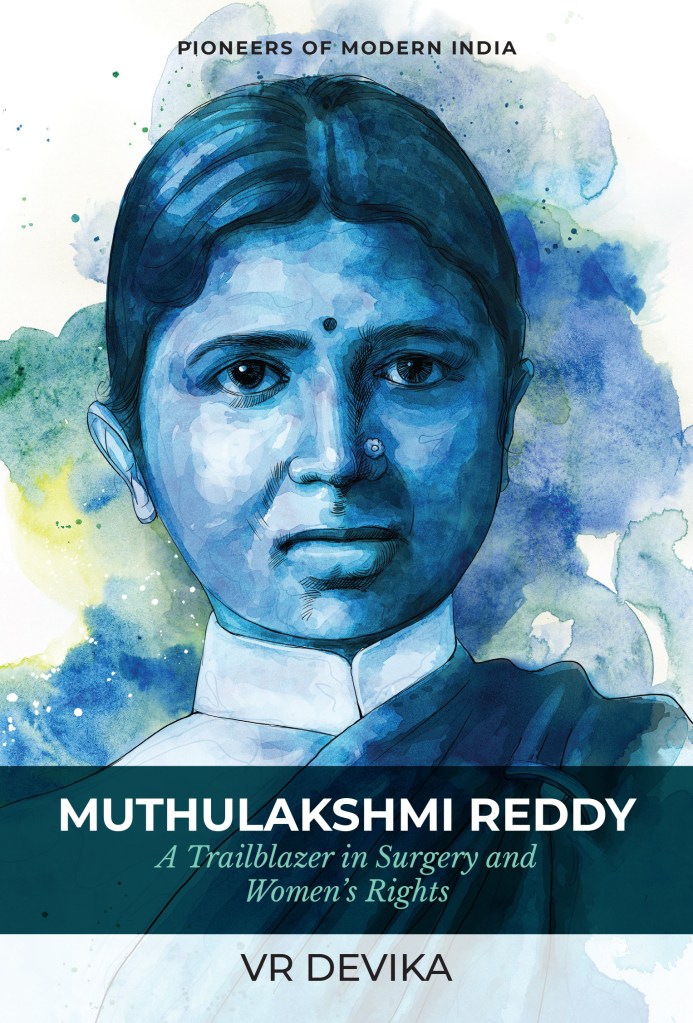
A conversation with VR Devika, author of Muthulakshmi Reddy: A Trailblazer in Surgery and Women’s Rights, Niyogi Books.

“Education, Freedom and Responsibility bring out the best from the individual and race. This will apply to all men and women irrespective of caste, creed or colour.”

—Dr Muthulakshmi Reddy, Muthulakshmi Reddy: A Trailblazer in Surgery and Women’s Rights

 Muthulakshmi Reddy: A Trailblazer in Surgery and Women’s Rights by VR Devika is a biography of a woman who shouted out to demand reforms among devdasis ( women who had been ‘married’ to lifelong service of a deity or a temple) and prostitutes in the nineteenth-twentieth century. The biographer, V R Devika, is a storyteller, educationist and Gandhi scholar.

Muthulakshmi Reddy (1886-1968) was born to a devdasi mother and transcended the system that had deteriorated from when a devadasi was considered ‘auspicious’ as she would never be widowed or married, and she could maintain her status quo, the book informs, adding a historic perspective to this ‘norm’. By Reddy’s times, these women had been reduced to become mistresses to rich men. In ancient times, before malpractices set in, a princess is said to have opted to become a devdasi. The decline started in the sixteenth century when devdasis were transferred from temple to temple.

The narrative is simple and straightforward but what stands out is the value of the content, the strength of the woman who could speak up boldly and demand reforms — even have some of them instituted. She spoke out for reforms with searing words. The author quotes from many of her speeches.

“Muthulakshmi used strong language to explain her position on the Devadasi question. ‘Of all the laws, rules and regulations which down the centuries have helped to place women in a position of inferiority, none has been so very powerful in creating in the minds of men and people a sentiment of scorn and contempt for women as the degrading idea of the double standard of morals.’

“She thundered, ‘From this double standard that has sprung that worst attack on women’s dignity, that safety valve theory that a certain number of women should exist, should sacrifice their self-respect, their honour, their comforts, their health and happiness to satisfy the lust of the other sex. At the present day, the continuance of such a doctrine and of the laws which are founded on it, is a shameful anachronism unworthy of our civilisation. Both in the past and in the present, women have disproved their inferiority, and how then can we at the present day tolerate or connive at a system which transforms a woman of whichever caste or class she may be, into a mere chattel, a piece of tainted merchandise? The inequity of the system is too deep for me to give expression, and further under that inhuman and unjust system the innocent children of a certain caste or community are trained to become proficient in all the arts of solicitation that they become captives to vice.’”

That men and women perpetrate social norms to justify the existence of the so-called ‘world’s oldest profession’ is well brought out in the book. That women forced into the sex trade are not doing this out of choice is conveyed with conviction. Names of Reddy’s associates include Sarojini Naidu (1879-1949) and the well-known singer whose mother was a devdasi too, MS Subbulakshmi (1930-1997).

Reddy was one of the first female medical graduates[1] in India, the first woman[2] to enter an Indian Legislature and the first woman in the world to preside over a Legislative Assembly. A recipient of the Padmabhushan and more accolades, she, as a doctor founded the Addyar Cancer Institute in 1952 after her sister was caught with cancer, and, as a humanitarian, started the Avvai Home in 1931 for those rescued from brothels and streets. Her spirit is well captured by the author when she writes:

“In 1942, during the World War II, soldiers of the British Royal Airforce camping in tents on the banks of Adyar river had made some derogatory remarks about the girls and harassed them. Muthulakshmi stood vigil all night with a stick in her hand and dared any soldier to come near the Home. She even went up the ranks to the commander’s house near Fort St. George to complain to him about the conduct of the soldiers and curb their behaviour.”

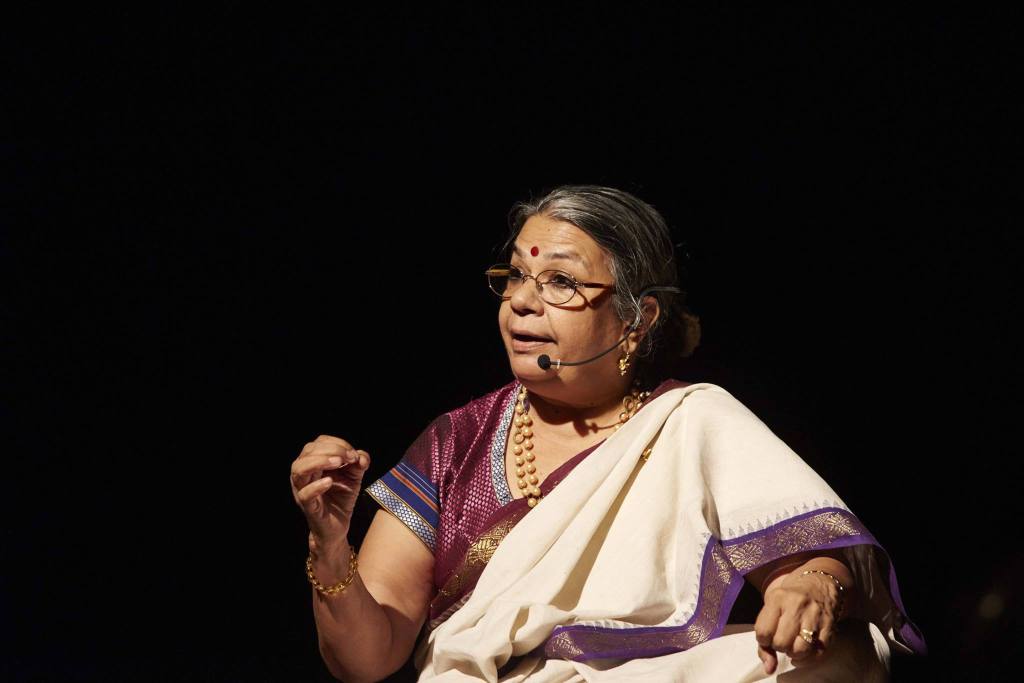
VR Devika has extensively shown that Reddy was a force to be reckoned with but she has not given way completely to adulation. She has objectively shown how Reddy over ruled her son’s choices for the well-being of her own institutions. It brought to mind Gandhi’s attitude towards his own family. An established cultural activist, VR Devika has been associated with the inception of Chennai’s Dakshinachitra Heritage Museum and Tamil Nadu INTACH[3], has been visiting the Avvai Home and in this exclusive she tells us the story of how the book came about and why she visited this home and its impact on her.

VR Devika. Photo provided by Niyogi Books

Tell us why you felt that Muthulakshmi Reddy’s story needed to be told. What was the readership you had in mind when you wrote the biography?

The dance scholarship [donors] consisting of mainly outsiders who had a hypothesis, got a good grant, employed interpreters and cherry picked to denigrate her in a fashion that took dance academic world by storm after the 1980s. I had also bought into them when I began to learn Bharathanatyam. But when I joined INTACH Tamilnadu and Madras Craft Foundation in 1985 after having been a schoolteacher since 1974, I began a project of English language as a skilling programme and theatre as empowerment for Avvai Home. That is when I began to get the other side of the story that was really fascinating. I kept thinking I must reach this story out. Dr.V.Shanta, chairman of Cancer institute, said I must write her [Muthulakshmi Reddy’s] biography and I decided to work on it after she passed away. I had young people who were studying English but had no access to English other than their textbooks as the target audience but I am a story teller and I just began to tell the story in simple way as I always do.

You tell us in the authorial note that you went on ‘work’ to the Avvai home. Tell us about the home. Why were you there?

Geetha Dharmarajan and I lived near Avvai Home. I had no idea about the history of the home etc. But I knew very poor girls studied there. Geetha had spoken to them and I went along but Geetha relocated to New Delhi and started Katha[4] and I stayed on helping Avvai Home in many different ways. I have written a full story of Avvai Home in the book. It was volunteer work. Rajalakshmi of Avvai Home requested me to help them on a production on Dr.Muthulakshmi Reddy. I interviewed Sarojini Varadappan, Dr.Shanta, and several others to write the script for the production. I am now on their school advisory committee.

For me, the most interesting aspect was how Muthulakshmi Reddy made the transition from being born a devadasi to empowering herself enough to outlaw the custom. Did her parents ever marry?

No there was no way they could marry as a girl born in the system was barred from ritualistic marriage according to Hindu custom. She was his companion.

Your narrative is direct and eulogistic of great names and associations of/ developed by Muthulakshmi Reddy and the lady herself. The personal is largely left out, except to emphasise her achievements. Why?

I cannot [describe that] as I never met her. I had to sketch a portrait from her writings, her achievements and her son’s writing.

Would you regard the devdasi system as a social ill that has been erased or is it an ongoing battle?

There is no social evil that has been erased completely. Nostalgists for devdasi system denigrate her [Reddy]. But there is the social evil of discrimination against Dalits still, but should Ambedkar be blamed for giving a legal handle for those who wanted to come out and achieve something of their own despite the caste hierarchy? Those who benefited from the abolition of dedication are in thousands while those who bemoan the loss of culture in the way they want it are in hundreds.

The devdasi system is a generic system in a number of states in India. Did Reddy’s reforms benefit all the states? Was the Avvai Home open to all devdasis or only from her state?

Avvai Home never claimed to be only for devdasis but for girls who needed protection and access to education. No reform benefits everyone. Her law was for the Madras Presidency of the time which consisted of parts of Andhra, Orissa and Karnataka too as part of it.

Muthulakshmi Reddy started a number of things, including the second oldest cancer hospital in India. But all these were reactions borne of personal experiences. Do you think if she had been born into a regular family, and her sister would not have had cancer, would she have striven for these institutions too?

I can’t answer a hypothetical question. How do we know what she would have done?

What was the driving force behind the reforms instituted by Muthulakshmi Reddy?

Her own indomitable will and the stubborn streak that sought to get it done and get others who would help her come in whole heartedly.

Would you justify the “emotional blackmail” on her son to fulfil her own dream by giving up his own? Do you think that it is right of a parent to impose their will in this way?

I am not justifying it. It happened that way. Just telling the story. She did not force her elder son who went into Electrical Engineering. Her second son never resented the “emotional blackmail” He went along whole heartedly.

What for you was the most endearing quality of Dr Reddy?

I have many who worked with her telling me she was very kind, but she was also a tyrant and would not bend. Her own indomitable will and the stubborn streak that sought to get it done and get others who would help her come in whole heartedly. She was a mother (Amma) was the unanimous opinion.

Thank you for giving us your time.


[1] Anandi Gopal Joshi(1865-1867) and Kadambini Bose Ganguly (1861 –1923) graduated and practiced as doctors in other parts of India.

[2]  Muthulakshmi Reddy joined the Madras Legislative assembly in 1930.

[3] Indian National Trust for Art and Cultural Heritage 

[4] Katha is a non-profit and non-governmental organisation that has established itself in the field of community development, child welfare, education and literature.

(This review and interview is by Mitali Chakravarty.)

.

PLEASE NOTE: ARTICLES CAN ONLY BE REPRODUCED IN OTHER SITES WITH DUE ACKNOWLEDGEMENT TO BORDERLESS JOURNAL

Categories
Review

Building a Free India

Book Review by Bhaskar Parichha

Title: Building A Free India

Author: Rakesh Batabyal

Publisher: Speaking Tiger Books

“Under this Flag there is no prince and there is no peasant, there is no rich and there is no poor… Whether we be Hindus or Muslims, Christians, Jains, Sikhs or Zoroastrians and others, our Mother India has one undivided heart and one indivisible spirit.” — Sarojini Naidu, poet and political activist, on the resolution on the national flag in the Constituent Assembly, 22 July 1947

The immutability of prodigious speeches and their magnifying impact on people can’t be underestimated. The prize of a great speech comes from pure wisdom that originates from indulgence. These words from Naidu’s speech can work as magic anytime one reads them.

Building A Free India – Defining Speeches of Our Independence Movement that Shaped the Nation by Rakesh Batabyal is just the book you needed to read as India celebrates her 75th year of its independence. It is a thought-provoking assemblage of solicitous speeches delivered by some of the most prominent Indian personalities.

Many of these men and women have made invaluable contributions to India’s coming together as a nation of people and are the pride and honour of the sub-continent. These are people who impacted the lives around them. Their words were the gems that had the power to evoke courage and emotion in countless people and inspire them to make history.

Rakesh Batabyal teaches history, theory, and philosophy of media at the Centre for Media Studies, Jawaharlal Nehru University. His The Penguin Book of Modern Indian Speeches is widely accepted as an important work in the genre. He is working on a book on the history of nationalism in India.

Says the blurb: “The new public sphere that emerged in nineteenth- and early-twentieth-century India was a space that enabled magnificent public oratory, particularly that which mounted a challenge to colonial rule. From social and political platforms like the Indian National Congress, in the courts of law, or inside legislative bodies, leaders of the freedom struggle gave eloquent and clear-eyed articulations of not only the social, economic, and political problems that faced India and their possible solutions but also the kind of sovereign nation we must collectively aspire to be. India’s democratic ethos was a product of these foundational ideas of the freedom movement.”

Building a Free India brings together these landmark speeches delivered over roughly a century by the leading lights of the national movement—from Dadabhai Naoroji, Surendranath Banerjee, Bhikaiji Cama, Lajpat Rai, and Tilak, to Gandhi, Nehru, Ambedkar, Bose, Sarojini Naidu, and Maulana Azad—as well as a range of lesser-known but equally remarkable figures.

Writes Batabyal in the book: “As the movement progressed—from the economic critique of colonial rule by the early nationalists to the unequivocal demand for Purna Swaraj[1] and the immense moral authority of the Mahatma Gandhi-led resistance—the notion of an equal society that ensured dignity to all—irrespective of caste, class, gender or religion—came to occupy a central place in it. By the time the Constituent Assembly met in December 1946, not just civil rights, but the particular rights of women, of minorities, of the Depressed Classes, and the Adivasis were being articulated and demanded, not as favours but as a matter of course.” As the editor of this volume writes in his brilliant introduction, the effect of the speeches delivered by the leaders of our national movement was to focus “political action towards scripting an ennobling nationalism that would give us a just and equal society”.

A couple of speeches in the book are captivating. This one by India’s philosopher-President Dr Sarvepalli Radhakrishnan on India’s history and legends reads: “Our pledge tells us that this ancient land shall attain her rightful and honored place. We take pride in the antiquity of this land for it is a land which has seen nearly four or five millenniums of history. It has passed through many vicissitudes and at the moment it stands, still responding to the thrill of the same great ideal. Civilization is a thing of the spirit; it is not something external, solid, and mechanical. It is the dream in the people’s hearts. It is the inward aspiration of the people’s souls. It is the imaginative interpretation of human life and the perception of the mystery of human existence. That is what civilization actually stands for.

‘We should bear in mind these great ideals which have been transmitted to us across the ages. In this great time of our history, we should bear ourselves humbly before God, brace ourselves for this supreme task that is confronting us and conduct ourselves in a manner that is worthy of the ageless spirit of India. If we do so, I have no doubt that; the future of this land will be as great as its once glorious past.’

Painstakingly divided into six chapters, each section in the 300-plus page veers around freedom and that itself makes the collection unique. What’s more Batabyal provides a context to every single discourse.

On his way to Noakhali and in the face of the large-scale massacre, to the question ‘Will Partition Change Us Forever?’ Mahatma Gandhi replied: “I have seen more of history than anyone of you, and I tell you that I have known Hindu boys who called Muslims ‘uncle’. Hindus and Muslims used to participate in each other’s festivals and other auspicious occasions. You want to force me to leave this place but you should know that I have never submitted to force. It is contrary to my nature. You can obstruct my work, even kill me. I won’t invoke the help of the police. You can prevent me from leaving this house, but what is the use of your dubbing me an enemy of the Hindus? I will not accept the label. To make me quit, you have to convince me that I have made a mistake in coming here.”

This and many such defining speeches make the collection truly exceptional. The book  is not only a priceless history of India’s  freedom movement but also of the ideas of universal equality, dignity, and justice that are—and must always remain—at the root of any democracy. The assortment of some sixty communicative moments of oratory would provide the reader with a fresh perspective and evoke feelings of patriotism, motivation, and infinite stimulus.


[1] Full self-rule

.

Bhaskar Parichha is a journalist and author of UnbiasedNo Strings Attached: Writings on Odisha and Biju Patnaik – A Political Biography. He lives in Bhubaneswar and writes bilingually. Besides writing for newspapers, he also reviews books on various media platforms.

.

PLEASE NOTE: ARTICLES CAN ONLY BE REPRODUCED IN OTHER SITES WITH DUE ACKNOWLEDGEMENT TO BORDERLESS JOURNAL