Categories
Poetry

Poetry by Terry Trowbridge

Well, I suppose it seems so to you, who are not normal,* 

Become a hermeneut. Ditch your tour guide.
Doubt the psychopomp who offers you a boat ride.
Challenge the river Lethe to prove that you forgot anything
when meaning is invented, when power is inverted,
when memory is a collage
and lucid dreams are preferable to the life you are leaving behind.
Shake the water from your arms,
where the drops fall, plant seeds.
Walk away from your garden. Leave it to the bees.
They will make honey, they will question the colours,
mix the nectar into syrup, and paint their hexagonal murals.
Do not return to the bees. Bees taste of honey, and stings.
That is their allegory. Their truth is their own.
Experience the sound of loneliness.
Empty your mouth of other people’s words.
Do not speak until you know the difference between
conversations and crossword puzzles. Do not
compare the descriptions of conversations and crossword puzzles.
Find a new difference between them. Cultivate that difference in your daily life.
Meaning: meaning making, making meaning making.
Somewhere, in there, exist.
Give thanks to what cups you in its ineffable hands.


* The title is a line from “The Last Romantic” by John Ashbery (1927-2017)

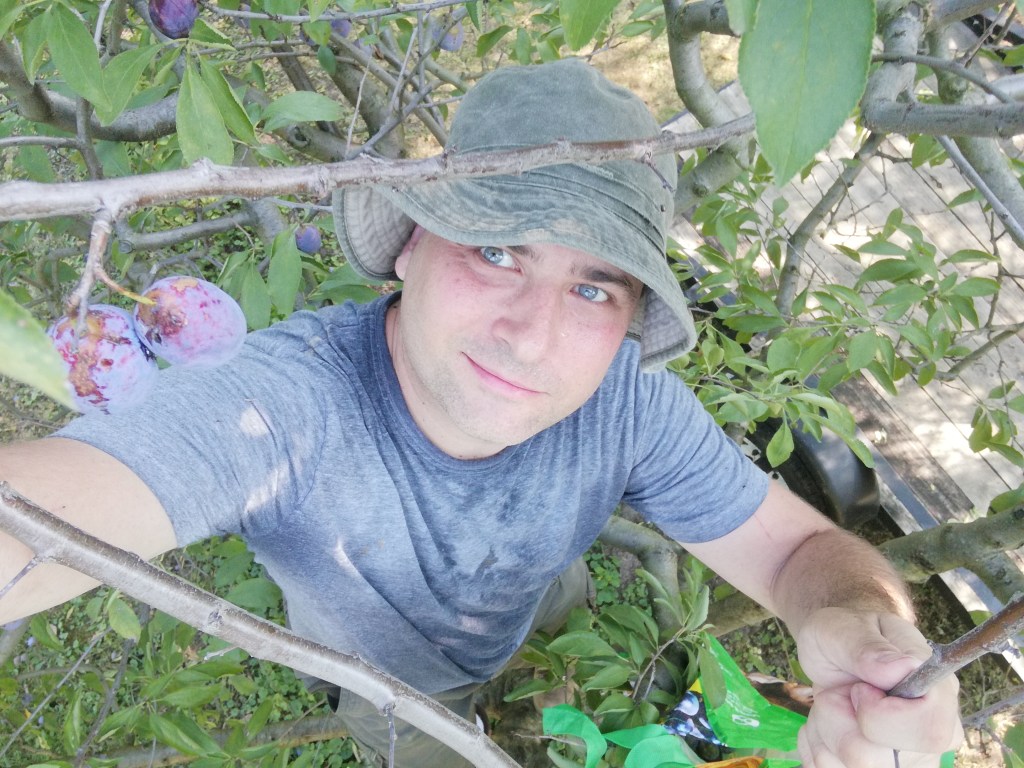
Poetry by Canadian plum farmer Terry Trowbridge has been published in over 60 journals, zines, and magazines, including The New Quarterly, Brittle Star, Orbis, The Dalhousie Review, subTerrain, paperplates, The Nashwaak Review, Carousel, Episteme.

.

PLEASE NOTE: ARTICLES CAN ONLY BE REPRODUCED IN OTHER SITES WITH DUE ACKNOWLEDGEMENT TO BORDERLESS JOURNAL

Categories
Poetry

“Hunters”  by Quratulain Qureshi

Painting by Abraham Rattner(1895-1978). Courtesy: Creative Commons
“HUNTERS”

On our way to the first picnic of Spring,
my daughter points her index finger to the uniformed crowd, 
shouts “hunters”.
I did not teach her that.
She must have gathered some idea from the stories of those around her
and some from the pictures while ravaging through my laptop.
My daughter does not understand the news; 
I think mistrust for the television was innate in her;
In that moment, I decided I’d tell her in bits and pieces truth and lived realities,
ones they ask us to keep away from the reach of younger children --
Shows with visuals of Violence flash warnings too -- 
Content warning: Violence. . . 16+ only.
But the world tends to ignore that our children live in the wretched embrace of shrouded stories.
So, the next time my daughter shouts “Hunters”,  
I will not give in to my fears and paranoia,
And while protecting her remains my first priority, I will nod my head in affirmative- “Hunters!”

Quratulain Qureshi is a Kashmiri native, who is currently pursuing her Masters in English Literature from New Delhi. She has published poems with journals such as Livewire, Wande Magazine, Inverse Journal and more.

Click here to access the Borderless anthology, Monalisa No Longer Smiles

PLEASE NOTE: ARTICLES CAN ONLY BE REPRODUCED IN OTHER SITES WITH DUE ACKNOWLEDGEMENT TO BORDERLESS JOURNAL

Categories
Poetry

Mannequin

By Ryan Quinn Flanagann

Courtesy: Creative Commons
MANNEQUIN

All those weekends with my mother.
Driving out to that K-Mart in the mall
along Bayfield Road.

Leaving me in the toy section 
back when such things were okay.

So she could shop on her own.

And how I quickly bored of the toys.
Heading over to the clothing section 
to pretend to be a mannequin.

Standing perched up on that display still as I could.
Posed like the family of mannequins 
around me.

A few women smiling at my pretend
as they wheeled by.

Even a wink or two.
A moment of shared knowing.

Ryan Quinn Flanagan is a Canadian-born author residing in Elliot Lake, Ontario, Canada with his wife and many bears that rifle through his garbage.  His work can be found both in print and online in such places as: Evergreen Review, The New York Quarterly, Borderless Journal, GloMag, Red Fez, and Lothlorien Poetry Journal

.

PLEASE NOTE: ARTICLES CAN ONLY BE REPRODUCED IN OTHER SITES WITH DUE ACKNOWLEDGEMENT TO BORDERLESS JOURNAL

Categories
Poetry

Saturday Afternoon

Written by and translated from Korean by Ihlwha Choi

Courtesy: Creative Commons
Sitting in a humble bar,
Two men in late sixties are talking friendly.
 
Sitting alone in the corner I drain my glass.
 
They are retired salaried men I suppose.
I realise the fact as words drift from their conversation.
After leaving their lifelong work,
Maybe, they are talking about their bygone days.
 
I wonder if they got a large amount of retirement pay?
Are they getting enough pension to sustain old age?
 
Across the tables from a distance,
I am now looking at myself of tomorrow,
On a relaxed Saturday afternoon,
While the sun continues to shine brightly outside

Ihlwha Choi is a South Korean poet. He has published multiple poetry collections, such as Until the Time When Our Love will Flourish, The Colour of Time, His Song and The Last Rehearsal.

.

PLEASE NOTE: ARTICLES CAN ONLY BE REPRODUCED IN OTHER SITES WITH DUE ACKNOWLEDGEMENT TO BORDERLESS JOURNAL

Categories
Poetry

In the Third Quarter of 2022

By Amrita Sharma

There have been too many suns in the sky lately,
too many times outnumbering the indefinite stars,
too dull, and yet too many for you and me.
I begin each day with a name, a number and a notice,
typed out in a grammatically incorrect frustrating format,
that I mentally attempt to correct over a breakfast of overcooked cereals.
As I work on a mediocrely fancy desk with a nonfunctional WIFI – I often imagine you smiling – high 
still on the share of my favourite white wine.
My mornings are the dullest part of the brightly sunlit
yellow brick walls, as they slowly cradle me to uncomfortable conversations at work.
I no longer complain intentionally as the afternoons
are rapidly habitualising me to an ungrateful existence.
I face a crowd, six times a week, and that alone
defines my love and command of the foreign English in 
an unbearably unkind Indian locale.
I am trying not to hate the place for the people,
I am trying not to abandon the people for the pain,
I am trying not to starve myself as the final consequence.
The food here carries an unfamiliar rural smell, far
divorced from what I read while growing up in a city,
and I unlearn each lunch as a survival necessity.
I often take the longest path after work, watching
the sunset sky as I walk, wondering
how unfriendly the clean air can get.
I feel really hungry at night but refrain from eating,
punishing myself for being too afraid to execute the mistakes at work that I promised myself to commit.
Each night I examine the things in my hostel room,
mentally chalking out a plan to travel,
weighing the odds of it against my unsanctioned holidays

Amrita Sharma is a guest faculty at the Indian Institute of Information Technology, Una, Himachal Pradesh. She has worked as a Fulbright Fellow at the University of Notre Dame, USA. Her works have previously been published in several journals. Her first collection of poems is titled The Skies: Poems.

.

PLEASE NOTE: ARTICLES CAN ONLY BE REPRODUCED IN OTHER SITES WITH DUE ACKNOWLEDGEMENT TO BORDERLESS JOURNAL
Categories
Poetry

Black Queen Devil

Hybrid Poetry by Mimi Bordeaux

they have drawn epistles, narrative cannonballs, dispatched correspondence and reprints 

prose before puberty what place would you want in the future..?

Having drawn from many artists, poets, scientists, eccentrics eventually falling into your own house of writing, now I ask how to sit properly or eat before using the cutlery? Am I entitled to this family? 

I read books given to me, bought for Christmas and ones I bought myself for true keeps. 
Lots were passed down from my older sister Danielle the year I turned 13; the early 70's. 
Woman of the Future by David Ireland. I was given this by Danielle with the words, 'this book reminded me of you '. 
Althea, the protagonist with a brain full of ideas and the body of the androgen, metamorphosis into a leopard near the end. Besotted I was, I imagined Althea around the places I played. She walked with me to school and stayed with me until I  layed on the grass later in the year, with a new fascination; The Interpretation of Dreams by Freud.  Given to me for my 13th birthday my grandma asked me what it was I liked so much about Freud. I think she thought I was too young to be reading such a controversial composition.  
Carefully recording my own dreams, pen in hand, I held a ton of notes in a scrambled batch of excercise books. 
My bedroom was strewn with paperwork and pictures of favourite artists. My school work lay around somewhere. I knew how to find anything in a split second. 

Oh teachers of the plain high school I attended. I'm sure you meant well but you had a hellraiser on your hands not to mention one up and coming intellectual who was also an existentialist. I wrote an essay on the subject and the teacher didn't believe that I had written it, accusing me of plagiarism. I swore black and blue that I didn't but he gave me a 'D'. Other teachers weren't so hasty in their appraisal, knowing fully well that I was a special case, either doomed for failure or going places with the mind of its own. Right, wrong.

Grieving for years I drank my heart out, writing songs that succeeded traditional melodies using chromatic scales as a base for a tune. I was onstage, my only home. Reality didn't interest me; writing songs about my predictions did. And I was always right. The psychic nature of mine was always accurate. 
And so on until I died. 

An autopsy revealed that I had consumed a number of barbiturates, heroin and cocaine. My stomach had swollen to the highest value. So I was cremated, indeed the first fire I had ever been to. No, the second. 

Once I was running out late, my ex husband following me. As I turned the corner I saw a huge amount of smoke coming from the chemist store. I ran into it, engulfed by fire all around me: burning hell. It looked so strange, like an orange sky lit up for Guy Fawks Night. Quickly I ran across the street without seeing him again and back at home, my clothes worn and black. 
For pennies, opals, amethysts and Onyx, my black queen you are the devil and dance of Eden. Fantasy of becoming someone, something, to look for the next new free styler is a hard department at all times. Open only at certain times. It takes luck to know when. Capacity full they say. Not true. 
All welcome at the house of fame and glory. 
Black Queen knows.

Mimi Bordeaux likes drinking coffee and smoking cigarettes in Melbourne Australia. She writes dark prose and hybrid poetry.

.

PLEASE NOTE: ARTICLES CAN ONLY BE REPRODUCED IN OTHER SITES WITH DUE ACKNOWLEDGEMENT TO BORDERLESS JOURNAL

Categories
Poetry

In the Andamans

By Saranyan BV

CORALS
 
Scuba divers lumber over the sand, the unwashed rocks, the algae water.
The bay showed odours of unwillingness.
At sun break,
One or two coconuts fell and made splashes
To deter us.
We lumber at dawn, flippers on shoulder,
Cylinders on back, the divers kit heavy;
We lumber, our hearts ingest what we’d experienced,
Our bowels anxious for new,
We lumber under seawater,
Careful not to touch or caress or be caressed
Knowing we can’t be corals.

Saranyan BV is poet and short-story writer, now based out of Bangalore. He came into the realm of literature by mistake, but he loves being there. His works have been published in many Indian and Asian journals. He loves the works of Raymond Carver.

.

PLEASE NOTE: ARTICLES CAN ONLY BE REPRODUCED IN OTHER SITES WITH DUE ACKNOWLEDGEMENT TO BORDERLESS JOURNA

Categories
Poetry

Lines Written at Nalanda

By Sourav Sengupta

LINES WRITTEN AT NALANDA 

The fanatics of every day and age
Are known to fear the inquisitive mind. 
One such was Bakhtiyar who came to wage
A campaign of a very savage kind.
Here, witnessed by these time-encrusted walls,
A thousand helpless monks he set ablaze; 
While o'er these hills a cloud of smoke so tall
Engulfed the skies that darkness reigned for days.
The knowledge of eight hundred years contained
In countless parchment scrolls, in flames was tossed;
And when the fires died all that remained
Was human ash and ash of wisdom lost.
     Today, a tale survives in these relics:
     Of mankind’s folly told in blackened bricks.

Sourav Sengupta is an architect by training and a human resource manager by profession. His poetry has been published in literary journals like Revue {R}évolution, Society of Classical Poets and Better Than Starbucks. He lives and works in Kolkata, India.

.

PLEASE NOTE: ARTICLES CAN ONLY BE REPRODUCED IN OTHER SITES WITH DUE ACKNOWLEDGEMENT TO BORDERLESS JOURNAL

Categories
Poetry

November Poems by Michael Burch

Courtesy: Creative Commons
LEAVE TAKING

Brilliant leaves abandon
battered limbs
to waltz upon ecstatic winds
until they die.

But the barren and embittered trees
lament the frolic of the leaves
and curse the bleak
November sky.

Now, as I watch the leaves'
high flight
before the fading autumn light,
I think that, perhaps, at last I may
have learned what it means to say

goodbye.

(Originally published by The Lyric)


DAVENPORT TOMORROW

Davenport tomorrow ...
all the trees stand stark-naked in the sun.
Now it is always summer
and the bees buzz in cesspools,
adapted to a new life.

There are no flowers,
but the weeds, being hardier,
have survived.

The small town has become
a city of millions;
there is no longer a sea,
only a huge sewer,
but the children don't mind.

They still study
rocks and stars,
but biology is a forgotten science ...
after all, what is life?

Davenport tomorrow ...
all the children murmur through vein-streaked gills
whispered wonders of long-ago.

Michael R. Burch’s poems have been published by hundreds of literary journals, taught in high schools and colleges, translated into fourteen languages, incorporated into three plays and two operas, and set to music by seventeen composers.

.

PLEASE NOTE: ARTICLES CAN ONLY BE REPRODUCED IN OTHER SITES WITH DUE ACKNOWLEDGEMENT TO BORDERLESS JOURNAL

Categories
Poetry

It’s Halloween!

By Michael R Burch

Courtesy: Creative Commons
IT’S HALLOWEEN

If evening falls
on graveyard walls
far softer than a sigh;
if shadows fly
moon-sickled skies,
while children toss their heads
uneasy in their beds,
beware the witch's eye. . .

If goblins loom
within the gloom
till playful pups grow terse;
if birds give up their verse
to comfort chicks they nurse,
while children dream weird dreams
of ugly, wiggly things,
beware the serpent's curse. . .

If spirits scream
in haunted dreams
while ancient sibyls rise
to plague nightmarish skies
one night without disguise,
as children toss about
uneasy, full of doubt,
beware the Devil's lies . . .

it's Halloween!

THIN KIN

Skeleton!
Tell us what you lack ...
the ability to love,
your flesh so slack?

Will we frighten you,
grown as pale & unsound ...
when we also haunt
the unhallowed ground?

THE WITCH

her fingers draw into claws
she cackles through rotting teeth ...
u ask “are there witches?” 
                                     pshaw! 
(yet she has my belief)


THE WILD HUNT


Few legends have inspired more poetry than those of King Arthur and the Knights of the Round Table. These legends have their roots in a far older Celtic mythology than many realise. Here the names are ancient and compelling. Arthur becomes Artur or Artos, “the bear.” Bedivere becomes Bedwyr. Lancelot is Llenlleawc, Llwch Lleminiawg or Lluch Llauynnauc. Merlin is Myrddin. And there is an curious intermingling of Welsh and Irish names within these legends, indicating that some tales (and the names of the heroes and villains) were in all probability “borrowed” by one Celtic tribe from another. For instance, in the Welsh poem “Pa gur,” the Welsh Manawydan son of Llyr is clearly equivalent to the Irish Mannanan mac Lir.

Near Devon, the hunters appear in the sky
with Artur and Bedwyr sounding the call;
and the others, laughing, go dashing by.
They only appear when the moon is full:

Valerin, the King of the Tangled Wood,
and Valynt, the goodly King of Wales,
Gawain and Owain and the hearty men
who live on in many minstrels’ tales.

They seek the white stag on a moonlit moor,
or Torc Triath, the fabled boar,
or Ysgithyrwyn, or Twrch Trwyth,
the other mighty boars of myth.

They appear, sometimes, on Halloween
to chase the moon across the green,
then fade into the shadowed hills
where memory alone prevails.

('The Wild Hunt' was first published by Boston Poetry) 

Michael R. Burch’s poems have been published by hundreds of literary journals, taught in high schools and colleges, translated into fourteen languages, incorporated into three plays and two operas, and set to music by seventeen composers.

.

PLEASE NOTE: ARTICLES CAN ONLY BE REPRODUCED IN OTHER SITES WITH DUE ACKNOWLEDGEMENT TO BORDERLESS JOURNAL