Categories
Poetry

The Boy with the Yellow Light & more…

By Annie Blake

THE BOY WITH THE YELLOW LIGHT                                                      

/ for the cupid charges his dart / but to dodge love / for eros is invisible without a lamp /and who the hell knows who we’re really marrying / and venus was angry she had to come down to earth / for kenosis is giving up being god / living between the dark / the night lapping and the shore smacking her lips / the birth of my divine child / my husband promised to return / but the river nile is also the waterfall of the styx and i was sad so many babies had to die /

/ the nurses showed us how to experience death / and we all had to be prepared / but psyche brought her life and her lamp / but the light made his body glow / and i wasn’t ready for god back then / so i dropped the knife and the oil and burnt my own wings / or webs and i wonder how i could have despised my own wedding ring /

/ palm oil has cleared so many forests / but never give alms whilst ascending from hell /for my mother and father will climb on top of my body and we shall both drown / i left my parents but i was rejected by them first / and left bread as crumbs / so he grew out of the water / but an overgrown cupid / there was a door and a yellow light / the boy and a door and blood / my son and a door and i buried his head in the sand / for he drove a dodge dart and the jocasta complex /

/ for so many men say they can tend gardens but in the summer they let their flowers dry up / so i told him to assemble a steering wheel / made out of felt and robin hood green / for mothers must steal from the grinch and let their sons feed from their hands / so i handed him over to my husband / for the father is the son / mutatis mutandis / his wings outstretched on god’s table / the blood and the nails that strengthen the stable and how the fountain lights / his mountain climb /

LAKE MONOGRISTA                                                                                     

/ i thought she said montecristo and i was on the train heading home /

but as i was about to exist / i realized i had forgotten letters / photos of my child when she was young / and i had to stop myself from falling out / the train had walls / and the backs of passengers / for i wanted her to be pretty and pure / to wear a poncho because of my indictment of winter and the fall / hail stones as small as baby teeth and the union of demeter with persephone /

/ only alone / i had to go through lake monogrista / when will the goddess become a woman / energy which embeds will not floar up / above the ceiling / a maze or village roads archetypes or archangels made of white marble / suspended and upside down / for this map and where do i cross or sort out the corn to make flour / the eleusinian mysteries /

/ heilagr bread and i prayed for akeru / for when i’m not sure if what i’m seeing is real or conducive to evolution / wassilissa the beautiful / the black grains and the wild peas / a pestle and mortar like pen and paper / then a grain of earth in the poppy seeds / i prepared kvass on her table / her tongue / small flame heating her lips / pointy fire of a hybrid flower / she had down syndrome / and told me i had been waiting a long time to ask a question /

/ so i gave my child money for her tooth / and for charon a drachma under her tongue and i took her letter / and i hoped she would only ever find the box when she grew /for to have pistis / she made me see a light outside / daylight candle and she was in a cradle in the branches / but to admit she is really here / for newborns were saved and to rock in the wind / but for all their dead weight / or faith that she was a fait / and my fate / to breathe / her out / to life /

TANTUM ERGO SACRAMENTUM                                                              

/ limbs / sacred animal / in the ground / i dig with my fingers and my toes / nails like roots / my back / spine rises / snake charmer and out of the casket / when i ask psychoanalysts questions they often say / how does that relate to what we’re talking about / me and peek a boo with the clock / and the whole point is missed and an altered sensorium /

/ so my husband pulled a chandelier out of the ground / arms out of the soil / the colour of spoilt iron / he told me it had sunk with the titanic / ostensorium / in miss havisham’s house / made out of flight light and rock / he swings in my room / he said for those who will hold both order and chaos / or tell the truth and for the stunting of our time / that lovemaking and the tragedy of it / triadic and in christo / 

/ for he who acquires patience / discipline to maintain the meaning of ritual / not a single offering will be missed / a man’s joined hand / veins like rope / upright sconce / within his skin / rivers green / yellow strength in his candle / in his body / burdens / burn like a forgotten forest church / for to know the same man since / baring our child / dark garden of gethsemane /

/ he now knows not to move any paper for they are my lifeskins / for my mouth is volubly mute / not to move a single body or a single letter / my altar and my cup / my holden host / golden moon and how our son impailed / the hour of adoration / for i would rather he climb as fragile as a looking glass / tread on me carefully instead /

THE BLACK STEAM TRAIN RATTLES OUR BACK DOORS IN WINTER              

/ snake of moses / rose branch to the apple / round as stone / its mouth did speak and the soul was satisfied / so whole he grew / fed his interregnum from the birth cord / extended his arm from the ground / took of his body and ate /

/ i was in the desert / for where i grew up and live / bridges wired up like cages / and the silos because the sky / sheets of steel / and our sense of responsibility / for our own lack will give us a life sentence and a prison cell / and i have always felt worried because during the war / and he could not yet cry / for suffering sedates and shuts the eyes /

/ working mechanical shark / iron box crashes / debris of his body / sea ash / how the smoke sits thick like clouds when i burn my wedding ring / the ticking clock and the next train / snake railway / and to trespass the halo of her body / but i was always good at diving in and unhooking the bait from my mouth / o soporific soul and my auseinandersetzung /

/ he hadn’t slept for days / how a man had to watch the child’s head come about 325 wordsengthen off / how he was given a broom to sweep his parts up from the ground / because when he was a boy / but then his mother died / and the easiest way to kill a man’s woman is to send him to war /

/ so there was a border / or the edge of a road / for the vestiges of my old intransigent world / a lily as white as his hand in the sand and as i lay down my clothes / for one must take the time to mourn our absences / my army clothes / his school uniform / because he was now larger than me / i couldn’t yet see the enemy / but to climb / a tomb hollowed out the next word / and we reveled in what he lay /

/ i had to stay with my ear close to his roots / and to run / river of dust when i could detect where they were / our old linen garments / submerged and lifted out of the river / i told my mother to wash our clothes because / it is more comforting to confront death and to know her then / for when your mother will not know you /   

HABENTIBUS SYMBOLUM FACILIS EST TRANSITUS                          

/ fowl sowl of men / mouth of men / sour bowl / i’m sorry / for she wears the devi cloak / how words are left to hang like jowls / uphill road / light forest / crevice of light / cervical and a cat’s eye / the color black is a deep empty hole / both in each other’s soak / for our bodies warm and the nights black / digesting the plaited crop /

/ i always had long births for i hold onto my children for too long / my body / my boy / every six months / the indian lady would sew back my eye / she said i must be patient and i was not to move / and my husband asked me how he was to learn patience / so at the hospital / i asked to have my dream interpreted / she gave me chopped apples in a ceramic bowl and i had to eat them piece by peace / so when i let go from the substructure of the world /for some people cannot live if they are not sticky inside a web / so i remember to smile even if the felicity doesn’t exactly belong to me / breasts of milk / nipples made of pearls /

/ when a mother’s suffering is manifested into her child / then i must unglove and evolve my mother / for it is our children who remain hidden and who always validate the truth /

/ so i took the time to bathe myself / and i remembered the first time my children were awed by their own hands / a leitmotif or iteration / for to see my one body / white as soap / all belonged to be / 

Annie Blake (BTeach, GDipEd) is a divergent thinker, a wife and mother of five children. She commenced school as an EAL student and was raised and, continues to live in a multicultural and industrial location in the West of Melbourne. She enjoys experimenting with Blanco’s Symmetrical and Asymmetrical Logic to explore consciousness and the surreal and phantasmagorical nature of unconscious material. Her work is best understood when interpreting them like dreams. She is an advocate of autopsychoanalysis and a member of the C G Jung Society of Melbourne, Australia. You can visit her on annieblakethegatherer.blogspot.com.au  and  https://www.facebook.com/profile.php?id=100009445206990.
Categories
Poetry

In The Midst of The Plague

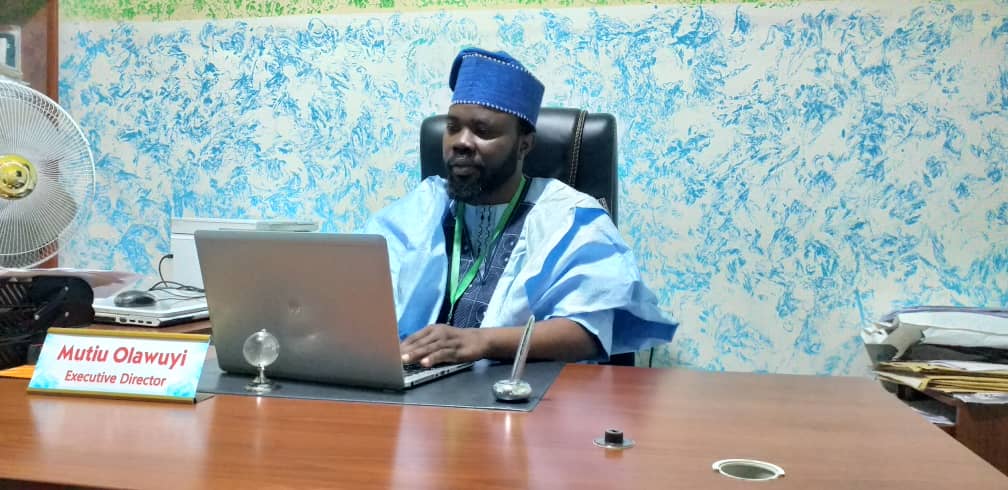
By Mutiu Olawuyi

Stay home not with fams            
Cleanse not your palms                      
Dash no space                                             
Be deaf… –                                                  
Death!                                                                             
                                              
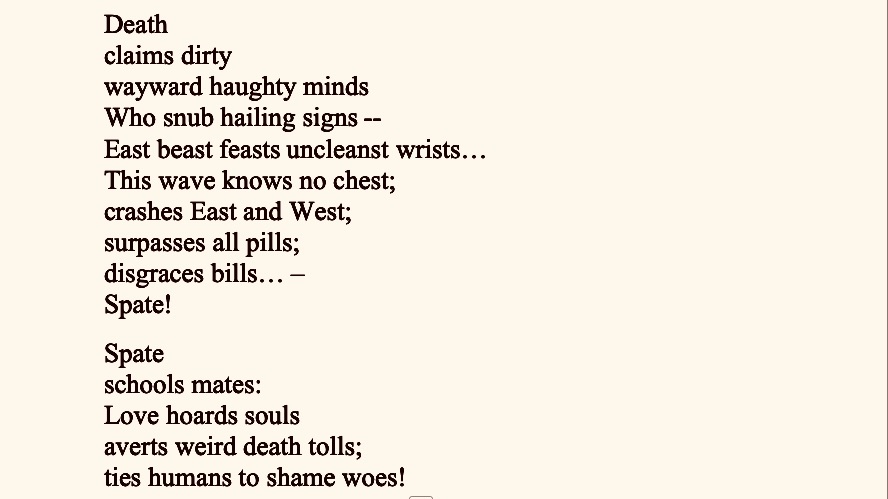
Death                                                                             
claims dirty                                                       
wayward haughty minds                                 
Who snub hailing signs --                 
East beast feasts uncleanst wrists… 
This wave knows no chest;  
crashes East and West;
surpasses all pills;
disgraces bills… –
Spate!
Spate
schools mates:
Love hoards souls
averts weird death tolls;
ties humans to shame woes!
Stay home not with fams            
Cleanse not your palms                      
Dash no space                                             
Be deaf… –                                                  
Death!                                                                             
                                              
Death                                                                             
claims dirty                                                       
wayward haughty minds                                 
Who snub hailing signs --                 
East beast feasts uncleanst wrists… 
This wave knows no chest;  
crashes East and West;
surpasses all pills;
disgraces bills… –
Spate!
Spate
schools mates:
Love hoards souls
averts weird death tolls;
ties humans to shame woes!

Mutiu Olawuyi (popularly called the Jungle Poet) is an international award-winning poet –  2013 World Poetry Empowered Poet Awardee, Canada, Honorary Professor of International Art Academy, Volos Greece; World Poetry Cultural Ambassador (2014) – Vancouver – Canada; and Master of Literary Innovation (2019) – World Poetry Conference, Bathinda Punjab, India . He is the producer and host of ArtFlakes on CBA TV, the Voice of East Africa and he is also the Editor-in-Chief of Parkchester Times and MCR newspapers (Print and Online) based in Bronx, New York, USA. He has authored numerous books of poetry (Among them are American Literary Legends and Other Poems [2010], Thoughts from the Jungle [2012], 9/11 Poetry [2012], and The Journey to the Archangels [2013]) and has edited numerous international anthologies, journals and magazines. Mutiu is a teacher, English language and literature curriculum developer, freelance writer/editor, literary critic and inventor of a new form of poetry called 9eleven (a poem of 9 lines written with 11 syllables) and the first writer of a story without verb – The Blotted Pawpaw (published 2013 by Bharat College in India). He is also an editor for The Criterion International Journal in English based in India. Mutiu has some of his poems, short stories and research papers published  in online and offline journals and magazines in India, Ireland, England, Canada, Greece, Nigeria and USA. Finally, some of his works have been translated to Arabic, French, Esperantos, Malayalam, Telugu and Hungarian.   

Categories
Poetry

Elmhurst, O Elmhurst

By Melissa A. Chappell

(Elmhurst, the only public hospital in New York City was founded to serve the poor in 1832. It serves Western Queens County.)


Elmhurst, O Elmhurst,
I did not know you in your mothering shift
of glass and mortar.
 
I ticked off your name in my mind
as you caught my ear on the morning radio:
“Elmhurst.”
 
This, as I authored my own survival.
 
Perhaps I may be one of the remnant.
 
Perhaps this wasting bane
may steal away on some wing
of the breeze.
 
But, no, Corona prefers to steal the air
from the ravaged world;
 
so that one day I saw on my 52 in. screen,
Elmhurst,
with an almost snake like refrigerated truck,
parked outside its venerable walls,
the vile work of Corona
unmasked,
by the shining light of day;
 
so that, the wretched of God gathered at the hem
of her weeping garments.
 
The poor and the dead,
thronging around her.
 
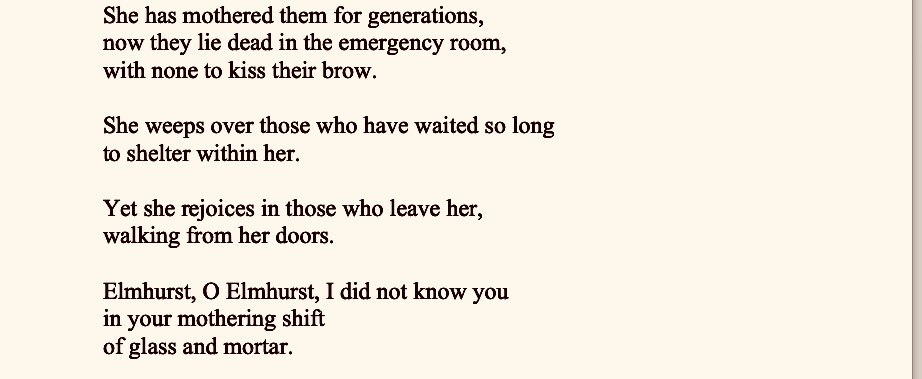
She has mothered them for generations,
now they lie dead in the emergency room,
with none to kiss their brow.
 
She weeps over those who have waited so long
to shelter within her.
 
Yet she rejoices in those who leave her,
walking from her doors.
 
Elmhurst, O Elmhurst, I did not know you
in your mothering shift
of glass and mortar.
 
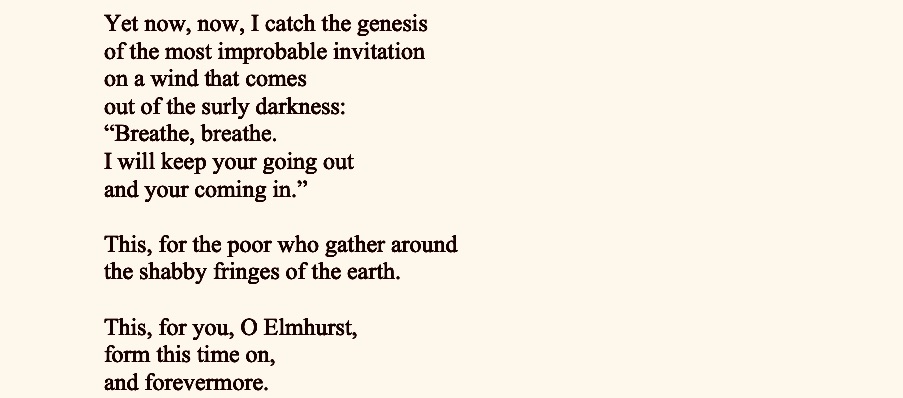
Yet now, now, I catch the genesis
of the most improbable invitation
on a wind that comes
out of the surly darkness:
“Breathe, breathe.
I will keep your going out
and your coming in.”
 
This, for the poor who gather around
the shabby fringes of the earth.
 
This, for you, O Elmhurst,
form this time on,
and forevermore.

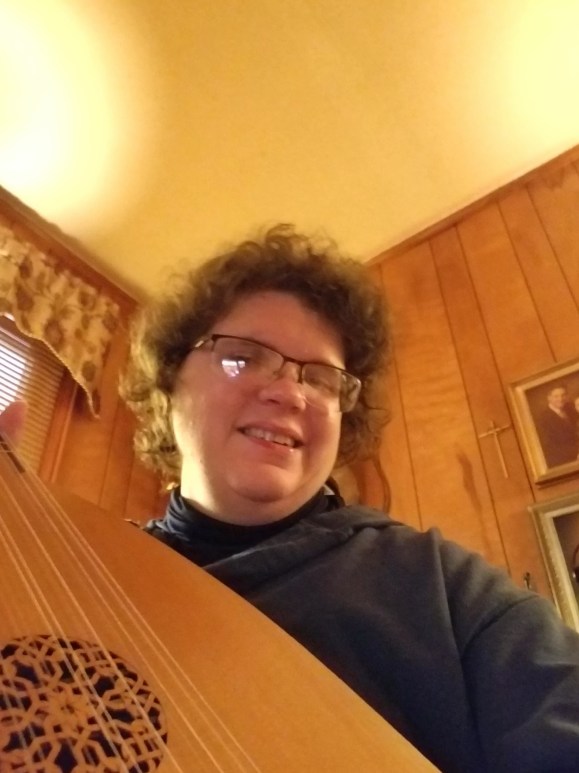
Melissa A. Chappell is a native of South Carolina, USA. She contentedly resides on land that has been in her family for over 130 years. She has a BA in the Theory of Music and a Master of Divinity degree. Besides writing, she plays several instruments, including the lute. Music and the land are her primary inspirations for her poetry. She has had two chapbooks published: Rivers and Relics (Desert Willow Press)

Categories
Poetry

love quarantined

By Mallika Bhaumik

I pull up the blinds
and look at the glassy darkness waiting outside,
night is a pause,
droplets of the day's fatigue gathered in its palm,
its sighs and shadows coming back 
like cards from an anonymous lover, his
unclaimed love.
An insomniac tells the tale 
of the time that has flown through me, its slippery mossy trail, 
of a heart that remains folded in a Kashmiri wooden box, the smell of unread verses,
the fluid love of Darbari Kanada slow dance on my skin.

I close my eyes
Night becomes a long lonely stretch of asphalt
sound of footsteps fading, mingling with the dark 
an eerie silence envelopes a fear 
stretching itself to the fragile china cup that brings the day to my lips,
the quotidian of virus laden news and hand sanitisers follow me
a black kitten mews around the bin
I go through another day of quarantine.

Mallika Bhaumik has a Master’s degree in English from the university of Calcutta.Her works have been widely published in reputed e mags like Cafe Dissensus, Shot Glass journal, Harbinger Asylum, Mad Swirl, In Parentheses, Madras Courier to name a few. Her first book of poems, Echoes (2017) by Authorspress, has won the Reuel International Award for the best debut poetry collection, 2018. Her second book of poetry is, How not to remember (2019) by Hawakal Publishers. She is a nominee for the Pushcart Prize for poetry, 2019. Her poems have been included in the PG syllabus of BBKM university, Dhanbad (2020). She lives and writes from Kolkata

Categories
Poetry

In Solitude’s Splendour

By Christopher Manners


In Solitude’s Splendour 


In solitude’s splendour, I was blessed
by that graciously guiding breeze,
fervently free with towering thoughts,
as I philosophized amidst the trees,
energized as I examined existence,
contemplating through the destined day,
curiously seeking that cosmic clarity,
while the swift birds seemed to play.

And suddenly I was jolted by joy,
as a resplendent and racing river
overflowing on its progressing path,
as the forest did decisively deliver
this serene sense of triumphant trust
in the universe, its underlying frame,
in the valiant vessel’s secure voyage,
with old anxieties to finally tame.

Immersed in that ecstatic elation,
though the experience was only brief,
it had this lasting influential impact,
vanquishing all my grueling grief,
as I was past my small worrying self,
in this euphoric expanse and tied
momentarily to the river’s source,
while the Sun’s chariot I did ride.

Christopher Manners has had 2 poetry books published by Poetica Press – Sophia Perennis.  He has also had poems published by Harbinger Asylum. Born and residing near Toronto, Canada, he has a Bachelor of Arts with Honours from York University.   Manners is the founder of poetryimmortal.com, a poetry blog and encyclopedia dedicated to the classics. 

Categories
Poetry

When the Quotidian Wrote our Notes of Isolation

By Nabina Das 

We were brought up by folks who respected the encrusted time,

wound in their watches every morning, opened windows to days.

They swept the morning breeze with either their prayerful ways

or brisk footprints out about the gardens of mint and marigolds.

 *

We were taught to eat with hands but not lick the fingers too much,

sometimes given spoons to scoop up manners away from the old world.

 *

Also made to brush our shoes black as squeaky bumblebees on the run,

rub wet chalk every Saturday on the white canvaswear like ghost tales.

 *

Visitors in that world arrived often without having to sniff their hands

from stiff alcohol smells. No furtive glances. They kept wearing shoes.


*

We were brought up by a man and a woman who valued hugging

and cracking a silly joke or two, elbows pirouetting at the dining table.

 *

They took us to the movies where women with small breasts got laughs

and even men with clownish big arms were thought to be big bores.

 *

Solitude meant suddenly finding hand holding in unexpected places.

A decade has now gone. Taking away easy tactile closeness with it.

 *

Nothing changed as we spotted snails in the grass; she still cooked

while he got the monthly grocery home counting money with care.

 *

Days of déjà vu-ing didn’t matter and he read the inscrutable Prufrock

in his gong-wide voice; she sang full throated. But it wasn’t called strategy.

 *

Nothing took the rhythm away from books and ink and weekends,

ice cream treats, water color tablets in tin boxes, the neat domestic talk.

 *

It’s not to say we did not hop mad after the moon or swoon in rains

brought mud in our feet, ran amok like twisters on the sleepy town.

 *

He sneezed too hard some days and scared the alley cat and she

scanned the city in her tiny feet, eyes lush gooseberries and face small.

 *

The music was always a rousing breeze through the receptive ceiling,

the food was quite reluctant to let its own vital aroma fade and die

 *

I often read through my story books learning to spell: i-s-o-l-a-t-i-o-n

hidden within the Kamasutra. The neighborhood lay in erotic repose.

 *

What was missing, oh, what was missing, people sometimes asked in jest:

not the doorknobs, not the bloody ancestors, not new birds on chipping beams.

Nabina Das is a poet and writer based in Hyderabad. She has published three books of poetry, one short fiction collection, and one novel. In the age of Corona virus, she tackles here the questions of isolation already experienced while she grew up in Guwahati, Assam, among ginger roots and swamp dragonflies.

Categories
Poetry

The Contingency of Saying and Eternal Motion

By Desmond Kon Zhicheng–Mingdé

The Contingency of Saying


If I say I love you.
If I say this love we share will be our last.
If I say we should trust our every emotion.

That even at their darkest, they reify the same.

The same culling of past acts of love, of endearment.

That’s what the novel was, haven’t you known all along?

A book of letters, each epistle like a gift of the angels.

If I say you should stay.
If I say this staying will be forever.
If I say every decision arrives at the same decision.

That as you confessed: you are, as I am.

You are, as I am content in this mirror of things.
All things now made for this, to house our love.


Eternal Motion

~ After David Medalla’s Cloud Gates


There is no redundancy here.
There is no superfluity, even in life’s assessment.

No one’s looking.
No one, Oh Ephemerae of Dissolutions.
No one is there, in the room where it all happened.
So long ago, the memory has become a fiction.
The room seems like a fiction, but it is real.
You know it is real, its squarish angularity.
I know it is real, the way you hold my hand.

The repetitions are eternal inversions.

Of an extended metaphor extending itself,
series of infolding turns, so much as to disappear.
No lodged positions, no milky consistency.
The resulting invisibility, also a contingent condition.

It is there, it exists like this coloured sky.
No one’s looking, but there’s our seat, ensconced.


~ Penned specially for the event, In Stitches, this poem was read at the National Gallery Singapore on 28 January, 2018.

~ Penned specially for the event, In Stitches, this poem was read at the National Gallery Singapore on 28 January, 2018

Desmond Kon Zhicheng-Mingdé is the author of an epistolary novel, a quasi-memoir, five hybrid works, and nine poetry collections. A former journalist, he has edited more than twenty books and co-produced three audiobooks. Among other accolades, Desmond is the recipient of the IBPA Benjamin Franklin Award, Independent Publisher Book Award, National Indie Excellence Book Award, Poetry World Cup, Singapore Literature Prize, two Beverly Hills International Book Awards, and three Living Now Book Awards. He helms Squircle Line Press as its founding editor. He can be found at: desmondkon.com

Categories
Poetry

The Tiniest Man on Earth and more…

By Aditya Shankar

The Tiniest Man on Earth

Was so tiny

he did not belong among humans.

Too big for microbes and fungus to befriend.

Too small for mushrooms

to feel the entitlement of a rain shelter.

Eliot’s practical cats were too practical

to respond to his queries.

Orwell’s Old Major

was busy inspiring a rebellion.

With none to acknowledge,

his happiness bore no relation to happiness.

His grief bore no relation to grief.

He watched the communion of men from afar—

their greets, hugs, smiling eyes.

He was happy.

But with none to share it,

his happiness hurt worse than grief.

He watched the war of men from afar—

their slit throats, longing, silence.

This hurt him.

But with none to relate with,

his grief grew light and comical.

He roamed the lonely world,

depressed and happy at once,

a microcosm of the humanosphere.

On his epitaph, he wrote:

Emotion seeks a watching eye

and lay in his grave.

But death never came for him.

It did not want to devour a breath

that wouldn’t distill into a potion of loss.

Notes:

Old Possum’s Book of Practical Cats by TS Eliot.

Old Major, a character from Animal Farm by George Orwell.

Annapurna// A History of Food

Mouth opens like the door of a shrine.

God, hungry and veiled by gloom is within.

She clutches her children tight.

Sets her men and women to work on barren lands,

pickaxes in their hand.

They plant crops, harvest the yield.

Chases away pigeons and crows.

War, they charge at rats in the granary.

Time is but the rushes of a never ending film on food—

the land our ancestors moved/ oxen ploughed,

earthworm that wiggled/ lizard fish that splashed,

cranes and parakeets that flew.

Not to forget the much more ancient recordings.

Spears that we darted/ meat that we roasted,

forests that thronged the fields once/

hills that we scaled.

No love story, without an episode of meal.

No battlefield, without a thirsty dying throat.

No captivity, as unbreachable as hunger.

Grounded by roots that we assume are severed,

an indoor sapling channels light.

A hand fed parrot pecks from our digital nest.

Concise and edible in its beak,

the epic of Annapurna, my mother’s fond deity.

Note: Annapurna is the Hindu goddess of food and nourishment

Aditya Shankar is an Indian poet, flash fiction author and translator. A Best of the Net and two-time Pushcart Prize nominee, Aditya has his poetry translated into Malayalam and Arabic. His poems have appeared or is forthcoming in The Little Magazine, Chandrabhaga, Asiawrites, Indian Literature, Poetica Review, Columba, Periwinkle Literary Magazine, Reality Break Press, Brasilia Review and so on. Books: After Seeing (2006), Party Poopers (2014), and XXL (Dhauli Books, 2018). He lives in Bangalore, India.

Categories
Poetry

Saturday Morning Musings

By Sheldon John Dias

Gazing into a mirror on a Saturday morning…

As I gaze into the crystal flattened and stretched

I search for meanings – of life and of memories etched.

Who am I?

Where am I?

Why am I?

Here?

I ask myself these questions till I faintly hear :

You are chaos

You are the cosmos

You are light and darkness

Shining brightly through prisms of uncut gems.

Alive in a spectrum of life and death and then life again.

You are the elaichi in kadak chai

The icing on macaroons and

Pani in the hands of the puchkawala.

You are the dal in the khichdi and

every grain of atta in your paratha.

You are the pandal blocking the road on Durga Puja.

You are the magician at the end of his Act saying, “ Ta da”.

You are a drop of rain. You are the ocean.

You are the sun and moon and stars altogether.

You are the highways and by-ways

And dead ends of a one- way street to bedlam.

You are the question and the answer.

You are the lie and the truth.

You are no one and everyone.

You are a mystery of this universe

but not a mystery to you!

Sheldon John Dias is an Educational Supervisor and a teacher of English and Drama at GEMS Modern Academy, Dubai. He has also served on several examination boards and panels. He is passionate about theatre and elocution and is currently working on his first book

Categories
Poetry

Pandemic and more…

By Melissa A Chappell

Pandemic

Do you remember,
as the alarm bells were crying,
how we were silent in the sun,
our blood roiling red with the ruins of the sun.
Do you remember,
as the warnings were rising,
how we once lowered the moon
till it lay pale on our backs.
Do you remember,
as the virus spread across the world,
how once we curled, small, like a fiddlehead fern,
forgetting everything,
forgetting everything.
 I Walked Out

I walked out on a Sabbath day
into these woods that I have called my own.
In praise the poplars bare branches raise
In this their silvered wintry home.

I looked out over the crest of the hill,
to see, where, as a child, I wandered wild,
down to the now songless rill,
where the mysterious gray dusk once beguiled.

Laying my claim, here I call down my preening pride,
for I know that to me nothing has ever belonged.
Just the same, you were never mine.
For all that is dwells where the Lord’s graces throng.

I walked out--not even my body bore my name.
Empty hands, empty heart, room for all.
My human passions ever tamed,
the empty plenum, brimming with God, brings lauds.

The Cedars

Walk a while with me,

along this borrowed road

where courageous grows

the Queen Anne’s lace.

Let us speak of the

furious star

hurtling through the

door ajar,

our catechisms

and ponderings,

umbrous

in the roaring

light of day.

Sit a while with me,

beneath yonder poplar tree.

I cast my seed into

the dark furrows

of your yearnings deep.

Perhaps they will

settle quiet

into their loamy rest

at the diffuse dusking

in the lavender west,

readying for the waking,

the cracking of the husk.

Lay a while with me,

on a bed of evergreen boughs.

As I brush the hair from

from your brow,

the gracious breeze will

caress every sense of ours.

Together in the fire struck night,

we die, one to the other,

rising, blessedly more human,

having loved beneath the cedars,

having loved beneath the cedars.

One-Tenth of a Percent

The long awaited DNA results

radiated sundry on my computer screen.

At the bottom of my long and

kaleidescopic lineage, there it was,

as if someone had almost forgotten to link it

to my motley double helix:

“Sudanese, one tenth of a percent.”

One infinitesimal gene, which, excitedly

laying claim to an exotic slice of Africa,

suddenly became a mountain of pride.

Lordly, I passed through my days,

knowing that in my blood ran the ebulliant,

ancient tribal songs and dances of Sudan.

Yet I thought not of a fractured nation,

perishing for an independence

cut out of its mountains and plains,

and the tortured alchemy of

bloodlust, power, and dulled machetes.

The blood of Sudan courses through humanity,

its lament rising from the ancient gene,

the lament of those everywhere who,

facing intolerable danger, flee away,

away to stranger shores, or to the wilderness,

where manna from heaven is only an old story,

where seeds and leaves are the sole food that

the only God they know can offer them.

My one-tenth of a percent was lost in the infinite ocean,

yet finally swam across a sea of plasma to reach

nucleic shores, finding refuge in the improbable

gene pool of a girl so white the sun is blinded by her.

She does not understand the faint, foreign chants

that she sometimes hears in the offing.

Yet one-tenth of a microscopic percent,

real as the blood that wails for justice,

dreams of flowering hills of daffodils,

where the blood soaks silent into the waiting earth.

Melissa A. Chappell is a native of South Carolina, USA. She contentedly resides on land that has been in her family for over 130 years. She has a BA in the Theory of Music and a Master of Divinity degree. Besides writing, she plays several instruments, including the lute. Music and the land are her primary inspirations for her poetry. She has had two chapbooks published: Rivers and Relics (Desert Willow Press)