Categories
Poetry

New York & more…

Poems by Pavol Janik, a virtusoso of Slovak Literature

(translated by James Sutherland Smith)
PAVOL JANIK | VIRTUOSO OF SLOVAK LITERATURE 


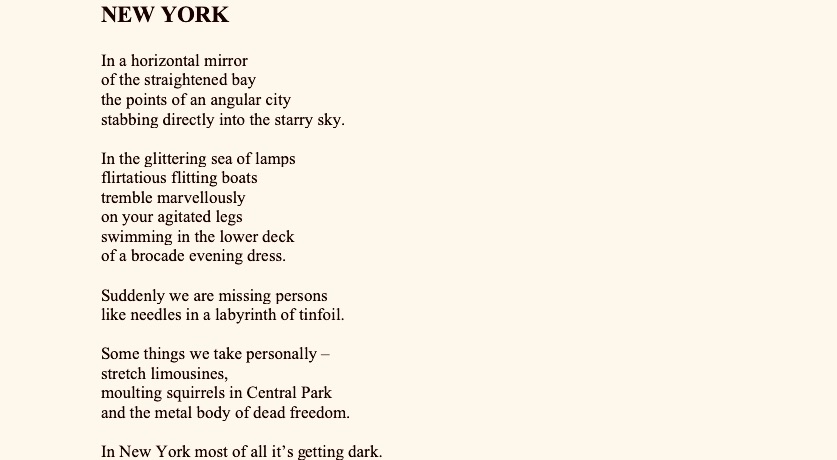
NEW YORK 


In a horizontal mirror
of the straightened bay
the points of an angular city
stabbing directly into the starry sky.

In the glittering sea of lamps
flirtatious flitting boats
tremble marvelously
on your agitated legs
swimming in the lower deck
of a brocade evening dress.

Suddenly we are missing persons
like needles in a labyrinth of tinfoil.

Some things we take personally –
stretch limousines,
moulting squirrels in Central Park
and the metal body of dead freedom.

In New York most of all it’s getting dark.

The glittering darkness lights up.

The thousand-armed luster of the mega city
writes Einstein’s message about the speed of light
every evening on the gleaming surface of the water.

And again before the dusk the silver screen
of the New York sky floods
with hectoliters of Hollywood blood.

Where does the empire of glass and marble reach?
Where do the slim rackets of the skyscrapers aim?

God buys a hot dog
at the bottom of a sixty-storey street.

God is a black
and loves the grey color of concrete.

His son was born from himself
in a paper box
from the newest sort of slave.


A DICTIONARY OF FOREIGN DREAMS


At the beginning it was like a dream.
She said:
“Have at least one dream with me.
You’ll see – it’ll be a dream
which you’ve never dreamt about before.”

Descend deeper with me,
dream from the back,
dream retrospectively
in a labyrinth of mirrors
which leads nowhere.

The moment you come to the beginning of nothing
you’ll dream an exciting dream.

Frame it
and hang it in your bedroom.

So it will always be before your eyes
because a dream which is removed from the eye
is removed from the mind
in the sense
of the ancient laws
of human forgetfulness.

Dream your own.

Dream your dream
which is reflected on the surface 
of a frozen lake.
A dream smooth and freezing:

Grieving keys,
a downcast forest,
curved glass.
The tributes of mirrors.

The rising of the moon
in a dream of water.

Recoil from the bottom
of the mirror’s dream.

In the gallery of dreams
then you’ll see
a live broadcast from childhood
fragments of long-forgotten stories.

Because our obsolete dreams
remain with us.

Don’t be in a hurry, dream slowly, completely
until you see the crystalline construction
of your soul
in which dreams glitter.
- intentionally and comprehensibly like flame.

Perhaps you’ve already noticed
that new dreams always decrease.
They wane.

Soon we’ll light up
in the magical dusk
of the last dream
the despairing cry
of a starry night.

Pay a toll to the dream’s
deliverance from sense.

You repeat aloud
the intimacies of secret dreams,
with the dull gleam
of your persistent night eyes
you explicate a mysterious speech of darkness.

You dream, therefore you exist!


UNSENT TELEGRAM


Inside me a little bit of
a blue Christmas begins.
In the hotel room it’s snowing
a misty scent – of your
endlessly distant perfume.
We’re declining bodily
while in us the price
of night calls rises,
waves of private earth tremors
and the limits of an ocean of blood
on the curve of a lonely coast.

*New York has been translated to 21 languages

PAVOL JANIK | VIRTUOSO OF SLOVAK LITERATURE 


NEW YORK 


In a horizontal mirror
of the straightened bay
the points of an angular city
stabbing directly into the starry sky.

In the glittering sea of lamps
flirtatious flitting boats
tremble marvelously
on your agitated legs
swimming in the lower deck
of a brocade evening dress.

Suddenly we are missing persons
like needles in a labyrinth of tinfoil.

Some things we take personally –
stretch limousines,
moulting squirrels in Central Park
and the metal body of dead freedom.

In New York most of all it’s getting dark.

The glittering darkness lights up.

The thousand-armed luster of the mega city
writes Einstein’s message about the speed of light
every evening on the gleaming surface of the water.

And again before the dusk the silver screen
of the New York sky floods
with hectoliters of Hollywood blood.

Where does the empire of glass and marble reach?
Where do the slim rackets of the skyscrapers aim?

God buys a hot dog
at the bottom of a sixty-storey street.

God is a black
and loves the grey color of concrete.

His son was born from himself
in a paper box
from the newest sort of slave.


A DICTIONARY OF FOREIGN DREAMS


At the beginning it was like a dream.
She said:
“Have at least one dream with me.
You’ll see – it’ll be a dream
which you’ve never dreamt about before.”

Descend deeper with me,
dream from the back,
dream retrospectively
in a labyrinth of mirrors
which leads nowhere.

The moment you come to the beginning of nothing
you’ll dream an exciting dream.

Frame it
and hang it in your bedroom.

So it will always be before your eyes
because a dream which is removed from the eye
is removed from the mind
in the sense
of the ancient laws
of human forgetfulness.

Dream your own.

Dream your dream
which is reflected on the surface 
of a frozen lake.
A dream smooth and freezing:

Grieving keys,
a downcast forest,
curved glass.
The tributes of mirrors.

The rising of the moon
in a dream of water.

Recoil from the bottom
of the mirror’s dream.

In the gallery of dreams
then you’ll see
a live broadcast from childhood
fragments of long-forgotten stories.

Because our obsolete dreams
remain with us.

Don’t be in a hurry, dream slowly, completely
until you see the crystalline construction
of your soul
in which dreams glitter.
- intentionally and comprehensibly like flame.

Perhaps you’ve already noticed
that new dreams always decrease.
They wane.

Soon we’ll light up
in the magical dusk
of the last dream
the despairing cry
of a starry night.

Pay a toll to the dream’s
deliverance from sense.

You repeat aloud
the intimacies of secret dreams,
with the dull gleam
of your persistent night eyes
you explicate a mysterious speech of darkness.

You dream, therefore you exist!


UNSENT TELEGRAM


Inside me a little bit of
a blue Christmas begins.
In the hotel room it’s snowing
a misty scent – of your
endlessly distant perfume.
We’re declining bodily
while in us the price
of night calls rises,
waves of private earth tremors
and the limits of an ocean of blood
on the curve of a lonely coast.

All these poems are excerpted from his book, A Dictionary Of Foreign Dreams

Mgr. art. Pavol Janik, PhD., (magister artis et philosophiae doctor) was born in 1956 in Bratislava, where he also studied film and television dramaturgy and scriptwriting at the Drama Faculty of the Academy of Performing Arts (VSMU). He has worked at the Ministry of Culture (1983–1987), in the media and in advertising. President of the Slovak Writers’ Society (2003–2007), Secretary-General of the SWS (1998–2003, 2007–2013), Editor-in-Chief of the literary weekly of the SWS Literarny tyzdennik (2010–2013). Honorary Member of the Union of Czech Writers (from 2000), Member of the Editorial Board of the weekly of the UCW Obrys-Kmen (2004–2014), Member of the Editorial Board of the weekly of the UCW Literatura – Umeni – Kultura (from 2014). Member of the Writers Club International (from 2004). Member of the Poetas del Mundo (from 2015). Member of the World Poets Society (from 2016). Director of the Writers Capital International Foundation for Slovakia and the Czech Republic (2016–2017). Chief Representative of the World Nation Writers’ Union in Slovakia (from 2016). Ambassador of the Worldwide Peace Organization (Organizacion Para la Paz Mundial) in Slovakia (from 2018). Member of the Board of the International Writers Association (IWA BOGDANI) (from 2019). He has received a number of awards for his literary and advertising work both in his own country and abroad.

Pavol Janik’s literary works have been published not only in Slovakia, but also in Albania, Argentina, Bangladesh, Belarus, Belgium, Bosnia and Herzegovina, Bulgaria, Canada, Chile, Croatia, the Czech Republic, France, Germany, Hungary, India, Israel, Italy, Jordan, Kosovo, Macedonia, Mexico, Moldova, Nepal, Pakistan, Poland,  the People’s Republic of China, the Republic of China (Taiwan), Romania, the Russian Federation, Serbia, South Korea, Spain, Syria, Turkey, Ukraine, United Kingdom, the United States of America and Venezuela.

James Smith Sutherland is a writer, critic, poet and translator.

Categories
Poetry

Poems from Morocco: Let’s Unite to Celebrate Humanity


By Abdelmajid Erouhi     

A “Borderless” Poem

Never talk to a bee as it is fecundating a sunflower,

Never talk to a butterfly as it is flying over a daisy,

Just keep seeing and thinking, and never glower

At them, just wonder on the way they go crazy!

Never abort their tuneful warbles while singing,

Never vex them or repress their deep thinking,

So, let them write the way their hearts like,

Let them think the way their minds like,

Let them sing the way their tongues love,

 Let them have fun and fly with a cooing dove!

Never besiege or cage them in poetic death,

Never make them short of imaginative breath.

What garrulous lips that oppose calm and freedom!

Oh! Maybe they ignore that silence is wisdom!

 Maybe, they think the two singers hate talking.

Yes, It’s true a bee and a butterfly hate talking,

And hate to be talked to while pollinating,

So, never imprison their words in one shut up house,

By talking to them about ladies’ soulless blouse,

As the butterfly and the bee like to resort to a journey

Across the world without a passport or a visa of entry,

As they don’t like to keep queuing at the embassy

To meet varied pollinated flowers from other continents,

Where they can go beyond any traditional confinements

Of thinking, feeling and creating a map of poetic seeds

That draws human love and peace that anyone needs,

So, let a ‘poet’ sing and fly like a bee and a butterfly,

Across his borderless world and transnational blue sky

Corona is a Plea for Love!               

How stupid of world colorful peacocks

To boast of their wings and hearts of rocks!

How stupid of woodpeckers to eat bees!

How stupid of birds of prey to harm trees!

How stupid of wolves to eat rabbits!

What a gloomy forest of unfair habits!

*

How stupid of wealthy peasants

To sow hemlocks to kill thousands

Of pigeons put in dark dungeons,

 Using Hitler’s nuclear weapons!

What a myopia to expose a pigeon to danger!

So, you fail to fight against a Honey badger!

Thus, corona is a cure for such a ‘corona!

It enfeebles tempted vultures’ vile stamina!

What a war that breaks out in the forest!

It stirs up peace and love to reach the crest,

As it’s unwise to keep seeing the waves of sea

And ignore inhaling its breeze that sows glee!

So, let’s quieten the roughness of East-West sea

Let’s stop political tides — it’s a sulky sky’s plea.

As the Nile and Euphrates complain of aridity,

Let’s unite world foes to celebrate humanity!

Enough of greedy guns, enough of grudge that is rife!

Coronavirus warns any lion as there is no eternal life!       


Abdelmajid Erouhi is a Moroccan poet and writer. He is a teacher of English from Zagora, from an Amazigh origin. He is currently teaching in Tantan City in the south of Morocco. He has published some of his poems in different magazines and websites. He has an unpublished collection of poems, and he is now working on a new one. He is also interested in writing short stories. He is pursuing his PhD about Cultural Encounters between the East and the West in Postcolonial Narratives of Contemporary Arab Muslim writers in Diaspora at Sultan Moulay Slimane Faculty of Letters and Humanities in Beni Mellal. He is similarly interested in Travel literature, Diaspora, Cultural Studies and postcolonial theories. Besides, he is interested in Arabic literature.      

Categories
Poetry

Poetry of Jibonanada Das

(Translated by Suparna Sengupta)

BANALATA SEN

For a thousand years, am I trailing the paths of this earth --
From the oceans of Ceylon, amidst darkling nights, to the Malay seas
Much have I wandered; To Bimbisara and Asoka’s ghostly days
Have I been; even farther, to the distant dark Vidarbha wen;
I am a tired being, all around me foams life’s ocean,
A moment’s peace came only from Natore’s Banalata Sen.

Her tresses, dense and dark, unbeknown like Vidisha’s nights,
Her face, like Srabosti’s sculpture; in the seas distant,
Like the rudderless sailor, who loses way,
A land of green grass, in the cinnamon island, when suddenly he sights, 
So too, in the dark, I sighted her; She said, “Where, for so long, have you been?”
Like a bird’s nest, her eyes uplifted, Natore’s Banalata Sen.

At a long day’s end, like the drop of a dew
Comes duskfall; its sun-scented wings, rubs off the eagle,
All shades of earth dimmed, the manuscript prepares anew,
For then stories, like fireflies, glow and twinkle;
All birds come home--all rivers--emptied, all loss and gain.
Alone this dark remains, for a face-to-face with Banalata Sen.


      1946-47

Daylight casts thither on uncertain mortal racket;
On lanes-bye lanes, on broadways, tramways, footways;
Some stranger’s home will be auctioned right away—perchance,
At throwaway rates. 
Everyone tries to hoax to heaven
Beating everyone else, everyone you bet.

Many, perforce, rush breathless—yet
Those auctioned houses, those furniture—or what’s not for auction,
All those stuff --
Only a few, depriving others, can still purchase.
In this world, interests accrue, but not for all.
Doubtless, the treasury, rests with one or two.
The demands of all these lofty men, dominate
Upon one and all, women too left unsaved.
All the rest, in dark, like ceaseless autumnal fall,
Wishes to meander, somewhere to a river
Or maybe upon earth--within some germinating seed,
Themselves embedded.  Knowing this earth has had several lives, still
They return sun-scented, to dust, grass, to flowering elixir’s
Long-known bliss, to light, the humble heirs must reclaim them—

Musing thus, they submerge unto darkness. 
Disappeared thus, they are currently all dead.
The dead, to this earth, never come back.
The deceased are nowhere; are they?
Excepting some autumnal ways, some sauntering gentleman’s
Arterial trails, the dead might be nowhere else,
May be then, before death’s onset, light, life, liberty and love
With serenity, could have been better greeted.

Lakhs of Bengal’s hamlets lie drowned, hopeless, despairing, still and lifeless.
As the sun sets, a well-tressed night, as if
Comes to dress her braids—but by whose hands?
Vaguely, she stares—but upon whom?
No hands, no humans are here—lakhs of Bengal’s hamlet-nights, once upon a time,
Like hand-drawn designs, like vivid scroll drawings, had grown into 
Wide-eyed prophets—all extinguished.

Here, even the other day, new harvest they had scented;
Upon new-born paddy sap, sunbathed, so many crows met;
The flock from this hood replied to the chatter from that hood--
Airmailed they came, lapping up the sap.

Not a whisper now, even in those cauldrons;
Skulls and skeletons are not beneath human counting;
In Time’s hands, they are unending. 

Over there, on a full-moon night, in the fields, the farmers danced,
Drinking mystical paddy-sap, the majhi-bagdi’s
Divine daughter beside. 
Some pre-marital—some still extra-marital—presaging birth of a child.
Those children in today’s evil state, are muddled,
Drained, this society has stamped them out
Nearly dead; the predecessors of today’s rustic class,
In blissful ignorance, stacking the evil Zamindar’s
‘Permanent Settlement’ atop a charok gaach, have passed away.
Not that they were too well-off; still,
Today’s famine, riots, hunger and illiteracy
Have blinded the distressed rustic beings, such that 
A distinct, clearer world, in comparison, once there was. 

Is all in doubt today? To see through things, is quite problematic now;
In dark times, divulging half-truths
Has its own rules; consequent, in this murk,
Gauging the residue truth, is a practice 
That remains; everyone looks askance at everyone else.

Nature’s hidden truth seems malicious.
Nature’s hidden truths, in all our sincerity,
Draw upon the shadow of our own doubts, to 
Uncover our own pains. In Nature’s hills and rocks, in 
Her exuberant falls, have I discerned, how first waters flush red 
With a dead creature’s blood, thence the tiger hunts down the deer, even today!
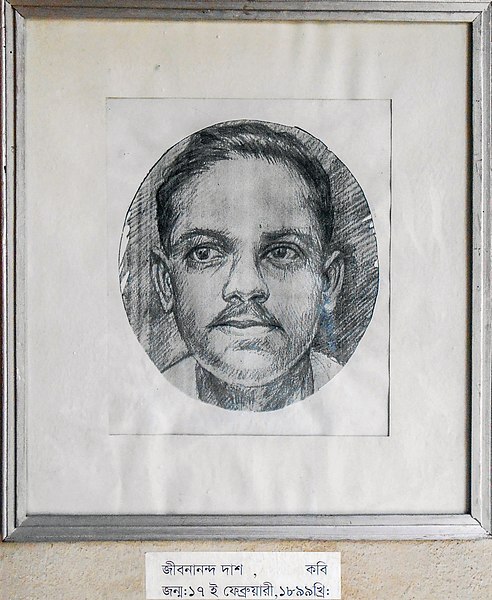
Jibonananda Das

Often hailed as the most influential poet of the post-Tagore generation, Jibonananda Das remains one of Bengal’s most intimate and incisive observers. Born in 1899, at the cusp of change raging across India and indeed the world, Jibonananda started his poetic career as a Romantic celebrant of Bengal’s vast green fields, sun-dappled rivers, lush horizons, its minutest of elemental forces. As years rolled by, a variety of societal changes impacted this landscape and indeed his own life—colonialism, World Wars, the Bengal Famine, communalism and the dark days of Partition.  His poetry and sensibility gradually took a turn to the urbane introspection of existential loneliness, tradition and its clash with modernity, death, sickness, and the newly evolving concept of the nation. However, the theme that towered over his thought-process was the concern of human civilization, its evolution and achievements and the paradox of death, disease and violence that this civilization always was confronted with. Both the pieces translated, ‘BANALATA SEN’ and ‘1946-47’ capture these romantic/humanist approach. ‘BANALATA SEN’ is perhaps his most-quoted poem, where the enigmatic, eponymous damsel offers respite and peace to the world-weary traveller-persona. What is striking in this piece, is the catalogue of places that the persona travels to—all strung together by a distinct Buddhist civilizational motif. Perhaps, he is quietly reflecting on India’s departure from its ethos of non-violence, peace and tolerance, across ages.

BANALATA SEN

For a thousand years, am I trailing the paths of this earth --
From the oceans of Ceylon, amidst darkling nights, to the Malay seas
Much have I wandered; To Bimbisara and Asoka’s ghostly days
Have I been; even farther, to the distant dark Vidarbha wen;
I am a tired being, all around me foams life’s ocean,
A moment’s peace came only from Natore’s Banalata Sen.

Her tresses, dense and dark, unbeknown like Vidisha’s nights,
Her face, like Srabosti’s sculpture; in the seas distant,
Like the rudderless sailor, who loses way,
A land of green grass, in the cinnamon island, when suddenly he sights, 
So too, in the dark, I sighted her; She said, “Where, for so long, have you been?”
Like a bird’s nest, her eyes uplifted, Natore’s Banalata Sen.

At a long day’s end, like the drop of a dew
Comes duskfall; its sun-scented wings, rubs off the eagle,
All shades of earth dimmed, the manuscript prepares anew,
For then stories, like fireflies, glow and twinkle;
All birds come home--all rivers--emptied, all loss and gain.
Alone this dark remains, for a face-to-face with Banalata Sen.

GLOSSARY:

  1. Bimbisara: a 5th century BC king of the ancient kingdom of Magadha; remembered for his military exploits and his patronage of the Buddha
  2. Asoka: Celebrated as one of the greatest imperialists in Indian history, he is remembered in history for his dramatic conversion from an aggressor to a Buddhist who spread the message of non-violence and peace. 
  3.  Vidharba: The north-eastern territory of Maharashtra, on the banks of Godavari.
  4. Natore: a district in northern Bangladesh. Legend has it that a Zaminder was once travelling by boat looking for a suitable place to build his principal residence. While travelling through Chalan beel (lake), he saw a frog being caught by a snake. His astrologers interpreted it as a sign of the end of his search for a place of residence. The Raja called out to his boatmen: ‘Nao Tharonao’ as in, ‘stop the boat’. From a corruption of this exclamation, the place eventually came to be called ‘Nator’.
  5. Vidisha: Situated very to the Buddhist pilgrimage city of Sanchi, Vidisha was an important trade centre under Buddhist rulers in the 5th century BC.
  6. Sravasti: Currently in modern day Uttar Pradesh, the city is one of the premiere centers of Buddhism.

‘1946-47’ is a landmark poem on the history of violence and bloodshed that came in the wake of Partition. The poet is a chronicler of Bengal’s changing landscape, her ethos and values in the modern times. But above all, Jibonananda voices the subaltern, especially the Bengal peasantry, whose plight and suffering under colonialism is deeply etched on his mind.

GLOSSARY:

  1. majhi-bagdi: Denoting the caste of fisherfolk and tribal warrior communities of rural Bengal
  2. Permanent Settlement: A revenue agreement between the East India Company and Bengal’s landlords to fix taxes/revenues to be raised from land.
  3. charok-gaach: a maypole erected out of the stump of a tall tree during the season-end festival of the last month of Bengali calendar, Chaitra. On top of this tall maypole are tied bundles of jute and flags with which a merry-go- round is built. Congregants whirl around the top of the maypole, supported by the ropes and hooks.

Although he spent his early days in earstwhile East Bengal, yet he moved to Kolkata where he graduated with an Honours in English in 1919 and thereafter earned an M.A., also in English, from the Calcutta University in 1921. Following his tragic death in a road accident in 1954, a vast body of novels and short stories, written by him, were discovered. Throughout his life, he shied away from public attention as posthumously he emerged to be a modern poetic giant in the annals of Bengali Literature.

Suparna Sengupta lives in Bangalore, India and is a faculty, Department of English at the Jyoti Nivas College for more than a decade now. She has translated various poets from India and Bangladesh and has been published in literature magazines. Her translated poem has been published in “Silence Between the Notes”, an anthology on Partition Poetry (ed. Sarita Jemnani and Aftab Hussain). She also features in the Annual Handbook of “Words and Worlds”, a bi-lingual magazine (PEN Austria Chapter) as also in ‘City: A Journal of South-Asian Literature’, Vol 7, 2019 (City Press Bangalore).

Categories
Poetry

Black Beauty

By Dr Santosh Bakaya

THE BLACK BEAUTY\ Dr.Santosh Bakaya 

It was just a small thing.
Come to think of it, not actually small,
but pretty big.
Huge and black. A Black Beauty.
A figure stood silhouetted near the window,
watching the beauty in black.
It shimmered and glowed in the noonday sun,
waiting for that touch which would galvanize it into action.
Dreams rippled in the figure’s eyes
Body taut, in an agony of apprehension.
He craved no luxury.
But that car, he did crave,
albeit , a second hand one.
I don’t know whether it was the Hillman minx,
the Hillman Avenger, Hillman Super Minx
or the Hillman Husky.
But it was Hillman, just a car.
A second hand one
standing outside our University quarters,
waiting to be claimed for a paltry sum.
“No , I cannot afford to buy it” , the figure said , casting one last ,
lingering look at the black beauty , and hastened out ,
pinned up his trousers , pulled a hat over his head
and pedaled away towards his department .
From the sun- dappled lawn,
his much loved menagerie of cats and
dogs looked on. Unspeakably sad.
The devoted friends of this hatted, handsome professor.
My dad.
Nissim Ezekiel was to be the guest speaker that day
and he couldn’t afford to be late.
I watched him from the balcony
as he became a speck in the distance.
Yes, a speck. That dream too was a speck,
which remained quiescent in his heart till his last breath.
“It is just a small thing, and this craving for a car,
is so embarrassing, but I don’t know why ,
it keeps coming back.” He would often say.
That towering figure suddenly travelled far
sans car, and became a distant star,
the shards of his broken dream,
well- hidden,
bidding us goodbye,
all of a sudden,
leaving me with this overwhelming feeling of guilt.
This devastatingly destructive guilt.
Many a night, when the clock on the mantelpiece
goes tick tock tick tock and the house resounds with lost echoes,
tiny pigeons venture out of pigeon holes of memories, it is then that
the fossilized monster of guilt also yanks away its shackles
and hurls accusations at me.
I hear the cacophony of the clash of priorities,
our school and College fees, summer holidays clanging against
his dreams and tiny cravings.
I submit to the night’s scrutiny, and ask myself,
if his dream had been bigger,
would my guilt have been bigger, too?
Suddenly, piercing the night, that Black Beauty resurfaces.
Nostalgia gushes through my ruptured wounds,
and I am red all over.

Dr. Santosh Bakaya is an academician, poet, essayist, novelist, biographer, Ted Speaker and creative writing mentor. She has been critically acclaimed for her poetic biography of Mahatma Gandhi
[Ballad of Bapu]. Her Ted Talk on the myth of Writers’ Block is very popular in creative writing Circles . She has more than ten books to her credit , her latest books are a biography of Martin Luther King Jr. (Only in Darkness can you see the Stars) and Songs of Belligerence (poetry). She runs a very popular column Morning meanderings in Learning And Creativity.com.

Categories
Poetry

The Mending Egg

By Juan Pablo Mobili

The Mending Egg

To Victoria, my grandmother

My grandmother had inherited
a wooden egg from her mother who
had used it to mend countless old socks;

its surface now thoroughly smoothed
after having sewn away so many holes
and reuniting so many wounded siblings.

I don’t believe I ever saw my grandma
fix a single sock with it; by then
we did not have to, we were fortunate that way,

but the egg remained carefully placed
atop the box where she gathered threads,
needles, and a tribe of orphaned buttons.

We never spoke about the mending egg
or how it earned its place. I think now
that she meant some sort of altar for it

because to neglect what gave its life
to repair what had been torn would be a sin
or, even more, to disrespect her mother.

Juan Pablo Mobili was born in Buenos Aires, Argentina, and adopted by New York, a long time ago. His poems have appeared in First Literary Review-EastThe Poetry Distillery, Anti-Heroin Chic, Red Planet Magazine; or are forthcoming from Spirit Fire Review, Mason Street, The Red Wheelbarrow Review, and The Journal of American Poetry.  In addition, he co-wrote a chapbook of poems in collaboration with Madalasa Mobili, “Three Unknown Poets,” published by Seranam Press.

Categories
Poetry

I am a Woman & Covid 19: An Intruder

By Pravat Kumar Padhy

I am a Woman

the stones stack

one above another

in deep silence

void mingles with the wind

rumbling into the emptiness

****        ****      ****

dark patches

of the colour of the skin

he screams aloud 

as if moon with its lost shine

hides behind the dense cloud

****        ****      ****

she fears to call

the wave by which name

layers over layers

she drags her footmarks

as the rain follows the rain

****        ****      ****

memory 

still frightens her

every evening

tears mingle

with her bereaved sea

****    ****    ****
wiping tears

gently from her face

with a needle of hope

she threads the pain in between

reading  life, like an anthology of poem

****    ****    ****

she reminisces

about events long gone by

floating leaves

gather patches  of shadow

mixed with receding sunshine

*****        *****      *****

holding the breeze

near the liberty square

she wishes

the sculpture to proclaim

her expression of tender pray

****     ****     ****

like an adrift tree

often she got bled and burnt

the woman of justice 

holds the beam balance,

the cover page of Social science

Note: These five-line poems are excerpts from the manuscript, “I am a Woman”

Covid-19: An Intruder

stillness

like a deep forest…

invisible invaders

axe everyone, like trees

falling silently into sleep

****    ****    ****

all around

beyond the border

a tremor of panic

swollen eyes turn

into craters of stormy rain

****    ****    ****

since sunrise

he has been breathing hard  

a stone even feels

the pain of suffering

as he strides towards his last evening

****    ****      ****

his last word

mingles with void…

we scream aloud

as the storm blows away

all the petals of our hope

****    ****    ****

aliens, if any,

might be wondering

about the planet

deep shadow of silence

eclipses under the trembling fear

****    ****    ****

dawn to dust

a long walk to the cemetery…

the last line

in the book of condolence

reads curse of the cruel Covid-19

****    ****    ****

seed of hope

lies under the soil

to sprout

wish for mankind to witness

the garden of flower and fragrance

Pravat Kumar Padhy has obtained his Masters of Science and Technology and a Ph.D from Indian Institute of Technology, ISM Dhanbad. His literary work is cited in Interviews with Indian Writing in English, Spectrum History of Indian Literature in English, Alienation in Contemporary Indian English Poetry, History of Contemporary Indian English Poetry etc. His poems received many awards and commendations including the Editors’ Choice Award at Writers Guild of India, Asian American Poetry, Poetbay, Vancouver Cherry Blossom Festival, UNESCO International Year Award of Water Co-operation and others. His tanka, ‘I mingle’ is featured in the “Kudo Resource Guide”, University of California, Berkeley. His poem, “How Beautiful” is included in the Undergraduate English Curriculum at the university level.

Categories
Poetry

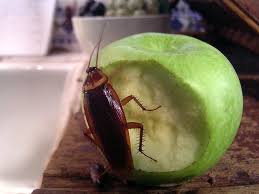
Katsaridaphobia/Gospel According to Cockroaches

By Aditya Shankar

1

And the insect haters, repellent sprayers, broom

wielders will eventually reside beneath soil:

the second life. The hand that swats thy loved

ones will lie defenseless. Time of cockroaches

and oppressed shall arrive.

2

Soil will erode like the layers of sandwich. The

one who seeks will traverse its depth. The one

who licks the world shall know and conquer.

3

Our itchy legs shall crawl and penetrate the fire

in the flesh and the temptation of the wood coffin.

4

He who comes digging for forefathers and lost

cities shall tremble at our conquest and return to

house of darkness, referred hereafter as hell.

5

Punish them with your touch. Tease them

with your shadow. Crawl in their nightmares.

Appear as rarely as God among sinners.

6

And when you take an avatar, infest his cup-

board and attic with the thousand children you

beget. Fear shall have no face.

7

The army of your lineage shall be the

messenger of colour. Fire, soil, and life beneath

shall have your shade.

8

Eat the sleep of men and women from whose

country, the messenger never returns.

9

Bore holes in their books and clothes. Plough their

notions until they turn into roads that lead nowhere.

Aditya Shankar is a Pushcart and Best of the Net nominated Indian poet, flash fiction author, and translator. His work has appeared in international journals and anthologies of repute and translated into Malayalam and Arabic. Books: After Seeing (2006), Party Poopers (2014), and XXL (Dhauli Books, 2018). He lives in Bangalore, India.
Categories
Poetry

Praying Mantis

By Orbindu Ganga

Painted in a shade 
Rested in her cave,
Silent enough to be staid
To be camouflaged
With the leaves,
Whirling from the obtuse
To touch the straight angle,
She echoes the form
In the way, she looks,
She creeps like a humanoid
To trigger the strive for higher form,
She drafts her movement
Like a saint for everybody’s well-being,
Seeing with a vision in two
To hear them mumble in one,
She was created 
To whisper in the ambiance,
Ingrained with gratitude
To seek the showers of blessings,
From the almighty 
With folded hands to him,
The human opened their eyes
To get intrigued to see the visual.
She stood still 
For as long she could,
Making her the cynosure
For rest to admire,
Showing all the species
The power of prayer,
The mantis is the prophet
Praying for all the species.

Orbindu Ganga is a post-graduate in science and the first recipient of Dr. Mitra Augustine gold medal for academic excellence. He worked in financial, banking and publishing domains, proving his finesse as a Soft Skills Trainer and Content Account Manager (Client Relationship Manager). Orbindu Ganga is a multilingual poet, author, critic, content writer, sketch artist, researcher, and spiritual healer. His poems have been published in many international publications and anthologies. He has published two research papers in poetry. His painting and article have been published in a spiritual journal – Awakening. He has authored the book “SAUDADE.”

Categories
Poetry

Virus, Unanswered Questions and more…

By Manu Dash

Virus


The ocean is now equipped to endorse swimming.
It’s time to endure the ineluctable annual trip.
The sky mirrors the swashbuckling journey; 
Someone waiting for you at the end of the shore.
Lights will be clouded when you move avoiding the lighthouse;
Use your instinct always before the lullaby disowns its source.
Darkness and sea-storms area package, inclusive of Olive Ridley.
Ignorance will one day fall like baby teeth.
Leading the life of a peacenik is a terrible act.
Have you taken the cutlass with you?
Not necessary that you should use all the things you have;
Throw in everything during the missionary position.
Avoid sand dunes which are nothing but Homeric nods.

An Unanswered Question


The little boy asked his mother,
‘Who made our village river?’

Mother raised her face from
The homework and answered, ‘God’.

‘Has he made our village too?’
‘Yes’ said she.
 ‘Why the inequality in making
 Buildings, roads, and facilities?’

‘Ask these questions with God
When you grow older,’
Mother laughed.

The following year, the boy met God
When his school bus plunged into the river.
But no one knew if he raised the question
Before God. 


Obituary for an Artist


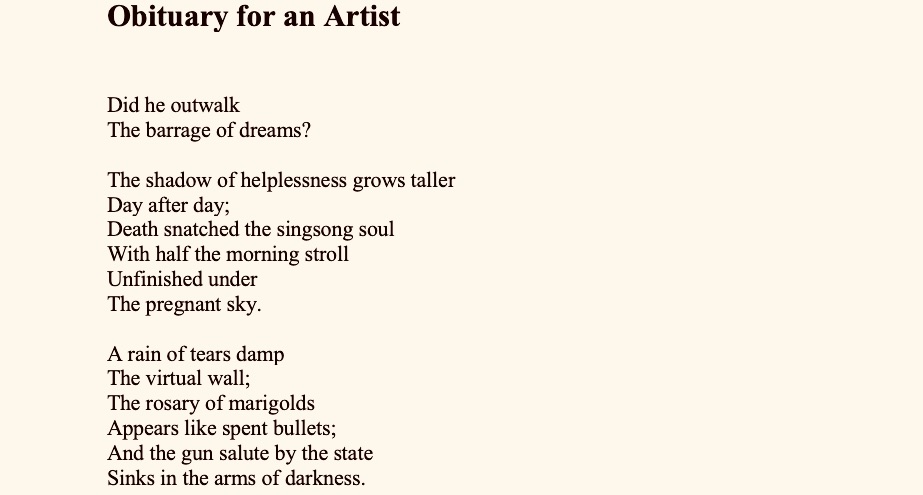
Did he outwalk
The barrage of dreams?

The shadow of helplessness grows taller
Day after day;
Death snatched the singsong soul
With half the morning stroll 
Unfinished under
The pregnant sky.

A rain of tears damp 
The virtual wall; 
The rosary of marigolds 
Appears like spent bullets; 
And the gun salute by the state
Sinks in the arms of darkness.

What’s there in the body
Without the soul;
What’s there in the soul 
Without the body?

You are thirdfourthfifthsixth
May be in this week alone.
Unfinished lines and incomplete brush strokes
Play with the washerman’s canine;
Experience the anguish of eternal waiting.
No one will bother to blame fragile memory
And wait for the echoing rhetoric.

Advice to an Osteoporosis Man Who Loves to Run

After dismantling the long night
Let’s stop running now.

It smells like a joss stick.
Fog captures the road ahead.

I’ll never know
Whose tender hands made these shoes
That chime and kiss our asphalt road of life.

May I donate to you my ancient history
Burdened with false pride and a whine
That may bring numinosity to the soul?

Let’s turn back now.

The days go ahead in their spendthrift way
Before you pray a silent prayer
Where no prayer-flag is in sight.

You may drink the newspapers
Brimming with the retching of time.

(with permission taken from A Brief History of Silence, Dhauli Books 2019)

Manu Dash (1956) is a poet, editor, translator, publisher and curator of the annual Odisha Art & Literature Festival. He has published 25 books in Odia and English. While in college, he joined the “Anam Writers’ Movement” — an anti-establishment movement in Odia literature — shortly before the imposition of Emergency in India in 1975. He is the founder of Dhauli Books, which won the prestigious “Publishing Next Industry Award for the Best Printed Book of the Year in Indian Languages” in 2018.

Categories
Poetry

The Birds in These Strange Times and more…

By Matthew James Friday

The Birds in These Strange Times
A pair of kites have come for the lake
now the airport is closed, buoyed by empty 
skies, rustling wooded hills, lacey waters.

My wife shows me trees on the lake’s
whispering edge where cormorants gather,
roosting in the trees like paused pterodactyls. 

An adult swallow giddy with its suddenes,
rolling in the early April air, the very first
migrant recoiled by a changed climate.


Back to Blue
Imprisoned in caution,
the cases rising, fear abundant,
school closed, classes cancelled.
All online now. I watch
a documentary about Miles Davis.

I have always struggled with Jazz,
berated the lack of melody,
felt lost amongst the jostling notes.
But following his story, the craft
from the chaos, the passion in tone

I choose to try again. Back to Blue
starts, and notes sound as alarming
as the online coverage but the jingling 
chords, the blasts of trumpet suddenly 
sounds peace while the world tears. 


Balance

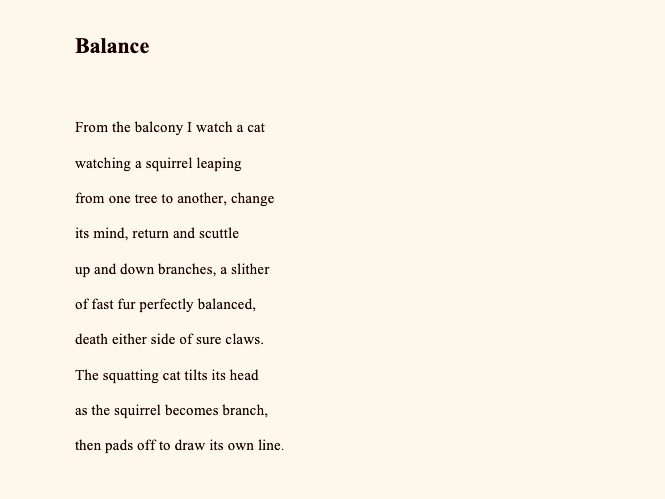
From the balcony I watch a cat
watching a squirrel leaping
from one tree to another, change
its mind, return and scuttle
up and down branches, a slither
of fast fur perfectly balanced,
death either side of sure claws.
The squatting cat tilts its head
as the squirrel becomes branch,
then pads off to draw its own line.

In Rooms, Therefore We Are

The rooms we build define us, shape us, create and consume us.

To function as a modern human is to be in a room: offices, classrooms, waiting rooms, shops, bedrooms, gardens, cafés, libraries, trains, airplanes, theatres, cinemas and stadiums.

Alone or confessing, on holiday, marrying, working or transgressing. Watching or waiting, dancing, defecating or contemplating.

Our own heads are a skeletal room we stare out of; thoughts, ideas and words bouncing around the bony walls. Billions pray to be safely ushered into the everlasting room beyond these rooms, to be reunited with those who were once in our rooms.

The number of rooms make all the difference between a slum resident and a billionaire, freedom and imprisonment; rooms that can be built from waste material or secreted into yachts; rooms that only the most valiant warriors can ascend to while others descend to the deepest unreachable rooms.

To feel free, we leap over the walls to the open, roomless countryside, though we return to rooms at night or make them using tents. We stare deeply and longingly into the blinking night sky, wondering if there are rooms on other planets like our planet, which is one giant, spinning room, moving through an ever-expanding room.

Even the atom itself is a kind of theoretical room, built mainly of nothing, of potentially something through which hums the moments of energy that we use to build up all the matter around us.

         Perhaps we love rooms because that is where we began, in our mother’s warm interior room; safe from everything outside and other. Perhaps it is the safety of this dark, nourishing room that is the shadow between every room thereafter.

As children we build pretend rooms, hide in them from the monsters that sneak into our rooms, that lurk in their own dark spaces in the corners.

As adults we spend days rushing in and out rooms. Now, confined to our rooms in fear of that which knows no walls, we are more thankful than ever for the walls. We stare at each other from balconies and buildings, all afraid in our rooms and wondering when the doors will open again.


Matthew James Friday has had poems published in numerous international magazines and journals, including, recently: All the Sins (UK), The Blue Nib (Ireland), Acta Victoriana (Canada), and Into the Void (Canada). The mini-chapbooks All the Ways to Love, Waters of Oregon and The Words Unsaid were published by the Origami Poems Project (USA).
Website:      http://matthewfriday.weebly.com