Categories
Musings

Blade of Grass: A Lesson Learnt

By Dr. D.V.Raghuvamsi

A blade of grass in my garden dancing in the summer morning breeze has offered a valuable lesson. I need to dismantle my human ego to accept it.

The entire world now grapples with the novel coronavirus that poses a threat to the lives and lifestyle adopted by humans. Of course, there is no doubt that Nature is transformation and transformation is Nature. But speaking on a pessimistic note, the pandemic may be interpreted as a way of the supreme design to balance several aspects. After all, life is all about balancing things!

If I have to come to terms with the fact that a small entity is able to pose a challenge to the technologically developed world, and make the so-called superior species pause, it is time to look within the trivial spaces of the human mind.

Is this pandemic a pre-planned act of Nature? Is this outbreak to make us comprehend that human organism is not the most all-powerful species on Earth? I use the term, ‘human organism’ only to drive home the point that we are a part of multiple species that are supported by the Earth.

I wish to put forward the idea that no other species is under the threat of Covid-19. Does it reinstate that it is the human perspective that has to change? Yes! It’s obvious.

If I have to delve into the deeper spaces, I feel that it is the human ego that pollutes all the entities. If we can take a zoom shot of the things happening around and observe the pattern, I can take home, three important aspects. In the first cycle, it is the human being who started exploiting the other species; in the second cycle, humans moved forward with the exploitation of his fellow beings. In the third cycle, it won’t be an exaggeration if I contend that man is exploiting his own inner self, paving a way for psychological disorders.

Till date, all the viruses disturbed the physiological elements feeding on the different organs of the human body. In future, there may be a day that uproots the so-called most developed entity called, ‘Human Mind’. A microorganism may pose the world’s biggest challenge to the home of thoughts, driving people towards illness that uproots the very foundation of human intelligence.

The whole world is eagerly waiting for a vaccine that treats the coronavirus. Human intelligence is on it and there have been developments on this front. But what if there comes a small entity that threatens the existence of human intelligence? It would be the end of the world for we have made other species subservient to man made technological constructs and they would remain as passive spectators while they watch the last human life on Earth snuff out the species to extinction.

In the name of war over resources, several countries all over the world have completed the second cycle of winning over their fellow beings. Perhaps now, we are headed for the third cycle of destruction. A reorientation of the approach towards other species that abound in Nature is something that demands attention. Living with Nature should be the slogan for today and even tomorrow, for it paves a way for the creation of sensitivity that treats all of living species as one. A moment can be the epitome of transformation. It is the concept of co-existence that constructs it.

.

Dr. D.V.Raghuvamsi has been working as Assistant Professor in MVGR College of Engineering, Vizianagaram, Andhra Pradesh . His interests include penning down short stories that offer a bird eye-view of the varied faces of human psyche.

.

PLEASE NOTE: ARTICLES CAN ONLY BE REPRODUCED IN OTHER SITES WITH DUE ACKNOWLEDGEMENT TO BORDERLESS JOURNAL. 
Categories
Musings

Of Cats, Classes, Work and Rest

By Nishi Pulugurtha

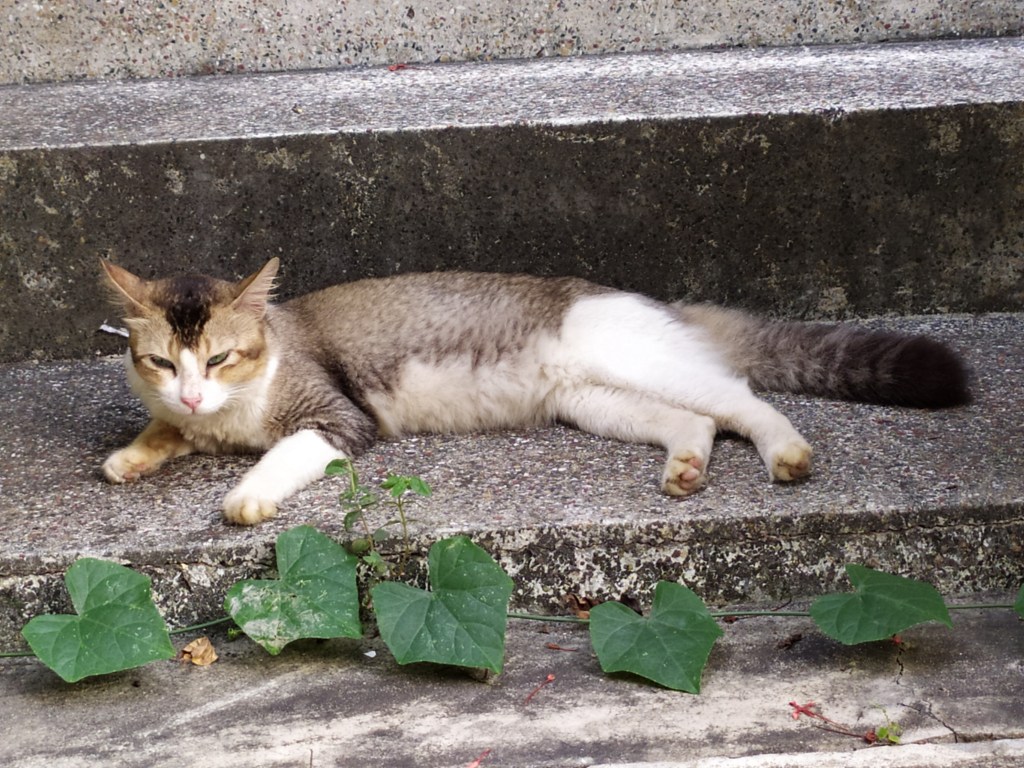
On the step of the building just opposite my living room window is a cat. A beautiful tabby that is in repose – a blissful repose, it seems, as I struggle to deal with things online. Examinations, messages, mails, calls, meetings, discussions – they just seem to go on. Beyond working hours, on Sundays too – yes, they do keep me busy, maybe keep me sane, however, at the same time they are tiring and exhausting. I attend sessions which tell me of various technical aspects of the online platforms that supposedly will make things easier, my take on them —  they seem to be even more complicated.

The cats are not my pets. It is just that I like to observe things around me and working from home my views are limited these days. One of my neighbours has about four pet cats, I can hear her calling out to them – Chini, Mini, Kini, Tini. I hear them purr in response to the call. They snuggle around her feet as she walks out. She picks up one, cuddles it and then picks up another. I see her kneeling and talking to them. That conversation goes on for a while. I hear all kinds of noises – human and feline. She goes in and gets to work and the felines decide to remain in the compound. I guess they want some more of the sun – it is scorching still but that does not seem to stop them.

One of them crawls into the green space in front. She seems to be looking for something — maybe she did get a scent of something that could be a delicious afternoon meal or snack. There is a big noise, an uproar, you could say. That is my other neighbour. I hear her go on. She seems to be shouting at someone. I can clearly understand that she is trying to drive something out of her house. She hollers out to her husband to close the kitchen door. She has just finished her cooking. Well, one of the felines decided to visit neighbours and that was the reason for the commotion.  Inspite of all this shouting and hollering, Mita makes it a point to mix a little bit of leftover rice and some fish bones every day after lunch. She puts this in bowls and puts them out in a small dish near the steps. Slowly the cats venture forth. She has been doing this for years now. She has a late lunch, a very late lunch.

I am in between classes then, online classes and need a cup of tea to cheer me up. As I make myself a cup, I see her walking towards that empty space, bowl in hand and a few of the felines following her. She is no longer shouting at them. Rather, she is talking to them, asking them to wait for a while. She leisurely walks, greeting someone in the distant window. As she puts the food, the felines get busy.

Mita decides to catch up on some conversation with the lady who lives upstairs. As I put on my headphones, I can hear their voices. I am off to another world, a virtual one – my classroom these days. The class consists of new students who are more than lost in all this huge virtual space. I tell them I am in as much trouble as they are in. I am still trying to negotiate my way through this maze of platforms, learning something, trying to learn and not always succeeding. They are quiet for some time, and then I see a message in the chat box. I answer, ask them to speak one by one. I have the list of names on a list, a list that has numbers too – numbers that confuse. This is the first time I am unable to associate the name with the person. I have never seen them, do not know when I will meet them in a classroom.

Room 212 on the second floor, a big, warm, airy room that in the summer months burns, is the allotted classroom for my students. The windows of the room look out to the huge playground. A lot of activity is seen there. A lot of noise too, that disturbs my class. I need to raise my voice to be heard by all. A couple of huge trees stand between the windows and the playground — trees that are home to beautiful pigeons and mynahs. Between the trees and the huge playground is a narrow path that meanders around the playground, branching off at two places. That physical space of my college and the classroom, the space beyond lingers on in my mind as I talk to these students who have just joined college. They have not been to the college. All they have seen are images in the virtual world. We go on trying to make some sense of things.

When it is done for the day, I still have work to be done, attendance and the like – there are still things that I need to attend to. I hear the sounds of the cats purring. They are all under my car that is parked just outside the window. It has been parked for most of the time in the past few months. The space beneath the car is the favourite afternoon siesta time for the cats. They play, they rest in the much cooler space there — nice and cozy too. As I walk on the terrace in the evenings to take a break from work, the two little girls on the neighbours terrace call out to me and point to two cats high up on a ledge. Like these two little ones they are at play too. A little later the cats are near the red toy teddy that has been discarded and tied to a pole on the terrace of the house opposite, their play still on.

Dusk settles in and the autumnal sky hues bring in much colour. The clouds, the setting sun, and that all those exuberant colours remain for a while. The cats are in by now. I know I will hear their names being called out again a little while later, at dinner time. As it gets dark and I turn towards the stairs I see a pair of bright eyes sparkle on the verandah grill – comfortably at rest.

.

Nishi Pulugurtha is an academic and writes on travel, film, short stories, poetry and on Alzheimer’s Disease. Her work has been published in various journals and magazines. She has a monograph on Derozio (2010), guest edited the June 2018 Issue of Café Dissensus and has a collection of essays on travel, Out in the Open (2019). Her recent book is an edited volume of essays on travel, Across and Beyond  (2020). She is now working on her first volume of poems.

.

PLEASE NOTE: ARTICLES CAN ONLY BE REPRODUCED IN OTHER SITES WITH DUE ACKNOWLEDGEMENT TO BORDERLESS JOURNAL

Categories
Musings

Travels with Gandhi

Dr. Nishi Pulugurtha meanders through the passages of Aga Khan Palace…

Places have always fascinated me. They say so much, about lived experience, about people and about culture. There is so much of history and life in places, known unknown and little known. Some waiting to be discovered, some familiar. Tucked in the familiar lanes and by lanes of the city I live and places that I have been to are moments of history, of lives, of stories that need to be heard, places and buildings that need to be discovered. Even familiar places throw up new stories and new histories.

Living in times such as these when COVID_19 has kept us locked in, at times I see some picture, a news item, a small story somewhere that takes me back to a place, a memory,  a slice of history and the past. Travel writing has taken up quite a bit of my time in the past few months as I sat editing my manuscript, an edited volume, a collection of travel essays. So, even though I was physically in one place, at home, I was able, at least, for some time to visit and re-visit places as I read the essays that my wonderful contributors had crafted.

 I thought of going back in time too, to speak of a place, a city that I had visited some years ago. Of a monument, a building that stood majestic, of a hot summer day when I decided to put to use a couple of hours that I had at hand before I had to catch my flight and head home. Those were times when travel was not a big issue and we travelled for various reasons. Moreover, we could travel when we felt like it, or wanted to. The pandemic has pulled the plugs on that, life has now become restrictive and as I try to make the most of it,   I decided to scribble some thoughts that came to mind. Especially, as October was knocking around the corner and being imprisoned was something that Mohandas Karamchand Gandhi often experienced. I refer to him as the monument that I speak about has a connection to him and to an important aspect of his life.

On a trip to Pune I encountered a small part of history. This was my first trip to the city and a very short trip at that. I was hoping to make the best of the few hours of leisure I had. A city that had been growing at a fast pace for some years due to the software industry, Pune seemed at first sight very much a modern city that is ever growing and expanding. The older part of the city is crowded with a lot of traffic. The dirty Mutha river, mostly dry, the Shaniwar Wada close by and the very popular Dadushth Ganesh temple are crowded with tourists and locals. I did check them out too. I did write about my visit to Shaniwar Wada some years ago too.  In this essay I will write of my experiences of my visit to the Aga Khan Palace. One of the reasons for my choice of it is its connection with Mohandas Karamchand Gandhi whose birthday falls in this month.

A short auto ride took me to the Aga Khan Palace that is located in Samrat Ashok Road on a scorching day in May.  Built by Sultan Muhammed Shah Aga Khan III, the spiritual leader of the Nizari Ismaili Muslim, this palace was built to help the poor in the region badly affected by famine in 1892. According to popular lore, the Sultan built the palace to provide employment to villagers of the surrounding region. About a thousand people worked on it and it was constructed in five years at a cost of about twelve lakh rupees. For many years the palace housed a school till it was handed over by Prince Karim Aga Khan to the Gandhi Smarak Samiti in 1972 as a mark of respect to the memory of Gandhi.

As one enters the compound one notices a plaque at the entrance that announces that this building is a monument of national importance. It is in this building that Gandhi was imprisoned along with his wife, Kasturba Gandhi, his secretary, Mahadev Desai and political activist and poet, Sarojini Naidu after he began the Quit India Movement, from August 1942 to May 1944. This monument is also important as it is here that both Kasturba Gandhi (February 22, 1944) and Mahadev Desai (August 15, 1942) died. In a corner of the premises of this monument is a Samadhi, a memorial to both of them, marking the place where they were cremated. Two tulsi plants mark the spots. A calmness pervades the whole place. A lone gardener cleans the dry leaves as I stand there for a while transported to another time.

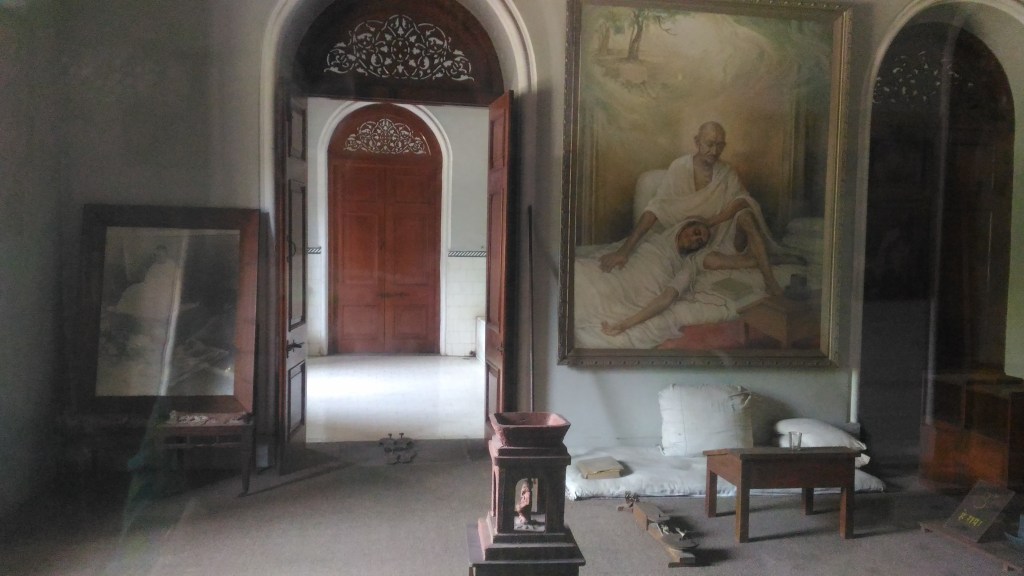
The palace is now a museum with the rooms used by Gandhi, Kasturba and Mahadev open to the public. The rooms are spartan revealing the simple life that its inhabitants lived. A few personal items of Gandhi are on display too – utensils, slippers, clothes and letters. As one enters into the big hall at the entrance there is a large statue of Gandhi. The museum has large paintings which present various aspects of him during the struggle for freedom. There is one that has Gandhi with a begging bowl in front of a big crowd. One image is that of Kasturba lying in Gandhi’s lap, a canvas that presents an intimacy in their relationship. A painting titled “New Hope for Rural India” reveals Gandhi’s engagement with the “Constructive Programme”- a programme that envisaged an agenda for a revolution that would bring about a change in the individual and in society, a programme that Gandhi undertook to prepare the people for a post-independence India. Another painting is titled “A Crusader for Humanity.

The imposing palace has Italian arches and lawns and has five halls. With a magnificent structure, the two storied building has a corridor that encircles the entire building. This building is now the headquarters of the Gandhi National Memorial Society. I recall walking through the building taking in every aspect of it, pausing to observe and note as I move through the rooms and corridor. I remember sitting under one of the large trees and gazing at this building that had been witness to a major part of Indian history. As I revisit the place with words and emotions, in times that are so different, I am reminded of the relevance of Gandhi’s ideals of non-violence in a world that is increasingly becoming violent — in action, in deeds, in words. It is time, to ponder about his ideals that are needed now more than ever.

.

Dr. Nishi Pulugurtha is Associate Professor in the department of English, Brahmananda Keshab Chandra College and has taught postgraduate courses at West Bengal State University, Rabindra Bharati University and the University of Calcutta. She is the Secretary of the Intercultural Poetry and Performance Library, Kolkata (IPPL). She writes on travel, film, short stories, poetry and on Alzheimer’s Disease. Her work has been published in The Statesman, Kolkata, in Prosopisia, in the anthology Tranquil Muse and online – Kitaab, Café Dissensus, Coldnoon, Queen Mob’s Tea House, The World Literature Blog and Setu. She guest edited the June 2018 Issue of Café Dissensus on Travel. She has a monograph on Derozio (2010) and a collection of essays on travel, Out in the Open (2019). She is now working on her first volume of poems and is editing a collection of essays on travel.

.

PLEASE NOTE: ARTICLES CAN ONLY BE REPRODUCED IN OTHER SITES WITH DUE ACKNOWLEDGEMENT TO BORDERLESS JOURNAL. 

Categories
Musings Nostalgia

Vignettes of Life: Unhurried at Haripur

Debraj Mookerjee journeys into the heart of rural Bengal

The perpetually potholed National Highway (NH) 35 going onto NH 34 en route to Assam from Kolkata mercifully trots off on its own as we veer left towards Shantipur in Nadia district after an exasperating three-hour drive from the metropolis. Passing through Phulia where Bengal handloom saris and a prominent ‘red light’ stretch are distinctive, we drive into Shantipur, just short of Krisnanagar. This is ‘klisht’ (difficult) Bangla territory, the area from which Queen’s Bangla, as it were, inherits its diction and tone.

From Shantipur, our sturdy SUV, a TATA Sumo, laden with as much family as it can accommodate, and followed by many other Sumos with much more of the same (family), makes the final left turn to snake the final five kilometres along a narrow lane (well-paved though) towards Haripur, where my ancestors from my maternal stock sunk their roots.

They also started a Kali Puja (a tantric variant of annual prayers to the goddess Kali) some 400 years ago. Kali is perhaps the most well-known of Indian goddesses, having made her way into poetry and song, most notably perhaps by Allen Ginsberg in his Planet News collection of poems, where he compares the destructive powers of the divinity to America’s cruelty towards the world, ironically embodied in the Statue of Liberty! The family may have preserved the tradition since, but the greater truth is that it is the tradition that has held the family together. Traditionalists, believers, non-believers, NRIs, apartment owners in Singapore, hutment dwellers in Haripur, pujari (priests), Bengali middle-class small towners, all somehow connected to the family, gather at the commodious, albeit somewhat ramshackle, house annually to partly pay obeisance to Ma Kali, and partly to charge their souls from the sap that flows up those ancestral roots.

I visit when I can. The visit under the description year marked my third. The show remains more or less the same. What changes is the nature of the attendance. Some are regulars, like those settled in Kolkata or other parts of Bengal. Also regular is the unlikely patriarch, my uncle from overseas, a much travelled, successful and sushi-loving internationalist. He is the star of Haripur. His half-German kids prefer to call the place ‘horrorpur’, but that’s a story we won’t get into. He pours his everything into Haripur, including trying to gather grants from his internationally renowned automobile casting company for the local school. The sight around the house on the morning of Kali Puja is enchanting, with about 200 kids falling over each other to collect one of those famous ‘Garman’ (German) balls. Let me explain this Haripur legend.

Some fifteen years ago, my uncle decided the tennis balls discarded at his tennis club could be useful in Haripur. Thus, began a year of collecting balls of the best make – Slazenger, Dunlop, you name it. Unfit to be used in matches, these were nevertheless better than anything these kids of Haripur had ever used for their game of cricket. These balls are the stuff of many a legend, their fame having spread far and wide. They last a year or more, they have great grip, the woolly fluff layer never really wears off, the bounce is consistent, and they never really pick up too much dirt when used on clay, and so on and so forth. It takes five able-bodied and very committed (I included when I’m there) volunteers to manage the crowd of intrepid cricketers in the making who storm Sovakar Bari (the Sovakar home) — my maternal side goes by the name Sovakar — for these legendary balls. The cousins coo about the lovely lessons their Nike-sporting kids learn from the humbling experience of having to watch these scrawny kids battle with each other for a mere used tennis ball.

I slip away one evening astride of a ‘thela’ rickshaw (fully pulled by the rickshaw driver — the only type available in rural Bengal) in the company of a locally acquired sidekick to watch a football match some two km from the village.

The game is good, save that all the action is on one side, the other having been turned into a veritable lake thanks to an unseasonal downpour. Tickets sell at Rs 3, and there is a 400 strong crowd. But for the rains it would be a 1000 strong. There are snack trolleys lined up just behind the touch line. ‘Ghugni’ (boiled green gram), ‘phuchka’ (puffed hollow patties stuffed with masala infused mashed potatoes) and something I’d never seen before completed the menu.

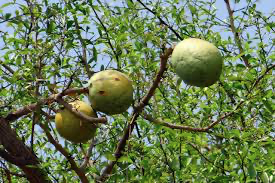
Bael tree with the fruit

The last mentioned is a unique chutney, made by cracking the tough shell of the bael fruit, also called Bengal quince, Indian quince, holy fruit, stone apple, etc, and mixing the green innards with salt, sugar and green chillies (number to be specified by buyer). This is one great chutney and very good for the belly. If village water gives you the runs, the bael fruit guarantees a healthy stop to overenthusiastic bowels.

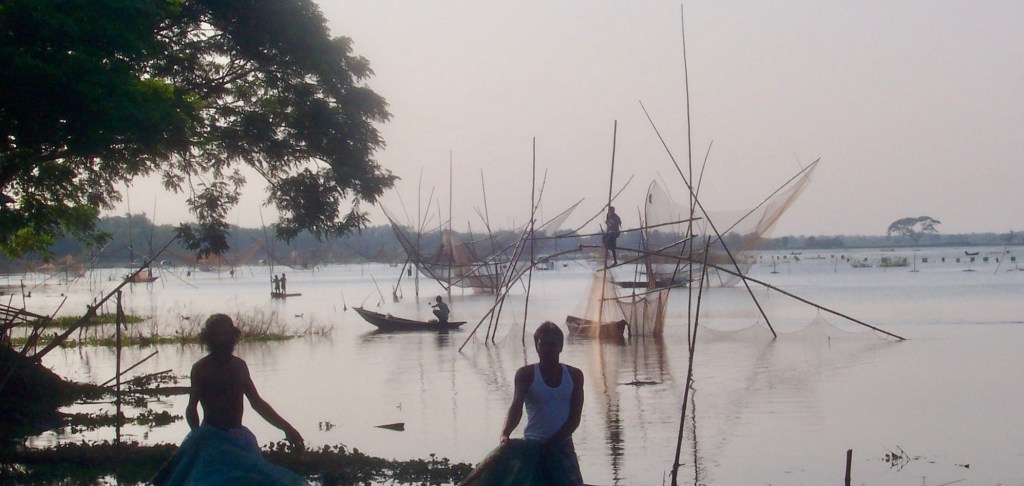
Then there is the waterfront. Actually, there are many. The Hooghly itself is narrower than the Bheel lake, some 500 yards behind our house. There a little fishing community lives along the embankment, with the waters washing into their homes on stormy nights. Tanku Halder is a mahajan (moneylender or simply put, the one with cash to invest) among the fisher folk.  He has a 800-feet long fine net (for still waters), which on a good day can fetch 500 kg of fish from this very lake. And when you consider that a 4 kg carp sells at close to Rs 180 per kilo ($2.5 per kilogram) even to the wholesaler who drops in to lift the catch, you realise these people are pretty well off.

Of course, the one ubiquitous feature of the village is the household loom, the famous rigs where the well-known ‘Shantipuri’ sarees (Bengal handloom sarees have a unique history and celebrated provenance among buyers across India) are woven. Thread spinners make Rs 50 per day, weavers about two fifty (two saris per day at Rs 125 per sari). Of course, the mahajans make the big bucks and live in fancy homes. One wonders why the government has so far not stepped into the business of supplying thread at concessional rates, besides providing design support (controlled by the wealthy mahajans).

The two days surrounding the actual puja are spent in food, festivities and fraternising. The food is good, the festivities enlightening since local stage talent is a revelation, with the stage presence of some simply outstanding, and the fraternising, well, welcome after the hiatus of many years (for those who visit once say in five years, or friends of family dropping in for their first visit; like this year there was this lady who flew in from Dubai to be in Haripur, and a couple, related to some cousin, who, along with their daughter, dropped in from Mumbai).

Forty-eight hours in unhurried Haripur slows your clock down to an almost meditative tick. In these COVID-induced times, time itself is the subject of intense reflection. The torpor of quarantine does the work of a yoga mat. It stretches your mind out flat, receptive to anything happening to drop onto it. Into mine dropped those ‘bael’ fruit from Haripur. And these thoughts sprang out!

.

Debraj Mookerjee has taught literature at the University of Delhi for close to thirty years. He claims he never gets bored. Ever. And that is his highest skill in life. No moment for him is not worth the while. He embraces life and allows life to embrace him.

.

PLEASE NOTE: ARTICLES CAN ONLY BE REPRODUCED IN OTHER SITES WITH DUE ACKNOWLEDGEMENT TO BORDERLESS JOURNAL.
Categories
Musings Nostalgia

Paper Trail

by Julian Matthews

I remember when I was eight or nine, dad bundled us children into the Morris Minor 1000 and drove us to Port Klang. We were sending back a distant relative — an uncle with white hair — to Sri Lanka, an uncle my mother never liked hosting. She cursed him under her breath for being a kanjan,  a word which even I knew back then meant stingy.

But we kids were excited to see the M.V. Chidambaram, an ocean liner, the size of which, we were told, was “several football fields” in length.

We were in good spirits, trying to pronounce the multisyllabic Chi-dam-bar-am with fake Indian accents and exaggerated headshakes, giggling excitedly like schoolboys did when the ice-cream man showed up outside the school gate; despite knowing that two adults and five children in a car no larger than an oven on wheels — and just as hot without air-conditioning — would stifle us to near-death even before we reached our destination. Unlike the Titanic, I thought, there would be no iceberg to end the suffocating mugginess of being squished like proverbial sardines in a tin can with the added ambiguity of a crowing cockerel on it. Perhaps it too was signalling to be freed from its labelling, as if to say: “No chickens in here, just us sweaty fish!”

(Ironically, the ship Chidambaram, which boasted of air-conditioning, was decommissioned a decade or two later after a fire broke out onboard fatally killing some crew and passengers before limping into a port in India)

The journey to Port Klang was uneventful — maybe we stopped for a fresh coconut respite — but what was memorable was turning the corner and gasping at the sheer size of the ship when it first came into view as dad parked the car. We tumbled out in awe.

By size, it was the closest thing to the Titanic, albeit less grand, but colossal by any measure, even bigger than the Seaview submarine in “Voyage to the Bottom of the Sea, a show on our tiny black-and-white TV back then. I wondered, deep within its bowels, if the ship might still contain a Flying Sub that could pop-out and fly, like its name implied, out of the sea and into the sky with the oh-so-cool David Hedison as Captain Crane in the helm.

David Hedison as Commander Crane

I remember my paper-folding skills were quite advanced back then and I could make a flying sub, apart from cranes and sampans, from watching Origami With Robert Harbin every Sunday.

Unfortunately, I was not allowed on board, to find the flying sub, although we did get up the gangplank, like pirates off to a raid,  only to be shooed away for being too small, or maybe, not fulfilling some height requirement — as while boarding a Ferris wheel at a funfair.

 Or, maybe, there were just too many of us and the captain was worried we would cut ourselves with our cutlasses — and fall overboard.

We were reduced to just waving from afar portside to our departing relative — just like at the Subang Airport in the 1970s — but with one exception. I was introduced to the odd tradition of holding onto a roll of toilet paper. Yes, people on board were flinging toilet paper at us, while they held on to one end of the roll, by the ship’s rails.

I was allowed, tentatively by my older siblings, to hold on to a rapidly uncoiling roll as the ship pulled away, making sure it rolled off uniformly — like fishing lines tied to the end of a kite that picks up in the wind — although much more fragile. The slightest tug and it would snap. I held on gingerly until it sped up and reached the roll’s end and, with a final sad tug, did snap. And I watched as other rolls around us snapped, one by one, the ends curling in the wind in almost slow-motion waves signifying the metaphorical link that bound those on land and those on sea were now temporarily cut. With a turn, the giant ship, its foghorn bellowing like a hoarse whale, was gone. We then gathered the remnants of the paper, as I recall, half of it already in the waters, and discarded it at a nearby bin. Or maybe, we were delinquent and just left it. Environmental concerns were not top priority those days.

I was reminded of that tenuous, unfurling link of paper, as we viral-vulnerable humans on spaceship Earth today, hold onto the threads of this unfolding drama before us. Like the ship of those days, Life is floating away, severing our ties to the past and snapping us into a New Norm. Our carefully paper-parcelled lives up to this point, which was always anchored to some reality, even though we indulged in escapist divergences or substance-fuelled partying, are now losing its moorings as days float into weeks and weeks submerge into uncertain months. We are now unravelling like so much toilet paper, untethered from somewhat stable ground, into a surreal journey to unknown ports. Even the onboard entertainment has started to repeat, and the binge-fest of  “free” entertainment has lost its novelty.

There is a quiet panic in the pandemic and I-told-you-so environmentalists are tut-tutting like lizards on the ceiling of our caged abodes, as if to say we are now paying for the sins of decades of single-use waste for all those portside farewells.

Hoarding toilet paper is now shamed online and deemed criminal. Even paper money has been dethroned so much so all delivery must be served “contactless” — as if that were even possible. And we must stand a reasonable six feet away from each other, or two meters if you prefer, the 17.12 additional centimetres making all the difference, or microdroplets will kill us.

We risk collapsing social distances through free Zoom-ing screens, even though we knew all along anything free — free lunch, free email, free wi-fi — always came with strings attached.

We connect relatives at new births, or funerals, through Facetime, changing the paradigm from womb-to-tomb to cradle-to-iPhone-to-iPhone-to-grave.

But when you cry, you still cry alone.

All “meetings” are oxymorons, even though the same persons keep showing up. But at least they aren’t breathing the same oxy-gen. In fact, they never did.

Some of us are on the verge of snapping, for real, and yearn for an avenging glove to restore our old masks. We harbour hopes — outdated pre-snap, pre-pandemic, even pre-pubescent beliefs — like nostalgic fools hanging onto false memories, that things would somehow return to the way it was.

But this ship has left the pier. The ground below us has shifted. The shore has permanently changed.

We look to the stars for navigation but they have faded and lost their lustre. Even the moon has paled and gazes at us and sighs. We can never, ever go back in time to fix the broken promises to ourselves — our fragile humanity — and to Mother Earth who hosts us.

Like that distant relative, we are overstaying guests who have lost our welcome.

We can only move forward by paying it forward.

Nature calls, and yes, we’re out of paper.

Julian Matthews is a former journalist and trainer currently exploring expressing himself in poetry, fiction and essay forms. He is based in Malaysia.

.

PLEASE NOTE: ARTICLES CAN ONLY BE REPRODUCED IN OTHER SITES WITH DUE ACKNOWLEDGEMENT TO BORDERLESS JOURNAL.
Categories
Musings

Racism is not only an American Problem

Teenager Shivam Periwal from Kolkata writes about the recent protests and why there is a lesson for all of us.

Many years ago, the world saw mass bloodshed unravel in the form of world wars. Many people died fighting with other countries for equality, but they were oblivious to the morbid reality of their own country which saw an uproar in mercenaries killing the civilians. 

The thing that they didn’t take into account was the harm that would fall upon their own country. It could cause deaths and unlimited sacrifices. The rich would get richer and the poor would become poorer. 

Years before that, the world saw an increase in slavery as African Americans were oppressed and forced into becoming slaves for the rich, in order to prevent their children from sleeping on a hungry stomach. 

There came a day when the African Americans had had enough and began their journey to freedom. People who were victims of racism wanted just one thing, justice. Everybody was scared and there was nothing one could do. You could either take part in the protest or stay inside your house under the bed or in some sort of bunker. Stores were broken into and small businesses were affected greatly.  

One day all that vanished, when the innocent people who didn’t want war, took a stand. The merciless war ended and unity started to grow. There was  harmony and brotherhood and now people started to think about others. People of all color, caste and creed were treated as equals. 

Now again, the issue has come up due with the recent case of George Floyd who was killed brutally in the US by the police, because of his colour. 

As a teenager it makes me sad to see the unjust killings in every nook and corner of the world. 

The worst affected would be the children learning about racism and its disadvantages. They would feel sorry for this world. And deep down in their hearts they would get the feeling that someday at any given point of time, they might suffer because of racism too.

Instead of having conversations about happy memories, parents have to tell their kids how to protect themselves if they are targeted because of their colour. This can discourage the children and make them feel scared and insecure within themselves.

I write about it today because this is a world issue, not just an American one. 

It is relevant to India too because after all we are a diverse country and despite our differences, of colour, religion, language and caste,  we all have to live together and in harmony at the end of the day.

We have to stay united and beat racism to its deepest core or else it would change the future of this world.

First published in Bookosmia

.

PLEASE NOTE: ARTICLES CAN ONLY BE REPRODUCED IN OTHER SITES WITH DUE ACKNOWLEDGEMENT TO BORDERLESS JOURNAL.
Categories
Musings

Playtime

By Nishi Pulugurtha

I see more of the sky these days. A beautiful blue sky, some clouds here and there. I try to figure the shapes in my head, something that I did as a child. I see the light from the rather dimmed sun endowing the clouds with some colour, at times bright, at others, dull and dim. There seems to be some play at work, the sun, the sky and the clouds. I used to walk in the gated compound that houses my apartment only to be largely disturbed by mosquitoes and other insects. As these creepy crawlies cause an allergic reaction on my skin, I decided that I had to find some other place to walk. A climb up some stairs to the terrace and the discovery of a small, restricted place to walk and an open, sprawling space around me (beyond the walls) and above me — this is where I walk most evenings now.

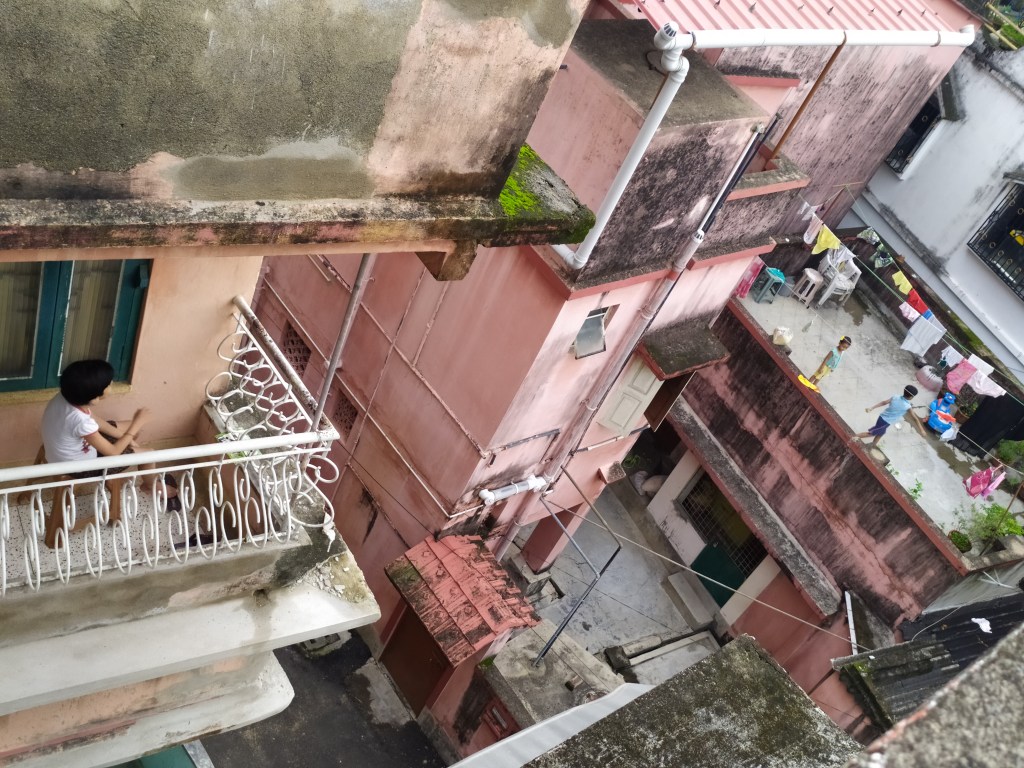
The other terraces around me also seem to have some activity. Just beyond the compound wall are two buildings, yellow and green. I see people there — an old gentleman leisurely walking alone. After some time, a lady joins in on a brisker walk. The old gentleman moves to one side and looks at children playing on the opposite terrace. He has a toy in his hand which he throws. It is caught by the little girl who is out at play. She runs, hops, jumps, and plays. At times she has company, another small one. But mostly, she is there with her father. I see her learning to ride a bicycle. He is there holding on, trying to teach her, reaching out to lend a hand if he thinks she needs help. I am sure she will learn it soon.

The red house next door is usually quiet. As I was looking around, I heard someone calling out my name. I turned to see a young girl of about eight. There was another little one behind here, about two years old. And then I saw their mother and we start catching up. She decided to visit her mother and that is the reason why the quiet house has so much activity now. Moreover, she said that kids were getting restless. She had come for a week, she said. A small break for the kids. Well, not much of a break for the older one, though – online classes were still on. The kids moved on to play. They were not playing among themselves.

Right opposite the red house was another pink one with a terrace adjacent to rooms on the first floor. Two small boys played there each evening – riding a small car, playing with plastic cricket bats, running about and the like. Their mother is a nurse and has long hectic hours. I hear their voices every day, they wave to me when I look out too. I noticed a new game these days with the kids talking across buildings, not just talking but playing as well – the girls in the verandah of the red building and the boys just opposite. I hear their voices, I notice their games too. It is mostly a kind of a dumb charade – the eight year girl mostly deciding on the nature of the game. She is the oldest of the lot.  The girl in the red house enacts a scene and the boys have to guess what it is all about and vice versa. As I look at them at their ‘game’ I find it sad, I smile too. They have managed to find a way to ‘play’. Sad, because their ‘play’ reveals the situation we are in at the present times, stuck in our respective homes, trying to deal with the present scenario.

I am reminded of our games and play too. As kids we played on the road in front of our homes. We ran about, played ‘hide and side’, hiding in lanes, behind houses – we had a particular demarcated zone of play. We had our fights, our quarrels too. Those were days when there were not too many cars on the streets and hence it was safe playing on the street.

We had spectators then too. There would be Pishima* sitting on her tall stool upstairs, her afternoon nap done, with a cup of tea and a biscuit in hand. There would be Bubun’s mother who took an active interest in all what we did, at times even interfering in our play — Bubun was one of our playmates. There would be the Dida* in the opposite house, alone in that big house, looking out and delighting in our play. We played every day, after we got back from school, after our homework was done. As we went on to middle school, we played only on Wednesdays and Thursdays (school was off on Thursdays) and on the weekends.

There would be some weekends when there was no company to play outside, my playmates were off to their grandparents’ place. However, my sister and I played at home, in our long verandah. We managed to keep ourselves busy. Yes, we did complain that all our playmates were away. It was not possible for us to travel to Ammamma’s place on weekends, she was in Kakinada and later moved to Hyderabad. We had to wait for our vacations to visit her – and we longed for that, looked forward to it with so much excitement and anticipation. That excitement of going to Hyderabad still persists in both of us even today.

As I climb the stairs this evening and come into the open, there I see a long cloud, fluffy, a bit dark just behind that skyscraper, almost as if holding it up, supporting it. It remained like that for quite some time. A languid, beautiful scene that filled my senses for quite some time, filling me with a Wordsworthian sense of delight in the simple things of nature. I rest for a while after my walk is done, mostly to take a few photographs of what the city offers me. Tall buildings in the distance, familiar buildings I am able to identify, houses, water tanks, pipes and crows on them, many buildings I am unable to identify. I try to locate the directions as I look around.

The birds seem to be pausing for a while, catching up with their conversations, before heading home, the day done. I notice a few pigeons on a maze of pipes, perched away from each other, almost as if in keeping with the times. The play of the little children continues. I can hear their laughter and talk as I move indoors. As we approach another 15th August, another Independence Day, I just hope that we are able to create a place where these young ones are able to think freely, to give voice to their thoughts freely, to live the way they want to, in a place where “their head is held high”. 

*Pishima – Aunt

*Dida – Grandmother

Dr. Nishi Pulugurtha is Associate Professor in the department of English, Brahmananda Keshab Chandra College and has taught postgraduate courses at West Bengal State University, Rabindra Bharati University and the University of Calcutta. She is the Secretary of the Intercultural Poetry and Performance Library, Kolkata (IPPL). She writes on travel, film, short stories, poetry and on Alzheimer’s Disease. Her work has been published in The Statesman, Kolkata, in Prosopisia, in the anthology Tranquil Muse and online – Kitaab, Café Dissensus, Coldnoon, Queen Mob’s Tea House, The World Literature Blog and Setu. She guest edited the June 2018 Issue of Café Dissensus on Travel. She has a monograph on Derozio (2010) and a collection of essays on travel, Out in the Open (2019). She is now working on her first volume of poems and is editing a collection of essays on travel.

.

PLEASE NOTE: ARTICLES CAN ONLY BE REPRODUCED IN OTHER SITES WITH DUE ACKNOWLEDGEMENT TO BORDERLESS JOURNAL. 

Categories
Humour Musings

Courting Controversies

By Devraj Singh Kalsi

When I read some short stories and found the writer dragged to court for writing bold stuff, I felt that the author created a larger ripple when slapped with a lawsuit. I was fully prepared to face any trial, waiting for a nerd or herd to feel offended and seek umbrage. The glorious phase of my literary career would begin once it gets caught in the legal whirlpool.

While they did not wish to be hauled up or put behind bars for their no-holds-barred writing, there exist a few brats who love to foment trouble at the drop of a hat. If only I could join their folds, the newspaper headlines should scream my name on the front page in bold font and accuse me of writing the most contemptible contemporary fiction. A liberal dose from the libellous story would generate further interest in my writing. Courting controversy would offer me the bliss of joining the august company of iconoclastic — and iconic — authors who served a sentence for writing those profane sentences.  

Despite more than a hundred short stories and articles published in various journals and magazines, not a single reader from any part of the world deemed it fit to charge me with obscenity or something similar. This is shocking and insulting for a writer who claims to command a global readership in the digital age. Forget the new generation of millennial readers, some old fogey somewhere should have pounced on me by now. I did forensic reading of my stories again but failed to gather why the sensibilities were not outraged with the intimate passages contained in them. I began to doubt whether these had been read by the right kind of people. I grew intolerant with the growing level of tolerance among discerning readers.  

I was sure that my content could trigger a wildfire, enrage some religious head or a fanatic to assign a big prize on my head. A new kind of literary prize launched for my prized head that scatters contagious thoughts of ruin. Despite the looming threat to my inconsequential existence, I would remain safe under my sturdy teakwood bed, studying and stirring up fantastic stories with gay abandon. In case the threat mounted, I would shift to my neighbour’s villa for extra security provided by his pets and home guards. Halt the train of evil thoughts and instead focus on lawsuits for the time being.    

I shared samples of short fiction with my conservative friends to create friction, urging them to forward the published links to their relatives and friends, with the fond hope that a case somewhere – even in a remote district court – would be filed against any of those stories. I could then highlight this achievement in the cover letter to the leading publishers who would merrily offer a three-book deal on the basis of the legal tussle, hailing me as the most controversial author in recent times on the book cover in order to launch a marketing blitzkrieg.

Unfortunately, my friends pronounced a favourable verdict. My writing was non-toxic and most unlikely to offend the prickly and hyper types spread across the planet. There was nothing potentially unsafe to mislead the youth, to create rebels or pollute their impressionable minds with dissent. They found my passionate stories layered with a good message in the climax. This relief was a disappointing confirmation that my literary output would never become controversial and sensational.  

I was almost convinced that the rugged path to great writing went through the dense jungles of controversy. I should think of something ahead of the times in terms of plot and narrative in my forthcoming collection of stories. I should ruffle feathers, shake the branches, and strike at the roots to raise a literary storm.   

When I showed the first draft of my new stories to a friend, she said there was nothing mildly, faintly, or remotely controversial. She said she had read bolder stuff and even those pieces were unable to stir any controversy. Becoming a controversial author, she suggested, was far more difficult than becoming a good author. Perhaps the surest way to raking up one was to do something controversial in real life instead of trying it on the pages.  

This feedback received further boost when I was told that I was a timid writer pretending to be a bold one. The person who diagnosed my frailties was my former English teacher and he advised I should give up the romantic notion of becoming a controversial writer as I did not possess that streak. I was advised to write what I enjoyed writing in a freewheeling manner, with large doses of humour.

The sight of a cop at the traffic light scared me. An open window generated fear of thieves and kept me awake the whole night. A person horribly scared of snakes and dogs was most unlikely to show symptoms of bravery on the page. No point visualizing myself being grilled inside a packed courtroom, in front of a battery of lawyers, accused and sued for hurting and offending sensibilities with my writings.  

I re-read some of the authors who hit big-time because their stories took them to court and thence, put them in spotlight. There was nothing derogatory or defamatory in terms of content that made them face the ordeal they did. So, there was a glimmer of hope that a lawsuit does come your way even if there is nothing objectionable or hurtful. Just as the writer is creative in weaving stories, some people turn creative in finding controversial elements. Such critics cross the writer’s path only if they are sure to gain something bigger for stoking it in favour of the wordsmith.

The desire to be hauled up and slapped with a lawsuit turned real and raw when a self-publishing project deal ran into rough weather recently, with the publisher demanding an upfront payment since the pre-orders for my book, despite sending the pre-order links to all my friends, relatives, and colleagues, failed to cross the agreed threshold number of copies. The publisher threatened to sue me for failing to shell out the money and I decided to shoo him away. To save my soft skin and all the vital organs I needed to lead a healthy life, I initiated the cancellation process but the advance paid was forfeited. The harrowing experience of writing an unpublished book and facing legal threats for non-payment jolted me. I realised there is no frisson of excitement in a legal battle as it rattles the mind and affects the writing output every day. The dream of being a controversial author was finally aborted after this nightmarish experience.   

.

Devraj Singh Kalsi works as a senior copywriter in Kolkata. His short stories and essays have been published in Deccan Herald, Tehelka, Kitaab, Earthen Lamp Journal, Assam Tribune, and The Statesman. Pal Motors is his first novel.  

.

PLEASE NOTE: ARTICLES CAN ONLY BE REPRODUCED IN OTHER SITES WITH DUE ACKNOWLEDGEMENT TO BORDERLESS JOURNAL. 
Categories
Musings

Zohra, what if you were my daughter?

By Aysha Baqir

On May 31st 2020, Zohra Shah, an eight-year old domestic worker in Pakistan was beaten to death by her employers. Each year over one billion children across the world experience physical or sexual abuse.

Dear Zohra,

I am sorry you are not Black. I am sorry the police have not released the video of how your employers, Hassan Siddique and his wife Umme Kulsoom, caged you, abused you and beat you to death for freeing a few parrots. I am sorry that no statues fell for you. I am sorry that your murder has failed to free over eight million child workers in Pakistan or over two hundred and fifty million child workers across the world.

Zohra five days before you died, a Minneapolis policeman, Derek Chauvin pushed his knee into the neck of a 46-year-old black man for nearly nine minutes while he pleaded, “Please, I can’t breathe.” George Floyd’s death sparked protests and rage across the country. Tens of thousands of protestors marched into the streets of Minneapolis. The protests spread to over a hundred cities in the United States including New York, Philadelphia and Washington. Within days, the movement Black Lives Matter transformed into a global struggle and protestors surged out in the UK, France, German, Spain and Australia. Gathering momentum, the crowds tore down statues of slave traders and white supremacists. Some of the biggest brands pledged support to the movement, Black Lives Matter. Other companies fired their CEOs and Executives for racist and insensitive remarks. Chauvin has been charged for second degree murder. Some countries, states, and cities forced police departments to ban chokeholds and neck restraints. Many cities outlawed unannounced police raids, known as “no-knock warrants”. The George Floyd’s Memorial Fund raised over 14 M for his family and his GoFundMe page is supported by over five hundred thousand contributors.

George Floyd’s crime was that he bought cigarettes with a counterfeit twenty-dollar bill. Zohra, your crime was that you freed a few parrots. The day after you died, tweets and posts flooded social media. Many even changed profile pictures. A few days later you disappeared from news like the parrots you released.

The Ministry of Human Rights promised reform. However recent tweets hint towards tweaking the out-dated Employment of Children Act, 1991, to include Child Domestic Labour (CDL) to the list of banned occupations (applicable only to Islamabad) while overlooking excluding far more dangerous occupations such as kilns, mines, mechanic shops.  There has been no attempt to change the age of a child from a person who is younger than fourteen years to a person who is younger than eighteen years.  To date thousands of children under the age of sixteen years continue to work in hazardous occupations.

Zohra, I am sorry no media, corporate Mughal or minister took up your cause. Some renowned civil society members organized a protest but less than twelve protesters showed up. There is lesson to be learnt from the family, friends, and community of George Floyd. Are our lawmakers are purposefully silent. Can we steal their silence? What if you were my daughter? Would tears, posts, vigils have been enough then?

Zohra, when I read the news of your death, I couldn’t stop trembling. I shouted at the universe. Stop it. No more. You understand. Enough. Silence. The universe was silent. It had not answers. I had not spoken. The words were inside my head. Biting. Gnawing. And with chilling certainty I knew that the pandemic was not outside, it was within me.

It is easier and more convenient for me to look outwards and to condemn others. It absolves me. But the problem is not out there it’s within me. It is difficult and uncomfortable to look inside because I am part of the problem. I am part of complex social economic system that that perpetuates discrimination, poverty, violence and forces millions of children into forced labour. If I am part of the problem can I even be part of any solution?

Not if I continue to exclude the poor and vulnerable populations from the decision making process and appoint myself as their representative or spokesperson. Not if I continue to excuse the culprits because they are rich, powerful, my friends, friends of friends, or someone or I don’t want to offend. Not if I leave the millions of child labourers to be physically and sexually abused without taking any action. A viable, sustainable and progressive movement rests on the voices of all stakeholders committed to the cause. 

The human rights movement will never progress if the poor and vulnerable are not part of the discussions and consensus building process. Stakeholders working towards human rights must facilitate the poor and vulnerable to be included in conversations about their rights even at the risk of losing their privilege. The goal is development not dependence. The worlds doesn’t need one Iqbal Masih, it needs millions of Iqbal Masihs.  It needs us to protect the Iqbal Masihs.

Some claim that the poor and vulnerable are uneducated and illiterate and unable to contribute towards the right decisions. However, in my over twenty years of working with the poor in low-income communities in the field of development, I have found that majority of the poor are bright, determined, resilient and waiting for opportunities and initiatives to improve their lives.  The uneducated and illiterate argument is an excuse to control and manipulate vulnerable populations and is strikingly similar to the justification of the East India Company and the British Raj to colonize the Sub Continent.

Our actions have a consequence, as does our apathy. Zohra, your future was stolen away from you. But, we still have a choice that can change many futures.

Note: A note of thank you to Mr. Naeem Sadiq for his precise and updated posts of the Zohra Shah case.

Aysha Baqir grew up in Pakistan. Her time in college sparked a passion for economic development. In 1998 she founded a pioneering not for profit economic development organization, Kaarvan Crafts Foundation, with a mission to alleviate poverty by providing business and marketing training to girls and women in low-income communities. Her novel Beyond the Fields was published in January 2019 and she was invited to launch her book at the Lahore and Karachi Literary Festivals and was featured in the Singapore Writers Festival and Money FM Career 360 in Singapore. Her interviews have appeared in Ex-pat Living, Mount Holyoke Alumnae Quarterly, Kitaab, and The Tempest.  She is an Ashoka Fellow. www.ayshabaqir.com

.

PLEASE NOTE: ARTICLES CAN ONLY BE REPRODUCED IN OTHER SITES WITH DUE ACKNOWLEDGEMENT TO BORDERLESS JOURNAL.

Categories
Musings

Lost in the Mists of Time

By Devraj Singh Kalsi

Before I ventured into the choppy waters of publishing and experienced what it means to have a book that sank without a trace, I had a somewhat condescending attitude of ignoring books that failed to acquire readership or impress critics. In the wake of my literary misadventure, I realised I should not feel ashamed of reading or holding an obscure book that nobody in my circle has even heard of.  

Being an unknown author, I have acquired adequate compassion for books languishing in anonymity. Instead of flashing best-sellers, I have overcome the shyness to identify myself with small-time, unknown writers. Now it is comforting to identify with their plight and feel I am also one of their kind.  

This transition happened when I tried something unusual last year. Call it an experiment to shape new thinking, to accommodate divergence, to stir empathy, to reboot my system. I must confess that the entire exercise turned out to be therapeutic in more ways than one.  

Inside a bookstore, I picked up a title lying upside down on the congested shelves, fighting for space to survive in the saturated market. The passport-size colour photograph of the author on the back cover made it look like one of the photographs clicked when he was applying for clerical jobs. As I checked out the year of its publication, it became clear that the title was resting there for more than a year. Some other queries bubbled in my mind. Was this the only copy left unsold? Or was this the only copy in stock? There was no way to know the facts so I had the freedom to imagine what I wished to imagine.   

It must have been a big high for the author when it was formally launched, when it found space on the shelves of the esteemed bookstore. As the failure of finding readers capsized the literary boat, the short-lived euphoria of the gift-wrapped copies stifled his spirits and expectations, pushing him into the morass of darkness, just as quickly as he was brought to public gaze. Left without any choice, he became another suitable candidate for the ever-growing club of authors who exist to launch another struggle to get rid of the stigma of commercial setback after enduring the long struggle of finding a publisher.   

Holding the book without any hesitation was the next step of boldness. An unfamiliar strength coursed through the hands as I began to rummage it. I felt overjoyed with this liberating and cathartic act – unable to recollect having done something noble of this kind before. While other readers around cherry-picked best-sellers and recommended titles, I held this one in my hands and continued reading it with seriousness. I was not conscious of the reality of reading an obscure book. If there was no sense of pride, there was no sense of guilt or shame either.  

After reading a few pages, I understood that readability was not the reason why the author failed or why the book collapsed. Probably the marketing apparatus was responsible for its dismal fate. Such mishaps do happen from time to time – almost forgotten like accidents that do not make any significant difference.

I imagined being a source of pleasure for the author who found no readers or very few readers. If he found me here reading his work, he would be thrilled to spot a live reader right in front of his eyes. I did think of clicking a photograph with the book and mailing it to the publisher who would hopefully forward it to the author. Maybe this small act to cheer him up would stimulate him and make him feel that his book actually created some difference in the life of a reader. Maybe, he will then pick up the pen and bangs out another book. I could be that spark to ignite his passion to write.   

I proceeded to the sales counter and the cashier gave me a strange look while trying to understand my choice. He appeared close to suggesting I should seek the assistance of sales staff. Without looking up, he said this title offered no discount. He billed me and dumped the copy on the desk without offering a carry bag. Before leaving, I asked him whether this author had any other release. He did not check the computer or bother to respond to my query.

I came out flashing the new purchase and planned to give it more visibility. I entered a nearby café and occupied a strategic spot from where it was possible to see the book cover. When nothing worked, I placed it on the table beside my cup of coffee, hoping the young couples seated nearby would cast a fleeting glance, raise a polite query or seek to hold the copy in hand out of curiosity. An hour passed. My best attempt to give exposure to the unknown author failed.

After coming out of the café, I took a bus and sat with the copy on my lap. The same response disappointed me and I returned home with a heavy heart. In the next few days, I read the book in the balcony. Then I displayed it on the tea-table in the living room, hoping that my guests would pick it up to read or at least flip through it. Perhaps the plain cover did not evoke interest. 

A week later, I posted the book cover on my social media handles, highlighting it as my current read. Only a few close friends and relatives pressed the like button without posting any comments. Finally, I donated the book to the public library in my neighbourhood — with the hope it would find some readers here.

Almost a month later, I ventured there and asked the librarian how many people borrowed the title to read. He was unwilling to dampen my spirit and said he had read it and found it nice. His words of fake praise did make me feel better and I thanked him warmly, behaving like the author of the work he had read. Such close identification with an anonymous author transformed my way of thinking, making it more collective in nature. I felt a sense of relief that I had done something good –- even if it was trivial for an unrecognized author completely unknown to me.   

Earlier, I loved to rummage through best-seller or recommendation sections inside bookstores. Now I realise how authors hire marketing and PR agencies to give traction to their books – both offline and online. As a result, I have lost interest in picking up such titles unless a reliable source refers it to me. I am far more comfortable browsing unknown writers from the shelves, looking for an occasional good pick that compels me to read beyond the first page. 

.

Devraj Singh Kalsi works as a senior copywriter in Kolkata. His short stories and essays have been published in Deccan Herald, Tehelka, Kitaab, Earthen Lamp Journal, Assam Tribune, and The Statesman. Pal Motors is his first novel.  

.

PLEASE NOTE: ARTICLES CAN ONLY BE REPRODUCED IN OTHER SITES WITH DUE ACKNOWLEDGEMENT TO BORDERLESS JOURNAL.