Title: Turmeric Nation: A Passage Through India’s Tastes
Author: Shylashri Shankar
Publisher: Speaking Tiger Books
Shyalashri Shankar is an academic whose third non-fiction, Turmeric Nation: A Passage through India’s Taste, won a woman author’s award in India called the AutHer Award (2021). This book is a detailed and rich journey through India’s multiple cuisines and culinary cultures divulging interesting facts like Aurangzeb was a vegetarian.
In the literature of food writing, we have both advocates of diversity, food fusionists as well as food fashionistas. Shankar’s approach is fairly eclectic and informed, drawing on the anthropology and sociology of both food and the cultures they originate from. Professing to write a “food biography” of India, she also realises that such a task is both “challenging and daunting”, given the magnitude and diversity of the task involved. She describes Indian cuisine as layered and pluralistic, where there is no one cuisine which can be described as ‘Indian’. Her book proceeds to map these regional diversities not only in food and food cultures, but also cooking styles.
Giving veritable gastronomic glimpses into the fascinating world of the great Indian kitchen, Shankar explores food histories of ancient India dating back to Harappans, while keeping a keen eye for networks of customs, habits and styles of living. From time to time, the cuisine has absorbed new methods of food processing and cooking and been hospitable to new and foreign influences. At the same time, it has at times exerted injustices since the sociology of food is shown to be intricately linked to the that of the caste as shown in the section on Dalit foods. Shankar rightly refuses to mythify or romanticise food, instead she refers to social anthropologist James Laidlaw’s notion that nowhere in the world are food transactions socially or morally neutral, and that the politics of and around food are probably the sharpest in South Asia.
She draws from the theories of ethnologist Claude Levi-Strauss, who, she argues, analysed different cooking techniques to put forward an influential structuralist idea of the raw and the cooked. Food, according to this theory, is a medium between nature and culture. The activity of cooking performs a process of civilising nature.
Shankar asks more fundamental questions: Did our ancestors determine the way we eat? What is the DNA of food preferences? Which is a better diet — vegetarian, non-vegetarian or paleo (what Is paleo)? Does food have a religion? What food creates ardour and desire? What are the transgressions and taboos on certain kinds of foods? What is the purpose and function of certain rituals around food — for instance, the logic of feasting and fasting? As Shankar takes us on this fascinating journey of culinary exploration, we see the emergence of a rich map of cultural anthropology.
Turmeric Nation is an ambitious and insightful project which answers these questions, and then quite a few more. Through a series of fascinating essays—delving into geography, history, myth, sociology, film, literature and personal experience—Shylashri Shankar traces the myriad patterns that have formed Indian food cultures, taste preferences and cooking traditions. From Dalit ‘haldiya dal’ to the last meal of the Buddha; from aphrodisiacs listed in the Kamasutra to sacred foods offered to gods and prophets; from the use of food as a means of state control in contemporary India to the role of lemonade in stoking rebellion in 19th-century Bengal; from the connection between death and feasting and between fasting and pleasure, this book offers a layered and revealing portrait of India, as a society and a nation, through food. It takes us on a fascinating culinary journey through the length and breadth of the subcontinent.
The proof of the pudding, many might feel, is in the eating. Why such a learned dissertation on food, gastronomy and culinary traditions? Is it ultimately to map unity, diversity, and work towards an idea of syncretism? Either ways, the book is worth keeping on our shelves and stocking in libraries, swelling the corpus on food studies which is now studied as an important part of Cultural Studies in many universities. The book ultimately gives us much food for thought as it theorises the practices of cooking and eating across Indian cultures.
.
Dr Meenakshi Malhotra is Associate Professor of English Literature at Hansraj College, University of Delhi, and has been involved in teaching and curriculum development in several universities. She has edited two books on Women and Lifewriting, Representing the Self and Claiming the I, in addition to numerous published articles on gender, literature and feminist theory.
.
PLEASE NOTE: ARTICLES CAN ONLY BE REPRODUCED IN OTHER SITES WITH DUE ACKNOWLEDGEMENT TO BORDERLESS JOURNAL
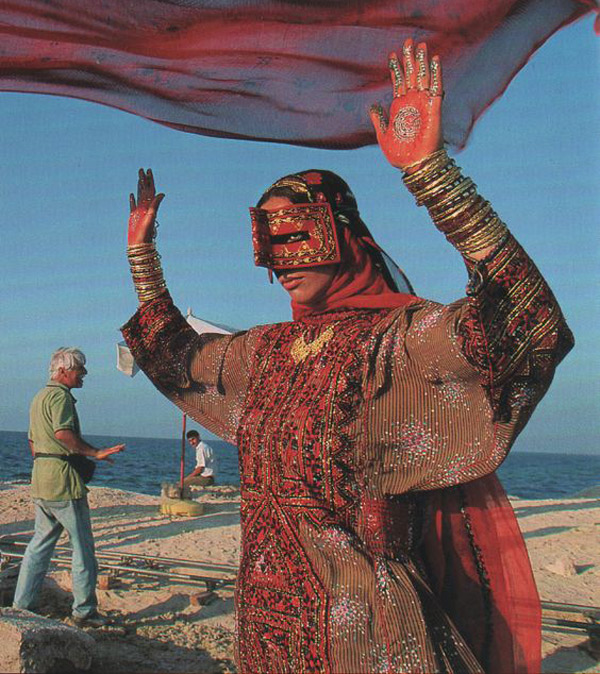
As a Baloch girl when I walk into a room full of people, what outwardly attracts them is my cultural Balochi attire. I often get compliments from people telling me how beautiful and enthralling our Balochi dresses are. I remember once this lady came up to me in an international fair to photograph me for her magazine-project because of the way I was dressed – in a traditional Balochi dress. I have heard it more than enough times about the beauty and creativity of Balochi dresses, but regrettably, those compliments never really got into a point where we could discuss the people and hardwork behind those dresses.
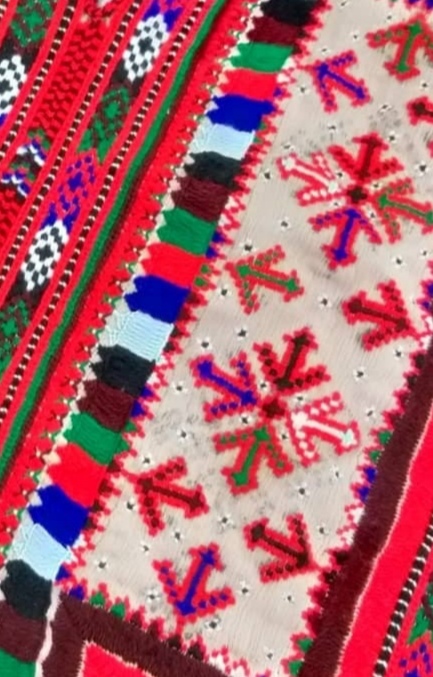
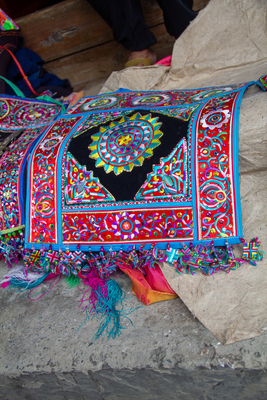
Balochi dresses are the result of utmost passion, hardwork and dedication. The professionals who make Balochi dresses are called ‘dochgir’ in the local Balochi language, and they are the key reasons behind these breathtaking outfits. They make these dresses out of scratch without technology and other resources. They make up their own designs by doing a lot of experiments and end up making something creative and later name it as per their convenience and the structure of the ‘Doch’ (embroidery).
Luckee, a tremendously diligent and hardworking woman in her mid-forties from a village named Saami (Makran, Balochistan), is one of the reasons that I had to write this piece. Her story, unlike any other person I have come across, is rare. Even though, most of the embroiderers are Baloch women who sew dresses to support their families financially, but Luckee’s story is unusual.
In tribal Balochistan, the means of livelihood is either agriculture or livestock. The lives there are very primitive, far from technology and present-day facilities. Baloch women have sewn dresses for centuries for the upkeep of their families, helping their male counterparts from within the house. The handicraft skills of the people of Balochistan are ancestral, passed on from generations.
Dochgirs not only sew or doch (embroideries) in their own villages but travel near and far to make these dresses from almost anyone especially those who they are familiar with already. A few months ago, I got a chance to have a conversation with Luckee about her life and I was amazed with what she shared with me.
The tale of agony, striking poverty and lack of platform for Baloch dochgirs was so gut-wrenching to know from the one already suffering with it. “I was married to a man who didn’t earn. He was a drug addict,” she continued with grievance. “I got divorced after undergoing domestic abuse from my husband.” Long before even Luckee got divorced, she was the only one in her family working and earning. “I have no option, even till today, but to sew dresses and raise my two sons,” states Luckee.
The village of Saami, where she lives, has drastically reduced the population since the past years. The Nawabs and Gichkis who have ruled these places for years, have moved to cities long ago except few of the families. “The only people who haven’t moved out of the village are those who cannot afford to live in big cities – people like us,” she shared, “I used to live with my other family members in their house, but the space was inadequate as my older son got married. So I had no chance, but to buy a cheaper house from someone who no longer lived in the village,” she added. The house she bought is shabby, but gives her a shelter and she is grateful for that. “I had to work hard to sew many Balochi dresses to get money for a committee to buy the house. I still haven’t paid the total amount of my home,” said Luckee, her eyes filled with tears.
When I asked her about the education of her younger son, who passed his 10th grade, her words gave me shivers down to my spine. “Don’t you know about the inflation in the country?” she asked, to which I replied, “Yes, I do, but I’m also well aware of the fact that without education you cannot improve the lives you are living – in poverty and ignorance.”
Her reply was quick and truly upsetting to hear from her own words, “Education is expensive. It is for the rich ones. We barely manage to find meals of our day. With an empty stomach, you cannot think of educating your children, but feeding them,” she also added, “I wish my son could go to college and become a great person after 10th grade, but we cannot afford it.”
In a resource-rich province like Balochistan, the people are enduring poverty in a way that for them two basics of life, food and education still remain the biggest hurdles of life.
Balochistan is a home of arts, culture and creativity. It is very unfortunate to know that the baseline of the creative works; dochgirs, regardless of the efforts they put into their work, rarely manage to find adequate sustenance. Creativity takes courage. Every Baloch dochgir puts their heart and soul in their embroidery work, but sadly their hardwork is not compensated by enough returns.
It is about time that these dochgirs should be given the opportunities and recognition that they deserve. Our government should take steps to promote art and culture in the country and make policies that provide dochgirs with a platform to showcase their talents and skills to a wider community. Hardworking people like Luckee deserve to be given chances to flourish with their handicraft works which deserve coverage, for it is worth it.
Tilyan Aslam belongs to Turbat, Baluchistan who has recently got admission in Quaid-e-Azam University, Islamabad. She has been actively writing since 2019 on various social and gender issues, cultural and travel blogs in different newspapers such as The Daily Times, Balochistan Point, Balochistan Express, Balochistan voices , The Baloch News and some other local websites.
.
PLEASE NOTE: ARTICLES CAN ONLY BE REPRODUCED IN OTHER SITES WITH DUE ACKNOWLEDGEMENT TO BORDERLESS JOURNAL
My Father’s Last Smile

The rain has returned to the city.
Puddles are forming on the road
And children are running in joy.
Kidding along, I play with them

Until I suffer from a coughing fit.
Unsteady, my heart starts flipping
As I sit there amid woeful eyes,
And in the blur could hear sounds afar

Of birds singing and me darting
With my father feigning to catch me.
I could see his blurred outlines
Coughing and sitting holding his heart.

I was laughing and he smiled at me.
He never talked about his failing health,
As more and more often he got nailed
To his bed, but his smile was intact.

The street was getting busy,
Yet, living with this everlasting memory,
I walked back to my home infused
With the last smile of my father’s love
Anchored to the silence of my heart.
Pramod Rastogi is an Emeritus Professor at the Swiss Federal Institute of Technology (EPFL) in Lausanne, Switzerland. He is a Member of the Swiss Academy of Engineering Sciences. He is the 2014 recipient of the SPIE Dennis Gabor Award. He is currently a guest Professor at the IIT Gandhinagar, India.
.
PLEASE NOTE: ARTICLES CAN ONLY BE REPRODUCED IN OTHER SITES WITH DUE ACKNOWLEDGEMENT TO BORDERLESS JOURNAL
Kalaw was tourist hub at the edge of Inle Lake, with its attitude of holiday resort and its air of clean crisp quality. The indigenous Shan people live predominantly in four main cities around the lake, including Kalaw where we were staying, in the numerous village along the lake’s shores, and on the lake itself. The last two days of our stay along the way to the former capital Rangoon gave us the opportunity to enjoy what the lake had to offer. For our two-day excursions on and around the lake, we boarded a long, narrow hand-made boat of teakwood, painted black and powered by a small motor in the back. The lake itself was quite large, covering nearly 45 square miles, giving ample opportunity for long, leisure rides in the early morning and late afternoon, while in between, we spent much of the day visiting the local sights on the lake itself.
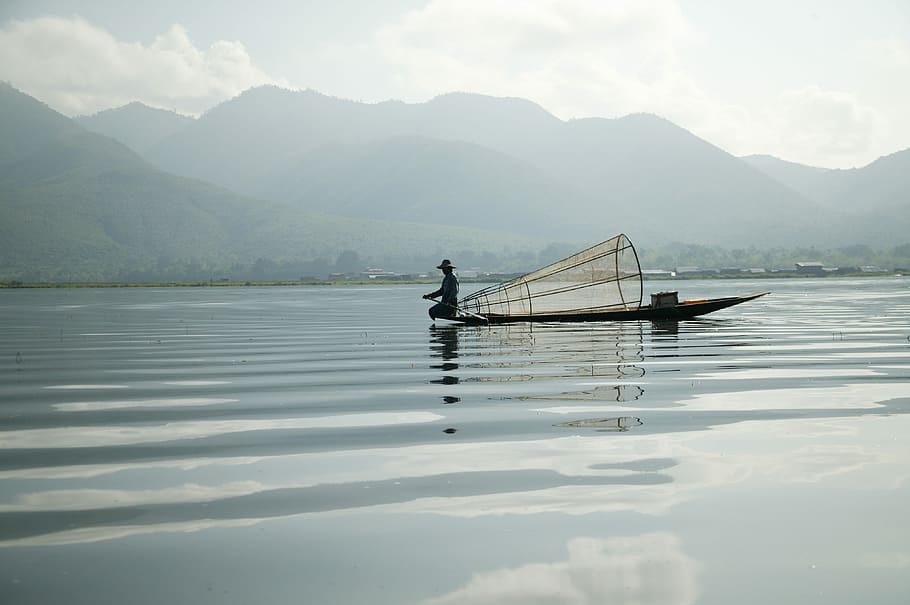
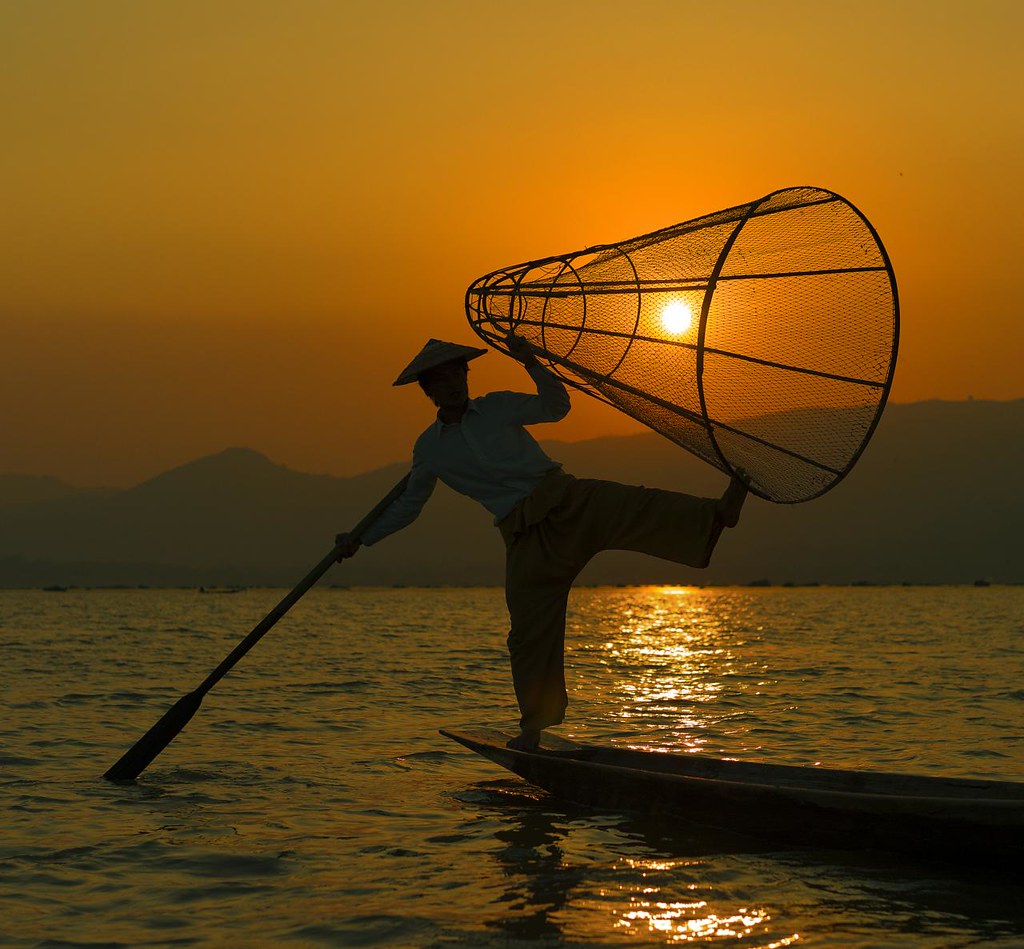
The first morning on the lake took us on an extended ride deeper into the expansive waters. You can see local fishermen fishing there. They live on the lake. The local Burmese fisherman are known for practicing a distinctive style of rowing. They stand on one leg on a small platform in the stern of their long fishing boat, similar to the boat we were riding in, while they wrap their other leg around the single oar as they steer and make their way along. Together with the tubular distinctive fishing nets that lay along the bow of the boat, the fisherman, dressed in their sand-coloured baggy pantaloons tied at the waist with a rope and their white cotton/linen shirts and triangular straw hats that provide mercifully ample shade, offered a picturesque sight as we sped by in our own boat on our way deeper into the interior of the lake. I couldn’t help but think when I saw them again on the way back into Kalaw late in the afternoon just before sunset, that it must have been a long, tedious day indeed, alone out there on the waters, rowing in slow motion with their single foot and finding what fish they may that would provide them with a livelihood for them and their families. I was touch by the nobility, the simplicity, the hardship of the scene, a stolen glance into the lives of others that exotic travel sometimes provides.
Further glimpses into the local culture and way of life as we stopped around noontime at a textile factory that stood in the middle of the lake surrounded by other houses, all built of teakwood and bamboo and rising out of the waters on stilts. Throughout our journey overland heading south from Mandalay on the way to Yangon, we had a number of opportunities to visit handicraft and textile shops in order to gain a deeper insight into how these handicrafts are born and worked by the local people. I would like at this point to focus on the textile industry, but before going into the details, let me make passing mention the intricate and incredibly fine and detailed work done by the local people in creating woodcarvings, lacquerware and silverware. The wood carvings are traditionally made from the softwood teak, a high-quality of wood found in abundance throughout the country. The unique art of this craft is handed down from father to son.
I stood in wonder before these young men and women sitting cross-legged on the floor as they meticulously and with great care carved scenes of mythical creatures, deities, fruits and flowers on panels, frames and doors as if it were second nature to them. Such focus and patience that called for these artisans to work throughout the long day from eight in the morning until five in the evening with breaks only for tea and lunch was amazing. They worked with such intimacy between the mind, the hand and then applied to the texture of wood. To watch them work gave an insight into how a work of art is born through not only sheer skill, but also with the devotion and love for the craft that has been handed down generations. Similarly, I went to a lacquerware factory where individuals sat in rows working through the various stages of production of the cups, jewelry boxes, vases and combs, all constructed from bamboo and horsehair, that make up an exquisite repertoire, all finalised in the colourful intimacy of hand-painted scenes from the sap tapped from varnished trees into works of art with all the delicacy of lace.
I am not that interested in precious stones and wear no jewelry, but if you are, then exotic Burma is the place to go. Rubies and sapphires are popular, but jade is the stone most abundantly available. One can easily pick up an exquisite bracelet or necklace for under $10. Of special interest were the beautiful parasols that are so characteristic of old Burma. The parasol is considered a necessity when heading out onto the street to protect oneself from the sun. In Myanmar, many still favor the traditional style, made with bamboo (for the frame and handle) and cotton, which is stretched over the bamboo frame and then decorated with a hand-painted traditional Myanmar design. It is very common to see monks carrying an orange version of the parasol as they go through the streets on their morning rounds with their begging bowl in hand.
As much as I would like to describe in meticulous details all the handicraft shops I visited while in Burma, I will focus my efforts on my experience visiting those textile shops where I climb the wooden stairs from off the dangerously swaying, hand-crafted boat that led up into the inner sanctum of the textile “factory” standing on proud stilts upon the waters of the lake. I place the word factory in quotations marks because it was like no other factory ever visited or ever will visit.
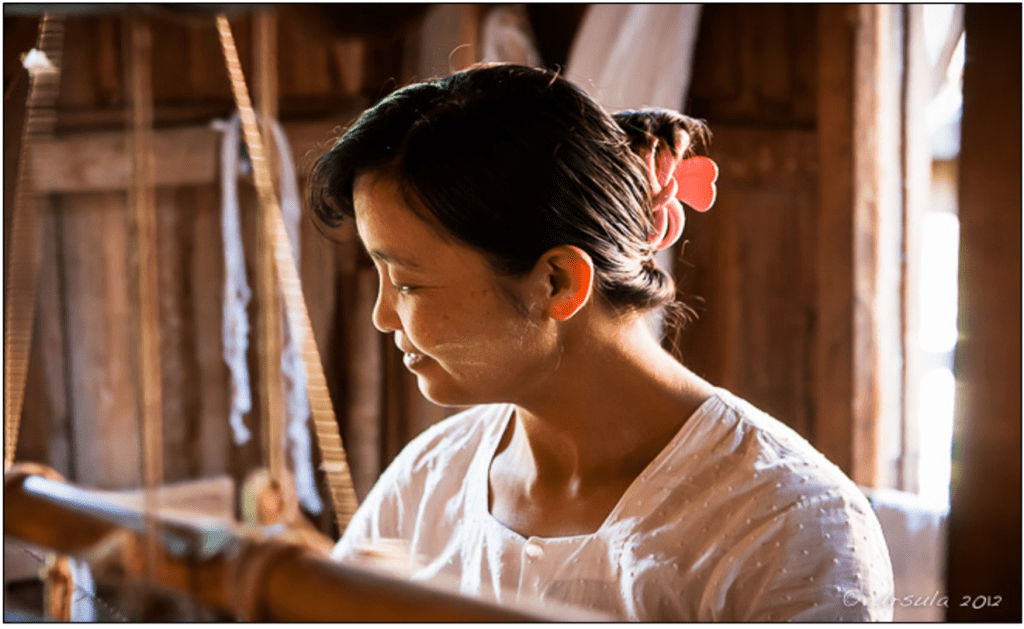
You hear the looms that create these fabulous textiles before you see them — the clear, punctuated sound, the steady beat, the rhythmic sense that something is happening, something is being made. Then the door opens to looms, row after row, casting thin shadows in the late afternoon winter sunlight. The wooden structures seem primitive, skeletal, and yet they are designed to perform and in performing produce minor miracles in the shapes and textures of cloth which are vibrant enough to take on a life that is born of pure art. It took me some time to understand for I had never seen a loom up close before. The spinning wheels of fairy tales were a part of my imagination, but never a part of my reality. Now I stood in the midst of mythical looms from which the fabric of the universe has been created, at least in principle, a loom that could have been in the distant halls of the Greek gods.
There was a seat before the loom and the weft and the warp were drawn by strings up and down and across, moving threads cast in coloured dyes that could have been spun by black forest spiders or perhaps sea snakes from the deep blue. How I loved the whole business of it! I stood there spellbound, unconscious of Peter, the guide, the light and shadows of the room, the wayward dust motes in the air, only this vision of infinite patience. The rhythms of the multiple looms created an exotic and mesmerizing melody of perfected industry. The simplicity and skill of the crafted machine came together to produce a lasting image. There it was, the smell of the wood, the shush of the shuttle, the satisfying way that weft stacks upon weft and the waft intermingled to create this single unity of fabric.
Photo Courtesy: John Herlihy
As I said, a simple wooden seat stood before the loom and upon the seat sat a simple Burmese woman, middle-aged bending forward with slight elegance as if in protection of her loom. Her hair jet black and oiled were pulled together into a bun with a wooden hair clip. The hands of the woman steady and sure, the mind of the woman focused and clear, the face of the woman detached and enduring. This was a labour of love in its finest moment. I stood there — spell-bound, conscious of the moment that would pass, but to be forever etched in my mind as a lasting memory, a moment in time that will never fade. Later, we saw the finished products, filled with colour and light, as though cast down from the rainbows of heaven to shine of glory in their own right. I took away with me a piece of fruit of the loom, in the form of a lotus scarf, made from the thread-like sap drawn from the stem of a lotus flower, a valued treasure that I will keep until my end of days.
Photo Courtesy: John Herlihy
*
In 2006, the Myanmar government established the modern capital of Nay Pyi Taw, north of the former capital Yangon, formerly more commonly known as Rangoon. We reluctantly left the serenity of the Lake Inle and Kalaw for the airport for a short flight down to Yangon for the final several days of our trip. In the heart of downtown Yangon lay the remnants and reminders of the old 19th century colonial style city that has come to be known in the former British colonies. The British seized Rangoon and all of Lower Burma in 1852-53 during the Second Anglo-Burmese War. On the afternoon of our arrival, after checking into our hotel, Peter and I were able to take advantage of enjoying the look and feel of colonial Rangoon as we walked through the spacious parks and lakes, the old colonial buildings, the Parliament and the old Railway Station. The city name, meaning “the end of strife” was once called “The garden city of the East.”
Photo Courtesy: John Herlihy
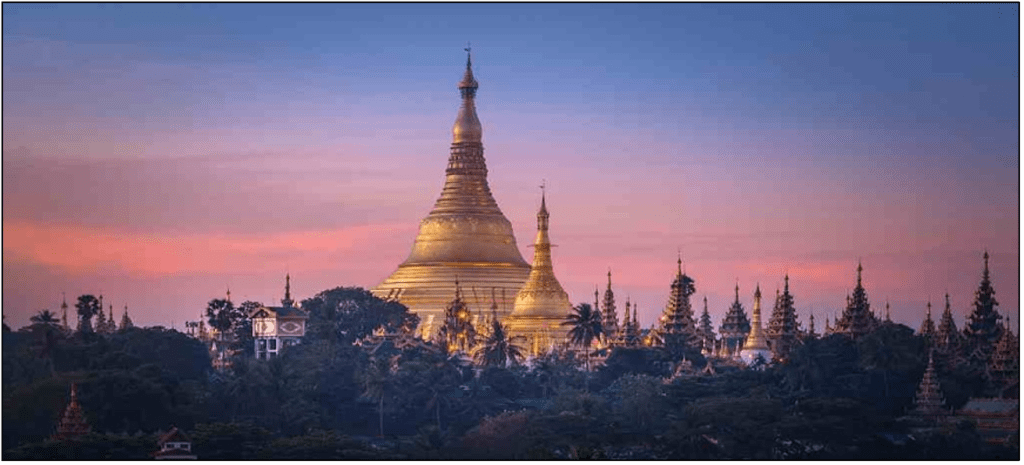
On our last full day in Yangon, we took the opportunity of visiting the famed Shwedagon Pagoda, the Golden Dagon Pagoda, a gilded golden stupa that dominates the skyline in downtown Yangon. Built upon a hill in the center of the town, the golden umbrella dome atop the stunning pagoda shone brilliantly in the crisp winter sunlight. Conveniently, we rode multiple escalators up to the citadel at the Eastern Gate to the enclosure. The most sacred Buddhist Pagoda in Myanmar, it is believed to contain relics of the four previous Buddhas of the present kalpa (an extended cycle of time). Not surprisingly, the extended area in the shadow of the golden dome was crowded with people, tourists mostly from Asia, especially China, and locals from other parts of Myanmar who come to visit as a pilgrimage. The place was also crowded with monks draped in their signature orange monastic robes. I enjoyed how much they seemed to like taking group photos of each other, pushing and shoving just as all young people do everywhere in the world.
At this point, I was perhaps suffering from pagoda-fatigue, sitting image and reclining Buddha fatigue, and yet one cannot help but be caught up in the drama, the sacredness and the mystery of the moment, walking through the grounds that have survived wars and pestilence across the millennia. Historians and archaelogists suggest that the pagoda was built by the Mon people between the 6th and the 10th centuries. However, according to legend the Shwedagon Pagoda was built more than 2,600 years ago, making it the oldest pagoda in the world. The stupa’s pedestal is made of bricks covered with gold plates. Above the base are terraces that only monks and other males can access. Next is the bell-shaped part of the stupa, followed by what is called the turban, then the inverted alms bowl, the inverted lotus petals, the banana bud and finally the umbrella crown. The brown is tipped with 5,448 diamonds and 2,317 rubies. Immediately before the diamond bud is a flag-shaped vane. The very top – the diamond bud – is tipped with a 76 carat (15 g) diamond!
After strolling around soaking in the exotic ambiance that has endured for centuries across the ages under the light of the sun and moon, we finally made our way over to an elaborate enclosure that housed a monumental bell, many times the size of Peter, reminding me of the cracked Liberty Bell on view in Philadelphia! The Maha Gandha (lit. great sweet sound) Bell, a 23-ton bronze bell cast in 1779, was carried off by the British with the intention of shipping it to Kolkata, but because of its abundant size, it fell into the river instead. When the British failed in their attempts to recover it, the local people offered to help provided it would be restored to the stupa. Divers sent down and tied hundreds of bamboo poles underneath the bell and floated it to the surface where the massive ornate bell was safely return to the stupa and now sits in all its glory in a pavilion in the northwest side of the pagoda platform.
On the final night of our stay, in search of our last dinner in Yangon before leaving Myanmar the next morning, Peter and I ambled down a side street in back of our hotel in Chinatown wondering where to eat. At first, the street was quiet and subdued, with little coffee shops and bars invitingly bedecked with red Chinese lanterns. We saw in the distance the street illuminated by overhead fluorescent lighting and larger crowds of people. We soon arrived to see little open-air restaurants spilling out onto porches, sidewalks and the street, with plastic tables and little stools filled with all sorts of people eating dumplings, noodles and fried rice expertly with their chopsticks. It all looked so inviting, I motioned for Peter to stop. After all, so many people couldn’t be so wrong about their choice of where to dine, especially these locals. Peter moved on, undoubtedly thinking of the days at the beginning of the trip and the nights spent going to the bathroom. But his appetite had returned “with a vengeance”!
Then I saw it, at the edge of the curb, tucked in amid the seemingly ravenous diners and pedestrians: a make-shift steel barbeque grill with six sizzling fish spread forth in abandon upon the flaming hot coals whose smoke wafted into the air as well as into my nostrils. I looked down to get a closer look, only to be met by the restaurant’s owner, making gestures of invitation to come inside and sit. I looked inside and saw an empty table amid the crowds. “Is this river fish,” I asked, thinking of the river we had walked alongside earlier in the afternoon. “Yes, yes, li-li-liver fish,” he replied eagerly, having characteristic trouble pronouncing the Western R. “How much,” I growled, deadpan, not wishing to appear the green-eyed tourist. “Six thousand kyat,” he said and smiled. You may recalled what I wrote at the beginning of this tale, that one dollar represented 1,500 kyat. A quick mental calculation told me that this glorious jumbo fish, bursting out of its skin, sizzling in its own juices and cooked to perfection, the fish skin singed to a crisp golden-honeyed brown, cost a measly $4, a bargain, a steal, by anyone’s reckoning. “Peter,” I cried, pointing to the inviting delicacy, “could anyone ask for better than this. Peter turned up his nose, sniffing: “Will it make me sick?”
“How,” I cried, “no herbs or spices, just the freshest possible fish ever.” Against his better judgement, Peter was sorely tempted I could see, and finally agreed with a resigned shrug. “Trust me, Peter, nothing will happen, and you will love this.”
We had drinks and finger snacks until our two fish finally arrived sizzling and steaming in their own juices, “Let’s take a picture,” I suggested, but Peter looked down at my fish more closely with a frown. “Your fish is bigger than my fish,” he said in earnest. “You can have my fish, Peter, no problem, be my guest. You can have the bigger fish and some of mine as well. After all, I could never eat all of this.” And that was our final night, there in Chinatown, in the backstreets of 19th century Rangoon, where people eat fresh fish to their heart’s content as pigeons sit patiently in rows on electric wires overhead as the street cats of Yangon made ready for their own feast.
Leave-taking comes far too soon. As the great leviathan of the plane responded to the lift of the wind, I looked down one last time at the countryside below. I was remembering the great rivers that I had ridden upon, that wound like snakes through the forested landscape speckled with stupas and pagodas, golden domes shining in the sun, the majestic lakes where people lived over the placid waters on stilts that rose their wooden houses with walls of woven bamboo into the blue of the sky, the black wasteland of mountains that huddled like sleeping animals wishing to be aroused into wakefulness, exuding a peacefulness to accompany the surrounding silence of the emerald forests, where only the wind could stir its silent heart with its whispers. I was remembering the people, the stoic, rounded faces, the street-smart, good-humored guides who took care of us as they would take care of their brothers. They too still whisper their greetings and their farewells in thankful gratitude that we had come to visit, and they had had the honor to lead us through the heart of their homeland.
The journey could be at an end, but the adventure of travel will never finish. It lies there within the mind and heart as a desire to escape from oneself, to let the world reveal itself, to go to places people have never gone before, from the edge of the mind to far beyond the horizon of the world. The pagodas, stupas and temples of ancient lore now a living part of a shared experience, where distant cultures come together in the same way that strangers come together to become friends. Farewell Mandalay — once the mirage of dreams, now the very stuff of a never-ending journey leading to new destinations and new climes, where the sun shines and eagles roam under ancient blue skies, where travelers like me roam across the earth under Heaven’s infinite dome.
John Herlihy, travel writer and poet, has published two collections of travel essays, Journeys with Soul and his more recent Distant Islands and Sealight, available at online booksellers and Amazon.
.
PLEASE NOTE: ARTICLES CAN ONLY BE REPRODUCED IN OTHER SITES WITH DUE ACKNOWLEDGEMENT TO BORDERLESS JOURNAL
A Moment of Rest

I feel for those
who do not get
a moment of
rest. I have been
in that place so
often I do
not know if rest
will only come
when I am dead.
Those you love who
do not love you
back will put you
deep in your grave
while they keep up
their bad habits.


Rainfall

I take refuge in the falling rain.
It falls only for me.
The raindrops fall on my head.
I find comfort in rainfall.

In the absence of rain, I take joy
in solitude.  I walk
softly and quietly like the dead.
I find comfort in anonymity.

I rely on luck and decent health to
keep me carrying on.
I hope to remain standing.
I can’t stand for falling.

I find power in the word or words
that save me from a life
I do not intend to live.
I go back to the rain.


Do You Really Want to Talk to Me?

Before we get to conversing
and you begin sermonising
you need to know that I have
died for your sins and that
I am followed by the sun.

That means the sun is always
the shadow behind my back.
Do not look into my eyes
because I have the devil in
my eyes and I can take your soul.

Before you begin to speak
take all my words under deep
contemplation and ask yourself
do you really want to talk to me?

I can do anything I want is all
you need to know. I do not want
to see you or to go to court to
talk to some judge about my mind.
Luis Cuauhtémoc Berriozábal is a Mexican-born author, who resides in California and works in the mental health field in Los Angeles. His poems have appeared in Blue Collar Review, Kendra Steiner Editions, and Unlikely Stories.
.
PLEASE NOTE: ARTICLES CAN ONLY BE REPRODUCED IN OTHER SITES WITH DUE ACKNOWLEDGEMENT TO BORDERLESS JOURNAL
The gears shifted and the spacecraft rose, then hovered. It was well-known that the most dangerous parts of space travel were the take-offs and landings. Eva adjusted her seat belt and stared at the window opposite, ignoring the rest of the crew strapped in all around her. She could still see the green of the secondary forests and the long winding brown of the Sarawak River. The settlements were tiny but linked by the roads and the zig zag of the aerial highways, human activity stretched out for as far as she could see. This was the reason after all, for the journey.
When she woke in the morning, Eva’s eyes were crusty with tears that had seeped down her cheeks. She didn’t have to look in the mirror to know that her eyes were puffy; her head was pounding as if she were suffering from space travel sickness. Her nose was blocked, and she breathed in deeply through her mouth. She felt like she had just emerged from a swim in the sludge of the Sarawak River with a crocodile on her heels.
The news screen by her bed was still on and she saw that the newscasters in their speech bubbles were continuing to wax eloquently over the return of the latest Space Shuttle to the landing station near Mount Santubong.
“Good morning, Sarawak! And how is everyone this fine day in the Land of the Hornbills?” called out the one-time state athlete turned newscaster.
“Wishing you fresh air and a healthy morning, this wonderful Malaysia Day!” chimed in his partner with her long black tresses and chirpy, lilting voice and endless smile.
Eva closed her eyes. She could see the crew, feel the wobble as the spacecraft hovered. But that was in the simulation. The training had gone well, until just before they were to board and take off for the future, for the New World. Every one of the crew had been given the antigen test. The tickle in her throat that morning and not being able to taste her breakfast – the warning signs had been clear, but she had tried to ignore them. But now, she could not ignore the two lines that had formed on her test kit.
“Sorry, Eva,” the team’s doctor had told her as he signed the form that grounded her to the Earth. The dimpled Ai-Lyn with her buffed up physique and genius IQ had taken her place.
Who would have known that fate was to deal her – simple, hard-working Eva – such a hand?
That wobble, that slight hesitation, the look on the faces of the crew. All these were etched in her mind. Eva had trained with the crew, been on multiple simulations preparing for the real take-off and for the real life on the Spacecraft Endeavour and for the real life that awaited on the newly discovered Planet with Two Moons.
In her dreams, she replayed the scenes, but always, always she woke before the moment when the spacecraft disappeared from the plotted flight path and when there was just silence instead of cheerful voices on the communication channels.
Like the mysterious MH370, the Spacecraft Endeavour had disappeared like a brilliant comet flaring and then blanking out in the night sky.
Eva got out of bed.
She wasn’t sure, but in her dreams, she had known that something had changed.
.
Christina Yin is a lecturer at Swinburne University of Technology, Sarawak Campus. Her fiction and nonfiction writing have appeared in Anak Sastra, e-Tropic, New Writing and TEXT Journal, among others.
.
PLEASE NOTE: ARTICLES CAN ONLY BE REPRODUCED IN OTHER SITES WITH DUE ACKNOWLEDGEMENT TO BORDERLESS JOURNAL
THE PSYCHOLOGIST SAID

“You have a high IQ,”
declared the psychologist
and I misheard
and thought he said “haiku”
which surprised me very much.
“Where is it?” I cried
in a panic and he laughed
as he replied, “Inside your head,”
and I clutched my skull
in both hands and tried
to understand how a short and
exquisitely pithy poem
had ended up in there.
Back home I stared
in the mirror but saw
nothing out of place on my face
and no lumps on my skull.
I hope for my sake that
the psychologist was mistaken!

               Japanese pressure
           waiting to burst on paper—
               haiku in my head.


LASSI COME HOME

I had a drink
made from yoghurt and spices
and fruit. So cute
it was! and I loved that
beverage like a brother, but times
were hard and I was poor
and I couldn’t pour
anymore of that delicious liquid
down my throat.
I had to sell it to a wealthy Duke.

Away it went
and I never expected to see it
again until we
both were heaven-sent after our
demise. How unwise
a notion! for this potion was loyal
to me and escaped
it’s aristocratic prison and made
it’s way across the land
back to fill the glass
in my hand.

Come home, Lassi.
Lassi, come home.
Rhys Hughes has lived in many countries. He graduated as an engineer but currently works as a tutor of mathematics. Since his first book was published in 1995 he has had fifty other books published and his work has been translated into ten languages.
.
PLEASE NOTE: ARTICLES CAN ONLY BE REPRODUCED IN OTHER SITES WITH DUE ACKNOWLEDGEMENT TO BORDERLESS JOURNAL
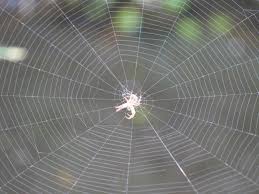
The Spider Web

Two wind chimes hang in the balcony.

Between them, a spider's web,
a delicate existence of gossamer spun sugar
glistening in the sunlight

Yesterday, it survived a storm.
being thrown this way and that, violently swinging
yet
refusing to fall completely apart

Imagine, trusting in such unstable things

And thinking of

making a

Home!
Vijayalakshmi Harish is a writer, poet, and the author of Strangely Familiar Tales, a self-published collection of short stories. Her work has previously been published in various online journals.
PLEASE NOTE: ARTICLES CAN ONLY BE REPRODUCED IN OTHER SITES WITH DUE ACKNOWLEDGEMENT TO BORDERLESS JOURNAL.
These weren’t the first rains. When did it rain first on Earth? The simple lines that the black-eyed girl could speak to herself was “it drizzles in August and rains in September”. It was less intricate to hide that big mole on her left arm, bulging out and eyeing the clouds, just like the notorious seven-year-old herself, prodding Mumma’s palms, for the ‘last’ mud roll!
She knew that mud roll wasn’t the last one. Childlike pleasures were more pleasurable when forbidden. And she knew that wasn’t a mole but a birthmark. Her parents never taught her how to make boats, how to jump on a puddle and splash mud water on the handsome red sports car. The sports car owner complained but he saved his paan (betel leaf) spitting stories inside the car itself. Years after the same car would be emitting flashes and sparks in a car repairing stores.
She visited the car repair store while it was raining heavily outside. The poorly shackled asbestos had non-stop tip-tip drips of rain water. Her nicely blow-dried hair had rolled into a big round bun, with humid drops of sweat all around her face. As she waited, she remembered …girls are meant to mend into difficulties — reiterated by the puckered smiles of her granny.
True, she thought for a while. The repair store had flashes erupting when a man with blue uniform welded a jagged piece of metal. For a while, she stepped on a dirty plastic cover, with rain water out of fear. The lightning streaked into the shop perhaps. Suddenly the sky turned violet and thunder swept through the black clouds. She saw a few girls, with knotted frocks and skirts, playing in a rainwater puddle. Running boats, moulding the clay, patting a frog.
“My parents never taught me what are rains…” she spoke to herself with audacity. All they taught was how to search for candles for that ‘Great Indian power cut’ or wear rain coats when your bus stop is still far away. What do parents teach children, to be a child lock in this big world?
Those two hours inside the store was a medley of sweat, flashes and the never-ending rain. The girls had watches with them, they looked at it and walked straight like a flock of birds assembled in an ant’s kingdom. Their line was like the one in her school assembly. They walked off and were suddenly lost to view.
She took out her scooter keys, as if she was heading out for a mission. She got some hair clips on the way. She found a big hostel, gated in front of a boarding school. She had run away as one escapes from an exploding crater of a volcano. She ran away from boarding school this way, ten years before.
She wove stories of her Granny’s ageing.
She had known by instinct when it rained. Rains were a product of water cycles; a learning from environmental science textbooks but she never knew that rains were deeply nuanced.
She touched her birthmark, now doubly bold in her diary and blogs as moles were also a product of staying at home and gazing at rains as if it were an intruder.
The next time it rained, she went out, wearing a pink kurta. The one she purchased during the Diwali Mela, a big maroon bindi from her mother’s dressing table and piece of paper from her sister’s classwork copy. She made boats, but ran inside when it started dashing on the green creepers. Her boat was floating.
Garima Mishra is a student pursuing her bachelors in microbial sciences in University of Delhi. She writes in English and Odia.
.
PLEASE NOTE: ARTICLES CAN ONLY BE REPRODUCED IN OTHER SITES WITH DUE ACKNOWLEDGEMENT TO BORDERLESS JOURNAL
Time

Time is a strange entity, you can't see it,
But it shows you a lot, you can't sense it,
But it teaches you a lot.
Time heals many wounds,
Frustrates some beyond healing.
The best time to act is now,
For yesterday is writing on water,
Tomorrow written on clouds,
Only today is written on solid walls.
Ashok Manikoth was born in 1956 in the coastal city of Visakhapatnam in Andhra Pradesh, India.Ashok is now residing with his family in Dubai, UAE.
.
PLEASE NOTE: ARTICLES CAN ONLY BE REPRODUCED IN OTHER SITES WITH DUE ACKNOWLEDGEMENT TO BORDERLESS JOURNAL










 Borderless