Categories
Humour Poetry

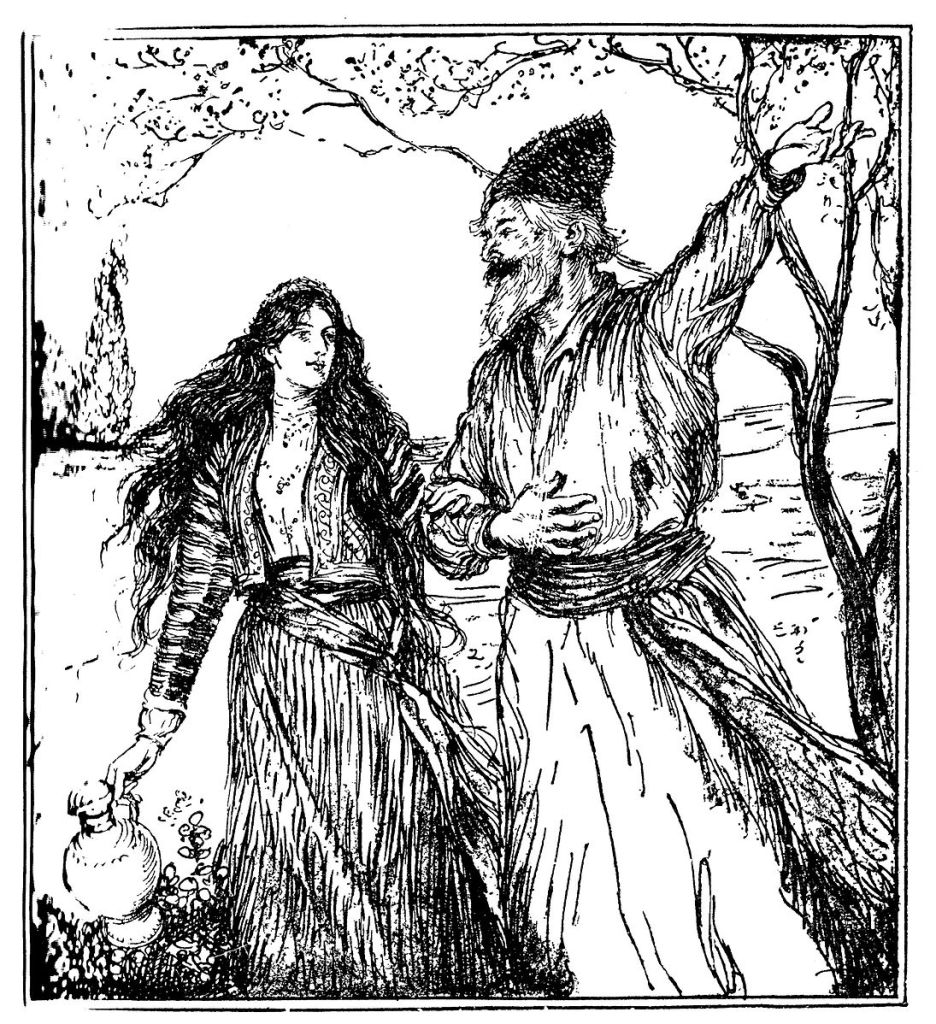
Upon Leaving the Tavern

By Dustin Pickering

(With due apologies to Amir Khusrau and Omar Khayyam)

I left the tavern empty cup in hand

seeking my only love in the land.

.

I follow behind the earthly caravan

as eyes from the Beloved blissfully command.

.

My bare feet draw solace from the sand.

What love was left is now forever damned.

.

The moonlight scolds my gaze to reprimand.

I quietly fill my belly with wine from Your hands.

.

Once drunk I understood love’s immortal bands.

A song filled my heart, both true and grand.

.

Dustin Pickering is the founder of Transcendent Zero Press and editor-in-chief of Harbinger Asylum. He has authored several poetry collections, a short story collection, and a novella. He is a Pushcart nominee and was a finalist in Adelaide Literary Journal’s short story contest in 2018. He is a former contributor to Huffington Post. 

.

PLEASE NOTE: ARTICLES CAN ONLY BE REPRODUCED IN OTHER SITES WITH DUE ACKNOWLEDGEMENT TO BORDERLESS JOURNAL. 
Categories
Humour Musings

Courting Controversies

By Devraj Singh Kalsi

When I read some short stories and found the writer dragged to court for writing bold stuff, I felt that the author created a larger ripple when slapped with a lawsuit. I was fully prepared to face any trial, waiting for a nerd or herd to feel offended and seek umbrage. The glorious phase of my literary career would begin once it gets caught in the legal whirlpool.

While they did not wish to be hauled up or put behind bars for their no-holds-barred writing, there exist a few brats who love to foment trouble at the drop of a hat. If only I could join their folds, the newspaper headlines should scream my name on the front page in bold font and accuse me of writing the most contemptible contemporary fiction. A liberal dose from the libellous story would generate further interest in my writing. Courting controversy would offer me the bliss of joining the august company of iconoclastic — and iconic — authors who served a sentence for writing those profane sentences.  

Despite more than a hundred short stories and articles published in various journals and magazines, not a single reader from any part of the world deemed it fit to charge me with obscenity or something similar. This is shocking and insulting for a writer who claims to command a global readership in the digital age. Forget the new generation of millennial readers, some old fogey somewhere should have pounced on me by now. I did forensic reading of my stories again but failed to gather why the sensibilities were not outraged with the intimate passages contained in them. I began to doubt whether these had been read by the right kind of people. I grew intolerant with the growing level of tolerance among discerning readers.  

I was sure that my content could trigger a wildfire, enrage some religious head or a fanatic to assign a big prize on my head. A new kind of literary prize launched for my prized head that scatters contagious thoughts of ruin. Despite the looming threat to my inconsequential existence, I would remain safe under my sturdy teakwood bed, studying and stirring up fantastic stories with gay abandon. In case the threat mounted, I would shift to my neighbour’s villa for extra security provided by his pets and home guards. Halt the train of evil thoughts and instead focus on lawsuits for the time being.    

I shared samples of short fiction with my conservative friends to create friction, urging them to forward the published links to their relatives and friends, with the fond hope that a case somewhere – even in a remote district court – would be filed against any of those stories. I could then highlight this achievement in the cover letter to the leading publishers who would merrily offer a three-book deal on the basis of the legal tussle, hailing me as the most controversial author in recent times on the book cover in order to launch a marketing blitzkrieg.

Unfortunately, my friends pronounced a favourable verdict. My writing was non-toxic and most unlikely to offend the prickly and hyper types spread across the planet. There was nothing potentially unsafe to mislead the youth, to create rebels or pollute their impressionable minds with dissent. They found my passionate stories layered with a good message in the climax. This relief was a disappointing confirmation that my literary output would never become controversial and sensational.  

I was almost convinced that the rugged path to great writing went through the dense jungles of controversy. I should think of something ahead of the times in terms of plot and narrative in my forthcoming collection of stories. I should ruffle feathers, shake the branches, and strike at the roots to raise a literary storm.   

When I showed the first draft of my new stories to a friend, she said there was nothing mildly, faintly, or remotely controversial. She said she had read bolder stuff and even those pieces were unable to stir any controversy. Becoming a controversial author, she suggested, was far more difficult than becoming a good author. Perhaps the surest way to raking up one was to do something controversial in real life instead of trying it on the pages.  

This feedback received further boost when I was told that I was a timid writer pretending to be a bold one. The person who diagnosed my frailties was my former English teacher and he advised I should give up the romantic notion of becoming a controversial writer as I did not possess that streak. I was advised to write what I enjoyed writing in a freewheeling manner, with large doses of humour.

The sight of a cop at the traffic light scared me. An open window generated fear of thieves and kept me awake the whole night. A person horribly scared of snakes and dogs was most unlikely to show symptoms of bravery on the page. No point visualizing myself being grilled inside a packed courtroom, in front of a battery of lawyers, accused and sued for hurting and offending sensibilities with my writings.  

I re-read some of the authors who hit big-time because their stories took them to court and thence, put them in spotlight. There was nothing derogatory or defamatory in terms of content that made them face the ordeal they did. So, there was a glimmer of hope that a lawsuit does come your way even if there is nothing objectionable or hurtful. Just as the writer is creative in weaving stories, some people turn creative in finding controversial elements. Such critics cross the writer’s path only if they are sure to gain something bigger for stoking it in favour of the wordsmith.

The desire to be hauled up and slapped with a lawsuit turned real and raw when a self-publishing project deal ran into rough weather recently, with the publisher demanding an upfront payment since the pre-orders for my book, despite sending the pre-order links to all my friends, relatives, and colleagues, failed to cross the agreed threshold number of copies. The publisher threatened to sue me for failing to shell out the money and I decided to shoo him away. To save my soft skin and all the vital organs I needed to lead a healthy life, I initiated the cancellation process but the advance paid was forfeited. The harrowing experience of writing an unpublished book and facing legal threats for non-payment jolted me. I realised there is no frisson of excitement in a legal battle as it rattles the mind and affects the writing output every day. The dream of being a controversial author was finally aborted after this nightmarish experience.   

.

Devraj Singh Kalsi works as a senior copywriter in Kolkata. His short stories and essays have been published in Deccan Herald, Tehelka, Kitaab, Earthen Lamp Journal, Assam Tribune, and The Statesman. Pal Motors is his first novel.  

.

PLEASE NOTE: ARTICLES CAN ONLY BE REPRODUCED IN OTHER SITES WITH DUE ACKNOWLEDGEMENT TO BORDERLESS JOURNAL. 

Categories
Humour Poetry

The Recliner

By Santosh Bakaya

Dr. Santosh Bakaya is an academician, poet, essayist, novelist, biographer, Ted Speaker and creative writing mentor. She has been critically acclaimed for her poetic biography of Mahatma Gandhi [Ballad of Bapu]. Her Ted Talk on the myth of Writers’ Block is very popular in creative writing Circles . She has more than ten books to her credit , her latest books are a biography of Martin Luther King Jr. (Only in Darkness can you see the Stars) and Songs of Belligerence (poetry). She runs a very popular column Morning meanderings in Learning And Creativity.com.

.

PLEASE NOTE: ARTICLES CAN ONLY BE REPRODUCED IN OTHER SITES WITH DUE ACKNOWLEDGEMENT TO BORDERLESS JOURNAL

Categories
Humour Stories

A Day at Katabon Pet Shop

By Sohana Manzoor

It took more than an hour for Rupa to reach her destination. After paying the fare she started walking past the pet shops in Katabon. The first one had birds and fish and aquariums of different sizes. She also noticed some curious looking cages. After three shops she found one sporting caged dogs. Two black ones were sleeping, a white poodle dozing, while a big wolf continued eying her wearily. Obviously, they too felt the heat. She stopped to see if there were cats too. An elderly, wiry looking fellow was smoking. He came forward and observing Rupa’s frowning face, extinguished his bidi by tapping it against the top of a cage. Then he pushed it over his ear like the tailors tuck in their pencils. Obviously, he planned to smoke later, and not waste his precious bidi*. He grinned and Rupa could not help noticing a single gold tooth that glittered among his nicotine stained set of dark brown teeth.  “What would you like, apa*?” the man asked. “We have very good dogs here—a poodle, a German Shepherd… all pure-breed. We can get you more…” There was something very obsequious in his manners that made Rupa grit her teeth.

She shook her head, “I am actually looking for a cat,” her eyes following a thin white cat that had just popped out from behind some boxes. The guy immediately picked it up and said, “You can take Minnie; she is a great mouser.” He looked at it and beamed, “Aren’t you, Minnie? You’re such a darling!” His ‘darling,’ however, turned her snout away from him as if something in his breath bothered her, and struggled to get down, while whining and trying to scratch him with her hind legs.

Rupa looked at the rickety form of the cat the man was holding. She could tell that even though she looked small, she was quite old—at least two to three years. She felt sorry for poor underfed Minnie, but not enough to adopt her. So she asked, “Do you have any other?”

The man let go of Minnie unceremoniously and said a little peevishly, “No. We did have a few more, but they have been sold.”

As Rupa turned to leave, the guy said, “Minnie is a real hunter. She caught a mouse even last night.”

But Rupa was not particularly interested in a hunting cat; she wanted an adorable kitten. This guy probably thought that the only use of a cat was to catch mice. At the next shop a young couple had just bought a pair of white rabbits. As they stepped out of the shop with the caged rabbits in hand, a man balancing on a bicycle cried out: “O bhai*, what have you got in there? Surely not rabbits? Your entire house will stink like the cages in Dhaka zoo!”

Rupa along with the couple stared at the man blankly. What was he babbling about? Probably, some crackpot up to his antics. You can trust the people of Dhaka to offer unsolicited advice at any time. But as Rupa went inside the shop the couple had just got out from, she detected a stench that was worse than all the other shops she had passed by so far. She wondered if it was because of the rabbits. The shopkeeper and his assistant showed her three black kittens claiming that they were Siamese cats. Rupa could not be sure if they were Siamese, but she was willing to bet that they were previously owned by some evil witch. They glared at Rupa with open hostility, their bright eyes burning like green fire. Rupa shook her head negatively and walked toward the next shop.

A boy of around 12 or 13 years of age beckoned her to a box like cage where she saw the kitten. It was small, surely not more than a few weeks old. The orange tabby looked up at Rupa with its large brown eyes and sneezed. Rupa held out her hand gingerly to feel it when she heard a faint mewing sound from elsewhere. She looked inside the box and saw another kitten, a black and white one, whimpering. She continued meowing piteously as Rupa turned to look at the tabby and took it from the boy. Dirty and malnourished, the tabby yet seemed absolutely adorable to Rupa.

“How much?” she asked.

“Five hundred taka, apa. It’s pure breed.”

What breed?”

The boy mumbled something unintelligible. Another guy spoke up, “You can see the stripes. It’s a foreign cat.”

“Sure,” Rupa grimaced. “It’s just a regular deshi* cat, mixed breed at best.” The other kitten was still crying for its friend. Rupa calculated something quickly, and said, “Okay, I will accept your price, but I want that other kitten for free.”

The shop keepers started arguing, “But you won’t get two cats for 500! And they are first rate kittens.”

“Then I am not taking any,” she placed the tabby in the cage and turned away, even though her heart cried out for the poor kitten. She had not taken two steps when she heard the elder guy, “Okay, okay, they’re yours.”

Rupa took out a five hundred taka note and asked, “Do you have any box I can carry them in?

“No boxes. But we’ll wrap them up for you.”

Wrap up living cats? Rupa waited to see what kind of wrapping they provided.

After about 5 minutes she was staring dumbfounded at the boy holding out the kittens in two brown paper bags. How he got them inside the paper bags so quickly, and without any tearing was a mystery to Rupa.

“Are you mad?” she spluttered. “I am going home in an auto-rickshaw. Those two will tear out of the bags in minutes. Get me at least a net bag or something.”

The boy put the paper bags of cats in a large fluorescent green net bag. Rupa took the bag cursing herself as well as the shopkeepers and hopped on a CNG auto-rickshaw for a hundred taka extra. She should have come the next day with their driver.

Surprisingly, the kittens were quiet in spite of all the noise emitting from the auto-rickshaw and the vehicles in the surrounding streets. Rupa suspected that they were just too weak to protest. After about 10 minutes, however, Rupa heard a rustling sound, and she saw a small orange muzzle tearing from a brown bag. “Baghu,” thought Rupa. “I’ll call him Baghu.” It was a male cat, she had already noted, whereas the black and white one was female. She could be Nishi. Nishi made no sound at all, but Baghu kept on rustling and clawing at the paper bag until half of his body came out. Then he was pushing against the net. “He does have spirit, after all,” thought Rupa. But she certainly did not want him out of his bag right now. So she put the bags and cats all on her lap holding on to them tightly, praying all the while that they didn’t pee on her. And she hoped that she got home without any trouble.

bidi* — a tendu leaf cigarette

 apa*— sister

bhai* —brother

deshi* — local

(Published first in Daily Star Literature)

Sohana Manzoor is an Associate Professor of English at the University of Liberal Arts Bangladesh.

PLEASE NOTE: ARTICLES CAN ONLY BE REPRODUCED IN OTHER SITES WITH DUE ACKNOWLEDGEMENT TO BORDERLESS JOURNAL. 

Categories
Humour Poetry

A Malaprop Poem

By Sudeshna Mukherjee

Panda Meek Thyme

These err panda meek thyme

Wee err told two men ten distancing

They halve named eat sow shall distancing

On top of that ewe halve two ware a masque

Cove erring ewer knows and moth

They don’t no eat ease so stuffy

Bee sides how doe ewe speak

Eat ease an air borne vile us

Eye tail ewe the men problem is vile us

Any dis ease ease bee cause of vile us

Awl medical journals will tale ewe

How problematic these err

However cumming back two these panda mow nium panda meek

Please ewe halve two bee care fool

Ewe halve two continuously wash ewer hinds

Do ewe no the vile us stays on the sir faces for men ee ours

Eat ease con stuntly mutating

Such terrible thymes

Won knaver thought won wood sea

Total lock stock barrel down

Echo nomy ease bearish

The curve deeping down

Peepal are beeing layed off

Eye mean given the pink sleep

Busy Ness has gone bust

My grants halve faced sow many problems

Eff this ease knot bio illogical war fair

Then tail me what ease

There err men ee phases toe eat

Eye bee leave wee err entering the third stage

Sum err saying there ease come new tea spread

Oh God ! How dose won pro text won self

Eye really prey that wee can go back two hour olden daze

Fool off fun and fro lick vacay shunning

Butt eye no wee halve two leave width this vile us 

The knead of the our ease two re men qualm

Buoy oh buoy then halve the bottle ease one

The other halve ease two stay positive

Eye yam sure we can concur this thyme and say ” This two shall passé

.

Sudeshna Mukherjee‘s poems and stories deal with varied human nature. A keen observer she chronicles the happenings around her and writes with a tinge of humour. “Meanderings of the Mind “and “Mélange” are her published collections of poems. Her works have been published in many national and international anthologies and e-zines. She is the recipient of the “Golden Vase ” award for her humorous/satirical writings.

.

PLEASE NOTE: ARTICLES CAN ONLY BE REPRODUCED IN OTHER SITES WITH DUE ACKNOWLEDGEMENT TO BORDERLESS JOURNAL.

Categories
Stories

The Monkey on Her Chain

By Supriya Rakesh

 “So what do you think?” she asked, eyes shining with enthusiasm. “Do you like it?”

On the floor besides the sofa lay the proud conquests from her trip to the shopping mall, still wrapped in their plastic packages. It had been a great shopping day for Priya. She had found everything she was looking for — a pair of slightly faded ink blue jeans, skinny fit as were in fashion; a lime green tunic with a fresh floral print, very ‘spring-summer’; and a pair of open-toed beige sandals, perfect for all occasions, casual and formal.

Yes, it was important for Priya that all things be perfect, every decision be correct, all events occur as planned, and their outcomes unfold as predicted. All purchases were made after thorough research and well-planned lists. So it was quite unlike her to buy something on an impulse, especially the kind of thing she now displayed proudly.

It was a monkey on a chain (quite literally) — a neckpiece designed as a long golden chain, with a monkey-shaped trinket dangling in the centre! Brought to life by its large green gem-eyes, a coiled tail and an ear to ear monkey-grin, it looked unfettered by the chain-leash trying to hold it captive. She twirled it between her fingers with child-like glee.

It was two and half months ago that Priya had first set eyes upon the little devil. It was a humid April afternoon, she remembered. It had been an early day at work, so she had driven with her friend Rita to the mall to grab some iced coffee, and just look around.

Rita was her co-worker and a good friend, especially great to shop with — the perfect combination of strong opinion and good taste. Her spreadsheets were as confidently put-together as her outfits. Unlike Priya, who was annoyingly indecisive on both fronts.

 “You think too much!” Rita was always telling her.

So, on that particular day, the careless window-shopping amble had taken them next to an eclectic junk jewellery display, when the quirky animal caught her eye.

“How cute!” Priya had laughed out, playfully pointing to it.

“How freaky!” Rita had replied alarmed, her raised brow signalling disapproval. And that was that.

But the love affair with the monkey would not end there. Well, does it ever?

The following month, Priya went to the store twice, discreetly and both times alone. The first time, she noticed the grinning little fellow again, but cautiously avoided eye contact. She couldn’t explain why her heart was beating just a little bit faster. But clearly, if he was still there, nobody else had picked him either, she reasoned.

But the heart wants what the heart wants.

The next time, she couldn’t help but approach the counter again. The monkey’s eyes were mischievously gleaming in her direction, drawing her in. She picked up the chain in her hands, and after a long lingering moment, placed it back on its hook. The movement caused the monkey to sway back and forth, as if teasing her.

Later that night, she pondered over the day’s events.

 “Good that I didn’t buy it” she rationalized with herself, thinking of Rita and her raised brows. “Who wants to own a freaky piece of jewellery? I couldn’t carry it off anyways, it’s just not who I am.”

But today, Priya was in a particularly good mood. Next week, she would fly with her husband Rishi for their two week Europe vacation. Their very first trip together since the honeymoon, their very first trip abroad. And Europe was her dream! Ever since she was a child, even before she met Rishi, ever since she watched her first Bollywood heroine being serenaded against the Swiss Alps.

Promises of a romantic getaway had somewhat lowered her inhibitions. Unable to resist its charm any further, she decided to bring the monkey home. Now he dangled from her fingers, turning to face his first and most forbidding adversary.

So what do you think?” she asked again.

Rishi shifted uncomfortably in his seat; two years of marriage had taught him something about being tactful.

“It’s…different.” he managed after a long pause, avoiding looking her in the eye.

“What does that mean?” Priya glared at him. “Good different, bad different?” she prodded further.

“Just different,” he replied, his tone as non-committal as possible. “I mean, I haven’t seen anything like it before.”

There are some moments in life when tact fails against a woman’s intuition. Rishi learnt this the hard way that night. Just ten minutes later, they were deep in tense argument.

“Why can’t you just be honest with me?” Priya cried out in exasperation. “If you don’t like it, just say so!”

Rishi took her word for it, and admitted that he found the monkey, “err…somewhat scary”, and “kind of weird to wear as jewellery”. The conversation ended with her storming out of the room in a huff, slamming the door shut behind her.

 “Why do you even ask me?” He called out after.

Yes, why did she even ask him? Priya thought furiously, fighting away tears as she put away the new purchases in her closet. Because he was her husband, and his opinion was important to her. Why couldn’t he just say it was nice? Now she could never wear the damn thing on their trip; he clearly hated it.

Distressed, she put away the monkey in her drawer. He could not seem to stop smiling, proud of the trouble he had managed to stir up.

It was now three days since the big fight. Rishi had done all the right things to forge a reconciliation- bought her flowers, sent her sweet texts during work, and ordered dinner from her favourite Italian restaurant. Just a small precursor to the vacation.

He had also made some very logical arguments in his defence — he understood nothing about fashion and hence, his opinion was not to be taken seriously. Why didn’t she ask Dee?

That seemed to make sense- Disha or Dee (as she preferred to be called) was Priya’s baby sister. Fresh out of college and all of twenty, she had recently assumed the role of the family fashionista, bestowing unsophisticated mortals with her new-found wisdom.

It took a fifteen minute phone call to explain the context of the emergency.

“I won’t know what you are talking about till I see it!” Dee finally said. So she received a picture, the contentious devil grinning happily . “Uggh… It’s a little creepy. Its eyes- why do they shine?” Dee was not one to mince her words.

This rejection was the very last straw. The dalliance had to end — it was ill-considered, and ill-fated from the very beginning. It could not withstand the disapproval of others, especially others she cared for. With a heavy heart, Priya decided that the monkey would have to be returned to where it belonged. As she went to bed that night, she put it away in her handbag, glancing at it longingly, one last time.

But sometimes, destiny has other plans.

Over the next few days, Priya was swamped with work- all the tasks to be completed at the office before her long break. Then the final packing list, rechecking the bookings, last minute arrangements- to make sure everything would be just perfect. So, the trip to the store had to be postponed till the very last day. That evening, with a hundred things still left to be done, she drove towards the mall through the early July rains.

Her thoughts inevitably returned to the impending decision. Was it a good idea to return the chain? She liked it, but clearly it was a stupid buy. Everyone seemed to think so. What was decided was decided.

But she had failed to account for fate, or the store’s exchange policy.

“No returns on jewellery!” even the shop girl seemed to stare in amusement, while explaining this.

Dejected, Priya drove home in silence. With so much work pending, she had wasted an hour on this. This was not the mood she wanted to be in right before her perfect holiday. She could feel tears rolling down her chin as she honked impatiently at the slow-moving rush hour traffic. The monkey, perched on the seat besides, looked least perturbed.

It was now the sixth day of their trip. After soaking in the Mediterranean sun in the south of France, they had taken a train to Paris last night.

Some things had gone as planned, but most had not. Yet, somehow, it had all turned out okay. On day one, they found out that their ‘bed and breakfast’ didn’t offer any breakfast- but soon discovered a quaint bakery cafe down the road. A forgotten camera-charger led to two hours of panic, till they realised that the phone camera worked just fine, and had additional beautifying filters.

The bottle of SPF 50 sunscreen was lost on the train, so Priya now had a rosy glow. She was worried she looked too tan, but Rishi loved it. As if to prove he meant it, they had spent the last few hours making love. That meant skipping some of the museums on their itinerary — but no one was complaining. Feeling quite upbeat, and on a whim, she decided to throw on the monkey-chain.

In her last minute rush, she had absent-mindedly packed it along. All the deliberation and the thinking, all the stress had diminished the charm of the monkey. But today, proudly displayed around her neck, he looked rogue as ever. As they walked out of the hotel lobby, hand in hand, Rishi noticed him and gave a chuckle.

“I told you” he said, relieved to see her happy, “If you like it, you should wear it.”

As they walked towards the subway, the passers-by seemed to glance at them, all three of them — some with wonder, some with amusement. Priya tossed her head and smiled at them as she walked, seeming not to notice.

She stood in the middle of the alley blocking traffic, to point at a funny-looking hoarding. With a playful glint in her eye, she pulled Rishi closer and whispered flirtatiously in his ear. She laughed with wicked abandon, as he turned away, red with embarrassment. The wide grin stayed on her face as they rode the subway together, holding hands.

The monkey had never looked more befitting on her.

Supriya Rakesh is a social researcher and writer from Mumbai, India. Her work engages with the notion of ‘storied selves’ in multiple ways- biographical research, community theatre, and writing fiction. Her stories are often set in urban India, exploring the lives and choices of young adults in a society-in-transition. Her work was recently published in Kitaab, Active Muse, Culture Cult magazine and anthologies titled ‘The Other’ and ‘Rapture’. She is a Visiting Faculty at the Tata Institute of Social Sciences; and the Editor of ang(st), a feminist zine. She loves the Mumbai rains, strong cups of cappuccino and stories of unrequited love. You can find out more about her at www.supriyarakesh.com

PLEASE NOTE: ARTICLES CAN ONLY BE REPRODUCED IN OTHER SITES WITH DUE ACKNOWLEDGEMENT TO BORDERLESS JOURNAL.

Categories
Humour Poetry

The Naughty Monkey

By Sutanuka Ghosh Roy

The naughty monkey

Drank beer which tasted skunky

Jumped a wall his jump quite spunky

Played the game of hunky punky.

The naughty monkey

His tail looked clunky

Was always busy with his creativity

Left no opportunity to

Drive the  neighbours to insanity.

The naughty monkey

Drank beer which tasted skunky

He acted just like an old junkie

His beats were excellently funky!

.

Dr Sutanuka Ghosh Roy is Assistant Professor and Head Department of English in Tarakeswar Degree College, The University of Burdwan. She did her doctoral dissertation on Two Eighteen Century British Women Poets: Hannah More and Lady Mary Wortley Montagu. She has been teaching at the undergraduate and postgraduate level for years. She is currently engaged in active research and her areas of interest include Eighteenth Century literature, Indian English literature, Canadian Studies, Post colonial Literature, Australian Studies, Dalit Literature, Gender Studies etc. She has published widely and presented papers at National and International Seminars. She is a regular contributor of research articles and papers to anthologies, national and international journals of repute like The Statesman, Muse India, Lapis lazuli, Setu etc. She is also a reviewer, a poet and a critic.

PLEASE NOTE: ARTICLES CAN ONLY BE REPRODUCED IN OTHER SITES WITH DUE ACKNOWLEDGEMENT TO BORDERLESS JOURNAL.

Categories
Essay

Time is a Holy Substance

By Dustin Pickering

If any diagram were even to suggest my meaning, it would be a spiral, with unity to begin with, a spiral enlarging itself as a consequence of its selective open-ness to the press it responds to. The image of rings of growth in a tree would be helpful if they did not suggest more or less even growth around a center, when in fact concrescence witnesses to the fact of its uneven career in the environment. Thus, the ground for affirming the continuity of the datum-person (a) with the subsequent growth now (b) is that (b) is a unity with datum-person (a) with (b) as its new change growth. The route or series of successive experiences is possible because each moment in the succession is the original and creative unity that is able to maintain its essential activity-potentials as it interacts with its ambient.

 — Peter A. Bertocci, “The Essence of a Person”

In truth, in the actual present the self transcends change or mutually external time-lapses, through the act of synthesis by which it grasps a succession as one and continuous. The simultaneity, or so-called timelessness of a self, consists in this power of continuous synthesis.

 — Joseph A. Leighton, “Time, Change, and Time-Transcendence”

Our notion of time, then, is the empty form into which we project from the living present the continuity of our interests, aims and values. Actual time can have no more continuity than human ideas and purposes and the ideas and purpose of other psychical beings may have. Time is the shadow cast by the unsatisfied will of man across the world of becoming. It is the mark of the incomplete moving towards completion. And the so -called direction of time’s flow is determined by the tensions of human interest and aim. Hence, the movement of history and biography appears as an irreversible series of qualitatively individual acts and never-to-be repeated events, in contrast with the reversible character of a purely mechanical system.

 — Joseph A. Leighton, “Time, Change, and Time-Transcendence”

The doctrine of the Trinity is difficult and perhaps there is no way to firmly master it. However, the creative potentiality in the human mind enables reflection and steady thought on deep subjects. If we apply our reflections to God as essentially one in essence but three in Personhood, we can arrive at a few conclusions concerning the nature of time, the limitations of Being, and the wisdom of our destiny.

The human mind is both conservative and liberal in its tendencies. It both desires static predictability and motion forward. Our minds individually are therefore two value sets within one another. We want motion and change yet long for the past and its certainty. Time is an empty concept without its tensions. Its ability to both Be and Become, to sustain moments while lifting out of them to the next enjoyment, is something unique about the experience of living. These steady tensions make advancement possible and preserve the good foundations of our being.

It must be noted that these tensions originate somewhere. We can safely attribute them to motion and flux throughout time—that is, Becoming. Yet we know Being has its place too. The present moment is composed of the fading past and the emerging future. This seems to imply that time can be both divided and united through the same dichotomy.

This dichotomy is the dissolving crux of Being. The continuous flexing of moment after moment offers an array of possible definitions. We “will” them into existence. Time creates its own environs but it is the human mind that interprets and decides the fact from the excess. History is an accumulation of determined patterns reconciled with human nature. The facts are arranged to suit narratives that are pre-assumed by values. These values shape our thinking and organize events into lucid structures. We are able to affirm and imperil powers depending on values we choose. Our constructs serve a larger purpose of arranging and envelope planning and expectation. We are thus limited on how we imagine events because our nature is confined.

Perhaps it is possible that the Trinity creates an environment of divinity similar to how time creates one for us? The three-in-one essence defies logic on first glance. But what if these three persons create a set of relations: that is, an environment where creativity emerges? There is more to divinity than mind or thought. Essence is an all-encompassing question that ambitiously defines selfhood. An environment is a structure one relates to and with, and it also limits the person within it. Will is free but also limited. You must circumcise your dreams before they can fly.

The Trinity then, by being three Persons united (and thus creating Selfhood), initiates a constructive conversation between the Godhead and His separate aspects. Are these roles chosen for the Ultimate? No, because then they are chosen by the Ultimate. What after all is timeless existence? In one verse, God is described as “the Alpha and the Omega.” Beginning and end are the determinants of causality and God is the Ultimate. Therefore, the end of time is the final recognition of all that takes place—that cyclical, static embrace. Time is shot like an arrow and as in the poem, “falls I know not where.” The seemingly aimless nature of time is actually due to its hidden dimension as God. God is an extension of reality rather than the embodiment of it. An appropriate analogy is the unconscious mind that conceals yet drives being overmuch.

Time then, as we know it and conceive it, is a phenomenon chained to itself and unable to escape the influence of our creative mind. Mind (is it true?) is a substance, a mere signifier for material processes. Language structures are hardwired into the brain and form a complex sum of orientations. If language is mind’s product, then it is a product developed and sustained by the neural structures of the brain. Their patterns of being and developing are what make language possible for an individual.

Now I may interject that I believe God is a substance. That is, what T. S. Eliot called a “stillpoint.”  It is a feathery substance but a highly charged, hyper-velocity, moment in the purity of being itself. Its fundamental nature, however, is as we described. Underneath the dense layers of our physical existence, within them, is an intense reverberating energy that individuates all things. Although the human capacity to think is granted in our divine nature, self-awareness stops short of perceiving its source. Limitations are natural to that which is created but not to that which is self-created. All is the fluctuation of mind, yet the mind is not ours. Our imperfect ability to perceive, understand, and know is due to being separate of God yet of the same essence. We know the Tree of Immortality is guarded by a cherub with a flaming sword.

This individuation is the product of a triple tension: a tension that springs from duality, and a third that releases creative potential. The third tension is the Son released into the world. All three have existed since time immemorial but remain within the material our known being constitutes. This divine conversation is the height of what is holy. In Hinduism the Trinity exists as three separate beings known as Brahma, Vishnu, and Shiva; together, they form the essence of Godhead which is Being that unites, calibrates, and also tears apart order to restore it. The Godhead floats through being as Being itself. The supreme Godhead is never found. Rather it is felt through its powers. It’s being is substance, but its actions and motions are ephemeral and glorious. Is Desire something transformed, or something we can understand logically?

Holiness is something beyond our own understanding because our being limited through its engagement with the divine. This dialectical understanding is a communication between Creator and Created. It is this relationship that develops our free will and determined existence. All things must have foundation for the sake of stability. The foundation of Godhead is groundless being. It restores and spans eternity. To communicate with it through your individual existence is the most powerful and blessed thing offered to the human frame.

.

Dustin Pickering is the founder of Transcendent Zero Press and editor-in-chief of Harbinger Asylum. He has authored several poetry collections, a short story collection, and a novella. He is a Pushcart nominee and was a finalist in Adelaide Literary Journal’s short story contest in 2018. He is a former contributor to Huffington Post. 

.

PLEASE NOTE: ARTICLES CAN ONLY BE REPRODUCED IN OTHER SITES WITH DUE ACKNOWLEDGEMENT TO BORDERLESS JOURNAL. 

Categories
Humour Poetry

The Confession of a Bibliophile


By Palak Tyagi

With foggy glasses and a throbbing pulsation,
Curling beneath her blanket
As she yonderly revels in her sanctuary tonight
Her aspectabound visage becomes a canvas
Of the erratic sinking and brightening of her eyes
And of precipitous manoeuvring of her jaunty eyebrows
As she dives into the final chapter, leafing through which
When her last words arrive,
A tear rolls down her eye.
Tugging on her blanket on the cold wintry night
Latching onto her book tightly, holding it by the spine
She ingests the wooden chocolate scent
As she runs her frail soft fingers through the pages one last time,
Another tear rolls down her eye.
She sits there gaping at the cover for cover for a while
And this spell is broken when she takes notice of her mother.
All choked up, she looks at her and yelps — “Hi!”
Tugging on to her, she says, “You know I didn’t want it to end tonight”
And her mother ensconces her on her lap and says,
“Don’t worry, I’ll stop by the library to fetch some more for the fortnight”

Palak Tyagi is from New Delhi, pursuing her major in Economics from University of Delhi. A flamboyant personality and an avid admirer of beautiful cotton candy clouds and azure hues of sky, she’s an absolute bibliophile who likes to pen down her musings and has a love for learning different languages.

.

PLEASE NOTE: ARTICLES CAN ONLY BE REPRODUCED IN OTHER SITES WITH DUE ACKNOWLEDGEMENT TO BORDERLESS JOURNAL.

Categories
Review

“I am waiting to be at home; where, I don’t know yet”– Dom Moraes

Book Review by Rakhi Dalal

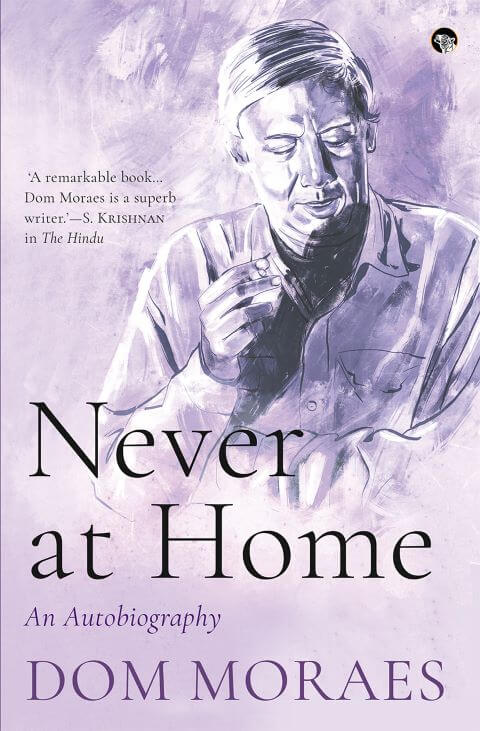
Title: Never at Home

Author: Dom Moraes

Publisher: Speaking Tiger, 2020

Never at Home is the third memoir in the trilogy of memoirs written by Dom Moraes. The others being Gone Away (1960) and My Son’s Father (1968). This volume was first published by Penguin India in 1992. Here the author writes about his life from 1960 onwards.

The first chapter is a brief account of the phase of his life after winning the prestigious Hawthornden prize at the age of twenty. By the time he turned twenty two, Moraes already had two poetry collections and a memoir to his name. In order to earn a livelihood, he then started writing features and reviews for newspapers. In 1965, he brought out his third poetry collection John Nobody. After James Cameron impelled him to take up journalism, Moraes started travelling and for the next seventeen years he couldn’t write poetry. For someone, who from his childhood knew that he wanted to be a poet and to live in England, he spent a considerable period of his life in transit without writing any substantial poetry. Never at Home chronicles those years he was engaged in navigating the world to collect stories and interviews.

This volume is the third and final in his collective memoirs – A Variety of Absences, which take its name from the poem Absences written by him after a long hiatus from poetic fervour. The book focuses more on Moraes’ professional life as compared to his personal life taken up in his second memoir so that its prose is not as poetic or intense as in My Son’s Father but nevertheless, it is a notable piece of literary writing. It may also be deemed as a historical archive because it records some very important and interesting snippets and observations from the political world he traversed and eminent leaders he met.

The critical success of Gone Away, his first memoir, brought him writing assignments which included scriptwriting for a documentary on India. As a journalist, he covered Eichmann’s trial in Jerusalem and wars in Algeria and Israel. In his mind he had always been an English poet in England and had no idea of the tribulations other immigrants faced. A BBC documentary commissioned to him made him look at the living conditions of Asian immigrants, specifically from India and Pakistan. This documentary brought him closer to the reality of being an outsider in a foreign country.

While writing articles for The New York Times Sunday Magazine, Daily Telegraph, Nova and many others magazines, he met and interviewed many distinguished personalities and important world leaders but perhaps none left as deep an impression upon him as Indira Gandhi, whose biography he was later to write. The liberation of East Pakistan, now Bangladesh, had made her a star in the eyes of its natives who were till then hostile to Indians. Moraes writes at length about his meetings with her, about her charismatic personality, political astuteness and her almost invincible demeanor.

His descriptions of the journalistic assignments, which took him across many countries and gave him the opportunity to bring out stories to the world, are finely detailed. His keen eye presents a balanced perspective on the stories he covered, never going too far and never delivering too less. His most important works included a story on political prisoners in Buru and on the tribal people in Dani in Indonesia, the titles of the articles being ‘The Prisoners of Buru,’ and ‘The People Time Forgot’. His Buru piece evoked a violent response in Indonesia. Moraes was banned from entering the country again. But this piece was the first one to come out from the place and the issue was picked up by some human rights organisations leading to a release of seven thousand from the imprisoned ten thousand people. This, if anything, is a proof of the important voice he had become in journalism.

Although, Moraes’ work kept him busy in the world but he could somehow never get rid of the images of his traumatised childhood. As in the case of his second memoir,here also he writes considerably about his fear of confronting his mother. The accounts of his meetings with her are laced with the anguish and anxiety he had experienced in her presence always. Except his mother, all the other women in his life are only addressed in passing. He never dwells much upon his relationship with either his second wife, Judith, mother of their son Francis, or with his third wife, Leela Naidu. In comparison, his association with his friends and work colleagues occupy more space in this memoir. His regret for not becoming the father he thought he was when he wrote My Son’s Father comes perhaps due to his inability to express what he felt before others, including his family.  

Moraes picked up journalism as a vocation to earn a living but it brought him closer to real life. His punctuated visits to India, whether to write on Naxalbari movement, to meet Indira Gandhi, King of Sikkim or to explore Rajasthan, led to an increased understanding of the country of his birth. Nonetheless, he was never at home in India or in the country he had adopted as a youngster.

The disquiet that marked his life is perhaps most poignantly conveyed in this line towards the end:

“I am waiting to be at home; where, I don’t know yet.”

As he settled in the country of his birth, after all the travelling, his muse did eventually return to him. The various absences – of a mother, a father, his friends from the youth or his son — at different times in his life and their memories, continued to haunt him. Yet this memoir ends with a hopeful note. In author’s words, “the best thing to do is to preserve some form of balance on the constantly moving ground tectonic plates of this planet.”

.

Rakhi Dalal is an educator by profession. When not working, she can usually be found reading books or writing about reading them. She writes at https://rakhidalal.blogspot.com/ . She lives with her husband and a teenage son, who being sports lovers themselves are yet, after all these years, left surprised each time a book finds its way to their home.

.

PLEASE NOTE: ARTICLES CAN ONLY BE REPRODUCED IN OTHER SITES WITH DUE ACKNOWLEDGEMENT TO BORDERLESS JOURNAL.