He’s dressed like the city. Where is the boy I love?
Not seeing us still, “Pa!” he echoes the buffalo’s bellows.
Then child-like, calls “Bu” in his mother-
tongue, peering thru the dust still stirring.
.
The wind sets the young padi* stalks stirring;
It’s whistle like the reed flute, reduces me to child-
like sobs and I stand speechless like a love-
lorn fool as they kiss my hand. The cloud-
laden sky turns dark and heavy with a mother-
load of rain. In the paddock the buffalo bellows.
.
The young child frets. “I’m hungry!” he echoes the bellow.
“I made rendang*,” proclaims his grandmother, stirring
spittle in our mouths while the mother
of all storms begins. “I want KFC” — truly a spoilt child
and for a moment my appetite clouds
till I remember that till he’s grown, KFC is puppy love
.
The rain thrashes the ground, a love
offering to the padi fields, drowns the bellows
Of our lungs, conjures memory clouds
of bare bodies and muddied feet and the first stirrings
of manhood riding on the buffalo, laughing in child-
ridden delight towards his padi-harvesting earth mother.
.
“Pa the roof leaks, the house creaks and this mother
earth is dying. Laterite will become tar. This love
nest will soon be concrete flats. No more child-
friendly fields, but roads with the horn bellows
of trucks and automobiles. Change is stirring.
Come with us to the city. Will you live among exhaust clouds?”
.
I see the future start in this man- child trying to mother
us, clouds of grey hair mingling with mists of love.
Slow the past departs, deaf to my heart’s bellows and my soul’s stirring.
.
*Rendang –aromatic spicy meat dish with ground coconut flesh and milk, sautéed for hours.
*Padi – unhusked rice
*Bu (Ibu) – mother
.
A. Jessie Michael is a retired Associate Professor of English from Malaysia and a writer of short stories and poems. She has written winning short stories for local magazines and newspaper competitions and received honourable mentions in the AsiaWeek Short Story Competitions. She has worked with writers’ groups in Melbourne, Australia and Suzhou, China. Her stories have also appeared in The Gombak Review, 22 Asian Short Stories (2015), Bitter Root Sweet Fruit and Kitaab (2019) She has published an anthology of short stories Snapshots, with two other writers and most recently her own anthology The Madman and Other Stories (2016).
.
PLEASE NOTE: ARTICLES CAN ONLY BE REPRODUCED IN OTHER SITES WITH DUE ACKNOWLEDGEMENT TO BORDERLESS JOURNAL.
(For the 800,000 people who perished in the Rwandan genocide of 1994)
I am a Eucalyptus tree.
For a hundred years I have stood here
with my roots pressed in this Rwandan earth.
They reach down
deep,
deep into the underworld,
where life is not,
and the dead
flee away.
.
My branches reach
high,
high into the heavens,
where there is
no wrong,
and death
flees away.
.
But I dwell on earth,
and what I have seen!
What I have seen!
The rain was blood
for my shamed roots,
and loathing myself,
I was made rich
by rotting flesh,
flesh that
no one claimed
because they, too,
had disappeared
into oblivion.
.
Come, Mercy, come!
Lay an axe to my trunk.
Butcher my wood
as they did the people
to whom I once
gave shade.
Set me ablaze.
Make me a holocaust
to the heavens.
Let me burn!
May my holy essence
float across
these thousand hills
.
so that none may
be forgotten,
so that none may
be forgotten.
.
Come, Mercy, come!
Let me burn.
.
Melissa A. Chappell is a native of South Carolina living on land passed down through her family for over 120 years. She is greatly inspired by the land and music. She plays several instruments, among them an 8 course Renaissance lute. She shares her life with her family and two miniature schnauzers. She recently published Dreams in Isolation: The World in Shadow: Poems of Reconciliation and Hope with Alien Buddha Press.
.
PLEASE NOTE: ARTICLES CAN ONLY BE REPRODUCED IN OTHER SITES WITH DUE ACKNOWLEDGEMENT TO BORDERLESS JOURNAL.
A password is often a prosaic keepsake of a faded romance, sometimes perhaps an idea of a home one longs to return to. An overcast sky, the concrete of the city recedes giving space to the smell of wet earth, a coiled creeper looks up to drink the rain,the tick-tock of time rolls down a valley that was once strewn with poetry of our younger days. The spread of the olfactory root is an asylum, I try to draw a route map of the bottled odours, how they tiptoe in to settle down, how I grow to become a habitat. A whiff of familiarity and I walk back to touch the whirring of an emotion ~the damp earth, orchids, rhododendrons, the whispering forest trails refreshing the sound of our footsteps from some other time; turning bodies to tangible dreams, nights to blooming cornflowers. I am somewhat like a vagabond cloud holding in me particles of places, their smell, colours, their warm embrace. A folder opens window to our archived youth, a dash of a fuchsia dupatta grows wings to become a firefly, brings back some pitter-patter of rain, vignettes of our Shillong days. deep deep within a rippling lake.. forever.pine_scent
Mallika Bhaumik has a Master’s degree in English literature from the University of Calcutta. Her works have been featured in many reputed mags like Mad Swirl, Cafe Dissensus, Oddball magazine, Shot glass journal, Kitaab, In parentheses, Stag Hill journal, Harbringer Asylum, Madras Courier, The Alipore Post to name a few. She is the author of two poetry books. Her first book,’Echoes’by Authorspress,New Delhi, has won the Reuel International award for the best debut book,2018. Her second book ‘How not to remember’ has been published by Hawakal Prokashona, Kolkata (2019). She is also a nominee for the Pushcart Prize for poetry, 2019. Her poems are included in the Post Graduate syllabus of BBKM University, Dhanbad,2020. She lives and writes from Kolkata .
.
PLEASE NOTE: ARTICLES CAN ONLY BE REPRODUCED IN OTHER SITES WITH DUE ACKNOWLEDGEMENT TO BORDERLESS JOURNAL.
Uma Trilok in conversation with Nalini Priyadarshini
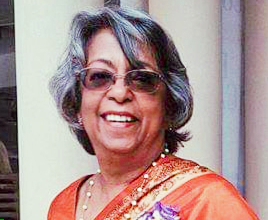
Uma Trilok holds a doctorate in Education management and has taught Philosophy and Education at various university colleges. She has been Principal in a women’s college.
Trained in Hindustani classical vocal music and Kathak dance, she has been performing at various forums such as All India Radio and Triveni Kala Sangam, New Delhi. She is a research scholar and has presented her papers in various national and international conferences, which have been highly acclaimed.
Uma Trilok is proficient in both in English and Hindi and writes poetry, short stories and novels. Her short stories and novels have been staged as plays and are also being produced as web series.
Uma Trilok has written eighteen books including much acclaimed, Amrita Imroz- A Love Story, published by Penguin which has been translated in 11 Indian languages. Her poems have also been translated in a number of foreign languages.
Nalini: How does a poem start for you, an image, a concept or a line? How does it develop?
Uma Trilok: Poetry flows on its own with its inherent elegance. It is so fragile that it cannot be forced into a determined design. Poetry is a moment, that gets expressed suddenly. A word, a gesture, a sound, anything can trigger a poem. It overpowers the poet to get itself revealed.
Its texture and its ambiance is its own, which unfolds itself. In fact, a poem soars within you, takes its own shape and expresses itself in an idiom, which is very peculiar of its own nature. Images collide with each other and bring about kaleidoscopic designs, so much so that sometimes even the poet wonders over its final outcome.
A poem is unexpected, it enlivens suddenly, discovers and invents its own vocabulary, which takes it to various by-lanes. It enjoys its surrounding beauty before it reaches the end. Its voyage is as important as its goal. The reader enjoys both its “ways” and “way to”.
Nalini: What did you like to read as a youngster? Would you please share something about literary influences that moulded your literary sensibilities?
Uma Trilok: As a youngster, while I was trained in vocal classical music, I was introduced to the poetry of Urdu poets like Faiz Ahmed Faiz, Shakeel Badaauni, and the likes of Sahir Ludhianvi, whom I loved to sing on the stage as well as on the All India Radio.
Though I did not study literature, Hindi or English, systematically, in college but I read works of Maya Angelou, Octavio Paz, Pablo Neruda, Rilke, Rumi, Khalil Gibran and Rabindranath Tagore with great relish and admiration.
In Hindi, I admired Mahdevi Verma, Nirala, Pant, Dinkar, and Dushyant Kumar to name a few.
In Punjabi, Amrita Pritam and Shivkumar Batalvi were my all-time favorites. Dharmaveer Bharti, Munshi Prem Chand, Bheesham Sahni and Kamleshwar are also some of my most favorite authors.
When you read, enjoy and admire writers and poets like these, you definitely tend to get influenced by them in sensibilities as well as in style.
Nalini: Poetry is often considered a stronger medium of expression in comparison to prose. As a writer, who is equally proficient in both, what is your opinion?
Uma Trilok: A poem is a capsule of messages of semi-elaborated issues of great concern, with the capacity to hit to which readers cannot help but respond. It has its advantages as well as it handicap — ambiguity and brevity. On the other hand, prose has a setting, a plot, a point of view along with a theme and a mood. There is a difference in the composition of both. The effectiveness of both depends on the treatment given.
Prose can be written in a poetic style, using emotional effects and heightened imagery. Poetry can also be written like prose with no rhythm or rhyme. I believe prose has a little raw element in it, whereas, poetry is brewed, distilled and refined.
A poem is like a shot of liquor and prose is like a glass of chilled lemonade. Both are refreshing, though. For example, if I were to recite following two lines of Dushayant Kumar, they are equal to a couple of chapters in prose,
” Kaun kehta hai aasmaan mein suraakhnahi ho sakta
(Who says the sky cannot be punctured with holes)
Ek pather to tabiyat se uchaalo yaro “
(Friends throw a stone and see)
Or, if we were to read lines of Nazim Hikmat,
“Being captured is beside the point,
The point is not to surrender “
The lines are loaded with meaning, but are said in so few words.
Nalini: Has the world become accepting of female poets with out of the ordinary thought process? From Plath to Amrita Pritam, what has changed, what hasn’t and what needs to?
Uma Trilok: In literary history of the world, through the ages women poets have raised their voices as catalysts against the atrocities and injustice against women. There are countless women poets who deserve acclaim. There are many loud and meaningful voices who have kept the flame of protest burning after Sylvia Plath and Amrita Pritam.
Maya Angelou was surely one of the phenomenal poets who won admiration from millions of people. She wrote poetry, essays, and autographies.
Mary Oliver, who through her very powerful poetry, called upon the women to claim and occupy their due place in the world. Rita Dove, a Pulitzer award winning poet has been named U.S. Poet laureate in 1993, youngest to date. Aditi Rao is another name, whose poems speak of griefs, wounds and exhilaration that women suppress.
Arundhati Subramaniam is yet another very prominent poet, writing upon issues that directly concern women. Rupi Kaur writes powerful poems on most forbidden topics such as menstrual taboos and sexual violence. She writes,
“our backs/ tell stories / no books have / the spine to carry “.
She also writes,
“the earth has waited its whole life for us “
The younger generation of female poets has attracted millions of online viewers, who take poetry quite seriously. Poetry of female poets is being sold much better than ever before. Figures tell that U. K. Market alone has grown by 48per cent. Wendy Cope managed to sell almost as many volumes of her own poetry as the all-time favorite Sylvia Plath could. And Rupi Kaur made nearly £ 1 million from poetry sales last year.
If this be taken as one of the reasons of their popularity and the prizes, awards and acclaims which they have won, I would say the female poets are being recognized well. There is an upswing. There is bristling activity, which is very encouraging.
Nalini: You had the opportunity to closely observe and know Amrita Pritam, who happens to be an icon of feminist writing in India. Has it influenced your sensibilities and writing style?
Uma Trilok: Interacting with Amrita Pritam was a golden opportunity for me. To know a person of her stature so intimately and not be influenced by her is not possible.
She did influence my sensibilities and quite deeply. But for her style of writing I am not conscious, how much that has affected my writing style, I don’t know. But people do say that our reactions to situations are similar.
Nalini: Please share some of the challenges you faced while writing Amrita Imroz, A love story. How has writing this enriched you?
Uma Trilok – One of the biggest challenges that I faced while writing Amrita Imroz, A love story was to ryo to avoid not to deviating from the reality of the two characters I was handling. They were living legends already. They were known all over. In fact, people had known about them but they had not known them as I saw them, the ardent lovers that they were, especially Imroz. The reality of Imroz was misconceived by them for years, I had to put it straight.
The book is a unique love story, quite an unbelievable in modern times. I had to make it sound unusual as it was and yet true. The story also is very delicate and fragile; my presentation of it, also had to be very non- interfering. In every story, there is always a scope of fictionalizing it but in Amrita Imroz, A Love Story I was only an amazed onlooker, who put the story as it was without fiddling with it in the least.
I was deeply impressed by the story of such intense love. I had to bring out Imroz, who was so misunderstood. His true self came into light through this book. I was so happy that I was instrumental in doing that. People came to know how giving and sacrificing he was towards Amrita. We all wondered how can any man in this world be so egoless. In fact, one has to be gallant and heroic to give so much and yet not demand anything in lieu of that. His unassuming self, expressed his large heartedness, but his modesty and humility has been misunderstood by people as debility which I firmly believed, had to be corrected. The book was a step towards it.
Nalini: How important are literary groups and readings.? Do you have circle of writers with whom you share your work?
Uma Trilok: Readings in small literary groups in dim lights, preferably when listeners sit around in an immersive mood, is the best way to read and listen to literary work, especially poetry. The word has an image to visualize, it also has a sound to listen. Sound enriches the word. Spoken word has its own very energizing connotation. In this type of gatherings, listeners can ask questions and ask for a repeat also. The ” Mehfil ” environment is very conducive to good reading and good listening.
Yes, we have groups of poets and writers, who meet and read to each other and get unedited feedback on their work. We, as a group, had a regular coffee table meets every weekend, where poets like Keshav Mallik, Rakshat Puri and Keki Daruwala and the like, participated along with us. We enjoyed cups of coffee and read poetry to each other.
Also, every month end we met at Aparna Art Center, Siri Fort to enjoy our own poetry and also the poetry of poets who were invited from outside. This type of meetings are very enriching and fulfilling.
Nalini: Has poetry taught you anything about yourself that had not occurred to you earlier?
Uma Trilok: I cannot fully analyze the value of poetry in my life, but the first word that pops up is emotional resilience. For example, when I write about hatred, anger and violence, I have love, empathy and fellowship at the back of my mind.
Poems take away stress and gift out serenity, contentment and congeniality. A poem speaks for all, for ourselves and also for those who cannot speak for themselves. you expand your purview of experience.
Nalini: What is the role of the personal in poetry? When you write, is it for you or the reader?
Uma Trilok: I write when I am fully filled with emotion, which I cannot carry any further. It is a compulsion for me, it is not a choice. The events that affect my feelings, my sorrow, my anger, my desperation force me to write. That is the time, a poem holds my hand. In fact, I don’t write a poem, it is the poem that writes me.
I do not change my words, make them mild or strong, to suit the audience. I say, what I want to say, irrespective of how the audience take it or ignore it.
Nalini: Any words for the aspiring poets and writers.?
Uma Trilok: In my view, the younger generation of poets and writers are doing very well. They are quite conscious of the environment around and are taking up issues, which were a taboo earlier. They are inventing new idioms to express in their own unique way. The female writers are being recognized and awarded for their work. They have been able to make poetry more popular and relevant by using new ways through print and social media. I want to say only one thing to the youngsters that they read more, more and more. Because if we don’t deposit, from where will we withdraw.
Thank you, Uma for taking time for this thought-provoking conversation and your insights about poetry and creative process.
.
Nalini Priyadarshni is a feminist poet, writer, translator, and educationist though not necessarily in that order who has authored Doppelganger in My House and co-authored Lines Across Oceans with late D. Russel Micnhimer. Her poetry, prose and photographs have appeared in numerous literary journals, podcasts and international anthologies including The Lie of the Land published by Sahitya Akademi, New Delhi. A nominee for the Best of The Net 2017 she lives in Punjab, India and moonlights as a linguistic consultant.
.
PLEASE NOTE: ARTICLES CAN ONLY BE REPRODUCED IN OTHER SITES WITH DUE ACKNOWLEDGEMENT TO BORDERLESS JOURNAL.
Binu Mathew, Founder and Editor of Countercurrents.org, in conversation with Mitali Chakravarty
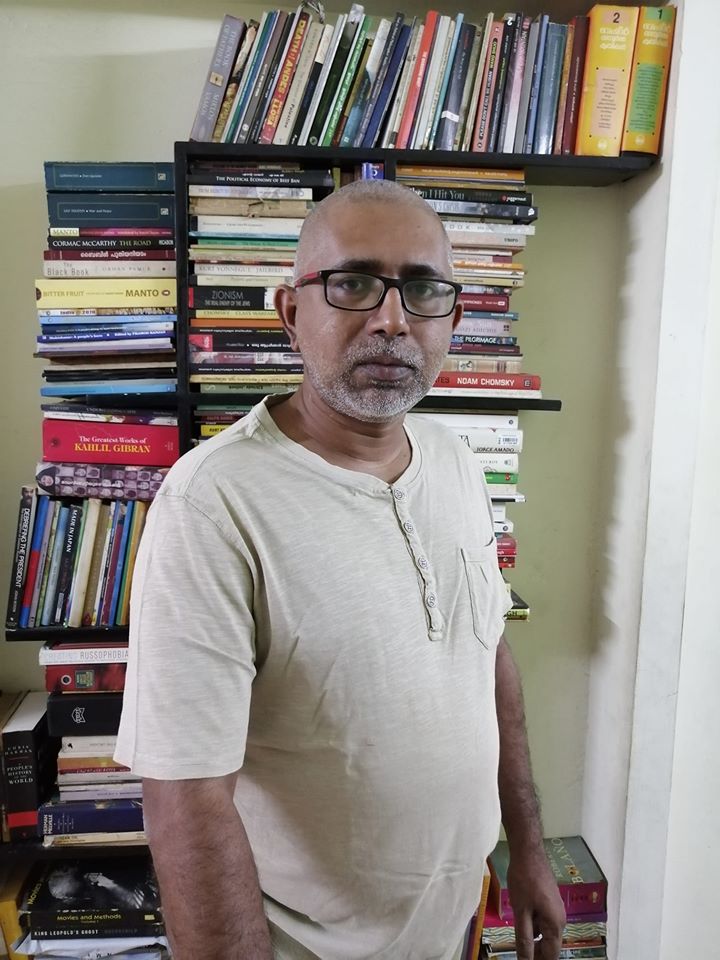
Binu Mathew
Can you interview an online site?
You can’t. So, I did the next best thing. I interviewed Binu Mathew, the man behind the award-winning million readers a month or three million-page views a month online journal, Countercurrents. Mathew claims this is not a big thing except that his journal is based on ideology and openness. He calls it a “people’s journal” in his you tube interview.
He has also started a ‘People’s Manifesto‘, a campaign that will be released by August 15, 2020. He is asking people to give an alternative vision to the government for a post-COVID 19 India. Mathew grew up in a farm on Kerala and turned to journalism. He has talked of his life in an interview with John Scales Avery, a theoretical chemist who is a part of the Nobel Peace Prize winning Pugwash Conferences.
Mathew is a man who finds links and interlinks between major world issues from climate change, COVID to economics and politics. What impresses me most about Mathew is that while almost all writers and journalists see their journeys at an individual level, he completely identifies with his journal and lives by his ideology. Here in this exclusive, we have Mathew himself unravel his ideology.
You have been running Countercurrent.org for 18 years. Tell us how it was conceived and why?
I was working as a journalist in Malayalam language news paper. It was a mundane job. Although the job gave me some financial security, it didn’t satisfy my intellectual curiosity. My desire to do something positive for the society kept nagging me. The job itself was a monotonous one, doing local beats and making local pages.
Some of my college mates and I had some discussions about starting an alternative weekly or monthly in Malayalam language. But the financial cost was huge, and it was beyond our capacity.
By the year 2000, internet infiltrated into our homes. There I chanced upon Znet, Electronic Intifada and many such fascinating websites. It was a revelation to me. Znet was a great source of left intellectual literature. Noam Chomsky, the rock star of intellectuals was free to read at the click of a mouse. In those days it was very expensive to buy books by Chomsky. In other websites, I found people telling stories from Palestine and other conflict zones.
In around the same time, I read the book, When Corporations Rule The World by David Korten. It was an eye opener. I thought I had to do something more than doing the local beats for my paper. Internet gave me the opportunity to do this. I decided to start a website like Znet.
I had zero knowledge in computing language. So I joined a basic html course. I and some of our friends had a brain storming session and decided on the name “Countercurrents“. I took a loan from bank and bought a computer. It was a 20GB hard disc, 256 MB RAM computer. It cost me Rs 40,000 at 18% interest! I paid it back by monthly instalments from my salary.
It was also the time a pogrom in Gujarat against Muslims was going on, in which at least 2000 Muslims were killed. We decided to launch the site as soon as possible.
Artist Razi designed the site, Ajith Kumar B converted it into html. I translated an article from Malayalam by the well-known writer Sarah Joseph titled, “The Womb and the Sword”, on the attack on pregnant Muslim women in Gujarat, in some cases where the pregnant women’s belly was cut open and the foetuses were thrown into the fire. That’s how I became the editor of Countercurrents. It was on March 27, 2002 the first article was published. Since then more than fifty thousand articles have been published. Thousands of well-known and young people have written for CC. Some of them went on to become big journalists or activists.
Tell us about your team and what makes you tick?
I don’t have a team to speak of. Most of the editing work is done by me. There are people like K.P Sasi and Satya Sagar who help me with their intellectual inputs. There are also many other people who are part of the Countercurrents Collective who don’t like to be named. In that way, I’m very fortunate and extremely thankful to them.
What is the philosophy of Countercurrents?
Humanity is facing its greatest existential threat ever with climate change and resource depletion and environmental degradation. This is not a crisis waiting to happen in the future, but it is already here and manifests itself in the COVID-19 pandemic we are facing today. Many resources wars continue to rage in several parts of the world, rising food and fuel prices, growing hunger, natural calamities of horrifying proportions, water scarcity, debt crisis, unemployment, social tensions among communities, growing human rights violations and unprecedented ecological degradation. Unless we take urgent action to change the way we live, trashing our only home, this beautiful planet, this crisis has the potential to wipe out the entire humanity and a majority of the other species from the face of this Earth.
The objective of Countercurrents.org is to spread awareness about this crisis and search for meaningful solutions. We believe that energy intensive globalization should end and it must be replaced by a low energy, ecologically sustainable local economies. If humanity is to survive, the destructive system of capitalism and consumerism must be replaced by an economic system which is based on just equitable distribution and need based use of resources.
Your motto says —“Educate! Organise! Agitate!” How do you explain it?
Susan B. Anthony (February 15, 1820 – March 13, 1906), who was an American social reformer and women’s rights activist and played a pivotal role in the women’s suffrage movement said, “Organise, agitate, educate, must be our war cry.”
In the Indian context Dr Ambedkar gave the call “Educate, Agitate and Organise.”
We combined both the slogans and took as our motto —“Educate! Organise! Agitate!”
We thought of it as a revolutionary call for caste annihilation and women’s empowerment, two of the major concerns in the world today. It also envisages a new kind of journalism which ‘educates’ instead of entertains as in ‘infotainment’. Organisation is necessary for social change. Without organisation, we cannot make any social change. However, it is not the duty of Countercurrents to establish an organisation. We hope that an organisation would emerge organically from the masses. An example is ” Fridays For Future” initiated by Greta Thunberg. Countercurrents has been educating the world about the danger of climate change from its inception. It is happy to see organisations emerge organically, especially on critical issues like climate change. Agitation is the final push for social change. It will happen or it should happen. Otherwise, we are all going to perish.
You have many hallowed names attached to your journal, like noted intellectuals like John Scales Avery, Magsaysay award winners, Sandeep Pandey and Prafulla Samantara and social activist Ram Puniyani. What do you think made them pick your journal over others?
I respect and love all these people. They are regular writers of Countercurrents too. They must have seen Countercurrents as an engine of social change. Otherwise they would not have endorsed CC.
You have recently started a section called Citizenship Amendment Act and it has won some recognition from US universities. Can you tell us a bit about this initiative and the subsequent recognition? How will this recognition help Countercurrents or your initiative?
Countercurrents was covering the Citizenship Amendment Act from the initial days of this controversial pact and the resultant agitations across the country. We were happy to know that Ivy Plus universities in the US decided to include it in their digital library for the benefit of faculty and researchers. Their communication said, “The Ivy Plus Libraries Confederation has selected your website — https://countercurrents.org/tag/citizenship-amendment-act — for inclusion in its India’s Citizenship Amendment Act Protest Movement Web Archive. The Archive is an initiative developed by librarians at Columbia University, the University of Pennsylvania, and New York University, under the auspices of the Ivy Plus Libraries Confederation. The Archive contains material related to protests against India’s new Citizen Amendment Act and the National Register of Citizenship, and was created to preserve and expose this content for academic research in politics, religion, sociology, and interdisciplinary South Asian Studies.”
It is extremely heartening to have this recognition from such prestigious universities, especially in this age of fake news. This speaks volumes of the authenticity of the content Countercurrents publishes. By the way, Countercurrents is archived in the US Library of Congress too. That too is an immense recognition
What kind of contributors do you look for?
Whatever the articles that Countercurrents publishes have some insights, give a new perspective to the reader. We won’t publish articles that don’t fit this criterion. We have contributors from Nobel Prize winners to grade ten students. Achievements doesn’t matter. Insights matter.
What kind of readership do you have?
We have readership from around the world. I get emails from even a remote village of Nicaragua.
What do you see as the future of Countercurrents and your own?
The future is beyond our control. We do our best while we can is my motto, the rest is beyond our control. If I die tomorrow, I hope someone will be willing and capable enough to take over.
You Tube interview of Binu Mathew with Vidya Bhushan Rawat, a social and human right’s activist
.
PLEASE NOTE: ARTICLES CAN ONLY BE REPRODUCED IN OTHER SITES WITH DUE ACKNOWLEDGEMENT TO BORDERLESS JOURNAL.
A brief journey into the world of founder Nidhi Mishra and co-founder, Archana Mohan.
Nidhi Mishra(Left)&Archana Mohan(right)
What is the smell of a book? Bookosmia.
Bookosmia is also a publishing house that aims to promote reading among children, curates writing from youngsters and brings out books for youngsters in both hard and soft copy as well as audio books in varied languages. It was conceived by Nidhi Mishra who pivoted to children’s publishing from a 10-year banking career, post IIM, in 2017. After a fast paced career, she quit as Vice-President of HSBC (Hong Kong & Shanghai Banking Corporation) to create something from scratch in a space she was passionate about, making better use of her time and skills. Nidhi teamed up with Archana Mohan two years ago. Mohan had worked as a journalist, corporate blogger and editor working with names like Business Standard, Woman’s Era, Deccan Herald, Chicken Soup for the Soul and Luxury Escapes Magazine. She won the Commonwealth Short Story contest’s ‘Highly Commended Story’ award in 2009.
In this exclusive, Mishra, founder and CEO of Bookosmia, and Mohan, co-founder and head of content, tell us about their journey.
When and how did Bookosmia come about?
NM*: Bookosmia was launched in 2017 as a disruptive children’s content company, hoping to make kids fall in love with reading, writing and everything else around stories. While an already cluttered space in India, children’s content was either always educative, western or inappropriate. No one wanted kids to just enjoy a good story without necessarily helping them in academics or teaching moral values. We wanted to change that.
But what kind of stories do kids really like? What better way than to ask them directly. Hence our key premise that kids are perfectly capable and deserving, of telling their own stories, is the biggest differentiator in the market.
What does Bookosmia do?
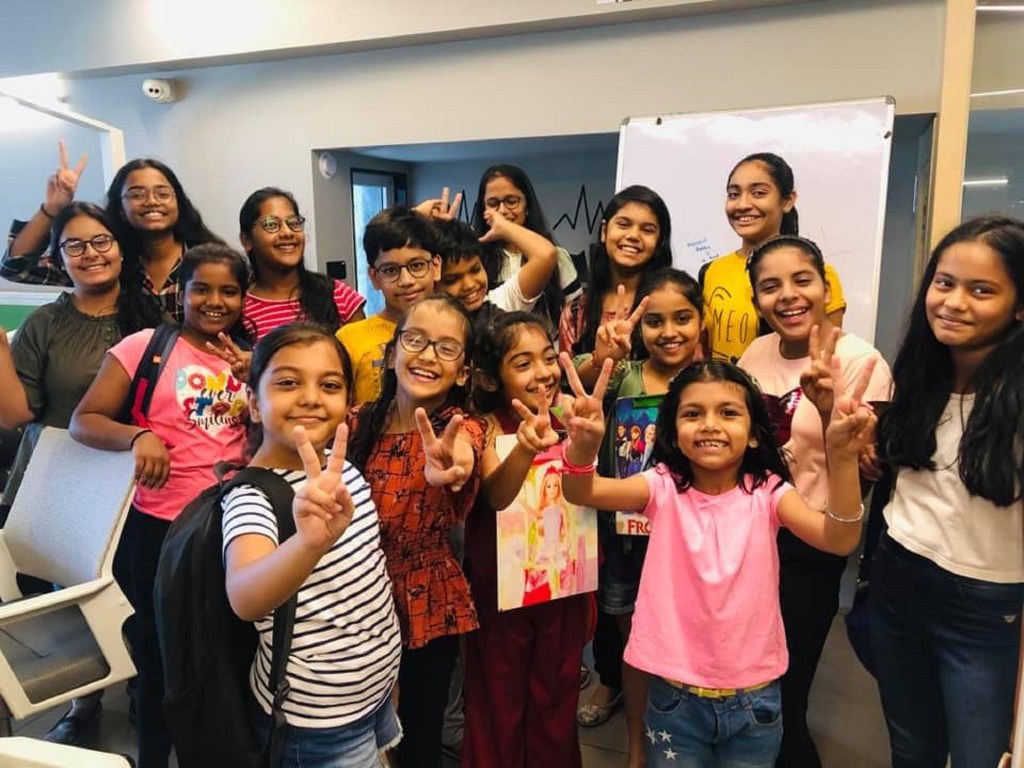
NM: Bookosmia is India’s premier writing platform for kids, publishing over 100 original digital stories a month with young writers from lesser known Indian districts like Kiccha, to the bustling metros, from Munich to New Jersey. Bookosmia recently launched its brand persona— a 10 year- old athlete Sara, fondly hailed as “our new best friend” by The Hindu recently. Sara has India’s premier and largest repository of stories for kids, by kids. Additionally she brings a whole host of fun and age appropriate content to kids through digital stories, video stories, audio stories and lots of fun activities for kids for perfect engagement for kids. That is what we offer from a product perspective.
However, we are onto a larger mission– to create a new ‘category’ of kids content, which strongly hinges on a “stories for kids, by kids” philosophy. Children lead their lives with a constant inflow of inputs. Parents, schools, teachers rarely pause to ask them for their original output. How are they feeling?
At Bookosmia, we are different from other content companies and publishers because we have a two-way conversation with our audience. Yes, we have digital and video stories to engage children meaningfully. But we also have the intent to ask them and publish how they are feeling in the lockdown, during a world cup final, after listening to our science stories. We feel making young kids feel valued and heard will help in the following ways:1) They will be able to process their emotions and launch their imagination better, instead of hopping from one activity to another. For example, we love the stories 6-year-olds write to us where animals feel lonely, are behaving badly only because they are looking for a best friend. 2) It will help them boost their self-confidence. A child who feels empowered today will grow up to be a more engaged citizen tomorrow. For example, we have older kids writing to us on issues of racism, taboo around periods, refugee situations and more. 3) It will help children feel more positive, hopeful and raise awareness by evaluating what they can be grateful for. For example, our “Gratitude during Covid” series was a perfect example where even little kids sent us entries recognizing there is a lot to be thankful for, even in these difficult times.
How did you conceive Sarachats?
AM*: At Bookosmia, we take our ‘by kids, for kids’ mantra a little too seriously! This is a company where children call the shots. Our young friends decide the topics they will write on for the month, activities and new features to be added. So, the obvious thought was why not have a young character representing us in all our interactions as a brand? That was when Sara was born.
Ms Sara
Sara isn’t a genius, nor does she possess magical powers. She is a curious and happy go lucky kid and every child will identify a bit of themselves in her. With her young friends from across the globe, Sara reads stories by kids, she listens to story tellers, she tells stories to little ones, she does fun activities and she even chats to cool older people to know more about their lives.
To us, Sara is a heart child. She has not one but many mothers! She was designed by the brilliant Parvati Pillai, ex design head of Chumbak. Our chief visual designer Aayushi Yadav has adapted the design fabulously and brought in her trademark humour, enriching Sara’s personality. As for how Sara talks, behaves and the capers she gets into, blame that all on the rest of us!
In a very short span of time, Sara has made quite an impression on our young followers. Everyday, Sara’s inbox is flooded with messages by her friends across the world who love to share their thoughts and wait to hear back from her. For them and for us, Sara has become an inseparable part of our lives.
How many children have responded to Sara chats?
AM: We publish over 100 young writers a month, so the answer is, quite a few! But it’s not just about publishing. Some of our young writers are from lesser privileged backgrounds, so the whole concept of expressing themselves in a medium like the short story, is an alien experience to them. But guess who instantly connects with them and draws them out of their shell– their friend Sara.
Similarly, some of our young writers have great ideas but lack proficiency in English and it is Sara who writes to them regularly encouraging them to put their thoughts into words without being boggled by vocabulary. We believe that every child has a story to tell and our global platform through a much-loved ambassador like Sara gives children an opportunity to express themselves and feel heard in a safe and non-judgemental space. From writing about their dreams, their family to topics like periods, disability, grief to bullying, our young writers are unafraid to write about subjects that move them. To say their refreshing optimism and understanding of the world stuns us, would be an understatement.
What made you think of the icon of Sara?
AM: Our girl Sara, is a stereotype buster. She is the answer to generalisations like “all girls like pink” and “sport is for boys”. Sure, she is notorious for breaking a windowpane or two with her football, but she is no different from any other girl in the world. She represents every child who gets picked on for ‘being different’, for daring to think out of the box and for questioning norms that don’t make sense to them. Does loving sport instead of playing house make her any lesser of a girl? Absolutely not. And that’s the message Sara brings to every child of the world. You are you. Don’t feel pressurised to change just because you don’t fit into someone else’s mould.
Is this a voluntary organization?
NM: No, Bookosmia is a for profit private limited company.
Tell us how Ms Sara serviced children across borders through the trying times of COVID.
AM : Like we always say, it is the kids who drive this company and so it should come as no surprise that our much lauded ‘Gratitude During Covid’ series was conceived out of children’s conversations with Sara where they spoke about how their lives had changed post Covid. While most adults chose to binge watch during the lockdown, children from far flung corners of the country and even abroad, took up on our call to write essays, poems and short stories about ‘gratitude’, exhibiting an incredible amount of maturity in handling an unprecedented situation.
And what delightful takes they had! While the younger ones were thankful for the cleaner air, food on the table and more time with their families, the teenagers wrote about how they had become conscious of their privilege, developed empathy for their domestic help and learnt to go ‘within’.
As a company, we felt validated. Clearly, by engaging with them meaningfully, we had been able to make children feel valued.
Are you still into bringing out books online? Or has it suffered from the pandemic too? Has the pandemic affected Bookosmia?
NM: Yes, the pandemic has affected Bookosmia, but only for the better. We have doubled our audience every month and it only speaks of the strong need that exists for safe, meaningful yet fun screen time for kids .We like to think of ourselves as the intersection of a parent’s need ( to keep their child meaningfully engaged) and a child’s want (to find relatable content).
We publish 4 free digital stories, written by kids, on our website everyday. Yes, we are releasing fewer online paid ebooks but that is mainly because our focus right now, through these tough times, is to make our free content available to as many kids as possible and build a community.
What are your future plans for both Bookosmia and Ms Sara?
NM: In question two, I touched upon our intent to create a new “category” of kids content. A few years back I used to be very judgemental of the new generation of teens. Always on social media, gunning for more likes and comments, with dwindling attention spans and enormous need for approval. Over the years, I have realized the problem was not in that generation but in the world we have created for them. Yes, they are active on Facebook and Instagram and snapchat, but which other platforms value them. We have to give these young minds a platform where they feel safe speaking up, sharing their views and stories, not afraid of being dismissed with a ‘too young’ tag.
Yes we have some excellent writers who share their stories with us. And it can be expected that children can create content(stories/ essays/ poems) that other kids will like more. Purely because it is first hand and organic. But we are not looking to churn out great authors, we are looking to make young voices feel valued.
Sara has found great relatability with children. She looks, talks and thinks like them. They have a lot less inhibition in writing to her than they would to a publishing house. We want Sara to take these stories from kids, far and wide across the globe and not be tied down to a particular country. Like any other kid, Sara is also upto a lot of things. Good at some, like sports and curious about others like Science, Art or Nature. So you will see Sara introducing kids to a whole range of topics and not limit herself to reading and writing. Also conscious that there is nothing more joyful than holding your beloved characters in your hand, Sara may soon be seen in a physical format.
*NM : Nidhi Mishra, Founder and CEO of Bookosmia.
*AM : Archana Mohan, Co-Founder and Head of Content, Bookosmia.
.
PLEASE NOTE: ARTICLES CAN ONLY BE REPRODUCED IN OTHER SITES WITH DUE ACKNOWLEDGEMENT TO BORDERLESS JOURNAL.
Thank you Ms Sara and Book Osmia for this lovely selection. We love having the sporty Ms Sara on our pages with her lovely collection of stories, poems and essays. We handover the stage to Ms Sara as she starts on her introductions.
Hey there, everyone’s best friend, Ms Sara is here! Here is a cute little poem by 6 year old Tuhina Nambiar from Mumbai sends in a message to the parrots, her new friends since the lockdown.
Poetry
Cute Parrots
By Tuhina Nambiar
We are all at home now.
Roads are clear.
There is no pollution.
The sky is clear.
The cloud looks like cotton.
Parrots are free to fly.
Everyday they sing me a lullaby.
They chat in my balcony.
Looking at them, I feel I am talking to my friends.
Sara now welcomes a colourful story from the youngest poet — 5 year old Amaya from Kolkata. Rainbows are great but when the storm is coming, you have got to head home.
Poem- Magical Rainbow
By AmayaRupramka
One day a wizard gave me a pair of wings
And I started flying
Then, I went to the clouds
And I was thinking it’s some milk
Then I saw lot of colors
Then surprisingly it was surprise for me, it was a RAINBOW
Do you want to learn what were the colors?
Violet
Indigo
Blue and
Green
Yellow
Orange
Red
Then I met Eagles, Sparrows, Pigeons & Parrots
And we flew together…
Then a storm came, a thunder storm
And the birds were very scared
And that’s when I flew back home.
A simple handshake, a roaring stadium, a breath of fresh air — all seems like a dream now, beautifully captured by 15 year old Abhipsa from Bhubhaneshwar.
May We Never Take For granted
By Abhipsa
Life seemed to be peaceful
Alas! Corona you made it dreadful.
There was no time to sit and stare
But you made it all fair.
.
All of us always thought–
Life is a quick succession of busy nothings
But you changed our perception regarding everything.
.
The earth whispered but we didn’t hear,
The earth spoke but we didn’t listen,
The earth screamed we didn’t pay heed.
.
That was why Corona was born
To awaken us,
To enlighten us.
.
Many great heroes, yet names unknown
Many sacrifices and pain undergone
Many new heroes have been born.
.
“Please don’t decorate me in garland,
Please don’t give me applause,
I just want to return home safe,
Even if all my remains are bones,
I must bring myself back home to my family,” they said.
.
We call this all a heartbreak
But ask nature
It is alive like never before
Blue skies, sparkling water,
Animals with happy feet .
.
When this is over may we never take for granted
A handshake with a stranger
A stadium roaring
Fresh air to breathe.
.
To learn
We must respect
Nature and our fellow beings
All of us are apart,
But we stand together
And together we shall,
Overcome.
Stories
Ms Sara shares this extremely creative story by a little author, 7 year old Naisha from Little Readers Nook Gurgaon.
Suzy and the Grey Kite
By Naisha Bothra,7, Gurgaon
Once upon a time there lived a girl called Suzy. She was going to the Kite festival riding on her beautiful unicorn. As they reached the kite festival, Suzy saw a gloomy grey kite sitting alone.
Nobody took him .Everybody only bought colourful kites. The grey kite was locked in a glass and it was sobbing. Suzy felt sad for the grey kite and quickly took the kite from the shopkeeper.
The kite was relieved to come out of the glass and thanked the girl for taking him. Suzy sat on the unicorn and they went on top of the green mountain to fly the grey kite high up in the blue sky. The grey kite felt awkward in the sky among all the bright ones. He thought, “If I fall all the other kites will laugh at me.”
But Suzy and the kite did not give up. Soon he began to enjoy the fresh air and began to rise high, high, so high. He started loving it. Seeing him dance so high all the other colored kites learnt a lesson that they should not have made fun of him. They realized that dark or colorful doesn’t matter. It is important to be confident and happy with ourselves.
Now the grey kite lives happily ever after in his new home…
Ms Sara wonders — are animals capable of kindness? Read this story by 7 year old Miraya from Gurgaon to find out.
The Lost Blackberries
By Miraya
Once there lived a dark eyed seven-year-old girl named Tara. She had pink cheeks and a sharp nose. She lived in a cozy cottage in a village.
One day she really felt like having her favourite fruit, blackberries.
GULP! GULP! GULP! Tara imagined herself having those yummy blackberries. So, she requested her mother to bring some delicious blackberries.
Her skinny and hardworking mother at once agreed. There was a huge black berry bush behind their cottage. So, they went to pluck some juicy black berries. After reaching home, Tara kept the basket of the black berries in the backyard.
As soon as Tara turned to pick a plate, WHOOSH! The black berries were gone!!
After a moment Tara saw a little monkey sitting on the fencing of their backyard. She could see the monkey holding the basket of the blackberries. Tara started screaming and howling.
Her mother rushed outside and noticed the notorious monkey. Tara’s mother tried her best to console her. To Tara’s surprise, that kind monkey dropped the basket without even tasting any black berry. From that day onwards, Tara and that monkey became best friends.
They also shared their blackberries every day.
Now, are you now ready for some spookiness? 9 year old Koushiki from Kolkata has got it all in place for us. Read her story —
The Train to Milan
By Koushiki
Once, I had got a job offer in Milan. As I had to earn a living, I left for Milan the very next day. I didn’t live in Italy and so before going to Milan I had to first reach Italy. I had arrived in Italy and on the same day I was going to Milan.
Unfortunately, the train was supposed to come at 12:00 p.m. but it didn’t because of a train accident. At 5:30 p.m, I came to know that the train could not arrive that day and so the train would come the very next day. It was a very lonely station and I was the only person there.
I was very tense as I had to spend the night there. After all I didn’t know the place at all. I had arrived that day only. How would I know anything about it!
Suddenly I saw two children coming towards me. They started talking to me and asked me my story. I had no other option and so I told the whole story to them. They asked me to follow them. There was not much else to do, so I followed them.
They took me through a dark and deep tunnel. To my surprise, when the tunnel ended I saw a train waiting there. So strange! There was no other station there as far as I had read and the clock says it was 1:00 O’clock in the night now. One of the children said this was the train to Milan. They said goodbye to me as I entered the train. I got a good seat beside an old woman. In my cabin, there were only a few people.
There was a very cold breeze blowing. Suddenly the old woman said her name is Amelia and asked my name and also something about myself. I told her my name and that I loved adventures. Amelia was a very friendly woman and seeing her kind nature, I told her my story and then said I was focusing on my goal to get a good job but I was very nervous and tense. She said she traveled everyday from her workplace here to her home in Milan. She asked if I would mind her asking something. I told her I wouldn’t.
Amelia said, “At the beginning you told me you were an adventurous person but you can’t face life itself. Life is the biggest adventure, it has so many challenges which brings happiness as well as sadness, isn’t it? And then you said you were focusing on your goal but you are too nervous. How can you focus on your goal if you are focusing so much on your nervousness? And why are you so nervous? You don’t know what life has in store for you just as you did not know you will get a train, when you had no chance of it. Then why be nervous?”
Just as I heard her say life is an adventure and you have to face it, my eyes opened and suddenly I found myself in Milan and I could not see the train anywhere. Strangely, it was still 5:30 p.m in the clock just as I had seen earlier when I was sitting in the station. I thought maybe I was wrong.
I went to the hotel where I was going to stay and on the very next day I went for the interview. It turned out very well and I got the job. After a few months I got a holiday and so, I wanted to go home.When I was leaving for home, I thought I should thank the old woman who had helped me. So I went to the stationmaster and asked if she was travelling today. He asked for her name. I told him about Amelia, that she was a very old lady and traveled everyday from this station.
The stationmaster was frightened and showing me a photo of Amelia, asked if she is the person I was talking about. I replied happily that this was indeed her.“Ma’am she died on 13th January at 2.30p.m. in a train accident, while she was traveling. It was the same day I met her and maybe the same accident for which the train had not arrived that day. I went out of the stationmaster’s office and remembered the conversation between me and her.” Suddenly, I felt the same cold breeze I felt that day.
One spooky story is never enough! Here is another one from 12 year old Aditya from Delhi. Do tell Ms Sara when you have it all figured out. Read on !
The Bicycle Adventure
By Aditya
The night was pitch dark and the atmosphere was rather gloomy. I have absolutely no idea why I thought this was the perfect night to spend some time alone.
Reflecting upon my life, thinking about how in childhood I used to promise myself that I am going to be a billionaire but here I am, at a dhaba (roadside restaurant) in the outskirts of my city travelling on my bike. Just don’t interpret something wrong from the above sentence, actually to be precise, it’s a bicycle.
It was around 11:50 pm, so I started an hour’s journey back to my house thinking if I had a car, how much faster it would have been. The way back home, all that I was thinking about was me as a failure but then suddenly I got a rather eerie vibe. I just thought that it was normal as I was the only person at midnight going through the woods besides a river… until it wasn’t. After some time, out of nowhere a boy appeared in front of me. I stopped my bike beside him and went towards him.
Normally under these circumstances, any boy would have been scared, but this particular boy had something special about him. He stood all alone in the dark at a corner without even hesitating about his surroundings. I asked him what he was doing here. To my surprise what the boy said was a bit hard to digest. He told me that his parents were traveling across the forest with him and they told him the story of a fresh lake full of blue water. He had been so excited to reach there that he had wandered away from his parents.
I nodded but found that hard to believe. A blue river, here? In the middle of the desert? Surely, the parents were just making up a story to keep the little one entertained. Or maybe the boy was bluffing, but then I thought that what would a 6 year old child, who is blinded in one eye, earn by lying?
There were many questions in my mind at that moment, but then I neglected all the thoughts that occurred to me and told myself that right now my first priority was to take this child back to his parents and ensure his safety. I immediately felt that this was the reason why I happened to chose this particular night for self-reflection and self-pity.
I knew that God had directed me to this unfortunate event in the child’s life and my job was to take this innocent child back to protection. I offered him a seat on my bicycle and told him not to worry as I will be taking him back to his parents. I turned around and asked him about his home address. He gave me a confused look from which I understood that he did not know the address of his house. At that moment I thought that we were in a fix, but then the idea of taking him to a police station struck my mind.
I told the child not to worry and to hold me tightly on the bicycle so that he doesn’t fall. I gave him the good news that soon he would be with his family but shockingly even after hearing this news, there was not a glimpse of happiness on his face; it was as if he had not even heard what I said. I heard him mutter something about ‘blue river’. Ignoring this reaction of his, I moved on but then came the terrifying part of the journey.
Slowly and steadily the bike started getting heavier and I started losing my balance. It was not long before I fell down. I quickly turned back to see if the kid was safe but to my surprise, he wasn’t there. It was as if he had disappeared into thin air. I looked all around, I even searched the woods to some extent but he just vanished. I got worried. This boy wasn’t communicative plus he had only one eye. I wondered how could he just disappear in front of my eyes, but then something else happened.
I spotted something gleaming like water. It was a river! Sparkling blue, just like the boy had told me. I crossed this road everyday and I had never seen that before.
I went closer and found a small elephant near the bank of the river splashing water happily on itself. It looked at me in the moonlight and gave a big smile. It had only one eye.
Essays
Read this simple essay by 7 year old Sarthak from Gurgaon, very nicely summing up how are parents are there for us, every day and in every way.
Parents
By Sarthak
My parents are my best friends. I feel happy because my parents help me in everything I do and they are very polite with me. I get sad when my mamma gets upset with me. But later I realize that my parents always say and things for my good. Then I forget everything and I hug them.
Whenever I have any problem, my parents always cheer me up and help me solve it.
During lockdown, me and my elder sister help my mom in dusting and doing laundry. My mother makes delicious food for me. Sometimes I demand for french fries, white pasta or jelly and she cooks them all for me.
Even though she is busy with her online work , still she reads books to me and plays with me. Normally, my father goes to office but during the lockdown he is also at home. He does his office work and also helps mother in the house hold work. He just bought a blue office chair and I also enjoy swirling on that chair. My papa plays board games, indoor cricket and outdoor games with me during normal days. I enjoy doing meal time talks with my parents.
Yesterday my father told me about football World Cup and sometimes we play ‘I see’ guessing games. My parents tell me their childhood stories. I enjoy listening and laughing at the funny stories. My parents also take care of their parents because they are old. I thank god every day for blessing with such a wonderful family.
And here is a very thoughtful essay by 12 year old Rehan from Kolkata written on the occasion of World Refugee Day. At the end of the day, we all just want to be home, right? But unfortunately, that is not an option for some. Lets understand and honour their courage.
Quest for home away from home
By Rehan
International Refugee Day is observed by UNESCO to honour the courage, strength, bravery and determination of people who are forced to flee their homeland under the threats of conflicts and violence. Many of us probably do not know that Delhi is home to several refugees and asylum seekers – mostly Somalis, Syrians, Afghans, Burmese et al who are registered with UNHCR in India. Here is the story of one such refugee, Samin.
Samin seems inconsolable when asked about his family. A refugee from Syria, he lives alone in Delhi. While talking about his past the profound pain was apparent on his face. Still he is willing to talk about his past.
“I am Samin from Syria. When I was just 21, my parents died one after another within a span of six months, leaving me practically lost and heartbroken. There was no one except me to look after my sister, so I took a job in a nearby restaurant. Things started off well but soon took a turn for the worse. The country descended into civil war as rebel brigades were formed to battle government forces for control of cities, towns and the countryside. Several people started fleeing the civil war between President Bashar Al-Assad’s government and the rebels, as well as extremist groups.
“One morning, I along with with my sister went to the nearby market. Suddenly a roar shook the entire market place. It was an intense bomb blast which hit the entire market and its nearby places.
“While remaining down on the ground, I lifted my head up and looked around to find everything completely changed. Almost all the shops had been mangled and tossed around. I suddenly realised my sister was not there beside me. I searched for her here and there among all the dead and injured. I found her, yes. But amongst the debris. I lost my only sister. The bomb had destroyed all the adjacent buildings, one of which was my house.
“All my neighbours decided to flee the brutal conflict in Syria and the repressive government and decided to start the perilous journey across the Mediterranean into Europe. It was then my old friend Emnauel suggested that it would be better to move to India as India has been a host to a small group of refugees who sought to avoid the crowded countries that share the borders with Syria or the perilous sea journey to Europe. India is one of very few countries where we still have a Syrian embassy.
“So Emnauel and I took visa and came here,” Samin shared his dreadful past. Initially, Samin and Emnauel had to struggle here as they used to face discrimination.
Even after facing several hurdles, refugees live with the dream of going back to their own country.
We all must remember that a refugee is someone who is forced to leave their country and we must also realize that no one in the world would willingly leave his home and homeland unless he is forced to do so.
.
PLEASE NOTE: ARTICLES CAN ONLY BE REPRODUCED IN OTHER SITES WITH DUE ACKNOWLEDGEMENT TO BORDERLESS JOURNAL.
Borderless Journal is back with its first monthly edition. It has more than fifty posts for you to enjoy from all over the world and a children’s section selected by Ms Sara’s creators. Filled with poetry, stories, musings, interviews, reviews and essays, it has something for everyone to savour.
We have to thank Dustin Pickering on our editorial board for giving contributors space in his esteemed hard copy quarterly, Harbinger Asylum. And Nidhi Mishra and Archana Mohan of Bookosmia for giving us lovely reads from Ms Sara’s friends in our young people’s selections. We have an interview with them on our pages to explain what their company, Bookosmia, is all about. Another interview that will be of interest to all of you is with Binu Mathews of Countercurrents.org, an online presence which garners one million views a month! His publication explores all new perspectives and hosts Borderless Journal’s articles every now and then. Countercurrents.org voices protests for a more equitable, more humanitarian world like we do at Borderless Journal.
In quest of a better world, Aysha Baqir, a novelist and activist, brings out the plight of a young girl in her letter to Zohra, an eight-year-old domestic worker who was beaten to death in Pakistan on May 31st, 2020. There has been no concerted movement to resolve the plight of child labour the way there has been of the expanding movement to end differences in skin colour which are just like the colours in nature. An inability to comprehend that, never ceases to amaze me. Ratnottama Sengupta, an eminent senior journalist, has highlighted through her essay, ‘Wisdom of the Wild’, that animals care for their youngsters, even if the fledglings belong to a different species. But looking at Zohra’s case study, one wonders if humans are doing the same?
Echoing the plight of children in a world ravaged with distorted values based on ‘gentility’ and wealth and giving it historicity is an essay by academic Sohana Manzoor, on children in Emily Bronte’s Wuthering Heights. Reading the two pieces one after another, one is left wondering how much we have reformed the social ills that existed in the Victorian era. In Borderless, we look at trends in human development. Have we really gone up the ladder of change towards a better world which will be seamless and borderless in its intent, where being majority or minority does not lead to violence, ostracisation and victimisation?
It is also Emily Bronte’s birth anniversary on July 31st. We like to commemorate great authors and major events on our pages. Another major event we covered is the American Independence Day celebration on July 4th, 2020. A powerful essay by Dustin Pickering that talks of the American dream as opposed to the American reality today. One can glimpse more of the issues faced by the human race in an interesting story by Sunil Sharma named after a great in literature, Baudelaire. We have a lively rounding up of the corona situation in Nishi Pulugurtha’s roundup which gives us an unusual glimpse of the value given to divine intervention in the backwaters of Bengal with the evolution of a Corona puja.
An academic and gender studies researcher, Meenakshi Malhotra, has looked into why we have a nomenclature that draws up a border around writings by women. We have reviews by Bhaskar Parichcha, Gopal Lahiri, Rakhi Dalal and Debraj Mukherjee on recently released books. Devraj Singh Kalsi continues with his distinctive narratives on authors who feel unknown. Poetry with both major names and newcomers, musings, essays, stories liven the pages of this journal that unites with its ideas and ideals across all borders.
I could go on describing each individual piece for the joy it has been in reading and posting them for all of our wonderful readers. Though we have many more stories, translations, essays and poems from more than a dozen countries and covering diverse issues, I will leave you to enjoy our fare rather than describe each piece individually. Thank you all for giving me the time to sort and organise our fare. Wish you a wonderful read till next month, when I hope we can continue to celebrate our hope for a better world with laughter and sunshine.
Borderless Journal today completes three full months of its virtual existence and will take a plunge towards a refreshed image. We hope to be a monthly from now on to serve you better, to do more justice to our submissions which continue to be overwhelming in numbers.
Meanwhile, in our pages, we have tried to connect mankind with ideas and thoughts that move away from borders drawn to divide humans — we want a world that transcends race, colour, creed or nationality. The only thing we look for is connectivity and coherence. We want to see the best in humans, what makes us strong and what carries us forward into a world that is not fragmented by fears, anger, hatred and marginalised thoughts.
Marginalisation also creates borders because there are humans within the border who for some reason are seen as different from humans without the border. I am not thinking of equality but of equity, where we can all feel we have been treated with justice.
These few months we had writing not just on COVID 19, lockdowns, quarantines and opening of lockdowns, but also stories of major natural calamities like the Amphan, race riots like that of Floyd’s and more. Perhaps, the latest riots in America, will make us all realise that in every country, every culture, we have our own Floyds. And to acknowledge that we are of the same flesh and blood as the marginalised or underprivileged masses is a mammoth task for all mankind. We need to rise above things that divide and fill the world with love, kindness and tolerance.
Mark Twain in A Connecticut Yankee in King Arthur’s Court (1889) has the protagonist who travels back in time to Camelot observe prisoners from the underprivileged masses waiting to be sentenced and he thinks:” …they are white Indians.” Indians, meaning the Red Indians who had their housing and way of life shrunk into reserves in the same year in Minnesota the book was published — 1889. In 1887, their land had been taken away by the Dawes Act signed by the US President Cleveland. Was it just — taking away the land in which they had lived for centuries? Was it just to hate someone for having a different culture or a different way of life anywhere in the world at any point in history? Was it just to have slaves? Was it just to kill Floyd? Was it just to kill in the name of creed, or on the basis of what people eat? Was it just to give people no work, no food and no transport and have them walk till they dropped dead?
To me, all these are Floyds of the modern-day world, people killed in mob violence or for following different food habits, lifestyles, cultures or beliefs. History speaks only the truth. It is heartless and as Churchill said, “History is written by the victors.” And the victors to perpetrate their hegemony, create margins for those they dominate — the ruled become the marginalised and non-marginalised as that makes it easy for power brokers to fan differences to maintain their own strength. In the colonial period, they called it divide and rule.
Toni Morrison, another lady with a great deal of wisdom, said in an interview, “Race is a construct, a social construct.” History, Yuval Noah Harari, and more have shown this assertion by Morrison to be a fact. All of these are man-made constructs.
I have a very basic question: if we can accept the different colours in nature, why can we not find it in our hearts to accept differences not only of skin colour but of beliefs, of creeds and of food habits? These are questions that Borderless seeks to explore, to find the weaves that connect mankind to help move towards a richer tapestry of humanity. This is just the start of the journey and we can all make it together.
Sara’s Selections in the loving nurture of Bookosmia hopes to integrate these larger values into the younger generation.
Let us all lead by example with exemplary writing, with exemplary choice of subjects and with exemplary writing skills. We are open to comments and feedback by readers who are as necessary to the existence of writers and journals as air to breathe and live.
Welcome to an exploration of a world beyond borders!
hand in hand in their home-land inundated in water.
.
It’s August and they’re happy—
they shared their share they suck from soil, peace in harmony but aggravated by agony. .
Are these both daughters of nature? .
I asked in muse because it’s October.
October—when anthropomorphic humans rise
from the bed of utilitarianism.
.
Saw them break the neck of the weed
and water the paddy.
Weed is no need and paddy is daddy,
they said. .
“From their roots or they will be back,”
said the man,
uprooted the weeds,
and expected the grains to grow.
.
I’m the parrot and the nightingales are singing
“the blissful assonance of humans and demons”
.
Then I saw a philosopher
ankle-deep amongst the sisters
philosophizing friend-foe dichotomy. .
Followed him the earth doctor;
“Weed’s no need and grains our friends,”
who said so.
.
Who would know things deep
in the anguish of orphan sisters?
But then there are humans,
more prominent.
They part them,
break the bones of the bond
and make them irrelevant.
.
I’m the parrot and the nightingales are singing “the blissful assonance of humans and demons.”
.
What destiny keeps them there?
A one meant to last a flash?
Day selects weed homeless
and night strips the grains
Twice they raised them together
only to part them later?
.
I’m the parrot and the nightingales are singing “the blissful assonance of humans and demons.”
.
White, green, and brown balls,
they’re fed profuse.
Are they this frail
to nourish them to nausea?
Like a slaughtering animal
nursed to its brim,
they slaughter the weed young
partly by poison,
and parting them in season.
.
I’m a parrot and the nightingales are singing “the blissful assonance of humans and demons”
.
Where do these weeds come from
where they plant only the grains?
Were they there all along
waiting for their sister to show up?
And how all along is all along?
.
It’s but humans
who treasure precedence and succession,
value estrangement,
who mend the rules of nature.
.
I’m a lone dead parrot.
We are lone dead parrots.
And the nightingales are gone.
.
Umesh Bajagain has been a Science and English Educator for twelve years. Also an editor by profession, he likes to call himself a short story writer by-choice and poet by-chance. Humour, Satire and Dark are his areas of interest. He is also a budding translator and a ghost author for various publications. His works have been published in local English dailies and had been waiting for the Big Pharma of literature. Right now, he’s working on a number of short stories and poems for an anthology.
.
PLEASE NOTE: ARTICLES CAN ONLY BE REPRODUCED IN OTHER SITES WITH DUE ACKNOWLEDGEMENT TO BORDERLESS JOURNAL.


















 Borderless