fuelled by our whims, aided by liberal market winds.
.
Now, the old squat house, built on a shoestring,
has been gobbled up by a sleek building
and a cosmetic patch of periwinkle flowers —
graveyard flowers — as father would say,
is the only product of the soil.
The beauty, that we had barely acknowledged
now appears in streaks of memories.
We are gentler, when we breathe free.
.
Homecoming
What have you done to the room?
A row of silver and another of golden lights
glittering through a wooden panel,
in manic eagerness to welcome me,
shelves filled with a display of a fleet of ships,
as if to jolt my memory to the spells of sea-sickness.
Where are my plants by the window,
my low chair and the filigree silver peacock?
.
So many things I love,
have been swept into a mound of dust
and with it go my carefully crafted thoughts
of putting aside, the quarrels of the past.
Nothing has really changed,
it has only disintegrated into a bigger mess.
.
And then suddenly, springs the fragrance of white lilies,
stuck hurriedly in a vase, looking thoroughly sheepish.
.
There is promise in the morning air,
as I sit down to drown my thoughts
in calming breaths, when you come up
attempting to mask your boss -of –the- house stride
and as your first compromise,
to the worthy goal of joint-decision-making
ask helplessly- ‘This bottle of medicine is empty,
shall I throw it out?’
.
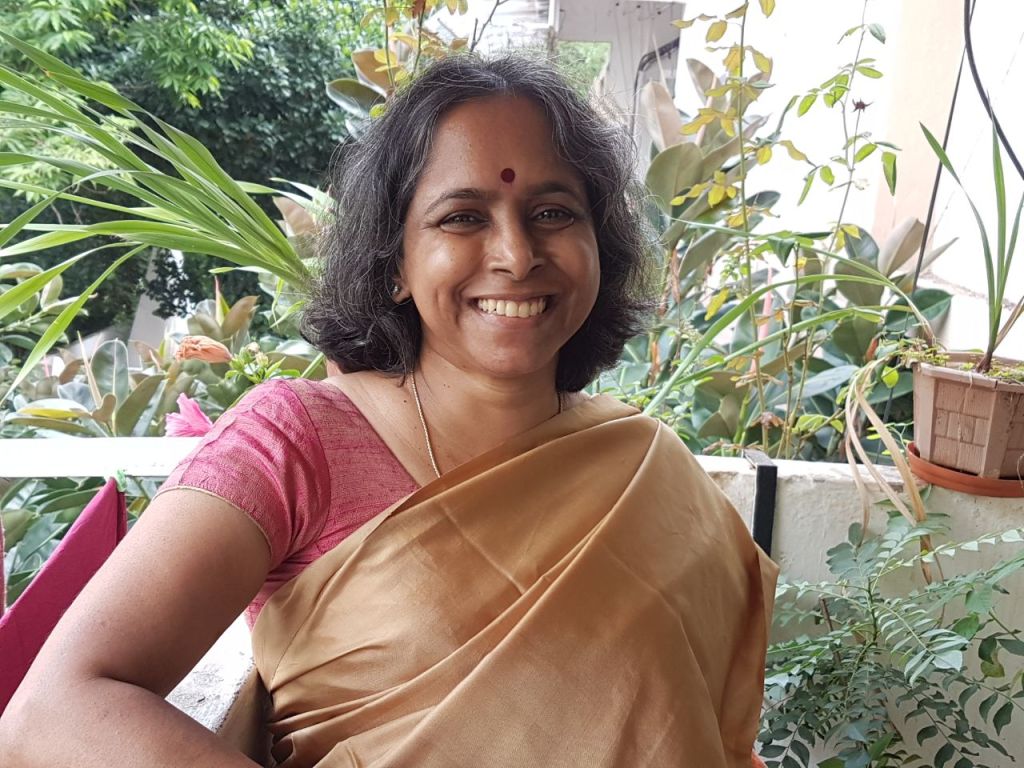
Geetha Ravichandranis a bureaucrat, presently posted in Mumbai. It is writing, that she most enjoys doing. She has written contemplative articles for Direct Path and middles for DeccanHerald. Her recent poems have appeared in Reading Hour and Mountain Path. One of her poems has been included in the recent anthology, Hibiscus published by Hawakal publishers.
.
PLEASE NOTE: ARTICLES CAN ONLY BE REPRODUCED IN OTHER SITES WITH DUE ACKNOWLEDGEMENT TO BORDERLESS JOURNAL.
The navel chuckles, “Don’t ask the colon’s opinion.”
Throughout this chatter
the brain has remained complacent.
“Have fun without me,” it sings
as it flits out an ear.
.
Penny Wilkes, MFA served as a science editor, travel and nature writer and columnist. Along with short stories, her features on humour and animal behaviour have appeared in a variety of publications. An award-winning writer and poet, she has published a collection of short stories, Seven Smooth Stones. Her published poetry collections include: Whispers from the Land, In Spite of War, and FlyingLessons. Her Blog on TheWrite Life features life skills, creativity, and writing: http://penjaminswriteway.blogspot.com/
.
PLEASE NOTE: ARTICLES CAN ONLY BE REPRODUCED IN OTHER SITES WITH DUE ACKNOWLEDGEMENT TO BORDERLESS JOURNAL.
Teenager Shivam Periwal from Kolkata writes about the recent protests and why there is a lesson for all of us.
Many years ago, the world saw mass bloodshed unravel in the form of world wars. Many people died fighting with other countries for equality, but they were oblivious to the morbid reality of their own country which saw an uproar in mercenaries killing the civilians.
The thing that they didn’t take into account was the harm that would fall upon their own country. It could cause deaths and unlimited sacrifices. The rich would get richer and the poor would become poorer.
Years before that, the world saw an increase in slavery as African Americans were oppressed and forced into becoming slaves for the rich, in order to prevent their children from sleeping on a hungry stomach.
There came a day when the African Americans had had enough and began their journey to freedom. People who were victims of racism wanted just one thing, justice. Everybody was scared and there was nothing one could do. You could either take part in the protest or stay inside your house under the bed or in some sort of bunker. Stores were broken into and small businesses were affected greatly.
One day all that vanished, when the innocent people who didn’t want war, took a stand. The merciless war ended and unity started to grow. There was harmony and brotherhood and now people started to think about others. People of all color, caste and creed were treated as equals.
Now again, the issue has come up due with the recent case of George Floyd who was killed brutally in the US by the police, because of his colour.
As a teenager it makes me sad to see the unjust killings in every nook and corner of the world.
The worst affected would be the children learning about racism and its disadvantages. They would feel sorry for this world. And deep down in their hearts they would get the feeling that someday at any given point of time, they might suffer because of racism too.
Instead of having conversations about happy memories, parents have to tell their kids how to protect themselves if they are targeted because of their colour. This can discourage the children and make them feel scared and insecure within themselves.
I write about it today because this is a world issue, not just an American one.
It is relevant to India too because after all we are a diverse country and despite our differences, of colour, religion, language and caste, we all have to live together and in harmony at the end of the day.
We have to stay united and beat racism to its deepest core or else it would change the future of this world.
We are on our fourth edition of Sara’s Selections. Ms Sara has again brought us a wealth of young writers, writing from all over the world on multiple issues. Sometimes it is amazing to see how they think… and also give us a fresh perspective… And now let me hand over the collection to Ms Sara.
Poetry
Hi there friends, Sara here. Fifteen year old Varisha Rehman from Delhi, giving us the just the right dose of it in this message to a girl.
This is for the girl
This is for the girl Who only wanted to be loved, Shone like a pearl And moved like a dove.
This is for the girl Who was like a queen, She ruled her world with everything.
This is for the girl Who wrote words no one heard, A pen was her sword A paper was her shield.
Here is a message to this girl Life has a funny way to teach us, Live your life without a grudge Live the life, you love. Just be yourself. Because… Life is too short to be someone else.
Nine-year-old Diya Sheth from Ahmedabad brings us some furry love in this adorable poem.
My Pet
One day I thought how pets love us a lot, So I told my parents to bring me a dog.
Father said we can bring two birds, Mommy said we can bring a turtle.
But still I argued for a dog, My parents refused so I cried a lot.
On my 10th birthday my parents told me, This time you will get a gift, You wanted from the age of three.
I wondered what it will be. I was so excited for it, My father gave a bow, My mother brought a puppy.
I thanked my mother and father, The dog’s name was Jimmy.
Now I play with him every day, He protects me in every way. We go on walk everyday, I still thank my parents for my 10th birthday.
Nine-year-old Rohan Santhosh from Bangalore shares this adorable poem for his best friend.
My Best Friend
You are smart and kind
You can almost read my mind
You’re the first to notice when I’m blue
You have a 6th sense, it’s true.
You’re so intelligent and strong
You always tell me when I’m wrong.
Always alert and aware
When I need you, you are there.
I still remember the day at school,
So scared of the teachers looks,
I almost dropped all my books.
You noticed the slightest frown
You picked me up when I was down.
When I’m confused you help me decide,
Thanks for being by my side.
I always wished I had a brother,
But now I see, you are one…
Just from another mother!
Stories
Eight-year-old Navoneer Bhattacharyya from Kolkata writes of the most amazing conversation with Lord Ganesha.
When Lord Ganesha cancelled his birthday party…
And we were off to bed. But neither I nor my elder brother could sleep as we were a bit upset. Next day was Ganesh Chaturthi, the celebration of the elephant headed god’s rebirth, but due to COVID we could not go for pandal ( temporary structures set up to jubilate the festive occasion) hopping.
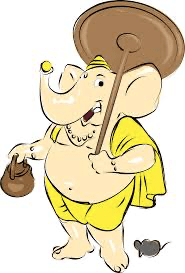
Nearly half-an-hour had passed when we heard a mouse squeak. We looked out and to our greatest surprise, what did we see there?
Ganesha & mouse
Lord Ganesha on his mouse was standing right outside our house!
“Lord Ganesha,” squeaked the mouse, “You said some kids are sad in this house so we have come here!”
“Yes you are right, we have come to meet them.”
My elder brother suggested that we should invite them to come in. So I opened the door and said humbly, “Oh Lord Ganesha, we would be honoured if you could step in our house and spend some time with us.”
modak
Laddu
He agreed and came in. We offered them some of his favourite sweets, modak and laddu. After having that he asked us, “Now tell me why all of you are so sad?”
I said,”Lord Ganesha, the Coronavirus is like the demon, Mahishashura. It is spreading death and sadness all over the world.”
“See here in Mumbai too, we cannot go for pandal hopping on our favourite festival, Ganesh Chaturthi.” said my elder brother.
Again I said, “Dear Lord, we all are terrified. Our life has come to standstill, we cannot have guests in our house. We cannot go anywhere; we cannot play with our friends; we cannot even go to school.”
Lord Ganesha listened to us very attentively and then he nodded his head and said, “My dear friends, I can understand your pain. But tell me one thing — is there no light of hope? I know doctors, scientists and lot of others are working day and night to protect the human race from this killer. But to defeat this deadly virus is not so easy. We Gods are also supporting these great warriors and patiently waiting for something positive to come out.”
He paused, took a deep breath and then again he said, “Us Gods are cancelling the celebration of our birthdays on earth just to protect mankind. Please, try to understand. If you want to overcome this hardship and again happily want to celebrate my birthday in future, then this year you need to sacrifice your festival enjoyment and be a little patient till my next birthday comes.”
I said, “Lord Ganesha, I know how it feels when birthday celebrations are cancelled as mine got cancelled this year too. But yes, you are right. We should be patient.”
Lord Ganesha smiled and said, “Hope you understood that it is time for Gods and humans to team up against the deadly virus and throw it out. Now all of you give me a big smile and a big hug.”
Then he left with his carrier and we bid them goodbye.
We all found that suddenly our sadness had gone and our minds had become light.
We looked into the sky and said, “Thank you Lord Ganesha. We love you a lot. Happy Birthday.”
This haunting piece by Aashvi Rajani from Ahmedabad is a beautiful example of what thirteen-year-olds can do. While most of us are fussing over missing our birthdayday parties and gifts, here is a story to showcase reality of a different kind.
An Unforgettable Birthday
Raheema’s typical day would begin with mopping their home in Kabul and end with her burying herself under heaps of assignments. But today was not a regular day, Raheema Jan would be thirteen today. It was a significant day. Under no circumstances could her parents afford an enormous celebration, but Raheema didn’t mind this, as long as Baba would be with her. Baba would be her shadow, against all odds.
“Are you ready Raheema Jan?” Baba questioned in a silvery tone, standing beside the flimsy door.
“In a minute!” She replied as she sprinted to pick up her book.
Raheema had picked up the skill of reading since she was five, yet hearing her father narrate a story was one of the most congenial things to her. He cleared his throat dramatically, and began, “I became…”
Baba’s eloquent storytelling came to a halt when Raheema spotted a figure hurtling towards them.
“What happened?” Baba’s hazel eyes narrowed as he saw Khalil gasping for breath.
“They are looking for you Agha, it’s urgent.”
His eyes laid on Raheema, she flashed a priceless smile that made him feel sorry for her. He crouched down and asked in a whisper, “Shall I go?”
She reluctantly nodded.
When Baba departed, Raheema locked herself in the washroom and unwillingly broke into sobs. Soon she was shuddering. Mâmâm interrupted her by banging the door. “Come out, Mariam is here to wish you!”
Carefully, she wiped her tears and prepared to be just the buoyant girl she was expected to be. “Happy Birthday!” Mariam beamed. Enthusiastically, she dragged Raheema out and began babbling. Baba kept crawling back to Raheema’s mind, despite her attempts to pay attention. Were they harassing him?
Mâmâm barged in to inform Raheema that she had to pay a visit to Akmal Agha’s mansion, and Raheema should return home. Obediently, the girl nodded.
“What’s going on Raheema? Is everything okay?” Mariam questioned. Initially, Raheema decided against revealing anything, but it was too much for her. And so, she confessed it all. She narrated how Baba was responsible for Akmal Agha’s residence, how the gangsters had an eye on it, how Baba had refused to sacrifice his integrity for them, how they had been receiving appalling threats.
Mariam gently embraced Raheema, who was now weeping. “Don’t—”
The air shattered and they heard a roaring crack, then, absolute stillness. Raheema darted to the street like a whirlwind, oblivion to all the eyes gaping at her. She was terrified to the thought of what happened. No, Baba wouldn’t leave her. She was his Shāhdaught, his princess.
What she saw at the end of the street was something she will never forget. Baba on his knees, soil smeared on his kameez. Alive. His hands were folded, tears rolling down his cheeks. A man in front flashed a lopsided grin and said, “You are fortunate because I will let you go this time.” His hoarse voice sounded like a melody to Raheema at the time. To her surprise, she was weeping as Baba dashed towards her.
Never did Baba’s embrace console her more. That was when she found herself detached from everyone but her Pādīshāh, Baba.
How can you play a good host to wild animals in your house? What a scenario to think of! Here is a very unique and empathetic story by nine-year-old Eric Johan from Chennai. Welcome to his world of creativity!
My Wild Home
One fine morning, I woke up and saw my bedroom full of wild animals.
I was surprised on seeing all the animals talking. A lion stood before me and said, “Do you have any animals to eat?”
I replied, “I don’t have any.” I saw the lion roared in great hunger and went away.
Then a big crocodile of twenty feet length came near me and asked, “Do you have any meat to eat?” I replied saying, “No.” Then the big crocodile went away.
Next a tall giraffe looked at me and asked, “Do you have any grass to eat?”
I answered, “Yes, you can find grass behind my house, in the garden.” The giraffe and his friends went joyfully to have the grass in my garden, but the lion and his friends were sad.
Suddenly my dad rushed into the room with some delicious breakfast. It had my favourite roasted chicken. The lion and his friends saw it and asked me, “How many plates of meat do you have?”
I said, “ We have twelve plates”.
The lion asked, “Can I have nine of them?” I said, “Yes, of course, you can.”
Finally, the lion and his friends enjoyed the meat and went away happily. It was the most amazing morning ever.
Essays
Ten year old Shashwathi V from Bangalore would like us to think beyond one day and beyond a few popular names to understand better the meaning of independence.
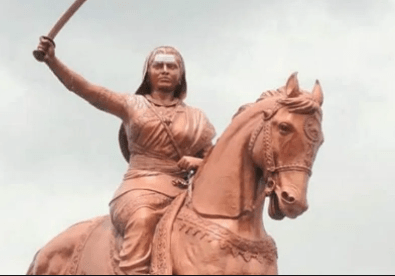
Here is a much needed write up on the courageous queen and freedom fighter from Karnataka, Kittur Rani Chennamma.
Shashwathi V is a student of CMS NPR, Bangalore.
Kittur Rani Chennamma: Remembering one of the first female freedom fighters
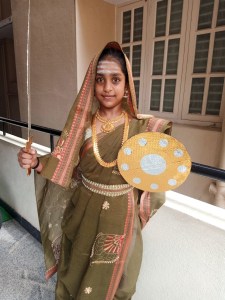
On 15th August, our 74th Independence Day, my school asked us students to dress up as freedom fighters. I dressed up like “Kittur Rani Chennamma” for my class celebration online.
She is one of our greatest freedom fighters but to my surprise some of my friends did not know about her. So I thought I should write about her for my friends who do not know about her.
Kittur Rani Chennamma was born on 23 October 1778, in Kakati, a small village in the present Belagavi District of Karnataka, India. She learnt to ride horses, sword fighting and archery in her childhood. At the age of fourteen, she got married to Raja Mallasarja. She became the queen of Kittur. After her husband and only son died, she took over the kingdom and adopted a son but the British refused to accept her son.
The British tried to take over her kingdom thinking she would easily give up but she fought them in a war in which she won. The British, angered by the defeat, fought more wars in which despite her bravery she lost and was put in jail where she died.
Like Jhansi Rani, who came several years later, she made a mark on the country for her courage.
She was one of the first female freedom fighters to resist British colonization. She is a national heroine, well known in Karnataka and a symbol of the independence movement in India.
Here is one of the inspiring lines she said in response to the British demanding high-taxes, that people remember her best by:
“Why should I pay you tax (Nimageke kodabeku kappa)? Are you my brother, sister, relative or a friend?”
This moving piece by eleven-year-old Mehr Kapoor from Kolkata is for everyone who ever left behind their house, and a piece of their life in it. How there is an urge to capture every little moment spent there!
Walk down the memory lane
We walked through the garden one last time, knowing we’d never return to this house again. My family and I were moving to a better house this very day and while we took a stroll for the last time in this beautiful garden it brought up a lot of emotions.
I thought about the day I was running around the garden playing games with my friends, knowing I would never be able to do that again. I think the most difficult part of moving is giving up the garden because almost everything in a house could be packed up however a garden is the one thing that one cannot take with them. I looked at the cherry plant which I had grown on my own. I remember I was very proud that day because it was the first time I had ever planted something on my own. As I walked away, I thought about whether the next family that would stay here would even want a garden? Maybe they will build something in place of that, the thought disheartened me. I moved away from the garden and went inside the house.
I went inside and to my room for the very last time. I tried to absorb everything around me because I knew I would never see it again.
I went around every room in the house this way, for the last time.
Whatever the new family would change about this house, I shall never forget it and the eleven special years I spent in this house will be memories that I will cherish forever.
We live in a world flooded with endless images, spending so much time and effort spent in clicking, editing and publishing them. But is this how it always was and is this how it should be? Ten year old Hridi Talati from Vadodara raises and answers some of these important questions in her wonderful essay.
Photographs are Memories on Paper
And click! 5 years ago your mother just clicked a memorable photo of you in the summer. Now you are skimming across your mother’s pictures when a bright picture catches your eye, you click on it and go down a little trip in your memory lane and flashback to what happened 5 summers ago…
Clicking a photograph means that you want to preserve a moment till the end of time, and when you look at that old photograph again you feel exactly the way you did that day.
Each picture holds a powerful feeling, whether it is sadness or happiness, anger or relaxation, nostalgia or forgetfulness. A picture doesn’t have to be perfect to be memorable, it just has to be heart-felt.
I am personally not a fan of editing a picture to make it look like it is done by a professional. Why would you want to spoil a perfectly good and truephotograph by adding false make- overs to it? It makes the photograph look a little too overdone, unless, of course, it needs the editing to make it look better.
A good memory is the most popular kind of picture because seeing it makes you feel pleased and happy. And so ,“When you think good thoughts, they will shine out of your face like sunbeams and you will always look lovely.”- Roald Dahl.
.
PLEASE NOTE: ARTICLES CAN ONLY BE REPRODUCED IN OTHER SITES WITH DUE ACKNOWLEDGEMENT TO BORDERLESS JOURNAL.
An exclusive interview with Kathleen Burkinshaw, author and the daughter of a survivor of the first nuclear blast that bloodied the history of mankind three quarters of a century ago
Kathleen Burkinshaw
The best introduction to Kathleen Burkinshaw is that she a humanitarian. She wrote a novel that has been taken up by the United Nations as a part of its peacekeeping effort. She has been actively participating in efforts to ban nuclear weapons, including presenting with Nobel Laureates. Kathleen Burkinshaw, the author of The Last Cherry Blossom, a book that is in the process of gathering further accolades, is a peace activist who talks of the effects of the nuclear war. She is the daughter of a hibakusha, a survivor of the Hiroshima blast that took place seventy-five years ago. Burkinshaw still suffers the impact of her mother’s exposure to the Hiroshima blast, where the protagonist of The Last Cherry Blossom, based on her own mother, sees her father die of the exposure and loses her best friend in the middle of a conversation. In this exclusive, Burkinshaw talks of the book, why and how it came about and the impact the bomb continues to have in our lives.
Why did you write your book? Tell us your story.
When my daughter was in the seventh grade, she came home from school terribly upset. They were wrapping up World War II in their history class, and she had overheard some students talking about the ‘cool’ mushroom cloud picture. She asked me if I could visit her class and talk about the people impacted by being under those famous mushroom clouds, people like her grandma.
I had never discussed my mother’s life in Hiroshima during World War II. My mother was a very private person and she also didn’t want attention drawn to herself. But after my daughter’s request, she gave me her consent. She bravely shared more memories of the most horrific day of her life. Memories that she had locked away in her heart because they had been too painful to discuss.
The main reason, my mother agreed (aside from the fact her granddaughter asked her), was that she knew students in the seventh grade would be around the same age she was when the bomb dropped. She was twelve years old. She hoped that students could relate to her story and by sharing her experience, these future voters would realise that the use of nuclear weapons against any country or people, for any reason, should never be repeated.
I received requests to visit other schools the following year. I began to write about my mom after teachers requested a book to complement their curriculum. I told my mom about this request.
Later that week, she sent me a copy of her most treasured photo from her childhood. It is the one of her and her papa (which is in the back of the book). When I looked at the photo which I remembered from my childhood because it always had a place of honour in our home, I realised there was more to her life than just war and death, she had loving memories as well.
That’s when I knew I needed to start the book months before the bomb was dropped. I wanted to show the culture, the mindset and the daily life in Japan during the war. I intended to give the reader the view of the last year of WWII and the atomic bombing through the eyes of a twelve-year-old Japanese girl—something that has not been done before.
That’s when I knew I needed to start the book months before the bomb. I wanted to show the culture, the mindset, and the daily life in Japan during the war. I intended to give the reader the view of the last year of WWII and the atomic bombing through the eyes of a 12-year-old Japanese girl-something that has not been done before.
Your book explores colours of Japan. How different is it from US?
The Last Cherry Blossom (TLCB) discusses life in Japan during WWII. I wanted to show how the Japanese citizens viewed their political leaders — very different from the US. I also wanted to show that Japan had been at war for 14 years (they invaded Manchuria in 1931) by the time of the atomic bombing — they were out of so many natural resources, as well as the young soldiers. The majority of the Japanese soldiers were fighting out in the Pacific. So even though Hiroshima was once a strong military port, in 1945 it was mostly elderly, women, and children. In addition to that, the firebombs dropped on Tokyo decimated that city and other areas in Japan had endured Allied bombing. The US did have the horrific Japanese attack of Pearl Harbor, bringing the US into the war — but no other US cities with citizens endured bombing after that. However, what I really wanted to emphasise was the similarity between the two countries. The children in Japan like my mom, loved their families, worried might happen to them and wished for peace. Exactly the same as the children in the US.
When and why did your mother move to US? Did your mother find it difficult to adjust?
My mother met my dad (a white American serving in the Air Force at a base close to Tokyo) in Tokyo. They married at the US Embassy in Tokyo in 1959. His time serving ended shortly thereafter and they moved to the United States.
Yes, my mother found it difficult to adjust. My mother didn’t expect the prejudice and racial slurs against her. She figured it was 14 years after the end of the war and she was on the losing side. She didn’t tell them about the atomic bombing-she wanted to have the least amount of attention. She told everyone she was from Tokyo. I didn’t even know she was from Hiroshima until I was 11.
She wasn’t a shy person. She was intelligent and determined. She learned English and became a citizen within 5 years of arriving in the US. She had a job at an electronics company and made circuit boards that were on Apollo 11. Unfortunately, the town we lived in had very few Asian people and none of them were Japanese. When I was born, she “Americanised” (her word) our home. She wanted people to know that I was an American so I would not experience racist actions. However, being one of the few Asians in elementary school, I experienced quite a bit of prejudice and racial slurs, anyway.
My mother was the bravest person I will ever know. She lost so much on August 6th, 1945. Yet, she never lost her ability to love.
The UN has taken up your book as part of its peace process. Tell us a bit about that.
In December of 2018, John Ennis, the Chief of Information and Outreach at the United Nations Office of Disarmament Affairs (UNODA) contacted me after reading The Last Cherry Blossom. He felt very strongly that the book should be used in classrooms to future voters. Nothing like it has been written before from this point of view of a 12-year-old girl. He told me that it would be designated a UNODA Education Resource for Students and Teachers. I was beyond happy that a book honoring my mom and what she experienced would be on that list. Later in 2019 UNODA invited me to the United Nations in NYC to discuss my book at the UN Bookshop as well as to participate in a workshop for NYC teachers on how to add nuclear disarmament to their curriculum. It was a surreal honour to be a presenter with Noble Peace Prize winners Dr. Kathleen Sullivan and other members under the International Coalition Against Nuclear Weapons (ICAN) for the Treaty to Ban Nuclear Weapons!
What exactly do you do to create an awareness about the nuclear issue?
In addition to interviews like yours I have spoken at teacher conferences, school librarian conferences throughout the United States. In addition to that TLCB has been on many school lists so I have had opportunity to speak with students, future voters all over the world! For example, I have had the joy to speak with students in Hiroshima who have chosen TLCB to be their 6th grade read for 4 years in a row. The students also made my first book trailer. The latest group of students I had the joy to speak with were in India!
I feel that the more I can discuss my mother’s experience so that students can relate and connect to the devastation, horror, and loss my mother and her family endured — they leave that classroom as future voters knowing that nuclear weapons should never be used again.
Do you think after the holocaust another nuclear war is likely? How do you see the role of your book propounding peace?
People have asked me 75 years later — why should these stories still be told? Well time passes, and technology changes but the need for human connection through emotions is timeless. So, I feel that while statistics and treaties are very important — if we can’t get people to understand/relate to the humanity under those now famous mushroom clouds, then none of the numbers or science is going to matter. And if it doesn’t matter because there is no connection, then yes, we are at risk of repeating the same deadly mistakes again.
I hope that TLCB relays the message and an emotional impact that two paragraphs in a textbook could never do. I want readers to understand that NO family should ever have to endure the hellish, horrific deadly destruction that MY family has.
I lived with the scars of the atomic bombing during my childhood watching/reacting to the post-traumatic stress disorder (PTSD) effects on my Mom and I still live with it each day with Reflex Sympathetic Dystrophy (chronic, progressive neuro pain disease that affects the sympathetic nervous system). Doctors have said that the damage to my immune system from the radiation my mom was exposed to from the atomic bomb, attributed to this.
.
This was an online interview conducted by Mitali Chakravarty
.
PLEASE NOTE: ARTICLES CAN ONLY BE REPRODUCED IN OTHER SITES WITH DUE ACKNOWLEDGEMENT TO BORDERLESS JOURNAL.
Click here to read the review of The Last Cherry Blossom.
On August 6, 1945, at 8.15 am, an atom bomb was dropped at Hiroshima to end World War II. Archana Mohan takes us on a journey through a novelwhich gives the story of before and after the bombing & currently lauded and promoted by the United Nations for peacekeeping.
Title: The Last Cherry Blossom
Author: Kathleen Burkinshaw
When a book opens with American B-29s flying overhead and school children cowering under desks hoping they are alive to see what grade they got on their school report, it is a wake-up call.
War has no business threatening children in their safe temples of learning.
But what is war really? It is when we forget that the enemy is a human being too with lives just like ours. That, is the crux of The Last Cherry Blossom, a sparkling debut novel filled with hope and resilience by Kathleen Burkinshaw.
The story, set in Japan, in the 1940s, centers around a pleasant 12-year- old named Yuriko.
Yuriko is an average middle grader. She struggles in government mandated bamboo spear classes and can’t sew to save her life. At home, her aunt isn’t cordial to her and her five year old cousin just keeps pressing her buttons but she is a happy trooper thanks to the two people who love her and understand her like no other — her Papa, a well respected newspaper editor, and her best friend, Machiko.
Soon, there are big changes in Yuriko’s life – a new addition to the family and a stunning secret but all of those pale in comparison to a chilling realization – even though the authorities claim otherwise, Japan is losing the war against the allies.
Amidst the colourful ‘kimonos’, the tea ceremonies, dips in koi ponds, the delicious Toshikoshi Soba and the beloved Sakura Hanami (the cherry blossom viewing), the smell of the inevitable lingers on.
In a poignant moment, Yuriko’s best friend Machiko, who has been drafted to work in an airplane factory says that she doesn’t even bother moving to an air raid shelter because she is too exhausted to care. Still, they carry on, like teenagers do, with their banned American Jazz records, crushes and heart to heart talks.
Until one day, the nightmare turns true.
An ear shattering popping noise.
An intense burst of white light.
And just like that, the lives of Yuriko and everyone around her are never the same again.
In an earlier insight into her mind, Yuriko confesses that she loves mathematics because everything is black and white. But when you lose everything you love, for no fault of your own, does anything make sense anymore?
The cherry blossoms are the glue holding this story together. It is at the cherry blossom festival that the family is together for one last time, hence the title but the significance of these beautiful flowers go deeper than that.
They represent life itself — so beautiful, yet so fragile that they bloom for only a short time. The characters who lived a privileged life before, come to a realisation that not everything can be foreseen, not everything can be planned but life is about living it to the best potential.
This is not a fictional story. The author’s mother herself is a ‘hibakusha’ or a survivor and this is her true story.
No one knows the devastating effects of warfare more than the author. Effects of the radiation from atomic bombs impact generations and Burkinshaw unfortunately suffers from a chronic neurological disorder because of that.
This is a deeply moving and personal story, laying bare the far reaching effects of war and that is why the book is now a United Nations Office for Disarmament Affairs Resource for teachers and students.
Perhaps, the greatest quality of the book is the hope it weaves into the narrative despite the desolation and fear that paints the landscape after the blast.
A point it makes with the versatile cherry blossoms again.
Scientists said nothing would grow again in the Hiroshima soil for many years after the atomic bomb was dropped. Yet, the cherry blossoms defiantly bloomed the following spring.
“The cherry blossoms endured much like the spirit of the people—like my mother—who were affected by the bombing of Hiroshima,” writes the author.
Seventy five years ago, on August 6, 1945 at 8.15 am, the atom bomb or ‘pika don’ killed 80,000 people and the toll rose to more than 1,40,000 within the next five years.
As Yuriko grapples with difficult decisions in the aftermath, through her eyes, something becomes clear as day. We must never find ourselves in a position where the colour of the sky is no longer unrecognizable.
Never must we forget what happened in Hiroshima that day. Never again must we take peace for granted.
.
Archana Mohan is the co-founder of Bookosmia (smell of books) a children’s content company that delivers brilliant content to the world through Sara — India’s first female sports loving character. Her book Yaksha, India’s first children’s book on the dying folk art form of Yakshagana received wide acclaim. She has worked as a journalist, corporate blogger and editor working with names like Business Standard, Woman’s Era, Deccan Herald, Chicken Soup for the Soul and Luxury Escapes Magazine. She won the Commonwealth Short Story contest’s ‘Highly Commended Story’ award in 2009. She loves interacting with budding writers and has conducted journalism workshops in colleges.Do check out Bookosmia’s website https://bookosmia.com/about-us/ for more information.
.
PLEASE NOTE: ARTICLES CAN ONLY BE REPRODUCED IN OTHER SITES WITH DUE ACKNOWLEDGEMENT TO BORDERLESS JOURNAL.
“Are you sure it’s safe for us to be this close?” Anushka asked.
“I don’t know. They said it’s not over,” Rizwan said.
“Who says it’s not over?”
“It’s all over the radio,” Cheng said.
“All over?” Rachel asked.
“It was on every channel I was scanning this morning.”
“You can’t believe everything you hear.”
“It’s from the Ministers. The 6Gs.”
“We don’t even know who they are. All we hear about them is from the radio,” Anushka said.
“But everything they said had turned out to be true.”
“We aren’t sure of that. All we hear is the numbers of people who disappeared from some voice who claims to have the mandate to govern,” Rachel said.
“The voice had been right about the virus,” Rizwan said.
“If it’s a virus.”
“I don’t know what else to call it. It makes logical sense that the government would have a continuity plan, some kind of team after things fall apart.”
If the government was smarter, it wouldn’t have needed a continuity plan, Cheng thought. But then again, no one has seen anything like this. Who would be smart enough to know that people would start turning when two or three were gathered. Physical contact seems to be the main trigger, but reports had come in of people mutating even when they were near each other.
“Hey, watch the distance!” Anushka yelled.
“Sorry, let me move a bit,” Cheng said.
“I don’t want to become one of them, not at a time like this. Sorry, I don’t mean you have it.”
“I know, I know, I’m sorry.”
“It’s okay. Are you sure this is going to work though?”
“I don’t know,” Cheng said.
“We have to hold hands. I don’t think it’s a good idea,” Rizwan said.
He looked at the symbols they have set up for the ritual. Five stars and a moon drawn in blood and white chalk on the ground. The four of them had seen it in their dreams, a city of glistening mirror colossi, glistening with the reflected sun under clean blue skies. It was so vivid that they could smell the aroma of the air and the soothing embrace of the heat. And the people! None of these horrid mutations that flailed and shrieked about. What they would have given to just walk down the street without the risk of getting mauled by their twisted limbs or infected by their touch! If they did the ritual right, that’s where they would be — or at least that’s what they thought.
“We don’t even know if it’s going to work,” Anushka said
“You’ve seen it. You’ve seen it in the dreams,” Rachel said.
“It could be that. Just dreams. Nothing more.”
“We’ve come this far, we’ve got to give it a shot.”
Rachel looked at her friend from secondary school. She wanted to tell her that it was alright, that once it was done, she was sure that the ritual would open up a better world for them. But she wasn’t sure. The legend had been circulating after the mutations spread throughout the world. The sickness was biological, but it was something more. There was talk that it could bend reality, which explained how the virus warped human physiology. When this idea spread through the airwaves, it led to several theories about a hidden gateway to a parallel world — similar to theirs but with a brighter fate.
“Lots of people have died to come to this place. We got lucky, we’re here now,” he said, remembering the many moments in their journey when they narrowly escaped death. Mid-way, Cheng had caught a bad case of fever and breathlessness, and he felt that his body was turning inside out. It was the most fearful experience he had in his entire life. Just put a bullet in my head, he told Anushka. He heard her refusals through her soft sobs, but he didn’t want to end his life as some kind of inflamed monstrosity. No one dared to go near him, and that sense of isolation fuelled his anguish. He didn’t know how they got through it but the fever faded after a week. It delayed the entire journey, and depleted their rations ahead of time.
Johnson, one of their original companions, died of hunger a few days after that. Since then, Cheng hadn’t been able to sleep well. Even if they succeeded in getting out of this place, he knew his feeling of partial responsibility over Johnson’s death would continue to demonise him for the rest of his life. The four of them readied the items. The candles were set around the six symbols painted.
“It looks a bit like our flag, isn’t it?” Rizwan asked.
“A little,” Cheng said.
“What do you think we saw?”
“I don’t know. But it sure looks better than here,” when those worlds rolled out of Cheng’s tongue, he realised how absurd it sounded. It didn’t bode well for hope. He was beginning to think that this was all a mistake. He tried to comfort himself by thinking that that the distance between them and freedom was that one metre which prevented transmission, but his heart began to tremble and he prayed that his fear wasn’t showing.
“That’s it. All we need to do is to hold hands and close our eyes,” Cheng said.
“How long?” Anushka asked.
“I don’t know. What did the stories say?” Cheng asked.
“They say you will hear crackling in the air and the stench of death will be gone,” Rizwan said. He was haunted by hesitations, but they had come this far. If ahead lay death, it was nothing better than what they were leaving behind.
“Are we ready?” Cheng asked.
“I don’t know,” Rachel answered.
“Let’s start with the first step.”
The first step could be the deadliest. They stared at each other for what seemed like lifetimes, before they slowly reached out with their hands. When their fingers touched, an icy sensation crept up their arms and spine. Cheng cursed. The foul words released the tension from his shoulders and throat like a magical incantation.
“We’re still normal,” Cheng said.
“That’s a good start,” Anushka said.
“Okay, then we just keep repeating the chant?” Rachel asked.
“Yes,” Rizwan said.
And they begin to sing. The words and melody filled their minds and the room. The lyrics and music were familiar, they sang it every morning before school started — though the tune of this version was slightly distorted.
Eyes closed, it was hard to tell how much time had passed.
They were lost in the words. As they became more absorbed into the verses, they felt themselves dissolve. But without opening their eyes, they couldn’t know what was going on. A thought came up in Rizwan’s mind. He felt removed from the entire process — like a disembodied eye that watched over them. They were still in the room, he felt.
There was nothing left to do but to carry on. And so they continued — drowning in the sea of words and time, waiting and waiting, only coming up to grasp the scent of fresh air.
.
Tan Kaiyi is on a literary odyssey to unearth the wonders and weirdness within the mundane. His poems have appeared in the Quarterly Literary Review Singapore (QLRS). His play, On Love, was selected for performance at Short & Sweet Festival Singapore. He has also been published in Best Asian Speculative Fiction (2018), an anthology of science fiction, fantasy and horror stories from the region.
.
PLEASE NOTE: ARTICLES CAN ONLY BE REPRODUCED IN OTHER SITES WITH DUE ACKNOWLEDGEMENT TO BORDERLESS JOURNAL.
Paresh Tiwari is a poet, artist and editor. He has been widely published, especially in the sub-genre of Japanese poetry. A Pushcart Prize nominee, his work has appeared in several publications, including the anthology by Sahitya Akademi, ‘Modern English Poetry by Younger Indians’ released to celebrate 200 years of Indian English Poetry. ‘Raindrops chasing Raindrops’, hissecond haibun collection was awarded the Touchstone Distinguished Books Award in the year 2017. Paresh has co-edited the landmark International Haibun Anthology, Red River Book of Haibun, Vol 1 which was published by Red River Publications in 2019. He is also the serving haibun editor of the online literary magazine Narrow Road.
.
PLEASE NOTE: ARTICLES CAN ONLY BE REPRODUCED IN OTHER SITES WITH DUE ACKNOWLEDGEMENT TO BORDERLESS JOURNAL.
It was an early Saturday morning when I dropped my eleven-year old for a race in northeast Singapore. My son was excited to find his friend and I was anxious to find a coffee shop and nose-dive into the novel I had started last night. The race, I had been told, would last for over an hour. As we waited on the sidewalk for the light to change, I cheered up sighting a small mall on the left. Suddenly, the clouds cover shifted to reveal a clear blue sky. In the horizon, misty clouds shimmered and spun gold.
We entered the lush grounds and my sneakers made a squelching sound. I grimaced. It must have rained last night. How were they going to run?
“Mama,” My son tugged my hand to let me know he’d spotted his friend. And in the next instant, with a quick “Bye, will call you when it’s over,” he darted towards the long cue in front of the uniform booth. For a few moments, I stood there. My eyes followed him until he joined his friends, and I forced myself not to walk after him to demand a goodbye hug. Catching the second, “you can go away now” look from him I turned around and trudged back.
I crossed the road and headed straight for the mall already anticipating the strong aroma and the smooth taste of a cappuccino, and then stopped, stumped. The glass doors were shut. I stared through the glass doors trying to get the attention of the cleaners who mopped and vacuumed. No luck. I stepped back and caught the sign for opening and closing hours. The mall would open at 9 AM. Impossible. This was supposed to be the “me” time. I peered again into the glass doors but when it was clear I would get no attention, I turned around and debated my options. I could head back to the park and wait it out, or explore the area. Pushing away the thoughts of the page-turner in my tote, I opted for the latter. In a few minutes I had crossed a few blocks and found myself in a quaint neighbourhood. I walked along a narrow road with colourful buildings on either side. Red and gold decorations adorned many doors. Some grocery and home supplies shops were already open.
I continued to walk further, and hearing chatter, turned a corner, stopped, and stared. It was a small hawker centre with a row of stalls and a few dozen tables. All the tables were full. Grandparents, parents, and children gathered for the morning meal. Glasses and plates clinked and clanked.
Young and old and ate together. In one corner, a mother helped her son with his homework. In another corner a man helped to feed his aged mother. Some families exited, and more entered. They knew each other and stopped to talk and share news. Two young children played a game in a corner.
I moved forward drawn by the whiff of strong black sweet coffee mixed with the aroma of fried roti paratas, and creamy coconut laksa. My eyes lingered over mounds of white rice on fresh green pandan leaves, crisp leafy vegetable heaped on steamed noodles, stacks of butter toasts, bowls of soothing ayam sotto, and moist carrot cakes.
Spicy. Savory. Salty. Sweet. Flavors and colors blended and melted together. They ate different food, but they ate together.
Food brings people together.
Had I read it somewhere or heard it from someone? I didn’t remember. But in that moment, something shifted. The easy banter, the jokes, and laughs made me pause. I saw an old Chinese man offer a bowl of noodles to his friend. I saw an Indian dad urge his daughter to finish her vegetables. I saw a little Malay boy perform magic tricks to make his grandmother smile. Frowns faded. Faces beamed. From the ease with which they interacted, I sensed they knew each other and lived close by. Had they grown up together, shared life events, and supported each other through difficult and challenging times? Their differences ceased to matter when they ate together and shared food. In that one moment in a small hawker centre, I saw Singapore, a nation of approximately 5.7 million people and diverse ethnic groups become one. Warmth and love wove around them like fairy dust.
The Uncle at the coffee stand beckoned, and I ordered a black coffee. A distant memory tugged. I had seen this in my home country once upon a time, when neighbors knew each other and looked out for each other and when they ate together. Men, women, children, all together. No more. I remembered years back when my cousin had wandered outside our gate and walked to the nearby market and the fruit vendor had brought him back. The time was gone. But it existed here in this instant, where the individuals fused into families, merged into a vibrant community, and cemented into one strong nation. When people ate together, meal after meal, day after day, year after year, they became one, one nation.
I smiled at the Uncle as he handed me my coffee and decided that my son and I would have breakfast together before we headed home. I turned knowing I walked away something special, glanced back one last time and blew a prayer. Peace. Protection. Prosperity.
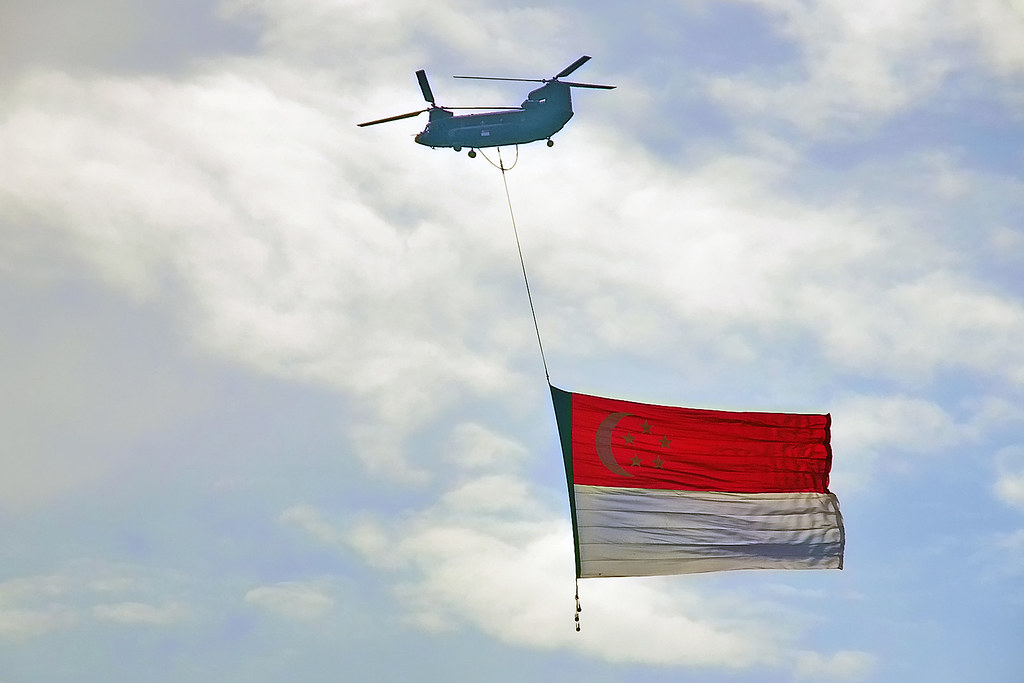
Happy National Day, Singapore.
Aysha Baqir grew up in Pakistan. Her time in college sparked a passion for economic development. In 1998 she founded a pioneering not for profit economic development organization, Kaarvan Crafts Foundation, with a mission to alleviate poverty by providing business and marketing training to girls and women in low-income communities. Her novel Beyond the Fields was published in January 2019 and she was invited to launch her book at the Lahore and Karachi Literary Festivals and was featured in the Singapore Writers Festival and Money FM Career 360 in Singapore. Her interviews have appeared in Ex-pat Living, Mount Holyoke Alumnae Quarterly, Kitaab, and The Tempest. She is an Ashoka Fellow. www.ayshabaqir.com
PLEASE NOTE: ARTICLES CAN ONLY BE REPRODUCED IN OTHER SITES WITH DUE ACKNOWLEDGEMENT TO BORDERLESS JOURNAL.























 Borderless