Categories
Essay

Time is a Holy Substance

By Dustin Pickering

If any diagram were even to suggest my meaning, it would be a spiral, with unity to begin with, a spiral enlarging itself as a consequence of its selective open-ness to the press it responds to. The image of rings of growth in a tree would be helpful if they did not suggest more or less even growth around a center, when in fact concrescence witnesses to the fact of its uneven career in the environment. Thus, the ground for affirming the continuity of the datum-person (a) with the subsequent growth now (b) is that (b) is a unity with datum-person (a) with (b) as its new change growth. The route or series of successive experiences is possible because each moment in the succession is the original and creative unity that is able to maintain its essential activity-potentials as it interacts with its ambient.

 — Peter A. Bertocci, “The Essence of a Person”

In truth, in the actual present the self transcends change or mutually external time-lapses, through the act of synthesis by which it grasps a succession as one and continuous. The simultaneity, or so-called timelessness of a self, consists in this power of continuous synthesis.

 — Joseph A. Leighton, “Time, Change, and Time-Transcendence”

Our notion of time, then, is the empty form into which we project from the living present the continuity of our interests, aims and values. Actual time can have no more continuity than human ideas and purposes and the ideas and purpose of other psychical beings may have. Time is the shadow cast by the unsatisfied will of man across the world of becoming. It is the mark of the incomplete moving towards completion. And the so -called direction of time’s flow is determined by the tensions of human interest and aim. Hence, the movement of history and biography appears as an irreversible series of qualitatively individual acts and never-to-be repeated events, in contrast with the reversible character of a purely mechanical system.

 — Joseph A. Leighton, “Time, Change, and Time-Transcendence”

The doctrine of the Trinity is difficult and perhaps there is no way to firmly master it. However, the creative potentiality in the human mind enables reflection and steady thought on deep subjects. If we apply our reflections to God as essentially one in essence but three in Personhood, we can arrive at a few conclusions concerning the nature of time, the limitations of Being, and the wisdom of our destiny.

The human mind is both conservative and liberal in its tendencies. It both desires static predictability and motion forward. Our minds individually are therefore two value sets within one another. We want motion and change yet long for the past and its certainty. Time is an empty concept without its tensions. Its ability to both Be and Become, to sustain moments while lifting out of them to the next enjoyment, is something unique about the experience of living. These steady tensions make advancement possible and preserve the good foundations of our being.

It must be noted that these tensions originate somewhere. We can safely attribute them to motion and flux throughout time—that is, Becoming. Yet we know Being has its place too. The present moment is composed of the fading past and the emerging future. This seems to imply that time can be both divided and united through the same dichotomy.

This dichotomy is the dissolving crux of Being. The continuous flexing of moment after moment offers an array of possible definitions. We “will” them into existence. Time creates its own environs but it is the human mind that interprets and decides the fact from the excess. History is an accumulation of determined patterns reconciled with human nature. The facts are arranged to suit narratives that are pre-assumed by values. These values shape our thinking and organize events into lucid structures. We are able to affirm and imperil powers depending on values we choose. Our constructs serve a larger purpose of arranging and envelope planning and expectation. We are thus limited on how we imagine events because our nature is confined.

Perhaps it is possible that the Trinity creates an environment of divinity similar to how time creates one for us? The three-in-one essence defies logic on first glance. But what if these three persons create a set of relations: that is, an environment where creativity emerges? There is more to divinity than mind or thought. Essence is an all-encompassing question that ambitiously defines selfhood. An environment is a structure one relates to and with, and it also limits the person within it. Will is free but also limited. You must circumcise your dreams before they can fly.

The Trinity then, by being three Persons united (and thus creating Selfhood), initiates a constructive conversation between the Godhead and His separate aspects. Are these roles chosen for the Ultimate? No, because then they are chosen by the Ultimate. What after all is timeless existence? In one verse, God is described as “the Alpha and the Omega.” Beginning and end are the determinants of causality and God is the Ultimate. Therefore, the end of time is the final recognition of all that takes place—that cyclical, static embrace. Time is shot like an arrow and as in the poem, “falls I know not where.” The seemingly aimless nature of time is actually due to its hidden dimension as God. God is an extension of reality rather than the embodiment of it. An appropriate analogy is the unconscious mind that conceals yet drives being overmuch.

Time then, as we know it and conceive it, is a phenomenon chained to itself and unable to escape the influence of our creative mind. Mind (is it true?) is a substance, a mere signifier for material processes. Language structures are hardwired into the brain and form a complex sum of orientations. If language is mind’s product, then it is a product developed and sustained by the neural structures of the brain. Their patterns of being and developing are what make language possible for an individual.

Now I may interject that I believe God is a substance. That is, what T. S. Eliot called a “stillpoint.”  It is a feathery substance but a highly charged, hyper-velocity, moment in the purity of being itself. Its fundamental nature, however, is as we described. Underneath the dense layers of our physical existence, within them, is an intense reverberating energy that individuates all things. Although the human capacity to think is granted in our divine nature, self-awareness stops short of perceiving its source. Limitations are natural to that which is created but not to that which is self-created. All is the fluctuation of mind, yet the mind is not ours. Our imperfect ability to perceive, understand, and know is due to being separate of God yet of the same essence. We know the Tree of Immortality is guarded by a cherub with a flaming sword.

This individuation is the product of a triple tension: a tension that springs from duality, and a third that releases creative potential. The third tension is the Son released into the world. All three have existed since time immemorial but remain within the material our known being constitutes. This divine conversation is the height of what is holy. In Hinduism the Trinity exists as three separate beings known as Brahma, Vishnu, and Shiva; together, they form the essence of Godhead which is Being that unites, calibrates, and also tears apart order to restore it. The Godhead floats through being as Being itself. The supreme Godhead is never found. Rather it is felt through its powers. It’s being is substance, but its actions and motions are ephemeral and glorious. Is Desire something transformed, or something we can understand logically?

Holiness is something beyond our own understanding because our being limited through its engagement with the divine. This dialectical understanding is a communication between Creator and Created. It is this relationship that develops our free will and determined existence. All things must have foundation for the sake of stability. The foundation of Godhead is groundless being. It restores and spans eternity. To communicate with it through your individual existence is the most powerful and blessed thing offered to the human frame.

.

Dustin Pickering is the founder of Transcendent Zero Press and editor-in-chief of Harbinger Asylum. He has authored several poetry collections, a short story collection, and a novella. He is a Pushcart nominee and was a finalist in Adelaide Literary Journal’s short story contest in 2018. He is a former contributor to Huffington Post. 

.

PLEASE NOTE: ARTICLES CAN ONLY BE REPRODUCED IN OTHER SITES WITH DUE ACKNOWLEDGEMENT TO BORDERLESS JOURNAL. 

Categories
Humour Poetry

The Confession of a Bibliophile


By Palak Tyagi

With foggy glasses and a throbbing pulsation,
Curling beneath her blanket
As she yonderly revels in her sanctuary tonight
Her aspectabound visage becomes a canvas
Of the erratic sinking and brightening of her eyes
And of precipitous manoeuvring of her jaunty eyebrows
As she dives into the final chapter, leafing through which
When her last words arrive,
A tear rolls down her eye.
Tugging on her blanket on the cold wintry night
Latching onto her book tightly, holding it by the spine
She ingests the wooden chocolate scent
As she runs her frail soft fingers through the pages one last time,
Another tear rolls down her eye.
She sits there gaping at the cover for cover for a while
And this spell is broken when she takes notice of her mother.
All choked up, she looks at her and yelps — “Hi!”
Tugging on to her, she says, “You know I didn’t want it to end tonight”
And her mother ensconces her on her lap and says,
“Don’t worry, I’ll stop by the library to fetch some more for the fortnight”

Palak Tyagi is from New Delhi, pursuing her major in Economics from University of Delhi. A flamboyant personality and an avid admirer of beautiful cotton candy clouds and azure hues of sky, she’s an absolute bibliophile who likes to pen down her musings and has a love for learning different languages.

.

PLEASE NOTE: ARTICLES CAN ONLY BE REPRODUCED IN OTHER SITES WITH DUE ACKNOWLEDGEMENT TO BORDERLESS JOURNAL.
Categories
Review

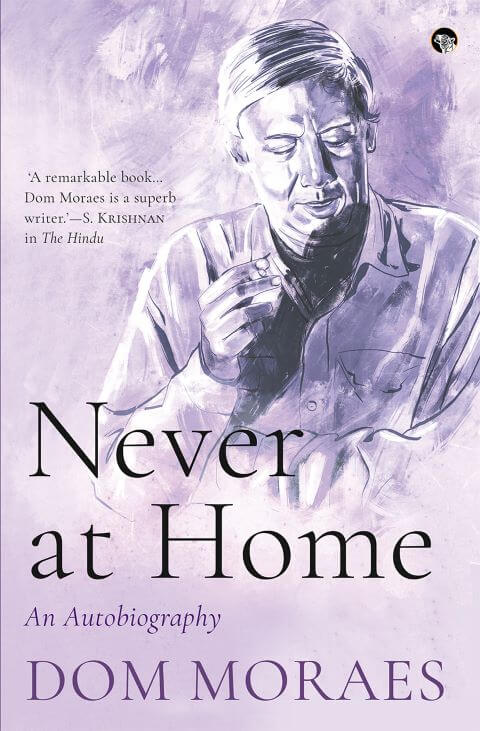
“I am waiting to be at home; where, I don’t know yet”– Dom Moraes

Book Review by Rakhi Dalal

Title: Never at Home

Author: Dom Moraes

Publisher: Speaking Tiger, 2020

Never at Home is the third memoir in the trilogy of memoirs written by Dom Moraes. The others being Gone Away (1960) and My Son’s Father (1968). This volume was first published by Penguin India in 1992. Here the author writes about his life from 1960 onwards.

The first chapter is a brief account of the phase of his life after winning the prestigious Hawthornden prize at the age of twenty. By the time he turned twenty two, Moraes already had two poetry collections and a memoir to his name. In order to earn a livelihood, he then started writing features and reviews for newspapers. In 1965, he brought out his third poetry collection John Nobody. After James Cameron impelled him to take up journalism, Moraes started travelling and for the next seventeen years he couldn’t write poetry. For someone, who from his childhood knew that he wanted to be a poet and to live in England, he spent a considerable period of his life in transit without writing any substantial poetry. Never at Home chronicles those years he was engaged in navigating the world to collect stories and interviews.

This volume is the third and final in his collective memoirs – A Variety of Absences, which take its name from the poem Absences written by him after a long hiatus from poetic fervour. The book focuses more on Moraes’ professional life as compared to his personal life taken up in his second memoir so that its prose is not as poetic or intense as in My Son’s Father but nevertheless, it is a notable piece of literary writing. It may also be deemed as a historical archive because it records some very important and interesting snippets and observations from the political world he traversed and eminent leaders he met.

The critical success of Gone Away, his first memoir, brought him writing assignments which included scriptwriting for a documentary on India. As a journalist, he covered Eichmann’s trial in Jerusalem and wars in Algeria and Israel. In his mind he had always been an English poet in England and had no idea of the tribulations other immigrants faced. A BBC documentary commissioned to him made him look at the living conditions of Asian immigrants, specifically from India and Pakistan. This documentary brought him closer to the reality of being an outsider in a foreign country.

While writing articles for The New York Times Sunday Magazine, Daily Telegraph, Nova and many others magazines, he met and interviewed many distinguished personalities and important world leaders but perhaps none left as deep an impression upon him as Indira Gandhi, whose biography he was later to write. The liberation of East Pakistan, now Bangladesh, had made her a star in the eyes of its natives who were till then hostile to Indians. Moraes writes at length about his meetings with her, about her charismatic personality, political astuteness and her almost invincible demeanor.

His descriptions of the journalistic assignments, which took him across many countries and gave him the opportunity to bring out stories to the world, are finely detailed. His keen eye presents a balanced perspective on the stories he covered, never going too far and never delivering too less. His most important works included a story on political prisoners in Buru and on the tribal people in Dani in Indonesia, the titles of the articles being ‘The Prisoners of Buru,’ and ‘The People Time Forgot’. His Buru piece evoked a violent response in Indonesia. Moraes was banned from entering the country again. But this piece was the first one to come out from the place and the issue was picked up by some human rights organisations leading to a release of seven thousand from the imprisoned ten thousand people. This, if anything, is a proof of the important voice he had become in journalism.

Although, Moraes’ work kept him busy in the world but he could somehow never get rid of the images of his traumatised childhood. As in the case of his second memoir,here also he writes considerably about his fear of confronting his mother. The accounts of his meetings with her are laced with the anguish and anxiety he had experienced in her presence always. Except his mother, all the other women in his life are only addressed in passing. He never dwells much upon his relationship with either his second wife, Judith, mother of their son Francis, or with his third wife, Leela Naidu. In comparison, his association with his friends and work colleagues occupy more space in this memoir. His regret for not becoming the father he thought he was when he wrote My Son’s Father comes perhaps due to his inability to express what he felt before others, including his family.  

Moraes picked up journalism as a vocation to earn a living but it brought him closer to real life. His punctuated visits to India, whether to write on Naxalbari movement, to meet Indira Gandhi, King of Sikkim or to explore Rajasthan, led to an increased understanding of the country of his birth. Nonetheless, he was never at home in India or in the country he had adopted as a youngster.

The disquiet that marked his life is perhaps most poignantly conveyed in this line towards the end:

“I am waiting to be at home; where, I don’t know yet.”

As he settled in the country of his birth, after all the travelling, his muse did eventually return to him. The various absences – of a mother, a father, his friends from the youth or his son — at different times in his life and their memories, continued to haunt him. Yet this memoir ends with a hopeful note. In author’s words, “the best thing to do is to preserve some form of balance on the constantly moving ground tectonic plates of this planet.”

.

Rakhi Dalal is an educator by profession. When not working, she can usually be found reading books or writing about reading them. She writes at https://rakhidalal.blogspot.com/ . She lives with her husband and a teenage son, who being sports lovers themselves are yet, after all these years, left surprised each time a book finds its way to their home.

.

PLEASE NOTE: ARTICLES CAN ONLY BE REPRODUCED IN OTHER SITES WITH DUE ACKNOWLEDGEMENT TO BORDERLESS JOURNAL. 

Categories
Humour Poetry

Two Boons and one Bender

By Saranyan BV

Two boons and one bender

Although in a situation where most people living on earth die en-masse
Blown by pandemic or by bacterial catastrophe,
Or by freak accidents like trail of large meteoric rocks crashing,
Or the ocean fed by melting of snow in North pole come bashing
(Like when Arctic begins to look like Sahara and my continent like archipelago,
I happen to be in foothills of Mont Blanc that eventful day 
(For logic’s sake I say this to explain why I don’t die)
Bargaining with the Italian store owner there with cutting edge aquiline nose
Trying to rent low-cost ski-board and other skiing tackles),
Or by evolution of new species more intelligent than mankind,
More robust and more disciplined and more tech savvy
(the funny type which doesn’t tell lies and looks for rationality in all the things they do),
Either by mutation or by unfortunate leak of synthetic embryo 
From some secret lab in Basel or in Rio-de-Janeiro.   
Or the landing of aliens using satellites which look like Harley Davidson
Whose lethal weapons kill in unison, 
Alien species which have eyes located on their bums and can’t see when seated,
(Any incubator company want to design chairs for seating arrangements 
In movie theatre or chaise lounge or bistro, or for suntan under orange-colored parasol?)

Although most people living on earth die like this
(After natural life gets over that is - How boring! How disastrous!)
And earth has enough 6/3 space left to bury
I wouldn’t like to be interned, for who would want to be unearthed,
Discovered long after dead by some disparate archaeologist of random genus
And be smeared with some new chemical which doesn’t let me disintegrate
Either by sound-bite or by light or toxic smell of some obnoxious substance.
I ask God for two boons, one - give me two minutes of life after death; 
To narrate and record events that lead to my death and the causes thereof,
So that no one spreads rumors how I died, that my wife doesn’t say I was reckless 
(God, kill me two minutes before my time and lend me those two minutes for post-mortem!)
I like my remains to feed leg-less organisms in sea, (this the second boon request)
My ankles tied to three-inch nylon rope saddled with fifty kg Hematite rock-horse
Slid where the depth is more than four thousand eight hundred and ten meters
Which is the altitude of Mont Blanc. (we need planned coincidences, right?)
If I can complete the narration in less than two minutes,
I have time to dangle and watch the fishes tugging at me, 
Carrying bits of me to crevices where turtles live and twaddle, 
I like to comb the oceanic floor with my hair, 
Watch fishes mating like there’s no tomorrow
And not fear bad breath because down under the sea bad smell doesn’t carry.

Saranyan BV is poet and short-story writer, now based out of Bangalore. He came into the realm of literature by mistake, but he loves being there. His works have been published in many Indian and Asian journals. He loves works of Raymond Carver.

PLEASE NOTE: ARTICLES CAN ONLY BE REPRODUCED IN OTHER SITES WITH DUE ACKNOWLEDGEMENT TO BORDERLESS JOURNAL.
Categories
Stories

The Night of Sirens

By A Jessie Michael

It was 11.00 p.m.  On the third storey of Luther House on Utara Road, in the furthest corner of the corridor that skirted the whole left wing on each floor, Chris was on night watch,  braving the mosquitoes and watching for strangers that might walk up the pitch dark entrance approach from the main road just a few hundred meters away with only an unlit torch for company. His fellow students stayed quiet in the meeting room downstairs, whispering and waiting for their turn to patrol the building.

It was not meant to be like this at all. They were twenty students from their campus Christian Society on a pre-semester formation camp.  Such live-in camps were always better than attending lectures.  In such camps they talked and brainstormed and changed and grew. The group was fired with the anticipation of examining liberation theology and the documents of Vatican II and the students burned with a newfound energy that questioned all that they had been taught. They had meticulously organised the speakers and the forums – rebel priests, political science advisors and lecturers, politicians – people who would split their young brains and say things otherwise left unsaid in classrooms and in the public arena.

How exciting that the camp was taking place on Malaysian election week – the election that might be the game changer for the nation, according to the experts. And only the day before, as the poll counts came rolling in, one of the students had procured a transistor and given running commentaries on the results. It was clearly a game changer – the non-race-based opposition groups were leading. The ruling Alliance, with the dominating Malay party and its weaker Chinese and Indian partners, polled only 48 percent of the vote, although it retained a majority in the legislature. The students’ evening forum would be quite a fiery one, of what direction the country could be expected to move in.

However, the harried telephone call had come in at 3.00 p.m. The main speaker would not be able to attend. There were roadblocks in the city and talk of gangs causing violence. The caller advised caution about anyone venturing into the streets. Within minutes, the early guests for the forum were sent off in their own cars and advised to book into a hotel or a friend’s house in case of roadblocks. The transistor became the student group’s focal point. The announcements came fast and furious – racial riots, curfews.

The camp leaders, their chaplain, and their host, the pastor of Luther House huddled to discuss the situation and decided that the students stay put. Campus was barely three kilometres away but there was no transport and there was rampaging on Pantai Road just outside the campus.

Then the sirens began. They were ceaseless. From the highest points of Luther House on the low hill could be seen the tops of ambulances, fire trucks and police cars frantically running on either side of Pantai Road, sirens screaming and lights flashing red, blue and yellow.  Flames flared sporadically in the distance with black smoke twisting high upward, thick, and then dissipating into the greyness of the dull sky, the acrid smell of it pervading the air.

 The twenty students and their chaplain were left as unwitting guests of the pastor of Luther House. There was enough food for a couple of days, if rationed well. The camp programme had disintegrated but there was a different fever in the air – the excitement of violent change. This was real. They were living the change but did not know what to make of it. They met periodically during the day, all afire, to discuss the transistor news. They knew a national emergency had been announced and the army had taken over all operations, imposing curfews in the city of Kuala Lumpur and Petaling Jaya; but besides announcements of curfews and warnings of penalties for breaking curfew, news was censored, the interim between announcements filled only with calm, happy music. The students phoned home to reassure parents of their safety. They kept busy organising cooking schedules, watches, patrols. No lights were allowed. Complete blackout at night so as not to attract rioters. And no noise. Only the sirens. Ceaseless. And intermittent gunshots.

On the morning of the elections, Murad, Bakri and Sulaiman, all college mates and too young to vote, had left the campus to see a movie in town. It was late evening when they caught the bus back to Pantai Road from where they could walk into campus. However, the bus was roadblocked at the entrance to Pantai Road, not by police, but by rough youths shouting at the passengers to go home on foot. People tumbled out of the bus in panic and scattered. The bus driver abandoned the bus. The three boys ran down Jalan Pantai only to be met by another cluster of men yelling incoherently and throwing firebombs into buses and cars already trapped on the street. It was a free for all. The shouting was in Malay and Chinese and it was hard to tell what they were shouting about. While some people dodged into back lanes and buildings, the three boys lost track of each other. It was every man for himself and Sulaiman could only think of the campus gates perhaps just half a kilometre away.

 He got to the edge of the road and huddled behind a torched car and a smoking bus. He was almost in the bus when he heard crude shouting coming from around the corner. Instinctively he dived under the bus, crept to the centre and lay flat. Feet passed him but no one saw him. He was safe but fear now came in nauseous waves and he began shaking. From his low vantage point he could see only groups of feet running hither and thither at short intervals. Just when he thought he might peep out a little more to see if the coast was clear the shouting began again. Running feet. Just one pair. Running fast. Desperate. And hot on those heels, a mad crowd- maybe ten pairs of feet. The shouting rose to a crescendo. “Get him. Chop him”

Then a begging voice “Don’t! Please Don’t! Help! O God”,

Then silence.

Then ten pairs of feet walked back and Sulaiman now saw the machetes held downwards and dripping blood. He closed his eyes to utter a prayer for the soul of the butchered one, but no words came. He pulled at his hair to recall the prayer, however, his fear posed to be a barrier. He knew he could not show himself. He could not make sense of what was happening. Light turned to dusk and dusk to dark. There was a yellow flare, running feet, pungent smoke choking him and still he dared not move. The car in front of the bus was burning. Would it explode? Sirens. Ambulance or police or the fire brigade? Feet running away. If he crawled out would they nab him as the perpetrator? The car still burned. The sirens faded away, gone elsewhere, and then they began again till they rang relentless in his ears. He did not know when he fell asleep.

As Murad and Bakri ran into the wild bunch on Pantai Road they had realised they could not pass unless they were thought to be part of the unruly crowd. “Let’s pretend,” they said and yelled and screamed. They picked rocks off the ground and threw them at the damaged cars but made sure they were heading towards campus. Once close enough to the campus gates manned by police and campus guards and away from the violence, they sprinted blindly without looking back, pulled their student IDs’ out of their pockets and blabbered at the guards. Only then did they realise that Sulaiman was not with them. The guards would not let them go back for him. “They are killing people out there. They are wild. They don’t care who they are killing!” The boys were in tears, but the guards were adamant and escorted them back to their college.

In their rooms they prayed desperately for Sulaiman’s safety. They felt they had abandoned him. They refused to answer the curious questions of their friends who wanted to know details of their escape. How were they to tell that they pretended to be rioters to escape to safety and did not notice that they lost their friend? They went looking for Sulaiman’s sister who also lived on campus, hoping Sulaiman was there. But he was not. They told her their story, barely able to look her in the eyes as she burst into hysterical tears.

On the second day, the transistor at Luther House broadcast that there were short curfew lifts for people to shop for provisions within their housing areas.  The students felt safer when the sirens were blaring as it meant a lawful presence of a police car, an ambulance or fire engine. They were restless to be back in the safety of the campus grounds.

Chris, the camp organiser, knew he had to take a risk to go out to the main road during a curfew lift and hitch a ride to the campus on any vehicle passing by. He had worries that he could not voice. They were too vulnerable in the building; too close to the main road and the burning and rioting in the village not two kilometres away. He walked off casually, promising to contact the police to arrange for them to return to the campus. Chris prayed as he walked. This street, Utara Road, was clean. There had been no reports of violence on it, but anything could happen now that the curfew had lifted. He hoped a police car would pass. Anything would be good, even a fire engine. Within ten minutes an army jeep passed, and someone shouted his name. Chris froze in shock as the jeep screeched to a halt in front of him. It was his territorial army commandant ordering him to duty. All uniformed personnel had been called up.

Chris was quick. He negotiated. His uniform was at home, he needed to get there, but could he buy provisions for his aged and stranded parents on the way? And could the territorial army please send a truck to rescue the stranded students up in Luther House before they got attacked or starved?

In half an hour his parents were provided for, he was in fatigues and there was a truck at Luther house to ferry the students back to the campus an oasis of safety amidst the carnage. Music all day and college dances for two weeks till order was restored in the country. Keep them happy, feed them well. No classes. No talks. No news. No thinking. No changing. No growing.   The ignorance was bliss.

 For now, he had to go with his colleagues to check out the damage on Pantai Road.

The jeep Chris was in with three uniformed colleagues drove into Pantai Road. Their job was to assist the army wherever needed. Pantai Road and the adjacent village were a hotbed of rioters. The curfew kept people off the streets. Shoot on sight was the order. The jeep trawled the street, which was strewn with rocks, shattered glass and with half dozen burnt motorbikes, five scorched cars and three buses still warm from smouldering. The air smelt of petrol, burnt rubber and death but there were no bodies. At one spot there was a dark shadow on the ground, trailing off towards the sloping edge of the road. Blood. Someone had removed a body. A dog barked. Can’t curfew a dog. Should they shoot the dog? But the dog was barking at a torched bus. Or rather barking at something under the bus. They shooed the dog away and went on all fours to see. It was a young man. Motionless. They dragged the body out. No marks of assault. No burns. Probably asphyxiation from fumes from the bus. Slightly bloated. Not rotted. Someone thought of examining his pockets. A student ID. Sulaiman bin Roshidi. University of Malaya.

Chris cursed. Another body bag to join the thousands already piled in the hospital morgue.

.

A. Jessie Michael is a retired Associate Professor of English from Malaysia and a writer of short stories and poems. She has written winning short stories for local magazines and newspaper competitions and received honourable mentions in the AsiaWeek Short Story Competitions. She has worked with writers’ groups in Melbourne, Australia and Suzhou, China. Her stories have also appeared in The Gombak Review, 22 Asian  Short Stories (2015), Bitter Root Sweet Fruit andKitaab (2019)  She has published an anthology of short stories Snapshots, with two other writers and most recently her own anthology The Madman and Other Stories (2016).

.

PLEASE NOTE: ARTICLES CAN ONLY BE REPRODUCED IN OTHER SITES WITH DUE ACKNOWLEDGEMENT TO BORDERLESS JOURNAL. 

Categories
Poetry

Protest

By Melissa A. Chappell

Skin charred, my keychain thermometer

registered 102 degrees

in front of the Post Office,

whom I was defending

on this freedom-fired day.

.

My anti-Trump sign

filled like a sail in

the hot wind.

.

Most people weren’t looking.

.

I hadn’t done anything for the children.

.

I hadn’t done anything for the refugees.

.

I wondered if anyone could see

the shame smeared on my brow.

.

And yet I continued

and continued

and continued

.

A mail sorter was just removed.

.

Someone’s overtime got cut.

.

Tonight a blue postal box will

disappear into the darkness.

.

And all of this will be dust.

.

Down by the Enoree

there’s a train bound

for redemption.

.

I’m the outlaw

whose robbing it.

.

 As for America,

if we must steal the next sunrise

from a madman,

then storm the house of alabaster,

and flee away into the night

with all the stolen light we can carry.

.

Melissa A. Chappell is a native of South Carolina living on land passed down through her family for over 120 years. She is greatly inspired by the land and music. She plays several instruments, among them an 8 course Renaissance lute. She shares her life with her family and two miniature schnauzers. She recently published Dreams in Isolation: The World in Shadow: Poems of Reconciliation and Hope with Alien Buddha Press.

.

PLEASE NOTE: ARTICLES CAN ONLY BE REPRODUCED IN OTHER SITES WITH DUE ACKNOWLEDGEMENT TO BORDERLESS JOURNAL. 

.

Disclaimer: The opinions expressed are solely that of the author.

Categories
Stories

A Dark Barbie Doll

By Sunil Sharma

 Her voice was excited.

“Hey, Nina Davuluri has won! The dark-skinned girl has won the Miss America crown for 2014!  Great! Is it not?”

“Wow! If she had been in India, she would have been rejected!”

“How can you say that?” asked my friend who gave me this piece of information on her cell phone.

“Simple. Indians hate dark skin! And the most hated one is a dark girl!”

There was a pause…longer one.

Then: “Yes. You are right.”

I could hear the pain in the voice.

“We are the most hated girls in our society.”  She said and did not wait for my response before hanging up on me suddenly.

Certain facts do not need to be confirmed.

I understand Rima. Both of us know the pain of rejection and taunts. I am called a Kali, a black bitch or a Dark Barbie by my classmates.

How I hate myself for being dark-skinned!

Rima and I form a strange sisterhood. A sisterhood of pain. We often chat in the evenings. Exchange tidbits. We are the discarded ones. Such sessions are a therapy. They are healing.

“My dad hates me!” She shared one night.

“Why?”

“He says I am a dark … and dark girls are not lucky!”

Her voice breaks and she starts sobbing.

I, too, become emotional. In life, we often mirror close friends.

“How will they find a suitable boy for you! Nobody wants to marry a dark girl. He always laments. This is how God has created me. How am I at fault?” asks she, broken.

I have no answer.

Every morning, the mirror screams: Ugly! Ugly!

I hate mirrors! Remarks by the louts, family elders, females. Words as cannon balls, designed to demolish you.

Nobody wants me except an old lady ejected from her son’s family and living off the temple premises. She often smiles kindly at me during my daily visit to the temple and says, “Dear, you are so beautiful! Like my own daughter…”   

On the other hand, fair girls are idolised.             

My cousin, fair, gets all the attention and love. She was gifted Blondie dolls and is affectionately called our White Barbie!

Together, we draw wolf whistles and — “Here comes the ebony and cream-white pair!” exclamations, things that please her and devastate me completely. I now avoid going out with her. Who wants to be jeered at and insulted by the boorish boys?

Rita, my cousin, has all the boys and even men swooning for her delicate skin and hair dyed blonde. On special occasions, she wears blue contact lenses and at parties, men take her to be a Westerner.

“Are you an American?” They invariably ask Rita dressed in a snug black T-shirt and slim jeans, impressed by her American English—-she had worked earlier in a call center where they coached her to use an American accent. She drawls and leaves the desi* audience completely overawed!

“Yeah!”

“Which part?”

“Washington, DC.”

And all the young men — overbearing MBAs, engineers, doctors or businessmen –would get floored by the sight of this sexy foreigner chic and quietly follow her everywhere, eager to win her hand. Her slim figure, fluent English and smiling blue eyes would convert men into permanent slaves ready to climb the Everest or dive from a helicopter into the Bermuda Triangle. Just for her yes! She would enjoy the cult status among the males. Even Uncles — the neighbourhood ageing males called Uncle-ji by the younger ones — would try to detain her with inane conversations, measuring her full figure through their lusty eyes.

“Bastards!” Rita would say disgustedly.

We would be s-o envious! In a room full of admiring Romeos and a stately Rita conversing on Hollywood or Desperate Housewives, other females would be invisible. Only she existed. Males could murder for her!

“What do you do?” asked a dashing man once in another south Delhi party where Rita was an anglicized Indian babe.

“I am a writer.” This time she was truthful. She did write and write well.

“What?” his mouth was about to fall off.

“Why? Can women not be writers?” she asked, eyes fluttering.

The man went limp. “N-o…Y-e-s, ye-s, I mea-n…” he stammered hopelessly under the chandeliers in that big hall, while other waiting suitors smiled.

“You write!” he managed to ask, going red and pink and white at the same time.

“Yes.”

“In Hindi?”

Rita, already headed in the opposite direction, spun around on her red high heels and glared for long and then spat out a loud exclamation, “In Hindi!!!” It sounded like an obscenity hurled at some defenseless figure. The voice echoed in the hall and a hush fell. The guests stopped immediately and stared at the insulted lady who repeated, “In Hindi!!! My Gawd!!!”

The man was killed — almost by the loud sarcasm and dripping hatred.

“Do not folks write in Hindi? Or, in any other language of India?” he blurted, unwilling to give up easily before a hostile audience of the socialites wearing leading western brands of the designer suits and gowns and loudly conversing in English only.

“Let them. I will NEVER write in Hindi or any other vernacular. I WRITE IN ENGLISH,” Rita screamed. “That is the future.”

A female got interested. “A vernacular? Hindi?”

“Yes,” Rita asserted, “For me, English is the language. Others are the vernaculars.”

“Is it?” asked her interrogator, tone mocking now, eyes rolling.

“Yes. English is the center. Rest is periphery. I live and breathe Beautiful English.”

“So, the vernacular is ugly!”

“Yes. It is,” announced Rita. “After sixty-six years of independence, middle-class India reveres English. Is it not beautiful for us then?”

The female smiled and then asked, “Fine. What do you write on? Your basic themes? Concerns?”

“Who are you?”  Rita was haughty memsaab by now; livid, impatient, ready to spar in a room suddenly gone hushed.

“I am a journalist working for a top English daily,” she said, unperturbed. This mollified Rita. She knew the value of the quick media- promotion.

“Oh! S-o n-i-c-e! I write on slums, poverty, rapes, violence, cows in the street, bride burning—Impossible India! Yes, that is my theme. Capturing India, a nation impossible to live,” she said, assuming a neo-colonial tone of complete dejection and implied evangelism.

The fat, bespectacled woman with tousled hair and a cigarette in mouth, smiled and said, “Okay. An area of darkness. Perpetual darkness. An impossible nation. A despotic oriental country refusing to be civilized. Then you can expect at least a Booker and a Hollywood contract soon for your notion of India as a barbaric country of one billion plus people!”

They both laughed.

“Who knows?” said Rita, pleased. “But what I see, I paint. Shouldn’t we give realities through fictions?”

“Only one-sided realities? Pandering to certain preconceived ideas about India in the West?” Asked the journalist, eyes twinkling, tone somber.

“Well, that is what India is basically. Writers give unvarnished versions.” Rita answered calmly.

 “Perhaps India is more than that. It is not about the gutters only.”

Rita smiled more broadly. “Sorry. I see only the gutters, despite its long post-colonial history. It is rotten!”

The journalist smiled. “Expect a Nobel also at the end of your career.”

They both laughed — neither serious about India.

I felt repelled by her outrageousness and stifled in that artificial place! Fakes!

Rita was like that — dominating, self-opinionated, brazen and very calculating. Some six years my senior, she lived in a bungalow maintained by servants. My uncle was a rich exporter of the ethnic wear and other apparel. In their comparison, we were very poor. My father was a lowly government clerk.

Rita had once confessed, “I am obsessed with the West. I was born in India but will not die in India.”

And she proved it—by seducing an American assistant director of a visiting movie crew that had auditioned her, among others, for a role of an Indian bride. During their stay on location, Rita got hired for the role, stole the heart of the restless 42-year-old American and left India after two months as Mrs. John Brown to settle in LA!

A writer, a bit actor and settled domesticity in the USA. Fair skin can be made to do so many things in this divided world.

I felt so discriminated and low!

“You also seduce some firangi* and leave this damn country. Some goras* love dark women.” That was her whispered last advice to me. Afterwards, she completely erased me from her memory!

Often, late evenings, alone in my little room in a congested north Delhi colony, I would pray to whosoever was listening up there for a quick end to my existential pain and 24X7-humiliation. One particular December mid-night, unable to forget the insults of the local thugs, I prayed to Him, voice breaking, “God! Why do you make girls in the first place, then make them ugly and dark and then, send them to India?”

A cold wind blew in from the open fourth-floor apartment and I saw a blurred face in the moon.

“God! Please make me beautiful and wanted! I do not want to die ugly and ordinary. Please, God, turn me into a blue-eyed, fair-complexioned slim maiden. Make my life a modern-day fairy tale. I know you can do this.”

And suddenly there was a blinding light and a clear booming voice that shook the earth—or so it seemed to my fevered mind, “Granted! Your foolish wish!”

I leapt out of my small bed, happy to have talked to Him inaccessible to fasting monks and sages and cried, “Thank God for your mercy!”

There was more rolling thunder and lightning in the vast sky and the baritone saying, “I never wanted to make the world monochromatic. I wanted the world to be colourful and diverse.”

“But we worship only the colour white,” I said, almost pleading.

A roll of thunder and a flash that blinded me and then…primeval silence.

The rest happened fast, almost dream-like, as in a Hollywood movie.

Next morning, on the college campus, a film crew was filming a segment of a reality show. They wanted to audition a couple of faces also. Hundreds of wannabes were milling around the crew. A thrilled Rima said we should go watch the shoot. We went. In the amphitheatre milling with students, a shoot was on. It was impossible to enter the crowded area and there was a near stampede. We timidly decided not to venture into such a risky situation where molestation was a reality. We went in the opposite direction, disappointed but safe and sat down on a bench under a Gulmohar tree. Rima said one of the visiting faculties for the mass media course had brought his TV production house team where he worked as an assistant editor and they were filming mass media students for current campus trends.

“We two could have become a TV star!” 

My tone was sad.

“Who cares for dusky girls these days? Everybody wants a fair-complexioned girl.” Rima was equally pessimistic.

“I care for dusky beauties!”

The booming voice—so God-like—made us turn around and face a bearded unkempt man, pony-tailed, wearing bifocals, dressed in an electric pink T-shirt and cream Bermudas. The man, in his early forties and smoking, almost popped out from nothing—another heavenly sign!

“I am the director hunting for real faces,” said he, puffing and coughing, while a female religiously followed his bulky figure, “Hunting for faces that are Indian. Authentic faces! Dark. Sensitive. Coy. Both of you have the classic Indian face and you,” pointing towards me, “you have that additional smoldering look!”

He peered closely—into my eyes and winked, “Yes. Perfect!”

I, a typical middle-class domesticated mute, blushed.

“Your name, my beauty?” He was openly flirtatious and I secretly enjoyed the adjectives and scarce male attention.

“Priya.” I said and blushed more.

“Wonderful! You are my heroine!”

He winked again and smiled. I went limp: Heroine!

Next day, in the studio, we both auditioned and were signed on for a contract. The director was helpful. “We are planning a show called Desi Divas. We would feature girls from small towns, suburbs and even villages. Our beauty coaches will train them for the final competition. Priya, you stand a good chance to be a winner with your round face and black eyes.” And he winked! I again went limp! We both returned home excited. Late evening, the call from Rima was heart-breaking, “Papa and elder brother have refused permission.”

“Why?” I was incredulous. “These days every parent wants a celeb status for their children and are crazy for money and fame TV or films can provide!”

“They do not see TV or films. They do not want instant stardom for me. Mum was hysterical. It is a sinful world there, she screamed.”

“Then?” I asked.

“I will forget this also as a dream…” and the poor simple girl cried. I, too, cried with her that night.

“Do you not have a voice?” I demanded.

“No. We, Indian girls, never have a voice.” And she cried more…

My short tryst with TV was eventful…a roller-skater ride.

A few days into production, the reality show Desi Divas, underwent a silent transmutation. One afternoon, a cigar-smoking fat man dropped onto the sets and told the team to change the concept.

“For TRPs, we want Desi Divas must look like an average Indian female. That is wheatish, if not very fair.” His tone was final as the financier.

“But s…ir…” the director was almost stammering.

“You want to continue?” asked the bald guy, more of an underworld don than a financier. The director immediately clammed up.

The concept got changed. Now it was blonde all the way to TRPs and bank but in a subtle way.

 In a way I was benefitted indirectly by this change. The major ad sponsor was a Detroit-based MNC (Multi-National Corporation) promoting a special fair-skin facial cream for the Asian countries. Temptingly called Blondie Cream, it promised a magical cream that turned a darkling into a lovely person that is a Blondie. They spotted me on the sets of the Divas and featured me in this costly 30-second prime-time TV commercial. I was shown as ugly and dark, lacking in confidence and after a month’s application of this wonderful concoction, turned into a fair-complexioned Indian girl! I was paid a good amount and the commercial had become a sensational source of revenue.

That commercial announced my arrival on the national scene as a competent actor.

I daily thanked God for this miracle. Of course, my face was airbrushed by the computer professionals in an upscale editing studio of Mumbai.

“These cream-sellers!”  the director had exclaimed. “They are running the whole show!”

“Why not? When we are pumping money into it, why should we not control?” the assistant to the financier asked.

After a long and detailed market research of the emerging middle-class market for beauty products in India — a $ 4.6 billion cosmetic industry growing at the annual rate of 15-20 per cent — it was decided to re-name the show as the Glam Divas of India.

“Every second Indian wants a fair-skinned bride or girlfriend for him. Skin is big business. Skin tones bring big bucks!” said the financier gleefully.

“Right Boss! These days even pampered Indian males have become conscious of their appearance. Even they want fair skin. This is a booming business,” said the assistant. “Going by their pace and ad-reach, very soon, there will be no dark-skinned people left on the face of the planet! Ha ha ha!”

“Good! When the Americans can make us eat Big Macs, then these smart guys can convert us for any other cause that brings dollars for them!” predicted the financier. They laughed uproariously, upsetting the director.

Then the preparations for the Glam Divas began in earnest.  The grueling sessions left no space for any frolicking by the teen middle-class participants from various regions of the country. Every girl was ambitious and confident of winning. During our stay in a big bungalow, we began as friends but ended up as enemies by the end of the show.

The initial weeks were very tough.

A team of stylists and makeover artists worked on us relentlessly. Henna madam was my mentor. A team of bustling professionals worked on the lights, clothes, accessories, make-up and camera angles. They applied foundations, rouge and lipstick to achieve the desired results. By highlighting certain facial features and skin surfaces and shooting at particular angles under certain lighting conditions, by sticking false eyelashes or darkening them further and pouting red-lips, they kept on creating and innovating the perfect image of a sexy desi diva. Human face became their live canvas. A slim diet and severe exercise regimen were strictly enforced by the production house. We did yoga, meditation, aerobics, speech training sessions. It was hectic and completely draining! During our long stay in the rented bungalow on the beach, family visits were few. It was a totally regimented commune of ruthless and competing models being finally groomed as the mercenary fighters for the coveted crown and the big purse it carried…and the ensuing stardom.

“Billions are riding on this show,” said the grim financier one late evening, “The Glam Divas will be telecast across the world. The UK, USA, Canada and Australia with sizable Indian presence are our favorite targets. More than two billion homes is our mantra!”

After weeks of intensive coaching, we were transmuted into the light-skinned, golden-streaked divas ready for the waiting world. When we arrived on the stage, before the shoot, air crackled with suppressed energy and implicit hostility among the ready-to-kill warriors for the crown and celeb status. The demure middle-class females had been transformed into merciless combat machines. As we entered in our fineries and practiced poise, the audience gasped by the dazzling spectacle. All the select members of the critical jury were equally impressed.

“That is wonderful!” financier exclaimed voice hoarse with anticipation. “Nobody wants a darkie on such costly shows. They want blondes. They are all MJ-clones!”

MJ-clones?

I did not know.

“It is the lightning of skin by the famous singer Michael Jackson. We call it in fashion industry MJ-syndrome.” Henna Aunty gave me the gyaan*. “The light-skinned beings are dubbed as his clones. Dark-skinned models prefer that look these days to get noticed.”

“We are successful in making these suburban and small-town teens into fair products. Our brand triumphs!” said the financier loudly and his team laughed dutifully.

The final contest was nail-biting. I was pitted against a chirpy thing from Chandigarh. We fenced with each other and the jury. Questions were rapid and tough.

“Your favourite novel?” somebody asked from the jury.

The Hunger Games.”

“Why?”

“Life is an arena. Tough gladiators survive.”

“Icon?”

“Miley Cyrus.”

“And twerking?”

A loud laughter followed.

“Why not? It is my body. It is a different type of dance that celebrates the female body.”

An audible gasp and some murmurings and smiles.

“Film?”

The Twilight Saga.”

“Why?”

“Because it talks of the possibility of a workable romance between a human teenager and a vampire. What girl would not swoon on a lover so unusual? Two different species united by love. It deifies love…love in all its manifestations, human and non-human.”

They were impressed. Secretly, I was thanking Henna madam and Rita, my cousin, for coaching me about popular culture. The final question from the Asia Head of the Blondie Cream proved to be the clincher.

“If reincarnation is a choice, where would you like to be re-born?”

There was a hushed silence. Ticking of clock can be heard. Cameras zoomed in on me. I smiled sweetly and said, “Born an Indian, my soul belongs to the West. Dark-brown outside, white inside. I am a dark Barbie doll with golden locks and skin. A perfect resident of a changing borderless world. A truly globalized resident, cosmopolitan, sensitive to both eastern and western cultures that I am proud enough to straddle. A citizen of both the worlds, developing and developed. I am like a classic harlequin moving about on a post-modern stage.”

A post-modern harlequin!

That clinched it!

The auditorium burst into applause. A standing ovation and I was announced as the Glam Diva of India, “a girl who represents emerging India in her originality, boldness, love for good things and appreciation of the global culture. She is the one who is not afraid of raising inconvenient issues and very calm in answering tough questions from a high-profile panel of international judges. PP or Pretty Priya is in fact a typical Indian girl reincarnated!”

That was true!

They placed the crown. I cried, hugged and thanked everybody and especially God. Confetti fell in a constant stream. Lasers beams added glitter. There were huge crackers and loud music. It was a staged fairy land for the TV-hooked audience!

I became an instant national celebrity and icon—thanks to the hungry media and a great reality show!

Katniss Everdeen has finally won!

A few nights later, woken up by lightning and thunder, I heard the famous rich baritone, “Happy?”

“Yes. Thank you, God.”

“You will soon realize the cost you have to pay for this dabbling in my plan,” He said and disappeared behind a white cloud.

Surprisingly, nobody else heard any voice or lighting and thunder that had totally shaken up the foundations of the neighbourhood and convulsed my bedroom.

Was it an illusion?

Too much of the unreality of Reality TV?

A manufactured high-tech fantasy?

Was I real or unreal? Some poor version of TV or B-grade film?

I could not figure out the right answers.

The answer arrived soon. In a non-glam setting, away from the camera lights and staged pomp of a big TV show.

It was a different show, a public spectacle of a different scale and appeal!

It was Ramleela. The open-air nightly public theatre free for all. The grand show! A costume drama where gods come down on the earth for their believers. A colourful show that is extremely popular in the north of India — kind of folk theatre involving loud music, dry humour and loud acting.

I was forced to watch this on a late evening in October in a village some 250-km away from Delhi.

We were returning from a show in a big vanity van along with an entire team of stylists, make-up men and body-guards hired by the Blondie Cream company for the product promotion in smaller cities and villages in malls and multiplexes that had recently mushroomed in the north Indian urban centers and semi-urban villages. Everywhere I was treated as royalty. Teen girls went berserk at every appearance. It meant good business.

Properly rouged, highlighted and enhanced, with large sunglasses and mandatory pouted lips, a black dress, I felt I was a real princess! There were assistants looking after my needs. And the company was paying good money. Two cars followed my van. As we were returning from a successful promotion, one of the senior personal assistants wanted me to visit his village to meet his grandmother and mother who was staying there for a few days. It was on the way. So, we decided to take a break and meet some village women for unscheduled promotion. The road-show manager liked the idea and so we halted at the village, some 10- km away from the national highway.

 A different world was waiting for us there…

It was a rural India hardly seen on television. Women roamed in half-veils. The eldest woman was the matriarch. Village elders rarely watched television. We were mere city slickers. I was not a gorgeous cover girl but an ordinary, overdressed female in that simple milieu. As the mother and grandmother had both gone for the local Ramleela and we were in a hurry to leave, we decided to trace them in the venue itself. The maternal family of the assistant seemed to be very important in the village and we were shown full courtesy and respect. With the help of a few volunteers, we could trace the grandmother and mother in the second front row. As the grandmother wanted to see Lord Rama, Sita and Laxmana, she asked us to sit for a while and watch the gods play their roles as human beings. Their avatars were sacred for the audience that sat spellbound by the spectacle being conducted on a well-lit vast stage.

The divines were before them in the human forms!

It was a special moment as women bowed at their appearance on the stage. They were very young actors taking their roles seriously. At one point in my life, I, too, was thrilled by the Ram Leela but this time, I found it primitive. Its earlier appeal was completely lost for me. The whole thing looked quizzically loud, garish and overdone. Actors were overly heavily painted, wore fake jewelry and long costumes. The make-up was too obvious for my refined taste. Phony hair-buns, dresses and arrows and aces looked out of sync. Even the dialogues were archaic for modern theatre. But the live audience loved every minute. The music, songs and long exchanges and monologues were hungrily lapped up. Many members could even recite the couplets from the Ramanaya along with the singers sitting at a corner of the stage.

It seemed that these rustics were producing/creating their individual versions of this popular epic by participating in this public event. The audience as the co-producer/creator of a public text held sacred by the Hindus across the centuries!

Even the brief comic interludes provided insightful commentary on the current political India and people laughed out loud at these crude jokes — as they do in the carnivals. Clowns appeared during the short scenery change and regaled the audience with their hilarious takes on corruption, casteism, communalism and other evils plaguing the nation of more than a billion people. Their buffoonery evoked universal mirth from the large public mainly sitting cross-legged on the green grass of the open ground under twinkling stars.

I was there for more than an hour and became restive. During another brief break, an over-done clown appeared and looked at me sitting on a sofa set in the front row — a few feet away, he shouted loudly, “A FREAK! A stiff  FREAK!”

“Where? Who?” asked his fat companion.

“There. Look at that figure. That freakish person.”

“Where?”

The first clown pointed at me. The second looked, confirmed and then shouted over the microphone, “Yes. A freak. Neither black nor brown nor white nor golden! What a freak! A devil in our midst!”

They slapped their hands and heads and laughed uproariously. People started looking at my direction. I stood up angry and hurt. Kids laughed. So did men and women. An old wild woman chased me out of the venue, cursing me loudly.

“You have defiled the show!” she shouted, angrily brandishing her staff, eyes crazed with hatred.

Then many urchins began running after me. I ran for my safety and when finally, I caught up with my driver and settled down in a running car, breathless and scared, I happened to glance at the rear-view mirror.

What I saw in the bumping car shocked me!

A multi-coloured cracked face was staring back at me!

Eerie!

Shocking!

It was like becoming an internal feature/ character part of a surrealistic work…perhaps by Dali!

And then the blackness of a long highway hit us…and a terror of new reality within the enclosed space of a moving car that almost left me nauseated and claustrophobic.

*desi — Local, Indian

*firangi — foreigner

*gora — white

.

Sunil Sharma, an academic administrator and author-critic-poet–freelance journalist, is from suburban Mumbai, India. He has published 22 books so far, some solo and some joint, on prose, poetry and criticism. He edits the monthly, bilingual Setu: http://www.setumag.com/p/setu-home.html
For more details of publications, please visit the link below:
http://www.drsunilsharma.blogspot.in/

.

PLEASE NOTE: ARTICLES CAN ONLY BE REPRODUCED IN OTHER SITES WITH DUE ACKNOWLEDGEMENT TO BORDERLESS JOURNAL. 

Categories
Poetry

Translations of three Malayalam Poets

Three Poems translated by Ra Sh


By Ammu Deepa

Raven

A raven
who was keenly waiting for sundown
flapped open its black wings
and scooping up the earth in its claws
soared up towards the sky.

.

The clouds slide aside in its wing beats.
The stars grow cold,
The moon extinguishes.
The sun is left far behind.

.

In the clutches of the raven are
the multiplication tables of kids,
yawns of women and
kitchen pots rolling on the slab
fed up with waiting for the father.

.

As the raven flies along the galaxies
the kids slip into dreams.
The women stagger towards the bedroom
postponing for the next day
the washing of the utensils
heaped up near the cistern.

.

The silk cotton trees from which
the clouds scatter around
are beyond the Milky Way.
The raven settles on one of
their branches,
wets its wings and shakes off
the moisture.

.

Feeling the cold, the women
shut the windows.
The kids look for sheets to
cover themselves.

.

After its bath, the raven
shivering in the bitter cold
flies back towards the sun.

Ever slowly, the day breaks.

.

Ammu Deepa is from Pattambi, Palakkad. Has been publishing poems in various periodicals in Malayalam for a decade. She has published a collection of poems titled ‘Karimkutti’ which has received much critical acclaim. She is a painter too. She is a teacher by profession.

***

By Jaqueline Mary Mathew

The windows of nice girls


The windows of nice girls are

open to November.

They dream of the window magic

of the paramour that makes the snow

fall on their soles.

With salt crystals they catalyze

the possibilities of the wound

that can heal quickly.

They swim across rivers of wine and

sail out in ships on oceans of vodka.
.

Nice girls don’t write poems or

Cry over their beloveds.

They shake off love

from the wrinkles on their skirts.

They fold sorrow in many ways and

make origami flowers.
.

The four walls around nice girls

are their own construction where

they stick the souls of flowers

banished from the spring.

They loop life through a yellow thread

and their minds pained by the slavery

of their inner wear, get ready

to commit suicide.
.

They tattoo themselves.

They sing.

They chant prayers to the god of the nose stud.

Nice girls are never nice girls.

Planting mahogany in their minds frequently,

and installing the scent of the forest there

to be canonized by the poetry of

one and only one person.

.

Jacquiline Mary Mathew is from Alappuzha, Kerala and currently works in Toronto, Canada. She writes poems exclusively on the social media.

***

By Stalina S

The sea gaze

As the feet pirouette

around the songs that bore

into ears,

in the brine

coagulating on

the tongue,

in the scalding gaze

of the sea,

the storms that lay

concealed in the feet

get the urge to

tear asunder the sails

and become the moon

shattered anchorless

in dreamy whirlpools.

.

If the red mesh of the liver

of the invisible rivers

in the eddies of the eyes

desire to bloom again,

it has to meditate with shut eyes

inside the coral shells.

.

the roots that creep upon

the body gone dry

of the sea smell

become scales where the

greenness crawls.

.

as the steps develop cramps

slipping on the white roads

of the land,

rubbing off the mould

on memories,

abandoning the meltings of

the body on the rocks,

spreading like awakening songs

of the sun,

falling on the bosom of the sea

that sleeps not,

to kiss the inner eye

of the sky

fins are sprouting on the feet.

Stalina is from Muvattupuzha, Ernakulam. Her poems have been published in various magazines like The Economic and Political Weekly, Bhashaposhini, Samakalika Malayalam and Madhyamam etc. She is currently working on her first collection of poems. Stalina is a teacher by profession.

***

Note on Translator: Ra Sh has published three collections of poetry – Architecture of Flesh (Poetrywala), Bullet Train and other loaded poems (Hawakal) and Kintsugi by Hadni (RLFPA).  Forthcoming books are The Ichi Tree Monkey and other stories (translation of Tamil Dalit writer Bama’s short stories, Speaking Tiger) and Blind Men Write (a play) (Rubric).Rash’s English translations include Mother Forest (Women Unlimited, from Malayalam), Waking is another dream (Navayana, Srilankan Tamil poems translated with Meena Kandasmy), Don’t want caste (Navayana, collection of Malayalam short stories by Dalit writers) and Kochiites (Greenex, a book on different communities in Kochi.)

.

PLEASE NOTE: ARTICLES CAN ONLY BE REPRODUCED IN OTHER SITES WITH DUE ACKNOWLEDGEMENT TO BORDERLESS JOURNAL. 

Categories
Excerpt

On the Pandemic: To the Rising

Poetry by John Beacham

“Open Up and Die” Updated and Re-titled, “Your Mask is Our Life!”


It all comes down to your masks and your big love, my friends, ‘cause the Big Love is just not in the U-S-A. Not yet. Not until the end of this poem. Perhaps

Florida, where the governor’s mansion makes you “live” with the virus, ‘cause, you know, business before safety. That is what it is is: the bosses’ money before your lungs, heart and brain

Open the gates, open the gates … onward, onward to Disneyworld!

Genocide by individual liberty

Illinois and California, where the demgov does a better job for a few weeks and still more people die than in all of victorious China ‘cause …

The “libgovs” capitulate to a tiny handful of open-it, anti-mask racists; there is no social or public health fabric flesh; there is no we the people, just delusions of “at least we’re not Florida or Texas or Arizona or South Carolina”

Genocide by liberalism

(33 percent

33 percent of children tested in Florida as of July 15 have the genocide. Children!

“We currently have 85 babies under the age of one year in Nueces County that have all tested positive for Covid-19,” said the director of public health for Corpus Christi Nueces County (in Texas).

“These babies have not even had their first birthday yet. Please help us stop the spread of this disease.”

Wear a mask!)

Now.  Quiet your heart, breath and ears feeling …

The pandemic is at your door.   At your door.      It is at your door!

Smashing your door into a million flying pieces of masks that twist a virus into tiny shards of mostly harmless waves harmonium

What other option? What other option? Tell me and …

Wait.  Track back finely

The United States, where we send the young out to get infected in pandemic spreading zones of crowded bars and gyms at the epicenter

The country of death and disease is not
Russia, Russia, Russia
It’s not China, China, China

Now.  Look.  I don’t blame the bar owners though some of them are scum

I don’t blame the bargoers though most should do better and don’t

I don’t blame the families getting together

I blame the system that is in reality a non-stop lo-fi psychic filament of virus transmission belt

So.    What now?

Have you seen the new futured-monument? It is twenty-one stories high. On top of the glory mountain. Five of us like one rock, all masked. Realist. Humanist. Crisp steel

Arms twined and extended to the sky with slightly cupped hands. Heads up. Steady and calm. Visage to the stars. Front foot forward to …

The socialist future we drink up as a lip-satisfying, face caressed gentle breeze fountain that was always there but now finally understood and welcomed

I say to you now: “Welcome, my loves!”

“Open Up and Die” and “‘Open Up and Die’ Updated and Re-titled, ‘Your Mask is Our Life!’” are from the book, “On the Pandemic, To the Rising,” which can be found here: https://www.mass-action.org/On-the-Pandemic-Poems.html

Florida is a capitalist dictatorship

Florida so sad …profit-open > your

Friends, let us not mince. The government is killing people. Thousands of people. Florida and everywhere

To be precise: GENOCIDE

Florida so sad is america. Don’t miss miss it—as america as California or NYC where they haven’t stopped the genocide with better words

Words, words, words that do not stick or solve or sinew or lead. Where is the leader? Ohhhh, where are you in all of this?

Listening? Shout it through that massive placard bullhorn over the four corners: Who will stop america?

You. You will stop america

Or else, sister. Or else as Columbus statues brought down by the work of the rainbow future teens

“Florida is a Capitalist Dictatorship” and “Florida is a Communist Dictatorship” are from the book, “On the Pandemic, To the Rising,” which can be found here: https://www.mass-action.org/On-the-Pandemic-Poems.html

John Beacham is a social justice activist, podcast host and college writing teacher who writes political commentary, poetry and science fiction. He is founder of MASS ACTION podcast and publications platform: https://www.mass-action.org. He would bird more if he could.

Disclaimer: The opinions expressed are solely that of the author.

PLEASE NOTE: ARTICLES CAN ONLY BE REPRODUCED IN OTHER SITES WITH DUE ACKNOWLEDGEMENT TO BORDERLESS JOURNAL. 

Categories
Essay

Binapani Mohanty: The iconic Odia story-teller

By Bhaskar Parichha

Binapani Mohanty

‘Writing comes spontaneously from the heart, from one’s own experience, from search for truth and by empathizing with characters and grappling with incidents.’ — ‘Meet the Author’ programme by Sahitya Akademi

When eminent author Binapani Mohanty was recently conferred with the prestigious Atibadi Jagannath Das Samman –- Odisha’s topmost literary award — at her Cuttack residence in the midst of the pandemic, it was only a fitting compliment by the Odisha Sahitya Akademi to an author who has immensely contributed to Odia literature and enriched it.

In a literary career spanning six decades, Mohanty has carved a niche for herself in the field of Odia fiction writing. She was awarded the ‘Padma Shri’ this year. Numerous other awards have come in her way during the long career. 

Born to Chaturbhuja Mohanty and Kumudini Mohanty of Chandol in an otherwise politically sensitive district of Kendrapara, the eighty-four-year-old Binapani Mohanty is a retired professor of Economics at Cuttack’s Sailabala Women’s College — an exalted institution that has added a glorious chapter in the realm of women’s education in Odisha. Mohanty had also been a chairperson of Odisha Lekhika Sansad — the women writers’ group.

Binapani Mohanty’s career as a story-teller began with the publication of ‘Gotie Ratira Kahani’ (Story of a Night) in 1960. Some of her best-known stories are ‘Khela Ghara(Doll House),’Naiku Rasta’(Road to a River), ‘Bastraharana’(Disrobing), ‘Andhakarara Chhai (Shadow of Darkness), ‘Kasturi Mruga O Sabuja Aranya’(Kasturi Deer and the Green Forest).

But it was Pata Dei and other Stories that won her the Kendriya Sahitya Akademi Award in 1990. Mohanty’s oeuvre has been ever-expansive: thirty short story collections, three novels (Sitara Sonita, Manaswini and Kunti, Kuntala, Shakuntala); autobiography; translated Russian folk tales from English to Odia. She has also   a one-act play entitled ‘Kranti’ to her credit. Several of her short stories have been translated into different Indian languages:  Hindi, Kannada, Malayalam, Marathi, Bengali, Urdu, Telugu and obviously English and Russian.

If Odia short stories have evolved over time and kept pace with the changing trends, writers like Binapani Mohanty have experimented the form in all its hues and colors. A feudal society with all its specious characteristics, Odisha has been a fertile ground for literary exploration and the short story genre has only facilitated that quest.

Social injustice, women’s rights, and the caste system have been the central themes of Mohanty’s short stories. The focus has, all along, been on the storyline and the circumstances rather than the new-fangled aspects of syntax and language.

 ‘Pata Dei’ essentially talks of how women are expected to conform to societal norms and are taken for a ride by the very people who take advantage of their hopelessness.

The story begins somewhat like this:

 “Nobody had ever seen Pata dei (1) after that fateful night of Dola purnima. It seemed as if the night itself had engulfed her. The moon was spread clear and bright all over the village. After the ritual journey from house to house the deities were being gathered in the field. The air was thick with the swelling crowds, the sounds of cymbals and bells, and the children smearing colours on one another. The excitement of the purnima night is very different from what follows the next day – the Holi celebrations. This night comes once a year, only to disappear before one realizes it was there. But the experience generally settles down like dust, like the colours, unnoticed by all. It clings to the body and mind the whole year long – piled up inside. That is how, maybe, behind her pleasant smile Patadei had layers of worries spread like slime inside her.”

Mohanty’s Pata Dei (Elder Sister) tackles the hypocrisy that surrounds sexual assault in society. As Pata Dei — the protagonist — returns to her father’s home with a child, slanderous accusations are hurled at her and the villager’s question who the child’s father is. Defiant and fearless, Pata Dei narrates to the villagers the trauma of the night when a group of her own village men had raped her

“You want to know who the father of this child is. There, they are all standing here. Ramu, Veera, Gopi, Naria and a couple more of them later. How can I tell whose child this is? That night, during the Dola festival when the mock fight was going on, these people had stuffed a cloth in my mouth and carried me away to the edge of the graveyard. There, behind the bushes, they had chewed me up alive…like plucking out flesh from bones. My mouth was closed but before losing my senses I did recognize them all by the moonlight. How can I tell whose child this is? Ask that Hari Bauri. He took money from all of them to leave me at Cuttack. I didn’t come all these days because I didn’t want to bring more shame on my father. After returning too, I’ve revealed nothing. But ask them all now. Let them swear on themselves and decide who the father of this child is.” (Translation by Sunita Mishra*)

Then she turns to her infant son and says, “…Why should you cry, dear? Don’t be afraid of these people. None of them is man enough to stand up and admit to being your father. But your mother is always there for you…” 

 Pata Dei was serialized as ‘Lata’ in the now extinct Femina in and around 1986. In 1987, its Hindi dramatization was telecast on Doordarshan as a series entitled Kashmakash.

Many of Binapani Mohanty’s stories are grim tales where characters refuse to bow down to social prejudices, despite undergoing extreme torment. But then the reader does not lose all hope and there is a silver lining at the end of each story.

*Sunita Mishra teaches in the Department of English, University of Hyderabad.

.

Bhaskar Parichha is a Bhubaneswar-based  journalist and author. He writes on a broad spectrum of  subjects , but more focused on art ,culture and biographies. His recent book ‘No Strings Attached’ has been published by Dhauli Books. 

.

PLEASE NOTE: ARTICLES CAN ONLY BE REPRODUCED IN OTHER SITES WITH DUE ACKNOWLEDGEMENT TO BORDERLESS JOURNAL.