Categories
Humour Poetry

A Dumb Query

By Sunil Sharma

There was this dogged donkey

befriended by a supple monkey.

The unusual pair

roamed freely, everywhere,

in the silent city,

resented by the bipedal monkeys

and donkeys, real,

long- imprisoned in

their smelly dens, 

by a new global master,

invisible,

and, to the wonderment

of the duo,

this dreaded dictator

called strangely

as COVID-19,

in the year 2020!

Sunil Sharma is Mumbai-based senior academic, critic, literary editor and author with 21 published books: Seven collections of poetry; three of short fiction; one novel; a critical study of the novel, and, eight joint anthologies on prose, poetry and criticism, and, one joint poetry collection. He is a recipient of the UK-based Destiny Poets’ inaugural Poet of the Year award—2012. His poems were published in the prestigious UN project: Happiness: The Delight-Tree: An Anthology of Contemporary International Poetry, in the year 2015.

.

PLEASE NOTE: ARTICLES CAN ONLY BE REPRODUCED IN OTHER SITES WITH DUE ACKNOWLEDGEMENT TO BORDERLESS JOURNAL. 

Categories
Humour Stories

Pickled Pink

By Sudeshna Mukherjee

Peerless Ponchu Da* had a peculiar problem.

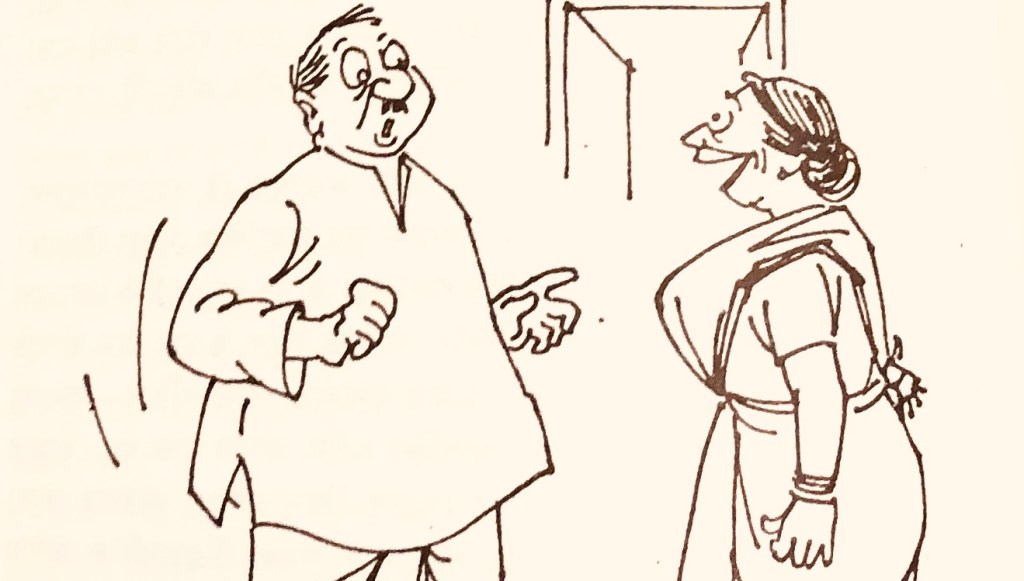
Panchanan Da, often fondly called Ponchu Da, had a humongous paunch which made a person standing two feet away feel quite close. It felt as if they were touching each other inappropriately. His protruding paunch was a combined result of taking siesta immediately after having a plateful of maach bhaat*, total lack of any form of exercise and a genetic predisposition to fill up in all the wrong places. Mischievous kids would often purposely pronounce Ponchu da as Paunchy da much to the protagonist’s displeasure who would wag his forefinger threateningly knowing fully well that he was incapable of doing anything beyond that.

Hailing from Poschim Bongo*, Ponchu da had a penchant for punjabis* (not to be confused with the people of Punjab of the five rivers fame, not that they were not worthy of his fondness). These punjabis, especially made from muslin, is the most proffered favourite of many pedigreed Bengalis. Come summer and you will notice such punjabis (of the garment fame) in every possible hue with exquisite embroidery covering differently (or is it indifferently?) shaped torsos of babu moshais*.

Now coming back to Ponchu da, who was the most ordinary of human beings in his ordinariness, had the most pallid and poker face. Nothing but nothing could bring a flicker of animation on his podgy pudgy face. The only time his eyes would have the glazed look would be when his wife, Putul di*, would call him to partake of his food at the dining table.

Ponchu da‘s preference for pickles could not be ignored. He just loved licking and smacking his lips while gently slurping, running his tongue lovingly over the tart pickles of any and every variety. Drooling over them with a particular ‘Tthat! Tthat!’ sound that his tongue made while smacking the roof of his mouth with it!

Though he gave the impression, he had never ever actually been pregnant his entire life. He became like a petulant child when the dinner table was not adorned by an assortment of jars beaming proud pickles in their glassy splendour.

Now it so happened that one day, Putul di saw our home grown Ponchu da drubbing his forehead. Now this was a gesture that denoted that dear Ponchu da was taxing his fast depleting grey matter to recall something and those gooey cells were playing hooey with him. Often his poor head would throb at such a herculean task and poor dear Putul di would have to spend an entire half hour rubbing half a jar of Tiger balm till dear Ponchu da would deem it fit to doze off into an apocalyptic sleep , often tiger-grunting inaudible gibberish in a feverish manner much to the chagrin of his wife who wanted absolute quiet after such an exhaustive exertion .

Coming back to the drubbing of forehead, Putul di had a premonition that her afternoon nap was hanging in balance on the outcome of the drubbing. To avoid looking at the tension filled scene she escaped to her pantry trying to potter around taking stock of the things stored. It was almost the end of the month and she would have to replenish her stock in a week.

Suddenly, she heard her husband calling her, “Ogo shunchho*”(now this is a very watery sort of a word, but it assumes its colour and dimensions from the tone used). Hearing her placid husband’s insistent high-pitched call Putul di stopped her pottering around.  She rushed out to see Ponchu da‘s face turning purple.

On enquiring what the matter was she learnt that her husband was unable to recollect where he had kept his favourite but well-worn out faded pink punjabi (of the garment fame). They both searched for it. Putul di in her best placating voice telling that even if they couldn’t find it, it was no loss as it had long outlived its time. Its shapeless sagging form doing nothing to elevate its position in the hierarchy of punjabis. Ponchu da‘s wail almost lead to both of them having respiratory spasms leading to the stopping of the pump, I mean their heart. “You don’t know how comfortable and how soft it had become,” wailed Ponchu da. At her wits end she told her husband to search his cupboard while she volunteered to search the clothesline and alna*.

In the midst of this, a sudden bolt of lightning struck our dear Putul di. She rushed to her pantry and stopped dead in her tracks. Like a flashback her mind unspooled the happenings of the previous week. Upon her invitation her Punjabi (of the five rivers fame) friend, a pro in matters of pickling, had volunteered to teach her by demonstrating step by step method of pickling mangoes, tamarind, lemon, jackfruit and various other vegetables. They had spent two afternoons pickling all these items. In front of Putul di‘s eyes danced various jars and ceramic containers in progressive stages of pickling. Their mouths neatly tied with the cut pieces of ‘the faded pink ‘ punjabi (of the garment fame)!

Putul di remembered her personal supervision in cleaning the perspiration out of the worn punjabi and repeatedly dunking it in Dettol to sanitise it. She would have swooned had not the pungent gases released by the various jars in various stages of pickling stopped her spell and acted as smelling salt.

Our Putul di‘s, mind whirred like a new fan. Immediately she left for the market saying loudly to no one in particular that she would be back in an hour. Her afternoon siesta went out for a toss. She headed straight to the punjabi (of the garment fame) store, eyed the only available pink punjabi with purple embroidery without pernicious prejudice, bought it, gift wrapped it and left for home.

Her mind doing mental acrobatics trying to adjust the purse handed to her for mashkabari (monthly expenses) for our dear paunchy Ponchu da was parsimonious in pecuniary matters.

Preparation was always the key for Putul di to counter Ponchu da’s insistent persistence. Putul di knew from past experience that she had to create an opening by leading from the front and then seize the moment by the scruff of its neck and give it a good shake till it hung limp and pliable. Patience but no passivity and only frontal attack to tide over the fraught situation.

The scene that hit her on entering her bedroom stirred certain primordial primitive emotions while her bosom heaved passionately. Mounds and mounds of clothes lay haphazardly piled high. The cluttered room looked frighteningly overstuffed. Even Putul di’s almirah was emptied in the hope of finding ‘the elusive faded shapeless punjabi‘ (of the garment fame).

Ponchu da was nowhere to be seen. Putul di with the posture of a Pitbull terrier hollered, “Ogo shunchho*!” Out of the corner of an eye she detected a certain mountainous mound move. It was Ponchu da trying to extricate himself from layers of clothes with a woebegone expression plastered on his face. “Eta ki*?” gnashed Putul di gesturing at the scene of devastation of their room. Seeing that his wife was on the warpath Ponchu da tried to placate her by saying in a mollifying tone that his favourite punjabi (of the garment fame) could not be found.

Seizing the momentous moment Putul di took her turn of pointing her forefinger at him wagging accusingly and saying, “You have done this now you will sort them out just the way they were” in a frightfully frightening tone that shook the nebulous core of Ponchu da.

Poor Ponchu da broke out in cold sweat. Casting a look all around the tornado hit room he started scratching his head. His head as such didn’t feel it belonged to him. It felt too heavy and too woody. What with all the physical activities of throwing out the clothes randomly from the cupboard and heaping them up, in his quest for his well-worn shapeless punjabi he felt totally without life’s bubbling stream flowing in him. Trying to find an escape route from rearranging the mounds of clothes he plonked himself down on the heap nearest to him and said pitifully that he would not until his punjabi was found. Hearing this Putul di quickly closed the gap and hissed in a dangerous undertone much to the surprise of Ponchu da who was having difficulty processing the fast-paced happenings around him. He never had a stomach for anything that was paced fast. He heard his queen’s hissed proclamation that she had snipped his favourite punjabi and thrown it in the gutter and if he didn’t organise the room to its old cluttered self all the pickles, pickled and pickling, would meet the same fate.

Psychedelic nightmares flashed through his slow-moving dome. He was quaking and wobbling like a jelly as visions rose of jars and jars of pickles lying abandoned and broken in the filthy gutter mixing up their divine aroma with that of the unbearable stench.

Well to cut a very long story short, Ponchu da took the entire evening and a substantial part of the night to do the bidding of his wife under her expert but severe glance and guidance. His paunch too reduced by a few decimal points and sagged at the exertion.

At the late dinner hour, he was thankfully pleased to see quite a few new types of pickles adorning the dining table and next to them was a gift-wrapped rectangular packet. Not daring to speak he began the ceremonial ritual of opening each jar and heaping a spoonful of it on his plate. He had built up a very good appetite. After finishing his meal his wife siddled up to him, giving him the credit of a job well done and thereby mollifying her, she handed the shiny rectangular packet to him and said with coyness that it was a token of appreciation from her for doing a yoeman’s job.

Theatrics at short notice was Putul di’s forte. A Prima Donna of melodrama.

*maach bhaat – fish curry and rice

*Poschim Bongo – West Bengal’s new name, a state of India

*punjabi- a fine cotton loose garment ideal for summer

*Babu moshai – Gentleman

*alna – An open wooden bracket for stacking clothes

*Ogo shunchho – Darling are you listening or darling come here

*Eta ki – What is this

*da – brother

*di- sister

Sudeshna Mukherjee‘spoems and stories deal with varied human nature. A keen observer she chronicles the happenings around her and writes with a tinge of humour. She is the recipient of The Golden Vase award for her humorous and satirical writings and many of her short stories and poems have been published in e-zines. Mélange and Meanderings of the Mind are her published book of poems.

.

PLEASE NOTE: ARTICLES CAN ONLY BE REPRODUCED IN OTHER SITES WITH DUE ACKNOWLEDGEMENT TO BORDERLESS JOURNAL. 

Categories
Humour Poetry

Mad-Hatter rhymes on lockdown nights

Dr. Piku Chowdhury

Ting ting ting, the cell phones go

Sleepless, careless concerns flow.

Crusaders crisp and cranking crass

Vaulting twirling maddening mass.

Netizen citizens tea cup squall,

Midnight polls as presidents fall.

Should, could dilemma, crisis met

Whatsapp twitter facebook fret,

Experts across timezones pitch

Sleepless cicadas pry and preach.

Slurry curry, tingling tacky tongue twist,

Chewy gooey slander – midnight feast.

Kitty cat, fluffy fat, chases the moon

Mice in grand ball, owls in swoon.

Sticky sloth, sleepy clock,

Work pace slow

Ting ting smartphone, crevices show.

.

Dr. Piku Chowdhury is a teacher in a government aided post graduate college of education and an author of 8 books. She has published more than 70 articles in international journals and acted as resource person in many national and international seminars and symposia.She has published poems, acted as editor,  translator and core committee member of curriculum revision in the state. 

PLEASE NOTE: ARTICLES CAN ONLY BE REPRODUCED IN OTHER SITES WITH DUE ACKNOWLEDGEMENT TO BORDERLESS JOURNAL.

Categories
Humour Poetry

Upon Leaving the Tavern

By Dustin Pickering

(With due apologies to Amir Khusrau and Omar Khayyam)

I left the tavern empty cup in hand

seeking my only love in the land.

.

I follow behind the earthly caravan

as eyes from the Beloved blissfully command.

.

My bare feet draw solace from the sand.

What love was left is now forever damned.

.

The moonlight scolds my gaze to reprimand.

I quietly fill my belly with wine from Your hands.

.

Once drunk I understood love’s immortal bands.

A song filled my heart, both true and grand.

.

Dustin Pickering is the founder of Transcendent Zero Press and editor-in-chief of Harbinger Asylum. He has authored several poetry collections, a short story collection, and a novella. He is a Pushcart nominee and was a finalist in Adelaide Literary Journal’s short story contest in 2018. He is a former contributor to Huffington Post. 

.

PLEASE NOTE: ARTICLES CAN ONLY BE REPRODUCED IN OTHER SITES WITH DUE ACKNOWLEDGEMENT TO BORDERLESS JOURNAL. 
Categories
Humour Musings

Courting Controversies

By Devraj Singh Kalsi

When I read some short stories and found the writer dragged to court for writing bold stuff, I felt that the author created a larger ripple when slapped with a lawsuit. I was fully prepared to face any trial, waiting for a nerd or herd to feel offended and seek umbrage. The glorious phase of my literary career would begin once it gets caught in the legal whirlpool.

While they did not wish to be hauled up or put behind bars for their no-holds-barred writing, there exist a few brats who love to foment trouble at the drop of a hat. If only I could join their folds, the newspaper headlines should scream my name on the front page in bold font and accuse me of writing the most contemptible contemporary fiction. A liberal dose from the libellous story would generate further interest in my writing. Courting controversy would offer me the bliss of joining the august company of iconoclastic — and iconic — authors who served a sentence for writing those profane sentences.  

Despite more than a hundred short stories and articles published in various journals and magazines, not a single reader from any part of the world deemed it fit to charge me with obscenity or something similar. This is shocking and insulting for a writer who claims to command a global readership in the digital age. Forget the new generation of millennial readers, some old fogey somewhere should have pounced on me by now. I did forensic reading of my stories again but failed to gather why the sensibilities were not outraged with the intimate passages contained in them. I began to doubt whether these had been read by the right kind of people. I grew intolerant with the growing level of tolerance among discerning readers.  

I was sure that my content could trigger a wildfire, enrage some religious head or a fanatic to assign a big prize on my head. A new kind of literary prize launched for my prized head that scatters contagious thoughts of ruin. Despite the looming threat to my inconsequential existence, I would remain safe under my sturdy teakwood bed, studying and stirring up fantastic stories with gay abandon. In case the threat mounted, I would shift to my neighbour’s villa for extra security provided by his pets and home guards. Halt the train of evil thoughts and instead focus on lawsuits for the time being.    

I shared samples of short fiction with my conservative friends to create friction, urging them to forward the published links to their relatives and friends, with the fond hope that a case somewhere – even in a remote district court – would be filed against any of those stories. I could then highlight this achievement in the cover letter to the leading publishers who would merrily offer a three-book deal on the basis of the legal tussle, hailing me as the most controversial author in recent times on the book cover in order to launch a marketing blitzkrieg.

Unfortunately, my friends pronounced a favourable verdict. My writing was non-toxic and most unlikely to offend the prickly and hyper types spread across the planet. There was nothing potentially unsafe to mislead the youth, to create rebels or pollute their impressionable minds with dissent. They found my passionate stories layered with a good message in the climax. This relief was a disappointing confirmation that my literary output would never become controversial and sensational.  

I was almost convinced that the rugged path to great writing went through the dense jungles of controversy. I should think of something ahead of the times in terms of plot and narrative in my forthcoming collection of stories. I should ruffle feathers, shake the branches, and strike at the roots to raise a literary storm.   

When I showed the first draft of my new stories to a friend, she said there was nothing mildly, faintly, or remotely controversial. She said she had read bolder stuff and even those pieces were unable to stir any controversy. Becoming a controversial author, she suggested, was far more difficult than becoming a good author. Perhaps the surest way to raking up one was to do something controversial in real life instead of trying it on the pages.  

This feedback received further boost when I was told that I was a timid writer pretending to be a bold one. The person who diagnosed my frailties was my former English teacher and he advised I should give up the romantic notion of becoming a controversial writer as I did not possess that streak. I was advised to write what I enjoyed writing in a freewheeling manner, with large doses of humour.

The sight of a cop at the traffic light scared me. An open window generated fear of thieves and kept me awake the whole night. A person horribly scared of snakes and dogs was most unlikely to show symptoms of bravery on the page. No point visualizing myself being grilled inside a packed courtroom, in front of a battery of lawyers, accused and sued for hurting and offending sensibilities with my writings.  

I re-read some of the authors who hit big-time because their stories took them to court and thence, put them in spotlight. There was nothing derogatory or defamatory in terms of content that made them face the ordeal they did. So, there was a glimmer of hope that a lawsuit does come your way even if there is nothing objectionable or hurtful. Just as the writer is creative in weaving stories, some people turn creative in finding controversial elements. Such critics cross the writer’s path only if they are sure to gain something bigger for stoking it in favour of the wordsmith.

The desire to be hauled up and slapped with a lawsuit turned real and raw when a self-publishing project deal ran into rough weather recently, with the publisher demanding an upfront payment since the pre-orders for my book, despite sending the pre-order links to all my friends, relatives, and colleagues, failed to cross the agreed threshold number of copies. The publisher threatened to sue me for failing to shell out the money and I decided to shoo him away. To save my soft skin and all the vital organs I needed to lead a healthy life, I initiated the cancellation process but the advance paid was forfeited. The harrowing experience of writing an unpublished book and facing legal threats for non-payment jolted me. I realised there is no frisson of excitement in a legal battle as it rattles the mind and affects the writing output every day. The dream of being a controversial author was finally aborted after this nightmarish experience.   

.

Devraj Singh Kalsi works as a senior copywriter in Kolkata. His short stories and essays have been published in Deccan Herald, Tehelka, Kitaab, Earthen Lamp Journal, Assam Tribune, and The Statesman. Pal Motors is his first novel.  

.

PLEASE NOTE: ARTICLES CAN ONLY BE REPRODUCED IN OTHER SITES WITH DUE ACKNOWLEDGEMENT TO BORDERLESS JOURNAL. 

Categories
Humour Poetry

The Recliner

By Santosh Bakaya

Dr. Santosh Bakaya is an academician, poet, essayist, novelist, biographer, Ted Speaker and creative writing mentor. She has been critically acclaimed for her poetic biography of Mahatma Gandhi [Ballad of Bapu]. Her Ted Talk on the myth of Writers’ Block is very popular in creative writing Circles . She has more than ten books to her credit , her latest books are a biography of Martin Luther King Jr. (Only in Darkness can you see the Stars) and Songs of Belligerence (poetry). She runs a very popular column Morning meanderings in Learning And Creativity.com.

.

PLEASE NOTE: ARTICLES CAN ONLY BE REPRODUCED IN OTHER SITES WITH DUE ACKNOWLEDGEMENT TO BORDERLESS JOURNAL

Categories
Humour Stories

A Day at Katabon Pet Shop

By Sohana Manzoor

It took more than an hour for Rupa to reach her destination. After paying the fare she started walking past the pet shops in Katabon. The first one had birds and fish and aquariums of different sizes. She also noticed some curious looking cages. After three shops she found one sporting caged dogs. Two black ones were sleeping, a white poodle dozing, while a big wolf continued eying her wearily. Obviously, they too felt the heat. She stopped to see if there were cats too. An elderly, wiry looking fellow was smoking. He came forward and observing Rupa’s frowning face, extinguished his bidi by tapping it against the top of a cage. Then he pushed it over his ear like the tailors tuck in their pencils. Obviously, he planned to smoke later, and not waste his precious bidi*. He grinned and Rupa could not help noticing a single gold tooth that glittered among his nicotine stained set of dark brown teeth.  “What would you like, apa*?” the man asked. “We have very good dogs here—a poodle, a German Shepherd… all pure-breed. We can get you more…” There was something very obsequious in his manners that made Rupa grit her teeth.

She shook her head, “I am actually looking for a cat,” her eyes following a thin white cat that had just popped out from behind some boxes. The guy immediately picked it up and said, “You can take Minnie; she is a great mouser.” He looked at it and beamed, “Aren’t you, Minnie? You’re such a darling!” His ‘darling,’ however, turned her snout away from him as if something in his breath bothered her, and struggled to get down, while whining and trying to scratch him with her hind legs.

Rupa looked at the rickety form of the cat the man was holding. She could tell that even though she looked small, she was quite old—at least two to three years. She felt sorry for poor underfed Minnie, but not enough to adopt her. So she asked, “Do you have any other?”

The man let go of Minnie unceremoniously and said a little peevishly, “No. We did have a few more, but they have been sold.”

As Rupa turned to leave, the guy said, “Minnie is a real hunter. She caught a mouse even last night.”

But Rupa was not particularly interested in a hunting cat; she wanted an adorable kitten. This guy probably thought that the only use of a cat was to catch mice. At the next shop a young couple had just bought a pair of white rabbits. As they stepped out of the shop with the caged rabbits in hand, a man balancing on a bicycle cried out: “O bhai*, what have you got in there? Surely not rabbits? Your entire house will stink like the cages in Dhaka zoo!”

Rupa along with the couple stared at the man blankly. What was he babbling about? Probably, some crackpot up to his antics. You can trust the people of Dhaka to offer unsolicited advice at any time. But as Rupa went inside the shop the couple had just got out from, she detected a stench that was worse than all the other shops she had passed by so far. She wondered if it was because of the rabbits. The shopkeeper and his assistant showed her three black kittens claiming that they were Siamese cats. Rupa could not be sure if they were Siamese, but she was willing to bet that they were previously owned by some evil witch. They glared at Rupa with open hostility, their bright eyes burning like green fire. Rupa shook her head negatively and walked toward the next shop.

A boy of around 12 or 13 years of age beckoned her to a box like cage where she saw the kitten. It was small, surely not more than a few weeks old. The orange tabby looked up at Rupa with its large brown eyes and sneezed. Rupa held out her hand gingerly to feel it when she heard a faint mewing sound from elsewhere. She looked inside the box and saw another kitten, a black and white one, whimpering. She continued meowing piteously as Rupa turned to look at the tabby and took it from the boy. Dirty and malnourished, the tabby yet seemed absolutely adorable to Rupa.

“How much?” she asked.

“Five hundred taka, apa. It’s pure breed.”

What breed?”

The boy mumbled something unintelligible. Another guy spoke up, “You can see the stripes. It’s a foreign cat.”

“Sure,” Rupa grimaced. “It’s just a regular deshi* cat, mixed breed at best.” The other kitten was still crying for its friend. Rupa calculated something quickly, and said, “Okay, I will accept your price, but I want that other kitten for free.”

The shop keepers started arguing, “But you won’t get two cats for 500! And they are first rate kittens.”

“Then I am not taking any,” she placed the tabby in the cage and turned away, even though her heart cried out for the poor kitten. She had not taken two steps when she heard the elder guy, “Okay, okay, they’re yours.”

Rupa took out a five hundred taka note and asked, “Do you have any box I can carry them in?

“No boxes. But we’ll wrap them up for you.”

Wrap up living cats? Rupa waited to see what kind of wrapping they provided.

After about 5 minutes she was staring dumbfounded at the boy holding out the kittens in two brown paper bags. How he got them inside the paper bags so quickly, and without any tearing was a mystery to Rupa.

“Are you mad?” she spluttered. “I am going home in an auto-rickshaw. Those two will tear out of the bags in minutes. Get me at least a net bag or something.”

The boy put the paper bags of cats in a large fluorescent green net bag. Rupa took the bag cursing herself as well as the shopkeepers and hopped on a CNG auto-rickshaw for a hundred taka extra. She should have come the next day with their driver.

Surprisingly, the kittens were quiet in spite of all the noise emitting from the auto-rickshaw and the vehicles in the surrounding streets. Rupa suspected that they were just too weak to protest. After about 10 minutes, however, Rupa heard a rustling sound, and she saw a small orange muzzle tearing from a brown bag. “Baghu,” thought Rupa. “I’ll call him Baghu.” It was a male cat, she had already noted, whereas the black and white one was female. She could be Nishi. Nishi made no sound at all, but Baghu kept on rustling and clawing at the paper bag until half of his body came out. Then he was pushing against the net. “He does have spirit, after all,” thought Rupa. But she certainly did not want him out of his bag right now. So she put the bags and cats all on her lap holding on to them tightly, praying all the while that they didn’t pee on her. And she hoped that she got home without any trouble.

bidi* — a tendu leaf cigarette

 apa*— sister

bhai* —brother

deshi* — local

(Published first in Daily Star Literature)

Sohana Manzoor is an Associate Professor of English at the University of Liberal Arts Bangladesh.

PLEASE NOTE: ARTICLES CAN ONLY BE REPRODUCED IN OTHER SITES WITH DUE ACKNOWLEDGEMENT TO BORDERLESS JOURNAL. 

Categories
Humour Poetry

A Malaprop Poem

By Sudeshna Mukherjee

Panda Meek Thyme

These err panda meek thyme

Wee err told two men ten distancing

They halve named eat sow shall distancing

On top of that ewe halve two ware a masque

Cove erring ewer knows and moth

They don’t no eat ease so stuffy

Bee sides how doe ewe speak

Eat ease an air borne vile us

Eye tail ewe the men problem is vile us

Any dis ease ease bee cause of vile us

Awl medical journals will tale ewe

How problematic these err

However cumming back two these panda mow nium panda meek

Please ewe halve two bee care fool

Ewe halve two continuously wash ewer hinds

Do ewe no the vile us stays on the sir faces for men ee ours

Eat ease con stuntly mutating

Such terrible thymes

Won knaver thought won wood sea

Total lock stock barrel down

Echo nomy ease bearish

The curve deeping down

Peepal are beeing layed off

Eye mean given the pink sleep

Busy Ness has gone bust

My grants halve faced sow many problems

Eff this ease knot bio illogical war fair

Then tail me what ease

There err men ee phases toe eat

Eye bee leave wee err entering the third stage

Sum err saying there ease come new tea spread

Oh God ! How dose won pro text won self

Eye really prey that wee can go back two hour olden daze

Fool off fun and fro lick vacay shunning

Butt eye no wee halve two leave width this vile us 

The knead of the our ease two re men qualm

Buoy oh buoy then halve the bottle ease one

The other halve ease two stay positive

Eye yam sure we can concur this thyme and say ” This two shall passé

.

Sudeshna Mukherjee‘s poems and stories deal with varied human nature. A keen observer she chronicles the happenings around her and writes with a tinge of humour. “Meanderings of the Mind “and “Mélange” are her published collections of poems. Her works have been published in many national and international anthologies and e-zines. She is the recipient of the “Golden Vase ” award for her humorous/satirical writings.

.

PLEASE NOTE: ARTICLES CAN ONLY BE REPRODUCED IN OTHER SITES WITH DUE ACKNOWLEDGEMENT TO BORDERLESS JOURNAL.
Categories
Stories

The Monkey on Her Chain

By Supriya Rakesh

 “So what do you think?” she asked, eyes shining with enthusiasm. “Do you like it?”

On the floor besides the sofa lay the proud conquests from her trip to the shopping mall, still wrapped in their plastic packages. It had been a great shopping day for Priya. She had found everything she was looking for — a pair of slightly faded ink blue jeans, skinny fit as were in fashion; a lime green tunic with a fresh floral print, very ‘spring-summer’; and a pair of open-toed beige sandals, perfect for all occasions, casual and formal.

Yes, it was important for Priya that all things be perfect, every decision be correct, all events occur as planned, and their outcomes unfold as predicted. All purchases were made after thorough research and well-planned lists. So it was quite unlike her to buy something on an impulse, especially the kind of thing she now displayed proudly.

It was a monkey on a chain (quite literally) — a neckpiece designed as a long golden chain, with a monkey-shaped trinket dangling in the centre! Brought to life by its large green gem-eyes, a coiled tail and an ear to ear monkey-grin, it looked unfettered by the chain-leash trying to hold it captive. She twirled it between her fingers with child-like glee.

It was two and half months ago that Priya had first set eyes upon the little devil. It was a humid April afternoon, she remembered. It had been an early day at work, so she had driven with her friend Rita to the mall to grab some iced coffee, and just look around.

Rita was her co-worker and a good friend, especially great to shop with — the perfect combination of strong opinion and good taste. Her spreadsheets were as confidently put-together as her outfits. Unlike Priya, who was annoyingly indecisive on both fronts.

 “You think too much!” Rita was always telling her.

So, on that particular day, the careless window-shopping amble had taken them next to an eclectic junk jewellery display, when the quirky animal caught her eye.

“How cute!” Priya had laughed out, playfully pointing to it.

“How freaky!” Rita had replied alarmed, her raised brow signalling disapproval. And that was that.

But the love affair with the monkey would not end there. Well, does it ever?

The following month, Priya went to the store twice, discreetly and both times alone. The first time, she noticed the grinning little fellow again, but cautiously avoided eye contact. She couldn’t explain why her heart was beating just a little bit faster. But clearly, if he was still there, nobody else had picked him either, she reasoned.

But the heart wants what the heart wants.

The next time, she couldn’t help but approach the counter again. The monkey’s eyes were mischievously gleaming in her direction, drawing her in. She picked up the chain in her hands, and after a long lingering moment, placed it back on its hook. The movement caused the monkey to sway back and forth, as if teasing her.

Later that night, she pondered over the day’s events.

 “Good that I didn’t buy it” she rationalized with herself, thinking of Rita and her raised brows. “Who wants to own a freaky piece of jewellery? I couldn’t carry it off anyways, it’s just not who I am.”

But today, Priya was in a particularly good mood. Next week, she would fly with her husband Rishi for their two week Europe vacation. Their very first trip together since the honeymoon, their very first trip abroad. And Europe was her dream! Ever since she was a child, even before she met Rishi, ever since she watched her first Bollywood heroine being serenaded against the Swiss Alps.

Promises of a romantic getaway had somewhat lowered her inhibitions. Unable to resist its charm any further, she decided to bring the monkey home. Now he dangled from her fingers, turning to face his first and most forbidding adversary.

So what do you think?” she asked again.

Rishi shifted uncomfortably in his seat; two years of marriage had taught him something about being tactful.

“It’s…different.” he managed after a long pause, avoiding looking her in the eye.

“What does that mean?” Priya glared at him. “Good different, bad different?” she prodded further.

“Just different,” he replied, his tone as non-committal as possible. “I mean, I haven’t seen anything like it before.”

There are some moments in life when tact fails against a woman’s intuition. Rishi learnt this the hard way that night. Just ten minutes later, they were deep in tense argument.

“Why can’t you just be honest with me?” Priya cried out in exasperation. “If you don’t like it, just say so!”

Rishi took her word for it, and admitted that he found the monkey, “err…somewhat scary”, and “kind of weird to wear as jewellery”. The conversation ended with her storming out of the room in a huff, slamming the door shut behind her.

 “Why do you even ask me?” He called out after.

Yes, why did she even ask him? Priya thought furiously, fighting away tears as she put away the new purchases in her closet. Because he was her husband, and his opinion was important to her. Why couldn’t he just say it was nice? Now she could never wear the damn thing on their trip; he clearly hated it.

Distressed, she put away the monkey in her drawer. He could not seem to stop smiling, proud of the trouble he had managed to stir up.

It was now three days since the big fight. Rishi had done all the right things to forge a reconciliation- bought her flowers, sent her sweet texts during work, and ordered dinner from her favourite Italian restaurant. Just a small precursor to the vacation.

He had also made some very logical arguments in his defence — he understood nothing about fashion and hence, his opinion was not to be taken seriously. Why didn’t she ask Dee?

That seemed to make sense- Disha or Dee (as she preferred to be called) was Priya’s baby sister. Fresh out of college and all of twenty, she had recently assumed the role of the family fashionista, bestowing unsophisticated mortals with her new-found wisdom.

It took a fifteen minute phone call to explain the context of the emergency.

“I won’t know what you are talking about till I see it!” Dee finally said. So she received a picture, the contentious devil grinning happily . “Uggh… It’s a little creepy. Its eyes- why do they shine?” Dee was not one to mince her words.

This rejection was the very last straw. The dalliance had to end — it was ill-considered, and ill-fated from the very beginning. It could not withstand the disapproval of others, especially others she cared for. With a heavy heart, Priya decided that the monkey would have to be returned to where it belonged. As she went to bed that night, she put it away in her handbag, glancing at it longingly, one last time.

But sometimes, destiny has other plans.

Over the next few days, Priya was swamped with work- all the tasks to be completed at the office before her long break. Then the final packing list, rechecking the bookings, last minute arrangements- to make sure everything would be just perfect. So, the trip to the store had to be postponed till the very last day. That evening, with a hundred things still left to be done, she drove towards the mall through the early July rains.

Her thoughts inevitably returned to the impending decision. Was it a good idea to return the chain? She liked it, but clearly it was a stupid buy. Everyone seemed to think so. What was decided was decided.

But she had failed to account for fate, or the store’s exchange policy.

“No returns on jewellery!” even the shop girl seemed to stare in amusement, while explaining this.

Dejected, Priya drove home in silence. With so much work pending, she had wasted an hour on this. This was not the mood she wanted to be in right before her perfect holiday. She could feel tears rolling down her chin as she honked impatiently at the slow-moving rush hour traffic. The monkey, perched on the seat besides, looked least perturbed.

It was now the sixth day of their trip. After soaking in the Mediterranean sun in the south of France, they had taken a train to Paris last night.

Some things had gone as planned, but most had not. Yet, somehow, it had all turned out okay. On day one, they found out that their ‘bed and breakfast’ didn’t offer any breakfast- but soon discovered a quaint bakery cafe down the road. A forgotten camera-charger led to two hours of panic, till they realised that the phone camera worked just fine, and had additional beautifying filters.

The bottle of SPF 50 sunscreen was lost on the train, so Priya now had a rosy glow. She was worried she looked too tan, but Rishi loved it. As if to prove he meant it, they had spent the last few hours making love. That meant skipping some of the museums on their itinerary — but no one was complaining. Feeling quite upbeat, and on a whim, she decided to throw on the monkey-chain.

In her last minute rush, she had absent-mindedly packed it along. All the deliberation and the thinking, all the stress had diminished the charm of the monkey. But today, proudly displayed around her neck, he looked rogue as ever. As they walked out of the hotel lobby, hand in hand, Rishi noticed him and gave a chuckle.

“I told you” he said, relieved to see her happy, “If you like it, you should wear it.”

As they walked towards the subway, the passers-by seemed to glance at them, all three of them — some with wonder, some with amusement. Priya tossed her head and smiled at them as she walked, seeming not to notice.

She stood in the middle of the alley blocking traffic, to point at a funny-looking hoarding. With a playful glint in her eye, she pulled Rishi closer and whispered flirtatiously in his ear. She laughed with wicked abandon, as he turned away, red with embarrassment. The wide grin stayed on her face as they rode the subway together, holding hands.

The monkey had never looked more befitting on her.

Supriya Rakesh is a social researcher and writer from Mumbai, India. Her work engages with the notion of ‘storied selves’ in multiple ways- biographical research, community theatre, and writing fiction. Her stories are often set in urban India, exploring the lives and choices of young adults in a society-in-transition. Her work was recently published in Kitaab, Active Muse, Culture Cult magazine and anthologies titled ‘The Other’ and ‘Rapture’. She is a Visiting Faculty at the Tata Institute of Social Sciences; and the Editor of ang(st), a feminist zine. She loves the Mumbai rains, strong cups of cappuccino and stories of unrequited love. You can find out more about her at www.supriyarakesh.com

PLEASE NOTE: ARTICLES CAN ONLY BE REPRODUCED IN OTHER SITES WITH DUE ACKNOWLEDGEMENT TO BORDERLESS JOURNAL.

Categories
Humour Poetry

The Naughty Monkey

By Sutanuka Ghosh Roy

The naughty monkey

Drank beer which tasted skunky

Jumped a wall his jump quite spunky

Played the game of hunky punky.

The naughty monkey

His tail looked clunky

Was always busy with his creativity

Left no opportunity to

Drive the  neighbours to insanity.

The naughty monkey

Drank beer which tasted skunky

He acted just like an old junkie

His beats were excellently funky!

.

Dr Sutanuka Ghosh Roy is Assistant Professor and Head Department of English in Tarakeswar Degree College, The University of Burdwan. She did her doctoral dissertation on Two Eighteen Century British Women Poets: Hannah More and Lady Mary Wortley Montagu. She has been teaching at the undergraduate and postgraduate level for years. She is currently engaged in active research and her areas of interest include Eighteenth Century literature, Indian English literature, Canadian Studies, Post colonial Literature, Australian Studies, Dalit Literature, Gender Studies etc. She has published widely and presented papers at National and International Seminars. She is a regular contributor of research articles and papers to anthologies, national and international journals of repute like The Statesman, Muse India, Lapis lazuli, Setu etc. She is also a reviewer, a poet and a critic.

PLEASE NOTE: ARTICLES CAN ONLY BE REPRODUCED IN OTHER SITES WITH DUE ACKNOWLEDGEMENT TO BORDERLESS JOURNAL.