Categories
Poets, Poetry & Rhys Hughes

Crossing the Date Line

Courtesy: Creative Commons

I have long been fascinated by the International Date Line, which I have never yet crossed but still intend to. I have unreasonable qualms that crossing it will change a person in some way, will project them into the past or future by a day and that some part of them will always remain displaced from the present. Even if they cross the line again in the opposite direction, they won’t entirely be back in alignment with themselves. It is difficult to explain without resorting to vague words such as ‘soul’ and the idea is without any basis in fact anyway. Yet it is a feeling that persists beyond logical thought.

I suppose that the origins of my excessive interest in the Date Line can be found in one of Jules Verne’s best novels, Around the World in Eighty Days, a book with one of the best twist endings ever devised. Phileas Fogg the explorer makes a bet that he can circumnavigate the Earth in only eighty days and thanks to an unfortunate set of circumstances he fails by one day. Or does he? He has crossed the Date Line from the east in order to enter the western hemisphere and thus has gone back in time one day. When he realises this fact, he uses the extra day to win the bet. Geometry saves him.

For a long time, I wondered why Verne wasn’t praised more highly for this brilliant plot device, but now I ask myself if it wasn’t a conceit he borrowed from Edgar Allan Poe, of whom he was a great admirer. Verne’s novel was first published in 1872 but thirty years earlier Poe’s short story ‘Three Sundays in a Week’ utilised the same ingenious idea for quite a different purpose. When the name of Poe is mentioned, we imagine tales of horror and bitter despair, morbid scenes, grotesque irony, but he also wrote strange comedies and ‘Three Sundays in a week’ is one of his lightest and happiest.

The narrator, Bobby, wishes to marry Kate, but her obstreperous father, Mr Rumgudgeon, is against the match while pretending to approve of it. He offers a generous dowry with his blessings but when Bobby asks that a date be fixed for the wedding, Mr Rumgudgeon replies that it will happen “when three Sundays come together in a week!”. This impossible condition is a cruelly humorous attempt to forestall the wedding. But Bobby is a clever young man. He knows a way in which the unfair condition can be met.

He arranges a dinner for himself, Kate and her father, and two guests, both of them sea captains who had lately returned from voyages around the world. The crucial point is that Captain Smitherton and Captain Pratt sailed in different directions while circumnavigating the globe. The dinner is held on a Sunday, but it is only Sunday for Bobby, Kate and Mr Rumgudgeon: for Captain Smitherton yesterday was Sunday and for Captain Pratt the next day would be Sunday. Thus, the impossible condition is met. It is a week with three Sundays in it and no further objection to the marriage can be made.

Poe was very clear in his mind about the technicalities of time difference in such voyages, as was Verne, but confusion about east/west crossings of the Line forms one of the recurrent absurdist jokes in W.E. Bowman’s The Cruise of the Talking Fish, in which the crew of a pioneering raft accidentally disrupt, at great cost, the launching of an experimental rocket from a remote Pacific island. This book was published in 1957 (one century after the midpoint date between Poe’s short story and Verne’s novel). It is a magnificent comedy that manages to make the reader doubt their own knowledge of how the Date Line works. And in truth the mechanics of the crossing still confuse me.

Yet another novel that utilises the Date Line and the oddities surrounding it is Umberto Eco’s The Island of the Day Before in which a becalmed sailor on a ship near an island that lies on the other side of the Line indulges in speculation as to the physical and metaphysical significance of our conventions of time. The island is unreachable but remains as an anchor that tethers his mind to the topic and he is unable to stop wondering (and extrapolating this wonder) until flights of fancy turn into mathematically-based obsessions. There is always the lurking suspicion that the Line is not just a human convention but something true that is now embedded in nature as a thriving paradox.

Deep down, I still believe that crossing the Line is an act of time travel, not only in terms of human timekeeping but also in relation to the natural world, so that a man who sails into tomorrow can find out the news of the day and learn such things from the newspapers or radio as to who has won a cricket match, then recross the Line in the opposite direction and lay bets on that team, raking in huge winnings. Or a man who has suffered an accident and is badly wounded can be carried back one day into the past, where he is well again and when the following day dawns, he can take evasive action.

I know that none of this is true, but I feel it is right nonetheless, and I have written my own stories in which the Date Line features, one of them being ‘The International Geophysical Ear’, which is about a gigantic ear positioned on the Line itself that can hear both backwards and forwards in time, and another being ‘The Chopsy Moggy’, concerning a talking cat who unfortunately turns up late for an inter-species conference that will determine the future of humanity. There are others and undoubtedly more will be written.

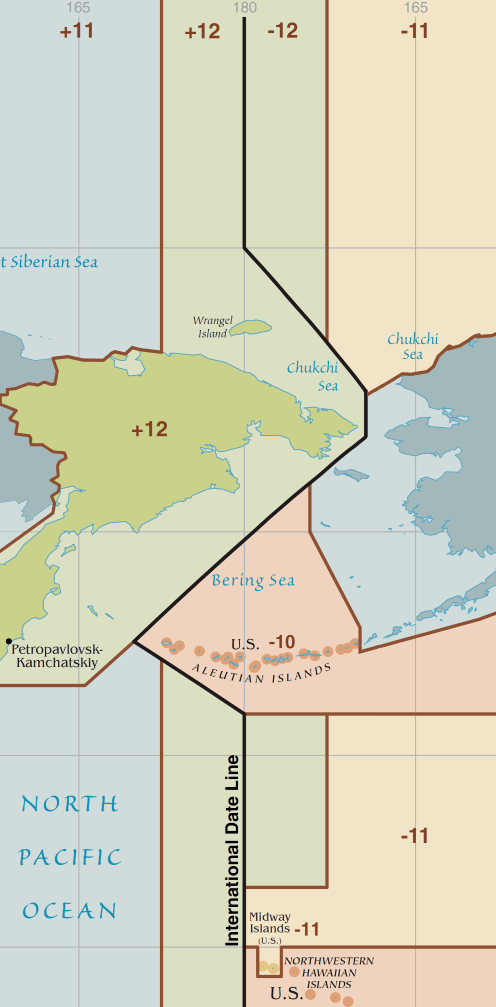
The Date Line has been host to rather strange happenings in reality as well as in fiction. On the map, it is no longer a straight line that follows the longitude of 180 degrees east and west. It veers abruptly to avoid landmasses, taking wide detours around islands. But once it deviated not one inch. It speared through the atolls and islands it encountered, dividing them in half, so that a person had the opportunity of standing with one leg in today and the other in yesterday or even tomorrow. Wrangel Island in the Arctic Ocean, the last dwelling place of woolly mammoths (still around when the pyramids were being constructed in Egypt), was one of these special places. Three Fijian islands too: Vanua Levu, Taveuni and Rambi, where unscrupulous plantation owners forced workers to cross the Line on Sundays to prevent them having a day off.

There is also the interesting fact that the equator crosses the Date Line and that a point therefore exists where it is summer and winter simultaneously while also being today and tomorrow (or yesterday). The SS Warrimoo was a ship that routinely travelled between Canada and Australia. On the last day of December 1899, the ship was very close to the point where the equator meets the Date Line and Captain Phillips realised that if he positioned the SS Warrimoo exactly on that point, something very curious could be achieved. He gave instructions for this to happen and on the stroke of midnight his vessel lay at 0 degrees latitude and 180 degrees longitude. Magical coordinates…

The forward part of the ship was now in the southern hemisphere and thus in summer while the rear remained in the northern hemisphere and in winter. Half of the SS Warrimoo was in the year 1899 (December) while the other half was now in the year 1900 (January). Captain Philipps was skipper of a vessel that was in two different days, two different months, two different seasons, two different hemispheres and two different centuries. Of course, the objection can be raised that December 30 is not the last day of a year. But the Captain waited until midnight before reaching the miracle point. December 31 did come but it flashed past in less than the blink of a mermaid’s eye. The ship leapfrogged an entire day, or at least the vast majority of it.

My hope is that there was a copy of Around the World in Eighty Days on board the ship when it made that spectacular crossing, or maybe a collection of the short stories of Poe. It is highly unlikely this was the case, of course. And I have just now had another thought. Suppose you are reading Verne’s novel on a ship that crosses the Line in an easterly direction. You have been reading it all day and have reached the last few chapters. Suddenly the ship crosses the Line and you are back in yesterday and find yourself only on the first page again. You might be frustrated not to know the ending to the book. Let me assist you. The hero and the heroine do get married.

Rhys Hughes has lived in many countries. He graduated as an engineer but currently works as a tutor of mathematics. Since his first book was published in 1995 he has had fifty other books published and his work has been translated into ten languages.

.

PLEASE NOTE: ARTICLES CAN ONLY BE REPRODUCED IN OTHER SITES WITH DUE ACKNOWLEDGEMENT TO BORDERLESS JOURNAL

Categories
Interview

Rhys Hughes Unbounded

In conversation with Rhys Hughes

I have always wanted to interview Ruskin Bond who lives in Landour, near the hill-station of Mussoorie in India. Bond, now 87, grew up in Dehradun, tried a stint in England and returned to the country that had nurtured him to write stories that make us laugh and yet bring out the flavours of love and kindness in the Himalayas. Sadly, no one seems to be able to get me an online interview with him. So, I did the next best thing…

I interviewed Rhys Hughes.

Rhys Hughes in Srilanka

You have to see it from my perspective, here was a humourist migrating from UK to India, just like Bond. Both their names begin with R — Ruskin wrote of monkeys conducting a fashion parade in colourful pyjamas borrowed from him, perhaps permanently and Rhys wants to interview a monkey who took a bottle of coconut oil from his current home. Only, Hughes’ monkey happens to be in Sri Lanka and Bond’s monkeys were in India. In fact, I told Hughes he could be the next Bond and could perhaps get into an apprenticeship. He has the basic compassion and humour in his writing that endears Bond to so many hearts. However, Hughes has not made it across to India as yet. He waits on the lush shores of Sri Lanka to make a landfall on the Coromandel Coast or … maybe the Himalayas… as the pandemic continues to upheave in tsunami-like waves. Maybe, Rhys Hughes will become the Ruskin Bond of Sri Lanka! Let us tread into the world of Hughes to check out what he thinks.

Tell us since when have you been writing? What gets your muse going?

I began writing when I was six years old or so. My earliest stories were inspired by films and comics I enjoyed and mostly were about monsters, adventures, space travel, robots, dinosaurs and ghosts. I doubt if any of them made much sense.

The first short story I wrote with a plot I remember was about a man who jumps off a cliff so that he will turn into a ghost and can create mischief in his village, which he does, but the twist is that he survives the fall and only thinks he is a ghost. The enraged villagers chase him back over the same cliff, and he isn’t frightened because he believes he can float on air, but he can’t and this time he doesn’t survive. I was about ten years old when I wrote that. But I didn’t begin writing short stories in earnest until I was fourteen. That was the real beginning of my writing career. I have been writing regularly ever since. I don’t require prompting to write these days. It has become a habit, a reflex, something I just do. I still write about the same old things as always, monsters, adventures, space travel, etc, but I have added a few more themes since I was a young child and my style has improved considerably. At least I hope it has!

That story you wrote as a ten-year-old definitely has potential! And we enjoy your writing as we read it now.  Now tell us why do you write?

Ideas come unbidden into my mind and they won’t leave me alone unless I put them into stories. The moment I embody these ideas in a work of fiction they stop bothering me. I get ideas all the time, especially when I am walking or travelling somewhere, but also in the middle of the night. I try to make notes so I can use them later but sometimes I neglect to note them down and I forget them. Then the ideas go away temporarily but return days, weeks, months or years later and bother me again. Only when I pin them down into a narrative of some kind will they go away forever. So writing is a compulsion for me as well as a voluntary activity. It wasn’t always like this.

In the beginning I found it difficult to come up with original ideas. I had to work hard at it. I would say that most of my ideas back then were fairly ordinary ones and only occasionally truly original. But I persisted and exercised my mind, and just like muscles do, the parts of my mind responsible for the invention of original ideas got bigger and stronger, and now the ideas come without effort. As it happens, not all these ideas turn out to be as original as I like to think they are. Sometimes I get excited that I have come up with a totally new concept only to later discover that some other author beat me to it years ago. But I do believe that originality is possible.

The oft-repeated maxim that there are no new ideas simply isn’t true. If originality is impossible, how were any ideas generated in the first place? I don’t mean to say that originality is the ultimate objective of writing, of course not, there are a great many other reasons to write, but I am talking about it from my own particular point of view. And all I am really saying here is that practice is the most important thing, the only essential thing. I write a lot and the very act of writing regularly seems to make writing in the future easier and smoother.

What is your favourite genre for writing and for reading?

The genre question is a difficult one to answer but I am going to say that if I had to choose only one genre to describe my own writing I would answer “comedy”. This doesn’t mean that everything I write is comedic, but a large percentage of it certainly is. And I don’t necessarily mean laugh-out-loud comedy but other types of comedy too, whether subtle irony, philosophical farce, absurdist and surrealist works. There are many grades of comedy, from wit to parody, and I enjoy most of them. When it comes to reading, I still have a focus on comedy, I suppose, but I will read very sober and serious works too. If I made a list of my favourite works of fiction, comedic works would be at the top of the list.

Broadly speaking there are two types of humorous literature, one in which incidents are funny and one in which it is the telling that is comic. Writers who combine both types tend to win my deepest admiration. Yet quite a few of my favourite books have no comedy in them at all, neither in subject nor in style, for example The Adventures and Misadventures of Maqroll by Alvaro Mutis ( 1993, translated by Edith Grossman, 2002) which is a sequence of tropical and troubling narratives, often sombre in tone, that nonetheless remains an enthralling and uplifting read.

Which writers have influenced your work? Are you influenced by other art forms?

I wanted to become a professional writer because of Robert Louis Stevenson. It was Treasure Island (1883) that opened the gates into the entire world of literature for me. I still admire him hugely but I have had much bigger influences since then. Delving deeper into the novels and short stories that were available to me, I was lucky enough to find authors who resonated with some deep part of my being and made me not only want to continue trying to be a writer, but to be a writer who wrote as they did. Of course, it’s better to develop one’s own style, but I suspect that ‘distinctive’ styles are really the result of amalgams of influences, a blend of prior styles. Italo Calvino (1923-1985) has been my favourite writer for more than thirty years, with Donald Barthelme (193i-1989), Boris Vian (1920-1959), Flann O’Brien (1911-1966) and Stanislaw Lem (1921-2006) not far behind. At the moment I am a keen reader of the work of Mia Couto (1955-2013). Alasdair Gray (1934-2019) is another favourite.

To answer the second part of your question, I have definitely been influenced by art forms other than writing, in particular music and visual art. I might even say that the paradoxical imagery in the artwork of M.C. Escher (1898-1972) has been at least as big an influence on me as the prose of any author. I was astounded and captivated when I first saw his graphic designs and have loved them ever since.

You have travelled to many places. How many countries have you visited? Has travel impacted your writing? How?

I have lost count of the number of countries I have visited. I used to keep a map and colour in the countries that I had been to, but I lost the map years ago. The truth is that probably the total isn’t as high as I think it is. Most of my travelling has been done in Africa and Europe, and I have only really dipped my toes into the vastness of Asia, and I haven’t even been to the Americas at all. No one is so well-travelled that they really know the world.

Travel has certainly impacted my writing, though. I can state that with confidence. I am often inspired to write stories set in the places I have visited and I guess I probably wouldn’t do so if I hadn’t been there. Having said that, I do occasionally set a story in a location I have never visited. Such stories can work well but there is nearly always a vital element missing, some immediacy that a certain level of familiarity gives to a work of prose. It’s far easier to create a convincing atmosphere when you are writing from experience rather than from research. Little details will give some solidity to the evocation of scenes, details that can’t be easily imagined without first-hand experience. This doesn’t mean that I think travelling is necessary for the creation of good fiction. Good fiction can be centred in nowhere, almost in no space or time if the author is talented enough. And there’s a paradox in the nature of travel, which is that even though the particulars of your surroundings might change, the essentials remain the same. We can put a lot of effort into the act of travelling only to discover that people are people everywhere. And would we have it any other way?

Tell us a bit about the world you grew up in — we have an interesting piece by you called ‘Dinosaurs in France’ — which claims you grew up in a world of different value systems. Would you see those as better or the present as better?

The past is another country. That’s one of the pithiest and truest maxims anyone has devised. In only half a century I have seen many changes, but in fact most of these changes came so gradually I didn’t notice that things were changing at the time. Only now, looking back, do I see the vast gulf between the present and my past. I was youthful in a world where information was much more difficult to obtain. There were rumours and suppositions and often no way of confirming or refuting them. People believed strange things and adjusted their attitudes to match these odd beliefs. People still do the same now, of course, but it somehow feels different. One can more easily check assertions now than before and learn much more quickly if they are true or false. The world I grew up in was one in which you had no choice but to take another person’s word at face value. So if a supposedly responsible adult, like the postman, told you with a straight face that he lived in a house made entirely from marshmallows, there was no easy way of disproving the claim. You had to take his word for it. I can’t say it was a better world and I don’t want to suggest it was a worse one. It was simply different, a world lacking ready access to information.

You have written a lot of humour. Not too many people do that nowadays. Could you tell us why your funny bone is tickled to create humour as it does? Do you think humour is a good way to address major issues?

Humorous writing has gone out of fashion to a certain extent in the anglophone world, yes, but it’s still there, in the background. There was a great tradition of British humorous writing that lasted about a century or so, and I was fortunate enough to grow up at the end of that phase. I am talking about a particular type of humour, dryly ironic but also theatrical, a sort of blend of surrealism and the old musical hall routines. J.B. Morton (1873-1979) was one of the masters of the form, and he was an influence on many of my favourite comedic writers, such as Spike Milligan (1918-2002), Maurice Richardson (1907-1978) and W.E. Bowman (1911-1985). These humorists also took the language and played with it a little, transforming it into something new, though I feel ultimately that such comedy derives more from the rhythms than the melodies of wordplay.

The entire range of comedic devices might be used but new ones invented as well. There can be over reaction to minor incidents and under reaction to major ones, constant misunderstandings, amplification of repetition, parody of existing forms. W.E. Bowman’s The Ascent of Rum Doodle is my favourite humorous novel, and its sequel, The Cruise of the Talking Fish, is also high on my list of best comedic literature. Bowman apparently wrote a third volume in the series that remains unpublished and is in the safe keeping of his son. If this is true, I hope it will appear one day.

Are you influenced by any specific humourist? If so, who?

Flann O’Brien is probably my biggest influence in terms of comedic prose. His work is quirky, inventive, curiously erudite, absurdist and often metafictional. I am staggered by the wealth of invention in his novels, the supremely silly but also highly ingenious conceits and concepts, and the bone-dry irony contrasted with farcical exuberance, the light touch and the dark tone. W.E. Bowman and Maurice Richardson are another two favourites. That is prose but when it comes to poetry I love Don Marquis (1878-1937), Ogden Nash (1902-1971) and Ivor Cutler (1923-2006) best, all of them with radically different approaches to comedy. Marquis in particular pushed humour in his free verse to a point where it often became profound, serious and socially critical. You asked if humour can be used to address major issues. Yes, sometimes it can, even with great force, but it doesn’t have to.

Tell us the extent of your work. How many books have you written?

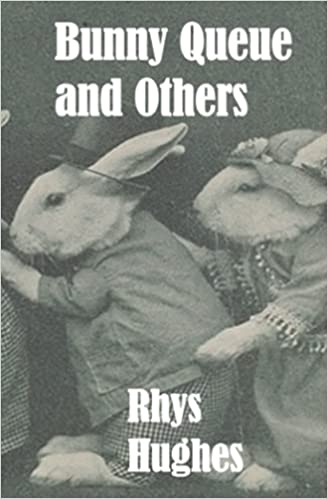
I have published many books. The question is how do I count them. I tend not to count the self-published books. It seems to me that self-publishing is too easy. On the other hand, traditional publishing is maybe too difficult. I have forty or so traditionally published books and twenty self-published books out there, so I am going to give forty as my answer. Most of my books are collections of short stories. I have only written a few novels. My poetry collections so far have been self-published with the exception of one single volume called Bunny Queue.

It is one of my goals to have all the short stories I have ever written appear in my books. At the moment there are many of my short stories that exist in magazines and anthologies that have never been collected. And there are many unpublished short stories in my files too. My plan is to write exactly a thousand short stories and consider them as part of one big story-cycle. This project is almost done. In a few more months, with luck, I will finish writing my thousandth story. Thirty years in total it has taken. When that last story is finished I will devote myself entirely to novels, plays, poetry and articles. No more short stories! So, in reply to your question, I can say that I have written a great deal of work, maybe too much, but as I said earlier, writing has been something of a compulsion for me.

What are your future plans?

I plan to finish my big story-cycle of one thousand stories. Then I will write a few novels that I have been planning for a long time. One of these novels will be called The Hippy Quixote and will be about a young, deluded fellow who in his mind is living in the 1960s. He takes a guidebook written in that decade and follows the old hippy trail to India, blissfully unaware that so many things have changed in terms of societal attitudes and geopolitics. This idea seems to me to be a fruitful one for the creation of comic scenes.

I also have to finish a novel I began a long time ago, The Clown of the New Eternities, sections of which have already been published. It’s long overdue for completion. This novel is about a highwayman who has accidentally outlived his own age and is forced to adjust to the modern world. Another variant of Quixote, I suppose. I think that many or most of my longer narratives are a blend of the Quixote and Candide models with a bit of Gulliver thrown in. We can talk about our future plans all day, of course, but whether we are lucky enough to have a chance to make them real is another question altogether. I intend to do my best, as I have always done, but nothing is certain in this world of ours.

Thanks Rhys Hughes for your time and lovely answers.

Click here to read prose & poetry by Rhys Hughes.

(This is an online interview conducted by Mitali Chakravarty.)

PLEASE NOTE: ARTICLES CAN ONLY BE REPRODUCED IN OTHER SITES WITH DUE ACKNOWLEDGEMENT TO BORDERLESS JOURNAL