Categories
Notes from Japan

A Day with Dinosaurs

Photographs and Narrative by Suzanne Kamata

My day job is “associate professor,” so I sometimes attend academic conferences. When I learned of an upcoming conference on language teaching in Fukui Prefecture, which I had never been to, I was eager to sign up. Sure, I wanted to hear all the cutting-edge theories about teaching English to language learners – how to motivate my students to write haiku, how to use AI, and so on – but my primary reason was to see the dinosaur bones.

Although at one time it seems that dinosaurs pretty much roamed the whole world, fossils of dinosaur bones weren’t discovered in Japan until 1989. Those bones were found in Katsuyama City, Fukui Prefecture. Since then, even more bones have been discovered, and a museum ̶ Fukui Prefectural Dinosaur Museum ̶ opened in 2000. As part of the pre-conference activities, the host university had arranged for a trip to the museum. A free shuttle but would depart at 11:30am.

I consulted an app on my smartphone and determined that it would take me about five hours to reach Fukui Station from my home in Tokushima Prefecture on the island of Shikoku. I would have to take a bus, a train, another train, and the high-speed bullet train. After a recent trip to Tokyo, I had learned how to use an electronic transit card, which was basically an app on my phone. This app could be used to breeze through ticket gates at train stations, as well as on buses and subways.

I got up at 5:30am on the day of the museum tour. My husband dropped me off at the bus station. I got on the bus and got off in Osaka. Then I took a train to Kyoto, which was mobbed with travelers. Although I thought I could get on the next train, the so-called Thunderbird, with my app, I discovered that I needed to have a reservation. I suppose I could have made one on my smartphone while standing in line, but I was confused. I left the platform and queued up to buy a reserved ticket from the vending machine, which disrupted my tight schedule and meant I would not be able to make it to Fukui in time for the free shuttle bus.

The Thunderbird goes straight from Kyoto to Fukui with few stops in between. The scenery is mostly composed of rice fields and squat mountains. The monotonous view was calming. About an hour later, the train pulled into Tsuruga where I had to switch to the brand-new Hokuriku Shinkansen for the last seventeen minutes of my journey. In my rush to finish my business at the vending machine in Kyoto, I had inadvertently booked a seat in the most luxurious car. I was the only one there.

I texted a friend who was also attending the conference. She had already arrived. I told her that I would be late, and that I wouldn’t be able to ride the bus with her. This was Japan, where everything was always on time! However, the organisers were Americans, and they were willing to wait for me. Hooray!

As soon as I got to Fukui Station, with its moving animatronic raptor keeping guard out front, I hopped into a taxi and finally arrived at the university, where the bus was indeed waiting. I sprinted onboard, apologised to my fellow passengers, and thanked the organiser profusely.

The museum was impressive, as advertised. Replicas of dinosaurs discovered in such far-flung locales as Morocco and Mongolia were on display. There were, of course, also exhibits of the five dinosaurs and one bird species discovered in Fukui, including the long-necked stubby-legged Fukuititan, the herbivorous Fukuisaurus, and the Fukuiraptor. Although the museum offers an excavation experience where visitors can pretend to dig and discover fossils, my friend and I just walked around looking at all of the cool rocks and bones.

Having gone through my son’s dinosaur obsession when he was young, I could remember some of the dinosaur’s names – the Ankylosaurus with its bumpy back, the Stegosaurus, and Pterodactyl. When we were ready to take a break, my friend and I made our way to the cafeteria for dino-themed snacks.

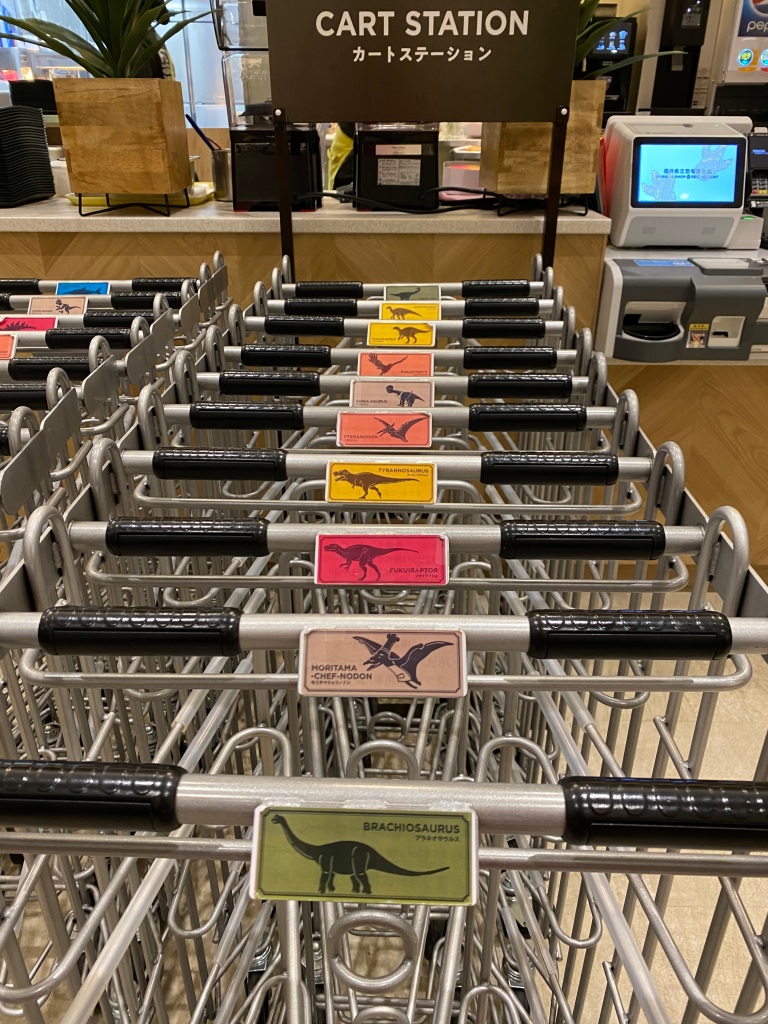
While many famous destinations in Japan are struggling with over-tourism, Fukui, while slightly off the beaten track, has a pleasantly relaxing vibe. Things may change with the new bullet train, but for now, I recommend it as a fascinating horde-free place to visit.

Suzanne Kamata was born and raised in Grand Haven, Michigan. She now lives in Japan with her husband and two children. Her short stories, essays, articles and book reviews have appeared in over 100 publications. Her work has been nominated for the Pushcart Prize five times, and received a Special Mention in 2006. She is also a two-time winner of the All Nippon Airways/Wingspan Fiction Contest, winner of the Paris Book Festival, and winner of a SCBWI Magazine Merit Award.

PLEASE NOTE: ARTICLES CAN ONLY BE REPRODUCED IN OTHER SITES WITH DUE ACKNOWLEDGEMENT TO BORDERLESS JOURNAL

Click here to access the Borderless anthology, Monalisa No Longer Smiles

Click here to access Monalisa No Longer Smiles on Amazon International

Categories
Essay

Where the Rice is Blue and Dinosaurs Roar…

By Ravi Shankar

The Kuala Terengganu Skyline. Photo courtesy: Ravi Shankar

The lighting was subtle but magnificent. The transparent minarets glowed red, green, pink, and blue in turn. We were at the Masjid Kristal on the island of Wan Man at Kuala Terengganu in the state of the same name in northern Malaysia.

The mosque is among the most photographed monuments in the Islamic Heritage Park, and we could easily guess why. This is the first intelligent mosque in the country with an IT infrastructure and wi-fi connection. We were glad we came. The reflection of the mosque lights on water was enchanting. Getting around KT — as Kuala Terengganu is lovingly called by the locals — could sometimes be tricky without your own vehicle. Ride hailing services may not work optimally in the peak hours of the evening. We were informed by one of the cab drivers that Maxim is the most popular e-hailing app in the city.  

The population in KT loves to eat out and in the evenings the restaurants are usually crowded. We were staying at the Intan Beach Resort at Pantai Batu Burok and the eating places by the beach were always crowded. The beach is popular with locals with several attractions and rides during the evenings. There is a three-kilometre walking path by the side of the beach. As we stayed right by the beach, we could enjoy early morning strolls on the soft sand.

Panti Batu Burok: Photo Courtesy: Ravi Shankar

The Kuala Terengganu state museum was huge and is located on over 23 acres of land. The museum was officially opened in 1996 and was designed by a well-known Malaysian architect, YM Raja Dato’ Kamarul Bahrin Shah, who also happens to be related to the royal family of Terengganu. The building is designed in traditionally Malay style and the outer façade was left undecorated. There are nine different galleries, and these include the Royal gallery, the historical gallery, the textiles gallery, the Islamic gallery, the handicrafts, the natural resources, the shipping and trading and the marine resources galleries.

Tha Batu Bersurat. Photo Courtesy: Ravi Shankar

The ‘Batu Bersurat’ (lettered stone) is the museum centrepiece and of great significance to the state. The stone is estimated to be 700 years old and mentions the position of Islam and the application of Islamic laws in the state. The stone is written in the Jawi script using Arabic characters. Jawi script is still used in Terengganu though in many areas Malay is written mostly in the Roman script. In the museum grounds, there is a good collection of different old cars and other vehicles used by the King and Chief Ministers of the state.  

The Islamic Heritage Park is a major attraction located on the island of Wan Man. The park has small scale replicas of famous global Islamic monuments. Among the monuments represented are the mosques at Medina and Mecca in Saudi Arabia, Dome of the rock in Jerusalem, the Taj Mahal in India, and a mosque in Aleppo, Syria. The national mosque of Malaysia and mosques in Singapore, Indonesia, Pakistan, Iran, China, Tatarstan, Uzbekistan, and Iraq are also on display. Replicas of these famous monuments were displayed in the vast gardens of the monument. I liked this concept, and the monuments were well maintained except one or two that may require more attention.

The sun was hot, and I had to drink copious amounts of water.  In the evening, my friend, Binaya, and I went to the floating mosque situated in Kuala Ibai Lagoon near the estuary of Kuala Ibai River, 4 km from Kuala Terengganu Town. The mosque combines modern and Moorish architecture, and is a white structure situated in five acres of land. There is also a floating mosque in Penang.

The next morning, we went to the Science and Creativity Centre. The centre is housed in a huge, modern building. There are multiple galleries to explore. I was fascinated by the stainless-steel exhibit showing the structure of DNA, the blueprint of life. The encounter with the dinosaurs was the highlight of the trip. The dinosaurs were colour coded in red (dangerous), yellow (exercise caution) and green (safe). Tyrannosaurus Rex was the highlight. Raptors, allosaurus and other dinos filled the hall with their cries and screams. The Stegosaurus had scales on the back. When I was young, I was a big fan of Phantom comics created by Lee Falk and Phantom had a stegosaurus as a pet. The inflatable dome on the top floor had a delightful cosmic show and you can see the universe projected above your head. The museum had plenty of things to see and do and is a big hit with children.

The Masjid Sultan Ismail Chendering has delicate artwork and is built entirely in white. The simple design and the beautiful artwork had me mesmerised. The mosque has a long history. The small Lebai Zainal Mosque which could accomodate150 people was first built near the current location of the mosque before being replaced by the Raja Chendering Mosque and then replaced again by a new mosque which is the Sultan Ismail Mosque.

Soon it was time for lunch. There are plenty of food options near our hotel. I enjoyed nasi kerabu, a Malaysian rice dish, in which blue-coloured rice is eaten with dried fish or fried chicken, crackers, pickles and other salads. The blue colour of the rice comes from the petals of Clitoria ternatea flowers, which are used as a natural food colouring.

In the evening, we went to see the Abidin Mosque which is Terengganu’s old state royal mosque built by Sultan Zainal Abidin II between 1793 and 1808. The Royal mausoleum is located next to the mosque. Istana Maziah, the official palace of the Sultan of Terengganu is located close to the mosque at the foot of the mountain, Bukit Puteri. The palace is the official venue for important functions such as royal birthdays, weddings, conferment of titles and receptions for local and foreign dignitaries. We wanted to climb Bukit Puteri, but the place was under renovation and closed.

We continued along the waterfront to the Shah Bandar jetty. A cool breeze was blowing, and many people were strolling along the promenade. We were moving toward the Kuala Terengganu drawbridge constructed in 2019 inspired by the London drawbridge. We waited for the sky to darken so that we could see the lights on the bridge.

Photo Courtesy: Ravi Shankar

Buses from KL take the highway to Kuantan and then bypass the town. The journey continues to the town of Paka and then takes the coastal highway through Dungun. Some parts of this state reminded me of my home state of Kerala in South India. Plenty of coconut trees were seen. Coconut trees grow so well in Kerala and in many areas along the west coast of India.

The expressways in Malaysia are well-designed and maintained. Traveling on these are usually a smooth experience though they get very crowded during major holidays when people leave Kuala Lumpur for their hometowns and villages. KT is about 400 km from KL and takes around eight hours by bus. Malaysia’s northern state on the East Coast can be a good getaway. The town and the state has culture, history, natural beauty, delicious food, and serene beaches. The islands off the coast were still closed. Redang island was mentioned to be one of the most beautiful islands in the world. Hopefully, we will visit these during our next trip. God willing, we shall!  

.

Dr. P Ravi Shankar is a faculty member at the IMU Centre for Education (ICE), International Medical University, Kuala Lumpur, Malaysia. He enjoys traveling and is a creative writer and photographer.

.

PLEASE NOTE: ARTICLES CAN ONLY BE REPRODUCED IN OTHER SITES WITH DUE ACKNOWLEDGEMENT TO BORDERLESS JOURNAL

Click here to access the Borderless anthology, Monalisa No Longer Smiles

Click here to access Monalisa No Longer Smiles on Kindle Amazon International