Categories
Essay

Deconstructing Happiness

By Abdullah Rayhan

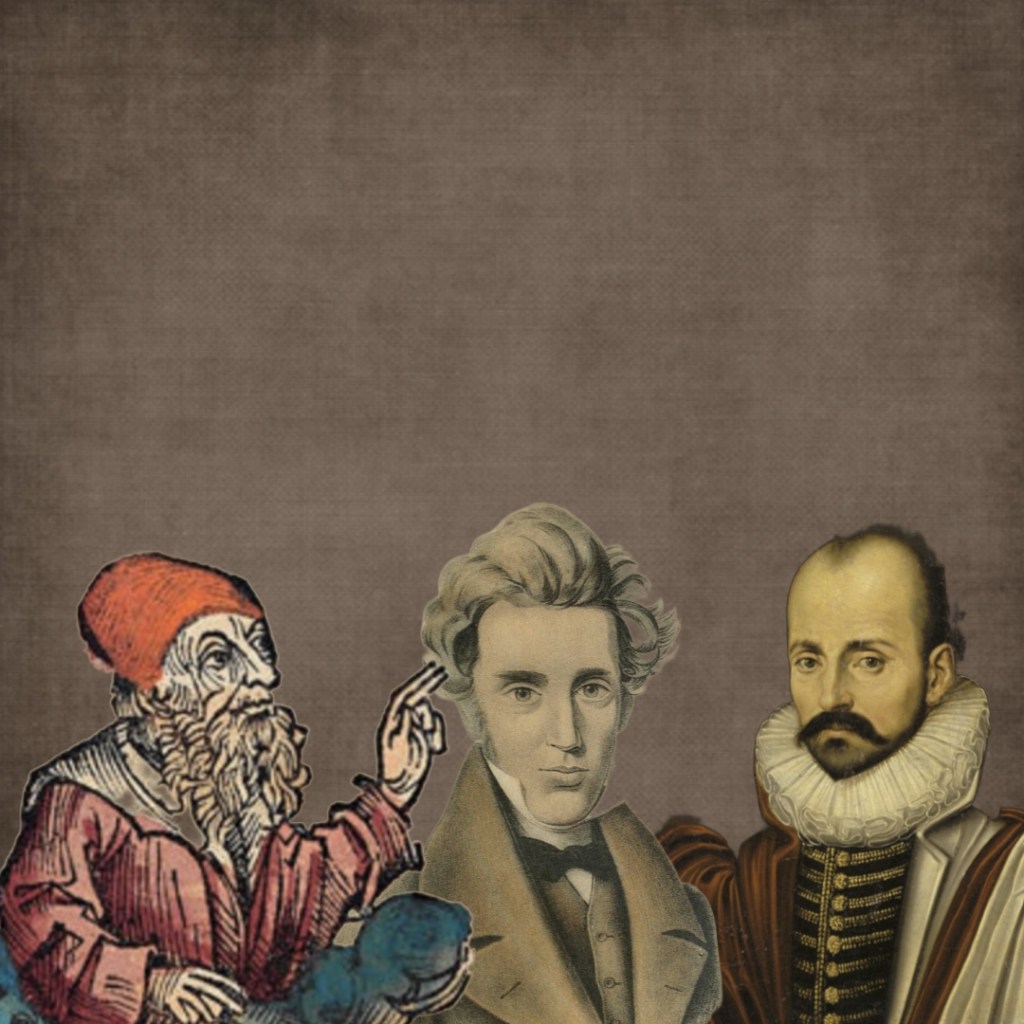
From Left to Right: Boethius, Keirkegaard and Montaigne. Courtesy: Abdullah Rayhan
“Do you hear the whisper of the shadows?
This happiness feels foreign to me.
I am accustomed to despair.”

-Forough Farrokhzad (1934-1967), Iranian Poet and Filmmaker

We seek psychotherapy to deal with the distress, sadness, depression, and psychological dimensions that are beyond our reach. Even after going through the medical procedure, we are seldom left with the satisfying sensation we deeply crave. This is where philosophy comes in.

To Socrates, philosophy was basically the way to live a life. He mainly observed how life functions and examined the influences that allocate life with certain affects. Other philosophical ideas too somewhat try to interpret the nature of existence in a similar manner. There are tons of such schools: from absurdism, to existentialism, nihilism, Hegelian, Kantian, and whatnot. But, apart from offering ideas and perspectives on existence, what else do they contribute? It can be a bit vague to trace the purpose of such philosophical ideas where the basic understanding, instead of leading toward fulfillment, can plunge us into the deepest pit of darkest despair. Existential philosophy will constantly remind you of life’s futility, ethical philosophies will keep painting idealistic portraits all to no avail. Finally, you are left with novel knowledge that does not necessarily help you deal with the struggles drowning your heart within a blurry tumult.

Fortunately, practical application of philosophy exists. Last year, when I was particularly at my lowest, estranged from everything I adored, all prospects of happiness ruined, abandoned to face monstrous adversities with a heavy bleeding heart, I found Boethius[1] comforting.

Camus, Sartre, and Nietzsche will comfort you with the assurance that you can construct optimism with your own effort. They tell your life has no inherent meaning, thus you are allowed to come up with your own sense of existence and give it any meaning you can conjure up at will. Bentham will tell you how to establish collective contentment. Kant will give you formulas to maintain peace. But none of them essentially gives a clear picture of what happiness really is. This makes Boethius unique. He doesn’t adhere to any false hopes, he rejects all things that are constructed, yet, through a transparent honesty, he shows a path that can lead toward organic satisfaction, not laced with any promises of universal fulfillment, just simple reasoning advocating for individual contentment.

Boethius basically inspires us to contemplate on our happiness. He directly questions the idea of happiness we so intimately endorse. Boethius asks you,

“Do you really hold dear that kind of happiness which is destined to pass away? Do you really value the presence of Fortune when you cannot trust her [Fortune] to stay and when her departure will plunge you in sorrow? And if it is impossible to keep her at will and if her flight exposes men to ruin, what else is such a fleeting thing except a warning of coming disaster?”

We consider ourselves lucky when we get our desired happiness. But, being lucky or ‘fortunate’ cannot be the standard that constructs happiness. In Boethius’ words, “happiness can’t consist in things governed by chance” mainly because there’s no guarantee it will last. He argues anything that is ephemeral, transient, and temporary cannot be of any value in terms of happiness as when that happiness evaporates, it is replaced by sorrow that is sometimes too much to bear. In this way, state of happiness is “a warning of coming disaster”. Happiness should not be the reason for despair and discontent. Thus, happiness brought by luck is not what it appears to be. 

He further asks if something that is temporary can really be claimed as one’s own. Boethius’s voice renders one mute when he states, “I can say with confidence that if the things whose loss you are bemoaning were really yours, you could never have lost them.”

A significant portion of Boethius’s argument is surrounding the transience of happiness. If happiness lies in what’s temporary, then isn’t misery temporary as well? Boethius puts it with much clarity. He comforts you, saying: “If you do not consider that you have been lucky because your onetime reasons for rejoicing have passed away, you cannot now think of yourself as in misery, because the very things that seem miserable are also passing away.”

Boethius inspires you to wonder about the nature of misery. We are miserable, sad, melancholic usually because we had a taste of happiness sometimes in the past, which is missing at the moment. We were happy once. But happiness is no longer part of our lives, and this absence is what’s causing our misery. Had we not had that happiness before, we wouldn’t have the misery that chokes our heart with a suffocating grip. This is the reason Boethius called happiness “a warning of coming disaster”.

Think about it. Someone who is currently living the same life as you may not be in similar misery as you because, as they haven’t had the happiness you had, they are not burdened to deal with the absence that you are compelled to plummet in. Thus, neither happiness nor misery operate based on any strict blueprint, rather it is something formed by one’s own experience and are inter-dependent. Boethius puts it very eloquently saying, “There is something in the case of each of us that escapes the notice of the man who has not experienced it, but causes horror to the man who has […] Nothing is miserable except when you think it so, and vice versa, all luck is good luck to the man who bears it with equanimity”. We lose our ability to “bear it (despair) with equanimity” because of our past interactions with pleasant experiences.

Perhaps you would relate to Boethius in terms of misery though not in an entirely literal sense. Boethius had everything. A beautiful wife, two affectionate children, popularity, respect, novelty, an amazing home, and enough money to live without any worrying. Yet, because of some false accusation, he was suddenly deprived of it all and was imprisoned. His happy life suddenly became a dark den overpouring with impenetrable despair. Many of our misery too is born because of its contrast to the time when we were happy. Now think about it for a moment. Boethius was devastated in the cell because he previously had a satisfying life. Had he lived like a homeless person with nothing of his own, the confined space of that very cell would appear satisfactory because of the roof over the head and chunks of food on the plate no matter how dim and damp the dark roof or how stale the smelly food. It shows how subjective the texture of happiness is.  

Boethius deconstructs the common perception of happiness, breaking it down to a rather ‘mundane’ prospect of life on the contrary to our belief of it being a significant one. He believes our idea of happiness itself is laced with misery. He proclaims, “how miserable the happiness of human life is; it does not remain long with those who are patient and doesn’t satisfy those who are troubled.”

So, if happiness indeed is of the nature that compulsorily leaves one unsatisfied, then does happiness deserves to be attributed with divine epithet? Boethius disagrees. He presents a compelling argument for this, saying, “[H]appiness is the highest good of rational nature and anything that can be taken away is not the highest good – since it is surpassed by what can’t be taken away …” It is the unreliability of our perceived idea of happiness that makes it a futile one with little or no value.

So, if happiness is something that is transient, unreliable, and can never offer the contentment it promises, then is happiness really something to chase after? “Happiness which depends on chance comes to an end with the death of the body,” propounds Boethius. Thus, to cling on to happiness is to cling on to a slippery rope dangling on top of a void filled to the brim with invisible abyss. You cannot do anything to make this notion of happiness fruitful in the sense you believe it to be. Boethius thinks it’s foolish to attempt to make this ineffective happiness endure and persist. He words it differently saying, “what an obvious mistake to make – to think that anything can be enhanced by decoration that does not belong to it.” Thus, again, the problem lies with the way we shape the notion of happiness.

As our immediate cognition tells us, the most apparent formula of happiness is a combination of romantic love and successful career. But is it really true? If you have understood Boethius, you probably realise that these temporary agents (romantic partner and career) cannot make you content for long. Something that is not entirely yours own cannot get you that contentment you crave. Kierkegaard too agrees how things that are not inherently one’s own are subject to loss, thus misery. Kierkegaard delivers the idea with a touch of subtle humour,

“Marry, and you will regret it; don’t marry, you will also regret it; marry or don’t marry, you will regret it either way. Laugh at the world’s foolishness, you will regret it; weep over it, you will regret that too; laugh at the world’s foolishness or weep over it, you will regret both. Believe a woman, you will regret it; believe her not, you will also regret it… Hang yourself, you will regret it; do not hang yourself, and you will regret that too; hang yourself or don’t hang yourself, you’ll regret it either way; whether you hang yourself or do not hang yourself, you will regret both.”

Kierkegaard and Boethius clearly intersect at certain points. Having happiness too, with its transience and all, is always the cause of a constant despair. Boethius very wittily points out that when we don’t have happiness, we strive and struggle to attain it. Once we have attained it, we become anxious to preserve it because no matter how much we enjoy happiness, at the back of our mind, we are aware of its temporary and fragile nature. This is why Kierkegaard says all our prospects of happiness are ultimately fated to end up in regret. Michel de Montaigne words this human tendency more concisely saying, “he who fears he shall suffer, already suffers what he fears”. In other words, as being in happiness always contains the risk of losing the happiness, this fear actually prevents one from ever fully attaining that state of mind.

Kierkegaard reaches such a conclusion because he too believed happiness as we know it is transient and fragile. The reason, as he locates, is its inorganic essence. Happiness modified with external force will never be permanent or make one content. He imagined happiness as an inswing door. He says, “the door of happiness opens inward, one should keep aside a little to open it: if one pushes, they close it more and more”. This is to say that one should not put any external force to influence happiness. That way, it’ll only cause more damage than good, or as Kierkegaard words it, the door of happiness will “close more and more”.

This overall means, our understanding of happiness, which is generally tied to external factors, can never bring within our reach the happiness we idealise with transcended romanticism. Thus, we are putting so much value in that idea of happiness in futile attempts, not knowing what it has in store for us while in reality it does not deserve to be the glorified item that sits at the epitome of human desire.

Interestingly, Boethius, Kierkegaard, and Montaigne have similar ideas on obtaining true contentment. They all agree that it’s not attainable with external properties and should be dug up from ones within. They commonly emphasise internal resources over external acquisitions.

Montaigne, for example, closely focuses on the nuanced foundation where the true happiness lies. Yes, material and metaphysical attainments can make us happy, he agrees, but not genuinely as we want it to be. He suggests, “[W]e should have wife, children, goods, and above all health, if we can, but we must not bind ourselves to them so strongly that our happiness depends on them. We must reserve a backshop wholly our own.” Similar to Boethius, Montaigne too recommends not relying our happiness on subjects that are subject to transience. Rather he advices to “reserve a backshop”. This “backshop” is the inner sanctum, a profound part of ourselves that remains untouched by the outer world, free from all kinds of external force. He designs this backshop as a space “wherein to settle our true liberty, our principal solitude and retreat”.

Kierkegaard too advocates for contentment that arises from within rather than from external influences whose essential nature is transient. In Kierkegaard’s perception, similar to Montaigne’s, it is silence, solitude, and introspection within us that can get us the contentment we idealise as happiness. He perceived all kinds of temporal gains as a reason for eventual dissatisfaction and advocated for things that remain untainted for eternity like intellect and truth.

Similar to Kierkegaard and Montaigne, Boethius agrees it is internal stability that overpowers the temporary shower of ecstatic sense of euphoria external fortune brings. Boethius advocates for this internal stability with better wording,

“If you are in possession of yourself you will possess something you would never wish to lose and something Fortune could never take away.”

This internal stability, according to Boethius, comes from one’s power of reasoning. Similar to Kierkegaard, Boethius prioritises intellectual resources because it has the ability to make one indifferent to their own fate. Intellect can make one recognise that there cannot be any prospect of contentment in things that are unstable, and everything that fortune brings is laced with this vicious instability. By fortune, Boethius does not mean a sudden stroke of good luck that potentiates all of our solvencies, but rather it’s everything good that happens to us without our own effort whether it’s a small gift from a loved one, or the smile of a baby. These make us happy, yet these are external forces. Fate intervenes in our life, leaving us with little to no control over our own selves. We can’t control a baby from smiling, and we won’t get out of our way and prevent a loved one from offering us a flower which they have invested so much thought in, but when babies do not smile at us, or when no one is left to offer even a stem of flower to us, that is when we experience a suffocation that could break our already shattered heart. Boethius asks us to realise all these with a clear conscience and allow our intellect and power of reasoning to locate what’s unstable and help us grip onto only what’s inherently ours.   

All these perspectives boil down to the fact that the reason we are not happy isn’t because we are constantly chasing it, but rather we have a wrong perception of what happiness is. Happiness is not the greatest good, nor is it anything to die for. It is, as clichéd as it may sound, something present within all of us with a very apparent eminence, and all one has to do to access it is have an open mind and reach ones within with honesty. Through this lens one doesn’t have to ‘imagine’ Sisyphus happy, rather Sisyphus is ‘happy’ for real and for eternity.

Works Cited:

On the Consolation of Philosophy by Anicius Manlius Severinus Boethius

Either/Or by Søren Kierkegaard

[1] Anicius Manlius Severinus Boethius (480-524), Roman statesman, historian and polymath

Essais by Michel de Montaigne

Abdullah Rayhan studies Literature and Cultural Studies at Jahangirnagar University.

.

PLEASE NOTE: ARTICLES CAN ONLY BE REPRODUCED IN OTHER SITES WITH DUE ACKNOWLEDGEMENT TO BORDERLESS JOURNAL

Click here to access the Borderless anthology, Monalisa No Longer Smiles

Click here to access Monalisa No Longer Smiles on Kindle Amazon International

Categories
Bhaskar's Corner

Chittaranjan Das: A Centenary Tribute

By Bhaskar Parichha

Chittaranjan Das (1923-2011)

In the contemporary world, with its multiple environmental crises, conflicts, and violence, persisting poverty, and social exclusion, the question about the role of arts in general, and of literature specifically, must inevitably arise. Do they have any positive role other than entertainment and distraction, or are they merely the icing on a rapidly decaying and disintegrating cake?

Without naming the problem in exactly this way, much of Chittaranjan Das’s work was devoted to implicitly answering this question, for he clearly recognised that a merely functionalist approach to trying to identify the role of the arts in society would be totally inadequate and theoretically shallow. Rather, to answer the question more fully, we should ask what constitutes a society’s self-understanding, its modes of self-representation, and its internal hermeneutics, and how, methodologically speaking, we can gain access to this deep cultural grammar of a society. Das’s original professional career was as a rural sociologist and teacher of the subject in Agra and elsewhere. As a sociologist he would have been aware that such questions arise not only in the sociology of the arts, but equally in relation to such intractable subjects as religion, suicide, and the emotions.[1]

The year 2023 is the centennial birth anniversary[2] of the thinker, educationist, critic, pioneer of Odia non-fiction writing and one of the finest translators, Professor Chittaranjan Das. Chittabhai — as he was known throughout Odisha — was the most prolific writer, with numerous diaries, essays, reviews, autobiographies, memoirs, columns, textbooks, and monographs.

Many eminent writers were born in Bagalpur village in Jagatsinghpur district. Chittaranjan Das was one of them. He was the third child of five brothers and three sisters. He attended Punang School after schooling in his native village. Afterwards, he attended Ranihat Minor School and Ravenshaw Collegiate School. In 1941, he passed the matriculation examination and enrolled at Ravenshaw College, Cuttack, for higher education. However, he became involved in the independence movement. His inspiration came from Manmohan Mishra[3]

During his Ravenshaw student days, he was an active member of the Communist Party of India. In 1942, he joined the Quit India Movement and was imprisoned. During his jail term, Das  acquired many skills, including learning languages, particularly French. In 1945, he was released from prison and attended Santiniketan. During his academic career, he was exposed to a wide variety of intellectuals, thinkers, and writers. He was deeply influenced by their works.

His studies in psychology, sociology, and cultural anthropology continued in Europe and abroad in the years that followed. He was trained in clinical psychology at the Vienna School established by Sigmund Freud. It was here that he met philosopher Martin Buber. He continued his studies at Santiniketan and later at Copenhagen University, Denmark.

He returned to Odisha in 1954 and joined the Jibana Bidyalaya, a school inspired by Gandhi’s ideals on education, established by Nabakrushna Choudhury and Malati Devi. Later on, he became the headmaster of this institution. He left after four years and took a teaching assignment near Agra.

Sri Aurobindo’s philosophy drew Das to the revered sage’s teachings. Upon returning to Odisha, he taught at the Institute of Integral Education in Bhubaneswar, based on Sri Aurobindo’s values. This was in 1973. While he did not stay for long, he remained associated with this movement until his death in 2011.

Das considered the whole world to be his home. He was proficient in a wide range of languages, including Hindi, Urdu, Bengali, Assamese, Sanskrit, Danish, Finnish, French, Spanish, and English. His vast studies covered many areas of social and human sciences like philosophy, psychology, religious studies, and linguistics as well as school studies. His knowledge is reflected in 250 books he wrote or translated into Odia.

He was a regular contributor to newspapers and his columns appeared in major Odia dailies like Dharitri, Pragativadi, Sambad, Samaja and more. These short pieces have been compiled into books that give insight into his views on contemporary issues. His first writing was an article in a school magazine. The article ‘Socrates’ appeared in 1937 in the Ravenshaw Collegiate magazine, Sikshabandhu.

Das travelled widely around the world. During his travels, he closely examined the social, cultural, and political life of the countries he visited. He wrote books describing his impressions. He has translated many books into Odia from countries he visited. His translation work is vast. His understanding of the topic and the translation of the books make for a pleasant reading experience.

He was an excellent diary writer. These captured his feelings about many incidents. The autobiographical diary entries have been published as Rohitara Daeri[4], a series of over 20 volumes. His love for the mother tongue was unparalleled. Despite excellent command of more than a dozen languages, including German, Danish and Finnish, as well as Sanskrit, Pali, Urdu and Bengali, he wrote mostly in his mother tongue, Odia.

His contribution to Odia literature was huge because he translated the works of many prominent writers — Bengali writer Ashapurna Devi, polymath Albert Schweitzer, French novelist François Mauriac, British-Indian anthropologist Verrier Elwin, Danish poet Karl Adolph Gjellerup, French writer Antoine de Saint-Exupéry, Lebanese-American poet and writer Kahlil Gibran, Russian poet Boris Pasternak, former President of India Sarvepalli Radhakrishnan and the iconic Mahatma Gandhi. Sri Aurobindo’s principal philosophic work, a theory of spiritual evolution culminating in the transformation of man from a mental into a supramental being and the advent of a divine life upon earth, Life Divine, is Chittranjan Das’s significant work.

Many awards have come his way. In 1960, for his essay ‘Jeevana Vidyalaya’[5], he was awarded by the Odisha Sahitya Akademi. He was given the Sarala Award in 1989 for his essay ‘Odisha O Odia’. He was conferred with the Sahitya Akademi Award in 1998 for his book Biswaku Gabakhya [6]. He bagged more accolades from Prajatantra Prachar Samiti, Gangadhar Rath Foundation, Utkal Sahitya Samaj and Gokarnika.

Chittaranjan Das’s works incorporate both creative experimentation and a transformative philosophy. He has worked in education, literature, cultural creativity and artistic criticism. During his lifetime, he was instrumental in the growth and development of numerous social action and development groups. Throughout his writings, he discussed self-development, social change, and mankind’s evolution. His Odia autobiography Mitrasya Chakhusa  [7]is an extraordinary work in the genre.

A scholar of eminence, literary commentator and author of numerous books in Odia and English, he was known as ‘Socrates of Odisha.’

.

[1] John Clammer (The Essays of Chittaranjan Das on Literature, Culture, and Society/Ed. Ananta Kumar Giri and Ivan Marquez)

[2] The Odia writer lived from 1923-2011.

[3] A revolutionary writer and poet who lived from 1917 to 2000.

[4] Rohit’s Diary

[5] School of life

[6] Window to the World

[7] Through the eyes of a Friend

Bhaskar Parichha is a journalist and author of UnbiasedNo Strings Attached: Writings on Odisha and Biju Patnaik – A Political Biography. He lives in Bhubaneswar and writes bilingually. Besides writing for newspapers, he also reviews books on various media platforms.

.

PLEASE NOTE: ARTICLES CAN ONLY BE REPRODUCED IN OTHER SITES WITH DUE ACKNOWLEDGEMENT TO BORDERLESS JOURNAL

Click here to access the Borderless anthology, Monalisa No Longer Smiles

Click here to access Monalisa No Longer Smiles on Kindle Amazon International

Categories
Review

Books in Rebellion?

Book Review by Rakhi Dalal

Title: Comfy Rascals

Author: Rhys Hughes

Publishers: Raphus Press, Gibbon Moon Books

“The moon was a tomato in the sky, then it was an orange, then a grapefruit, then a metaphor, then it was exactly like a simile, then like some other comparison, then finally it was itself, the moon. The comfy rascals reclined on loungers on the beach and watched it change and pretended it was a weak sun they had tricked out of sunbeams…..”

Thus begins the title story of the collection, which with its brilliant wordplay, focuses on the imagination of things, on moon and Baudelaire, thus first transferring awareness to the realm of uncanny and then almost quietly turning it back to the real world. It is peculiar and subtle, the way it happens. A tale of palpable human helplessness in a cold and dark world as the comfy rascals first laugh and “then shiver at night in their own last desperate resort, an abandoned seaside town”.

Comfy Rascals is Rhys Hughes’ recent collection of experimental short fiction where the stories constantly shift/ permeate to the realm of fantasy from real world and vice-versa, blurring the binary categories of human/nonhuman and natural/material world. Hughes was born in Wales. His first book, Worming the Harpy, was published in 1995. Since that time he has published fifty other books, more than nine hundred short stories, and innumerable articles. He graduated as an engineer but now works as a tutor of mathematics.

Hughes, who sees himself as a comedic writer, uses fantasy and humour to explore unusual concepts which compel readers to re-visualise the accepted ideas of reality, challenging their understanding of the certainties this world offers and the possibilities it may, when seen in a manner unaccustomed to the mind. While some of the stories may unsettle –

“I have destroyed the world, but what of that? Light a candle in my memory and that will be more than enough.” (‘A Deep Breath’)

Some bring a vivid element of the fantastic, like —

It is so cold that the candle flame just froze solid and I was able to snap it off and put it in my pocket for later. When it thaws out I will use it as a hand warmer and then put it back on the wick. In fact it is so cold that the flames of the fire have frozen solid and can be snapped off and used to cut butter, if cutting butter is something you need to do.” (‘How Cold is It?’)

And some others just amuse by virtue of their humour/satire:

“One Socrates in the market square is not a heap of philosophers. What happens if we add another Socrates? Still, this is not a heap. It is two philosophers, that is all. Add another Socrates and keep adding them.” (‘Sorites Speculation’)

Hughes works with human anatomy, sometimes in tandem with non-human forms, and challenges the anthropocentric worldview where everything human has more value over others. The elements of grotesque that he thus makes use of, subvert the notions of ‘real world’ and ‘materiality’ while being playful. He also makes use of spaces inhabited by humans, like homes to question the extent of boundaries we willing create.

One important space that is difficult to overlook in this collection is author’s use of the concept of libraries (Four stories in all), especially in the wake of a tyrannical rule. He employs it to drive home the point that tyrannies succeed when people become subservient to the rule. We witness books being burned but not always.  

“Tyrants burn books, but sometimes the books fight back and vanquish the inferno.” (‘The Library’)

Science fiction and mythology are brought into play by Hughes. His stories swerve socio-political understanding and narratives to the realms of the uncanny, the grotesque and the fantastic while displaying a vibrant play on words, thereby alluring with unconventional reads and hence, unimagined revelations.

In the author’s own words –

“Many rascals are too tense to be comfortable. Real life rascals have much to worry about. But rascals in fiction can afford to relax a little in the waves of prose that surround them, gently swirling on the wit and wisdom, bobbing on the contrivance, floating on the syntax. It is nice to be a comfy rascal.”

Rakhi Dalal is an educator by profession. When not working, she can usually be found reading books or writing about reading them. She writes at https://rakhidalal.blogspot.com/ .

.

PLEASE NOTE: ARTICLES CAN ONLY BE REPRODUCED IN OTHER SITES WITH DUE ACKNOWLEDGEMENT TO BORDERLESS JOURNAL. 

Categories
The Observant Immigrant

To be or Not to be…

 Candice Louisa Daquin takes a close look at death and suicide.

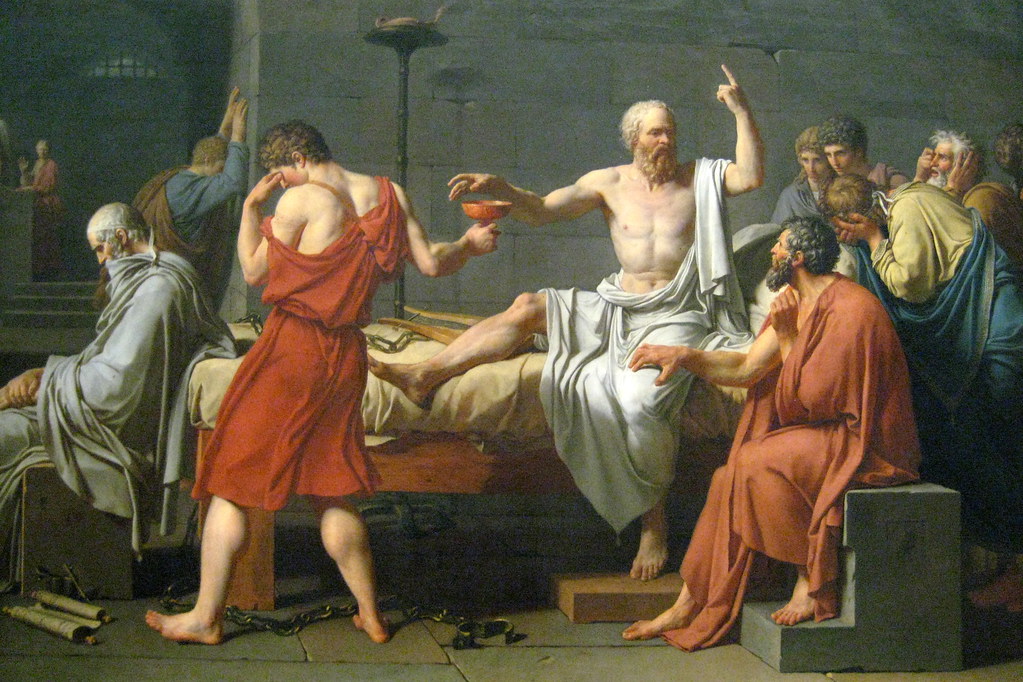
The Death of Socrates by Jacques-Louis David (1748-1825) Courtesy: Creative Commons

Recently I’ve been grappling with the imminent death of a very dear friend. She is very young. Maybe her youth or maybe my attachment to her, makes this particularly moving to me. I have dealt with death before and it is never something as simple as going softly into the night. Yet it is something we must all deal with, multiple times, often intimately and up-close-and-personal when it comes to our turn. This may be a macabre subject but, in a way, it shouldn’t be because it’s the one thing we will all are guaranteed to experience. Maybe it’s time to see death and dying differently?

In my friend’s case she wanted passionately to live. She didn’t want to get cancer in her thirties and have the rest of her days taken up with trying to survive. It’s unfair, it’s horrible, it’s what most of us fear. Despite this, her grace leading up to her death, including her time in the Hospice, had been startling for me. I saw a change in her, that I found unexpected and illuminating. One could have argued it was the hand of God touching her, those who do not believe might have mooted for inner peace. As much as I rail against her dying, and wish stupidly something could prevent it, what helps is knowing what I feel and think is nothing compared to what her family is experiencing, and it puts things in perspective and demands that I rein my feelings. By that, I don’t mean ignore the sadness, but put it in a context because everything is a context.

My context is: A few years back my beloved cat died, I was very upset. But I knew he was a cat who lived a long life, and he was ‘just a cat’ versus a human. For me, that context is different (despite ultimately believing us all equal). If my father passed on, it would devastate me more than say, a stranger, and that’s just being honest. When my grandparents died, I was very upset, but I put it in the context of expecting grandparents to die and whilst I still think of them and miss (some) of them, I’m able to cope. I think this is true with my clients, they rationalise by contextualising. It’s how we cope with grief and fear. When we cannot do this, we usually develop some type of imbalance and that can cause us to have unexpected responses like feeling as if it is the end of the world if your pet turtle has passed on. Everything is context-based. While it might seem insensitive to admit this, it’s what keeps us sane.

People can be dismissive of others pain. I have often heard people say things like: “Well her parents died more than a year ago, don’t you think she should be ‘over’ it by now?” Invariably when their time comes to lose their parents, they may finally understand why most people don’t get ‘over’ it when they lose parents, or siblings or their children. Others believe you are weak if you don’t ‘suck it up’ or that there is some time limit on grieving. In the faith I grew up in, we tend to give a year for grieving for parents (or close relatives) which allows the griever to not feel guilty (or guilted) for their emotions – it frees them. On the other hand, it could be negative if say, after a year they feel worse as many do because grief is not linear. Nothing is perfect. The important thing is to have empathy and realise we all process differently and there is nothing that is wrong or right, except for the individual.

If we all die, then we shouldn’t stigmatise illness or fear it but many people do. It is the great unknown. In modern times, a worse fear is suffering. We may not know what happens when we die, but we know suffering and nobody wants to suffer, but increasing numbers of people do. Why? We always suffered to some extent. In wars people would lie on battle fields for long periods of time dying of awful wounds. In modern times we harnessed the power of pain killers and believed ourselves free of pain and thus, suffering. Despite this quite the opposite phenomena has occurred. In some ways people suffer more.

Why? Because with the advent of ways to prolong life, came medication that extended life but it came with a price. When a person gets cancer say, it’s no longer a death sentence. Many recover fully and go on to live long healthy lives. For those who get a late diagnosis however, the cancer might have spread so much so that eventually it will take their life. This is where modern medicine seems to shine. There are a plethora of medications that prolong life. No, not cure but cause remission or sustain life for a period of time.

If you are someone with children or grandchildren, living an extra two years might be worth the astronomical sum it costs (if you can afford it) but at what cost? Many of these drugs cause horrible side-effects and do not reduce suffering, in fact it is the suffering (toward death) that becomes the experience. You could say, we have prolonged suffering in our attempts to give people ‘more time.’ The question then, is it worth more time and what do we mean by more time?

Whilst doctors want to offer hope, they do so more out of a stubborn desire to ‘try anything’ rather than because the six months they may give a dying person, is really beneficial when you consider the sheer backbreaking cost (bankruptcy from medical costs being the #1 reason) and very small gains (six months more of life and you have spent all your money on a treatment which only benefits Big Pharma, according to Dr. Azra Raza in her ground breaking book about death and dying, The First Cell). The unwillingness of doctors to give up, is admirable and very human (who wants to tell someone there is no hope?) but it brings with it, a false promise.

In the modern world, people have smaller families by and large, and as such, many of us when we get older and more likely to die, may have less obvious incentives to live if we get sick. It’s not so much a wish to die, but a pragmatism about death and dying. Easy in theory, perhaps less so in practice, we must all eventually deal with this issue. Better to consider it before the time comes, hence the increase of living wills, whereby we inform doctors and loved ones, what we want to happen should we get sick. Again, macabre maybe, but imminently sensible, and useful when doctors are not mind-readers and cannot predict what a patient coming into Emergency may wish by way of life sustaining treatment.

Speaking of life sustaining, one debate long held relates to dementia. Right now, if you were to write in a living will that should you get dementia you do not want any life sustaining treatment that would only include if something actually happened to you, such as a heart attack or your kidneys shutting down. For many with dementia though, it is the day-to-day living that is hard, both on the individual whom on some level knows they are not themselves, and on those who care for them. Whilst it seems inhumane to some, to consider letting people with dementia die, those lucid enough to know they have dementia will often wish to die rather than live, without any hope of recovery and the mental state of a child without any chance of growing up. Since dementia is so common place and we’re all living longer, this is a real issue and yet little is done to combat the increase in dementia patients who may often have nobody to look after them and no funds for full time care. What should be done?

Clients of mine with parents suffering from dementia will often describe the agonising decision to put them in care if they have the financial wherewithal or take care of them at home, often at great expense (loss of job, career). Some wish nothing more than the opportunity to care for their parents or loved ones, whilst others feel guilty for wishing it were anyone but them looking after their dementia patient. Both perspectives are understandable. For some there is a redemptive quality to caring, and it comes naturally. For others, financial or emotional reasons may make being a person who cares for others, incredibly hard. It is not surprising that older carers such as the husband of a woman with Alzheimer’s, often dies before the wife. The actual act of caring is exhausting as it may be redemptive, and nobody should be blamed for being unable to do it. Sometimes however, there is no choice, with rising costs for elder care, especially with dementia. It makes me wonder what will happen if the predicted number of elderly develop dementia. Will it be common place to see them walking the streets without anyone to look after them? Take me for example, should my father develop dementia and I live in a different continent, what would I do? This is something many of my client’s fear and yet little is done to resolve this issue by world Governments.

Some people believe dementia patients should be allowed to access euthanasia. As of now, all countries with some degree of access to euthanasia ask that the patient be ‘sound of mind’ – which would not apply to someone with dementia. But even if you write a living will stipulating that you wish to have euthanasia if you get dementia, this is a tricky situation because by the time that would apply, you would not be sound of mind, so it negates the ability to have euthanasia. Furthermore, what of unscrupulous relatives or friends, jockeying for inheritance or to financial gains? How can this be stopped from being misused? How can we gauge whether someone with full blown dementia really wants to die? The reason this matters, is by the time a woman is 80 she has a 1/3 chance of dementia of some kind and by the time she’s 90 that chance is 1/2. This is and is going to affect a huge swath of the population and as such, these conversations need to be had. The only way we do this is to consider what end of life means and how best to end life.

End of life conversations are common in therapy. Clients may be bereaved. They may have a partner dying of a terminal illness, they may have lost a child, parent, friend. Perhaps it is a relief to have counselors because many people don’t want to ‘go there’ and talk about death and dying as if it is contagious. It’s a hard subject, a sad subject, and difficult to put a positive spin on it. Life can be tough enough, without considering dying before it’s time, but that’s exactly what we should do to protect ourselves.

The other subject not discussed in depth is suicide. It’s one thing for us to die of disease, we know that’s a possibility but we’ve always struggled with the idea of suicide. For most of history, suicide has been variously unsanctioned by society-en-mass, but the question is why? Is it an ancient fear of the ‘unnatural’ impulse to die? That we work so hard to stay alive, it seems absolutely wrong to wish to die? Or something else? Whilst Emile Durkheim (1858-1917) wrote on suicide and many have questioned this, no one person that I’m aware of, has managed to figure out what our collective horror is in relation to suicide.

Let’s play devils advocate for a moment. What is it about the decision of another wishing to take their life that causes people to react so strongly? Is it the same as abortion? Pro-life over Pro-choice? Or the visceral horror we all have about dying? If the latter, why does it matter so much to us what others do? What right do we have to intervene? Yet we do, societally and individually. One might say we’re just trying to save lives, but do we put as much passion into feeding the starving or rescuing women from abusive relationships as we do banning abortion and making suicide illegal or socially frowned upon? When it’s not illegal, it’s considered ‘weak’ and a ‘cop out’ (to use an American term). The only society where suicide was really ‘embraced’ if such a thing can exist, is Japan, and nobody really knows why that singular country took the notion of suicide to such an artform.

Suicide bombers today may be Muslim fundamentalists protesting against the tyranny of an oppressive country. They are sold on the idea the after life will be a paradise, and much of what they are told is not from the Koran but from the machinations of those who impel them toward acts of terror. When a young person blows themselves up to destroy others, this is not the suicide we think we understand, but an act of anger, revenge, justice or ignorance. Suicide in its more common form is less about revenge or justice but can be about ignorance or anger. Ignorance in that many young people kill themselves almost upon an impulse, with little pre-thought or planning, just in a reactionary ‘of the moment’ way, that shocks loved ones who didn’t see it coming because it may not have been (coming). There is an element of ignorance to this act, they may be copying others, or reacting abruptly, and had they known more in that moment, they would possibly have looked back on the act and regretted it. As such the impulsive element of the act could be viewed as ignorance/nativity.

Anger is a very common reason for suicide, although probably the one everyone is most familiar with is despair (depression). Ironically anger is as much as incentive for suicide as despair, because of the heightened tendency to react with both those emotions. It is in that heightened state that many attempt or complete suicide and those who survive, often realize there were other options they wish they had taken. For the committed, then suicide is a personal decision, perhaps based on a terminal illness diagnosis or long-term suffering. Despite this people intervene and tell anyone who wishes to die rather than linger and suffer, that they are weak for taking this option. I have always found that fascinating and awful, because I see it exactly the way I would putting my cat to sleep. I did it out of mercy and love. I did not want my cat to suffer. A human being is not a cat but the same emotion applies. Where is the true difference?

The difference lies in religion. People who condemn people for taking their lives are not universally religious but many are. The tenants of a religion might dictate that someone should not take their life. I have always wondered why, because I believe most religions were written and created by humans and so it begs the question, why were they so intent on stopping people from taking their own lives? I can understand that if a God exists and says we should not take our lives, this would give pause to many. But it also creates a challenge, because what God would wish someone to suffer terribly?

This is a very personal decision and that’s my final word on whether someone should choose suicide if they are suffering. To some extent it should be the right of the individual and never anyone else, what they do with their life and death. I recall Brittany Maynard (1984-2014), a young woman with a terminal cancer in her 20’s talking of her right to end her life rather than brutally suffer and I felt then, even if I did believe in God, I would not strip her of that right, because I did not want her to suffer and I could not believe any God or human would. Again, if we have tools in place to deal with these issues, then people who are suffering terribly, do not have to battle through this, at their most vulnerable.

Many of us may not know this but suicide if we’re talking technically suicide, is incredibly common. Old people often stop eating and will themselves to die when they have had enough of life. Technically that’s suicide even if they do not see it that way. Maybe it’s more natural than we imagined? Likewise, hospices and long-term care facilities will medicate terminal patients at the end to hasten their death and relieve some of the suffering. Effectively causing a person to die before their ‘time’ if we think in God-given terms. I do not begrudge this because these carers are seeing people suffer in ways few of us can imagine, if there is not a mercy to ending a life of agony, then I don’t know what mercy really is.

The stigma of suicide is incredibly pervasive. Just like mental illness, suicide is seen as ‘not right in the head’ and a weakness. How sad that society believes judging those during their worst times is the right thing to do? How is that going to help someone choose anything else? And what of their right to end their suffering? This begs the question: Is it right to die before your time? And by right, what do we mean? Who is the judge of what is right and wrong? For some, it’s easy, it’s God and most Gods say suicide is ‘wrong’ but again, why? And at what cost? For those of us without God, then right and wrong become moral principles that we try to adhere to. Is there a downside to morality being the choice of humans rather than something more than us? Absolutely. We are flawed and liable to influence, but sometimes trying our best is all we can do. I would like to think I would be merciful before judging if someone I loved dearly wished to end their life. It would of course depend upon the circumstances, as it should.

Switzerland is the only country in the world where you can elect euthanasia for no specific reason. In America in the ten states that permit some degree of euthanasia, you need to be close to death and have a terminal illness.

Why is death sad?

Switzerland is testing a 3-D-printed pod that its creator says can painlessly end someone’s life in a matter of minutes. The device is called ‘Sarco’ and users can potentially end their lives at the push of a button. The advantage of this system is he pod becomes filled with nitrogen gas, which lowers oxygen in a person, until they fall unconscious and this occurs fast, within a minute. The idea of a truly painless death by euthanasia is why this was invented and users do not Sacro suffocate they die fast of oxygen deprivation after they’ve fallen asleep.

Some have argued a machine like this could glamorise suicide (although how, is not explained) and that it may be overly appealing to a mentally ill person seeking death. I don’t really agree. If there are checks and balances in place that work effectively, this won’t be an issue. The real issue is who wants to consider people taking their lives when death is sad? And how do we access without bias, who is ‘eligible’ for euthanasia and who can be helped another way, that doesn’t involve a premature death? After all, someone in the throes of depression, may wish legitimately to die, but what if a year later they are well enough to be glad they didn’t die? Those kinds of grey areas must be resolved before euthanasia could ever be expanded or wide-spread.

The Netherlands and Belgium permit assisted suicide for patients with unbearable physical or psychological suffering. Which differs from the USA where it can only be for terminal end stage physical illness. Switzerland has less qualms, making it a destination for ‘suicide tourism’ which again, is very sad, but perhaps what is sadder, is that they have to resort to this and what about those who don’t have the means? People assume those who are pro-euthanasia must be eugenicists or simply not care about others, but often the extreme opposite is true, just as it is with Pro-Choice advocates, who believe choice is freedom and the basic right of any woman.

Should we be able to die because we’re simply ‘tired of life’ or should we be expected to carry on to the ‘bitter’ end? This is such a cultural dilemma and maybe suicide became more acceptable in Japan because they reframed the concept of death, making it honourable to commit suicide (or as a means of regaining honor) just as suicide bombers find honour in the act. Should we need honour or some justification to believe suicide needs to be part of any argument about end of life? Maybe this is also connected to concepts of the death penalty. It is believed by many that America will not have the death penalty in years to come, that it’s a faded system that doesn’t work and scapegoats the most vulnerable. I see the death penalty as very different (a consequence for a bad act) than legally assisted suicide (to end suffering) and thus, when I consider arguments about end of life with clients, my considerations are about their quality of life and not, the myriad ways we can consider forms of dying.

In an ideal scenario nobody would wish to die, perhaps. Why? Because so much can be found in living and those who love us would not wish to lose us. Realistically however, people get sick, people get tired, people suffer. As long as we recognise this in ourselves and others, then debates about what end of life represents, will be part of a larger conversation and a necessary one. Perhaps if we cannot see anything positive in this, we can at least not shun it until it is too late. Likewise, we could consider that death is not the worst thing to happen to us, though suffering might be (or the suffering of those we love) and ways of alleviating suffering that are compassionate, should be part of the conversation.

.

Candice Louisa Daquin is a Psychotherapist and Editor, having worked in Europe, Canada and the USA. Daquins own work is also published widely, she has written five books of poetry, the last published by Finishing Line Press called Pinch the Lock. Her website is www thefeatheredsleep.com

.

PLEASE NOTE: ARTICLES CAN ONLY BE REPRODUCED IN OTHER SITES WITH DUE ACKNOWLEDGEMENT TO BORDERLESS JOURNAL.

Categories
Essay

Mimesis and Movies: Plato, Kurusawa & Kiarostami

Karan Tekwani discusses Rashomon and Certified Copy in light of Platonic Philosophy

“…what questions this will to truth has already laid before us! What strange, wicked, questionable questions!”

“What in us really wants ‘truth’?”

“… we want truth: why not rather untruth?”

Beyond Good and Evil, 1886, Friedrich Wilhelm Nietzsche

Friedrich Wilhelm Nietzsche begins his book, Beyond Good and Evil, with a series of questions challenging the “will to truth”. “Will to truth” can be defined as the human tendency to attach overriding importance to the quest of true knowledge. Perplexed by this obsession with truth, Nietzsche takes up in his later works a fierce critique at the “unconditional will to truth”.

Beyond Good and Evil opens with two important questions challenging the centrality and value of truth. The first question, “What in us really wants ‘truth’?”, concerns the psychological ground of human commitment to truth. The second question —  “Why not rather untruth?”–  is regarding the moral value man ascribes to truth over untruth. 

Plato banished all the poets from his ideal society.

The locus of this dramatic gesture can be found in the dialogues of Book X of Republic, where Plato has Socrates conclude, “we can admit no poetry in our city save only hymns to the gods and the praises of good men” (471). The reasons poets cannot be admitted into the ideal society, “are both epistemological and moral, but whatever the reason they have a word in common: mimesis” (Melberg, 10). Poetry, argues Socrates delivers untrue knowledge, because it offers a second hand imitation of an already second hand imitation. When a carpenter makes his platonic bed, he takes a step away from the ideal form. When a painter paints this bed, he moves even further away. “This, then” settles Socrates, “will apply to the maker of tragedies also, if he is an imitator (mimetes) and is in his nature three removes from the king and the truth, as are all other imitator” (464). This theory of mimesis, that discredits the value of poetry, works at two ends. At the first end we have the assumption that a central “ideal truth” exists and at the final end we presume that an imitation is always of less value.

Nietzsche’s questions, that destabilize the authority and worth of truth, are in direct contrast with Plato’s assumptions, establishing the centrality and value of truth. The questions that Nietzsche asked challenge Plato’s assumptions, giving rise to a new set of possibilities. What if we do not want truth? What if there is no truth? What if untruth is the truth? What if untruth is as valuable as truth? The paper proposes to explore all of these possibilities.

This essay evaluates the fundamental assumptions of Plato’s theory of mimesis, in light of Nietzsche’s questions concerning the “will to truth”. It undertakes this examination through a discussion of two movies:  Rashomon (1950) and Certified Copy (2010). The use of films to critique the assumptions is in line with Plato’s use of the word mimesis “with a primarily visual significance; mimesis suggests image, a visual image related to imitation, re-presentation” (Melberg, 10). And concludes by discussing the influence that Plato’s assumptions have had throughout centuries since their conception.

The theory of mimesis rests on the idea that there exists an ideal form, that poetry cannot capture. This ideal truth is conceived by the God and every attempt of the artist, be it carpenter or painter or poet, takes him a step away from this true reality. This centrality of truth has had such a captive hold over human mind, that in the past few decades various search projects have been undertaken to ascertain the true form of numerous artistic imitations.

The British historian Geoffery Ashe in his The Discovery of King Arthur claims to have identified the “original Arthur” in the fifth-century King Riothamus. In his Robin Hood: An Historical Inquiry, John G. Bellamy argues that the prototype of Robin Hood can be traced to thirteenth-century Robert Hode, a valet to Edward II. Abert Boime, professor of art history, in his paper presented at American Astronomical Society, stated that the night sky in Van Gogh’s famous painting “Starry Night” corresponds to the astronomical facts of June 19, 1889. But what if all these search endeavours are futile? What if neither Riothamus nor Robert Hode nor the astronomical facts are the actual true forms? What if all these, supposedly, true forms are subjective versions of truth themselves? What if there is no central truth to hold authority? Building upon this lack of centrality of truth, Nietzsche in the section four of Beyond Good and Evil writes:

“…we are fundamentally inclined to claim that the falsest judgements are the most indispensable for us that without accepting the fictions of logic, without measuring reality against the purely invented world of the unconditional and self-identical, without a constant falsification of the world by means of numbers, man could not live — that renouncing false judgements would mean renouncing life and a denial of life.”

Nietzsche argues that most untrue forms occupy the positions of central truth. The evidence and argument mechanism, employed to verify facts, does not apply to these untrue truths because these untruths become the “conditions of life”. There is nothing like centrality of ideal truth, every real truth is just an unquestioned untruth. Therefore, Nietzsche questions, “What in us really wants ‘truth’?”

This absence of central truth is best exemplified by Akira Kurosawa’s movie Rashomon. Rashomon literalizes the possibility of multiple untruths contesting to be the central true version.

Brimming with action, Rashomon is Kurosawa’s exploration into the idea that there is no absolute truth. The movie is about a rape and murder, and five different versions of the same incident. Influenced by their subjective perspectives, a priest, a bandit, a wife, a samurai (through a medium) and a woodcutter (who initially offers false story, the correct version), narrate their individual experiences. In absence of any significant clues, the audience cannot tell whose version is true. Kurosawa does not want the audience to decide who is telling the truth, the point is: truth is not absolute, it is relative. The Stanford Encyclopaedia of Philosophy defines relativism as

“… the view that truth and falsity, right and wrong, standards of reasoning and procedures of justification are products of differing conventions and frameworks of assessment and that their authority is confined to the context giving rise to them.”

Each of the characters in the movie espouse truth relative to their ethical, moral, cultural and social backgrounds. In the bandit’s version of the events, he is presented as a skilful fighter. The wife makes sure that her narrative showcases her as a devoted loyal wife. In the samurai’s story, told through a medium, the samurai is portrayed as a heroic man who kills himself when he disgraced by his wife. Though initially in his account the woodcutter does not confess, he later informs that he picked up the lady’s dagger and sold it in the market. Through this relativity of truth Kurosawa highlights that there is no central truth. The fundamental idea of Plato’s theory of mimesis, that there is an ideal true form, collapses when viewed in light of Rashomon’s belief in relativity of truth.

Another idea fundamental to Plato’s concept of mimesis is that only originals are valuable. The conclusion of the theory of mimesis is that since imitative poetry is thrice removed from reality, it is not valuable. According to Plato, any art form divorced from the stamp of truth is not worthy of appreciation. This idea that truth and value are sacrosanct has become prominent in past few decades when means of replication are easily available.

In 2010, the National Gallery of London staged an exhibition entitled Close Examination: Fakes, Mistakes and Discoveries to showcase the various high-tech devices capable of attributing a work of art as authentic. But what if original work is missing? What if the value of fake is more than the original form? What if the fake displaces the original? Developing this argument regarding the value of fake, Nietzsche writes in section two of Beyond Good and Evil:

“For all the value that the true, the truthful, the selfless may deserve, it would be possible that a higher and more fundamental value for life might have to be ascribed to deception, selfishness and lust.”

Nietzsche’s challenges the supremacy sanctioned to truth, arguing that untruth may be equally valuable. The fake can exhibit quality deserving to an original. If untruth is as worthy as truth, “Why not rather untruth?”. This argument rings a scene from Abbas Kiarostami’s Certified Copy, when Elle takes James to see a painting in a museum, that had long been considered authentic but was eventually revealed as a copy. Similar to this painting, Kiarostami’s movie blurs the difference between the original and fake.

Certified Copy, released in the same year as the National Gallery exhibition on fakes, unmasks the absurdity of the dichotomy of original and copy. Certified Copy deals with a mysterious relationship between a British writer James Miller (played by William Shimell) and a French art gallery owner Elle (Elle is French for she, played by Juliette Binoche).

James is on a visit in Italy to promote his non-fiction art history book, also called, Certified Copy and Elle invites him to spend a day with her. Elle drives James to Tuscany museum to see a painting called “original copy” that is related to the subject of his book. The museum guide explains, “This is the famous Muse Polimnia, the portrait of a woman, whose dramatic story is told on the cartel next to the painting. For years, this painting was believed to be Roman Art. It wasn’t until the 20th century about 50 years ago, that it was revealed to be the work of a skilled forger from Naples. However, the museum decided to conserve this fabulous portrait as an original. It is actually as beautiful as the original.”

However, contrary to Elle’s expectations, James does not seem captivated. On being asked what did he earn James responds, “They say how much they adore the picture. But they say it is a copy and the original is somewhere around”. James is upset that the painting’s status as a copy, denies acknowledgement of its artistic merit. After this museum visit, James and Elle go for a coffee to café, where the film’s key moment in terms of narrative twist takes place. While James steps outside to attend a call a call, the café owner an old lady, addresses James and Elle as married and Elle does nothing to correct her. Elle keeps up the pretence as they talk of marriage, work and fidelity.

Eventually, a subtle but a meaningful gesture occurs, the old lady steps in front of the seated Elle, blocking her from audience’s view, bends over and whispers something into her ear. After this moment, the distinctions between the real and fake are blurred in the movie. When James returns, both James and Elle act as if they have been married for fifteen years.

It becomes nearly impossible to decipher if the couple are strangers pretending to be married or spouses role-playing strangers. Just as the fake painting had been considered original, the audience realises that what they had believed to be reality was pretence. And now seems to be pretence can be the true reality. Unlike Plato, who works with neat distinctions between the original and the fake to ascribe value to the original, Kiarostami merges the difference between the real and fake to illustrate that untruth can be equally valuable as truth.

Plato’s idea of mimesis marked a turning point in the history of Greek ideas. The assumptions made by Plato: the centrality of truth and the value of truth, were unprecedented in Western thought. Jean Pierre Vernant notes, “Prior to Plato Greek culture regarded images as an actualization or ‘presentification’ of what they represent. Archaic statues of Gods, for example, were understood not simply as illusionistic depictions of a deity but as an actual revelation of a divinity that otherwise be invisible” (Mathew).

This is similar to what James said in his lecture in the movie, “The copy leads us to a better understanding of the original” (Certified Copy). The ancient Greek art, before Plato, was not regarded as derogatory imitation but a means to achieve the immaterial. However, Plato’s idea of mimesis brings a fundamental shift in this trend, by introducing the central authority of truth. Art now becomes a periphery to this centre; whose value is always inferior to the true form.

The true form becomes the standard against which the merit of art is judged. In spite of these changes, the universal appeal of mimesis cannot be denied. Plato’s idea has been discussed, adopted and even challenged, both directly and indirectly, by writers, film directors and critics, throughout the centuries. Its universality is evident in the case studies of this paper: an Iranian director in his French movie of 2010, uses a concept discussed by a Japanese director in his 1950 movie. Plato’s concept of mimesis with its assumptions, has percolated centuries, nationalities and even art forms.

.

Acknowledgement

The idea of this paper came from the classroom discussions with Mr. Naveen Panniker in his Literary Criticism classes on Plato’s Book X.

.

Karan Tekwani is a postgraduate student at Delhi University. He is passionate about world cinema and wishes to pursue cinema studies in future. 

.

PLEASE NOTE: ARTICLES CAN ONLY BE REPRODUCED IN OTHER SITES WITH DUE ACKNOWLEDGEMENT TO BORDERLESS JOURNAL.