Categories
Stories

The Mysterious Murder of Adamov Plut

By Paul Mirabile


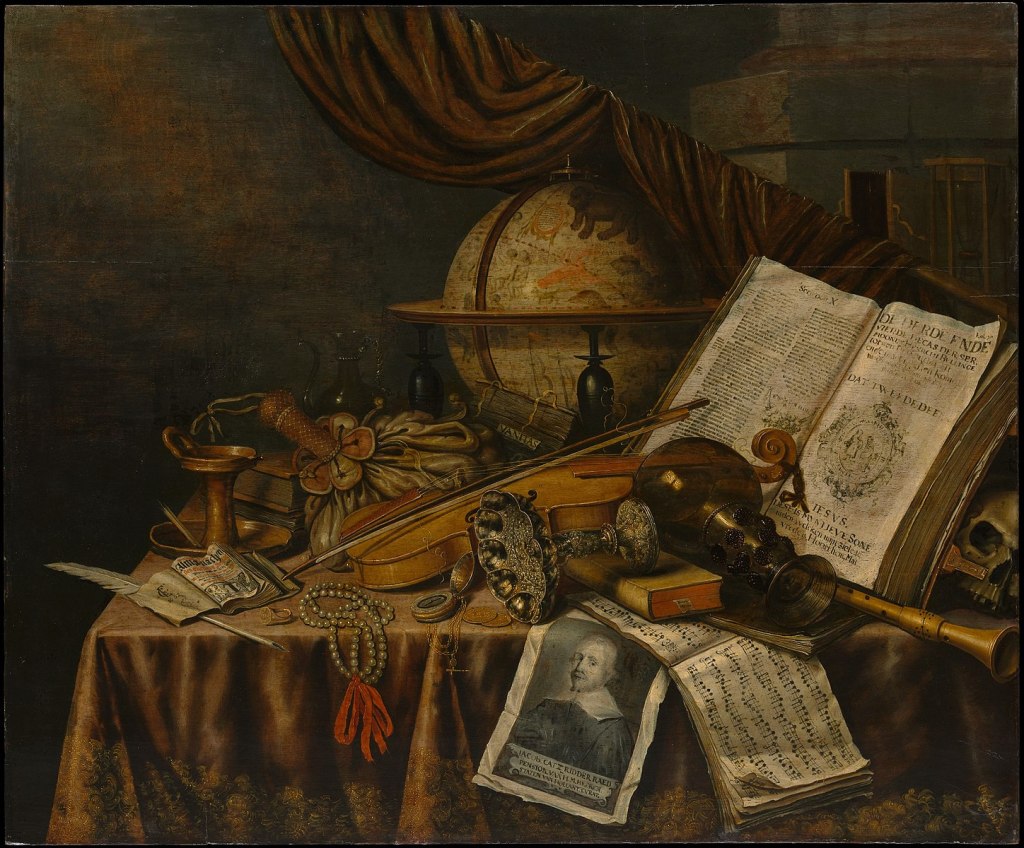
Vanitas Still Life, painting by Evert Collier(1640 –1708). Courtesy: Creative Commons

Back home in Madrid, having abandoned Adamov Plut to his posthumous fate, I was a bit surprised that neither the New York Times nor the Washington Post reported anything about the murder, not even a paragraph, or as the French so imagitively put it, an entre-filet ! I soon realised, due to this journalistic silence, that the time had come for me to give a full account of my relation to Mr Plut ; that the time had come for me to expose, publicly, by way of this revelation, his ‘mysterious murder’.

My information is of the surest sources for the simple reason that it was I who had Mr Plut murdered ! Yes, I ! And for reasons that shall be shortly disclosed. A mysterious man he might have been; however, his methods of acquiring priceless books and other inestimable valuables can hardly be called mysterious: Mr Plut was a vulgar thief, a scoundrel, an ingenious trickster whose singular flair caused much grief to many individuals, enraged those whose trust had been flouted.

It was in Istanbul, where I was invited to sojourn with an Armenian merchant, that I witnessed Mr Plut’s dupery. And if my naive friend fell for his crooked smile, I certainly didn’t swallow his high tale of returning to pay him for the two illuminated manuscripts my friend had graciously offered the blighter on condition that he be held accountable for them. His thick, coarse lips translated a smile that held contempt and disdain towards those who trusted him. So infuriated and insulted did I feel on behalf of my friend that that I reacted on a lightning urge and decided to follow him. I said nothing of this to my disbelieving companion, but left immediately in pursuit of my game — and game it was — for I, to tell the truth, had nothing more substantial to do at the moment and felt disposed for a good hunt.

I said that Mr Plut was a genius. Yes, in his own way. However, genius has its limitations. His arrogance and haughtiness knew no bounds, although he knew that his foul doings had attracted the attention of police and Interpol. Some may surmise that a certain paranoia drove him to invent individuals tracking him down like a wild boar or moose. No, no one was tracking him down except me, and that as subtlety as possible. In Uzbekistan, I actually chatted with him over a cup of coffee on two occasions disguised as a professor of Slavic philology, dressed in a quilted chapan robe and silk embroidered tubeteyka cap. There we sat in Samarkand, sipping our thick beverages in the vaulted bazaar at one of the storied cafés that dot the town. He was all smiles, obsequious and gold-toothed. I had the impression that I was dealing with a child or a mentally-dwarfed man whose sense of reality lacked all discernment or sagacity. I concluded that he had come into quite a bit of money, and never having had to work for a livelihood, traipsed about the world at his leisure, buying or stealing books, cheating people out of their invaluable collections. So self-indulgent and confident was he that he never saw through my masquerade as we conversed in broken Russian.

It was at that café where I learned about his fabulous treasure, as he called his book hoard. Only an idiot would have divulged this information to a perfect stranger, but as I said, Mr Plut’s contemptible demeanour caused him to fall into the most infantile traps. Traps that I began laying out for him, and that would lead to his downfall. For I had begun to design my own plan to relieve the rogue of his fabulous possessions, all the more so since he also let slip that his parents had passed away, and he had inherited the house. How I would make his treasure mine and ‘disinherit’ the  owner  still remained vague in my mind.

We departed as ‘friends’, as two strangers seeking an answer to the mystery of their existence. Or so I made him believe. Mr Plut appeared to me a dying species, a worldly aesthete, in spite of his extreme vulgarity and ponderous gait, whose debonair demeanour masked a loathing for his victims, a bent for the lowest duplicity, a gratification in spinning the most treacherous stratagems in order to allay his desire to prevail.

Mr Plut slipped out of Uzbekistan without my knowing it. He probably used his Russian passport, one of the four of five in his possession. I felt a twinge of misgiving. Had the fat fellow got on to me? After many enquiries, I finally discovered that he had crossed into China at the Xinjiang border, and was hastening towards the Yunnan. Why ? I hadn’t the faintest idea …

His brief sojourn in the town of Lijiang enabled me to catch up with him. My Chinese was fluent enough not only to query his whereabouts in that lovely town, but more important still, to learn of his new ‘purchases’, once I had questioned the director of the Dongba Museum of Culture. Mr Plut had planned to gone there to acquire several Naxi pictographic sacred books, which he did from a rather corrupt priest with whom he had been corresponding for some time, using a special code so as not to be unmasked by the Chinese authorities of the Centre. The director only learned of this a week after the unlawful negotiations had occurred, and three or four very valuable Dongba liturgical books had been stolen. It goes without saying that the rapacious priest was severely punished.

I immediately left Lijiang much to my displeasure for it was indeed a quiet, pleasant place, and set out in hot pursuit of the marauder. I followed his all too familiar scent through Nepal into North-western India to the Zanskar region where he put up for a while at the Phuktal Gompa[1], a strange spot to make a halt. But a perfect hideout to gain time in order for planning his next move, whilst at the same time inveigling in the most repulsive manner his generous hosts.

The monastery is nestled in the most remotest of valleys, ensconced within a cliff of tuft of fairy chimneys, crags and honey-combed spires which bulge black and red against the background of sandy, dazzling ash and cinerous tones of hemp. I had trekked there from Lamayuru in twenty days, and as I was to learn, Mr Plut had arrived there three days ahead of me, but by way of Padum. To gain the main entrance of the gompa, the pilgrim had to climb a steep path, keeping his or her right shoulder to the seventeen chortens[2] that mark the steep climb towards the vaulted entrance. I had shaved my head, grown a long beard and donned a woollen chuba tightened around my waist with a long colourful sash. It kept me warm, for in spite of it being Summer, the nights were very cold, and my cell had only a small wood-burning stove to keep me warm.

I spent three weeks at the monastery, sleeping on a ratten matting, eating skieu, tsampa and chappatti, drinking steaming salt-buttered tea off a chopsey — a low, small table — reading or gazing out of the little window that offered me a full view of the dusty, treeless courtyard below, where monks would mutter their mantras, and beyond into soundless nights whose stars were generally veiled.

Without Mr Plut’s slightest suspicions, I assisted at all the ceremonies, mornings and evenings, even vigils, while in the afternoon, I would venture out into the monastic complex, twisting and turning in the warren of lanes, under the low archways and high ladders, at times pursuing my promenades upon the rather precipitous mountain paths. As to Mr Plut, he hardly left his cell, and when we did cross paths, he most probably took me for a Buddhist pilgrim. Once or twice I sat near him in the prayer hall in the meditation grotto, but he never attempted to communicate with me, albeit he did not seem very deep in prayer or contemplation. He was probably scheming his next miserable move. His face had become terribly pale and flabby. His darting, black eyes seemed to have sunk deeper into their sockets. Unable to sit cross-legged on the low benches at the back of the prayer hall, he sat ‘western style’, staring off into the clusters of chanting monks, tilting his huge, bobbing head every so often to the banging drums, blowing ox-horns and tinkling triangles. Observing him from afar, I sought to sound his soul, to wring out his innermost thoughts, to extract from his evident lassitude and apathy his flight from both his victims and himself. But Mr Plut was a sphinx. Would he rise out of his own ashes when his hour came ?

I left the good monks three days after his departure, a hasty one indeed. And they were furious! The scoundrel had stolen several pustuks[3] and thangkas, and failed to pay for the prayer masks that he ‘purchased’. They implored me to find the culprit, inform the police and recover their stolen property. It was perhaps the beseeching words of the infuriated monks, after having received such incomparable hospitality from them, that my plans to have the thief killed began to germinate ! The theft was not only gratuitous, it exposed the very ugliness of the man’s heart, blackened by greed, cynicism and remorselessness. It would only be a matter of time before he tasted a soupçon of his own medicine.

Meanwhile the cat would play with the mouse, a rather fat mouse at that ! I boarded the cargo ship that took the fugitive from Karachi to Oakland via Japan. On the long, monotonous voyage across the Pacific, my ominous shadow crossed his at the most unsuspecting moments. Attired as a Pashtun merchant, bearded, long-haired and turbaned, Mr Plut sensed an onerous presence whenever he laboriously carried his huge body across the decks. How many times had my eyes penetrated his anguish, his torment, his pangs, not of compunction, but of incomprehension. He scented a sleepless menace pressing him. Fear inflamed his dark, beady, mirthless eyes like the burning incision of the trenchant knife.

Oakland … Sacramento … Reno … Tombstone … Boulder … Santa Fe … Saint Louis … Chicago … New Orleans … Birmingham … Miami … Atlanta and finally New York. Yes, New York, where the curtains would finally fall on this tragic fat figure. Where upon the stage of 8 million walk-ons, and against the backdrop of the grottiest of hotels, the last act of Mr Plut’s abominable performance would be played out.

His infatuation with Louis Wolfson amused me, as well as his grandiose project to write twelve stories in twelve different languages signed by twelve different authors. I found all this quite pompous and pathetic. A real exercise in self-indulgence to say the least. All this information I culled when I ‘accidentally’ met him in the ill-lit corridor of that hotel on Water street in downtown Manhattan. In New York, I played the role of a French researcher in mediaeval literature, a field that he completely ignored, in spite of possessing several manuscripts of Anglo-Norman stamp, apparently purchased (so he said ?) from a London book-seller. I pretended to be interested, taking the opportunity to study him closely. Besides, he was such an inveterate liar how could one believe anything he said ? He lied to curry favour and win confidence, only to swindle and steal from the naive and simple-hearted. Better to observe his eyes, his gestures, his bouncing from one tongue to another. These were all genuine signs of his distorted psychological make-up. To play my part well, I sported an immaculate white suit, orange tie, a pair of silver-rimmed glasses and spanking new alligator shoes. I had shaved my beard and moustache and had my hair cut very short, leaving a few gossamer wisps which touched the tips of my ears and fell bouncily on my forehead.

Every day I followed his Humpty Dumpty gait as he waddled to and from the public library, in and out of Central Park. And it was there, in Central Park, that I noted two blond-haired rough fellows slouching on a bench, eating the remains of fried chips or chicken sandwiches, cursing and making gross signs at the passers-by, drinking beer and spitting. They were seated at the same bench daily — the bench that Mr Plut walked by every day. They seemed to know him because they would hoot at him, call him names and ask for money. Fatso passed by without even a glance at them.

One Saturday, I decided to approach the two ruffians. They sized me up with obvious contempt, and made it perfectly clear that I was intruding on their ‘territory’. I sat down none the less, and exposed my scheme to be rid of Mr Plut once and for all, explaining how the culprit had cheated and robbed so many people. The two burly blokes, former marines in the Green Beret (or so they vaunted!) listened attentively as I unfolded my plan: Three thousand dollars for each if they would simply walk up to his room in the early morning hours, the night porter always being asleep, knock at his door and kill him, however, without any blood shed or theft of his belongings. It must be a murder without reason, without any sign of bestial violence. One of them suggested strangulation. Yes, excellent idea. It would thus be a ‘clean’ murder.

And so it was, very professional at that I must say. They were paid off, as agreed. And I left New York two days later, as planned, a very satisfied man indeed …

This all happened five years ago. Now … well, here is where my account ends and my confession begins. For you see, Mr Plut was never really murdered ! Those two ‘ruffians’ were in fact F.B.I. agents who had been trailing me since disembarking in California. To tell the truth, Interpol and local police had been following me since the Istanbul affair. How and why they began doing so I cannot say. During my trial neither the judge nor the prosecuting attorney afforded any information as how the F.B.I. learnt of my scheme, nor why they had decided, at one point in time, to cooperate with Plut. What was I convicted of ? What was my indictment ? As to my appointed lawyer, a young short-sighted clerk more than a seasoned lawyer, who could be easily cajoled by the ‘evidence’ against me, pliantly manipulated by the prosecutor, after he had taken the floor and had made an absolute fool of himself. He let out a sigh of relief when the judge pronounced a sentence of fifteen years instead of twenty-five! The wigged judge, a grotesque figure studded with huge warts, yawned throughout my lawyer’s deplorable speech for the defense, as well as during my feeble plea. There was no jury either to lament or to applaud his verdict. It was a trial held at ‘huis clos’[4], military style. I buried my face in my hands. As expected, my lawyer made no effort to appeal.

Had Plut sensed my innermost aversion towards him ? Or seen through my many disguises ? He was a clever man, and probably had hired detectives to learn why I was following him. The hotel room murder was staged. Plut lay recumbent on the floor, waiting for me to steal his papers so that I would be indicted for premeditated murder (although there was no murder!), of paying off hoodlums to commit this murder (although they were F.B.I. agents!) and the theft, which indeed it was (but fifteen years for that?) of his household papers, keys, and other official documents concerning his inheritance … and that vile short story of his.

So here I sit in my rancid smelling cell in Madrid, having been arrested at the aeroport on my arrival some five years ago, writing out this confession. I do not to repent mind you, I have no intention of atoning for my doings, nor avowing my sins. These words wrenched from my pen seek to vent the animosity and hatred I harbour towards that fat impostor who had the cheek to write me a letter from the Seychelles revealing how he had got on to me since Uzbekistan, and how our little cat and mouse game had amused him greatly : “You thought me a fool, deary, but I saw through your pusillanimous scheme in Samarkand ; that was some outfit, but you forgot the galoshes ! Not to mention your pilgrim weeds at Phuktal which truly charmed me, and your blazing orange tie in New York. Come, come, what French professor would ever sport an orange tie with a badly tailored, cheap white suit ?” The vicious irony underlining these sentences, along with a soupçon of cynicism caused me to gag. The blighter added in a post-script that he had sold all his books for a fabulous sum of money, and had retired from the world’s wearisome fair. In the envelope I found a photo of him sipping coconut juice, lying on the golden sands of a crescent-shaped beach under groves of swaying palm trees and an indigo blue sky. I laughed bitterly, and yet, in spite of my nettled nerves, pinned up the blasted photo in my lonely cell, a sort of souvenir of our enshrouded relationship …

One day at the prison library, browsing idly through a dull, detective story, I thought of Plut’s or Hilarius Eremita’s story The Enchanted Garden, which I had taken and read to amuse myself on the aeroplane to Buenos Aires. Had anyone ever published such ridiculous trash? To my horror, the answer came three days later whilst I rummaged through a new batch of literary magazines, some of which contained short stories in English, French and German. And there it was — The Enchanted Garden, by Hilarius Eremita, Plut’s pen name. I couldn’t believe my eyes — someone had published that rubbish ! Plut indeed had the last laugh, adding insult to injury, salt to my festering wounds.

I savagely tore out the pages of his story from the magazine, went to the toilet, ripped them into tiny pieces and flushed the filth down the bowl. So much for hiss ‘first of the twelve’ ! I shan’t be punished for it, no inmate in this prison reads any language besides Spanish, and that with a dictionary … I’m sure it was Plut who sent me that magazine to drive the knife deeper into my wounded pride. The miserable rat !

So here I sit at my iron table, staring at Plut’s photo as he sips his coconut drink under the blue skies and swaying palm trees whilst I sip my wretched thin noodle soup with strips of hard, nervy beef under a cracked, peeling, dirty grey prison ceiling …

.

[1]          Monastery in Tibet

[2]          The Tibetan word for stûpa, a Buddist shrine which initially housed the relics of the Buddha.

[3]          Books used for Buddhist ceremonies written in Tibetan.

[4]          Behind closed door without any public participation or observers. It is a French legal term.

Paul Mirabile is a retired professor of philology now living in France. He has published mostly academic works centred on philology, history, pedagogy and religion. He has also published stories of his travels throughout Asia, where he spent thirty years.

.

PLEASE NOTE: ARTICLES CAN ONLY BE REPRODUCED IN OTHER SITES WITH DUE ACKNOWLEDGEMENT TO BORDERLESS JOURNAL

Click here to access the Borderless anthology, Monalisa No Longer Smiles

Click here to access Monalisa No Longer Smiles on Kindle Amazon International

Categories
Essay

Kabir & His Impact on Tagore

By Mozid Mahmud

Kabir. Courtesy: Creative Commons

Kabir’s life still holds importance in a society in pursuit of the one true Lord, steeped in religiosity and caste. He was born at a time when the Hindu-Muslim strife was raging across the subcontinent. Divided into various sects, Hindu society was already engaged in conflict and the arrival of the Muslims and the expansion of Islam intensified the conflict of the time. The two camps – followers of foreign and indigenous religions – could not find a way to come together. Arbitrary rituals and sacrifices were damaging their dignity and short-selling God’s glory. In such a time, Kabir was the most significant of intellectual sages who bridged gaps through his clarity of thought, unwavering devotion to the Lord, and humanist reading of all belief systems. In simple, clear and logical language he pointed out the irrationalities of men, without outright attacking any faith. His teachings were not only effective to his devotees but were helpful to adherents of other doctrines as well. One did not have to be part of his sect to receive his teachings and capture the meaning behind his words. Anyone free from the shackles of self-interest were able to accept it.

Though there is little to deny in Kabir’s words, there is much debate among the experts regarding the period of his birth and death. The historical facts contain many contradictory components as well. Evidently, one sees that there are two versions of Kabir’s life visible. One has been constructed through analysing historical data, the other through beliefs and commentary provided over the ages by his followers and devotees, though all such projection by his disciples cannot be understood in the same light. Yet it should be noted that the accuracies regarding some of Kabir’s facts of his life do not pose any doubt to his teachings and appreciation for beauty. Still, in light of the contemporary commentary, a brief biography of the poet is outlined here.

According to Kshitimohan Sen (1880-1960), a scholar and acting chancellor of Visva-Bharati, Kabir was born on 1398 in Varanasi and died on 1518 in Maghar village. While specifics are understandably hard to gather, most experts agree that he was of the time when Sikander Lodi (1458-1517) ruled over Delhi’s throne. Kabir had met the man, too. Lodi had arrived at Varanasi in 1498. Rabindranath had talked of this in his translation of Kabir’s One Hundred Poems, which was published from Macmillan. There, it is said he was born in 1440. Though Kabir’s Hindu devotees liken him as a devotee of the Vaishnava poet-saint Ramananda, it is still a matter of debate, for Ramananda was born in 1298 and most texts that refer to their connection can only be traced a hundred years after Kabir.  

In his writings, mentions of the poets Jayadeva (1170-1245) and Namdev (1270-1350) are found. Though one was active in the 12th century and the other in the 14th. Moreover, one can find references to Kabir in the works of Raydas, Garib Das, Dharma Das, Pipa and Tukaram. Some of Kabir’s verses can be found in the Sikh religious text Guru Granth Sahib too.

There is much debate over his parentage and religion too.  However, it is taken as fact today that he was born in a Muslim family or was raised in one. It is hypothesised that he had come from a family of Muslim weavers, who had a trade in cloth. Another legend had him as the virgin son of a Brahmin woman, born through seedless conception and then he was abandoned and found floating in a basket. The fact that he was born in a Muslim family is mostly evidenced by the fact that he had an Arabic name, which meant “Great”. There is further doubt on his race and caste. According to Hazari Prasad Dwivedi, Kabir belonged to a Yogi community, for he would refer to his father as Gosai, meaning Guru. They were principally disciples of Nath-Panthis – worshippers of Shiva. While they had accepted Islam as their religion, they continued in their old ways as of yore. But Kabir did not proclaim himself as either a Hindu or a Muslim. As a result, many surmised that he probably wanted to be known as someone from the lower caste, who remained out of these two binaries.

The issue of caste might have irked him as well. It might have had no importance to him. This reticence had led to most communities intending to co-opt him for them, constructing all sorts of imaginary relationships. A Muslim guru of the time, Sheikh Taqi, had complained to Lodi that Kabir saw himself as a deity. His low-born caste led him to a path of constant discrimination. There are accounts of this discrimination in texts. He had been humiliated for proposing the idea of a formless God. Many a time he had been tied behind his back and beaten up. Let me account some of the accounts of his torture here.

The Emperor of Delhi, Sikander Lodi, had demanded Kabir be arrested and brought to his court. When he was somehow brought over, he stood there in silence.[i] The Emperor grew angry and asked, “Why don’t your curse at the Emperor, Kaffir?”
Kabir answered, “Those who understand the other’s torment are called Pir, and those who don’t are termed Kaffirs.

When the Emperor asked him why it took him so long to get to his court, he replied that he had seen such a scene on the way that he could not but be late. A line of camels was entering a gully as narrow as a needle’s eye. The Emperor thought he was being ridiculed and grew angrier. But Kabir said, “Oh Emperor! Can you feel the distance between the heavens and the Earth? The distance between the Sun and the Moon can be filled with innumerable elephants and camels, yet we can see these stars through a drop in our eyes.” The Emperor was so moved by the statement that he let him go.[ii]

Once, after a few Brahmin priests had complained, the Emperor ordered his death by tying him to a stone and throwing him off a boat. But while the boat itself drowned, Kabir was said to have been found unharmed and floating. When they tried to burn him, the fire wouldn’t take to his skin. They even accused him of being a witch and tried getting a mad elephant to stamp on him. But the animal got scared seeing Kabir and ran away – there are numerous myths of these nature surrounding Kabir.

Kabir did not receive a formal education. He did not know how to read and write. There is no evidence of him attending a school to learn of language and philosophy. Moreover, he had barely any experience with his weaving. Many are of the opinion that the “guru” he talks about in his texts refer to God or the Creator and that he did not have any mentors. However, researchers at times hold the opinion that he was a devotee of the Sufi mystic Sheikh Taqi. It is evident he was influenced by Sufism.  He had similarities with the Persian poets Attar, Hafez, Khayyam and Rumi. Besides, he was considered a key disciple of the Hindu monotheist mystic Ramananda. Kabir hadn’t mentioned anyone directly in his texts. But through his songs, various interpretations are made by the public. Kabir’s best teacher seems to have been just life. The hypocrisy, short-sightedness, superiority regarding one’s beliefs and inconsistencies of men and society around him angered him, it made him anxious. This torment had put him to the path of sage hood. Kabir characteristically expressed his perceptions through simple and irrefutable arguments devoid of any personal animosity toward anyone.

Kabir was not an ascetic who abandoned his family to attain higher forms of consciousness. He lived with his wife and son and daughter. In his writings, he showed contempt against the sages who left their families. His wife was called Loi and his son and daughter were Kamal and Kamali. His second wife was Ramjania. According to Dr Ramkumar Verma, the second wife was possibly a prostitute. However, Kabir was not quite happy in his marriages. His devotion to his poetry and philosophy made him less attentive to the task of earning a livelihood through weaving.  Some days, his family found themselves short of food after feeding his visiting devotees. He was thin, meditative and enthusiastic, and hated to beg for alms to survive.

We know from his works that he visited many places. It is believed he had gone on pilgrimage to Mecca. But it isn’t clear if he really physically visited the place or had a transcendental experience. Similarly, there isn’t any evidence of his visiting Baghdad, Bukhara and Samarkand. But it has been proved that he had visited many of the local pilgrimage sites around him.

Like his birth, the date of his death is cloaked in controversy. Some say he lived till the age of eighty. Others maintain that he was alive when he was 120. There’re broadly four dates that could refer to his passing. 1447, 1511, 1517, and 1518 AD.[iii] There is doubt, too, about his resting place. Some say he died in Ayodhya, some claim in Puri. The latter place is mentioned in the Mughal Emperor Akbar’s book Ain-i-Akbari.

Kabir’s literature and philosophy

The divisions and discriminations of religion had a profound effect on him. The communal conflict and the blatant ownership of God deeply tormented Kabir. He realised that God did not exist for any particular religion or people. He wasn’t a single entity either, but omnipresent. His realisations were a result of the overarching philosophical conflicts of his time. The clash and assimilation of various cultures into the Indian way of living had given way to myriads of philosophies and religions in the region. Among them, the radical ones, which professed to one sect’s superiority over the other were beginning to widen separatism in society. The first of these great conflicts were between the Aryans and Non-Aryans. It took many years for the two to assimilate.

Kabir and Rabindranath

Rabindranath had a prominent role in spreading Kabir’s words in Bengal. About a hundred years ago in 1910, he had written a preface to a book of translations of Kabir’s poetry. Kabir was among the few poets whose works were preserved at Santiniketan. Kshitimohan Sen had grown up in Varanasi, among the saints there, nursing a love for Kabir from a young age. A few months before his translations had come out from Santinektan’s press, Rabindranath had published Gitanjali. It was not possible to avoid drawing comparisons, with some claiming Rabindranath was inspired by the sage’s poetry. In Prasanta Kumar Pal’s biography of Tagore, the matter is discussed at length. He had written that in the original manuscript of Gitanjali, there were poems of various poets of such ages written over. Dr. Rameshor Mishra thought they were written by Rabindranath, but Pal could not agree with him. He had maintained that Kabir had been well-known as a poet over the years. Even before Kshitimohan’s translation, it would not have been unlikely for the young poet to have been aware of Kabir. Kshitimohan himself had dwelled on the matter saying that he had introduced Kabir’s poetry to Rabindranath after reading Gitanjali and finding the similarities in the balance of tone.

Whatever the case was, the fact that Rabindranath and Kabir wrote in a similar spirit cannot be denied. Rabindranath was heavily influenced by the Persian Sufis. One could clearly see the presence of both Sufism and Vaishnavism in Gitanjali. Rabindranath’s father was a devotee of the Persian poet Hafez. Hafez impacted Rabindranath as well. He had talked about this when visiting Iran at the end of his life. “My father was an admirer of Hafez,” he had said, “I have listened to his recitations and translations many a time. It is that beauty of Iran that has entered my heart during my travels here.”[iv] Around this time, he was studying Sufi theory as well. Therefore, one cannot claim it was solely Kabir who had an influence on Tagore’s Gitanjali. But Kabir did have an effect on Rabindranath, if for a little while.

Rabindranath began to work on Gitanjali in the early 1900s. He had written to Kshitimohan around then, saying, “I have been expecting Kabir. Do not delay.” The next year he wrote back to say, “Give my respects to him.”[v] From these letters we can see that Rabindranath had a good deal of interest in reviving Kabir. In one of those letters, he had maintained, “I have told you. One should not deviate from the principle aspect. If there is ambiguity regarding the literalness, then be it. Some of it is needed, or else the poetry loses some of its meaning.

“It is better to use the next most literal word when there is no direct translation possible. Kabir uses ‘word’ to express his songs and it seems that particular word does not work in all instances. There is a historicity to ‘word’ – one thinks of a child’s first cry, the first chants of creation. It is quite simpler and more complex than a song.”

Published as part of Santiniketan’s book series, Kshitimohan wrote in the preface of his translation that without the encouragement and help of Rabindranath he would not have been able to publish a work like this, that he was quite grateful to him. Rabindranath had a hands-on approach to Kabir’s translated poetry. That this happened around the time the poet was working on Gitanjali was a thing of co-incidence. Kshitimohan himself had talked of how he had brought Kabir to the poet’s attention after hearing about Gitanjali.

However, the matter has refused to die down. In books on Kabir, there have often been calls for Rabindranath to recognise the debt of Kabir in his texts, that Tagore’s mysticism had arrived solely from Kabir, which was merely given an occidental polish to accommodate the Poet’s international audience and that Rabindranath’s fame came from a decoration of mysticism for the pleasure of Europeans. Even as one notices the ludicrousness of such claims, it is understandable that much of Rabindranath’s spiritualism is a product of Sufi mysticism. Moreover, there was always a strain of India’s old traditions that included Kalidasa and the worship of beauty. He had discovered the bauls (minstrels) when looking for folk literature in his youth. He was fascinated with Lalon. However, Kshitimohan Sen had claimed that Rabindranath was not one to be heavily influences by these mystics. “The era of Gitanjali came head-to-head with the revival of these mystics. No one is indebted to anyone here.”

But how much of Kabir was on Rabindranath’s mind? Many would go ahead and say a great deal. That he had devoted to Kabir more so than Gitanjali in this period. Perhaps the indulgence toward both texts was a united effort in the pursuit of true worship. Two events around this time are noteworthy. One is Ajit Kumar Chakravarty’s translation of Kabir under Rabindranath’s guidance and the other is his own translations of Kabir. This was when Ezra Pound, too, was interested in Kabir’s poetry. There is no doubt that it was Tagore who had got Pound into it during their discussions on mysticism. Helped by his encouragement, Pound, who had little knowledge of Hindi or Kabir, made ten translations of Kabir’s poetry with the help of Kalimohan Ghosh. They were published in the 1913 January issue of Modern Review under the title, “Certain Poems of Kabir/ Translated by Kali Mohan Ghosh and Ezra Pound/ From the edition of Mr. Kshitimohan Sen.”

Rabindranath could have had the biggest scandal in his life regarding Kabir due to Ajit Kumar’s English translation. Ajit Kumar had decided to translate about 114 poems from the 4-volume work of Kshitimohan Sen while enjoying his summer vacation in Orissa. He was helped by Pearson. Rabindranath had to face quite a lot of criticism after winning the Nobel, both at home and abroad.

In his travels to America and Britain, he had to explain the mysticism apparent in Gitanjali. Moreover, when the text was published there, many Christian preachers had taken to saying that Christ had said it way before already. That Rabindranath had written these inspired by Christ’s sayings. This was a reason why Rabindranath felt it was important for the West to be acquainted with medieval poets and mystics such as Kabir, so that the long Indian tradition of spiritualism wasn’t co-opted by the West as one of their own. He even wanted to take Kshitimohan there and get to translating some of this poetry himself. He wished to show that the sages in India were preaching these truths long before the Europeans had arrived in their shores. If there is a sliver of debt that Rabindranath should recognise it is in this context. Gitanjali is not a deviation from Indian poetry; rather it is part of the land’s grand tradition. However, Rabindranath’s own translations did not seem to have gone far enough. He relied on Ajit Kumar’s.

Before leaving for America, Rabindranath was introduced to Evelyn Underhill, a Catholic writer and pacifist. She was a great admirer of both Jesus and Indian mysticism, authoring a book on the subject in 1911 called Mysticism. Rabindranath had referred to her as quite highly educated and influential in his letters. Tagore had even told Kshitimohan that with her help it would be possible to publish Kabir’s biography and poetry from Harvard University, urging him to take all necessary equipment with him. He had told Ajit Kumar that with the help of Ms. Underhill they would polish their translations and make it worth publishing. A review of the correspondence is enough to see that this translation project would come out under Ajit Kumar’s name. But that did not happen in the end. It came out as One Hundred Poems of Kabir, as translated by Rabindranath Tagore with a preface by Underhill.

Both Ajit Kumar and Kshitimohan were upset with this. How this had happened no one could know clearly. Whether it was Underhill’s doing or of Rabindranath himself, one could not know. From reading Rabindranath’s letters, it was quite evident that he had also thought the manuscript would come out under Ajit Kumar’s name. He had assured him as such in more than one letters. That Underhill might cut him out bothered Ajit and Rabindranath had written to him saying, “You have misunderstood. Evelyn does not wish to take your name off the Kabir Manuscript. Secondly, it is not my wish to leave you and Kshitimohan out financially.” In another letter he had said, “I don’t know how your book would do financially. Of course, there won’t be any lack of trying, but it is better to not hope much. Be content with what they give you.” [vi]

All we have in this case are conjecture. No concrete facts. Underhill in her preface had merely thanked Ajit and Kshitimohan and nothing more.

This had sparked a bit of controversy then and Rabindranath was accused of depriving Ajit Kumar of his credit. Rabindranath’s explanations regarding this matter was that it wasn’t intentional. That he did not even know this had happened until it was too late. It was Macmillan house that did this to bring more sales to the book. Rabindranath claimed to have sent in Ajit’s name under the title, but the publishers had disregarded it. It was the West’s commercialism at play, he said.

“Getting into the literary scene here is quite difficult. One is hard-pressed to enter if they don’t possess any reputation beforehand,” he said. But whatever Tagore’s excuse was, many did not see it sympathetically. Referring to his letters to Ajit, many pointed out his growing fascination with the manuscript. In one of the letters Rabindranath had said, “I finished the Kabir book after all this while. It seems that if I had done these translations it would’ve taken me far less an effort to read them through. I’ve had to write many poems but yours does make one clap.”[vii] There is no doubt that Rabindranath got most of the credit for the Kabir book that Macmillan had published. But many found the omission of Ajit had left a bad taste. Many felt his name should have at least been part of the conversation.

Bibliography

  1. Rabindra Kokkhopothe Khitimohan Sen By Pranati Mukhopadhyay
  2. Gurudeb O Shantiniketon  By Syed Mujtaba Ali
  3. RabiJiboni By Prasanta Kumar Paul
  4. 100 poems of Kabir By Rabindranath Tagore

[i] Who Invented Hinduism: Essays on Religion in History. David N. Lorenzen

[ii] The Bijak of Kabir. Kabir. Oxford University Press.

[iii] Bharatiya Madhyauge Sadhanar Dhara. Kshitimohon Sen. Pg.61

[iv] “Rabindranath Tagore’s Syncretistic Philosophy and the Persian Sufi Tradition”. Lewisohn, L

[v] Rabijibani Vol. VI, Prasanta Kumar Paul, Ananda Publishers, Kolkata. Pg.414

[vi] Rabijibani Vol. VI, Prasanta Kumar Paul, Ananda Publishers, Kolkata. Pg. 416

[vii] Rabijibani Vol. VI, Prasanta Kumar Paul, Ananda Publishers, Kolkata. Pg. 370-371

Mozid Mahmud is a poet, novelist, and essayist based in Bangladesh. Some of his notable works include In Praise of Mahfuza (1989), Nazrul – Spokesman of the Third World (1996), and Rabindranath’s Travelogues (2010). He has been awarded the Rabindra-Nazrul Literary Prize and the country’s National Press Club Award, among others.

.

PLEASE NOTE: ARTICLES CAN ONLY BE REPRODUCED IN OTHER SITES WITH DUE ACKNOWLEDGEMENT TO BORDERLESS JOURNAL