Art by Salvador Dali (1904-1989) From Public Domain
Soon, there will be nothing left to see.
One drop in the ocean - my imagination -
Walking past shards of disjointed memory
May kindle a profane, unkindly creation.
You meant more to me than I ever said;
Approving lesser still of what lay ahead.

Since you never asked for black and white,
Our paths may have crossed to some extent.
Well, you seem unobsessed. If you ever fight
My memories, unjaded and thus unspent,
Your voice will not crack. You'll choose to see
All my flaws for loving you unconditionally.

Seeing you then, I broke down in tears.
Opportunity knocked, as if in a dream.
What could I do? Despite the safety of years,
My mind still aches when rushing upstream.
Your memories come back to me, unasked.
And I find myself traversing to the past.
Mohul Bhowmick is a national-level cricketer, sports journalist, poet, essayist and travel writer from Hyderabad, India. He has published five collections of poems and one travelogue so far. His latest book, The Past Is Another Country, came out in 2025. More of his work can be discovered on his website: www.mohulbhowmick.com.
.
PLEASE NOTE: ARTICLES CAN ONLY BE REPRODUCED IN OTHER SITES WITH DUE ACKNOWLEDGEMENT TO BORDERLESS JOURNAL
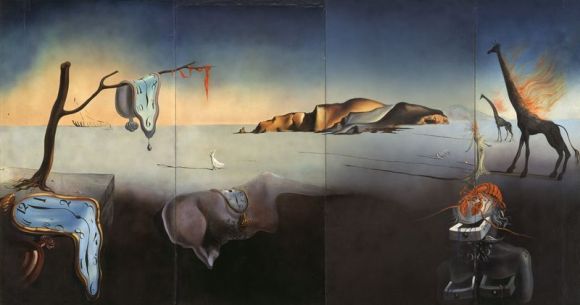
The Dream of Venus by Salvador Dali (1904-1989). From Public Domain
MY STILLBORN DREAMS

Clouds have hovered above me
For as long as I can recall.
Perhaps it was their destiny
To shadow me upon every path.

Of all the dreams I once beheld,
None became a rallying call
For those that came thereafter —
So many, yet their hymns elude me.

Beneath the ceaseless drought of light,
None could bloom or bear my name,
None to endure through centuries,
None to crown me with esteem.

A poet haunted by tavern walls,
I have spent a lifetime digging graves
For my stillborn, fleeting dreams,
Lined like bottles along the bar.

A fervent poet I remain, though still
My hands fall short of the desire
To etch a metaphor for each tomb.
Yet those I buried, I cherish as my own.
Pramod Rastogi is an Emeritus Professor at the EPFL, Switzerland. He is a poet, academician, researcher, author of nine scientific books, and a former Editor-in-chief (1999-2019) of the international scientific journal, Optics and Lasers in Engineering. He was an honorary Professor at the IIT Delhi between 2000 and 2004. He was a guest Professor at the IIT Gandhinagar between 2019 and 2023. He is presently an honorary adjunct Professor at the IIT Jammu.
.
PLEASE NOTE: ARTICLES CAN ONLY BE REPRODUCED IN OTHER SITES WITH DUE ACKNOWLEDGEMENT TO BORDERLESS JOURNAL.
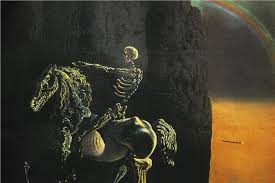
Horseman of Death by Salvador Dali (1904-1989). From Public Domain
DO NOT SPEAK FOR OLD STAVED MEN

Do not speak for old staved men whose faces glint like tyres,
In the twilight of their years, they hum a tune so grim.
Their stories told in whispers, kindling ancient fires.

Beneath the moon, their silhouettes like church spires,
Stand testament to lives lived on the brim.
Do not speak for old staved men whose faces glint like tyres.

With every wrinkle, a saga that never tires,
Eyes that sparkle with memories, vivid and dim.
Their stories told in whispers, kindling ancient fires.

They laugh with the madness that freedom acquires,
Dancing to the wind's capricious whim.
Do not speak for old staved men whose faces glint like tyres.

In the hush of night, their spirit aspires,
To cast off the shadows, stark and slim.
Their stories told in whispers, kindling ancient fires.

So let them be, these merry old sires,
As they sip the stars, on the world's rim.
Do not speak for old staved men whose faces glint like tyres,
Their stories told in whispers, kindling ancient fires.


IF AT FIRST DEATH'S WORLD IS ROUND

If at first death's world is round, take heed,
Where shadows dance and silent whispers play,
A routed cock will sing for prayer indeed.

In twilight's grasp, where heartbeats intercede,
And stars above in quiet judgment sway,
If at first death's world is round, take heed.

The moon's pale light, on which dark dreams will feed,
A canvas vast, where lost souls might stray,
A routed cock will sing for prayer indeed.

Through time's thin veil, where ancient fates are freed,
The echoes of the past are not held at bay,
If at first death's world is round, take heed.

In madness' grip, where sanity will bleed,
And reason's voice is oft led far astray,
A routed cock will sing for prayer indeed.

So listen close, for it's the earth's own creed,
In life's grand play, we all must find our way,
If at first death's world is round, take heed,
A routed cock will sing for prayer indeed.


OH, WHAT NOW FOR THE FORGETMENOT MEN

Oh, what now for the forgetmenot men,
In a world where fathers jack all pleasure?
Their laughs echo, "Ha ha," and then?

They dance in boots of heavy leaden,
Stomping on dreams with no measure.
Oh, what now for the forgetmenot men?

With every chortle, they count to ten,
A madcap rhythm to their leisure.
Their laughs echo, "Ha ha," and then?

They sip on the nectar of a pen,
Ink-stained lips betray their treasure.
Oh, what now for the forgetmenot men?

In absurdity's grip, beyond our ken,
They find in oddity their true pleasure.
Their laughs echo, "Ha ha," and then?

So raise your glass to the when,
To the forgetmenots, in all their splendour.
Oh, what now for the forgetmenot men,
Their laughs echo, "Ha ha," and then?


O, WHENCE VENAL BODIES BREAK AND SPURN

O, whence venal bodies break and spurn,
In twilight's sickly, dolorous embrace,
What now for death but a new day made up from sickness?

The stars above in cold judgement turn,
As shadows cast by the moon's pale face,
O, whence venal bodies break and spurn.

The raven's call, a direful mourn,
Echoes through the void of this haunted place,
What now for death but a new day made up from sickness?

Beneath the earth, where the lost sojourn,
Lies the heart's desire without a trace,
O, whence venal bodies break and spurn.

A dance macabre, the world does churn,
Absurd the stage, life's fleeting race,
What now for death but a new day made up from sickness?

So sing the dirge, as the candle burns,
And time erodes all but disgrace,
O, whence venal bodies break and spurn,
What now for death but a new day made up from sickness
Jim Bellamy was born in a storm in 1972. He studied hard and sat entrance exams for Oxford University. Jim has a fine frenzy for poetry and has written in excess of 22,000 poems. Jim adores the art of poetry. He lives for prosody.
.
PLEASE NOTE: ARTICLES CAN ONLY BE REPRODUCED IN OTHER SITES WITH DUE ACKNOWLEDGEMENT TO BORDERLESS JOURNAL
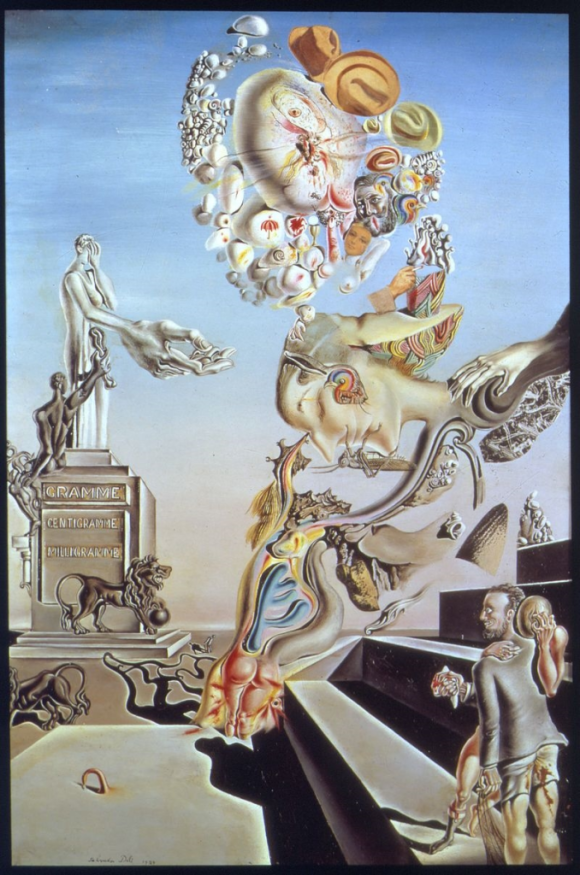
The Lugubrious Game by Salvador Dalí (1904-1989). From Public Domain
RIPPED NEUROLOGY

Humanity has succumbed
to a state of severe brain damage
The scariest part is the people revel
in the bramble of their thorny shackles
and shambles—in celebration
of a negative freedom tolling
in a resonance of an oncoming Oligarchy.


ODE TO NON-EXISTENT SPRINKLER ROOM

Tonight, the movie theatre’s essence has overdosed on the poisonous Simulacra it spits like the sprinkler room that is not located here—it's located somewhere else. There is also a mentally ill duck-billed platypus that is not currently here. There's a lot of things not currently here—but mainly the what's not here is the sprinkler room, tolerance, mercy, or empathy.


EMPTY SPACES

Nothing is more
eternally togetherly alone
than a parking lot at midnight.


VOIDED MORNING

You open
your door
to hear the doldrumesque dirges
of the Gasmask Choir.

Time to put toxins upon toxins.
Time to be outsmarted
by soulless artificial idiocy.


PEARL

Hold onto the silk
and satin you emanate.
Stay up on your rise.
Don’t let the omnipresent
negativity pierce your soft
skin with its cancerous
vibrations. Look for, and find,
the bright-bright white void
of evil. You are the virgin in the cesspool
and always will be. Stay
robed in the gossamer gown you created
and keep an open ear
for the Universe has something
it needs to tell you.
Heath Brougher is the Editor-in-Chief of Concrete Mist Press. He has published twelve books and after spending the last five years editing the work of others is ready to get back into the creative driver seat.
.
PLEASE NOTE: ARTICLES CAN ONLY BE REPRODUCED IN OTHER SITES WITH DUE ACKNOWLEDGEMENT TO BORDERLESS JOURNAL
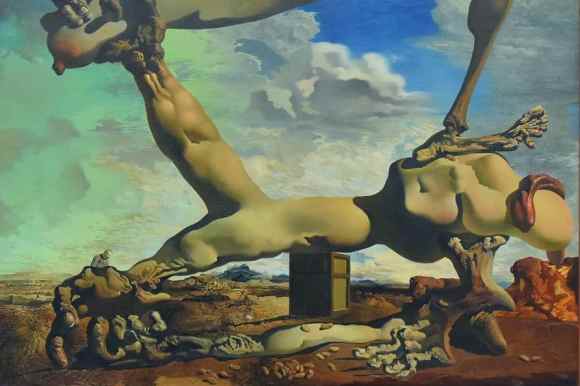
Art by Salvador Dali(1904-1989) From Public Domain
BEHIND BARS

I write about what I see…

If you don’t want me to see it
Close the TV channels down

I write about what I see…

If you don’t want me to scroll up and down
Close the internet down

I write about what I hear…

If you don’t want me to listen
Put all the people behind bars

Though I fear, the truth
	May slip through the cracks


COME BACK THE COUNTRY I LOVE

Come back the country I love
Come back and put
Food on my table

Come back and bring me
Peace and Love

No one is excluded
 and I belong here again

Not trembling over words
Or the bang at the door

It is you who don’t belong here
anymore


Come back
Come back
 the country I love

THIS IS HAPPENING

This is not happening
This you can’t see
The prison cells are filling
Whilst you digest the lies on TV

This is not happening
This you can’t see

You play deaf dumb and blind
Until you see

This is happening
This you can see
Your brother your mother your father
Taken away
Live on TV

CHEERING YOUR GENOCIDE

Every time I let the tap run, I feel guilty
Every time I fill my belly, I turn away from the screen
Every time the key clicks to my door, I can open and walk around
But you and yours are raised to the ground,
No guilt from those who cheer on your genocide.


DEAD SOUL

There is no limit
Because babies are still born
And each by being alive is dead

The last straw a family of nine wiped off this earth

But there are fields and fields of such dead souls.

SOMEONE IS KILLED

Everyday someone is Killed on your street. . .
No one says or does anything to help . . .

It’s not your street. . .
But everyday someone is killed on a Gaza Street
A human being just like you and me.
David R Mellor is from Liverpool, England. He spent his late teens homeless on Merseyside. He is currently writing and performing in Turkey. His work has been featured by the BBC and the Tate, and his published collections of poetry are What a Catch (2012, Some Body (2014), Express Nothing (2019) and So This Is It (2020). His collection of stories An Englishman in Turkey (Turkiye’De Bir Ingililiz) has recently been published .
.
PLEASE NOTE: ARTICLES CAN ONLY BE REPRODUCED IN OTHER SITES WITH DUE ACKNOWLEDGEMENT TO BORDERLESS JOURNAL
Thirty years from now, what will it matter? What goes wrong now will be forgotten then. I’ll be dead, my guitar in a dumpster.
When you toss money in my cap, you’re funding a stranger’s problems. Not the music. You barely listen to what
I’m strumming and singing. My body needs sustenance to keep from breaking down. Your spare change ends up in the pocket of some pusher.
But I’m not complaining. A boyhood dream warms itself by a grownup nightmare. I can call myself a musician. Addict is another’s word.
And thirty years from now, I’ll be as forgotten as the ones that got clean, who had no music in them. So nothing matters. But its generosity is always welcome.
PARENTS
She looks up from time to time, as if to penetrate the ceiling, to get at the room where she spent ten years nursing a dying father.
It's over now but her stress doesn't think so. Not while her mother’s fragile drifting speech, wrinkled eyes, fall far short of knowing anyone.
These are the only parents she will ever have – the father of her nose, the mother of her mouth, one passed on from life, the other from identity.
She once was their daughter. There’s no name for what she is now.
John Grey is an Australian poet, US resident. His latest books are Between Two Fires, Covert and Memory Outside The Head are available through Amazon. His upcoming work will be in Haight-Ashbury Literary Journal, Amazing Stories and River and Sout.
.
PLEASE NOTE: ARTICLES CAN ONLY BE REPRODUCED IN OTHER SITES WITH DUE ACKNOWLEDGEMENT TO BORDERLESS JOURNAL
In a tiny shop located within a narrow lane packed with people, sat Rakesh, in his late seventies, though he couldn’t say exactly. They didn’t keep proper records of birthdays back then. He sat staring outside as people pushed past one another, and over their heads, thick black electric cables coiled around one another and around long poles, forming a black canopy. He remained motionless, with glazed eyes.
Someone entered the shop, looked at him, and said something.
“What?” Rakesh muttered, coming out of his thoughts.
It was Nitesh, who had been running a food stall across the street for the past five months. It was called “Nitesh Snacks”.
“I came to have this watch repaired. It fell yesterday while I was going back home, and the glass broke.”
He put a watch on the counter. Rakesh picked it up and glanced thoughtfully at it. Then he nodded to himself and put it aside.
“I will give it to you tomorrow.”
Nitesh stood there hesitantly for a while, then said, “Arun ji was a very nice man. It’s a pity that he…died.”
Rakesh nodded again and said nothing. His shoulders seemed to weigh him down. His head was covered with thick grey hair, dyed bright orange with henna. He wore an oversized faded blue shirt that hung over his thin frame, and it was clear that he had forgotten to shave that morning. Nitesh looked worriedly at him. Things weren’t going well, and now that Arun ji was dead, they would likely worsen.
*
Rakesh walked into his single-floor house, which was a short distance from his watch repair shop. He remembered how he had started that shop. He had painted it himself, had the shutters fitted, and then began repairing watches. It had cost him plenty to buy that tiny room on the main street, but it paid well. People came frequently, and soon he could start selling clocks and watches. The shop was named after his late father, “Narayan Watch Repairing”. He remembered covering every shred of the wall with clocks- all colours and shapes.
He went right towards the back of the house, down a long narrow corridor, to a room that was visibly separated from all the other rooms. He sat down on the bed, thinking about when it had all started—when he became like this. It was probably when Arun died…no, that happened two days ago…it was when his wife died. Or around that time, or perhaps even before. He couldn’t think straight. He sat motionless, with a deep feverish glow in his eyes.
Someone looked into the room. It was his son with a big smile on his face. “How was work?”
Rakesh said nothing, and there was a pause. “You must miss your friend.”
Again, nothing.
“We all have to go sometime.”
This time, Rakesh just looked at him thoughtfully. His son nodded to himself and then said, “Sold any clocks today?”
When there was no reply, he added, “Well, that business is no longer as good. A few clocks, that’s all we can sell nowadays. Everyone has clocks on their smartphones. Who needs them now? That’s why we decided to shut it down. You do remember that we have only got a month left? I hope you have started wrapping everything up.”
His son had an easy smile on his face ever since he had entered the room. He looked at him for a moment before adding, “If you need any help at all while closing down, you can always call me.”
Rakesh nodded but said nothing. His son kept talking and then left after a while. Yes, he remembered now. He remembered how it had all started. It had started soon after his son got married. They began quarrelling frequently, especially Rakesh’s wife and their son. It felt like they were always in their son’s way, like they were always doing things to disrupt his life. He remembered his wife crying all night because of their son. He didn’t say anything much until she died. He did not like quarrelling. Many things displeased him, but he learned to remain quiet or use very few words. It had still not been as bad. At least, he still had some respect around the house.
Then one day, his son had seemed to turn over a new leaf. He was always there for him suddenly. He took an interest in the shop. He sat and chatted with him in the evenings over a cup of tea. Rakesh liked this change. Over several months, he came to trust his son, feeling a sense of satisfaction when he looked at him. There were disagreements, of course, but his son invariably seemed to come to his senses and apologised.
Rakesh couldn’t remember how long this harmony continued, but he did remember when it came to an end. It was a short time after he signed the documents that transferred all his property to his son. After that, things began to change. His son no longer took an interest in the shop. They barely spoke anymore. Rakesh’s health also started to deteriorate. Instead of taking more care of him, his son had a room built at the far end of the house. This room was bare except for an old wooden bed and an attached bathroom. It was in this room that Rakesh spent most of his time while he was in the house. His food was sent to the room. It always looked like leftover food from yesterday. Whenever they quarrelled, his son would always end the argument by giving the example of their old neighbour, who was sent to live in a temple by his children because he became ‘too much of a burden.’
He had lived like that for about a year now, missing his wife terribly. No one spoke to him in the house. His only solace was his shop. He eagerly spoke to the customers, absorbing himself in his work. His closest friend, Arun, was a barber whose small salon was right next to the watch repair shop. They had known each other for forty years. Every day, after closing up, they sat and chatted for about an hour. Arun was the one person he could always talk to, the one person who always shared his sorrow, and now Arun was dead. He had no one. At night, he would lie in bed, hearing laughter drift from the house. There was no outlet for his sorrow. It was bottled up inside him, and he felt that it was slowly poisoning him. His feet felt heavy, his breathing was often laborious, and he sometimes heard his wife calling out to him in the middle of the night. Was he going mad? Perhaps he was, and this month, his son’s news had been the final nail in his coffin.
His son had come bustling into the dingy room with a smile and told him that he urgently needed some money, then he had abruptly began talking about the watch shop—how it was not doing well, how people no longer cared about watches anyway, and how Rakesh was getting old and needed some rest. Then he explained that these things had prompted him to sell the shop, and they were required to clear out within two months.
There had been heated arguments between them. Rakesh had refused to speak to him for several days until one day, his son had assumed that his silence meant that the matter was settled. That there was no longer any need to discuss the issue anymore. Rakesh had become quieter than ever before. All he did was nod, as though if he was careful enough to maintain his stubborn silence, then perhaps someone out there would miss his words. Would miss them enough to make things right again. He would have a function in this world—a purpose. He would not be a burden on anyone. His son would miss speaking to him. They would once again sit in the evenings with a cup of tea and chat, not because he wanted his property, but for Rakesh’s sake. Because Rakesh would never be a burden. No one could make that happen to him.
*
Rakesh woke up and stared at the ceiling for several minutes before he realised that someone was in the room. Someone was speaking to him. He sat up and looked thoughtfully at his son. He was still too disoriented to hear him.
“You still haven’t done a thing…I can’t believe…we only have ten days left…do you realise how less time that is?” his son said.
Rakesh thought that he might be in a dream, but then he remembered that he hadn’t had a dream for years. He closed his eyes tightly and opened them again. It became clearer.
“You had two months to clear the shop. That’s more time than necessary in the first place, and today I went there in the morning to have a look, but not a thing has changed! I thought I could trust you with a simple task like this. How can I handle everything on my own? Haven’t I always taken proper care of you? But okay now, tomorrow I am coming down myself to start clearing things up. This has gone on for long enough. I know you have been handing over all the earnings from the shop to Arun’s old widow. I know that Arun was very poor, but we can’t really afford to be so generous if we are poor ourselves, can we? I tolerated all that, but you couldn’t even handle one small thing.”
Rakesh didn’t know how long his son had been speaking, but he understood what was being said. He did not reply at all and waited until his son stormed off.
He got his shirt off the hook and put it on. He stood in the middle of the room for a moment and then left the house. He walked for a long time to nowhere in particular. He had not eaten anything since the morning, but he didn’t feel hungry anyway.
He knew his son was lying. The shop had been doing just fine. His son just wanted to sell it off and get his hands on the money. Worst of all, Rakesh was powerless. Tomorrow, his son would come to start clearing up the shop, and after ten days, it would belong to someone else. He would probably spend the remainder of his days in the little cell his son had built as far away from their lives as possible, waiting for death. Waiting for time to pass.
He looked around and realised that he was near his shop. It was dusk now. In the deep orange sky, some birds were on their way home in a v-formation. How long had he walked? He felt drained, and his heart was fluttering slightly. He stared at the shop front for a while, waiting for his breathing to become normal again, but it didn’t. He then began to open the shutter, but it felt heavier than usual. By the time it was done, he was sweating profusely. Once inside, he collapsed into his chair behind the counter after locking the door from inside.
His mind was blank for a while. He was only aware of how tired his body was. Then he stared thoughtfully at each and every corner of the shop. He would leave this little space after ten days, and it would continue to exist without him. It might stand there for a hundred more years. He sometimes wished he could be a building. At least they were not a burden on anyone. They got to fulfil a certain function. He might leave, but this shop would continue to be a room. It might not be a watch repair shop, but it would still have a function. No one thought buildings were a burden. In fact, people fought with one another to get ownership. Wasn’t that what had happened to him? His son had lied and cheated to get his property, and it wasn’t even much at that.
He had thought that he would feel better after sitting down, but instead, his head had started spinning slightly. He looked at the walls. Each of them were covered with clocks from top to bottom. Normally, they would please him, the culmination of lifelong hard work. Now, looking at them, they all reminded him that time was passing. That the next day, he would have to pack each one of them. That ten days would pass soon, and after that all he would ever do would be to wait for time to pass. He could not bear the thought of packing the clocks up.
He realised that these were the last few moments of his old life, and they were passing really fast. Placing his palms on the counter, he hoisted himself out of the chair and stood for a moment, breathing hard. Then he walked over to the first clock on the wall—a bright yellow square-shaped one—and took it down from the hook. He stared at the minute hand for a while and then smashed it violently on the floor. Then he began moving faster, even though he still felt weak, but his eyes gleamed with determination. He went around smashing every clock. They all reminded him that time was flying by, leaving him behind, and for once, he wanted it to stop at the threshold of his shop. For once, he wanted to be free from the burden of the next day.
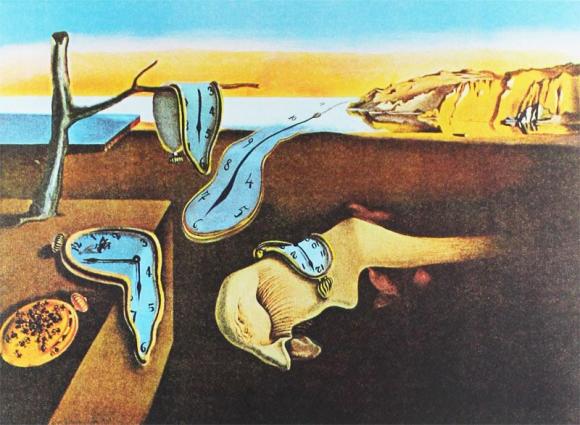
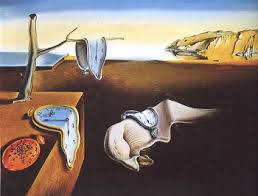
The Persistence of Memory by Salvador Dali (1904-1989). From Public Domain
Maliha Iqbal is a student and writer from Aligarh, India. Many of her short stories, write-ups, letters and poems have been published on platforms Live Wire (The Wire), Cerebration, Kitaab, Countercurrents, Freedom Review, ArmChair Journal, Counterview, Writers’ Cafeteria, Café Dissensus, Borderless Journal and Indian Periodical. She can be reached at malihaiqbal327@gmail.com.
.
PLEASE NOTE: ARTICLES CAN ONLY BE REPRODUCED IN OTHER SITES WITH DUE ACKNOWLEDGEMENT TO BORDERLESS JOURNAL
TIME IN ITS FLIGHT
(After Su Tung Po, Song Dynasty poet)

Torn from darkness,
the sun reveals a dismal day.
As if from a sermon,
a bird turns away.
I drink my tea with care.
I lean back in my chair.
It emits a squeak
of compressed air.
I sometimes think
life is unfair.
Dead leaves fall
everywhere, caught
in a fierce wind,
they careen wildly,
like epileptic drivers,
unaware they’re
no longer survivors.
George Freek’s poetry has recently appeared in The Ottawa Arts Review, Acumen, The Lake, The Whimsical Poet, Triggerfish and Torrid Literature.
PLEASE NOTE: ARTICLES CAN ONLY BE REPRODUCED IN OTHER SITES WITH DUE ACKNOWLEDGEMENT TO BORDERLESS JOURNAL


 Borderless