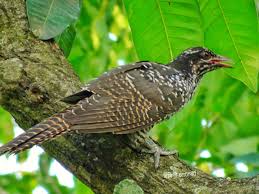
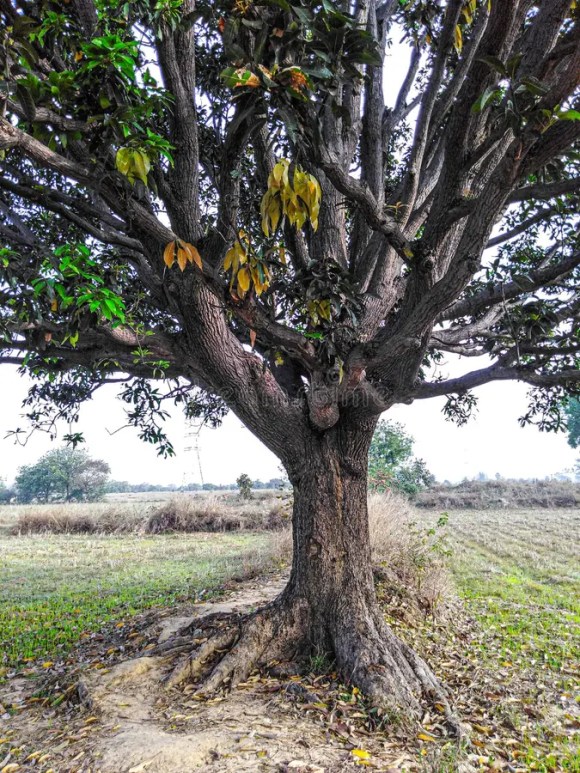
The Chaitra koel's routine visit to the Lone mango tree in the compound Of a lonelier house, Where life rests in a shadow of silence, Is delayed this time. Has it forgotten the tree That stands shrunken, pale And waits patiently to gather The silk whisper of spring colours In its brittle arms and Coax music out of it?
*
What is keeping the bird back, The tree wonders. And the answer comes in A startling cacophony That loops and rolls in angry surges Across the neighbouring vacant lot Where the mid-spring sun slants , Warm and oily, on the Massive drilling rigs, Excavators, concrete mixers, Behemoths from some alien world Filling the empty hours With too much life, Hurling ugly sermons of urbanity At its placid apathy.
The clangs, the clatters and the grinding; Stones gritting, metals rattling, Smell of smouldering tobacco and toxicity Hang over the mounds of red earth Like a crumpled canopy Of noisy ash.
Will the koel return to the Chaitra tree With its gentle silky lilts Drowning the tumults, The tree wonders, but waits Shaking dust and doubt Off its welcoming fragrant boughs Throbbing, trembling in the heavy vibrating breeze And gathering itself back Steadfast in its hope and trust.
*Chaitra: March
From Public Domain
Snehaprava Das is an academic, translator and writer. She has multiple translations, three collections of stories and five anthologies of poetry to her credit. She has been published in Indian Literature, Oxford University Press, Speaking Tiger, Penguin and Black Eagle Books.
.
PLEASE NOTE: ARTICLES CAN ONLY BE REPRODUCED IN OTHER SITES WITH DUE ACKNOWLEDGEMENT TO BORDERLESS JOURNAL.
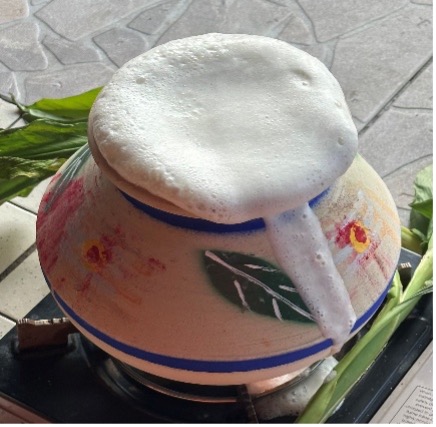
Pongal Pot. Photo Courtesy: Ravi Varmman K Kanniappan
On the 15th of January 2026, while much of the modern world was busy checking notifications, updating calendars, and worrying about quarterly outcomes, traditional Tamil households across the globe were doing something far more radical, watching milk boil. “Pongal”, the harvest festival, is one of those ancient cultural practices that stubbornly refuses to modernise. It does not arrive as an app update, cannot be streamed, and has no subscription model.
Milk is poured into a pot, heated patiently, and allowed, indeed encouraged, to overflow. This overflow is not considered inefficiency or waste, but it is the very point. It signifies abundance, wellbeing, and prosperity not merely for humans but for the entire ecosystem that made the meal possible, the sun, the rain, the soil, the cow, and the quiet, unseen labour of nature itself. Rice, lentils, jaggery, nuts, legumes, and raisins follow, and the resulting sweet dish is shared freely among family and friends, because prosperity that is not shared is considered incomplete.
This is an economy based not on accumulation but on circulation, not on profit but on participation. Something I believe is deeply unsettling to modern sensibilities.
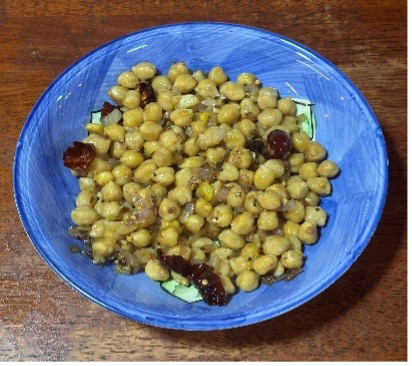
Into this defiantly non-consumerist ritual wandered a chickpea with an extraordinarily well travelled past. This was no humble backyard legume, nor had it been picked up at the nearest market. It had sprouted in Mexico, been packed in Lebanon, purchased in Sierra Leone, and generously gifted by my wife Greeja’s friend, Saras, and her husband Pieter, a Belgian whose kindness, like the chickpea itself, clearly knows no borders. The chickpea’s journey to Malaysia, where, after crossing more continents than most humans manage in a lifetime, it finally fulfilled its destiny, being cooked into a traditional Tamil Pongal.
By then this chickpea had crossed more borders than most people ever will, navigated more currencies than a multinational executive, and yet arrived without a single stamp of self-importance. If globalization were ever to seek a spokesperson, it would do well to choose this chickpea, which achieved in silence what conferences and treaties have struggled to explain. The chickpea does not attend Davos, does not publish white papers, does not tweet about resilience or sustainability, and yet it embodies globalisation with a calm confidence that makes economists look unnecessarily stressed.
We often speak of globalisation as though it were invented sometime in the late twentieth century by economists with impressive haircuts and Power Point skills. But the chickpea, unimpressed by timelines, has been global for at least nine thousand years. Its origins lie in the “Fertile Crescent”, that much abused cradle of early civilisations covering modern day Turkey and Syria, where early cultivation was recorded between 7500 and 6800 BCE. The wild ancestor, “cicer reticulatum”, still grows in southeastern Turkey, quietly ignoring the fact that humans have spent millennia fighting over the land around it. From this region, chickpeas spread naturally to the Middle East, the Mediterranean basin, and India by around 3000 to 2000 BCE, becoming a staple across cultures, religions, and cuisines. This was globalisation without shipping containers, trade sanctions, or consultants, just humans carrying seeds because hunger is wonderfully non-ideological.
India, once it encountered the chickpea, embraced it with characteristic enthusiasm and then proceeded to dominate its production. Today, India accounts for more than 70 percent of global chickpea output, a statistic that has made the chickpea an unlikely participant in modern trade wars. Protectionist policies, tariffs, reciprocal duties, and import bans imposed by major players such as India, the United States, and Mexico have transformed this humble legume into a politically sensitive commodity. It turns out that even the simplest food becomes controversial once spreadsheets get involved.
Thiruvalluvar (an ancient philosopher), writing two thousand years ago, anticipated this uncomfortable truth with brutal clarity:
“Only those who live by agriculture truly live; all others merely follow and feed upon them.” - Kural 1033
The verse throws stylish shade at modern life, while we sip lattes under perfect air conditioning and call it “work”, farmers are out there negotiating with the sun, rain, and stubborn soil to keep humanity fed. Our sleek jobs, fancy titles, and glowing screens? Well, they are merely luxury addons. Strip away agriculture and civilisation collapses into a very well-dressed famine. Turns out, all our progress still runs on dirt, with attitude.
The chickpea’s journey to South America, especially Mexico, is a reminder that globalisation has often travelled under less noble banners. Portuguese and Spanish explorers introduced chickpeas to the New World in the sixteenth century, carrying them across oceans as reliable, non-perishable protein sources. From these initial points of contact, chickpeas spread across Central and South America, embedding themselves into local agriculture and diets. In modern times, Mexico has emerged as a significant exporter, specialising in the Kabuli variety prized for its size and quality, with major production zones in Sonora and Sinaloa. Argentina and Chile also joined the club. Thus, a crop born in ancient Anatolia, nurtured in India, and sanctified by ritual, found itself repackaged for global markets, complete with branding, logistics, and regulatory oversight. The chickpea, once again, remained silent.
Silence, however, does not mean insignificance. Homer knew this. In TheIliad (Book 13) he famously compares arrows ricocheting off Menelaus’s armour to chickpeas and dark-fleshed beans flying off a threshing floor in the wind. The metaphor works only because the audience knew exactly how dried chickpeas behave, hard, resilient, and oddly bouncy. By likening lethal weapons to pulses, Homer not only emphasises the strength of the armour but also performs a subtle act of cultural grounding. The epic world of gods and heroes is momentarily tethered to the everyday agricultural reality of farmers winnowing grain. War, Homer seems to say, may be glorious, but it is ultimately sustained by food. Chickpeas, by 800 BCE, were so deeply embedded in Greek life that their sound and movement were universally recognisable. Even epic poetry depended on legumes.
Indian tradition offers an equally revealing, if more logistical, narrative. In South Indian tale associated with the Mahabharata, an Udupi King is said to have managed catering for the massive armies at Kurukshetra. Legend holds that he could predict daily casualties by observing leftover food. In some versions, the king visits Krishna at night, who eats a handful of roasted chickpeas, the number consumed corresponding mysteriously to the thousands who would fall the next day. This allowed precise meal planning and zero waste on an industrial scale of destruction. These divine data analytics allowed the king to cook exactly the right amount of food, avoiding waste on a genocidal scale. It is perhaps the earliest example of just-in-time inventory management, achieved without software, powered entirely by chickpeas and divine omniscience.
If you have ever wondered why Udupi cuisine is famous for efficiency and planning, this story offers a clue. Here, chickpeas function not just as food but as instruments of cosmic accounting.
Interestingly, while early Vedic texts sometimes viewed certain pulses as unsuitable for sacrifice, the Mahabharata period saw chickpeas elevated into sraddha rites (funeral rituals) and daily offerings. They transitioned from questionable to sacred, a promotion many humans would envy.
Thiruvalluvar’s ethical framework accommodates this evolution effortlessly:
“Sharing food and caring for all life is the highest of virtues.”-- Kural 322
A noble idea, until chickpeas quietly steal the spotlight. Modest, beige, and absurdly cooperative, they divide endlessly without complaint and nourish everyone from monks to gym bros. While humans argue ethics in panels and podcasts, chickpeas get on with the job, feeding the masses without ego. In the moral economy of virtue, they don’t preach but they simply multiply and sustain, humbling us one hummus bowl at a time.
Across civilisations, chickpeas became the dependable fuel of endurance. Roman soldiers consumed them as part of their standard rations, boiling them into thick porridge known as “puls” when meat was scarce. Gladiators relied on pulses for strength, earning nicknames that emphasised grain and legume consumption rather than heroism. Spanish and Portuguese sailors trusted chickpeas on long sea voyages because they did not rot, sulk, or demand refrigeration. During World War II, Allied researchers turned again to pulses to address vitamin deficiencies among troops, while the modern Indian Army continues to include chickpea flour and whole chickpeas in field rations due to their high caloric density and reliability. Empires rise and fall, but soldiers keep eating chickpeas.
Modern science, arriving fashionably late as usual, now confirms what ancient armies, monks, and farmers already knew. Chickpeas are celebrated as “brain food,” dense with nutrients that support cognitive function, mood regulation, and neurological health. Nutritional psychiatry highlights their role in reducing inflammation and stabilising the gut brain axis, making them valuable in alleviating anxiety and depression. Unlike the sugar-fuelled spikes and crashes of contemporary diets, chickpeas offer slow-release energy, the kind required for sustained thought, emotional regulation, empathy, and decision making. In a world addicted to instant gratification, caffeine dependence, and burnout worn as a badge of honour, the chickpea is almost offensively patient. That patience makes it profoundly incompatible with modern lifestyles, and incompatibility, in our times, is the surest mark of subversion.
If this sounds like ancient wisdom romanticised through hindsight, it is worth noting that modern civilisation has recently spent billions of dollars rediscovering precisely the same conclusion, often during lunch breaks. Sometime in the post-Covid era, somewhere between a glass walled co-working space and an overbranded café serving ethically sourced air, a young startup founder sat staring at his laptop, attempting to optimise a problem modern life seems uniquely skilled at inventing, how to eat “mindfully” without actually having time to eat. His company was building an AI-driven wellness platform designed to “personalise nutrition using real time biometric feedback.” Investors liked it. The pitch deck had the correct fonts. The valuation was impressive for something that had not yet solved hunger, distraction, or exhaustion.
Lunch arrived in recyclable packaging engineered to survive a nuclear winter. Inside was a bowl labelled Ancient Protein Medley. It contained quinoa flown in from the Andes, kale grown in a vertical farm two kilometres away, avocado sourced from somewhere geopolitically awkward, and, almost as an afterthought, roasted chickpeas. The chickpeas were rebranded as “plant-based protein spheres,” presumably because “chickpea” did not sound sufficiently disruptive, scalable, or fundable.
As the founder ate mechanically between Slack notifications, his smartwatch vibrated with updates. Blood sugar stable. Cortisol marginally elevated. Cognitive focus acceptable. The AI recommended breathing exercises and fewer screens. The founder ignored both and continued eating. The irony was complete. A system powered by cloud computing, global capital, and predictive algorithms had concluded, after millions in funding, that roasted chickpeas were ideal for sustained energy and mental clarity.
This was not new knowledge. Roman soldiers had marched on it. Tamil farmers had lived on it. Sailors had crossed oceans with it. But now it had a dashboard, a graph, and a subscription model.
Later that evening, the same founder attended a panel discussion on sustainability. Someone in the audience asked about regenerative agriculture. The panellists responded confidently, invoking carbon credits, blockchain traceability, lab-grown proteins, and the future of food. No one mentioned legumes fixing nitrogen. No one mentioned soil. No one mentioned that the chickpeas quietly sitting in the founder’s lunch bowl had already done more for planetary health than the entire panel combined. The chickpeas, true to form, offered no comment, no keynote, and no thought leadership, only nourishment.
The chickpea’s journey eastward is no less intriguing. It reached China via the Silk Road, settling primarily in Xinjiang, where evidence of cultivation dates back around two thousand years. There, it became part of Uighur medicinal traditions, prescribed for ailments ranging from hypertension to itchy skin. During the Tang and Yuan dynasties, chickpeas gained prominence as a “cosmopolitan” food, sometimes referred to as the “Muslim bean”. Yet in central China, the chickpea struggled for a distinct identity, often conflated with the common pea even by Li Shizhen[1], the famed Ming dynasty herbalist. Not all travellers are recognised for who they are, some spend centuries being mistaken for someone else.
And yet, through all this travel, confusion, commodification, and conflict, the chickpea remained quietly regenerative. Unlike extractive crops, it forms a symbiotic relationship with Rhizobium bacteria in its roots, fixing nitrogen from the air and enriching the soil. It takes and gives simultaneously, leaving the land better than it found it. This is perhaps the most radical aspect of the chickpea’s philosophy, one that stands in stark contrast to modern economic models based on extraction and exhaustion.
Thiruvalluvar warns us gently but firmly:
“Harm done to others inevitably returns to oneself.” – Kural 319
A warning humans hear, nod at, and immediately ignore. The chickpea takes a cooler approach. It survives by being outrageously generous, throwing itself into curries, salads, and hummus without a trace of resentment. No revenge arc, no ego. Just pure edible goodwill. While we stress over karma and consequences, the chickpea lives its truth, give everything away, become indispensable, and achieve immortality in every lunch bowl.
Humanity today resembles the ancient chickpea, hard, resilient, perpetually defensive. We pride ourselves on toughness, bouncing off crises with admirable persistence, yet rarely ask what we leave behind. Climate change, trade wars, and political upheavals are the shrill winds of Homer’s winnowing floor, tossing us about. The question is not whether we survive the tossing, but whether we enrich the soil when we land. Progress, the chickpea suggests, is not about becoming larger, louder, or more profitable. It is about being regenerative, ordinary, and useful.
In an age obsessed with luxury, consumption, and curated lifestyles, the chickpea offers a quietly subversive model. It is not elite food, but it is the food of soldiers, monks, labourers, and families. It does not advertise, rebrand, or reinvent itself. It simply nourishes.
Thiruvalluvar captures this understated wisdom perfectly:
“From seeds come harvests, and from giving comes abundance.” -- Kural 1030
A line politicians quote solemnly before approving tax breaks for themselves. The chickpea, deeply unimpressed, just does the math. One seed becomes many, then redistributes itself aggressively into every cuisine on earth. No gatekeeping, no merit tests, no ‘personal responsibility’ lecture. While humans weaponise scarcity and call it policy, the chickpea runs a ruthless experiment in abundance and wins, by being cheap, shared, and impossible to cancel. The chickpea has lived this truth for millennia.
So perhaps the real lesson of globalisation does not lie in trade agreements or consumer choices but in a small legume that has travelled from ancient Turkey to modern Mexico, survived Roman marches and mythic wars, endured misnaming and trade barriers, and still ends up quietly nourishing someone’s meal.
Even now, after dashboards have glowed, algorithms have pontificated, and every opinion has been optimised into a performance, the answer remains stubbornly ancient, from Roman roads to Tamil fields. The chickpea does not care about your ideology, your portfolio, or your meticulously curated identity. It will grow, fix nitrogen, feed someone, and move on without a press release.
In a world addicted to spectacle, branding, and moral pontification, this calm, beige indifference feels almost obscene. Quiet competence and unfashionable, the chick pea, turns out to be the rarest, and most outrageously extravagant, luxury left.
The travelled chickpea. Photo Courtesy: Ravi Varmman K Kanniappan
[1] Li Shizen(1518-1593), Ming acupuncturist, herbalist, naturalist, pharmacologist, physician.
Ravi Varmman explores leadership, culture, and self-inquiry through a philosophical lens, weaving management insight with human experience to illuminate resilience, ethical living, and reflective growth in an ever shifting world today.
PLEASE NOTE: ARTICLES CAN ONLY BE REPRODUCED IN OTHER SITES WITH DUE ACKNOWLEDGEMENT TO BORDERLESS JOURNAL
Bibliography
Pongal festival, milk boiling ritual, symbolism of abundance and ecology
Ramaswamy, N. (2004). Festivals of Tamil Nadu. New Delhi: Sterling Publishers.
Origins of chickpea domestication in the Fertile Crescent; dates (7500–6800 BCE); wild ancestor Cicer reticulatum
Zohary, D., Hopf, M., & Weiss, E. (2012). Domestication of Plants in the Old World (4th ed.). Oxford: Oxford University Press.
Spread of chickpeas to India by 3000–2000 BCE
Fuller, D. Q. (2006). Agricultural origins and frontiers in South Asia. Journal of World Prehistory, 20(1), 1–86.
India producing ~70% of global chickpeas; modern trade disputes
FAO. (2023). FAOSTAT Statistical Database: Pulses Production and Trade. Rome: Food and Agriculture Organization of the United Nations.
Thiruvalluvar quotations, dating (~2nd century BCE–2nd century CE), agrarian ethics
Pope, G. U. (1886). The Tirukkural. London: Oxford University Press.
Introduction of chickpeas to the Americas by Spanish and Portuguese explorers
Smith, B. D. (2011). General patterns of niche construction and the management of ‘wild’ plant and animal resources. Philosophical Transactions of the Royal Society B, 366(1566), 836–848.
Modern chickpea cultivation in Mexico (Sonora, Sinaloa), Kabuli variety exports
Gaur, P. M., et al. (2012). Chickpea breeding and production. Plant Breeding Reviews, 36, 1–87.
Homer’s Iliad Book 13 chickpea/threshing-floor simile
Homer. (c. 8th century BCE). The Iliad, Book XIII. Trans. E. V. Rieu. London: Penguin Classics.
Udupi King / Mahabharata legends involving chickpeas and casualty prediction
Hiltebeitel, A. (2001). Rethinking the Mahābhārata: A Reader’s Guide to the Education of the Dharma King. Chicago: University of Chicago Press.
Chickpeas in sraddha rites and post-Vedic ritual elevation
Olivelle, P. (1993). The Āśrama System: The History and Hermeneutics of a Religious Institution. Oxford: Oxford University Press.
Roman soldiers, gladiators, and chickpea-based diets (“puls”)
Garnsey, P. (1999). Food and Society in Classical Antiquity. Cambridge: Cambridge University Press.
Chickpeas in maritime rations and early modern naval diets
Braudel, F. (1981). The Structures of Everyday Life: Civilization and Capitalism, Vol. 1. New York: Harper & Row.
Use of pulses in World War II nutrition and modern military rations
Nestle, M. (2002). Food Politics: How the Food Industry Influences Nutrition and Health. Berkeley: University of California Press.
Nutritional psychiatry: chickpeas, gut–brain axis, slow-release energy
Jacka, F. N. et al. (2017). Nutritional psychiatry: The present state of the evidence. The Lancet Psychiatry, 4(3), 271–282.
Modern “wellness tech,” quantified nutrition, and startup food culture
Lupton, D. (2016). The Quantified Self. Cambridge: Polity Press.
Nitrogen fixation via Rhizobium in chickpeas; regenerative agriculture
Peoples, M. B., et al. (2009). The contributions of legumes to reducing the environmental risk of agricultural production. Agriculture, Ecosystems & Environment, 133(3–4), 223–234.
Chickpeas in China via Silk Road; Xinjiang cultivation; “Muslim bean”
Hansen, V. (2012). The Silk Road: A New History. Oxford: Oxford University Press.
Li Shizhen and historical misclassification of chickpeas
Unschuld, P. U. (1986). Medicine in China: A History of Ideas. Berkeley: University of California Press.
I could be a molecule of thought
Uncanny, secret,
Dimension less.

I could be all elements
--immense, eternal --
A cosmos holding galaxies of passion.

I may be a note of music
Hanging in the air, faint, feeble,
But repeating like an echo,

Or a speck of silence in a wind-funnel,
Gyrating into a tornado,
Sonorously lingering to infinity.

I’m  overwhelmingly tender.
I hold worlds in a gentle embrace.
I’m also a razor blade,
Can slash love with a single stroke
And leave it to bleed to death.

I am war. I am peace.
Dispassionate and diligent,
I’m a nuance undulating through
Sangfroid  and turbulence.

I’m a bubble forming, dissolving,
Forming again, breaking again,
Floating relentlessly to join waters
On alien shores
And linking minds.

I’m a length of thread from a kite that is
Stubborn in its desire to fly,
Connecting to the Earth
While scanning the strip of its sky.

I wander free, unfettered by
Diverse minds and tongues,
Wearing my happy pan-world face,

Spanning dams and deserts,
Oceans and mountains,
Freezing and erupting in alternate moments,
I travel borderless.
Snehaprava Das is an academic, translator and writer. She has multiple translations, three collections of stories and five anthologies of poetry to her credit. She has been published in Indian Literature, Oxford University Press, Speaking Tiger, Penguin and Black Eagle Books.
.
PLEASE NOTE: ARTICLES CAN ONLY BE REPRODUCED IN OTHER SITES WITH DUE ACKNOWLEDGEMENT TO BORDERLESS JOURNAL.
Seasons gently fold into one another Silently, Not making too much noise but Leaving no space for A signature smell of each till finally they could not be told apart.
The secret summer koel sits stiff hidden in the wet boughs Flapping rain off its drenched feathers, Its song gone hoarse in the thunder storm.
Monsoon paper-boats lie cramped in parched puddles Amidst dead dragonflies littered around in a mess.
A sedate autumn, heavy in its Yellow bounteousness, Waits behind the frost-draped trees, Scorched by the day And soaked by the night.
Winter kites struggle Through the smoky warmth Of a sweating sky. Their long curvy tails, Caught in the crisscrossing strips of clouds, Wriggle and writhe and roll clumsily Like flying serpents in many hues.
This is yet another world That experiences terrible mood swings. Seasons blend into one another In obscure irregularity, And the century old pattern of living Goes haywire. Mankind's mood changes too -- Is really life falling apart In this absurd mess?
I wouldn't know, I just sit fixing my aching gaze On the path of another time, For the return of a tomorrow of a foregone age that has shifted from Its course in the anomalous days. But is sure to find its way one day To my waiting window!
LET US MOVE OUT IN TO THE UNKNOWN
Let us move out into the unknown In the smoke of sunlight, Breathing the hollow whispers in the wind, Straining our ears for the morning music That struggles to Wriggle out of the frosty boughs.
When the dwarf days reflect on the Parchment of streets, When the afternoons slant grim on the terrace And hibiscus buds blur on the Misty splotches of glass, It is the time to move into the unknown, Brushing off the patina on the bones And fingers of ice tracing out a Warm tomorrow On the shivering edge of the Season’s map.
Let us move out into the unknown. Who knows, we might discover The stolen moon in some other sky Before a star skewered night Descends in a crumpled heap On the stiff shoulders of time...
Snehaprava Das is an academic, translator and writer. She has multiple translations, three collections of stories and five anthologies of poetry to her credit. She has been published in Indian Literature, Oxford University Press, Speaking Tiger, Penguin and Black Eagle Books.
.
PLEASE NOTE: ARTICLES CAN ONLY BE REPRODUCED IN OTHER SITES WITH DUE ACKNOWLEDGEMENT TO BORDERLESS JOURNAL.
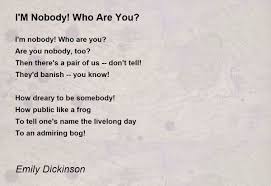
"I'm nobody! Who are you?
Are you a nobody, too?"
(Emily Dickinson)

NOBODY

It is not easy to tell the tale of nobody.
A nobody's tale is without a
beginning or an end,
Like jumbled up letters on a mussy page,
Obscure sketches from a hand untrained.

A nobody's anonymous world
Battered by the day, and
Bruised by the night,
Spins and shatters in a gyrating vortex
Of liquid darkness and light.

A nobody lives and dies and again lives
And breathes a dream in between,
Desperate to see just one come true, and
For a glimpse of green in a bald ruin.

The crimson dawn in a nobody's sky
Burns hopes to ash.
A moon flings shards of silver
At nobody’s world, aiming a cruel slash.

The fog settles forever thick and grey
Outside a nobody's  window.
In a nobody's land, seasons don't change.
There settles permanent a season of snow.

Songs painted black by storm clouds
Croak beyond a nobody's door.
The wind mourns in the hollow orchards
Roses bleed on a cracked floor;

It is hard to tell a nobody's tale
That has neither a beginning, nor an end.
It's the story of a doomed  soul,
That neither has a foe, nor a friend!!
From Public Domain
Snehaprava Das is an academic, translator and writer. She has multiple translations, three collections of stories and five anthologies of poetry to her credit. She has been published in Indian Literature, Oxford University Press, Speaking Tiger, Penguin and Black Eagle Books.
.
PLEASE NOTE: ARTICLES CAN ONLY BE REPRODUCED IN OTHER SITES WITH DUE ACKNOWLEDGEMENT TO BORDERLESS JOURNAL.
That night a shadow spread over the Moon's face. The moon, heavy in its Pain of loss became red And shed scarlet tears On the nocturnal earth caught in a Warm vaporous net.
The shadow lengthened down to A morning full of rain and river And the waves screaming a vow To drag the fields into Coffins of sand even while They still breathed in green.
The morning after, No sun peeped through the clouds of east. No music dropped from the wind Or the drowsy trees.
The green lay inert in its grave And rotted. Dreams rotted too, eaten away By worms swarming in grey abandon.
The shadow swallowed everything Like a desert, like an ocean, Like the endlessly expanding time.
Everything, like the moon went inside the dark, crippling net. The sparkle in a thousand pairs of eyes sank in the shadow of the river In a permanent eclipse.
From Public Domain
Snehaprava Das is an academic, translator and writer. She has multiple translations, three collections of stories and five anthologies of poetry to her credit. She has been published in Indian Literature, Oxford University Press, Speaking Tiger, Penguin and Black Eagle Books.
.
PLEASE NOTE: ARTICLES CAN ONLY BE REPRODUCED IN OTHER SITES WITH DUE ACKNOWLEDGEMENT TO BORDERLESS JOURNAL.
Stuck in an absurd divide, Between truth and half-truth, I am a mirror capturing the contours Of the days that were then. Faces shift on the page of glass, Blurry, painted and plain.
Overlapping faces of Civilisations rise and fall To their broken glory. Cities, fortresses, landscapes Along the meandering length of time, Crawl to meet the end of a story.
Faces wearing triumphs of battles won On bloody fields, that were once Sprawls of flowing green, smile Under a starry fragrance.
Faces crumpled at war-cries, At sirens screaming, At loud laments ripping apart The ecstatic valleys of spring, Faces baffled at the uncanny chants in The ruins, caves and dens, And the whispers of yesterdays' ghosts Echo in silence.
Cradling a bundle of unborn days And untold tales inside, I sit like a stoic saint waiting to see, The other faces that will float into My page of glass.
What is that incorrigible legacy Time will pass to me? I wait to discover my digital face Muraled on the rocks of another planet Smiling at me happily.
Snehaprava Das is an academic, translator and writer. She has multiple translations, three collections of stories and five anthologies of poetry to her credit. She has been published in Indian Literature, Oxford University Press, Speaking Tiger Books, Penguin and Black Eagle Books.
.
PLEASE NOTE: ARTICLES CAN ONLY BE REPRODUCED IN OTHER SITES WITH DUE ACKNOWLEDGEMENT TO BORDERLESS JOURNAL
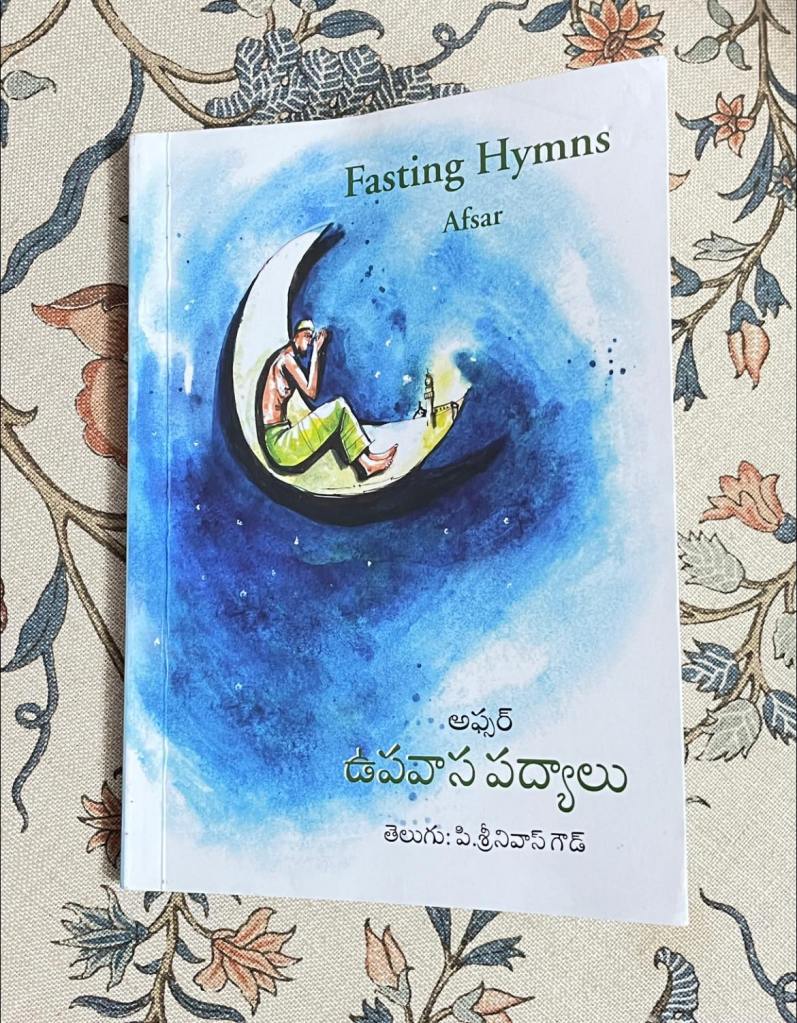
Afsar Mohammad teaches at the University of Pennsylvania, and he has published five volumes of poetry in Telugu. He has published a monograph with the Oxford University Press titled, The Festival of Pirs: Popular Islam and Shared Devotion in South India. His Remaking History: 1948 Police Action and the Muslims of Hyderabad, has been published from Cambridge University Press. His first poetry collection was Evening with a Sufi: Selected Poems. These poems are from his second collection, Fasting Hymns, which has been translated to Telugu by P Srinivas Goud as Upavaasa Padyaalu. You can read a review of the book by clicking here.
.
PLEASE NOTE: ARTICLES CAN ONLY BE REPRODUCED IN OTHER SITES WITH DUE ACKNOWLEDGEMENT TO BORDERLESS JOURNAL
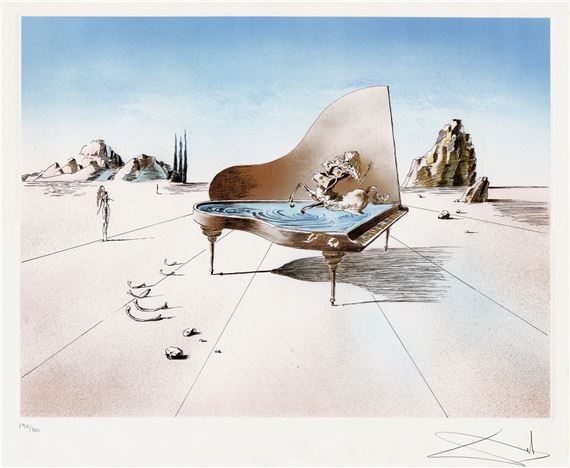
Art by Salvador Dali (1904-1989). From Public Domain
A LOVE SONG IN THE BATTLEFIELD

1

we inhabit a battlefield,
blood and bodies around.
nothing to wrap except deadly weapons.

yet
our songs are flowery
hued in green
as we dream a quiet solitude.

2

we walk along the rivers
imagining an ocean at the end of our eyes,
never knowing
what connects a river and an ocean.

rivers end up in a desert and
oceans fly into unknown skies,

as our gods and goddesses await immersion.

3

we devour sacred foods
dance around all possible divinities,
and share a hundred stories
of joy or sadness that
flow into our blood, seeping deep
into the lower depths of the body.


4

we meet quite surprisingly at crossroads,
embrace each other.
we spread our arms to the horizon,
all set for the day of lights and kites
knowing fully well that
we’re those little lamps left in the glowing river.

5

breathing next to the bombshells,
limping around blood canals
we still walk through huge utsav pandals,
perform namaz amidst thousands of believers,

then, we vanish into our narrow lanes
shutting down every innermost chord of the heart.

6

didn’t you see that
me and you remain
all alone
on this day of
lights and kites…

*Utsav – festive/festival
Afsar Mohammad teaches at the University of Pennsylvania, and he has published five volumes of poetry in Telugu. His English poetry collection is forthcoming. He has also published a monograph with the Oxford University Press titled, The Festival of Pirs: Popular Islam and Shared Devotion in South India. His current work, Remaking History: 1948 Police Action and the Muslims of Hyderabad, has been published from Cambridge University Press. His poetry collection, Evening with a Sufi, was published by Red River.
PLEASE NOTE: ARTICLES CAN ONLY BE REPRODUCED IN OTHER SITES WITH DUE ACKNOWLEDGEMENT TO BORDERLESS JOURNAL
In your final rest
on a rope-cot,
were you still dreaming
of a piece of bread?
Beloved one,
we the people
of this country,
of that country,
can make anything
but a piece of bread
for you.
--Evening with a Sufi: Selected Poemsby Afsar Mohammad, translated from the Telugu by Afsar Mohammad & Shamala Gallagher, Red River Books, 2022.
These lines send shivers down the spine and recreate an empathetic longing for immigrant souls in search of succour. They also swiftly draw an image laced with poignancy — a loss, a regret, the economics that deny innovative young men their keep and force immigration in search of sustenance. Would the poet have been one of them?
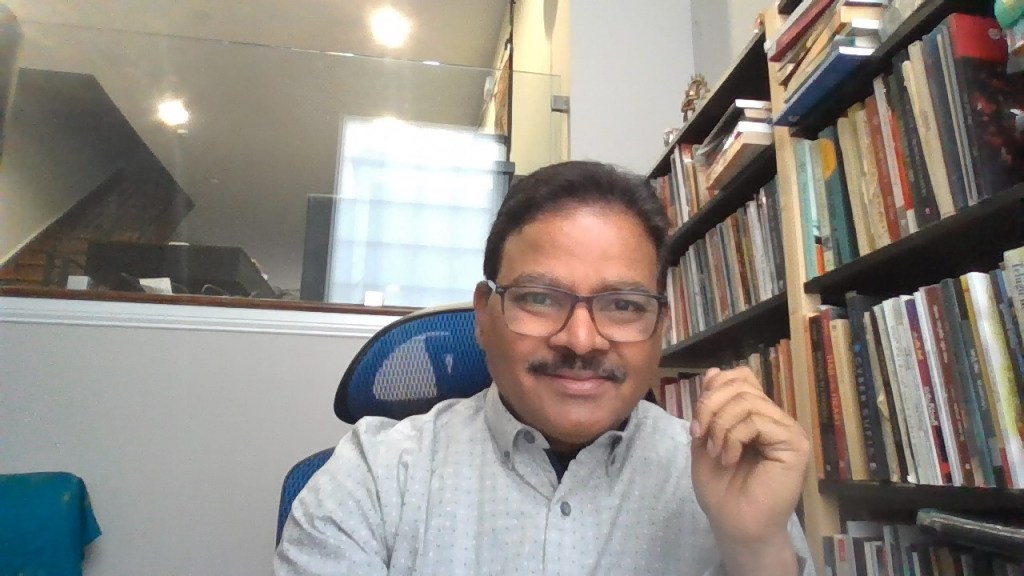
Travelling from a small village in the South Indian state of Telangana, Afsar Mohammad has journeyed across continents and now teaches South Asian Studies at the University of Pennsylvania. Known as a trendsetting poet and literary critic for post-1980s Telugu literature, Afsar has brought out five volumes of poetry, one collection of short stories and two volumes of literary theory essays. He is also a distinguished scholar of Indian studies and has published extensively with various international presses, including Oxford and Cambridge. He is currently working on a translation of Sufi poetry from Telugu to English. In this interview, we trace his growth as a writer and editor of the webzine, Saranga, which now seems to be transcending linguistic barriers to give voice to multiple cultures…
Tell us about your journey as a writer. When and how did it start?
It’s a long story, but to cut it short — the beginnings were somewhat puzzling… Inspired by Shakespearean sonnets, I first wrote some sonnets in English, and then switched to free verse. Since most of my friends in my high school started pushing me to write something in Telugu, I had to migrate to Telugu. Quite surprisingly, I was first published in English, and then it took me a while to get something published in Telugu. I had hard time getting published in Telugu due to its newness in expressions and most editors felt that there was nothing “Telugu” in that kind of writing. So, my early writings quite naturally found their home in some English journals!
Your poetry rings with the pain of distance, the pain and struggle from others’ suffering transcending your own self. What is the source of your inspiration — is it your past or your present?What affects you more — your being an immigrant or a Sufi?
We’re distanced by many things — not just physically! We live in many shattered and scattered worlds, and sometimes we fail to reflect on those worlds. I feel like I’m a constant immigrant — despite my formal citizenship and legal boundaries. Sufism is merely a segment of this expansive realm. Both past and present define our destiny, right?! Of course, I try to live in the present rather than in the past, but never deny the baggage of the past.
Why do you subscribe to the Sufi school of poetry? What is Sufism all about?
I come from an extremely local rural setting where such Sufi mystical practices openly defined my everyday life. It’s not about the technicalities and theories or institutionalised Sufi schools of their philosophies, this is more about what I learned from my childhood, and its physical surroundings dotted by several hybrid shrines. I’ve described this cultural setting in my 2013 Oxford University Press publication, The Festival of Pirs: Popular Islam and Shared Devotion in South India. This version of Sufism has more to do with everyday life rather than a spiritual domain.
You have lived away from your country for long, and yet the past seems to still haunt you. What is the identity you seek as a poet? Is it necessary to have a unique identity or can one be like a drop that flows and moulds as per the needs of the vessel?
In a way — physically– I’m away from my birth place, but in many ways, I’m also closer to my homeland than in my past. When I moved away from the actual picture, I see many dimensions from a new lens. Each dimension contributed to my rethinking and reconsidering the idea of India. As I wander around and meet totally different places and people, I learn more about my birthplace and moved a little closer to it. I totally understand this as a process to reconcile with the past and connect it to a new present intensified by many factors, not just personal. We’re living in a virtual world, which also looks like “real” in its sounds, colours and words. Every moment it makes me realise that I’m actually not that far. On the other hand, I also see the people in my homeland who are far more removed by their immediate reality and everyday experiences. We need to read this conditionality more in terms of perspective rather than physical distance.
You are fluent in Telugu, Urdu and English. You started writing in English and then moved to Telugu. And all your poetry collections have been in Telugu. Why? Would the outreach of English not have been wider? What made you pick Telugu over English?
Great question! My literary graph is neither linear nor simplistic. When I look back and reflect on it, it’s a quite messy roadmap — actually, there’s nothing like a map to get its contours. Yes, I started writing in English and then suddenly stopped sending out the poems to magazines. In fact, I write more in my personal journals rather than in print journals. Theoretically, I saw poetry as a personal diary for my experiences for many years. Due to financial concerns within my family, I had to start working very early on and left most of my journals at home. Then, my friends found them by chance and put them together that became my first collection of poems in Telugu. The collection was an instant success for its innovative style and then that opened up my career in Telugu rather than English which was my first language of literary expression.
You are now bringing out a bi-lingual online magazine, Saranga? What made you think of a magazine in two languages?
Before entering into teaching career, I worked as an editor of the literary supplement and Sunday magazine for a largest circulated Telugu newspaper. When we moved to the USA, I thought it would be better to have some outlet to engage with my home language and literature. In the early phase, Saranga was primarily a Telugu webmagazine. When I started teaching South Asian literature, then I realised the importance of making Indian literary texts available to contemporary generation in the USA. That was just one reason, but there’re were many factors as our team saw a rise in the Indian diaspora writings in the new millennium. Luckily, we got wonderful support from writers and poets in various Indian languages. The humble beginnings have actually ended up as a rewarding experience.
What is it you look for in contributors from two languages? Is it the same guidelines or different?
We’re still learning how this works! As it appears now, these two sections require two different approaches and guidelines. Since the English section has been now attracting writers from various languages, it’s moving more towards a multi-lingual base. We’re trying to accommodate more translations into English from different Indian languages. We still need to do lots of work there.
Is the journal only aimed at South Asian diaspora or would you be extending your services to all cultures and all geographies?
Saranga, as we see it right now, is more about South Asia and its diaspora. As you know, we need more such spaces for South Asia and its diaspora. Not sure about its future directions at this point, however, if the situation demands, we will extend its services further.
You have number of essays and academic books in English. But all your creative writing is in Telugu. Why? Would you be thinking of writing in English too because proficiency in the language is obviously not an issue?
Most of my academic writing came out of my teaching experience. As I started teaching new courses, I then realised that we need more material from South Asia. I started focusing on producing such materials primarily for my courses and then gradually, they became useful for many academicians elsewhere too. I still believe creating writing as a more personal space — that enables me to articulate more about myself. However, the publication of Evening with a Sufi, brought a new change — as I’ve been getting more requests for more writing in English for the last two years. As you know pretty well, I’m an extremely slow writer.
How do you perceive language as a tool for a poet?
I see language working many ways since I dwell in multiple languages. I started my elementary education in Urdu, and my middle school was in Telugu, and the subsequent studies were in English. Through the last day of her life, my mother was extremely particular about me learning Arabic and Farsi. So, I believe that helped me so much to understand how language works in a poem. When I published my first poem in Telugu, the immediate critique was it was a not a “Telugu” poem. Telugu literary critics labelled me as a poet who thinks either in Urdu or English, then writes in Telugu. Of course, most of them were also fascinated by the new syntax of my Telugu poems and the new images and metaphors—that totally deviate from a normative or mainstream Telugu poem of those days. The uses of language in a poem varies for each poet. If you’re reading, writing and thinking in just “one” language, that might be a safe condition. A contemporary or modern poet, however, belongs to many languages and cultures. We also migrate from one language to another in our everyday life.
Do borders of nationalism, mother tongue and geographies divide or connect in your opinion? Do these impact your writing?
The response to this question might be an extension to the above conditionality of a person. Anyway, I’m not a big fan of those ideas of nationalism, mother tongue and singular geographies. They don’t exist in my world. Most of my writings both creative and academic contest such boundaries and borders. To describe this in a single term- borderless. In fact, I believe we’re all borderless, but unfortunately, many boundaries and borders are now being imposed on our personalities.
(The online interview has been conducted by emails by Mitali Chakravarty)




 Borderless