Categories
Review

Short Stories by Nazrul

Book Review by Somdatta Mandal
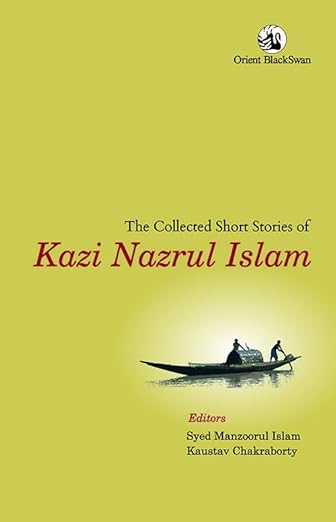
Title: The Collected Short Stories of Kazi Nazrul Islam

Editors: Syed Manzoorul Islam and Kaustav Chakraborty

Publisher: Orient Blackswan

He dons many mantles. Kazi Nazrul Islam (1899 – 1976), the national poet of Bangladesh, was a prolific Bengali poet, revolutionary, essayist, journalist, editor, activist and composer of songs. The very mention of his name conjures up the figure of a fiery iconoclast who fought against the structures of oppression and orthodoxy in society to bring about progress and change. In fact, his self-styled image as the volatile bidrohi or ‘rebel poet’ overshadows his other literary achievements and that is how ordinary people still remember him.

This unique volume presents all twenty of Kazi Nazrul Islam’s short stories for the first time in English translation. Done by different hands, they feature rich imagery, evocative landscapes, references to music, classical poetry, folktales and more. The prominent characteristics of these stories are simplicity, vivacity and emotionality. They have been sourced from different anthologies. The first six stories are from the collection Harvest of Sorrow1.  The opening story of the collection titled “Harvest of Sorrow”, is a collage of tales narrated by the three characters: Dara, Bedoura and Saiful Mulk. Dara, located in Iran’s Golestan, narrates his tale of love, separation and devotion to his motherland through a series of reminiscences. After that, we hear the same set of events narrated from Bedoura’s perspective. Then follows the account narrated by Saiful Mulk, portrayed as a sinner who tempted Bedoura into losing her virginity. Overcome by guilt, he joins the freedom struggle where he encounters Dara. What follows is a tale of redemption loss and transcendence of physical love to a more spiritual kind of love. “Hena”, the second story of the collection, is narrated by Sohrab, and its theme is also love and war – both internal and external battle. “In the Relentless Rain” is basically a story of love between strangers. The author doesn’t provide us the names of the lovers – rather both are addressed as dark-skinned. The next story, “Half Asleep”, is divided into two parts: Azhar’s story and Pari’s story. Azhar’s story is mainly about his sacrifices and why he favours detachment from the sensuousness. His renunciation of carnal pleasures towards attaining greater contentment ends his relationship with Pari, whose marriage he arranges with one of his friends. He ensures that Pari remains confined within the household structure. By making Pari assert that she will not betray her role as a loving wife without pretending to erase the love that she has for her former lover, Nazrul offers a critique of the conventional notion of ‘loyalty’ of wives to serve their husbands. The first-person narrator of “Insatiate Desire” soliloquizes on a saga of disunited love where the narrator falls in love with his childhood friend, feigns disinterest in her when her marriage is arranged to another man, and characterises his own actions as stemming from the most noble impulses. The final piece of the volume, “Letter from a Political Prisoner”, is an epistolary story of a political prisoner who has also been diagnosed with fatal tuberculosis. The story is addressed to the lady of his dreams, Manashi, who does not seem to have reciprocated his love.

 The title story of the next section is from an anthology of the same name, The Agony of the Destitute2. The story centres around the glorification of war but in the process, it also raises questions related to war and gender. In sharp contrast to the narrator-protagonist of this narrative who detaches himself from domesticity to join the war, the protagonist of the very next story, “Autobiography of a Vagabond” suffers a tragic end to his domestic life and thereafter joins the army and eventually dies while fighting in Baghdad. “Meher Negar”, the third story of this section, is another tale of war and conflicts in love. Yusuf Khan, the protagonist, is a Pathan from the mountains of Waziristan who meets Meher Negar (whose actual name is Gulshan) after reaching a distant land to learn music. Later he joins the War of Independence for Afghanistan. Unable to forget her, he visits Meher Negar one last time only to discover that she is no more. As an allegorical piece of writing, “Evening Star” is about a man’s love for a distant beloved that is ultimately futile because of the probable demise of the beloved.

“Rakshasi” is written in the language spoken by the Bagdi community of the Birbhum district in West Bengal in which the speaker Bindi is a woman who complains to her friend about how society has stigmatized her as a demoness because she has killed her husband to save him from abandoning her and getting remarried to a notorious girl.“Salek” is a short moral story where, through a series of events, a dervish (later revealed to be Hafiz) shows an arrogant Kazi the path to salvation; the former becomes the latter’s salek or the one who shows the way. In “The Widow”, Begum, the narrator, speaks of her sorrowful youth, her happy married life and the miseries of her widowhood to her friend Salima. The story challenge multiple stereotypes that are often associated with the women of South Asia. The concluding tale of this volume is titled “The Restless Traveller” which is an impressionistic story centered round the urge towards finding freedom by restless youth.

The four stories that comprise the third volume of Nazrul’s stories and the next section, called The Shiuli Mala3, speak about Nazrul’s ecological sensitivity. The opening story “The Lotus-Cobras” is about Zohra and her human and non-human intimacies. As the editors rightly point out, “In the portrayal of Zohra’s attachment with her serpent sons, Nazrul seems to be very close to the essence of posthumanism where radical posthuman subjectivity is understood on the basis of an intersectional ethics of plurality”. “The King of the Djinns” is a tragicomic story about how Alla-Rakha, the protagonist, resorts to a series of tricks to get married to Chan Bhanu, the woman he desires. “The Volcano” deals with the disaster that is caused by the sudden eruption of repressed anger and egotistic pride in Sabur, the humble, helpful and uncomplaining protagonist of the story. It is a study of the anxiety of manliness. “The Shiuli Mala”, the concluding story of this section, is a testimony to Nazrul’s love for the trope of separated lovers or unrequited love. Set in Shillong, it primarily deals with a platonic and disunited love between Azhar, a well-known chess player, and Shiuli, the daughter of another brilliant chess player, Professor Chowdhury. Structured as a flashback, Azhar narrates the story to his friends who are part of a regular chess adda.

Two unanthologised stories end the collection. “Letter from a Lost Boy” is an epistolary account of a boy who writes to his mother about some incidents in his life that have occurred since he had left her until the time of his return. The story is a critique of child marriage and the consequent early widowhood that brings never-ending misery in the life of a woman. “The Hawk-Cuckoo from the Woods” tells the story of a marital discord between Dushasan Mitra and his wife Romola. Their friction widens after Romola becomes too attached to an injured hawk-cuckoo and her husband feels agitated by her gradual disconnect from their conjugal life.  The story ends with Romola flaying her husband for throwing the bird away, finding and hugging the dying bird to her heart and plunging into the waters of the Padma.

All these twenty stories invite the reader to re-evaluate the ‘rebel poet’ as an empathetic humanitarian who also excelled in human relationships. Nazrul is essentially multilingual – he uses Hindi, Urdu, Arabic and Persian words along with Bangla. This book is the outcome of a project sponsored by the Nazrul Centre for Social and Cultural Studies, Kazi Nazrul University, Asansol, West Bengal. The volume is a transnational, collaborative labour of love bringing together the editors and translators from Bangladesh and India. Most of them are academics and have taken up the challenge to translate the stories, which in their infinite variety, is indeed a difficult task. The stories are accompanied by a timeline of Nazrul’s life and a detailed critical introduction that not only provides foundational context for the stories, but also highlights Nazrul’s attempt to counter majoritarianism and various hegemonies by dismantling hierarchies and celebrating intimate pluralities. In fact, at the end of their introduction, the editors Syed Manzoorul Islam and Kaustav Chakraborty ask two very pertinent questions. “In which category can we place Nazrul? Is there a need to formulate a different category altogether in order to position him?” The answers of course lie with the readers of the translated stories to decide. All said and done, this volume of short stories is strongly recommended for all classes of readers who are keen to discover the multi-faceted genius of Kazi Nazrul Islam and who could not earlier savour their uniqueness because they were only written in Bangla.

  1. Byathar Daan (Harvest of Sorrows) published in March 1922 ↩︎
  2. Rikter Bedon (Agony of the Destitute) published in January 1925 ↩︎
  3. Shiuli Mala (Garland of Jasmines) published in October 1931 ↩︎

Somdatta Mandal, critic, academic and translator, is a former Professor of English at Visva-Bharati University, Santiniketan, India.

PLEASE NOTE: ARTICLES CAN ONLY BE REPRODUCED IN OTHER SITES WITH DUE ACKNOWLEDGEMENT TO BORDERLESS JOURNAL

Click here to access the Borderless anthology, Monalisa No Longer Smiles

Click here to access Monalisa No Longer Smiles on Amazon International

Categories
Review

Safdar Hashmi: Towards Theatre for a Democracy

Book Review by Meenakshi Malhotra

Title: Safdar Hashmi: Towards Theatre for a Democracy

Author: Anjum Katyal

Publisher: Orient Blackswan

How do you write a biography of a man who was yet to reach the full expression of his multifaceted talents? How do you document his contribution to social action? Do you say that the tragedy of such a premature death is not only that he died young, but that his  life was cut short while his talents were still quivering on the cusp of flowering, struggling for full self-expression? As witnesses to this shocking and traumatic event, we can call it a critical event; a moment in time which is still out of it. It is a moment of reckoning which forces us to revisit our assumptions about theatre as entertainment, a Brechtian moment which alienates us from our previous experience and which forces on us “a new and shocking revelation/revaluation of all we have been.”

In a kind of tragic irony, Safdar Hashmi’s[1]story became front page news when he was brutally attacked by some goons who were trying to stop the Jana Natya Manch actors from enacting a street play in Sahibad, one of Delhi’s industrial suburbs, on the 2nd of January, 1989. At that time, he was barely 35 years old.

Born into a close-knit family in 1954, the youngest of four siblings, Safdar Hashmi grew up in Delhi and Aligarh. His first few years of initial schooling were Aligarh and then he moved to Delhi, where he graduated from St Stephens. While the family had to struggle financially, they had plenty of opportunities to be involved in the vibrant cultural scene of Delhi in the late 1960s and early 1970s.  Safdar Hashmi: Towards Theatre for a Democracy by Anjum Katyal, a writer, editor and translator, with a forward by the eminent actor Naseeruddin Shah, details the journey of Hashmi, his total dedication to and involvement with theatre. In his forward, Shah writes that Hashmi was an actor who was unconcerened with personal fame or celebritydom. He was a theatre activist who saw theatre as a means of social action and an instrument of change; he was so dedicated to his work that he was “willing to die for it”.

The book houses his early years, his stint in Kashmir, where he proved to be a catalyst in college and university theatre and drew students into it. He worked for the newly instituted television industry in Kashmir, which helped him earn some much needed money to sustain his passionate love for his own work with street theatre .

 The slim volume is a veritable treasure trove of anecdotes about theatre from one of its scholars and connoisseurs and the narrative of Safdar’s journey is interspersed with rich dollops of theatre history. Katyal tell us stories of theatre giants like Badal Sircar, Utpal Dutt, Vinod Nagpal and M.K.Raina, thespians whose life stories and work were closely entwined with the history of theatre in India.

To quote the author, “[T]here is little reliable scholarship on the history of theater in India and on Safdar Hashmi’s contribution to Indian theatre.” Katyal’s book on Hashmi addresses both the issues, covering a substantial chunk of post-independence theatre and specifically the 1960s and seventies. Thus, we get to hear about the contributions of Utpal Dutt and Badal Sircar, doyennes and trail blazers of people’s theatre.  Katyal examines the larger socio-political environment against which  activist theatre evolved within the country. Drawing from different folk traditions , this adumbrated the vision that was truly democratic in its scope and reach and which moved out of proscenium theatre to reach trade unions and factory workers, the streets, factories and the marketplace.

Utpal Dutt, the intrepid screen and theatre actor recalled that they were  “infected by the real IPTA[2]’s concern for the people’s political struggle” and he professed, “the exhilaration of direct political action…changed me completely”.  These actors also offered valuable insights into the nature of the street theatre, including its capacity for consciousness raising and revolutionary action. Many of the street plays with their specific critiques “gathered the dispersed rage (of the people); it rallied angry men into an angry mass.”

Apart from socio-economic issues like price rise and labour exploitation, street theatre also focused on  political issues like the Emergency  and the Naxalite movement. In terms of experiments with form, in 1972 Badal Sircar and his group, Satabdi[3], introduced their Third Theatre; pieces evolved through intensive workshops. The physical and even  “graphic body  language, the ensemble approach in which all actors formed a close part of the whole with interchangeable ‘roles’,  the simple uniform-like costumes, and the strategic props were all taken straight from the news or the actors’ lives, in many cases. The narrative was often non-linear, like a collage of facts , ideas and images”.

Non-proscenium theatre, which could be performed in intimate spaces or outdoors for larger audiences, inspired groups in other parts of the country to evolve performances, which were experimental and non-formal,  combining disparate styles. The Third Theatre enabled practitioners the flexibility to practise their art even if they had no access to funds or sponsors. However, state-sponsored violence and the imposition of the Emergency in 1975 clamped down on street and activist theatre in India.

From IPTA to the plays of Utpal Dutt and Badal Sircar, the book gives a dialogic account of history of theatre, both for the specialist and non-specialist alike. Safdar Hashmi himself has written quite extensively on the history of street theatre, stating that “street theatre as it is known today can trace its direct lineage no further than the years immediately after the Russian Revolution of 1917.” It was a basically a militant, political theatre of protest. As Katyal traces the history of street theatre, she writes, “The history of street theatre in India is usually traced back to the 1940s and to the IPTA. However, the attempt to use theatre in public spaces to communicate a political message to the common people began as early as the 1930s, when the SFI[4] started using it to spread the message of class struggle among the masses.”

JANAM or the Jana (People’s) Natya (Dramatics ) Manch (Stage)was founded by Safdar Hashmi in 1973. He poured himself into developing plays like Machine, From the Village to the City and Killers, which demonstrated the group’s commitment to workers’ rights and issues. The group also took up women’s causes to raise consciousness in a society which had normalised violence against women. Their play, Aurat (Woman), met with unprecedented success and had 2500 shows. Their theatre also dealt with sectarian or communal violence.

In her book, Katyal ultimately  locates the significance of Safdar Hashmi’s and the Jana Natya Manch’s work in its strengthening of democracy and democratic processes. Tragically and ironically, he paid a high price for it.

.

[1] Safdar Hashmi (1954-1989) was one of the most major proponents of street theatre in India.

[2] Indian People’s Theatre Association founded in 1943.

[3] Translates to mean century

[4] Student Federation of India

.

Dr Meenakshi Malhotra is Associate Professor of English Literature at Hansraj College, University of Delhi, and has been involved in teaching and curriculum development in several universities. She has edited two books on Women and Lifewriting, Representing the Self and Claiming the I, in addition  to numerous published articles on gender, literature and feminist theory.  Her most recent publication is The Gendered Body: Negotiation, Resistance, Struggle.

.

PLEASE NOTE: ARTICLES CAN ONLY BE REPRODUCED IN OTHER SITES WITH DUE ACKNOWLEDGEMENT TO BORDERLESS JOURNAL

Click here to access the Borderless anthology, Monalisa No Longer Smiles

Click here to access Monalisa No Longer Smiles on Amazon International
Categories
Review

The Story of an Indigenous Medical System

Book Review with Bhaskar Parichha

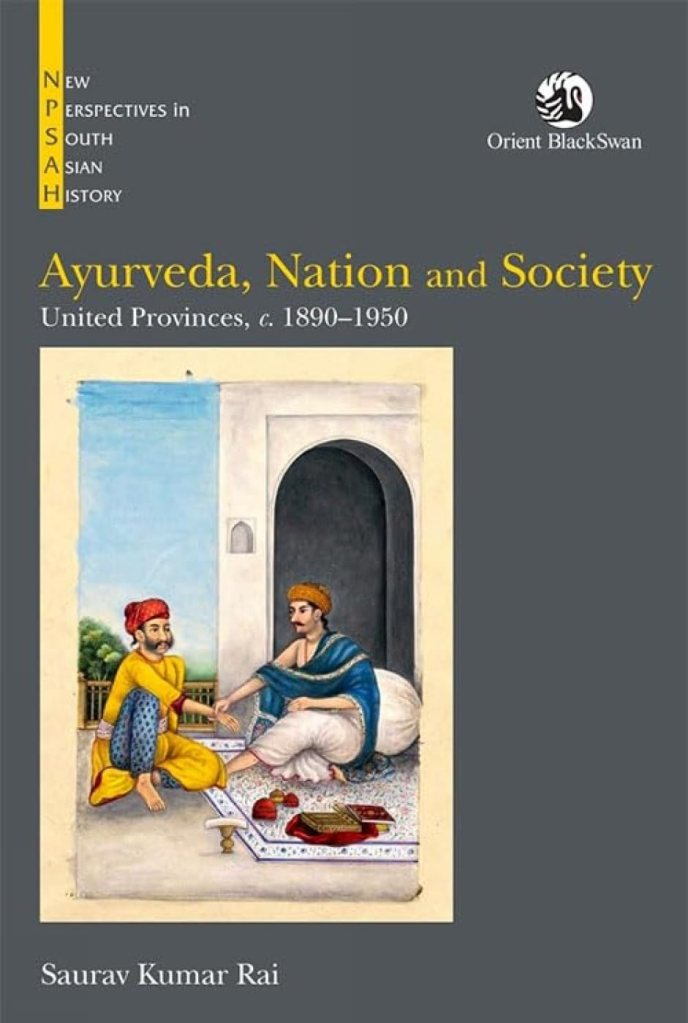
Title: Ayurveda, Nation and Society: United Provinces, c. 1890–1950

Author: Saurav Kumar Rai

Publisher: Orient Blackswan

The ayurvedic revivalist movement significantly influenced medical nationalism in the United Provinces[1] during the late 19th and early 20th centuries. This period saw a concerted effort to re-establish ayurveda as a legitimate and valuable medical system in the face of colonial dominance and the growing influence of Western medicine

 The revival of ayurveda was intertwined with the broader nationalist movement in India. Proponents of this school sought to assert an indigenous identity, positioning ayurveda as a symbol of cultural pride and resistance against colonial rule. This was particularly important as the demand for swaraj (self-rule) intensified, necessitating a projection of India as a modern and scientifically progressive nation.

The formation of groups like the All India Ayurvedic Congress in 1907 created an opportunity for the practitioners to come together, exchange insights, and push for the acknowledgment of their stream in the broader national conversation. These meetings encouraged dialogue on blending ayurvedic and wHindu

estern medical approaches, positioning the indigenous school as a legitimate alternative to the colonial healthcare systems.

In a way, the proliferation of ayurvedic literature in various languages during this period helped democratise access to its content. This literature aimed to transform ayurveda from a specialised knowledge system into a shared cultural heritage, reinforcing its relevance in contemporary society. The revivalist discourse often emphasised the scientific basis of ayurveda, thereby aligning it with modernity and progress.

Fascinatingly, the ayurvedic revivalists critiqued colonial medical practices, often blaming external factors, particularly the ‘Other’, for health crises affecting the Hindu population. This narrative not only served to unify the community around ayurveda but also reinforced a sense of collective identity against colonial narratives that marginalised indigenous practices.

Also, the movement led to the commercialisation of ayurvedic medicine, with an increase in its products and practitioners. This economic aspect played a crucial role in embedding ayurveda within the social fabric of the United Provinces, making it a part of everyday life and health practices

It is in this backdrop that this book holds significance.  Ayurveda, Nation and Society: United Provinces, c. 1890–195o by Saurav Kumar Rai explores the historical and socio-political dimensions of ayurveda during a transformative period in India.  It is part of the New Perspectives in South Asian History series by Orient Blackswan. Saurav Kumar Rai is Research Officer, at Gandhi Smriti and Darshan Samiti, New Delhi.

Says the blurb: “Ayurveda enjoys a growing global appeal, and is often touted as ‘true’ and ‘time-tested’ by contemporary political actors, governments, social groups, practitioners and NGOs in India. With ‘indigenous’ healing systems enjoying increasing state support today, an examination of the socio-political aspects of medicine, in particular Ayurveda, and its role in nation-building is critically important. Ayurveda, Nation and Society, the latest in Orient Blackswan’s ‘New Perspectives in South Asian History’ series, captures the late nineteenth and early twentieth century growth of ‘medical nationalism’ through the Ayurvedic revivalist movement in the United Provinces, and observes the ensuing change and continuity in the attitude towards ‘indigenous’ medicine in independent India.”

This study investigates the emergence of medical nationalism as reflected in the ayurvedic revivalist movement within the United Provinces, focusing on its role in the nation-building process. It offers a critique of the social dynamics of the era, drawing attention to the caste, communal, class, and gender biases that permeated ayurvedic discussions. The author contends that advocates of ayurveda played a significant role in the reconstruction of both tradition and society, frequently attributing health crises affecting the Hindu male demographic to external ‘Others.’

The book contextualises ayurveda as an indigenous medical system, delving into its complexities during the late 19th and early 20th centuries. It examines the involvement of the Indian National Congress in the ayurvedic movement, illustrating how political groups harnessed this school of medicine to foster national identity. The author further explores the influence of print media and organisational initiatives in shaping ayurvedic discourse and rallying societal support. Additionally, the commercialisation of ayurveda is analysed through its print and pharmaceutical markets, investigating the impact of economic factors on health practices. The narrative also encompasses the period surrounding India’s independence, evaluating the evolution of ayurvedic practices during this pivotal transition.

This book stands out as an important resource for those looking to deepen their knowledge of health and medicine during colonial India, attracting both scholars and general readers who are curious about the development of ayurveda and its relevance today.

[1] Present day Uttar Pradesh and Uttarakhand in India was called United Province during this period

Bhaskar Parichha is a journalist and author of UnbiasedNo Strings Attached: Writings on Odisha and Biju Patnaik – A Political Biography. He lives in Bhubaneswar and writes bilingually. Besides writing for newspapers, he also reviews books on various media platforms.

PLEASE NOTE: ARTICLES CAN ONLY BE REPRODUCED IN OTHER SITES WITH DUE ACKNOWLEDGEMENT TO BORDERLESS JOURNAL

Click here to access the Borderless anthology, Monalisa No Longer Smiles

Click here to access Monalisa No Longer Smiles on Amazon International