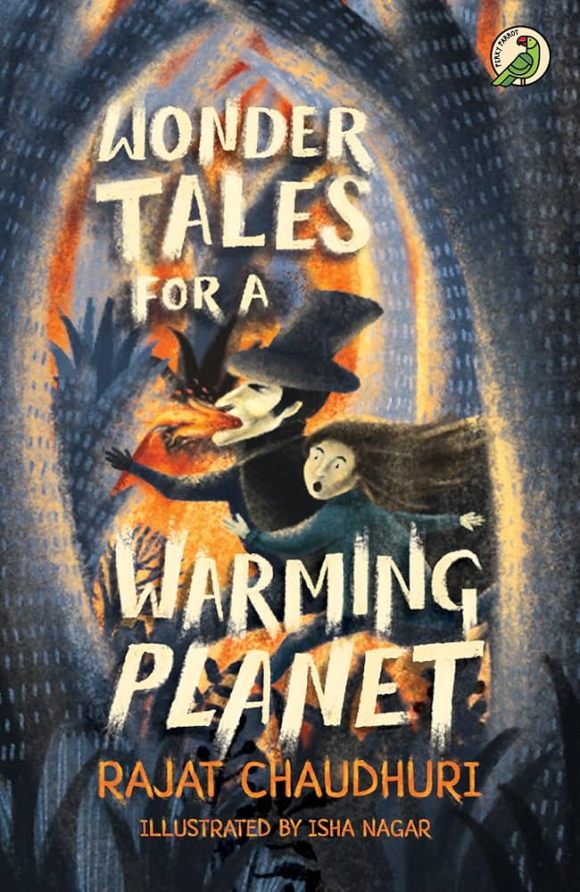
In a world teetering on the edge of ecological collapse, it’s often children who inherit the burden of our choices. But what if they could also inherit the tools to re-imagine the future? In Wonder Tales for a Warming Planet, Rajat Chaudhuri doesn’t simply tell stories—he offers blueprints for curiosity, resistance, and wonder. This collection of three speculative tales—’Tina and the Light of the World’, ‘The Seventh Sense’, and‘How Did the Oceans Vanish’—invites young readers to explore climate change not as a distant apocalypse, but as an unfolding narrative in which they are already key players.
Chaudhuri, author of acclaimed climate novels like The Butterfly Effect and Spellcasters, and short story collection like Hotel Calcutta, does not offer didactic lessons to children here. Instead he channels the age-old power of storytelling—immersive, imaginative, and intimate—to speak directly to children. His tales empower children not by shielding them from the truth, but by equipping them with imaginative tools to face it.
The first story, ‘Tina and the Light of the World’, revolves around a young girl’s encounter with a solar-powered future. In a town gripped by blackouts and crumbling infrastructure, where the rich have access to energy while the nights of those poor are engulfed in darkness, Tina meets Stoker who takes her to light but vanishes after sometime. Then Tina meets Anu who accompanies her for a while but soon she leaves her too. Finally, Tina meets sun-catcher in a place where people use solar panels to trap sun’s energy. Tina’s journey—from darkness to a solar-powered community—unfolds like a fable of illumination, both literal and symbolic. The characters she encounters—Stoker, Anu, and the sun-catcher—each represent stages in her awakening to the possibility of decentralised, sustainable energy. Chaudhuri while suggesting the alternate sources of energy other than those used earlier, cleverly weaves together issues of energy access, decentralised power, and the democratisation of technology. But the story also touches something deeper: the notion that light—both electric and symbolic—can emerge not from grand solutions, but from the small, often overlooked spaces where ingenuity persists.
In ‘The Seventh Sense’, Chaudhuri turns inward, weaving a delicate tale around Gogol, a neuro-divergent boy who develops an extra sense—one attuned to ecological shifts. What initially feels like a fantasy premise soon unfolds into a sophisticated meditation on sensory perception and ecological empathy. This “seventh sense” allows its young bearer to understand the impact of forest cutting to make way for an urban city. The brilliance of this story lies in its central metaphor: that saving the planet may not be about creating more infrastructures mindlessly in the name of fulfilling the needs of people but about cultivating an intuitive, affective connection to the non-human world. The writing is delicate, almost lyrical, yet grounded in a chilling recognition of the precarity the present world seems to now inhabit.
The final tale, ‘How Did the Oceans Vanish’, moves from the speculative to the cautionary. Told as an oral history in a distant future where seas have dried up, the story is framed as a conversation between a grandmother and her grandchild of a different evolved species. Through anecdotal fragments we piece together a slow-motion disaster — brought about by different methods of geo-engineering ushered without considerable testing — that no one tried hard enough to stop. This retrospective mode of storytelling is effective; it avoids heavy-handedness while building a quiet, cumulative sorrow. But even here, Chaudhuri resists fatalism. The tale ends not with despair, but with a question, almost whispered: What will you do differently now?
Across all three stories, Chaudhuri’s prose remains crisp and fluid. He avoids the pitfall of jargon while subtly integrating scientific ideas— alternate energy, sustainable living, geo-engineering, and more. What binds the collection is not only its thematic concern with climate but its faith in the moral imagination of children. These are not just tales about the future; they are invitations to imagine alternate presents.
That said, the book does not attempt to be everything. The storytelling is intentionally restrained. There are no dramatic twists or action-packed sequences. The stakes are emotional and ethical, rather than physical. Young readers who’ve already begun to sense the ambient anxiety of climate discussions—will find in this collection recognition, reassurance, and a language to speak about what they feel but cannot yet articulate.
Wonder Tales for a Warming Planet deserves a place not just in classrooms or children’s libraries, but in dinner table conversations. It dares to approach the climate crisis through the lens of empathy and imagination rather than panic or guilt. In doing so, Rajat Chaudhuri gives us what many adult climate narratives fail to deliver—a reason to believe that another world is not only possible but already being imagined by the young. All we need to do is listen.
Rakhi Dalal is an educator by profession. When not working, she can usually be found reading books or writing about reading them. She writes at https://rakhidalal.blogspot.com/ .
.
PLEASE NOTE: ARTICLES CAN ONLY BE REPRODUCED IN OTHER SITES WITH DUE ACKNOWLEDGEMENT TO BORDERLESS JOURNAL
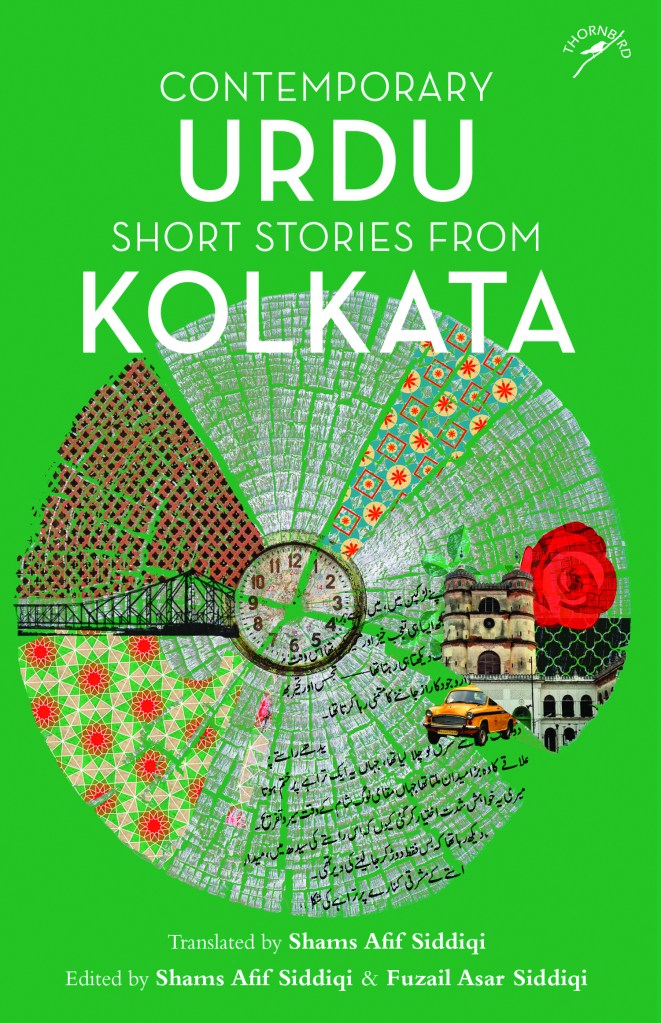
Translated by Shams Afif Siddiqi, edited by Shams Afif Siddiqi and Fuzail Asar Siddiqi
Publisher: Niyogi Books
The Stopped Clock
By Siddique Alam
The hands of the clock had stopped permanently at 13 past two and two seconds. Sitting on the bench under the shed, I am trying to understand the oval dial of the clock, the Roman letters of which had become dimmed and its edges covered with spider webs. I wonder when the clock might have stopped. I am 35 years old. Is there apparently any difference between us? Just like the clock, I have also stopped for a while because there was no announcement about the arrival of my train, its departure time being four hours ago.
I am trying to survey the place with wide open eyes. It is a usual day and an ordinary station that we are accustomed to see.
I have bid farewell to the city of my birth. I am leaving the city like a failure. But it seems after relinquishing me, the city, with a feeling of guilt, now wants to take me back. Its first step in this direction is to delay my train for an indefinite amount of time.
Despite being in the midst of a city, a station is free from its clutches. I am enjoying that freedom with a one-way ticket in my pocket. A bit of patience, I tell myself, and I would be far away. Nobody can stop me, neither by erecting obstacles in the way of the railway tracks nor by stopping the hands of the clock. Maybe I am a loser, but the journey of my life is yet to end. I am only 35 years old. I have to go far away from this place. The most important thing is that I am satisfied that the address I am carrying in my pocket is not my last destination.
It is a temporary waiting place that can help me make a new beginning. After all man is born free. The sun does not select a particular spot to shine, nor is every wave that dashes against the shore the last one, losing which the boatman would have to wait all his life for another wave.
An old coolie, wringing khaini[1] in the palms of his hands, passes by me. He is clad in a white banian and dhoti, his red flannel shirt thrown on his left shoulder.
‘Since when has the clock stopped?’ My question stops him in his stride. He turns around, his tired, thoughtful eyes staring at me. A sense of shame overpowers me. He may be an illiterate coolie, not a station employee who is answerable for such a question. ‘I am sorry,’ I quickly add, ‘I should not have put the question to you. I take back my words.’
‘Why sir?’ he stands by the side of the bench, and looks at me with a sense of intimacy. ‘People will be asking questions about a stopped clock, isn’t it? They cannot to be blamed. The story of the stopped clock is well known but only the signal man Gocharan Ray has the right to tell its tale. He had spent all his life showing green and red flags to trains and has retired today.’
‘Who has replaced him?’ my question betrays my foolishness. My imprudence had always entangled me in thoughtless acts.
‘Why don’t you ask the station master?’ The coolie moves away. ‘It’s a question that requires an answer; otherwise, you will regret it all your life.’
I was not ready for such an unexpected turn of events. I thought that my relationship with the city had been cut off forever. What do I make of a station that has ignored me, as if the ticket in my pocket is of no worth? Once again, I look at the dial of the clock hanging from the shed. It had stopped at 13 past two and two seconds. What might have happened when it stopped? Did an accident take place at the station? Had any incident of murder taken place? Was it at the time of the departure or arrival of an important leader? An attack by Naxalites? Or was the place the site of a communal incident?
The coolie returned again. This time he was wearing his shirt. ‘Unless you hear the story,’ he says, ‘your train will not arrive. This is the rule here. It may take weeks, months, or even years and you have to move from one platform to another with your suitcase. Once, a passenger alighted here to board another train. He faced a similar dilemma. He asked the same question about the clock but I do not know what happened and why he refused to listen to the story. Do you know what happened to him?’
‘How can I?’ I replied impatiently. ‘The city hardly gave me any time so that I could listen to stories.’
‘You are becoming irritated unnecessarily, Sir,’ he said. ‘I want to tell you about the man. The fact is nobody knows much about him. Some say he went to the city and did not return. Others say he took another train that never reached its destination. Some may even tell you that a prostitute took him to her house by the railway tracks where he developed leprosy and is slowly dying there. There is also no dearth of people who say he is still moving, suitcase in hand, amidst platforms, difficult to spot in the teeming crowd of passengers.’
‘You mean to say he can be anyone, even me?’
‘Did I say that, sir?’ He was on the verge of leaving. ‘It seems you have tasted bitter gourd.’
I was staring at the departing coolie’s back. The constant use of the flannel shirt had not only exposed its fibres, it had also thinned the material exposing the bones of the man’s neck. I have no hesitation in saying that I did not believe him. Since the time when suitcases developed wheels, the number of coolies has dwindled in stations. The last nail was the introduction of the backpack. Either passengers drag their suitcases on wheels, or carry luggage in their backpacks, leaving the coolies with little work. So, this may be their way of passing time.
About the Book
Dealing with love and loss, dreams and reality, as well as history and violence, this is a collection of best 19 short stories that encompasses the whole gamut of human experience, seen through the eyes of current Urdu writers from Kolkata.
Stories from Kolkata are often assumed to be about bhadralok culture and the Bengali way of life. But Kolkata is a city with amultiplicity of stories to share. Contemporary Urdu Short Stories from Kolkata highlights the diversity of recent Urdu short stories fromthe city. In one of these stories, a writer trying to escape the city wants to find the reason why the railway clock has stopped working, in another, a new friendship sours as soon as it blossoms, while some other stories show how the complexity of human relationships is explored. There is an experiment in abstraction, and legend and reality are brought together when three sleepers of an earlier civilization wake up in the modern world.
About the Editor and Translator
Shams Afif Siddiqi, former Associate Professor of English (WBES), author, short story writer, and literary critic, was born in 1955 in Kolkata. He taught in government colleges of West Bengal for 35 years and was a faculty member at MDI, Murshidabad. Khushwant Singh selected his short story for publication in The Telegraph in the 1980s. His publications include The Language of Love and other Stories (2001), a critical look at Graham Greene’s novels, Graham Greene: The Serious Entertainer (2008), and an annotated edition of G.B. Shaw’s Arms and the Man (2009).
Fuzail Asar Siddiqi is currently a PhD candidate at CES, JNU, New Delhi, researching on the modernist Urdu short story, in general, and short stories of Naiyer Masud in particular. The founder/editor-in-chief of an academic editorial services company, he has been an Assistant Professor of English at Gargi College, New Delhi.
A brief overview of Rajat Chaudhuri’s Spellcasters, published by Niyogi Books, and a conversation with the author.
Spellcasters by Rajat Chaudhuri is a spellbinding fast paced adventure in a phantasmagorical world against the backdrop of climate change and environmental disasters. Chaudhuri, a proponent of solarpunk[1], has nine books under his belt, including the Butterfly Effect (2018) a few fellowships (like Charles Wallace), and a sense of fun as the characters hurtle through the book gripping the readers with their intensity.
In this novel, Chaudhuri’s universe is run by a council, based on Akbar’s Navratnas[2]. They seem to be people in charge of running a chaotic world. This group — though not drawn from Akbar’s court but from various parts of the world — are known as the ‘Nine Unknown Men’. They are said to host great people from the past in another dimension. As they “fold the dimensions and transform matter from one form to another”, manipulating and yet healing characters like Chanchal Mitra, his protagonist, putting the world to ‘rights’ by destroying villainous capitalists who sport shrunken heads of their enemies and indulge in creating drugs that can lead to annihilation of humankind, there is a fine vein of coherence which gives credibility to Chaudhuri’s imagined world.
The locales are all fictitious but highlight real world problems of climate change, unethical scientific research and uncontrolled economic growth that only pamper the pockets of the rich craving power. He weaves in episodes that had made headlines in Indian media, like Ganesha drinking milk, and Himalayan disasters, a result of interferences by human constructs like dam building and ‘development’. A sensuous mysterious woman with curly hair, Sujata, who sets Mitra back on track and is as good as a Marvel heroine when accosted with villains, adds to the appeal of the book.
He describes a barefoot tribe which seems more idyllic than real. But given that it is a phantasmagorical fantastical novel, one would just accept that as a part of the Spellcasters’ world. However, the import of the message the tribal leader conveys to the characters on the run is astute. “We take little from this land and try to return what it gives us. So did our forefathers and all those who walk this country with the animals. But the settlers in villages and cities never tire of drawing out the last drop of earth’s riches…” A similar take on nomadism and settler communities can be found in nonfiction in Anthony Sattin’s Nomads: The Wanderers Who Shaped our World, who talks of the spirit of brotherhood, or asabiyya, that bound the nomads together, a concept borne in the fourteenth century in the Middle East. One wonders if the Nine Unknown Men who cast spells are also bound by some such law as at the end the ‘Perfect Lovers’ disappear into another adventure in time… perhaps, to resurface in Chaudhuri’s next book?
Chaudhuri is poetic with words. He writes stunning descriptions of storms and climate events: “The rivers are boisterous and overflowing, the skies are being torn apart by forests of lightning. The great snow-capped peaks from where these rivers emerge have vanished behind walls of water tumbling down from the skies.”
The thing that makes his book truly unique is the way his characters seem to internalise or grow out of the miasma that encapsulates the world below the mountains. They seem like an extension of the chaotic external environment with strange happenings. Even in the council meeting held by the Nine Unknown Men, some of the crowd seem to be wisps of mists. Chanchal Mitra has to go above the hovering fog to start healing back to normal. The novel starts in a seemingly dystopian setting. The ending is more of a fantasy. There is a strain of Bengaliness in his wry humour, in small factual details, like we find Jagadish Chandra Bose seated in the council hall, though LJ drawn from RL Stevensons’ fictional pirate from Treasure Island (1883), Long John Silver, and Caligari from The Cabinet of Dr Caligari (1920), have larger and more crucial roles in the novel. Spellcasters is a thriller that entices with words, a gripping plot and suspense — set against a backdrop of strange climate events that are becoming a reality in today’s world, though the characters are more interesting than those drawn from real life.
The novel is written by an author who is compelled by perhaps more than a need to record his times. He has a vision… though not clearly laid out as a didactic message. But it hovers in the fog that is part of the book. One of the things that came across[3] was to create utopia, we need the chaos of dystopian existence…a theme that rebel poet Nazrul addresses in his poem, ‘Proloyullash’ (The Frenzy of destruction): “Why fear destruction? It’s the gateway to creation!”
Rajat Chaudhuri
In a past life, Chaudhuri had been a consumer rights activist, an economic and political affairs officer with a Japanese Mission and a climate change advocate at the United Nations, New York. Working in such capacities could have generated his vision, his worldview. Let us find out more about it by asking him directly:
What made you turn to writing from being an activist and climate change advocate? How long have you been writing fiction? What made you turn to fiction?
I am still involved with activism through my work with NGOs and my writing for popular media and other venues. However, I have gradually shifted my energies to creative fiction through which, nowadays, I try to engage with climate change and other planetary crises.
I have been writing fiction for nearly two decades now, my first novel, Amber Dusk was published seventeen years ago. As a full-time activist I have had the opportunity to interact and work with people from various strata of society right from the villages of India to international fora like the United Nations, where I have often noticed a tug-of-war of ideas between big business, sections of civil society, governments and other major groups like women, indigenous people and so on. While watching and participating in these, I had begun to realise how stories can open another flank in our efforts to communicate our ideas.
Today, you see, storytelling is everywhere. Stories are being recruited for issues big or small, important or completely worthless, even dangerous! In my case, I realised that stories can be an important vehicle for communicating issues surrounding planetary crises to my audience. Stories tend to be sticky — they remain with us for a long time and studies are now showing that well told stories can trigger changes in perceptions, beliefs and ideas. But it took me a long time to transform this realisation into book projects. Before that I had written other books – contemporary fiction, urban fantasy and so on.
What made you conceive Spellcasters? How long did it take you to write?
There are two or three strands that came together in the writing of Spellcasters. Most important among these is my interest in psychology and mental disorders and specifically in the fact that the ideas that dominate the world today, you can call them spells too, make us behave like we are affected by some kind of mental illness. Ideas and practices like limitless growth, conspicuous consumption and so on, make us behave as if we have lost our minds as we go on plundering the planet for energy and resources despite the fact that `nature’ is striking back at us with ever-increasing fury. So, our mental illness is causing planetary illness and at the centre of all this are these powerful, mesmerising, false beliefs, which right from the time of the Club of Rome have been known to be dangerous.
So, when I began to plan this novel, all these thoughts were in my mind partly driven by my activism. And at the same time, I had been reading Sudhir Kakar’s works about magic and mysticism in India and the parallels between Indian and western psychology so all of that came together. It took me about five years to complete Spellcasters not at one go, there was other stuff I have worked on in between.
What kind of research went into making the book?
To create the main character, the journalist Chanchal Mitra, I worked closely with my psychoanalyst friend Anurag Mishra who happens to be a student of Sudhir Kakar. And that research was really intense. We had long face-to-face and online sessions and I read a lot about the varieties and specificities of mental disorder.
Then there is of course that background layer of interest which oftenseeds ideas in your mind. This usually comes from your reading, and I had been interested in reading about the occult traditions of the East and the West for many years. Characters like Mme Alexandra David-Neel[4], the magic healers among indigenous peoples, the power of entheogenic substances like mushrooms have always fascinated me, and some of that came back while researching this book. Writing the climate layer of the story was comparatively easier because of my first-hand activist experience.
Do you have a vision or a message that you tried to address in this novel? I felt it moved from a dystopian setting to that of a fantasy — though not to utopia. Do you think a dystopian vision is necessary to evolve utopia?
The message is simple, and we all know it: Ideas of limitless growth have affected us mentally and so we behave and act in ways (resource extraction, carbon emission) that are making the planet sick. We are passing on our illness to the planet. The belief in limitless growth is a zoonotic disease that our species has transferred to the living planet. Still, we do not act because we are under the effect of these powerful ideas, these powerful spells, that’s where the novel gets its name. The message, if we can call it one, is to be aware of this and try to break out of these spells.
The path to utopia is not necessarily through dystopia. We can start hoping and acting today before things get really bad. Which is the locus of the whole solarpunk movement with which I am closely associated as an editor and creator. But `darkness’ can be redeeming too. Jem Bendell writes about this in detail. Grief and sorrow can indeed make us stronger; author Liz Jensen navigates grief and encounters hope in Your Wild and Precious Life, which is a must read for everyone asking these questions. But coming back to Spellcasters it is really neither dystopia or utopia if we are talking about the climate layer of the story, it’s very much set in the present. What might look dystopian are the gothic and magical elements and settings which serve as a counterpoint to the cold logic of the scientist character, Vincent.
Your novel has broken various barriers by mingling different constructs. So, tell us, how do you combine realism with fantasy, science with literature and create your own world?
It’s not difficult actually. Fantasy, magic and `unreason’ are woven around the borders of the familiar. We see them often without noticing it. Leaping a little higher or using a prescription eye-cleanser can do the trick!
To answer the other part of your question, science and literature or nature and culture were never apart in the first place. They were sundered because of the partitioning project of modernity which goes back to the work of Hobbes and Boyle and has its own history and protagonists. Science fiction as you know does not care much for this division. Climate fiction because of its scaffolding of science and reason needs to bring the two together. As a climate fiction writer, I try to keep the scientific complexities in the background, but they remain as building blocks of the story. In this book however we have a full chapter which is out of a scientist’s journal, and I did that for a change in flavour and in the spirit of experimentation.
Are your imaginary locales based on real cities? Please elaborate.
Often so. In Spellcasters the cities of Anantanagar and Aukatabadare modelled on Calcutta and Delhi respectively. A close reader can easily pick out the similarities but then I also enjoy changing some details especially when I am writing mixed-genre work like this one. So, there is no Chinese joint (like the one Chanchal hangs out at) in Calcutta where you can openly smoke weed but there are places quite similar to the one I described and there is indeed a real person with an eye of glass who used to hang out in one of these.
You have spoken of storms on the hills. Do you also see this as an impact of climate change? Do you think building roads, tunnels or hydel power stations on the hills can, over a period of time, have adverse effects on climate or humanity? Can you suggest an alternative to such ‘development’?
The avalanches, the unseasonal rains, especially the cloudbursts are all closely connected to climate change. Having said that, we also have to be careful to avoid climate reductionism. Often it is a concatenation of factors (including carbon emissions and climate change) and processes, their effects amplified by feedback loops, that precipitate disasters. This is very true if we study migration, for which climate change can be one of the driving forces but there could be other factors like economic opportunities, cultural patterns etc implicated in such flows.
Mindless development which does not take into account the fragility of nature and the interconnections between all beings big and small, microscopic or enormous, animate or inanimate, will set into motion processes that will precipitate crises like climate change. Yes, big dams are definitely a problem and small hydro is always a better option. We often hear that nature is self-healing or that there have been many previous extinctions, and that the planet has made and remade itself, but that’s like telling ourselves, please prepare for suicide while the super-rich and the cults of preppers, especially in the advanced industrialised nations, can escape to their doomsday bunkers.
The alternatives to the current development model is to be found in the ideas of Gandhi, of Schumacher, in solarpunk literature, in Vandana Shiva’s works among plenty of other places. The basic idea is to live in harmony with the planet, cut down on emissions, reduce resource extraction, try community based participatory solutions to problems instead of relying on economic, high-tech or market-based instruments, step back, go slow and let nature cloth and feed us so that we can live with dignity while forsaking greed.
In Spellcasters, you show climate change as an accepted way of life at the end. Do you think that can be a reality? Do you think climate change can be reversed?
A novel often presents itself as a bouquet of ideas without the author demonstrating any clear bias for one over the others. But as an activist-writer I usually drop clear hints as to what is more desirable without making it too obvious. There is always this ongoing duel between politics and aesthetics in a novel and the best among us balance the two quite well.
Climate change can of course be engaged with, controlled and reversed, if we can stick to the ambitious targets of the Paris climate agreement with the rich nations facilitating the process with more funds to poorer nations. Both producers and consumers have a role to play here, and we need serious lifestyle changes in the advanced industrial nations (or rather the global North) and a serious focus on climate justice for any meaningful change to occur. Only planting trees and carbon-trading won’t do.
Your language is very poetic. Do you have any intention of trying poetry as a genre?
Thank you. I haven’t ever thought of writing poetry because I am not gifted with the art of brevity which I think is essential there. But I have enjoyed translating poetry from Bengali to English, which was published as a book. I plan to do more of that.
What can we next expect from your pen?
I have been trying to finish a work of non-fiction about climate change and I hope to do this by the end of the year.
Let me also take this opportunity to thank you Mitali and your team at Borderless Journal for your service to literature. You are doing important work here and I am really grateful for your interest in my novel.
Thank you so much for giving us your time and sharing your wonderful book.
.
[1]Solarpunk is a sci-fi subgenre and social movement that emerged in 2008. It visualizes collectivist, ecological utopias where nature and technology grow in harmony. Read more by clicking her
[2]Navratnas or the nine gems were a bunch of very gifted men in his court, like Birbal and Tansen.
[3]The author does not agree to this reading in the interview. He sees his novel evolve out of the solarpunk movement.


 Borderless