Categories
Stories

Blue Futures, Drowned Pasts

By Md Mujib Ullah 

The air at Patenga Sea Beach hung thick with salt and memory, a living weight that clung to Karim’s skin and settled in the grooves of his thoughts. He stood motionless, his feet half-buried in the damp embrace of sand, facing the heaving expanse of the Bay of Bengal. Each wave broke with a rhythm once known to him, a lullaby of youth and simplicity. Now, it rolled like an echo chamber of loss.                            

He didn’t just see the sea—he saw the absence it bore. Azimpur Union, a coastal village once nestled like a secret in the arms of Sandwip, no longer existed. The Meghna River had devoured it, inch by insatiable inch, until it was reduced to memory. His family, like countless others, had fled inland, displaced not by war or persecution but by the creeping violence of climate change. Halishahar became their reluctant refuge. Karim, now a climate scientist, carried the wound like a relic—not healed but honed.

Beside him, Anika traced idle circles in the sand with her bare toe, drawing galaxies destined to be washed away. Her short hair fluttered in the breeze, framing a face defined by quiet determination and dark, searching eyes. As a student of Environmental Sciences at the Asian University for Women, she viewed the beach not just as a source of beauty, but as a battleground.

“It’s getting worse, isn’t it?” she asked, not breaking her gaze from the horizon, where cargo ships floated like steel ghosts. Karim nodded. “It’s not just the sea creeping in. It’s the salt in our fields, the poison in our wells. My grandfather spoke of golden paddy fields in Azimpur. Now it’s all water. Still. Empty. Unforgiving.” A voice, crisp and clear, cut through the air. “That’s why your work matters, Bhaijaan[1].”

Hafsa had arrived, stepping into the wind like it obeyed her. Younger than Karim by a decade, she wore her uniform from Feni Girls Cadet College like a blade sheathed in pride. Her eyes, sharp and unwavering, carried a fire that scorched complacency.

“Understanding the science is our first defence,” she said. “You’re giving us a fighting chance.” Karim smiled—not the performative curve of lips, but the rare, involuntary kind that cracked through layers of grief. “That’s why I studied Oceanography. Not for grades. To learn the language of the sea. To understand the force that took everything from us.”

They drifted to the quieter banks of the Chittagong Boat Club, where boats bobbed like dreams tethered to fragile ropes. Here, the water lapped gently, less a threat, more a whisper.

“Sandwip’s shoreline is disappearing,” Karim said, leaning on the railing. “Sometimes by metres each month. It’s a perfect storm: rising seas, broken river systems, displaced sediments. The Bay of Bengal funnels it all into disaster. It’s not just nature. It’s a mirror of our neglect.” Anika picked up the thread like a weaver. “It’s a slow massacre. Salt invades the soil. Crops wither. Freshwater turns brackish. The mangroves—our final fortress—are dying. The Sundarbans are gasping.”

“And with them,” Hafsa added, “everything unravels. People flee inland. Cities like Halishahar swell and groan. Agriculture collapses. Food security frays. And without mangroves, every cyclone cuts deeper. Everything is connected.”

Karim nodded, the weight of data behind every word. “The models I build are no longer predictive. They’re prescriptive. They warn of what is already unravelling. Sea levels, salinity, erosion—they all spike. The IPCC[2] confirms it. But the tide doesn’t wait for consensus.”

At Foy’s Lake, serenity shimmered over the water like an illusion. But their thoughts grew darker.

“Bangladesh knows storms,” Anika said, her voice soft. “Bhola, 1970. Chittagong, 1991. Cyclones that rewrote our history in wind and water.”

“Those storms taught us resilience,” Karim said. “Shelters. Warnings. Community drills. However, the storms are now stronger. Hotter oceans feed them. And higher seas mean bigger surges—even from weaker storms.”

Hafsa’s voice quivered at the edges. “But how much more can we endure? Our grandparents rebuilt after every storm. But if this continues, is it resilience, or a kind of slow exile?” Anika nodded. “Traditional adaptation isn’t enough anymore. We need foresight. Long-term planning. Even planned migration. And that’s not just about moving people. It’s about moving lives, cultures, entire identities.”

They sat for a while, sharing silence, watching birds slice the air like omens. In that stillness, Anika said, “You know what hurts most? It’s not the loss of land. It’s the loss of certainty. The knowledge that what raised you, fed you, and shaped your memories is vanishing. And there’s no going back.”

Silence followed them to the War Cemetery, where white stones bore witness to another kind of war. One with bullets and borders. Karim saw it differently now: this, too, was a battlefield. But here, the enemy was time, water, and indifference. Later, among the blooms of DC Park and the Sitakunda Botanical Garden and Eco Park, their talk turned to life beneath the waves.

“Most people think of fish,” Karim said, gesturing to a flowering hibiscus. “But the ocean’s true wealth lies in biodiversity. Coral reefs, like those near St. Martin’s Island, are the lungs and nurseries of the sea.”

“And they’re dying,” Anika said. “Warming waters bleach them. Carbon dioxide makes the ocean acidic. Reefs dissolve before our eyes. It’s extinction, hidden by depth.”    

Karim’s voice dropped like an anchor. “The blue economy—fishing, tourism, aquaculture—depends on healthy oceans. Without reefs, fish vanish. Livelihoods collapse. The sea becomes a graveyard.”

“So it’s not just conservation,” Hafsa said. “It’s survival. But how do we grow our economy without destroying what sustains it?” Karim didn’t hesitate. “Balance. Policy grounded in science. Marine protected areas. Sustainable fishing quotas. Eco-tourism. Stewardship over extraction.”

They spent hours walking through the botanical paths, discussing seagrass, kelp forests, and the future of ocean farming. Anika shared her dreams of working with community-led marine conservation, and Hafsa spoke of pushing climate policy debates in every youth parliament session she attended. High in the Chandranath Hill, where the wind carried the scent of leaves and legacy, their voices softened.

“There’s more to the sea than science,” Karim said, his voice almost reverent. “There’s a myth. Memory. Identity. That’s what the blue humanities teaches us. When Azimpur disappeared, it wasn’t just land. It was language. It was lullabies.” Anika blinked; her eyes were glassy. “I see it in displaced communities. They lose more than their homes. They lose stories. The names of trees, the tastes of festivals.” Hafsa, ever the compass, brought it home. “So blue humanities means recognising the ocean not just as a resource but as part of us. A mirror. What we take from it, we take from ourselves.” Karim looked at them and felt a surge rise in his chest, not of sorrow this time, but something like hope. “You’re right. This fight isn’t just scientific. Or economic. It’s human. And we can only win it together.”

As the sun dipped behind the Chandranath Hill, setting the sky ablaze in golds and blood-reds, they walked in a hush, not of despair, but of reverence. They were young, yes. But in their hearts, they carried the future—and it was heavy.

Then Anika asked, “What gives you hope?” Karim looked at her, then at Hafsa, and smiled. “You do. The fact that we’re talking like this. That we care. That we haven’t given up.” And Hafsa, eyes firm as stone, said, “We won’t. We’re the generation that listens to the tide before it screams.”

They turned from the sea, toward the uncertain shore of tomorrow. The water behind them was not done. But neither were they.

Sandwip beach. From Public Domain

[1] A respectful way of addressing a man, translates to brother

[2] Intergovernmental Panel on Climate Change

Md Mujib Ullah reads, researches, thinks, and writes. His work has appeared in Artful Dodge, Text, Borderless, and elsewhere.

.

PLEASE NOTE: ARTICLES CAN ONLY BE REPRODUCED IN OTHER SITES WITH DUE ACKNOWLEDGEMENT TO BORDERLESS JOURNAL

Click here to access the Borderless anthology, Monalisa No Longer Smiles

Click here to access Monalisa No Longer Smiles on Kindle Amazon International
Categories
climate change

A Manmade Disaster or Climate Change?

Salma A. Shafi writes from ground level at Noakhali

The Greater Noakhali region of Bangladesh is experiencing one of the most severe flood and water-logging crises in recent memory, driven by persistent heavy rainfall since mid-August 2024. The flood affected more than 5 million people, submerging houses, roads, and marketplaces, and leaving large portions of the region inundated. A total of 71 people, including women and children, lost their lives in the flood affected areas. With water levels reaching alarming heights, the disaster has raised significant concerns about vulnerability of the region for future flooding.

Almost every year floods occur in Bangladesh, but the intensity and magnitude vary from year to year. Their nature causes and extent of destruction gives them various definitions such as river flood, rainfall flood, flash flood, tidal flood, storm surge flood. The term manmade flood is a recent phenomenon attributed to encroachment on vital water channels, such as canals and wetlands sometimes for construction of roads and bridges and frequently for fish cultivation, hatcheries and shrimp farming.

Context of recent flood in Bangladesh

Since August 20, 2024, Bangladesh has been facing severe flooding triggered by continuous heavy rainfall and, according to the Bangladesh Ministry of External Affairs, water releases from Dumbur Dam, upstream in Tripura, India[1], a claim that is denied by the Indian government. Tripura also suffered severe floods and landslides[2] from this August. The flood impacted several districts in Bangladesh, including Feni, Noakhali, Comilla, Lakshmipur, Brahmanbaria, Cox’s Bazar, Khagrachhari, Chattogram, Habiganj, and Moulvibazar. By August 23, 2024, the Ministry of Disaster Management and Relief reported that floods had affected 4.5 million people across 77 upazilas in 11 districts. Nearly 194,000 people, along with over 17,800 livestock sought refuge in 3,170 shelters as the crisis continued.

In addition to widespread displacement, the floods led to tragic fatalities, with deaths reported across multiple districts. Communication with key river stations, such as Muhuri[3] and Halda[4], were completely severed, hampering collection of vital data necessary for relief and rescue operations. The extensive flooding has caused significant damage to property, crops, and infrastructure, displacing thousands of families. The disruption to transportation and agriculture  deepened the humanitarian crisis, demanding immediate action to mitigate long-term impacts of disaster on the affected communities.

The flood situation in Noakhali District worsened due to continuous heavy rainfall and rising water levels of the Muhuri River. The district Weather Office recorded 71 mm of rainfall within 24 hours, exacerbating the flooding. Approximately 2 million people were stranded as floodwaters submerged roads, agricultural fields, and fish ponds. Seven municipalities in the district went underwater, with widespread waterlogging affecting both rural and urban settlements.

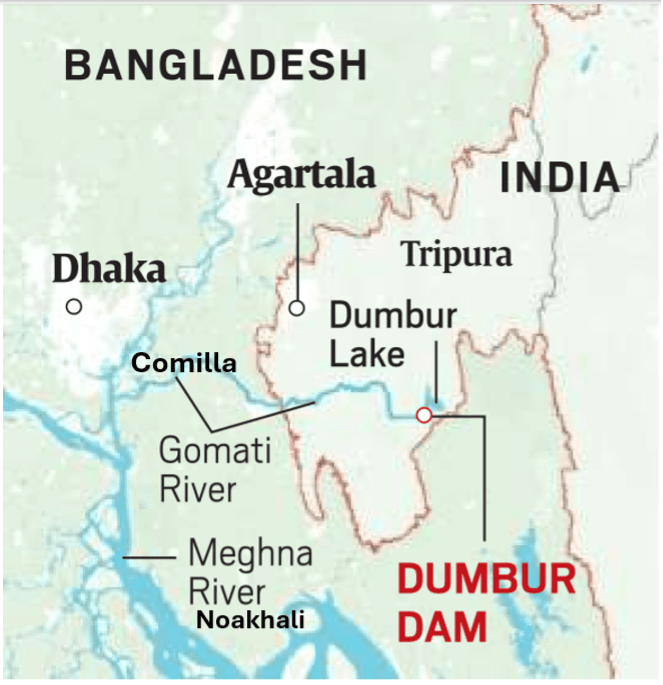
Map provided by Salma A Shafi

On September 1, 2024, the Noakhali Meteorological Office reported a staggering 174 mm of rainfall within a 12-hour period, causing widespread flooding and waterlogging across low-lying areas. The worst-affected upazilas include Noakhali, Senbagh, Sonaimuri, Chatkhil, Begumganj, Kabirhat, Companiganj, and Subarnachar, where over 2.1 million people were stranded. Additionally, more than 264,000 individuals sought refuge in emergency shelters and school buildings. The prolonged water-logging devastated local economy, particularly the agricultural sector, where vast areas of farmland, including Aman rice seedbeds and vegetable fields, were submerged, jeopardizing livelihoods of farmers and disrupting essential food production for a prolonged period.

With 90% of Noakhali district’s population impacted by this flash flood, the region faced critical humanitarian and environmental emergency. An analysis of the causes and consequences of flood and waterlogging in Greater Noakhali reveals an interplay of meteorological, infrastructural, and environmental factors coupled with geographic location of Bangladesh and the geo morphology of the river systems of the region. Bangladesh and India share 54 rivers of which the Teesta, Ganges, Brahmaputra, Meghna forming the GBM basin are the most important. This river basin is one of the largest hydrological regions in the world and stretches across five countries Bangladesh, Bhutan, China, India and Nepal. This basin area is home to 47 percent of the Indian population and 80 percent of the Bangladeshi population. Food security, water supply, energy and environment of both countries are dependent on the water resource of the rivers.

Uncertainty and Challenges in Flood situation 

During the monsoon periods development of a low-pressure system over northern Bangladesh can bring very heavy to extremely heavy rainfall in Assam, Meghalaya, and Tripura posing great threat to flood-prone areas in Bangladesh. These overlapping weather patterns and regional dynamics create highly uncertain and dangerous situation, making it difficult to coordinate an effective response and leave millions of people vulnerable to worsening flood conditions.

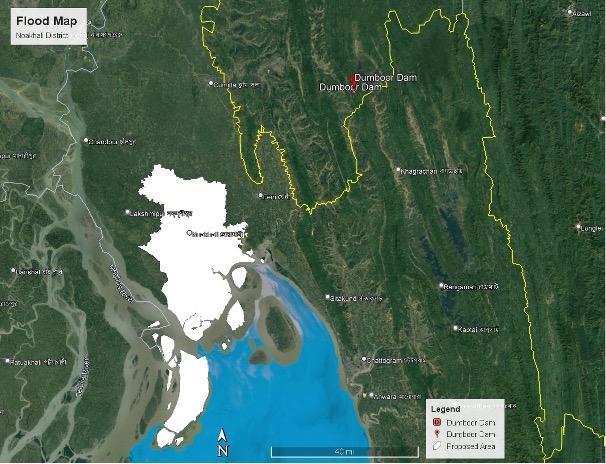
Map provided by Salma A Shafi

Flooding in Noakhali region resulted from heavy rainfall and floods in western Tripura in August and as per MEA[5] news broadcast that the Dumbur Dam, a hydro power project had been, “auto releasing”, water as a consequence of the rainfall. The Dumbur Dam in Tripura is located far from the border about 120km upstream of Bangladesh. It is a low height dam (30m) that generates power and feeds into a grid from which Bangladesh also draws 40MW power. There are three water level observation sites along the 120km river course. As per news from the monitoring agencies excess water from the Gumti reservoir was automatically released through the spillway once it crossed the 94m mark which is the reservoirs full capacity. It is a known fact there is no comprehensive regional mechanism for transboundary water governance or multilateral forum involving the five Asian nations. The lower riparian nations particularly India and Bangladesh are therefore the worst sufferers.

Key Impact Areas in Bangladesh:

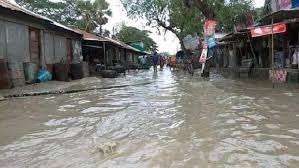
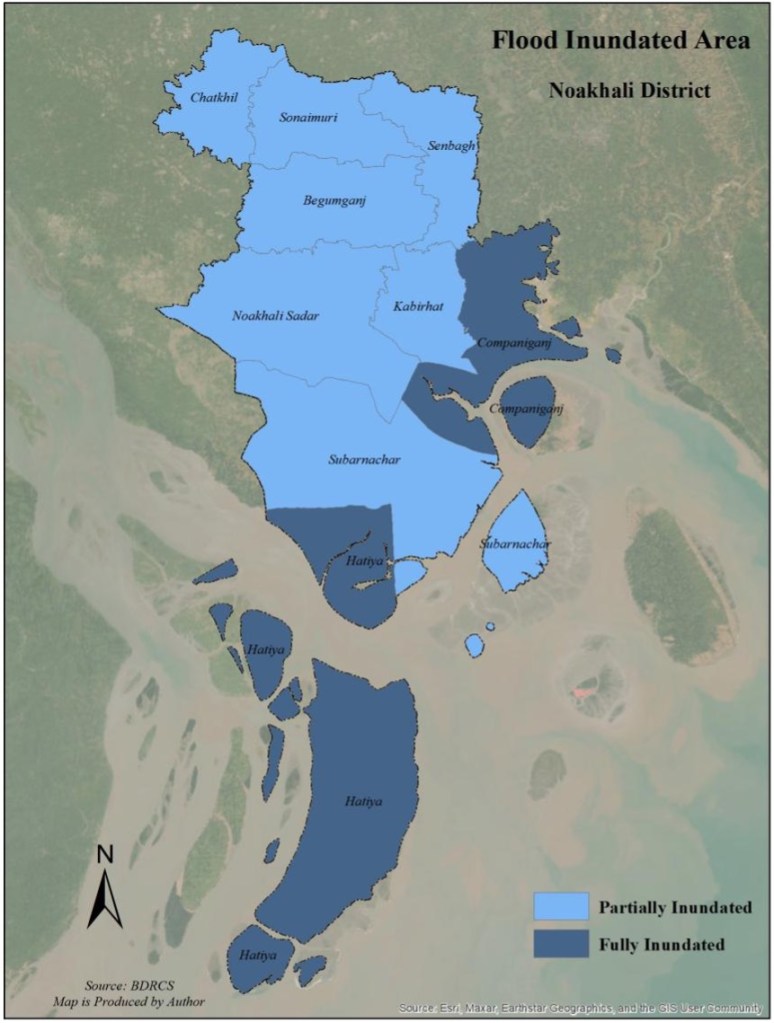
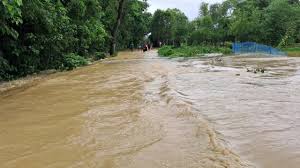
The flood in the Noakhali region was caused by overflow of water from the large catchment areas downstream of the Dumbur Dam. While river channels were not deep enough to accommodate the excess water, unplanned constructions on rivers and canals caused the water to spill into settlement areas causing humanitarian crisis unseen in decades. Kompaniganj and Hatiya upazilas (sub-districts) were completely inundated by floodwaters, while Subarna Char, Sonaimuri, Noakhali Sadar, Kabir Hat, and Senbag upazilas were partially affected. The flooding submerged homes, roads, and marketplaces, with water levels reaching roof levels in the high flood zones, waist-deep in some areas and knee-deep inside most homes. The rising floodwaters devastated farmlands, particularly Aman paddy seedbeds and vegetable fields, swept away, a large number of the cattle, poultry including the sheds which sheltered them.

Current Challenges

The ongoing flood crisis in Bangladesh faces several critical challenges. One of the most immediate issues is the submersion of roads and the disruption of communication networks, which has significantly hindered relief efforts. The situation is fluid, with new districts continuously being affected, complicating the delivery of aid and emergency services to those in need. This has also resulted in delays in evacuations, leaving many communities stranded without access to basic necessities.

Another key challenge is the conflicting information from different meteorological agencies. The Bangladesh Meteorological Department and the Flood Forecasting and Warning Center (FFWC) have issued varying reports regarding upcoming weather conditions. This uncertainty is affecting the preparedness of the affected populations, making it difficult for them to take timely and appropriate measures to protect themselves and their property.

Geo-political Tension in River Management in Bangladesh

Bangladesh, known as one of the most climate-vulnerable nations globally is facing increasing geopolitical challenges due to its strategic location on the Ganges-Brahmaputra Delta. Besides, annual monsoon floods, flash flood, particularly in northeastern districts of Sylhet, Feni and Cumilla, Noakhali are exacerbated by water releases from upstream dams, such as the Dumbur Dam. These actions have intensified tensions between Bangladesh and India, highlighting the complex dynamics of transboundary river management.

Despite legal recognition of rivers as living entities, both nations continue to exploit these water resources through infrastructure projects that disrupt natural river flows. Extensive dam and hydropower projects on shared rivers have caused significant environmental and social injustices downstream, impacting both ecosystems and livelihoods. This situation reflects a broader pattern of unilateral control and inadequate cooperation in water management, which contradicts international agreements and hinders equitable water sharing.

The Bangladesh-India Joint River Commission, established in 1972, is yet to resolve these critical issues. The recent floods have further underscored the need for more effective communication and cooperation between the two nations to prevent future disasters. As calls for water justice grow louder, there is increasing pressure on both countries to remove barriers and ensure the free flow of rivers across borders, upholding the principles of transboundary water governance and protecting the rights of those affected downstream.

Flood Map of Noakhali District, 2024. Map provided by Salma A Shafi

[1] India disputes this claim saying that they have been releasing the same quantity of water for the last fifty years. https://www.downtoearth.org.in/natural-disasters/india-has-no-role-in-bangladesh-flood-dumbur-dam-opens-automatically-for-last-50-years-tripura-official https://www.thedailystar.net/news/bangladesh/news/india-refutes-claims-causing-floods-bangladesh-3683526

[2] The floods displaced 65,000 people and killed 23 in Tripura. https://www.reuters.com/world/india/floods-landslides-indias-tripura-displace-tens-thousands-2024-08-23/

[3] A river that starts in Tripura and flows down to Feni. Also, Muhuri Irrigation Project is Bangladesh’s second largest irrigation project. https://en.wikipedia.org/wiki/Muhuri_Project

[4] The Halda River is the breeding ground for carp and fishermen harvest the carp eggs.  https://bsmrau.edu.bd/seminar/wp-content/uploads/sites/318/2020/08/003-Umme-Hani-Sharanika-seminar-paper.pdf

[5] Ministry of External Affairs, in this case Bangladesh.

Salma A. Shafi is an architect and urban planner. She did her MSc. in Urban Planning from AIT, Bang­kok, Thai­land and has a Bachelor of Architecture (B. Arch.) degree from BU­ET, Dhaka. Salma Shafi has extensive experience in urban research and consultancy, specialising in urban land use and infrastructure planning, housing and tenure issues. She is a well-known researcher in the field of urbanisation and urban planning. Urban Crime and Violence in Dhaka published by the University Press Limited (2010), Housing Development Program for Dhaka City, Centre for Urban Studies, Dhaka (2008) and Feroza, a biography of her mother published by Journeyman (2021).

.

PLEASE NOTE: ARTICLES CAN ONLY BE REPRODUCED IN OTHER SITES WITH DUE ACKNOWLEDGEMENT TO BORDERLESS JOURNAL

Click here to access the Borderless anthology, Monalisa No Longer Smiles

Click here to access Monalisa No Longer Smiles on Kindle Amazon International