Categories
Conversation

‘Soumitra Chatterjee was my father first and then everything else’

Poulami Bose Chatterjee converses with Ratnottama Sengupta
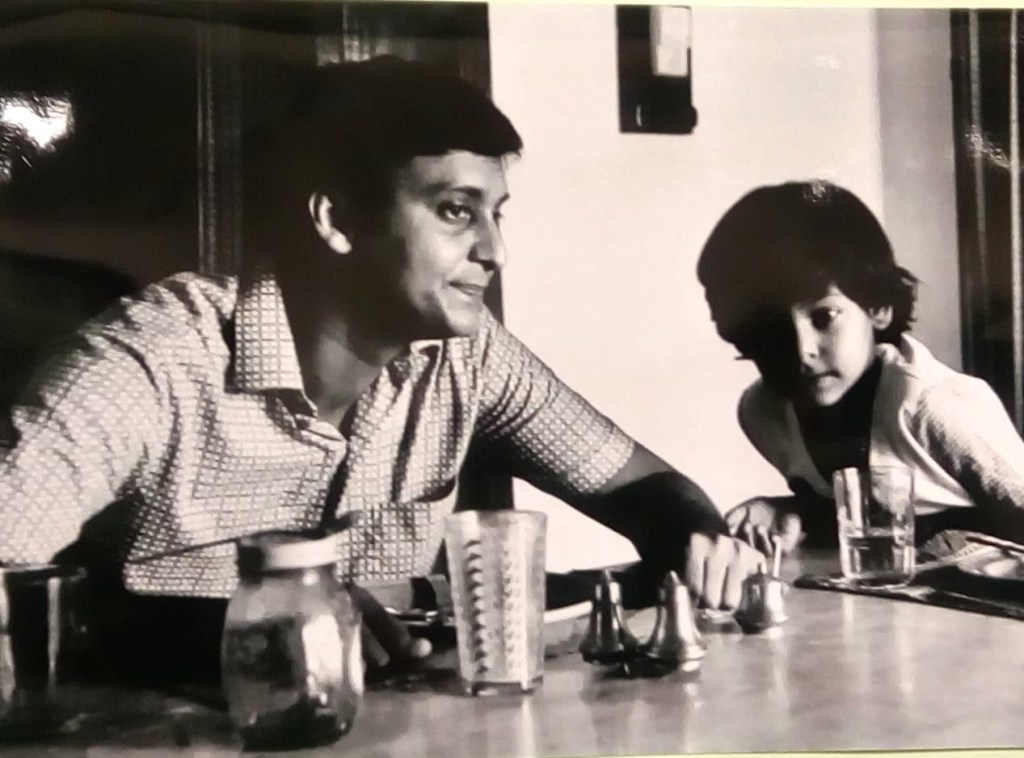
Young Soumitra Chatterjee with his daughter, Poulami. Photo provided by Ratnottama Sengupta

“All the recovery Rono Bhaitu[1]( Soumitra’s grandson) has made, is entirely due to his mother,” Soumitra Chatterjee (1935-2020) had said to me when I met him before Covid set in. His voice was laden with deep affection and paternal pride for his daughter. Deservedly so, as the world has been witnessing since the star actor passed away in November 2020. Poulami took upon herself the male mantle of lighting her father’s pyre.
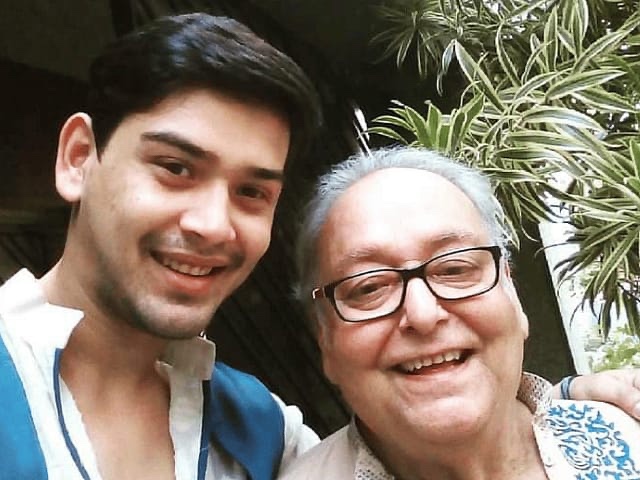
An older Soumitra Chatterjee with his grandson, Ronodeb Bose. Photo provided by Ratnottama Sengupta

But that was neither the beginning nor the end of her duty towards her father. I had seen her perform on stage alongside the thespian in Homapakhi [A Legendary Bird] that had explored the complexities of a society trying to reconcile its modern aspirations with traditional roots.

And last November she directed Janmantar [Rebirth], an original play Soumitra Chatterjee had written in 1993 but was never staged before. Seen through the eyes of a matinee idol who is visiting a remote village in Purulia, it focused on ills like child marriage, witch hunting, clash between and land owners and cultivators.  “Unfortunately, 30 years later too, all the ills are still thriving on that soil,” Poulami said to me.
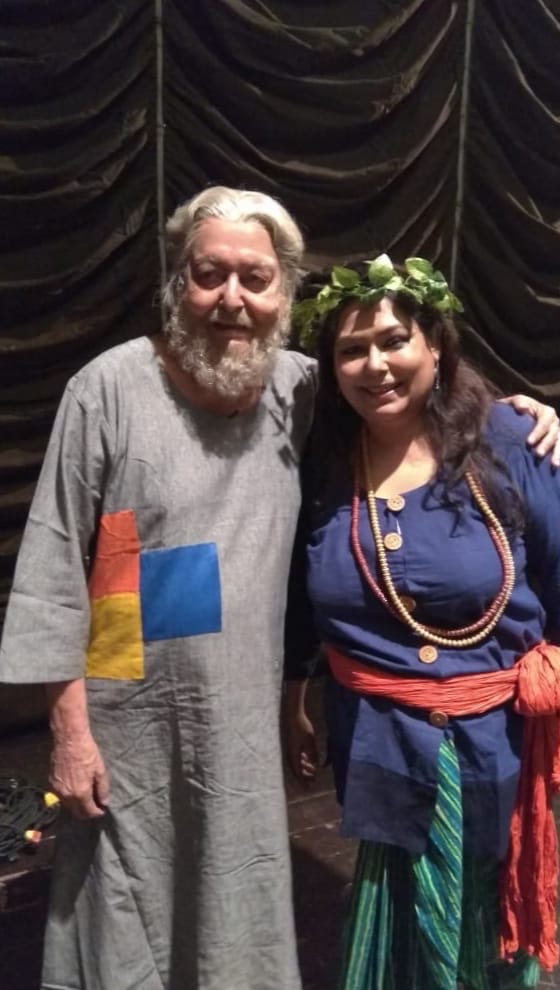
Poulami with Soumitra. Photo provided by Ratnottama Sengupta

And in January, even as the definitive biography Soumitra Chatterjee and his World was being launched in the Kolkata Literary Meet, she staged Chandanpurer Chor [The Thief of Chanderpur], his light hearted transliteration of Jean Anouilh’s Carnival of Thieves[2], to mark his birth anniversary.

On the eve of the International Women’s Day I conversed with Poulami, whose parents have been an integral part of my life too.   

Ratnottama Sengupta: Who is Poulami? A Bharatanatyam dancer? A theatre person? Mother of an actor with a brief trajectory? Or, daughter of Soumitra Chatterjee?
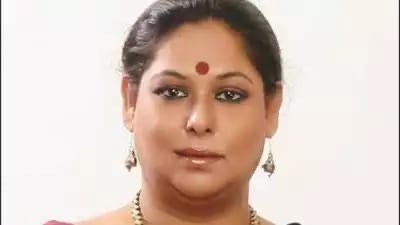
Poulami Bose Chatterjee

Poulami Bose: I think Poulami is a bit of all this — along with a passionate theatre practitioner. I am my mother’s daughter too. I hope I am a loyal friend to my friends. But above all I’m myself. I like to think of myself as a free spirit — absolutely totally in love with my daughter and son and music and dance and theatre and all that is wonderful in the world.

RS: When did you first realise that your father was not a 10-5 pm office going father like that of other girls? That he was a star?

PB: For a long time in my growing up years I actually didn’t realise how big a star he was. He was a very loving, hands-on father, very involved in our lives. I always knew he was an actor but didn’t realise the magnitude of his stardom. He never brought that aspect home. Our home was always filled with lively discussions, about books, music, paintings, dance, theatre, cinema, the environment, travel… It was a beautiful childhood, very loving, very secure.

Bapi [father] and Ma were always introducing us to new things. Encouraging us to embrace the world. I thought that was normal and that’s what every father was like. Only after I grew up did I realise his impact on the Bengali moviegoers’ lives.

RS: What did a ‘cine star’ mean to you when a) you were learning Bharatanatyam under Thankamani Kutty? b) Studying? c) Getting married to Ruchir Bose?

PB: The word ‘Cine Star’ didn’t matter much when I was learning dance or studying because I was treated just like any other student, by my teachers and my friends. In fact my father didn’t believe in the word ‘Star’. He maintained that he was a professional actor — and we were certainly not encouraged to have airs and graces about us. So we interacted normally with people, and people did likewise. Some people were of course star struck but they didn’t make a difference to me. As for getting married to Ruchir: he was and still is a very down to earth person, far removed from the film industry, very humane. He and his family have always accepted me and treated me for who I am rather than who my father was.

RS: Who was a bigger star for you — Soumitra Chatterjee or Satyajit Ray?

PB: Of course Satyajit Ray! Soumitra Chatterjee was my father first and then everything else, whereas Satyajit Ray was larger than life. We grew up hero worshipping him. Our whole family was absolutely in awe of him — as a person, as a filmmaker, an author and the rest. We were influenced a great deal by his way of life. His sensibilities. In fact we still idolize him.

RS: Which films of Soumitra Chatterjee have you loved most?

PB: Oh there are so many! Apur Sansar, Sansar Simante, Jhinder Bondi, Koni. Ekti Jiban, Dekha, Mayurakshi, Agradani, Ashani Sanket, Abhijan, Sonar Kella, Ganadevata, Atal Jaler Ahwan, Aparichita, Teen Bhubaner Pare, Baghini, Basanta Bilap, Shakha Prasakha, Charulata, Kapurush, Akash Kusum, Dwando, Borunbabur Bondhu…[3] I can go on.

The most impressive thing for me was his versatility. He was different in all the films that I have mentioned above. He was one actor who didn’t have mannerisms. He always became the character. I have seen him doing a lot of homework, research to delve deep into the character’s psyche. Acting was his passion and that was evident in whichever role he played.

RS: Which film of your father has impacted you most? One that moved you at a personal level, perhaps because you identified with it most?

PB: I think Koni. His now iconic dialogue, “Fight Koni, fight!” has stayed with me till this day. Whenever I feel low or face any kind of obstacle, I always remember him in the film. How the human spirit is capable of rising against all odds. How hard work and determination can carry you forward. It inspires not to give up without a fight.

RS: Soumitra Da was a Master in Bengali; Deepadi[4] in English. Who guided you in your studies? Who selected what books you will read?

PB: My parents, like I said earlier, were hands on parents. They, both, helped me with my school work. The atmosphere in our house revolved around books, so we read a lot while growing up. Ma had done her MA in Philosophy. She and Bapi introduced me to both English and Bengali literature. Bapi was more strict, he expected me to read classics and serious books. Ma was more liberal, she let me read anything I wanted to, including romance novels which my father thought were a waste of time.
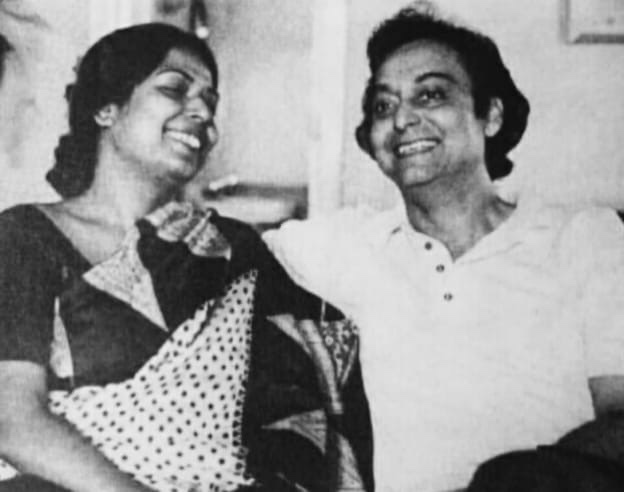
Soumitra and his wife Deepa. Photo provided by Soumitra Chatterjee

RS: So who are your favourite authors?

PB: I am eclectic in my choice. I read classics as well as bestsellers, plenty of them. My favourite authors are Tarashankar Bandopadhyay,  Bibhuti Bhushan, Manik Bandopadhyay, Jibanananda Das, Shakti Chattopadhyay,  Sunil Gangopadhyay, Charles Dickens, O Henry, Oscar Wilde, Maupassant, Shirshendu Mukhopadhyay, Samaresh Basu, John Grisham, Pablo Neruda, Gabriel García Marquez, Arundhati Roy, Agatha Christie, Akhtaruzzaman Elias, Humayun Ahmed, Jeffrey Archer, Khaled Husseini, Chitra Divakaruni Banerjee, Satyajit Ray, Sukumar Ray, Saradindu Bandopadhyay, Paolo Coelho, Gerald Durrell, Charlotte Bronte, Emily Bronte, Lewis Carroll… to name a few!

RS: Soumitra Da was a poet. He also translated plays — classics of world theatre — into Bengali. What was he most happy to do — act in movies? Write and direct plays? Or retire to the inner world of poetry?

PB: All three. I’ve never seen him sit idle or waste time. It depended on his mood — he loved doing all three. But I must add: theatre was, always, his first love. He was deeply influenced by Sisir Bhaduri (1889-1959), with whom he had started out. He directed plays for Pratikriti, a group that Ma had — and he directed plays for Abhinetri Sangha, set up by the actors of Tollygunge.

RS: Deepadi was an ace badminton player. Did she give up her own world to be Mrs Soumitra Chatterjee? 

PB: She gave up her career primarily for us. Bapi was at the peak of his career and was naturally very busy. Ma felt we needed to have at least one parent around, always. In retrospect, I realise it was a huge sacrifice. But I have to say, both my brother and I needed her. I think she realised that and did what most mothers do: she prioritized us over her career.

Ma had the biggest heart ever. She was more intelligent than the three of us put together. And she was non-judgmental about who she was reaching out to. So many sportswomen she helped, on her own. And I vividly remember this young Muslim boy in New Market who always carried her shopping to the car. One day Ma learnt that he had TB. She immediately brought him home and organised a room on the terrace for him to stay until he recovered. She didn’t hesitate because she had children, she didn’t seek the advice of doctors, she didn’t think twice because her husband was a star!

RS: Why did you choose to carry forward Soumitra Chatterjee’s legacy on stage rather than on screen? 

PB: Theatre kind of seeped into me. I used to watch Bapi – when he was idling, he would arrange the empty cigarette and matchboxes to design sets. I have been on stage ever since I could walk. It is my first love. I’m passionate about live performances, be it dance or theatre. Not that I didn’t get offers for films but I never actively pursued them. I married relatively early and had both my children by the time I was 26. Stage was always more accommodating and easier to manage. And till now the magic of the stage hasn’t worn off. I am still madly in love with the stage. Screen just didn’t happen… no particular reason, really.

RS: Soumitra Da was proud of his grandson’s screen presence. And he was extremely proud of the manner in which you handled your son’s unfortunate accident. Would you like to talk about it?

PB: Bapi had high hopes for Ronodeep. He felt Rono was a very sensitive actor perfectly suited for the screen. He was devastated by Rono’s accident. It was the most tragic thing to have happened in all our lives. But I have come to terms with it. I count my blessings — it could have been worse! Rono is with us — a bright and wonderful boy, sensitive and sweet, full of love and empathy. He still has a long way to go in terms of recovery and health but he’s getting there, one step at a time…

I have learned a lot from this phase of my life. I continue to learn every day. It has also shaped me, moulded me as a person. Bapi-Ma told me always to have grace even under pressure, to be always dignified. I have tried to follow them.

RS: Can you recount one cherished moment with your father?

PB: In May 2020, months before he passed away, during Covid, Bapi and I were just sitting and talking about various things. Suddenly he told me, “Mitil I have never said this to you before but I want you to know that I am very proud of the way you have conducted yourself during Bhaitu’s accident and every day since then. Your dignity and your grace has made me really happy. I’m so proud that you have turned out to be the person you are!”

All through my life I will cherish this one moment.

RS: In today’s world many daughters are taking up the responsibility of carrying forward the legacy of their fathers. What, in your opinion, has brought about this social change? Did Soumitra Chatterjee raise you to (consciously) fight patriarchy?

PB: I guess the world is waking up to the fact that what sons can do, daughters can do better! I really don’t know what exactly has brought this social change but I definitely welcome it. My daughter is a great source of strength for me. She is my best friend. My father had raised my brother, Sougata, and me as equals, maybe favouring me a tad more!

Bapi was always ahead of his times. He always told me, “The sky is the limit, you can do whatever you set your mind to.” But it was Ma who very consciously taught me to fight patriarchy. She was a champion for the girl child.

RS: Soumitra Da was never lured by the reach and fame of Bollywood? So, why did he direct Stree Ka Patra[5], the telefilm he made for the national television, in Hindi?

PB: Bapi believed that he could deliver best in his own mother tongue. Besides, he was not enamoured of the kind of films made in Bollywood at that time. He loved his life here, his theatre, his poetry, and co-editing Ekshan, the culture magazine that first published Satyajit Ray’s script. Going to Bollywood, he felt, would put a stop to all his literary and theatrical pursuits.

However, he got the offer to direct Stree Ka Patra for National Doordarshan, and it came with the clause that it had to be in Hindi. The other telefilm he directed, Mahasindhur Opar Theke [ From the Other side of the Ocean] was in Bengali 

RS: Many uncharitable people say that Soumitra Chatterjee wasted his talent by limiting himself to Bengali films and by indiscriminate selection of roles — because of his family responsibilities. Your response to this?

PB: Limiting himself to Bengali films was a conscious decision he made. And I have just elucidated the reasons. Yes he wanted to provide for his family, and he did so the only way he knew to — by acting. He never shied from saying that he was a professional actor. And if he wanted to take on the responsibilities who is anyone else to talk about it?

He could have abandoned his family like many others. He chose not to. His family, his life, his choices… that’s all I can say.

RS: You have grown up in close proximity with stars like Sharmila Tagore, Madhabi Mukherjee, Sandhya Roy, Tanuja, and directors like Tapan Sinha, Ajoy Kar, Tarun Majumdar, Rituparno Ghosh. Please share some memories/ anecdotes with us.

PB: The only name in the list who I have grown up in close proximity with is Tapan Sinha, whose birth centenary is being celebrated. He was a wonderful human being! While we were growing up we didn’t interact much with people from the film industry. We certainly met them but at parties, weddings, social events… 

My parents had a huge circle of friends. A doctor’s group. My mum’s friends. Poets like Shakti Kaku and Sunil Kaku. My dad’s friends like Nirmalya Acharya, the co-editor of Ekshan. Directors Ajit Lahiri, Ashutosh Mukherjee, Nripen Ganguly who was fondly called ‘Nyapa Da.’ Friends from theatre. His childhood friends. It was a vast cross section of people, so it was wonderful, happy and great fun growing up around so many amazing people.

RS: Gaachh [Tree], the documentary by Catherine Berger, focused only on his stage life. Abhijan[6][The Expedition] directed by renowned actor Parambrata Chatterjee, did not excite cineastes who have adored Soumitra Chatterjee, honoured with Dadasaheb Phalke for cinema, Sangeet Natak award for theatre, decorated with the Lotus award of Padma Bhushan and the French Order des Arts et des Lettres. Will you give us a biopic of Soumitra Chatterjee on stage?

PB: I am not in favour of a biopic for someone like Bapi. On the other hand, a stage production would be limiting. He was a multihued talent. It is difficult to capture so many facets of his personality. It is a daunting task to encompass every nuance, every shade of such an extraordinary life in a single film. A biopic should not be made if it does not do justice to the magnificence of the man.

.

[1] Ronodeb Bose, grandson of Soumitra Chatterjee, had a bike accident in 2017

[2] Jean Anouilh (1910-1987), Carnival of Thieves(1938)

[3] Bengali films in which Soumitra Chatterjee played the lead.

[4] Deepa Chatterjee, wife of Soumitra Chatterjee

[5] A pun in the heading. Stree is woman, Patra is vessel as well as a prospective groom. So, a Woman’s Vessel or Prospective Groom

[6] Soumitro Chatterjee played the lead in the 1962 Abhijan, directed by Satyajit Ray

.

Ratnottama Sengupta, formerly Arts Editor of  The Times of India, teaches mass communication and film appreciation, curates film festivals and art exhibitions, and translates and write books. She has been a member of CBFC, served on the National Film Awards jury and has herself won a National Award. 

.

PLEASE NOTE: ARTICLES CAN ONLY BE REPRODUCED IN OTHER SITES WITH DUE ACKNOWLEDGEMENT TO BORDERLESS JOURNAL

Click here to access the Borderless anthology, Monalisa No Longer Smiles

Click here to access Monalisa No Longer Smiles on Amazon International
Categories
Essay

Celebrating the novel… Where have all the Women Writers Gone?

G Venkatesh writes about a book from 1946. What is interesting is no women writers are featured in it despite their being a phrase which he quotes in his essay, ‘a stepdaughter of the Muses’…

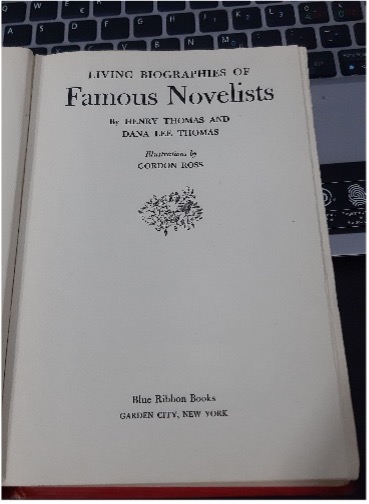
Photo graph by G Venkatesh

There is this book published in 1946 in New York, that I picked up at a Red Cross charity shop in Karlstad (Sweden) of late. A compilation of micro-biographies (make that ‘nano’ if you will) of 20 novelists (fiction-writers in other words) from Italy, Spain, France, England, Scotland, the USA, Russia and Ireland, who graced the world of literature in flesh  between the mid-14th and the mid-20th centuries, and will continue to do so, in spirit, forever.

Pillars of fertile imagination, seeded from the idea-realm
Visual by G Venkatesh

I venture in this article to present some gleanings from this little gem of a book, to enlighten, motivate, inspire, educate and rekindle interest in the classics of yore. Ralph Waldo Emerson wrote that all writing happens by the grace of God. We witness that in the lives of the twenty writers profiled in the book. Some had an inborn urge to write, some developed the penchant to do so as if the idea floated in from the idea-realm beyond the astral, and some others were blessed by the Divine to transmute their pain and suffering to the written word that has stood the test of time, and will continue to do so, into the distant future. Condemnation paved the way to commendation for some, while rejections emboldened others to transcend the limits of human judgement and rejoice in the sunshine of hard-earned glory.

At its perigee, the ‘novel’, as observed by Henry and Dana Lee Thomas, is an epitome of philosophy as applied to life. The Thomases ask readers to consider the life of every novelist profiled to be a magnum opus in itself – each adorned with facts stranger than fiction.

Boccaccio, Rabelais, Cervantes

This is an Italian-French-Spanish trio (encompassing the 14th to the early 17th century), and perhaps most of the readers may be familiar only with the third-named. Giovanni Boccaccio was a contemporary of Alighieri Dante (whose biography he wrote). A ‘friendly sinner’, he was a devotee of the here and now, while also being profoundly interested in the hereafter.’ Novelists, well and truly, leave behind accounts of their times, couched in fiction (and that, read alongwith factual history, helps us readers to visualise and understand better how things were in the past). The ‘poets’ in them, simultaneously dwell on and dream about how things can, must and will be in the future. Many of them refrain from including a semi-autobiographical element to their novels, and the Thomases have identified Francois Rabelais as being one such. To the Frenchman, all life was an anecdote with a bitter ending, a truth he based his limited fictional creations on.

Miguel de Cervantes, the Spaniard, is presented as a disappointed, shattered and disgusted man, who was chiefly motivated by his own trials, travails and tribulations to pen the famous Don Quixote. This knight who fought windmills, was perhaps what Cervantes thought himself to be – blessed with the good fortune to live in folly and die in wisdom.  

Defoe, Swift, Sterne

From the simple Quixote and the clumsy Sancho Panza to the resourceful Robinson Crusoe and his helpful Man Friday, characters created by Daniel Defoe in a novel eponymous with the protagonist. Defoe was a paradox of moral integrity and material ambition (if you can visualise one such blend), who by virtue of the fact that he donned the mantles of businessman, pedlar, politician, pamphleteer and spy (not necessarily in that order) in his life, could interpret mankind expertly in his fiction. A kind of ‘been-there, seen-that, done-that, can-write-about-all-with-authority’. Jonathan Swift, of Gulliver’s Travels fame, was gifted with a supreme intellect and a spiritual-religious leaning, but encumbered by physical weakness. God gives but also deprives at the same time, a mystery which humankind has not been able to solve. Fatherless when barely half-a-year old, he was verily a titan (like the character Gulliver he created) among pygmies (like the Lilliputians). He abhorred injustice and thought and prayed forever for the felicity of humankind. He lived to be 78, but contended on the basis of his experiences that the gift of a long life is bought at a very high price.

Laurence Sterne, the preacher-poet Yorkshireman, left behind several nuggets of wisdom in his novels and a couple of them can be cited hereunder:

“I laugh till I cry, and I cry till I laugh” (reminding one of the Yin and the Yang which feed into each other)

“Give me all the blessings of wisdom and religion if you will, but above all, let me be a man.”

Scott, Balzac, Dumas

Sir Walter Scott, while being a prodigy like Swift, also had to contend with physical disabilities like him.  He tided over them marvellously, prudently, gallantly and tirelessly, en route to a knighthood and immortality in the realm of English literature. Dreamy Honoré de Balzac, obdurate and uncompromising, believed that man’s destiny and purpose in life was to “rise from action through abstraction to sight” – a deed-word-thought ascent in other words. “Life lies within us (spiritual), and not without us (material)”, he averred. He never got the glory he deserved when he was alive, and his soul perhaps got the peace it richly merited when fame showed up posthumously.

Athos, Porthos, Aramis and D’Artagnan – characters from The Three Musketeers, a novel by Alexandre Dumas which presents the facts of 19th century France through the medium of fiction – were known to school-goers in the 1970s and 1980s, like yours sincerely. Dumas, as the Thomases have noted, met praise with a shrug and insults with a smile – stoically in other words. However, he had a penchant for sarcasm and trenchant wit which were unleashed whenever required. “I do not know how I produce my poems. Ask a plum tree how it produces plums,” is verily a testimony to his transatlantic contemporary Ralph Waldo Emerson’s “All writing happens by the grace of God.”

Hugo, Flaubert, Hawthorne

Two Frenchman and a New-Englander American comprise this trio. Viktor Marie Hugo, of Les Misérables fame, was born in the same year as Dumas, and was regarded widely as the ‘Head’ of the 19th century to Abraham Lincoln’s ‘Heart’. His crests of hard-won success coincided with the troughs of ill-deserved sorrow (he had to contend with the deaths of his wife and children). The Divine Will strengthened his mind, soul and fingers to move quill on paper, enabling the much-bereaved Frenchman to cope and conquer. “Sorrow,” he wrote, “is but a prelude to joy.” A stoic would however add, “and vice versa”. Quite like Sterne’s “I laugh till I cry, and I cry till I laugh”. Despite all that he had to endure; Hugo always believed in God and the purposes he lays out for human beings in their lives.

Hugo’s friend Gustave Flaubert considered the written word to be a living entity, with a voice, perfume, personality and soul. A concoction of realism and romanticism, if ever there was one, Flaubert was also a peculiar amalgamation of poet-cynic, artist-scientist and humankind’s comforter-despiser.  He ardently believed that though the soul is trapped within a mortal corpus on the terrestrial realm, it (which is the actual identity of a human being) lives in the idea-realm, and finds its rewards therein.

Hawthorne, on the other side of the ocean, was charmed by the sea and surf and sand in his childhood and youth, having spent a lot of time along the New England coast in north-western America. That led him to dwell on the mysteries of the human soul (which continue to be mysteries at the time of writing), while rebelling against the Puritanic influences that had engulfed the region. He was on an eternal quest, an intellectual and moral pathfinder in his own right, and a pioneering rebel with the pen and quill in his arsenal.  

Thackeray, Dickens, Dostoyevsky

William Makepeace Thackeray, readers will be interested to know, was born in Calcutta (now, Kolkata). A sentimental cynic who glimpsed the stupidity of life through the fog of sorrow, he believed that foolishness of the past is a pre-requisite to wisdom in the present and the future – in other words, simply put, we learn from our errors as we move on. ‘Gifted with a bright wit and an attractive humour’, in the words of Charlotte Bronte, he contended that literature was more a misfortune and less a profession. His cynicism helped him to grasp reality, and feel empowered in the process –“How very weak the very wise; how very small the truly great are.” Kind and wise humans often lack the power to change things for the better, while the powerful ones lack the conscience, will and goodness to want to do so.

Thackeray rivalled with Charles Dickens for fame and glory. Dickens, similar to Scott and Swift, had to contend with physical discomfort in his childhood and adolescence, in addition to a father who was not responsible with the money he earned. These experiences would later feed into the stories he churned out prolifically; semi-autobiographical some of them, while informing readers at the same time about the times that prevailed – “the best of times and the worst of times” (A Tale of Two Cities). His humble beginnings made him burn the midnight oil later in life, fuelled by the ambition to succeed, which he sustained all along. Quite like it was Hugo across the Channel, the troughs of torment annulled the acmes of accomplishment. Yet, he remained grateful to God and fellow-humans for the life he lived, and bade one and all a ‘respectful and affectionate farewell’, before ascending to the astral realm.

Reclusive Feodor Dostoyevsky, like Hawthorne in America, struggled to shake off a Puritan upbringing and sought fodder for his literature among the common man – the suffering proletariat who visited liquor shops to drown their sorrows in alcohol. Man, he believed, was responsible for his own salvation…and not God. He however did believe at times that God saved those whom men punished. But then, he also contradicted himself or seemed to do so, when he said that man is saved only because the Devil exists. But perhaps that was not a contradiction after all – God saves man from what he has to be saved from! The meaning of life, according to Dostoyevsky, was the brute-to-angel and the sinner-to-saint transformation of man; quite on the lines of Balzac’s action-abstraction-sight prescription.

NovelistLifespanSelected works
Giovanni Boccaccio1313-1375Filocolo, Filostrato, Teseide, Fiammetta, Amorosa Visione, Ameto, Decameron, Life of Dante
Francois Rabelais1495 – 1553Pantagruel, Gargantua
Miguel de Cervantes1547 – 1616Galatea, Don Quixote, Novelas Exemplares, Persiles y Sigismunda
Daniel Defoe1661-1731The True-Born Englishman, The Apparition of Mrs Veal, Robinson Crusoe, The Dumb Philosopher, Serious Reflections, Moll Flanders
Jonathan Swift1667 – 1745The Battle of the Books, The Tale of a Tub, Gulliver’s Travels Children of the Poor, Directions to Servants, Polite Conversation
Laurence Sterne1713-1768A political romance, Tristram Shandy, Sermons by Yorick, The Sentimental Journey
Sir Walter Scott1771 – 1832The Lady of the Last Minstrel, Ivanhoe, Kenilworth, The Lady of the Lake, Waverley, The Monastery
Honoré de Balzac1799 – 1850The Country Doctor, Eugenie Grandet, Jesus in Flanders, Droll Stories, Louis Lambert, Seraphita, A Daughter of Eve, The Peasants
Alexandre Dumas1802 – 1870The Three Musketeers, The Count of Monte Cristo, The Black Tulip, The Prussian Terror, The Forty-Five, Chicot the Jester, The Queen Margot
Victor Hugo1802 – 1885Les Misérables, The Toilers of the Sea, The History of a Crime, Legend of the Centuries, The Hunchback of Notre Dame, The Supreme Pity
Gustave Flaubert1821 – 1880Madame Bovary, The Sentimental Education, The Temptation of St Anthony, Bouvard and Pécuchet, Salambbô
Nathaniel Hawthorne1804 – 1864Twice Told Tales, The Blithedale Romance, The Scarlet Letter, Mosses from an Old Manse, The Marble Faun, Tanglewood Tales, The Snow Image
William Thackeray1811 – 1863The Great Hoggarty Diamond, Vanity Fair, The Book of Snobs, Henry Esmond, The Virginian, Lovel the Widower, The Newcomes
Charles Dickens1812 – 1870Pickwick Papers, Oliver Twist, Nicholas Nickleby, Barnaby Rudge, David Copperfield, A Tale of Two Cities, Great Expectations
Feodor Dostoyevsky1821 – 1881Crime and Punishment, Poor Folk, The Double, The Landlady, The Family Friend, The House of Death, The Gambler, The Idiot,
Leo Tolstoy1828 – 1910War and Peace, Anna Karenina, Childhood, The Cossacks, Two Hussars, Three Deaths, A Confession, Master and Man, Resurrection, What is Art
Guy de Maupassant1850 – 1893Une Vie, The Ball of Fat, Mademoiselle Fifi, The Necklace, Yvette, Our Heart, Bel-Ami, Pierre and Jean, A Piece of String
Emile Zola1840 – 1902Doctor Pascal, Therese Raquin, The Dram Shop, Nana, Germinal, The Earth. The Dream, Rome, Paris, Fertility, Work, Truth, Justice
Mark Twain1835 – 1910Huckleberry Finn, The Adventures of Tom Sawyer, Joan of Arc, A Connecticut Yankee, What is Man, The Prince and the Pauper
Thomas Hardy1840 – 1928A Pair of Blue Eyes, Under the Greenwood Tree, Far from the Madding Crowd, The Trumpet-Major, The Mayor of Casterbridge, Jude the Obscure, Tess of the D’Urbervilles
Table: The novelists profiled, and a list of their selected works

Tolstoy, Maupassant, Zola

Leo Tolstoy, also a Russian like Dostoyevsky, unlike Dickens, was not guided onward and forward by ambition. He believed in stooping to conquer and was motivated in his life’s journey by compassion. Orphaned when not yet a teenager, haunted by an inferiority complex pertaining to his ‘unprepossessing appearance’, and disgusted with organised religion (the Orthodoxy which prevailed in Russia), he discovered his purpose in Rousseau’s philosophy and in ridding the human heart of evil and helping it to live in peace, in communion with Nature. His dissent, rebellion and dissatisfaction with extravagance (of the nobility), bigotry (of the clergy) and tyranny (of the royalty), were the seeds, water and fertiliser for his contributions to Russian literature. Readers know that Mahatma Gandhi was inspired by the philosopher-prophet-penman Leo Tolstoy to set up the Tolstoy Farm in South Africa. Some nuggets which will serve as parts of vade mecums for readers:

“Death, blessed brother death, you are the final deliverance.”

“There are millions of human beings on earth who are suffering. Why do you think only of me?”  

Guy de Maupassant was one of those millions who suffered a lot. Reading about the tragic short life led by him, with constant physical and psychological afflictions which led to autoscopy in his 42nd year, and death in the 43rd, makes one sad. It also makes readers turn to his short stories – of which he is known to be a master – more eagerly. Flaubert and de Maupassant knew each other well, the former being a ‘guru’ guiding the latter on from time to time, along his literary journey.

Another Frenchman – Emile Zola – a contemporary of de Maupassant and Flaubert and a good friend of the painter Paul Cezanne, progressed through pitfalls and serendipitous godsends to profile the poor people of France, and ironically rise to richness thereby. A man who defended justice and spoke up against all forms of unfairness, Zola is known for standing up for the French army captain Alfred Dreyfus, a Jew who was wrongly (and knowingly so) accused of treason in 1894, and playing a key role in clearing the Jew’s name in 1906 (four years after Zola passed away). His last written words –“…to remake through truth a higher and happier humanity.”

Twain and Hardy

The man most readers know as Mark Twain, was born Samuel Clemens in America. Though it would not be right to compare and contrast the travails endured by the novelists profiled by Henry and Dana in this book, it can at least be said that a peep into Twain’s life tugs at your heartstrings and the vibrations linger on for a long time. Indeed, as a natural consequence, respect and admiration well up in the heart, for this novelist. He suffered an awful lot, but also learnt to laugh at his own agony as an ‘onlooker’ – the soul observing the pain of the body and the trauma of the mind it enlivens, from a distance, without being affected in any way. Like Hugo on the other side of the ocean, he endured what can be considered as possibly the greatest sorrow a man can face – burying/cremating his own children, one after another. Twain always supported the underdogs while voicing his disgust at the pompousness of the rich and powerful, in his own unique brand of sarcasm. The following words of his may sound cynical, but they are open to interpretation:

“Nothing exists but you. And you are but a homeless, vagrant, useless thought, wandering forlorn among the empty centuries.”

Without letting these words deter you, link them with the other sufferer Viktor Hugo’s “Nothing is as powerful as an idea whose time has come”, and soldier on.

The last of the twenty, Thomas Hardy, is yours sincerely’s favourite (I happen to read all his important works in my twenties, if I remember right). Hardy like his fellow-Britons Swift and Scott was born with a “frail body, strong mind and compassionate soul”. He was compassionate towards and appreciative of the forces and elements of Mother Nature – winds, clouds, bees, butterflies, squirrels, sheep etc., as pointed out by the Thomases. The manner in which he moulded his protagonists in his novels was catalysed by this compassion. Most of them are compassionate themselves, and evoke compassion in the hearts of readers, quite easily. Hardy wanted to teach his fellow-humans how to “breast the misery they were born to”, by using his fictional protagonists as instruments. His life was an exercise in “subduing the hardest fate” and “persistence through repeated discomfitures”. As it often happens with true geniuses, he was much ahead of his times, and the glory that illumined his soul in heaven posthumously, more than compensated for the disappointments which had to be endured when it was encased in his mortal corpus.

Not the last word by any means

Serendipity, it must have been, which made me stride into the Red Cross charity shop in Karlstad in June, wherefrom I purchased this 280-page treasure. To quote Longfellow (who incidentally was a college-mate of Hawthorne’s),

“Lives of great men all remind us/We can make our lives sublime/And departing leave behind us/Footprints on the sands of time.”

The 20 authors profiled in this book represent a huge family of writers who converted fiction from ‘a stepdaughter of the Muses’ to an ‘epitome of the  philosophy of life’, except that there were no ‘daughters or stepdaughters of men’ listed among the novelists in this volume.

.

G Venkatesh (50) is a Chennai-born, Mumbai-bred ‘global citizen’ who currently serves as Associate Professor at Karlstad University in Sweden. He has published 4 volumes of poetry and 4 e-textbooks, inter alia. 

.

PLEASE NOTE: ARTICLES CAN ONLY BE REPRODUCED IN OTHER SITES WITH DUE ACKNOWLEDGEMENT TO BORDERLESS JOURNAL

Click here to access the Borderless anthology, Monalisa No Longer Smiles

Click here to access Monalisa No Longer Smiles on Kindle Amazon International