Ghee-laden, sugar-loaded, deep-fried, I have been warned that Indian sweets are naughty, even dangerous, and that I shouldn’t eat them at all, or if I do insist on eating them, then they must only be sampled in moderation, and even when I eat them in moderation I ought to visit a reliable doctor every week for a full health check, and even if I do that, I must bear in mind that men of my age die of heart attacks even when they don’t eat sweets of this nature. Indian sweets might look harmless on the plate but they are like cluster bombs, detonating inside the body and speeding a man into the next world.
But I climb mountains and mountaineering has been a huge part of my life, and when we climbed mountains back in Britain we took with us large amounts of a substance called Kendal Mint Cake. I need to talk about this food before I am able to make the point that I intend to make about Indian sweets. If you bear with me, I won’t be too long. Kendal Mint Cake is a sugar-based confection and is flavoured with peppermint oil. In fact, sugar, water and peppermint oil are the only ingredients, but they are prepared in a special way which remains a secret. I don’t think there’s much that’s very secretive about blending sugar, water and peppermint oil, but who am I to say that?
The ingredients are mixed together and boiled in copper pans while being continually stirred. If this stirring stops, the mixture becomes translucent and it will be ruined, because opacity is the desired feature of Kendal Mint Cake. How can a translucent sugar-rush product be taken seriously? We see the light after a lifetime of contemplation. We see a solid lump of minty sugar when we plan to ascend to the summit of some peak or other.
Kendal Mint Cake has a formidable and perhaps peerless reputation as the energy-providing snack of choice for the intrepid explorer. It played an essential role in the Trans-Antarctic Expedition of 1914–1917, led by Ernest Shackleton, one of the fittest and toughest men who ever lived. It aided Hillary and Tenzing in the first successful attempt on Everest in 1953 and other members of the team wrote, “It was easily the most popular item on our high altitude ration” and “our only criticism was that we did not have enough of it”. High praise indeed, with an emphasis on the high. Bonington also climbed Everest in 1975 using Kendal Mint Cake, as well as ropes and crampons.
I think we can safely declare that Kendal Mint Cake is heroic. Therefore, it seems to be that Indian sweets can also be regarded as mighty, valiant, doughty, gallant, fearless and daring. And when we consider that India has mountains far higher than those in Britain, shouldn’t we tend to the conclusion that the sweets of India are themselves a bracing landscape when seen on the counter of a shop that sells them? We hear a lot of talk about sugar highs and lows, but viewed as a backdrop, rather than as the progress of a graph line through time, highs and lows form mountain ranges. Indian sweets recreate on the inside the geography of the northern icy reaches of the country.
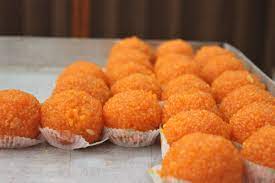
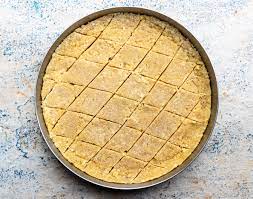
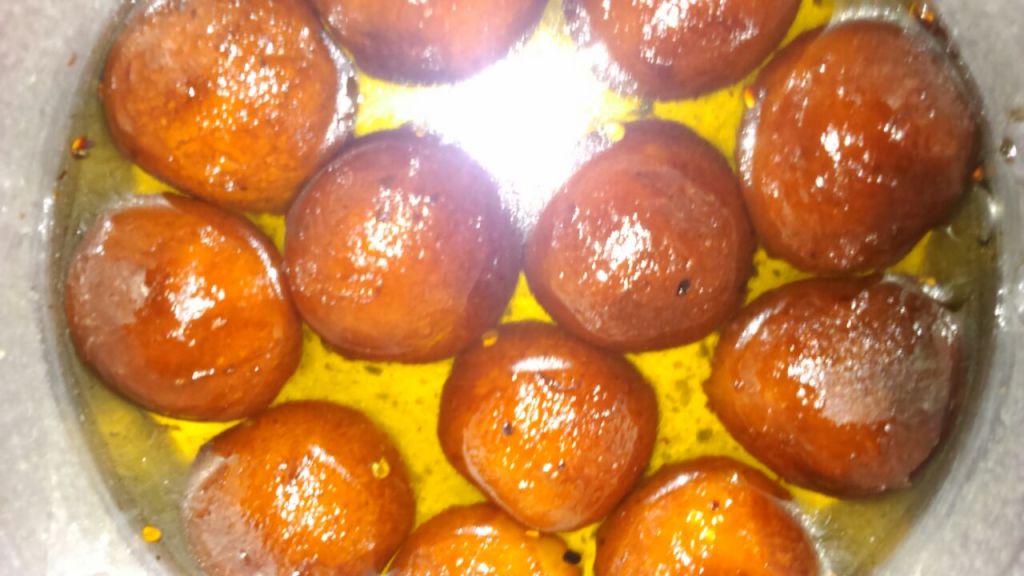
It is high time (more wordplay) that mountaineers and other explorers start carrying Indian sweets on their expeditions. Kendal Mint Cake has proved itself in the lonely heights, and now gulab jamuns and ladoos, and boxes of sandesh, modak, barfi and bowls of payasam should be given a fair chance, to say nothing of kulfi, halwa, gujiya, and my favourite, Mysore pak. Need I list them all? It is not just a question of providing energy to the adventurer, energy that can be expended a very short time after eating the sweets, as opposed to eating healthy foods which provide energy slowly and in trickles. No, there are many other good reasons for adding a broad selection of sweets to the supplies that are to be taken up slopes of staggering steepness into the very clouds.
First of all, sweets are light. They are lighter than so-called healthy foods. I pity the mountaineer who hefts sacks of cabbages and carrots to the top of harsh and fearsome Annapurna or Dhaulagiri. Sweets are considerably more compact than vegetables, especially the unpleasant-tasting vegetables. Sweets can remain fresh for longer and that’s another advantage. You don’t have to eat them all in the foothills but can save some for the ascent.
Sweets are rewards too. The fellow who promises himself a ladoo or two when he finally attains a certain tricky ledge is more likely to be motivated to strive for that ledge than the man who tempts himself with a turnip or beetroot. Who would want to munch on a root vegetable during a blizzard? Not me. The taking of sweets on expeditions also provides work for sweet-makers. It is both economically wise and aesthetically sensible to carry sweets together with ropes and pitons and carabiners and all the other accoutrements of a sober climb if one happens to be a serious climber. Hunger pangs are one thing at sea level, but at altitude they tend to be much worse.
There is another consideration that hasn’t yet been touched on. There is the perennial risk for the mountaineer who attempts the Himalayas that he will meet and be abducted by Yetis. I won’t overstate the risk. Most of the climbers of that range have returned without being abducted. But is it really responsible to poke one’s nose into the eternal snows without something to mollify the beast? There is the question of simply organic respect. The explorer who suddenly encounters a Yeti and emits a shriek has insulted his potential host. The explorer who opens a box of sweets and offers one, or several, or many, to the hairy brute will surely make a good impression. I can almost see them now, in my mind’s eye, man and monster sitting on a crag, sharing gulab jamuns.
Rhys Hughes has lived in many countries. He graduated as an engineer but currently works as a tutor of mathematics. Since his first book was published in 1995 he has had fifty other books published and his work has been translated into ten languages.
.
PLEASE NOTE: ARTICLES CAN ONLY BE REPRODUCED IN OTHER SITES WITH DUE ACKNOWLEDGEMENT TO BORDERLESS JOURNAL
I am from Wales but now I live in India. I am therefore in a very good position to note any differences between life in the two different countries. The first of these differences concerns food. Indian food is the main kind of food in public eating places in both locations. But the food itself isn’t quite the same. Indian food in India is Indian by default. In Wales no one knows whose fault it is. I fell into a curry in Wales once. I slipped on discarded laddoo peel (we peel laddoos over there because we think they grow on trees) and into the pot I went. It was a good curry and might be considered authentic. After I fell into it, ‘in authentic’ was the correct term for it. I wiped myself clean with a large naan bread. Later I wore the naan bread as a cloak. Waste not, want not.
So much for food. I am writing this short essay at the end of November. India is especially different from Wales at this time of year. Here I am playing badminton in shorts and a t-shirt. Back in Wales it is so cold that the sunbeams have frozen solid and I would be hanging my washing on one of the horizontal rays. In the afternoon, here in India, I will probably read a book of poetry under a banyan tree while drinking mosambi juice and listening to sitar music. But in Wales, I would be snapping off that frozen sunbeam and using it as a long lance while riding my yeti[1] over the misty mountains.
Traffic is another difference. In India the roads are choked with cars, autos, tuk-tuks (yes, I know that autos and tuk-tuks are the same thing but I need more wordage in this essay), trucks, buses, bicycles, wheelbarrows and cows. Wales doesn’t really have roads and the only traffic consists of crows. A crow perched on the back of a cow would make a perfect official emblem for a Welsh-Indian Friendship Association. If there are no roads in Wales, how do we get about? It is a pertinent question. We jump, is the answer. This not only enables us to reach our destinations but keeps us warm in winter.
In India there are monsoons but in Wales they are never soon, they are here already. The only time it stops raining in Wales is when the clouds go on strike for more pay. Lightning also goes on strike. There are puddles everywhere, even on the surfaces of lakes and ponds. Because we jump everywhere, there is a lot of splashing in Wales. This splashing puts most of the moisture back into the air where it forms clouds and perpetuates the cycle. I once perpetuated a cycle. It was a bicycle originally but I sent it away to get an education and it came back as a unicycle. I connected it to a motor powered by a rainfall gauge. Off it went on an endless journey around Wales. I would never attempt something like that in India. So there’s another big difference.
India is actually a very advanced country in terms of technology. Based in Bangalore, I am able to order anything I like with an app on my mobile phone. If I want food or drink or a bicycle, I just have to tap a few keys and a delivery guy will turn up with the ordered stuff. I once ordered a delivery guy using one of these apps and a different delivery guy turned up carrying the first delivery guy over his shoulder. But then I decided I didn’t really need a delivery guy so I sent him back and obtained a full refund.
It’s not like that in Wales. We only acquired mobile phones very recently in history and they are of a decidedly primitive sort. We started with parrots that one keeps in a pocket and speaks the messages to before releasing them to land on the shoulders of the recipients, where they recite the messages. This meant the pockets of our trousers had to be enlarged but we felt it was worth the cost. The parrots didn’t like flying through the endless rain and the messages usually went astray. So we progressed to a more advanced model, which consisted of riders on bicycles holding tin cans connected by string. You can’t order food on our mobile phones or even new trousers.
Wales is behind the times in other ways too, in fact in all ways. Wales is so belated in every respect that when the end of the world finally takes place, the country will continue for a few more years as if nothing has happened. I suspect that very slow processes, such as continental drift, evolved in Wales. I suppose that even evolution evolved in Wales, considering how slow it is and how long it takes a dinosaur to change into a chicken. I can change into a chicken with a great deal more efficiency, but I prefer pretending to be a gorilla or a chimp. It’s a very relaxing thing to do. Why not try?
Also in India you have holy men, but in Wales we only have holy socks. A holy man can open himself to the secrets of the universe. A holy sock is open to the weather, which is generally wet, and not much else. Holy men can levitate if they are sufficiently pure in spirit, or so I have been told. I once saw a flying sock, but it had been lobbed at me by a neighbour and wasn’t pure at all. That’s not the only thing I have seen rushing through the atmosphere in Wales. Parrots with sad expressions, of course, but also gloves. Why this should be so was a mystery for ages but recently the enigma was solved by an enigma machine and the answer is that “glove is in the air, everywhere I look around”. Or perhaps it is just the wind. Yes, I think it’s the wind.
The Enigma machine was used in the early- to mid-20th century, especially in WWII, for commercial, diplomatic, and military communications. Courtesy: Creative Commons
An enigma machine, incidentally, is a device invented in Wales that looks like an abacus, but it has small onions on wires instead of beads. Crows perch on the wires and peck the onions and move them into different positions, which gives the answer to any question. But the answer is cryptic and must be studied by a druid, who will interpret it. Druids are common in Wales. They aren’t holy men, strictly speaking, but are highly respected because they wear intact socks. They also wear cloaks made from naan breads but if you ask them, they insist they are made from wool and cobwebs.
You are probably beginning to ask yourself, is this a serious essay? And at this point you might be harbouring doubts that it is. There are many harbours in Wales, which has a convoluted coastline, but not many in the interior of India. That’s another difference. I have already mentioned laddoos and the fact that we peel them (and I mentioned it in brackets) but we also peel bells. I don’t think bells are ever peeled in India. They are rung instead. The peel of Welsh bells is used to make the tall hats that old women wear, conventionally on their heads, that you might have seen in vintage photographs. Bell peel is more enduring than satin or any other kind of fabric. It means that every old woman always knows what the time is when their hat bongs.
India is full of palaces. Not long ago, I visited Mysore Palace and found it truly impressive. In Wales we have nothing quite like that, but I often mention Mysore Feet after all the jumping I have to do to get anywhere. And now one final difference before I go. In India, the essays that writers write are generally detailed, comprehensive and lengthy. In Wales they often end abruptly in the middle with three dots, as if the writer was eaten by a yeti unexpectedly… but not this one. No yeti. Not yet anyway.
[1] The Welsh yeti, Abominablis Boyo, is only distantly related to the Himalayan species.
.
Rhys Hughes has lived in many countries. He graduated as an engineer but currently works as a tutor of mathematics. Since his first book was published in 1995 he has had fifty other books published and his work has been translated into ten languages.
.
PLEASE NOTE: ARTICLES CAN ONLY BE REPRODUCED IN OTHER SITES WITH DUE ACKNOWLEDGEMENT TO BORDERLESS JOURNAL
Because Indian food is the best in the world, as everyone knows, a scientist who worked for an educational institute on the outskirts of Bangalore once tried to devise a method of ensuring there was more of it. The more the better, was his motto. His attempts to construct a machine that would multiply chapatis, vadas, dosas, idlis and bowls of curry failed, for it turned out to be impossible to create new matter from nothing — thanks to the physical laws of the universe. But this scientist wasn’t a man to be so easily discouraged. Where there’s a will there’s a way, was his other motto. He had two mottos, just as he had two arms, two legs, two eyes and a pair of spectacles on his nose.
He thought of a way he could get around the particular law of physics that had sabotaged his first plan. Instead of multiplying the food in order to increase the amount available, why not shrink the eaters instead? A man or woman the size of a thumb would be confronted with chapatis that were like islands, vadas like boulders, bowls of curry like the craters of active volcanoes. Yes, that was the best solution. He got to work on it right away and he even stayed late in his makeshift laboratory at the institute and ignored all phone calls from his parents, who wanted to know when he was going to marry a nice girl, or failing that, any girl at all. He was wedded to his experiments.
At last, he chanced on a viable method of shrinking people to a specific size. He celebrated by going home and sleeping for three days. When he awoke, a wide smile on his face, he knew that finding volunteers would be fairly easy. He placed an advertisement in a local newspaper, and it wasn’t long before people began contacting him. He would pay them a small honorarium for taking part in the trial run and they would be allowed to eat as much food as they wanted. So many applicants contacted him that he was overwhelmed, and he had to declare that the offer was over. No more volunteers were required. He had two suitable candidates and wanted to use them immediately.
Pawan Kumar and Shruti Patil were both at loose ends, like pieces of string that knew knot what they had let themselves in for. That’s a pun, but neither one of them cared for wordplay. Pawan was an auto driver and Shruti worked as a maid in a gated community. Neither were gluttons but it must be admitted that they hadn’t had a notable feast for a long time. They jumped at the opportunity that the scientist offered. And in case you are wondering why this scientist has remained nameless so far, it’s because after what happened he preferred to stay anonymous for all time, and we must respect that.
Pawan had found a copy of the newspaper left by a passenger on the back seat of his auto, and Shruti had found one stuffed into the bin that she took out of the apartment she was cleaning. Both had paused for less than one minute in order to read the advertisement. This was a happy chance, if chance can ever be said to be truly happy and isn’t faking it, and then and there they had decided to plunge headlong into this new adventure. They were perfect volunteers, in other words, without a twinge of anxiety between them.
The scientist said, “Are you sure?”
They both nodded in agreement, bemused that he should seem more nervous than they were. All they were risking was their existence, but he was risking his entire career, and success in this unfortunate world is often held to be more important than life itself. He continued, “There might be complications, but I don’t think it is likely. I just want you to be aware.”
They were aware, fully so, and he ought to worry less.
“So be it,” he said dramatically.
It’s still a trade secret as to how he shrank them from ordinary sized people to miniature versions of themselves, so I am unable to describe the machine he used and the green rays it beamed on them from a series of crystal lenses all of which were carved into different shapes that were offset polyhedra, and even the copper coils and capacitors and diodes as big as cucumbers must be passed over in discreet silence, nor can I say how the whole contraption was powered by an array of solar cells on the institute’s roof.
Pawan and Shruti found themselves diminishing rapidly but that’s not how it seemed from their perspective. It appeared to them that the outside world was expanding, rushing to inflate itself, and the effect was so startling and alarming that they clung to each other for comfort, despite the fact they hardly knew each other, and their parents didn’t know each other either. This embrace also helped them to keep their balance as they rushed down the scale until they were almost exactly the size of the scientist’s thumbs.
The scientist spoke and his voice was so deafening that it boomed like the thunderclaps that sometimes echo from the crowded buildings of Bangalore and rumble down the streets before fading. They understood none of his words and it was a minute before they could gather their wits to act on their own initiative. He had simply said, “Please begin eating.”
He had picked them up and was lowering them on a long table that groaned with the amount of food it held. He was careful not to squeeze them too tightly. Then he released them, and they wandered in utter amazement among the plates, bowls, dishes and banana leaves, all heaped with delicious foodstuffs. The idea that they should devour this landscape seemed as absurd to them as any resident of Mysore supposing he can munch his way through the Amba Vilas Palace. It was too overwhelming, far too miraculous.
The scientist now clapped his hands impatiently. “Come, come, tuck in, I don’t have all day. Let’s see what happens!”
But his voice was still too low in pitch for their tiny ears to hear anything more than an incomprehensible booming. That was of no importance because the mission that had been assigned to them was plain. They had to eat as much as they liked in the time available to them.
It never occurred to Pawan or Shruti to ask whether the miniaturisation was permanent, and in fact even the scientist didn’t know if the effects would wear off naturally, or if he might find it necessary to try reversing the polarity of his machine in the hope it would restore them to their former size. But they had full faith in his competence and began nibbling at tasty objects that were in their vicinity. They were only a little cautious.
Soon they grew confident, then became joyous. They bounded between dishes and plates, climbed mounds of sweet and savoury foods, waded through curries, cavorted among the vegetables.
In the meantime, a reporter from the newspaper was on his way to the institute on the outskirts of Bangalore to find out why this scientist needed the volunteers he had asked for. The reporter smelled a story in the making. When he entered the building, after showing his press credentials, and approached the laboratory, he smelled something beyond a story. It was a banquet! He rapped on the door with his knuckles and cried: “Good afternoon, sir.”
To which the scientist replied, “Go away! You are disturbing the future of the human race. The door is locked.”
“I merely wish to interview your volunteers.”
“They are far too small to answer your questions. You must depart now. I will have you ejected from the premises if you refuse to leave of your own free will. The volunteers can’t understand your words, no matter what language you speak. They are cavorting on the table.”
“How so? You mean that they are monkeys?”
The scientist cursed at this.
The reporter struggled to see anything coherent through the frosted glass of the door. All he could make out was the shape of the banqueting table, which at this distance was like an operating table, and parallel rows of foodstuffs, which to him looked like an array of gadgets. The scientist stood with a spoon ready to serve rice onto plates and to the reporter it seemed he was clutching a surgical instrument that could probe brains.
“Is he brainwashing monkeys? Turning them into robots or assassins! I will write an article about this scandal.”
And he dashed out of the institute building as fast as he could run. During this rumpus, Pawan and Shruti had gained even more confidence. They started to eat with gusto and passed from dish to dish like explorers among the ruins of an ancient civilisation, taking morsels from every alluring display. Most of this food was from Karnataka but not all.
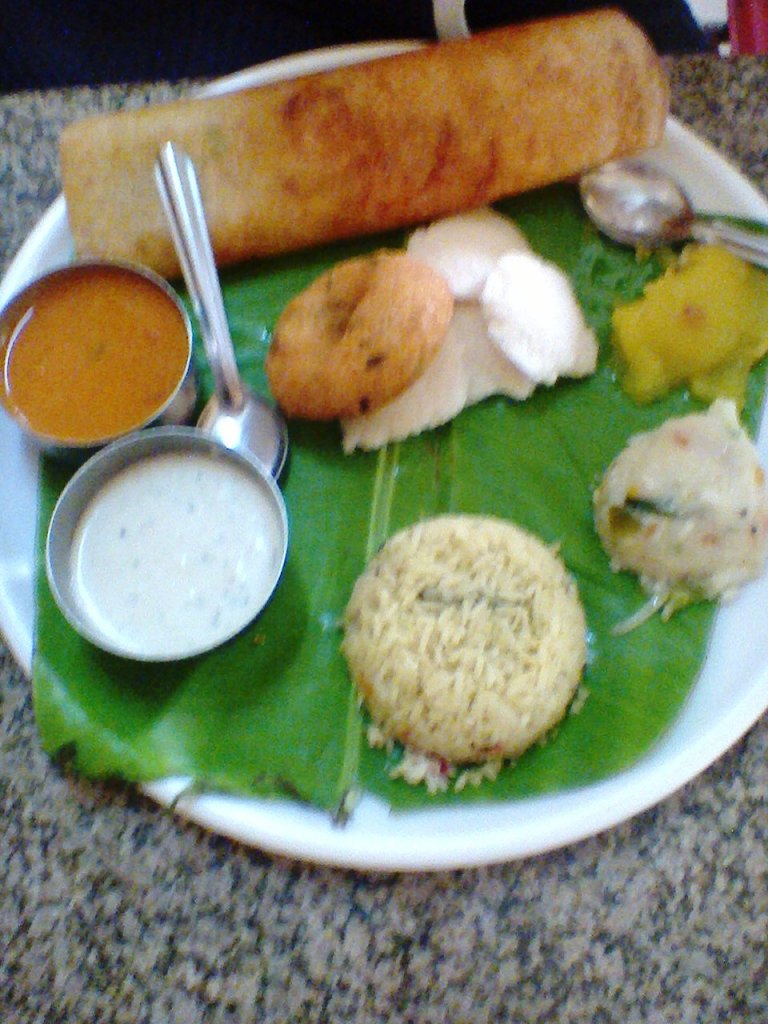
They chewed and swallowed bisi bele bhath, maddur vada, Dharwad peda, akki roti, saagu, upma, ladoos, three variants of idli, namely thatte idli, rava idli and Muday idli, churumuri and many other typical foods. They were soon full, but they continued eating, more on aesthetic grounds than from physical need. It was like a chain reaction. They would keep going until something exploded and that something would be their bellies.
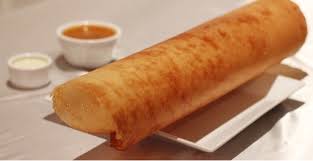
But now something strange happened, and the simple adventure became a much more complex and tricky exploit. Pawan found a paper dosa, a very long and crispy example, and it had been rolled into a tunnel and he peered into the mouth of the tunnel and he was baffled.
“The landscape on the other side of the tunnel looks different,” he said to Shruti with a frown. “Come and see.”
She did so and she was no less astonished.
“There’s a garden there.”
“Yes, there is, and it makes no sense.”
A dosa with a tunnel. Courtesy: Creative Commons
They exchanged meaningful glances, but the exact meaning was unclear to both of them. Nonetheless they tingled with anticipation and Pawan gave into temptation and suggested they walk together through the dosa tunnel in order to see what the far side might actually be like.
Have you ever walked through a dosa yourself? It is surely an odd feeling. They stumbled on the batter, which yielded too readily to their feet, cracking a piece off here and there, but soon enough they emerged from the exit. And what they saw was remarkable. They were no longer on a table in a laboratory in an institute on the outskirts of Bangalore.
Pawan and Shruti were unworldly people and had never heard of the myth of the Garden of Eden, but that’s what they found on the other side of the magic dosa. There are some special points in our world that are portals to other worlds and if you step through them, you will end up in that new dimension. They saw that the garden was full of trees, but the trees had gulab jamuns hanging from the branches instead of fruits. Gulab jamun trees! Was that even possible? Clearly, yes it was, here in this incredible place.
Gulab Jamuns. Courtesy: Creative Commons
As they strolled deeper into the garden, enchanted by the sights, they took slightly diverging paths and ended up alone. Shruti stopped by a tree and despite the fact she was full, she reached up to pluck a gulab jamun that glistened most invitingly just above her head. And that’s when the snake appeared. It slithered down from the top of the tree and said:
“You are allowed to eat the sweets from any tree in the garden with the one exception of this tree, which is the tree of knowledge. But I think you should be a rebel and eat it anyway. Why not?”
The snake had the voice and face of the scientist.
Shruti pouted at him.
“Because that would be greedy,” she said.
“Don’t be so timid!”
“Knowledge is overrated. You have plenty of knowledge and what has it done for you? Turned you into a snake.”
“Don’t say that. I am an intellectual benefactor.”
“You eat it then.”
And she held out the gulab jamun for him.
He hissed and swayed in annoyance, his forked tongue flicking, but at that very moment Pawan came over to see what the fuss was about, and he shook his fist at the snake and warned him: “I am an auto driver. I often have passengers like you. I will throw you out of the garden if you don’t behave.”
The snake continued hissing angrily but it slid away and they still don’t know where it went because they have never seen it again. Meanwhile, the scientist mysteriously disappeared from the laboratory and the only theory that explained his vanishing was that he had turned the rays of his own machine on himself and shrunk down to a dot and then to an atom.
But why would he do that? Nothing made sense any longer. Pawan and his wife, Shruti, still live in the garden beyond the dosa, and because all the food in the laboratory has been taken away, there is no way for them to return to the real world. They don’t care about that. They are satisfied where they are. They keep the gulab jamun of knowledge safe and maybe one day they will take bites from it. But they are in no rush to do so.
The reporter wrote his story about monkey robots and assassins, but it was never published because his editor thought he had gone mad. He was told to take a week off work and go on holiday. He went but never returned. Searching for him proved futile but rumours persisted of a monkey on the coast who liked to read the newspaper as if he understood the words. Probably some sort of coincidence. The world is stuffed full of them.
.
Rhys Hughes has lived in many countries. He graduated as an engineer but currently works as a tutor of mathematics. Since his first book was published in 1995 he has had fifty other books published and his work has been translated into ten languages.
.
PLEASE NOTE: ARTICLES CAN ONLY BE REPRODUCED IN OTHER SITES WITH DUE ACKNOWLEDGEMENT TO BORDERLESS JOURNAL




 Borderless