Categories
Review

“…in order to hear the Earth, we must first learn to love it…”: Amitav Ghosh

Book Review by Somdatta Mandal

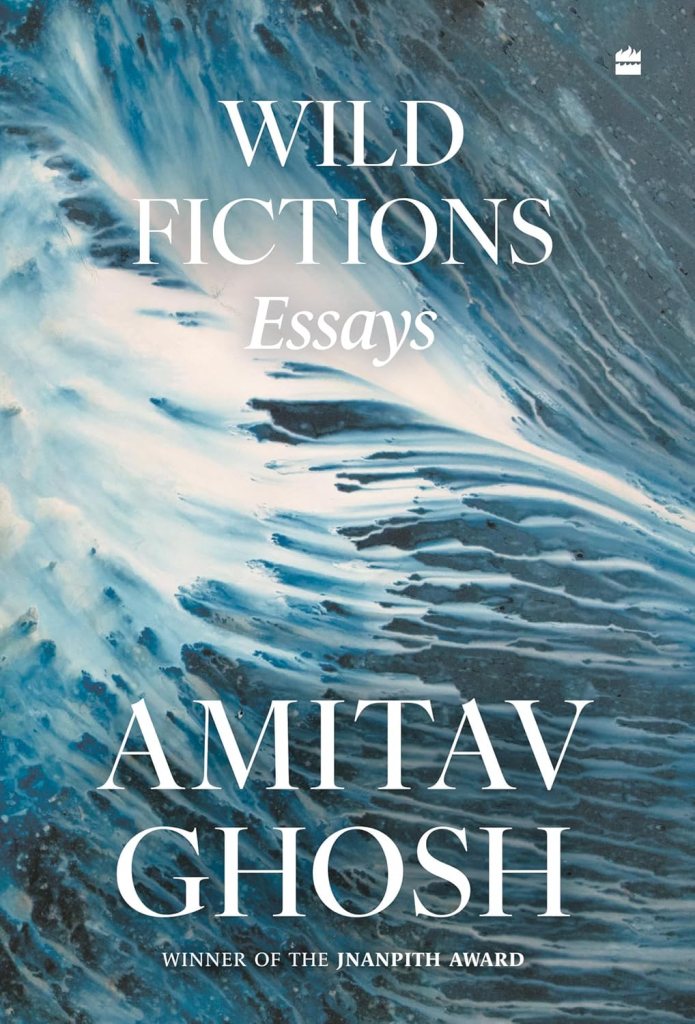
Title: Wild Fictions: Essays

Author: Amitav Ghosh

Publisher: HarperCollins (Fourth Estate)

How can a 470-page long book turn into a page-turner when it is neither a historical novel nor a whodunit thriller that compels the reader to go on reading as quickly as he/she can? That too when it is a motley collection of twenty-six essays written on different occasions and on different topics for the last twenty-five years. The answer is of course Amitav Ghosh who can literally mesmerise his readers with his multi-faceted interests and subjects ranging from literature and language, climate change and the environment, human lives, travels, and discoveries. Divided into six broad sections, Ghosh clearly mentions in the Introduction that the pieces in this collection are about a wide variety of subjects, yet there is one thread that runs through most of them: of bearing witness to a rupture in time, of chronicling the passing of an era that began 300 years ago, in the eighteenth century. It was a time when the West tightened its grip over most of the world, culminating ultimately in the emergence of the US as the planet’s sole superpower and the profound shocks that began in 2001.

A subject very close to his heart and that is reflected in all the books that he has been writing over the last decade or more, the six essays of the first section are on “Climate Change and Environment.” Ghosh writes about different aspects of migration (both in the sub-continent and in Europe), about the storm in the Bay of Bengal, cyclones, the tsunami affecting the Andaman and Nicobar Islands, and about Ternate, the spice island in Indonesia. According to him, by knowing about anthropogenic greenhouse emissions and their role in intensifying climate disasters, it is no longer possible to cling to the fiction of there being a strict division between the natural and the political. Climate change and migration are, in fact, two cognate aspects of the same thing, in that both are effects of the ever-increasing growth and acceleration of processes of production, consumption and circulation.

According to Ghosh, each of the six essays in the second section entitled “Witnesses” grew out of the research he undertook for his four historical novels, The Glass Palace, and the Ibis Trilogy. All the essays in it “are attempts to account, in one way or another, for the recurrent absences and silences that are so marked a feature of India’s colonial history”. While looking for accounts written by Indian military personnel during the First World War, Ghosh came across two truly amazing books, both written in Bengali, on which three pieces in this section are based. The first of these books is Mokshada Devi’s Kalyan-Pradeep (‘Kalyan’s Lamp’; 1928), an extended commentary on the letters of her grandson, Captain Kalyan Mukherji, who was a doctor in the Indian Medical Service. The second, Abhi Le Baghdad (‘On to Baghdad’), is by Sisir Sarbadhikari, who was a member of the Bengal Ambulance Corps, and is based on his wartime journal. Both Mukherji and Sarbadhikari served in the Mesopotamian campaign of 1915-16; they were both taken captive when the British forces surrendered to the Turkish Army in 1916 after enduring a five-month siege in the town of Kut-al-Amara – the greatest battlefield defeat suffered by the British empire in more than a century. He also writes about how these two prisoners of war witnessed the Armenian genocide.

Regarding the exodus from Burma, Ghosh narrates the plight of one Bengali doctor, Dr. Shanti Brata Ghosh from whose diary (written in English) we are given incidents of events that are a striking contrast to British accounts of the Long March. What the doctor remembered most clearly were his conflicts with his white colleagues and his diary represents a personal assertion of the freedom that his nation’s hard-won independence had bestowed upon him.

Section Four entitled “Narratives” consists of three essays. Speaking about the etymology of the word ‘banyan’, and a short personal anecdote about 11 September 2001, we come to the essay from which the title of this collection – Wild Fictions – is taken. It shows us how the policies and administrative actions have divided landscapes between the ‘natural’ and the ‘social.’ Discussing several environmental issues related to the manner in which over many decades there has been a kind of ethnic cleansing of India’s forests and how the costs of protecting nature have been thrust upon some of the poorest people in the country, while the rewards have been reaped by certain segments of the urban middle class, Ghosh warns us why the exclusivist approach to conservation must be rethought. Before environmental catastrophe happens, we have to find some middle way, one in which the people of the forest are regarded not as enemies but as partners. The idea of an ‘untouched’ forest is none other than a wild fiction.

As mentioned in the beginning, Ghosh’s intellectual curiosity ranges from exploring themes of history, culture, colonialism, climate change and the interconnectedness of human and natural worlds and the readers will get a sample of these different topics in this rich collection. Over the years, we had read some of the essays in journals like Outlook, The New Yorker, The New York Times, The Hindu, The Economic and Political Weekly, The Massachusetts Review, Conde Nast Traveller and so on, and some of the articles have been the product of his detailed research before he commenced writing a novel. The five essays in the penultimate section titled “Conversations” begins with a long correspondence that Ghosh had with Dipesh Chakraborty via email after Provincilaizing Europe was published in 2000. The two never met personally as Chakraborty was in Australia at that time, but the exchanges between these two scholars on such wide-ranging issues is surely a reader’s delight. The pieces on Shashi Tharoor’s An Era of Darkness and Priya Satia’s Time’s Monster which were written as reviews also form parts of ongoing dialogue. As Ghosh states, Sattia’s work “has given me new ways of understanding the role that ideas like ‘progress’ have played in the gestation of this time of monsters”. In ‘Storytelling and the Spectrum of the Past’, we are told about the historians versus the novelists view of seeing and documenting themes.

The final and sixth section comprises of three pieces that were originally conceived as blogposts or presentations, accompanied by a succession of images – “the texts that accompany my presentations are scripts for performances rather than essays as such”. In the first one, Ghosh gives us new insights from his diary notes (the Geniza documents) about how he chose to study social anthropology and how In an Antique Land was made—about the Muslim predominance in the Arab village where he stayed and how he evaded the attempt at conversion. In a lecture he delivered at Indian Institute of Technology, Kharagpur, Ghosh asks us to think back for a moment to the intellectual and historical context that led to the foundation of such institutions as the IITs, the IIMs and the outstanding medical institutions of contemporary India. He tells us how we cannot depend on machines alone to provide the solution to our social problems and talks about mercenaries, prisons, the hegemony of the Anglo-American power and how the empires kept close control over rights to knowledge. One of the great regrets of Ghosh’s life was that he never met A.K.Ramanujan and in the concluding essay of this section, he tells us how he considered Ramanujan to be “one of the foremost writers and intellectuals of the twentieth century and how one of the most important aspects of his work is the context from which it emerged.

In the introduction to this collection Ghosh wrote that we were now in a time between the ending of one epoch and the birth of another – ‘a time of monsters’, in the words of Antonio Gramsci. In the Afterword he mentions how the strange thing about this interstitial era is that it could also be described as a ‘time of benedictions’ in that it has suddenly become possible to contemplate, and even embrace, potentialities that were denied or rejected during the age of high modernity. He reiterates that it is the elevation of humans above all other species, indeed above the Earth itself, that is largely responsible for our current planetary crisis. “The discrediting of modernity’s anthropocentricism is itself a part of the ongoing collapse that we are now witnessing.” The only domains of human culture where doubt is held in suspension are poetry and fiction. Though it is not possible to discuss all other aspects that Ghosh deals with in this anthology as the purview of the review is rather limited, I would like to conclude it by quoting the last couple of sentences written by Ghosh himself when he categorically states: “High modernity taught us that the Earth was inert and existed to be exploited by human beings for their own purposes. In this time of angels, we are slowly beginning to understand that in order to hear the Earth, we must first learn to love it.”

.

Somdatta Mandal is a critic and translator and a former Professor of English at Visva-Bharati, Santiniketan, India.

.

PLEASE NOTE: ARTICLES CAN ONLY BE REPRODUCED IN OTHER SITES WITH DUE ACKNOWLEDGEMENT TO BORDERLESS JOURNAL. 

Click here to access the Borderless anthology, Monalisa No Longer Smiles

Click here to access Monalisa No Longer Smiles on Kindle Amazon International
Categories
Review

Ladies Tailor

Book Review by Somdatta Mandal

Title: Ladies Tailor: A Novel

Author: Priya Hajela

 Publisher: HarperCollins

Seventy-five years after the Partition of India took place, the cataclysmic event on both sides of the country — in Bengal in the East and in Punjab in the West — has fuelled research on the trauma of migration, loss, and resettlement, and the interest in the theme is still proliferating today. It is interesting to note that apart from documentation through innumerable non-fiction and memoirs, stories of grim reality of the Partition as documented in stories by earlier writers like Sadat Hasan Manto or Khushwant Singh’s Train to Pakistan, the interest on the theme remains unabated even today. The only difference now is that with the passage of time, writers are often relying on memory of the Partition as narrated by their ancestors firsthand, or through books, films and documentaries in a new sort of writing that blends fact and fiction and try to use the background events of migration and displacement into stories of resilience, grit, and people rebuilding their lives anew after crossing borders as refugees with even more stamina.

Priya Hajela’s debut novel Ladies’ Tailor is an attempt to recreate the story of the actual Sikh migration of her paternal grandparents Bakshi Pritam Singh (Papaji) and Beant Kaur (Biji) who left their home in Harial Gujarkhan (Pakistan) and made a new life in Ludhiana, Punjab. Dedicating the book to them, she mentions in the foreword how the places she has written about in the novel – Delhi, (Nizamuddin, Patel Nagar, Khan Market, Shahdara, Kingsway Camp), Lahore, Amritsar and Sukho are all real, but many elements are fictional. All these places provide the setting needed to tell the story, many details imagined and manipulated based on the needs of her characters. Ladies’ Tailor is a story that captures a setting and a group of characters that represent the immigrant and the refugee spirit, the optimistic spirit of never giving up on what you want and a spirit of adventure and entrepreneurship that to this day is the driving force in Delhi and Punjab.

The novel begins primarily with the protagonist Gurdev, a Sikh farmer who had deliberately moved from his parent’s house in Lahore to settle and work in a remote village called Sukho for ten years where all the religious communities lived in harmony and led peaceful lives. It took a lot of time for people to realize the Muslim-Sikh violence in the village that began around 1946 and that resulted in fear, hatred, insecurities as real and when large-scale massacres, butcheries, annihilation of entire clans, that was beyond Gurdev’s imagination happened, and he participated like everyone else. He made a brief visit to Delhi where he judiciously deposited cash with different people so that he could use it later. When he finally decided to migrate to India along with his wife Simrat and their two children, he could not convince his parents in Lahore to join them as they were determined never to leave Pakistan, the birthplace of their gurus.

After braving the horrific massacres and ordeals along the way, Gurdev landed up at Kingsway Camp in Delhi only to reach safety and find new problems ahead of him. Not only is he determined to make a fresh start for himself, his wife and sons, but he proves to be quite a meticulous, strategic planner and motivator for fellow refugees in the camp. Simran, the all-enduring and never complaining type of wife, turns sick and is admitted to the hospital and by the end of the ninth chapter, she silently disappears after that when Gurdev hands her some ornaments that his mother had given her. We don’t hear from her again as well as the two sons who accompany their mother.

Though taken aback, the indomitable Gurdev takes it all in his stride and tries to concentrate on his business and survival instincts. He befriends two sardars, Nirmal Singh, a Ladies’ Tailor, and Sangat Singh, and convinces them to start a business venture for readymade and customised garments of Khadi, an affordable hand-woven fabric preferred by women in the refugee camp and for those who wouldn’t like to wear British fabrics and wanted only ‘Made in India’ clothing. He sets up shop in the upcoming Khan Market, provided by the government in lieu of his land in Pakistan, forms a partnership with a trader in Shahadra to supply superior quality Khadi exclusively to them, and together the four of them start attracting a steady clientele, with Noor, a Muslim war widow from nearby Nizamuddin, as their brand ambassador. Hajela focuses on interfaith camaraderie with intricate details about how survival strategies result in Hindu-Muslim marriages and how names are changed to remain safe in the community.

The next move in the plot comes when Nirmal, the tailor, is somehow dissatisfied with the output because his clothes lack ornate embroidery work, a very important embellishment that used to make his outfits stand out across the border in Lahore. He wants a special sort of embroidery on their garments that was the kind crafted by two orphaned boys in Lahore, who he had nurtured like his own sons. Gurdev, the mastermind, plans a daring trip to Pakistan with Noor as his partner, to bring the two boys to Delhi for Nirmal and for their business to succeed. A complicated procedure begins with Gurdev cutting off his hair and shaving his beard to take on a new Muslim identity, and procuring a false passport, plans to visit Lahore along with Noor posing as his wife. This is where Hajela finds ample opportunity to implant a sort of interfaith romance and love relationship between the two of them. Once they arrive in Lahore, they take shelter in a Hindu man’s house and both of them feel trapped because Shakeela Begum, the mistress, seemed suspicious of their visit and itch to see them in jail. More complications arise with the driver Akbar and actual agents who keep on shadowing them.  

Hajela’s narrative is full of intricate details, be it in the furniture, clothing, food, social mores, and other material objects that prevailed in the Indian subcontinent in the 1940’s and 1950s. She fills the novel with little details like how the cut of the ladies’ salwar could determine which side of the border you belonged to, differences between the taste of the same food in Delhi and Lahore, and how people on both sides believed that one day, when things settled down, they could go back to their homes. Noor’s shopping for glass bangles, jootis, and dupattas with Phulkari[1]work in the tiny stalls of Liberty Market and Anarkali acts as a camouflage for their real mission to trace the two young boys who excel in embroidery. The novelist describes things here in great details, especially with new problems arising each day. But with his survival instincts, Gurdev takes each stride adapting to the situation and his determination to overcome all odds and thrive with new beginnings remains praiseworthy.

Despite crowding the plot towards the end with too many ramifications, like suspicion, counter espionage, breach of trust, car chases, bribing people with American dollars, the protagonists are constantly shadowed by unknown people. Strange twists to the story occur where Gurdev manages to locate his aged parents forcibly living in the outhouse of their grand home in Lahore when they were assumed to have been burnt alive during the riots. The way Gurdev plans to cross over to India once again through a remote and lesser-known spot along the border by bribing people left and right with dollars sounds a bit contrived no doubt and it seems that Hajela wanted to put in too many imagined situations to make her book a page-turner till the end with ample amount of suspense like a mystery thriller. It celebrates the unvanquished spirit of the Punjabi refugees, who, using their skills and energy, made a success of their business. Fairly linear in narration, a lot is left to the imagination at the end and therefore the novel is a feel-good read that celebrates the human spirit’s victory in the face of terrible odds. Apart from narrating the lingering afterlife of the Partition, Hajela’s statement clarifies the mission of her writing quite clear — “It’s not what sets us apart but what brings us together that’s important. How we resist the forces that are intent on separating us is what defines us. How we recover from past transgressions is what carries us forward. Ladies’ Tailor takes a resolute look at stumbling and making amends, at holding close and letting go and at turning back in order to move on.”

[1] A type of folk embroidery of Punjab

Somdatta Mandal, critic and translator, is former Professor of English at Visva-Bharati, Santiniketan, India.

PLEASE NOTE: ARTICLES CAN ONLY BE REPRODUCED IN OTHER SITES WITH DUE ACKNOWLEDGEMENT TO BORDERLESS JOURNAL

Click here to access the Borderless anthology, Monalisa No Longer Smiles