Categories
Excerpt

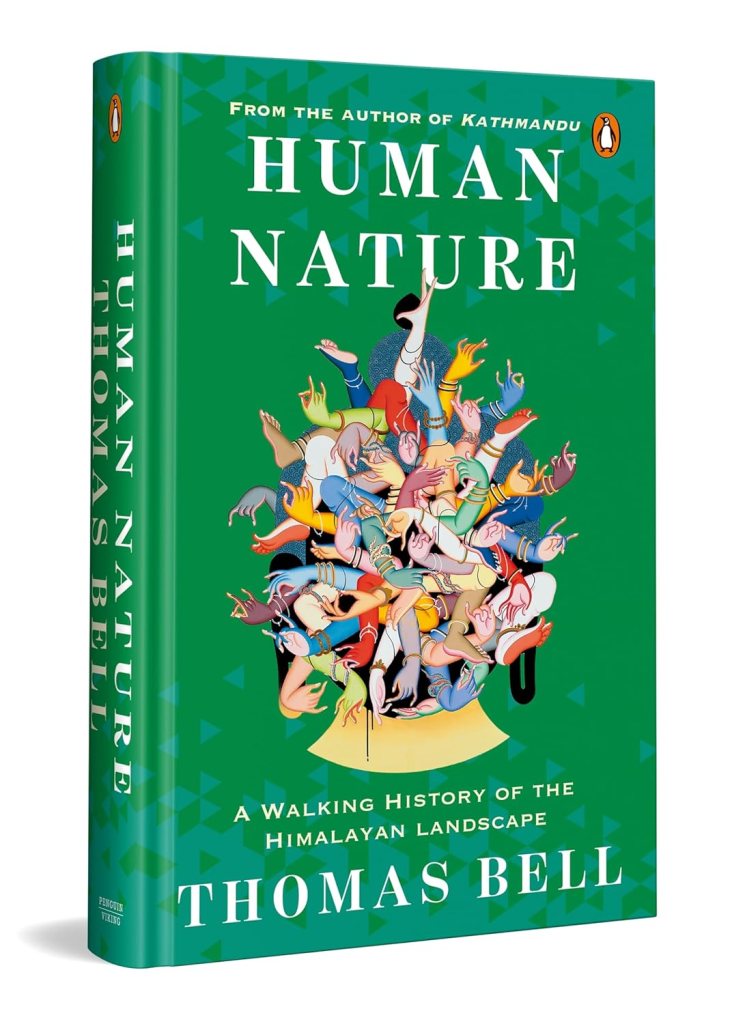
A Walking History of the Himalayan Landscape

Title: Human Nature: A Walking History of the Himalayan Landscape

Author: Thomas Bell

Publisher: Penguin Random House

On the plane from Kathmandu I could see the thunderheads building over the eastern hills, after a month of drought. At the bus park, when I claimed my place in the front of the jeep, the soldier who’d already taken his said, ‘This is going to be awkward.’ He spent the first part of the journey asleep on my shoulder.

The road climbed through the clouds and tea gardens of Ilam. The neat little tea hedges were whorled around the round hills like the ridges on a fingerprint. The air was opaque with condensation, like every time I’ve been there. I was once told that this continually cloudy weather—‘the sun never shines, it’s so depressing!’—accounts for the fact that Ilam has the highest suicide rate in the country. But a woman from here, whom I met in Kathmandu, said, ‘No, it’s because the kids’ parents won’t let them be with whom they want to be; they’re lovesick, then their exams come, they come under even greater pressure, feeling their whole lives are at stake, and they drink poison or jump in a river.’

The music in the jeep was loud, and there wasn’t much conversation until we began descending into Phidim in declining light. Beyond the steamed-up glass we saw a blur of rain, cloud and forest, the lights of the town below, and white flashes of lightning. ‘Mother!’ squealed the young woman in the back, and the passengers began talking about deaths by lightning. In his home district they’re quite common, Rajendra said. ‘The victims are burnt black-black!’ The jeep dropped people off at various places, lastly me and Rajendra at a hotel. He carried most of the bags and fishing rods upstairs.

That evening in the hotel restaurant I was joined by an engineer, who was living there while he worked on a hydropower project. It was stormy outside. We drank whisky and talked about fishing, which he was interested in, and about walking routes. After we’d been talking for a while, and it seemed I knew enough to get around, he asked why I needed a guide, referring to Rajendra, who he’d seen carrying the rods upstairs.

‘I need someone to help me with my stuff,’ I said.

I was planning to walk down the Tamar River, do some fishing, and make our way back through the hills to Kathmandu in two or three weeks. ‘Start your walk from the village of Majhitar,’ the engineer said. ‘It’s on your way, and the fishing will be good where a stream flows into the Tamar.’

In the morning a car from the engineer’s project took me and Rajendra and dropped us a few kilometres away, which was as far as the road stretched then. The map I had was only ten years old, but very out of date, because in a short time the hills have filled with roads. The footpath leading from Phidim towards the Tamar was in the process of becoming the Mid-Hill Highway, a major project that will coil over ridge after ridge across the whole country. We began tramping along the unfinished surface towards Majhitar.

Except for last night’s squalls, the weather had been dry throughout the hills. Forest fires were in the news. Here, the villagers were ploughing in preparation for more rain, whereupon they’d plant maize. Where the immense red slopes were too steep to farm they were thinly forested with sal trees, which had shed their leaves to endure the arid spring. The braided streams of the Tamar came into view beneath us. After last night the water was a dirty, concrete grey. The road descended to Majhitar.

The name of this village means that members of the fishermen’s caste—Majhi—are living on a flat piece of alluvial land called a tar. The first people we reached were rethatching their house ahead of the monsoon. Their nets were hanging in the rafters. Rajendra stopped to talk, and they fried some minnows for us. ‘There are fish in this river as big as ourselves,’ the Majhis said, ‘but there’s no chance of catching them in this black water.’ They showed us the thick lines and 2-inch hooks they use, baited with minnows, to catch the big ones. ‘Fish eat fish?’ Rajendra asked.

For the rest of the day we crossed the slopes high above the black waters of the Tamar. We climbed steeply through a burnt forest, the path levelled out among fragrant pines, then we walked all afternoon in grinding sunshine, through leafless jungle with little to drink. The brightness, heat and thirst, last night’s whisky, the weight of my bag, and the awkward load of fishing rods swinging around my body made the world contract. By the end of the day I’d withdrawn into determination only to reach the village where we’d stay. When we got there the villagers asked us, for some reason, ‘Are you from the land registry department?’ They were also Majhis.

Archaeologists have speculated that fishing villages were the first permanent settlements, because even before agriculture they had a source of food in one place. It seems plausible that a similar principle is relevant here. This village, which only consisted of half a dozen stone huts, was built on a naturally formed terrace about 20 yards above the river. Each hut was a single windowless room, with a wall-less sleeping platform above it under a pitched thatch roof. Drunks were asleep on steps and benches at the end of the afternoon. We put our stuff down and were shown which house would take us. Rajendra and I asked them to prepare daal and rice for us, but they said they had no daal.

‘Vegetables then?’ They had no vegetables.

‘Can I have a cup of tea?’ There was no tea.

‘Then give me a cigarette.’ There were no cigarettes. They rolled the tobacco they grew in strips of fibre from their maize cobs.

About the Book

Human Nature, Thomas Bell embarks on four walks through the Himalaya, each in a different season, to explore the interplay between the land and the people who call it home. This evocative history entwines travelogue with folklore, literature, art and anthropology, offering a nuanced portrait of life over the centuries in one of the world’s most enigmatic regions.

Bell’s decades of living in Nepal give him an unusual perspective that bridges the gap between insider and outsider. The stories told to him touch on themes from religion to ecology and political economy, and from pre-history to the present day. He also deftly examines the impact of British imperialism and the growing external pressures on the environment.

Accompanied by striking photographs, Human Nature is a magnificently written account that spans big ideas and real lives. Erudite, intimate and evocative, this is essential reading for anyone seeking to understand the relationship between communities and their environment.

About the Author

Thomas Bell was born in the north of England. After university, he moved to Nepal to cover the civil war there for the Daily TelegraphThe Economist and other publications. He was the Southeast Asia correspondent of the Daily Telegraph, before returning to Kathmandu where he was a political officer for the United Nations during the peace process. His earlier book, Kathmandu, is a history of Nepal’s capital.

.

PLEASE NOTE: ARTICLES CAN ONLY BE REPRODUCED IN OTHER SITES WITH DUE ACKNOWLEDGEMENT TO BORDERLESS JOURNAL

Categories
Bhaskar's Corner

Richard Hughes: The Reporter Who Inspired Ian Fleming

Death came to Richard Hughes a little over a quarter century ago — precisely on 4th January 1984. For his friends it was more than a personal loss, not just the occasional twinge of sorrow. It was a permanent bereavement. Richard Hughes was the foreign correspondent of the Far Eastern Economic Review from 1971 to 1983 and was one of Asia’s top-notch reporters.

Born to an Irish mother and Welsh father, Hughes combined Catholicism and Calvinism. Hughes was a pressman, complete and unassuming. He began his life with a writing job in the public relations department of the Victorian Railways. He soon joined the Melbourne Star (he was reported to be cracked, leaving PR for journalism is like running away from sea to go to school). Then he joined Sydney’s Daily Telegraph and was sent to Tokyo. Hughes reported the events of World War II. After the war ended, he continued reporting for other wars — particularly, the Korean War (1950-53).

His journalistic stints hovered around The Economist and The Sunday Times. Like all great reporters, scoops were his forte — the best known being an exclusive interview in Moscow with Burgess and MacLean, both British men who spied for the USSR. Later he shifted to Hong Kong and began writing his weekly columns.

Richard Hughes was more than a pressman. A towering personality who loved his job eminently, he was equally in the company of eminent people. Ian Fleming who was penning his James Bond thrillers was Hughes’ foreign editor and John le Carre wrote him into his books. Dikko Henderson of the Australian Secret Service in Fleming’s You Only Live Twice (1964) and Old Craw in Le Carre’s The Honourable Schoolboy (1977)are none other than Dick or Richard Hughes.

The life of Hughes as a reporter spanned many decades, most of which was spent in Asia. Hughes wrote extensively about Asia and his memoirs of those decades are chronicles of some important happenings in the continent. From hilarious events to the macabre ones, Hughes wrote about them and with great elan.

Hughes was an avid China-watcher and in most of his reports China figured prominently. Even the first report he filed on 16 October 1971, carried a commentary on Chairman Mao Zedong’s health and Lin Biao being anointed heir-apparent.

The year 1972 was, like 2008, the Chinese year of the Rat. Hughes wrote rather assertively: “The late Comrade Marx may not have heard of this celestial law of the animal calendar, and Chairman Mao himself does not refer to it in any of his manifestos; but stubbornly it persists, real and abiding, if non-ideological.”

President Nixon was visiting Peking early 1972. Hughes in his ingenious style commented: “The Chinese comrades have their own Maoist version of champagne, which was available in an alleged nightclub in a hutung behind the old Peking market as late as 1957; but the less said about that bastardized product the better for the Washington-Peking detente.”

In yet another of his weekly columns, Hughes described how Comrade-Prince Sihanouk of Cambodia (1922-2012) feared and distrusted the communists and the Vietnamese (Hanoi and Saigon alike) more than he feared or distrusted the Americans and the West.

Hughes’ oeuvre spanned from small little facts to great tributes. His piece on the death of Mitsugoro Bando VIII, the 69-year-old Kabuki actor, which he wrote in February 1975,was not only an homage but it carried an incisive analysis of the cause of this theatre personality’s death-eating fugu or Japanese globefish. Mark these details which Hughes had appended in his dispatch:

“Globefish poisoning is caused by tetrotoxin, usually found in fugu liver or ovaries, which can be far deadlier than potassium cyanide and causes violent paralysis. Since 1958, when a total of 289 diners suffered from globefish poisoning in Japan and 167 died, only licensed cooks have been authorized to prepare fugu dishes.”

Hughes was once expelled from the press galleries of both the Senate and the House of Representatives in Canberra because of his critical remarks about an irresponsible Senate vote against John Curtin’s Labor government. As he was re-seated after being exonerated in the galleries, he was not only delighted but gave this bit of information in his column that the Canberra press is one of the friendliest in the world.

Richard Hughes’ dispatches were not always matter-of-fact reporting; some of them were comical and conversational. One such backdrop was the lunar zodiac in which Chairman Mao and Premier Zhou were born.

Here is another account of Kim II Sung of North Korea (1912-94), who was speculated to have disappeared from public life owing to an incurable malignant neck cancer. Hughes wrote:

“Many of my barefoot spies in Peking and Seoul believe that when Kim II Sung sought medical advice in Rumania in 1974, he was told that he could expect to continue in public office for only two more years. This story certainly helps to explain his family-cult buffoonery and the controversial promotion of his 37-year-old son Kim Jong II as his successor.”

A September-1978 column of Hughes takes us to what happened in Indonesia in the late sixties — Ratna Sari Dewi, the one time Tokyo geisha hostess and the third  wife of the late president Sukarno, denouncing the CIA for complicity in the abortive 1965 communist coup. In the same vein, Hughes wrote eulogistically about President Suharto: “He sought to retire Sukarno, the father figure of Indonesian revolution, with relative dignity and avoid humiliation of the man who had been the country’s voice for two decades. But Sukarno, that arrogant hypocrite, never gave Suharto credit for his characteristically Indonesian perception and generosity.”

No newspaper columnist can ever keep himself aloof from writing about newspapers themselves. So, when Hughes attended a reception of Shimbun’s 35th anniversary celebrations he was nostalgic about the Foreign Correspondents’ Club of Japan and how it had grown to a strong 250-member association by 1946. In a similar vein, he argued in one of his reports in November 1981 that the world’s first daily newspaper was not The Times but the contest was between west and East Europe or Korea. Based on various sources Hughes resolved that The Leipziger Zeitung (Korea) was the world’s first daily newspaper.

Richard Hughes’ last column was on the charade by former Australian prime minister Harold Holt’s espionage and his submarine escape to China. He, no doubt, called him a patriotic Aussie and recalled their friendship from the debating days of Melbourne. This column was submitted on 15 December 1983 and after which he never returned to write those brilliant columns once again.

Hughes columns were hilarious and sensitive to prevailing situations. He touched those niceties of life which he could handle with great aplomb. Whether it was the slave children of old Shanghai, plunging pathetic, claw-like hands into vats of boiling water to prepare silk cocoons for spinning or the Teikoku poisoner who massacred a bank’s staff for a haul of US 80 dollars, Hughes’ columns were down-to-earth.

No wonder he was called the ‘barefoot reporter’!

.

Bhaskar Parichha is a journalist and author of No Strings Attached: Writings on Odisha and Biju Patnaik – A Political Biography. He lives in Bhubaneswar and writes bilingually. Besides writing for newspapers, he also reviews books on various media platforms.

.

PLEASE NOTE: ARTICLES CAN ONLY BE REPRODUCED IN OTHER SITES WITH DUE ACKNOWLEDGEMENT TO BORDERLESS JOURNAL