
Categories
Stories

Echoes in the Digital Expanse

By Apurba Biswas

In the heart of a bustling metropolis, where neon signs battled the stars for supremacy, stood a high-rise that pierced the sky. On the 42nd floor, amidst the hum of advanced technology and the glow of omnipresent screens, lived Michael and Apollonia. Their apartment, a futuristic enclave, was filled with gadgets and gizmos that spoke of an age where technology reigned supreme.

Michael and Apollonia, once a couple whose love story could have inspired poets, now found their bond fraying in the unrelenting embrace of the digital world. Their home was an altar to the modern age, with walls adorned with the latest ultra-thin screens, surfaces cluttered with virtual reality gear, and AI assistants that responded to their every whim.

Michael, a software engineer with a passion for gaming, spent his days and nights in alternate realities. His VR headset was more a part of him than his own limbs. In these digital realms, he was a hero, a conqueror, a legend. Apollonia, a digital marketing strategist, found her solace in the lives of others through her social media feeds. Her world was one of perfectly curated images, witty captions, and vicarious living through the adventures of influencers.

Their apartment, high above the city’s ceaseless rhythm, had become a silent bubble. Conversations, once filled with laughter and shared dreams, were now a series of emotionless texts and emojis, even when they lounged on the same sofa. Dinners were silent, save for the soft tapping of their devices; their eyes rarely met, each lost in a personal digital labyrinth.

.

Michael’s world was one of fantastical landscapes and impossible quests. His laughter, once a melody that Apollonia adored, was now a rare sound, often drowned out by the synthetic scores of his games. Apollonia, whose zest for life and storytelling had captivated Michael, now channeled her creativity into crafting an enviable online persona, her real emotions hidden behind a filter of digital perfection.

Their home was a stark reminder of a past filled with genuine connection. Framed photographs of their early adventures — hiking trips, impromptu road trips, and lazy Sundays in the park — were now just relics of a bygone era. Michael’s guitar, once a source of serenity, lay in a forgotten corner, its strings still. Apollonia’s collection of travel books, which had fueled her wanderlust, now served as mere decorative trivia, untouched and gathering dust.

.

It was on a stormy evening, as the city beneath them was a spectacle of rain-drenched lights, that their worlds momentarily collided again. Michael, his VR adventure paused due to a rare glitch, noticed Apollonia. She sat curled on the couch, her face illuminated by the soft light of her tablet, scrolling endlessly. For a fleeting moment, he saw not the Apollonia lost in the digital world, but the woman he had fallen in love with.

Moved by a surge of nostalgia, Michael reached out and gently touched her shoulder. Apollonia looked up, her eyes wide with surprise, as if seeing Michael for the first time in ages. Their eyes locked, and for a brief moment, the digital fog lifted, revealing the raw, vulnerable humans beneath. A torrent of memories flooded back — their first date, the late-night talks, the tender moments.

But the magic of the moment was fleeting. Apollonia’s gaze shifted back to her screen, the ghost of a smile fading as she immersed herself once again in the digital stream. Michael, a wistful sigh escaping his lips, re-entered his virtual world. The screens that had grown between them were too strong, their digital habits too ingrained.

Their night did not end in a dramatic confrontation or a tearful goodbye. Rather, it faded, like the last bars of a forgotten melody. They continued to share their high-rise haven, yet their worlds were galaxies apart. Their love, once vibrant and tangible, had dissolved into the ether of cyberspace. Around them, the city throbbed with life, but in their high-rise sanctuary, they existed in a state of digital solitude, side by side yet worlds apart. As the city lights flickered and danced below, they sat together in their digital cocoon, a testament to a world where hearts beat in sync with bytes, and love stories are written in the code of a bygone era.

Apurba Biswas is a Ph.D. scholar at the School of Humanities and Social Sciences, National Institute of Science Education and Research Bhubaneswar (An Autonomous institute under the Department of Atomic Energy, Govt. of India), and an OCC of Homi Bhabha National Institute, Mumbai. Apurba Biswas specialises in bridging gaps between science and humanities.

.

PLEASE NOTE: ARTICLES CAN ONLY BE REPRODUCED IN OTHER SITES WITH DUE ACKNOWLEDGEMENT TO BORDERLESS JOURNAL

Click here to access the Borderless anthology, Monalisa No Longer Smiles

Click here to access Monalisa No Longer Smiles on Amazon International
Categories
Review

A Thinker who Fought for an Inclusive India

Book Review by Bhaskar Parichha

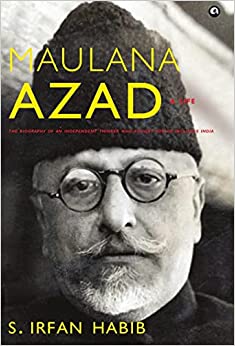
Title: Maulana Azad – A Life

Author: S.Irfan Habib

Publisher: Aleph Book Company

At a time when India is celebrating its 75th anniversary of independence, it is only fitting that Maulana Azad’s contributions to the country should be remembered. He was one of the most prominent Muslim leaders in India’s freedom movement, whose contribution to the establishment of the education foundation in India is recognised by observing his birthday across the country as “National Education Day”.

Azad became the youngest member of Congress to hold a presidential post. Using his position to work to re-unite the Swarajists and the Khilafat leaders under the common banner of the Congress. He opposed the Partition of India because he thought Muslims would be more powerful and dominant in a united India. After independence, he became the first Minister of Education in the Indian government. In 1992, he was posthumously awarded India’s highest civilian award, the Bharat Ratna.

Maulana Azad – A Life by S. Irfan Habib is “the biography of an independent thinker who fought for an inclusive India”. In this in-depth chronicle, historian Habib takes the reader through some of the most decisive moments in Azad’s life.

 A widely published historian of science and modern political history, Habib was the Maulana Azad Chair at the National University of Educational Planning and Administration, New Delhi. He has authored To Make the Deaf Hear: The Ideology and Programme of Bhagat Singh and His Comrades and is the editor of Indian Nationalism: The Essential Writings.

Says the blurb: “Born into an orthodox family of famed Islamic scholars, Azad was deeply influenced by the pan-Islamic philosophies of Sir Syed Ahmad Khan and Jamaluddin Afghani. Azad had no formal education, but he was an autodidact who taught himself about culture, philosophy, languages, and literature. As a teenager, he successfully published several magazines and newspapers and went on to publish the immensely popular Urdu weekly Al-Hilal through which he tried to persuade Indian Muslims to shake off the shackles of British rule. He became inspired by Gandhi’s non-violent civil disobedience movement and was extremely critical of the Muslim League’s communal politics.”

Azad’s unusual upbringing, his illustrious family, upheavals in the Islamic world, and the initial inklings of Azad’s freethinking outlook on life. ‘Maulana Azad and Critical Thinking in Islam’ examines the various schools of thought, ethical questions, and pan-Islamic debates that shaped Azad’s religious attitudes and his approach to the idea of nationalism. ‘Azad, Islam, and Nationalism’ looks at Azad’s political career and his unwavering belief in composite nationalism and staunch opposition to the Muslim League’s sectarian politics. ‘Ghubar-i-Khatir Beyond Faith and Politics’ lays bare Azad’s philosophical moorings and personal likes and dislikes through a collection of epistolary essays written during his imprisonment in the Ahmednagar Fort prison in the 1940s. And, finally, ‘Building a New India’ charts Azad’s efforts to strengthen the country’s weak education system through initiatives aimed at primary and adult education, his efforts towards the scientific and cultural advancement of the country, and his contribution to the arts and culture of a newly independent nation.”

As Habib writes, “justice is all the more relevant to education as a process of harmonious nurture. Indeed, social justice commands a pivotal place in Azad’s general perspective, which influenced his educational outlook quite profoundly. He was conscious of the fact that a class or caste-ridden education system needed to be replaced by a more inclusive and just educational order. In 1948, while addressing the educational conference, Azad again reiterated that education, at any rate, must be pushed forward as rapidly as possible. We must not, for a moment, forget that it is the birthright of every individual to receive at least the basic education, without which he cannot discharge his duties as a citizen.”

Writes Habib : “With a view to gearing education towards the cause of democracy, he, in his very first official statement, referred to Disraeli’s verdict: ‘A democracy has no future unless it educates its masters.’” In independent and democratic India, with universal franchise as the key principle, the voter was truly the master of democracy, and Azad wanted this voter to be educated and aware. He was conscious of the sad inheritance of colonial inequalities, where 85 per cent of the country’s population was illiterate on the eve of Independence. Several classes and caste discriminations were discussed for the first time, and it was necessary to eliminate them immediately.

Azad was convinced, according to the biography, that the state had to play a key role in combating such social afflictions and provide everyone with the means to “the acquisition of knowledge and self-betterment”; however, the most disconcerting factor was the lack of necessary funds to carry forward the state’s responsibilities. Azad conceded with a sense of guilt as minister of education that the central government had allotted only 1 per cent of the funds in the budget for education. He therefore urged the Constituent Assembly to raise expenditure to 10 per cent.

Maulana Azad pursued the issue with passion and was able to raise the allocation from Rs 20 million to around Rs 350 million during his tenure as minister of education. On September 30, 1953, Azad addressed the nation on All India Radio, reiterating that “every individual has a right to an education that will enable him to develop his faculties and live a full human life.”

In about three hundred pages of inexorable text, Habib reconstructs the life of the remarkable man while arguing that Azad is more relevant now than ever before. An essential read for understanding India’s pre-independence history and the significance of a dedicated life.   

Bhaskar Parichha is a journalist and author of UnbiasedNo Strings Attached: Writings on Odisha and Biju Patnaik – A Political Biography. He lives in Bhubaneswar and writes bilingually. Besides writing for newspapers, he also reviews books on various media platforms.

PLEASE NOTE: ARTICLES CAN ONLY BE REPRODUCED IN OTHER SITES WITH DUE ACKNOWLEDGEMENT TO BORDERLESS JOURNAL

Click here to access the Borderless anthology, Monalisa No Longer Smiles