We have not accepted your message. Forgive us, O Prophet. We have forgotten your ideals, the path you showed. Forgive us, O Prophet.
Lord, you spurned luxury and riches under your feet; You did not want us to be kings and nawabs. All the wealth and treasures of this earth Are for all to share in equal measure. You said all human beings are equal on earth. Forgive us, O Prophet.
Your religion does not reject those of other faiths; You have cared for them, sheltered them in your home. Their temples of worship You did not command to be broken, O brave one. But today we cannot tolerate those of other beliefs. Forgive us, O Prophet.
You did not want shameful wars in the name of religion; You did not put swords in our hands, but your immortal message. We have forgotten your magnanimity; We have embraced blind intolerance. That is why blessings no longer shower upon us from heaven. Forgive us, O Prophet.
These Lovely Flowers, This Luscious Fruit [Ei Shundar Phul Ei Shundar Phal]
Thank you for all these bounties, Lord, For these lovely flowers, this luscious fruit, The sweet water of this river. Thank you for all these bounties, Lord, For these fertile fields of green and grain. You have bestowed precious gems on us, Brothers, companions, sons. You give us sustenance when we are hungry Without our asking. Lord, I disobey your command every day Still you bestow air and light on this worthless being. You gave me the greatest prophet To save me on Judgment Day. That I might not forget the true path You sent the message of the Holy Quran.
To the Poets of the Future [Na-Asha-Diner Kabir Proti]
O poets of the future, may you arise Like the morning sun, Bright and red like hibiscus blossoms. In the golden dawn for which we long May you wake up like countless flocks of birds. I sing in the hope that you will come To soar in the blue sky that I create. I leave behind the memory of my greetings to you: Play on my veena the song of the new day.
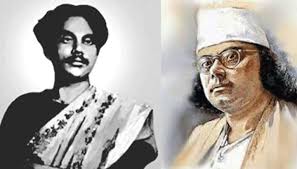
Born in united Bengal, long before the Partition, Kazi Nazrul Islam(1899-1976) was known as the Bidrohi Kobi, or “rebel poet”. Nazrul is now regarded as the national poet of Bangladesh though he continues a revered name in the Indian subcontinent. In addition to his prose and poetry, Nazrul wrote about 4000 songs.
Niaz Zaman is an academic, writer and translator from Bangladesh. She has published a selection of Kazi Nazrul Islam’s work in the two-volume Kazi Nazrul Islam: Selections. In 2016, she received the Bangla Academy Award for Translation. “Forgive Us, O Prophet” and “To the Poets of the Future” were first published in Kazi Nazrul Islam: Selections 1, edited by Niaz Zaman (writers.ink, 2020).
.
PLEASE NOTE: ARTICLES CAN ONLY BE REPRODUCED IN OTHER SITES WITH DUE ACKNOWLEDGEMENT TO BORDERLESS JOURNAL
Roquiah Sakhawat Hossein was born in 1880, Kazi Nazrul Islam in 1899. Apart from their difference in gender, there could not have been more differences in the circumstances of their class and upbringing. Roquiah was born and brought up in an affluent Muslim family of Pairaband. Her brothers went to elite schools in Kolkata. Though she was forbidden to read and write Bangla or English as a child, her brother Ibrahim Saber helped her to learn both languages so that she could write fluently in both. Later, her husband, Sakhawat Hossein, encouraged her to read and write, both Bangla and English.
Kazi Nazrul Islam was born in an impoverished family in the village of Churulia in the district of Bardhaman in West Bengal. Nazrul’s father was the khadim or caretaker of a mosque next to his small mud hut. The death of several earlier children led to Nazrul’s being given the nickname “Dukhu Miah,” the sorrowful one, perhaps also to cast off the evil eye. Initially, Nazrul studied in a maktab, an Islamic elementary school. When Nazrul was about nine, his father passed away, and the young boy was obliged to support his family. This might have meant teaching the children at the maktab, cleaning the mosque, and participating in religious rituals which entailed reciting the Quran.
Sometime in 1915, Nazrul got admitted to Searsole Raj High School, and studied there till 1917. This was the longest time he had spent in one place and in one school. However, he did not sit for the matriculation examination, but went off to join the British Indian Army which had started recruiting Bengalis. Posted to Karachi, Nazrul started subscribing to Kolkata papers and also writing for them.
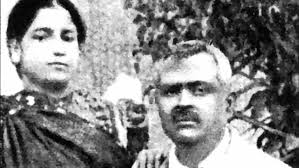
Begum Roquiah (1880-1932) with her husband, Sakhawat Hossein, in 1898
In 1898 – a year before Nazrul was born – Roqiuah Khatun was married to Sakhawat Hossein, an Urdu-speaking widower from Bhagalpur. A civil servant under the British Raj, Sakhawat Hossein, not only encouraged his wife to read and write but was so amazed at her piece of English writing that he showed it to Mr. Macpherson, Commissioner, Bhagalpur. Mr. Macpherson commended the quality and content of the writing. We do not know whether Roquiah sent the story herself to Indian Ladies Magazine (Madras) or whether her husband did so. Nevertheless, Roquiah’s first published writing appeared in the magazine in 1905. Three years later, her Bangla translation of the story – with some changes – was published as a small book by S. K. Lahiri and Co, Kolkata.
Sakhawat Hossein passed away on May 3, 1909, leaving a large sum to his widow to start a school. Roquiah initially started the school in Bhagalpur but was unable to continue there and moved to Kolkata. It was there that, onMarch 16, 1911, she re-started Sakhawat Memorial School at 13 Wellesley Lane. Besides persuading Muslim parents to let their daughters enrol in her school and running it, she also had to write letters explaining why certain things were being done or not being done in her school. In addition to these activities, she started writing for local Kolkata newspapers and journals.
Perhaps the earliest Bangla essay of hers that was published was “Pipasha.” This piece about Muharram was published in Nabaprabha in Falgun 1308 [1](Bangla) corresponding to mid-February to mid-March 1912. She also wrote in other journals such as Mahila, Nabanur, BharatMahila, Al-Eslam, Bangiya Mussulman Sahitya Patrika, Saogat, Sadhana, Naoroz, Mohammadi, Sahityik, Sabujpatra, Muezzin, Bangalakshmi, Gulistan, and Mah-e-Nau. News about her school was published in The Mussulman under her initials, Mrs. R. S. Hossein.
During his deployment in Karachi, Nazrul subscribed to Bangla journals from Kolkata and also sent them some of his writings. His first publication was a short story “Baundeler Atmakahini” [The Autobiography of a Vagabond], which was published in Saogat in May 1919. The short stories “Hena” and “Byathar Dan” [The Gift of Sorrow] were published in Bangiya Mussalman Sahitya Patrika in November 1919 and January 1920 respectively. Roquiah’s writings too were being published in Saogat and Bangiya Mussulman Sahitya Patrika. Though it is not known whether Nazrul and Roquiah actually met, it is impossible that they did not know about each other’s writings.
A few years ago, I asked Majeda Saber, Roquiah’s grandniece who has written considerably on her grandaunt, whether Nazrul and Roquiah had ever met. Majeda Saber did not know. However, even if they did not meet, it is quite evident that Nazrul and Roquiah did meet in print and that they shared some common ideas. Nazrul reveals a deep empathy for women in both his poetry and his fiction. The short story “Rakshushi[2],” about a woman who has killed her husband and gone to jail for her crime, is a sympathetic portrayal of a murderess in her own voice. Nazrul’s poem “Nari[3]” demands equality for women.
I sing of equality.
In my eyes, there is no difference
Between a man and a woman.
Whatever is great and blessed in this world,
Has come equally from both, man and woman.

		(Translated by Selina Hasib)
His song, “Jaago Nari Jaago” [Rise Up, Women], gives a clarion call to all women to rise.
Rise up women – rise up like the flaming fire!
Rise up, O wife of the Sun god,
with the mark of blood on your forehead!!
...

Like the fire blazing out of a smouldering heap,
rise up – all you mothers, daughters, wives, sisters!
              (Translated by Sajed Kamal)
In his epistolary novel, Bandhon Hara [4]– which began to be serialized in Moslem Bharat from mid-April 1920 and was published as a book in 1927 – the feelings of the women letter writers reflect Roquiah’s ideas.
The narrative of Bandhon Hara seems to focus on the soldier-protagonist Nuru. However, the letters of the women not only contribute to the narrative of the triangular love story but also reflect on the condition of Muslim women in seclusion. For example, Mahbuba writes to Sophie – her friend, who, like her, is also in love with Nuru – about the claustrophobic nature of the inner quarters where women reside. It is a place where even the sun may not enter. But women are not criminals, Mahbuba says. “We are entitled to some freedom, for are we not human beings? Are we not made of flesh and blood, don’t we have feelings? Do we not possess a soul?”
After Mahbuba gets married, she writes to Shahoshika, a Brahmo teacher and a family friend, that women are supposed to be self-sacrificing. She tells Shahoshika that she has no wish to be renowned for self-sacrifice. She would like to die but refuses to die locked up in the inner quarters. “If I have to die, I would wish to have all the doors and windows around me open wide . . . I want to die looking straight at Mother Earth”.
In her essay “Subeh Sadek” [Dawn], published in Muezzin between mid-July-mid-August 1930, Roquiah asked women to proclaim aloud that they were human beings, not possessions. “Buk thukiya bolo ma! Amra poshu noi. Bolo bhogini! Amra asbab noi. Bolo konye! Amra jarau olonkar rupe lohar sinduke aboddha thakibar bostu noi. Sokole somoswore bolo,Amra manush. Mother, proclaim aloud, we are not animals. Proclaim, sister, we are not inanimate objects. Proclaim daughter, we are not ornaments set with precious gems to be locked up in iron trunks. Proclaim together, we are human beings.” In Aborodhbashini [The Secluded Ones], published in 1931, several years after Bandhon Hara, she described the claustrophobic, unhealthy, and often fatal conditions of extreme purdah.
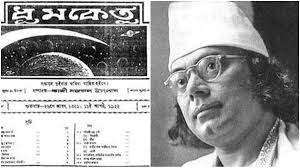
Dhumketu edited by Nazrul
These similarities might simply be coincidences. However, it is clear that Nazrul thought highly of Roquiah and that she too reciprocated that feeling. Roquiah had been contributing to several Kolkata journals. In 1922, she contributed two pieces to the newly founded bi-weekly paper, Dhumketu[5], edited by Nazrul. The paper started publication from 26 Sravan 1329 BS/11 August 1922. A month later, a large extract from Roquiah’s essay “Pipasha”[Thirst] was published in the Muharram issue of 16 Bhadra 1329/ September 2, 1922.
Thanks to Selina Bahar Zaman[6], we have facsimiles of Dhumketu. From this valuable collection we realise that, from the very beginning, the paper not only voiced Nazrul’s anti-British views but also displayed his non-communal and non-gendered outlook. Many of the contributors to the paper included Hindu writers as well as women. There were at least ten women who wrote at least once. One of these included a ten- or eleven-year-old girl as well as a thirteen-year-old girl, the former Hindu, the latter Muslim. Mrs. M. Rahman, to whom Nazrul dedicated his book Bisher Banshi[7], wrote several times. Roquiah – as Mrs R. S. Hossein – was published twice in Dhumketu.
We do not know whether Roquiah sent the extract from “Pipasha” herself or whether Nazrul asked her for the piece for the special issue of twenty pages. The extract published in Dhumketu reflects on the plight of Hazrat Imam Hossain and the group of warriors, women and children, who accompanied him on his tragic journey to Karbala.
The only other piece by Roquiah to appear in Dhumketu was a poem, “Nirupam Bir” [The Dauntless Warrior], published on 5 Ashwin 1329 BS / September 22, 1922. Unlike “Pipasha”, the poem does not seem to have been published before. This time, Roquiah might herself have sent the poem to Dhumketu. She would not have had to go in person to the office of Dhumketu. With a good postal service, contributions were mailed to journals.
“Nirupam Bir” is a remarkable poem from a woman who has been called an “Islamic Feminist.” The 18 August issue of Dhumketu had published a photograph of Kanailal Dutt (1888-1908). Did this inspire Roquiah to write the poem? Kanailal was a revolutionary belonging to the Jugantor Group[8]. Arrested with a number of other revolutionaries, he was imprisoned in Alipore Jail. There, along with another revolutionary, he succeeded in assassinating Narendranth Goswami, a government approver. Kanailal was hanged on 31 August, 1908. He was the second revolutionary to be hanged by the British after Khudiram Bose – whose picture also appeared in Dhumketu.
In the poem, Roquiah eulogises Kanai as the dauntless warrior. The poem begins with the magistrate telling Kanai that he will be hanged. But Kanai – addressed here as Shyam, another name of Krishna – laughs. The one who willingly sacrifices his life does not fear hanging. “Moriya kanai hobe omor/ Shadhyo ki bodhe tarey? By dying Kanai will become immortal. Who can slay him?” The poem ends with a strident call hailing Kanailal: “Bolo bolo ‘Bande Shyam[9].’” It is a brave poem by a woman who was the widow of a government servant, a woman who ran a school for Muslim girls and promised their parents that purdah would be observed.
There were no Muslim revolutionaries at the time – though Nazrul’s friend Muzaffar Ahmad was a communist – and in Mrityukshudha Nazrul would describe a Muslim Bolshevik and in Kuhelika[10] he would portray a Muslim revolutionary. In his two poems on Durga, “Agamoni[11]” and “Anandamoyeer Agamone”, published in the Puja issue of Dhumketu on 9 Ashwin 1329 BS /September 26, 1922, Nazrul used the legend of the goddess to call for the overthrow of the British. In his editorial in the thirteenth issue of Dhumketu, 26 Ashwin 1329 BS / October 13,1922, Nazrul called for complete independence from the British: “‘Dhumketu’ bharater purno swadhinata chay.[Dhumketu wants India’s complete independence]” He quoted a line from his poem “Bidrohi”: “Ami aponare chhara kori na kahare kurnish [I bow to no one but myself].” Unlike Khudiram and Kanai, Nazrul did not resort to bombs or pistols, but to soul-stirring words. Just as in some of his writings, Nazrul revealed the feminist perspectives of Roquiah; in “Nirupam Bir”, Roquiah approached the revolutionary spirit of Nazrul.
Selected Bibliography
Hossein, Roquiah Sakhawat, “Subeh Sadek.” Rokeya Rachanabali ed. Abdul Mannan Syed et al, revised edition. Bangla Academy: 1999.
Islam, Kazi Nazrul. Unfettered (translation of Bandhon Hara).Translated by The Reading Circle Nymphea Publication: 2015.
Niaz Zaman is an academic, writer and translator from Bangladesh. She has published a selection of Kazi Nazrul Islam’s work in the two-volume Kazi Nazrul Islam: Selections. In 2016, she received the Bangla Academy Award for Translation. This essay was first published in In Focus, the Daily Star, December 12, 2022.
.
PLEASE NOTE: ARTICLES CAN ONLY BE REPRODUCED IN OTHER SITES WITH DUE ACKNOWLEDGEMENT TO BORDERLESS JOURNAL
O faithful one, say your prayers in my house today;
Below your feet I spread the jainamaz* of my heart.
I am a careless sinner,
Find no time to pray;
Touching your feet, may my sinful head be raised.
Wipe your ablution water with my garments,
Turn my house into a mosque by your touch today.
The Devil, through whose wiles
I do not find time to call upon God,
Will flee, hearing your call to pray.
*Jainamaz: A Prayer rug
The Passing of the Prophet
What an amazing scene is this! Even Azrael’s eyes well with tears.
His merciless heart trembles as at the onset of fever.
His stony fist, quick to kill, is still today.
His grasp is weak, his heart pierced,
His blue crown kisses the dust.
Gabriel’s fiery wings have shattered to pieces.
The world’s debt has been paid, but the heart is still in pain.
Mikhail ceaselessly pours
The salt water of the rivers
On all the lands; in the dark night, the pines sway.
Is this the same moon of the twelfth night?
The same Rabiul Awwal*?
In the north-east a dark flag flutters.
Israfil’s trumpet of destruction
Also sounds feeble today. The breast-shattering lightning weeps inconsolably.
Why does the devil Azazel stand at the Prophet’s door?
From his breast too tears flow, flooding the plains of Madina.
Borak raises his hooves above his head,
Tears through heaven and earth.
He weeps aloud, and, looking up towards
Heaven, neighs loudly.
Houris and fairies grieve,
Their eyes sparkling with tears.
Today the flaming rivers of hell have turned to water;
The narcissus and poppies of Paradise shed countless tears.
Mother Earth weeps, clasping the corpse of her son to her breast.
She carries the bier of her son, her body racked with sighs.
In the cave of hell, the jinns weep.
Will Solomon die a second death?
The doe forgets to nurse her young;
The sorrowful bird forgets to sing.
Flowers and leaves fall, a cold north wind blows.
The life of the earth is ebbing, her veins and arteries rent.
There is no end to mourning
In Makkah and Madina
It is the field of the Day of Judgement;
Everyone rushes about madly.
The Ka’aba trembles, and all Creation seems to gasp its last breath.
The herald’s bugle sounds sadly today.
Whose sharp sword slashes again and again at the distant moon?
Abu Bakr’s tears flow in an endless stream,
Mother Ayesha’s cries cause the heavenly stars to grow faint.
Maddened with grief, Omar violently twirls his dagger,
“I shall beat the life out of God,
I shall not spare Him today.”
The hero roars again and again,
“I will slash off the head of any one who dares to say
That the Prophet is no more – of anyone who tries to take him to the graveyard.”
In his mighty hand, his sword he whirls.
Who is that weeping inconsolably in every mosque today?
The grief-stricken muezzin’s call is faint;
There is no strength in him, in his empty heart.
Bilal’s voice breaks and falters as he calls the azan.
Who recites the heart-wrenching call for the funeral prayer?
Osman swoons, racked with pain, foam on his lips;
The brave Ali Haider has been subjugated by his grief;
His double-edged Zulfiqar
Is blunt with sorrow.
Alas, the Prophet’s beloved daughter Fatima weeps.
“Where are you, father,” she cries, her hair dishevelled and unbound.
Hasan and Husain writhe on the ground like slaughtered doves.
“Where are you, Nana?” they call and search for him everywhere.
The light of the day has gone out,
The moon and stars have faded.
The world has grown dark,
Every eye sheds drops of blood.
The seas crest and foam to drown the skies above,
Except for their salty tears, they will leave nothing behind on earth.
God Himself is helpless,
His seat itself has shattered.
He wishes to clasp His friend to His bosom,
But how can He wrench away the one for whom all creation weeps?
There is great festivity in Paradise today, great rejoicing.
The houris and angels sing in unison, “Sallallaho aleihe sallam*”.
Standing in rows, they sing praises of the Prophet.
Mother Earth weeps, unable to keep her son.
“Have Amina and Abdullah come? Is the virtuous Khadija here?”
Seeing the joy on the mother’s face as she sees her long-lost son,
The Lord of the Universe laughs.
“God, what injustice is this?”
Cry the children of the earth.
Today the bright lights of heaven grow brighter still;
There is increasing happy laughter there.
Only the light of Mother Earth is dimmed and darkness reigns.
The laughter of the heavens rings out above the tears of earth,
And from everywhere echoes the cry “Sallallaho aleihe sallam".
* Rabiul Awwal : The third month of the Islamic calendar * Sallallaho aleihe sallam : May Allah honour him and grant him peace
Born in united Bengal, long before the Partition, Kazi Nazrul Islam(1899-1976) was known as the Bidrohi Kobi, or “rebel poet”. Nazrul is now regarded as the national poet of Bangladesh though he continues a revered name in the Indian subcontinent. In addition to his prose and poetry, Nazrul wrote about 4000 songs.
Niaz Zaman is an academic, writer and translator from Bangladesh. She has published a selection of Kazi Nazrul Islam’s work in the two-volume Kazi Nazrul Islam: Selections. In 2016, she received the Bangla Academy Award for Translation. This translation was first published in Kazi Nazrul Islam Selections 1, edited by the translator and published by writers.ink in 2020.
.
PLEASE NOTE: ARTICLES CAN ONLY BE REPRODUCED IN OTHER SITES WITH DUE ACKNOWLEDGEMENT TO BORDERLESS JOURNAL
Samya (Equality) by Nazrul, translated from Bengali by Niaz Zaman
I sing the song of equality –

Of a country where fresh joy blossoms in every heart

And new life springs in every face.

Friend, there is no king or subject here,

No differences of rich and poor.

Some do not feast on milk and cream here,

While others grovel for leftovers and broken grains.

No one bows before the feet of horses here,

Or before the wheels of motor cars.

Disgust does not arise in white men’s minds here

At the sight of black bodies.

Here, in this land of equality,

Black and white are not buried in separate graveyards;

Nor do black and white pray in separate rooms and churches.

In this land there are no footmen or guards,

No policemen to evoke fear.

There are no conflicting religions here,

No cacophony of conflicting scriptures.

The priest and the padre, the mullah and the monk

Drink water from the same glass here.

The Creator’s house of prayer

Is contained in the human body and mind here;

Here His throne of sorrow

Is formed by human suffering.

He responds readily here

To whatever name He might be called,

Just as a mother responds readily

To whatever name her child might call.

No one comes to blows here

Over the different apparel one wears –

Payjama, trousers or dhoti.

Clad though in soiled or dusty garb,

All are happy here.
Born in united Bengal, long before the Partition, Kazi Nazrul Islam(1899-1976) was known as the Bidrohi Kobi, or “rebel poet”. Nazrul is now regarded as the national poet of Bangladesh though he continues a revered name in the Indian subcontinent. In addition to his prose and poetry, Nazrul wrote about 4000 songs.
Niaz Zaman is an academic, writer and translator from Bangladesh. She has published a selection of Kazi Nazrul Islam’s work in the two-volume Kazi Nazrul Islam: Selections. In 2016, she received the Bangla Academy Award for Translation. This translation was first published in Kazi Nazrul Islam Selections 1, edited by the translator and published by writers.ink in 2020.
.
PLEASE NOTE: ARTICLES CAN ONLY BE REPRODUCED IN OTHER SITES WITH DUE ACKNOWLEDGEMENT TO BORDERLESS JOURNAL



 Borderless