Categories
Bhaskar's Corner

Chittaranjan Das: A Centenary Tribute

By Bhaskar Parichha

Chittaranjan Das (1923-2011)

In the contemporary world, with its multiple environmental crises, conflicts, and violence, persisting poverty, and social exclusion, the question about the role of arts in general, and of literature specifically, must inevitably arise. Do they have any positive role other than entertainment and distraction, or are they merely the icing on a rapidly decaying and disintegrating cake?

Without naming the problem in exactly this way, much of Chittaranjan Das’s work was devoted to implicitly answering this question, for he clearly recognised that a merely functionalist approach to trying to identify the role of the arts in society would be totally inadequate and theoretically shallow. Rather, to answer the question more fully, we should ask what constitutes a society’s self-understanding, its modes of self-representation, and its internal hermeneutics, and how, methodologically speaking, we can gain access to this deep cultural grammar of a society. Das’s original professional career was as a rural sociologist and teacher of the subject in Agra and elsewhere. As a sociologist he would have been aware that such questions arise not only in the sociology of the arts, but equally in relation to such intractable subjects as religion, suicide, and the emotions.[1]

The year 2023 is the centennial birth anniversary[2] of the thinker, educationist, critic, pioneer of Odia non-fiction writing and one of the finest translators, Professor Chittaranjan Das. Chittabhai — as he was known throughout Odisha — was the most prolific writer, with numerous diaries, essays, reviews, autobiographies, memoirs, columns, textbooks, and monographs.

Many eminent writers were born in Bagalpur village in Jagatsinghpur district. Chittaranjan Das was one of them. He was the third child of five brothers and three sisters. He attended Punang School after schooling in his native village. Afterwards, he attended Ranihat Minor School and Ravenshaw Collegiate School. In 1941, he passed the matriculation examination and enrolled at Ravenshaw College, Cuttack, for higher education. However, he became involved in the independence movement. His inspiration came from Manmohan Mishra[3]

During his Ravenshaw student days, he was an active member of the Communist Party of India. In 1942, he joined the Quit India Movement and was imprisoned. During his jail term, Das  acquired many skills, including learning languages, particularly French. In 1945, he was released from prison and attended Santiniketan. During his academic career, he was exposed to a wide variety of intellectuals, thinkers, and writers. He was deeply influenced by their works.

His studies in psychology, sociology, and cultural anthropology continued in Europe and abroad in the years that followed. He was trained in clinical psychology at the Vienna School established by Sigmund Freud. It was here that he met philosopher Martin Buber. He continued his studies at Santiniketan and later at Copenhagen University, Denmark.

He returned to Odisha in 1954 and joined the Jibana Bidyalaya, a school inspired by Gandhi’s ideals on education, established by Nabakrushna Choudhury and Malati Devi. Later on, he became the headmaster of this institution. He left after four years and took a teaching assignment near Agra.

Sri Aurobindo’s philosophy drew Das to the revered sage’s teachings. Upon returning to Odisha, he taught at the Institute of Integral Education in Bhubaneswar, based on Sri Aurobindo’s values. This was in 1973. While he did not stay for long, he remained associated with this movement until his death in 2011.

Das considered the whole world to be his home. He was proficient in a wide range of languages, including Hindi, Urdu, Bengali, Assamese, Sanskrit, Danish, Finnish, French, Spanish, and English. His vast studies covered many areas of social and human sciences like philosophy, psychology, religious studies, and linguistics as well as school studies. His knowledge is reflected in 250 books he wrote or translated into Odia.

He was a regular contributor to newspapers and his columns appeared in major Odia dailies like Dharitri, Pragativadi, Sambad, Samaja and more. These short pieces have been compiled into books that give insight into his views on contemporary issues. His first writing was an article in a school magazine. The article ‘Socrates’ appeared in 1937 in the Ravenshaw Collegiate magazine, Sikshabandhu.

Das travelled widely around the world. During his travels, he closely examined the social, cultural, and political life of the countries he visited. He wrote books describing his impressions. He has translated many books into Odia from countries he visited. His translation work is vast. His understanding of the topic and the translation of the books make for a pleasant reading experience.

He was an excellent diary writer. These captured his feelings about many incidents. The autobiographical diary entries have been published as Rohitara Daeri[4], a series of over 20 volumes. His love for the mother tongue was unparalleled. Despite excellent command of more than a dozen languages, including German, Danish and Finnish, as well as Sanskrit, Pali, Urdu and Bengali, he wrote mostly in his mother tongue, Odia.

His contribution to Odia literature was huge because he translated the works of many prominent writers — Bengali writer Ashapurna Devi, polymath Albert Schweitzer, French novelist François Mauriac, British-Indian anthropologist Verrier Elwin, Danish poet Karl Adolph Gjellerup, French writer Antoine de Saint-Exupéry, Lebanese-American poet and writer Kahlil Gibran, Russian poet Boris Pasternak, former President of India Sarvepalli Radhakrishnan and the iconic Mahatma Gandhi. Sri Aurobindo’s principal philosophic work, a theory of spiritual evolution culminating in the transformation of man from a mental into a supramental being and the advent of a divine life upon earth, Life Divine, is Chittranjan Das’s significant work.

Many awards have come his way. In 1960, for his essay ‘Jeevana Vidyalaya’[5], he was awarded by the Odisha Sahitya Akademi. He was given the Sarala Award in 1989 for his essay ‘Odisha O Odia’. He was conferred with the Sahitya Akademi Award in 1998 for his book Biswaku Gabakhya [6]. He bagged more accolades from Prajatantra Prachar Samiti, Gangadhar Rath Foundation, Utkal Sahitya Samaj and Gokarnika.

Chittaranjan Das’s works incorporate both creative experimentation and a transformative philosophy. He has worked in education, literature, cultural creativity and artistic criticism. During his lifetime, he was instrumental in the growth and development of numerous social action and development groups. Throughout his writings, he discussed self-development, social change, and mankind’s evolution. His Odia autobiography Mitrasya Chakhusa  [7]is an extraordinary work in the genre.

A scholar of eminence, literary commentator and author of numerous books in Odia and English, he was known as ‘Socrates of Odisha.’

.

[1] John Clammer (The Essays of Chittaranjan Das on Literature, Culture, and Society/Ed. Ananta Kumar Giri and Ivan Marquez)

[2] The Odia writer lived from 1923-2011.

[3] A revolutionary writer and poet who lived from 1917 to 2000.

[4] Rohit’s Diary

[5] School of life

[6] Window to the World

[7] Through the eyes of a Friend

Bhaskar Parichha is a journalist and author of UnbiasedNo Strings Attached: Writings on Odisha and Biju Patnaik – A Political Biography. He lives in Bhubaneswar and writes bilingually. Besides writing for newspapers, he also reviews books on various media platforms.

.

PLEASE NOTE: ARTICLES CAN ONLY BE REPRODUCED IN OTHER SITES WITH DUE ACKNOWLEDGEMENT TO BORDERLESS JOURNAL

Click here to access the Borderless anthology, Monalisa No Longer Smiles

Click here to access Monalisa No Longer Smiles on Kindle Amazon International
Categories
Review

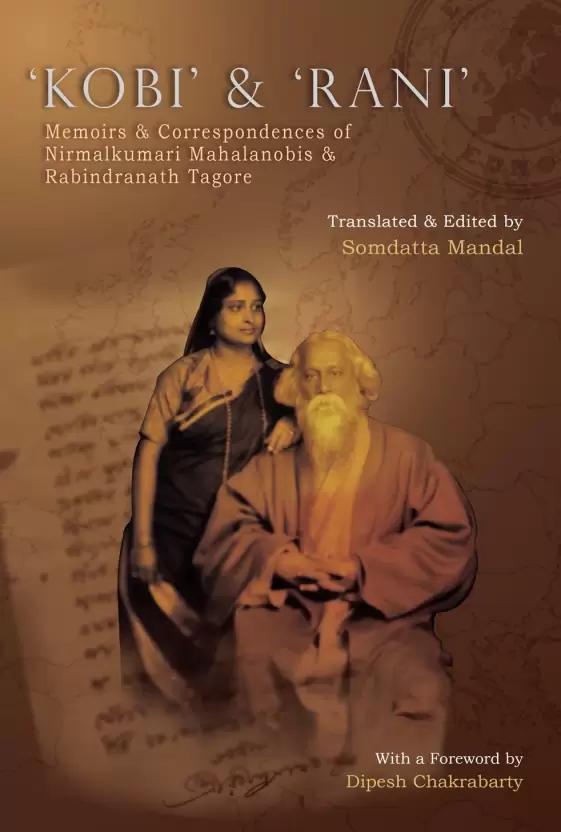
Letters between Tagore & Nirmalkumari Mahalanobis 

Book Review by Himadri Lahiri

Title: ‘Kobi’ and ‘Rani’: Memoirs and Correspondences of Nirmalkumari Mahalanobis and Rabindranath Tagore

Translator/Editor: Somdatta Mandal; Foreword by Dipesh Chakrabarty.

Publisher: Bolpur: Birutjatiya Sammiloni.

Memoirs and correspondences constitute two alternative sources for reconstructing historical narratives. Generally kept outside the pale of mainstream history, memoirs, such as those included in the volume under review, can offer significant insights into the reading of important public figures and their activities. Despite the charges of ‘unreliability’ of memories with the help of which personal narratives are constructed, memoirs contribute to the understanding of a historical period with the help of small, apparently insignificant, details which can offer penetrating insights into reality. Personal correspondences with a public figure, preserved in family archives, too may contain interesting facts, figures and episodes which may help constructing their lives and recreating the social and intellectual environment of the time. Due to their very subjective nature, which mostly flouts the norms of objectivity, these genres may provide unique dimensions to the familiar historical narratives.

Somdatta Mandal’s book ‘Kobi’ and ‘Rani’: Memoirs and Correspondences of Nirmalkumari Mahalanobis and Rabindranath Tagore (2020), selected, translated and edited by her, is an important source, particularly for non-Bengali readers, for comprehending Rabindranath Tagore, the Nobel Prize winning poet from Bengal who continues in global limelight. It unearths hitherto unknown facts, some activities of ‘small’ actors who played a role in history and ‘trivial’ details which help us view Rabindranath Tagore and his contemporaries from fresh perspectives.  Written from an informed woman’s point of view, the narratives offer us opportunities for discovering ‘the lighter’ and homelier aspects of Tagore’s life – this is something “which is sorely missed in other serious narratives and biographies” (Mandal xvii).

The publication of this book is timely for yet another reason. Tagore’s tirade against fascism, unfettered authoritarianism, aggressive nationalism and his advocacy for personal freedom, national independence, universal humanism and global understanding have much relevance in our times. Reading Kobir Shonge Europey (With the Poet in Europe, 1969) in particular, one understands how a public figure with an impeccable record of liberal philosophical practices and humanist activities can be duped by the machination of fascist agents and utilised for fascist propaganda to the consternation of liberal intellectuals and common citizens across the world. For this very reason we need Tagore more than ever before. This is a point strongly emphasised by historian Dipesh Chakrabarty in his ‘Foreword’ to the book.

‘Kobi’ and ‘Rani’ anthologises English translation of two memoirs of Nirmalkumari Mahalanobis — Kobir Shongey Dakshinatte (With the Poet in the South) and Kobir Shongey Europey (With the Poet in Europe). The European tour took place in 1926 while Tagore travelled to South India and Ceylon in 1928. In her valuable Introduction to the book, Mandal raises the question of difficulty of determining the genre of the narratives. These are, according to her, not just memoirs, they are travelogues as well. Through them, one gets the feeling of following the trajectory of the author’s journey. But a reader also feels how Rani’s journey, along with her husband, revolves round an iconic personality whom they revered and valued. From this point of view, the memoirs often read like hagiographies as well.

In addition to these two memoirs, the anthology includes Pathe O Pather Prante (On the Road and Beyond It),a collection of sixty letters Tagore wrote to Nirmalkumari whom he affectionately called Rani. In the Appendices, we find three other articles on Tagore written by Nirmalkumari: “Om Pita Nohosi,” “Tamaso Ma Jyotirgamaya,” and an essay written for children and originally published in Anandamela, a children’s magazine published by the Anandabazar Patrika. All these make the book voluminous and largely comprehensive. It may be mentioned here that Mandal has recently translated and edited another volume on Tagore entitled The Last Days of Rabindranth Tagore in Memoirs (April 2021). It includes memoirs by Pratima Thakur, Rani Chanda, Maitrayei Devi, Nirmalkumari Mahalanobis, and Amita Thakur.

Interestingly, all these memoirs were written by women who either belonged to the Tagore family or were in close contact with the poet. Dipesh Chakrabarty, in the ‘Foreword’ to Kobi  and Rani, raises the issue of his “friendship with women that Tagore sought and sustained throughout his life” (iv), and mentioned in this context the names of Ranu Adhikari, Maitreyi Devi, Hemantabala Devi and Kadambari Devi. He observes that “a feeling of respectful affection and concern for the poet finds a deeply gendered and womanly expression in this book. It oozes out of each page” (iv). The above statement is true of The Last Days of Rabindranath Tagore in Memoirs too. Taken together, these two anthologies provide a very intimate and comprehensive account of one of the greatest poets of our time.

Tagore felt the need for recording the accounts of his travels in writing. That would be, in his opinion, a valuable source of literary and historical information in future. He was particularly sensitive about his European tour during which he met several well-known intellectuals. In the ‘Introduction’ to On the Road and Beyond It, he asserts, “the value of the narration of my European tour that has not been published anywhere is enormous” (391). Similarly, Tagore said in the Foreword to With the Poet in the South, “They [the details of his tour] should not be lost” (317). This sense of preservation of history is also present in Kobir Shonge Europey (With the poet in Europe). Here in the ‘Foreword’, Rani notes that Tagore, in a letter published in Prabasi, complained, “Those who had accompanied me during my foreign travel did not take the responsibility of protecting my travelogue, and that is why this chapter remains unknown to people, etc.” (3). As both her ‘Foreword’ and Prasantachandra Mahalanobis’s ‘Preface’ to the same memoir indicate, it was clearly the result of a misunderstanding for which Tagore apologised later.

The history of this misunderstanding goes deeper. The couple suspected the involvement of some insider in the loss of the file containing the manuscript of the despatches sent by Prasantachandra from Europe for publication in Visva-Bharati Bulletin. The file containing Nirmalkumari’s letters were also lost. Although retrieved afterwards, some valuable letters were never found.  Rani narrates in detail how the tour to Europe was mired in controversy and conspiracy right from the beginning. Rani’s narrative convincingly proves that Professor Guiseppe Tucci and Professor Carlo Formichi, two visiting professors at Visva-Bharati, functioned as Mussolini’s spies.

They were instrumental in Tagore being invited to Italy by Mussolini. Formichi who oversaw the arrangements of the tour conspired to exclude the Mahalanobis couple from the entourage. He also severely censored the list of Tagore’s visitors in Italy. How Benedetto Croce could meet Tagore with the help of Captain Rapicavoli reads like a detective story. Formichi wilfully misinterpreted Tagore’s messages to the press to create an impression that Tagore supported Mussolini’s fascist regime. The twisted versions were published in newspapers, and these spread across Europe, misrepresenting Tagore’s views.

When Tagore met Romain Rolland in Switzerland, Rolland was initially not well-disposed to Tagore because of the fake news stories in circulation. Nirmalkumari records all the details of Formichi’s machination in Kobir Shonge Europey (With the Poet in Europe). For this alone, if not for anything else, this book will provide invaluable materials to historians and common readers alike.

Although the narrative of the poet’s European tour will be of paramount interest particularly to non-Bengali readers who will try to visualize the poet from the East in the maelstrom of radical politics in Europe and to place him in the interface of East-West cultural encounter, his tour of Southern India will be of immense importance to readers intent on knowing the background history of two of his important novels Jogajog (Relationships) and Sesher Kobita (The Last Poem). This is provided in Kobir Shonge Dakshinatte (With the Poet in the South) which also brings to public knowledge intimate details such as how Tagore was affected by the Jalianwalla Bag killings, and how his interaction with Chittaranjan Das went on, C.F. Andrews’ meeting with Mahatma Gandhi as Tagore’s emissary, how intensely engaged Tagore himself had been in writing Lipika and so on. Tagore felt that all these should be preserved as “very important historical documents” (317). The poet’s meeting with Sri Aurobindo in Pondicherry is also an important part of the memoir.

Trivial but amusing incidents such as the idiosyncrasies of C.F. Andrews, Tagore’s own obsessions and childlike behaviour – all come out with a touch of humour. These correspond to Rani’s power of observation and sense of humour evident in the descriptions in Kobir Shonge Europey (With the Poet in Europe). She describes how a fancy dress ball was arranged aboard the ship Orama which took the Mahalanobis couple to Europe (36), how Rani was initially afraid of a large shark swimming on the water near Port Said (37), how Rani and her female companions, dressed in typical Indian attires and decked with heavy ornaments, became a public spectacle in Naples (39-40), how the unhygienic packaging of chocolates in Turin caused repulsion in Rani (70), and several other incidents.

Mandal has done well by including On the Road and Beyond It, Tagore’s collection of sixty letters, in the volume. Tagore wrote these letters to Rani after his return from Europe. He observes in the ‘Introduction’ to the collection, “I continued to keep our relationship alive through letters” (390-91). It, therefore, is intimately connected in spirit with the memoir With the Poet in Europe. The letters, the best medium for conveying emotional exuberance, testify to Tagore’s great affection for, and dependence on, Rani.

The book includes some black and white photographs of important persons and places. Two images of the first edition of Bangla Pathe O Pather Prante (On the Road and Beyond It) have found their place in the anthology. Mandal’s criteria for selection of texts are quite appropriate, her translation is smooth and editing praiseworthy. Her erudite Introduction will help the readers contextualising the texts included in the volume. The paratextual components of the book are aesthetically pleasing. On the whole, the production of the book is superb. This volume will be a valuable resource for Tagore Studies.

.

Himadri Lahiri is former Professor of English, University of Burdwan, West Bengal. Currently, he is Professor of English at the School of Humanities, Netaji Subhas Open University, Kolkata. Asia Travels: Pan-Asian Cultural Discourses and Diasporic Asian Literature/s in English (Bolpur: Birutjatiyo Sahitya Sammiloni, 2021) and Diaspora Theory and Transnationalism (Hyderabad: Orient Blackswan, 2019) are his latest books. He writes book reviews for academic journals and newspapers. He also writes poetry.

.

PLEASE NOTE: ARTICLES CAN ONLY BE REPRODUCED IN OTHER SITES WITH DUE ACKNOWLEDGEMENT TO BORDERLESS JOURNAL