Meenakshi Malhotra writes of the diverse ways histories can be viewed, reflecting on the perspective from the point of view of water, climate, migrations or women. Click here to read.
Sometimes, we have an idea, a thought and then it takes form and becomes a reality. That is how the Borderless Journal came to be six years ago while the pandemic raged. The pandemic got over and takeovers and wars started. We continued to exist because all of you continue to pitch in, ignoring the differences created by certain human constructs. We meet with the commonality of felt emotions and aesthetics to create a space for all those who believe in looking beyond margins. We try to erase margins or borders that lead to hatred, anger, violence and war. Learning from the natural world, we believe we can be like the colours of the rainbow that seem to grow out of each other or the grass that is allowed to grow freely beyond manmade borders. If nature gives us lessons through its processes, is it not to our advantage to conserve what nurtures us, and in the process, we save our home planet, the Earth? We could all be together in peace, enjoying nature and nurture, living in harmony in the Universe if only we could overlook differences and revel in similarities.
A young poet Nma Dhahir says it all in her poem that is a part of our journal this month —
This is how we stay human together: by refusing the easy damage, by carrying each other without calling it sacrifice, by believing that what we protect in one another eventually protects the world.
Translations has more poetry with Professor Fakrul Alam bringing us Nazrul’s Bengali lyrics in English and Fazal Baloch familiarising us with beautiful Balochi poetry of the late Majeed Ajez, a young poet who left us too soon. Isa Kamari translates his own poems from Malay, capturing the colours of the community in Singapore to blend it with a larger whole. And of course, we have a Tagore poem rendered into English from Bengali. This time it’s a poem called ‘Jatra (Journey)’ which reflects not only on social gaps but also on politics through aeons.
Christine C Fair has translated a story from Punjabi by Lakhvinder Virk, a story that reflects resilience in women who face the dark end of social trends, a theme that reverberates in Flanagan’s poetry and Meenakshi Malhotra’s essay, which while reflecting on the need of different perspectives in histories – like water and nomads — peeks into the need to recall women’s history aswell. This is important not just because March hosts the International Women’s Day (IWD) but because one wonders if women in Afghanistan are better off now than the suffragettes who initiated the idea of such a day more than a century ago?
This time our non-fiction froths over with scrumptious writings from across continents. Tamara-Lee Brereton-Karabetsos muses on looking at numbers and beyond to enjoy the essence of nature. Farouk Gulsara ideates about living on in posterity through deeds and ideas. Gower Bhat shares how he learns story writing skills from watching movies. Meredith Stephens talks of her experience of a fire in the Australian summer. Bhaskar Parichha writes with passion about his region, Odisha. We have a heartfelt tribute to Mark Tully, who transcended borders, from Bhowmick. And an essay on Arundhati Roy’s memoir, Mother Mary Comes to Me, from Somdatta Mandal, which explores not just the book but also the covers which change with continents. Prithvijeet Sinha travels beyond Lucknow and Suzanne Kamata brings to us stories about her trip to Phnom Penh.
Keith Lyons draws from the current crises and writes about changing times, suggesting: “Changes aren’t endings, but thresholds.” Perhaps, if we see them as ‘thresholds of change’, the current events are emphasising the need to accept that human constructs can be redefined. I am sure a Neolithic or an Australopithecus would have been equally scared of evolving out of their system to one we would deem ‘superior’. Life in certain ways can only evolve towards the future, even if currently certain changes seem to be retrogressive. We can never correctly predict the future… but can only imagine it. And Devraj Singh Kalsi imagines it with a dollop of humour where tails become a trend among humans again!
Humour and absurdity are woven into a series of short fables by Hughes while Naramsetti Umamaheswarao weaves a fable around acceptanceof differences. In fiction, we have stories of resilience from Jonathon B Ferrini and Terry Sanville. Bhat gives us a story set in Kashmir and Sohana Manzoor gives us one set in Dhaka, a narrative that reminds one of Jane Austen… and perhaps even an abbreviated version of the 2001 film, Monsoon Wedding.
In reviews we have, Mohammad Asim Siddiqui discussing Anisur Rahman’s The Essential Ghalib. Rituparna Khan has written on Malashri Lal’s poetry collection reflecting on women, Signing in the Air. And Bhaskar Parichha has reviewed Deepta Roy Chakraverti’s Daktarin Jamini Sen: The Life of British India’s First Woman Doctor, a book that reflects on the resilience that makes great women. Thus, weaving in flavours of the IWD, which applauds women who are resilient while urging humans for equal rights for one half of the world population.
While we ponder on larger realities, Borderless Journal looks forward to a future with more writings centred around humanity, climate change, our planet and all creatures great and small. This year has not only seen a rise in readership and contributors — and the numbers rose further after our unsolicited Duotrope listing in October 2025 — but has also attracted writers from more challenged parts of the world, like Ukraine, Iran, Tunisia and Kurdistan. We are delighted to home writing from all those who attempt to transcend borders and be a part of the larger race of humanity. I would like to quote Margaret Atwood to explain what I mean. “I hope that people will finally come to realize that there is only one ‘race’—the human race—and that we are all members of it.” And I would like to extend her view to find solidarity with all living beings. I hope that there will be a point in time when we will realise there’s not much difference between, a lizard, a fly, a human or a tree… All these lifeforms are necessary for our existence.
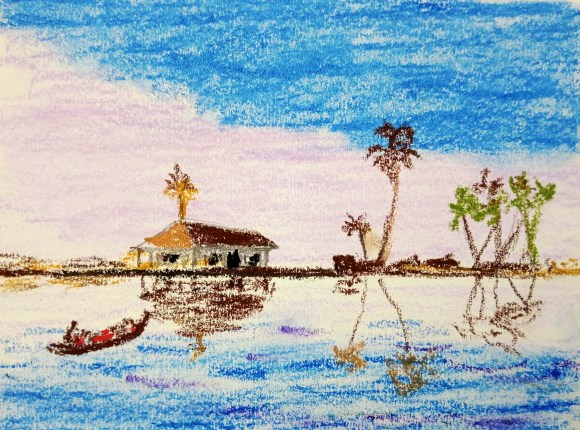
I would want to hugely thank all our team for stretching out and making this a special issue for our sixth anniversary and Manzoor for her fabulous artwork. Huge thanks to all our contributors and readers for being with us through our journey. Let’s change the world with peace, love and friendship!
Let me begin by saying that like most readers enamoured by her works, I really enjoyed reading Arundhati Roy’s first work of memoir Mother Mary Comes to Me published in 2025. It is a soaring account, both intimate and inspiring, of how the author became the person and the writer she is, shaped by circumstance, but above all by her complex relationship to the extraordinary, singular mother she describes as a gangster, as ‘my shelter and my storm’. In the meantime, many reviews of the book have already been published, some full of praise and some quite critical, but it can be undoubtedly said that the book created a literary storm that one hadn’t experienced for quite a long time. And to add to that, social media is now flooded with her interviews, readings etc., some very recent and some as old as fifteen years. This essay delves into several issues pertaining to it that have struck me as unique.
Born out of the onrush of memories and feelings provoked by her mother Mary’s death in 2022, this is the astonishing, often disturbing and surprisingly funny memoir of the Arundhati Roy’s life, from childhood to the present, from her movement from Kerala to Delhi. There are forty-two chapters in this book, not numbered, but the titles themselves are self-explanatory. By following their interesting nomenclature, one can get an inkling of how Roy has laid out her narrative strategy, by talking not only about her own life but how it has been intertwined with her mother in a peculiar love-hate relationship. In the very first chapter titled ‘Gangster’, (which Roy has been reading in many gatherings till now), she tells us about her peculiar relationship with her mother. In her excellent and unique narrative style, she says:
“As a child I loved her irrationally, helplessly, fearfully, completely, as children do. As an adult I tried to love her cooly, rationally, and from a safe distance. I often failed. Sometimes miserably. I wrote versions of her in my books, but I never wrote her.”
She then advices her reader: “Most of us are a living, breathing soup of memory and imagination – and that we may not be the best arbiters of which is which. So read this book as you would a novel. It makes no larger claim.”
The narration of the incidents always does not follow a strict chronological order. Some of the stories are already quite well-known. This tells us how the young Syrian Christian Mary Roy married a Bengali tea planter in Assam and had to soon leave her husband because of his drunkenness and lack of responsibility towards his family. Having no support except for a bachelor’s degree in Education, she takes the bold decision of walking out of the marriage and lands in Ooty along with her two young children to live in her father’s cottage. A few months into her fugitive life, her estranged mother and elder brother arrived from Kerala to evict her. They told her that under the Travancore Christian Succession Act, daughter had no right to their father’s property and that they were to leave the house immediately. Years later Mary would challenge the act in the Supreme Court and demand an equal share of her father’s property, and luckily by winning the case in 1986 she became a sort of celebrity overnight.
The story then moves on to Kottayam and then to Ayemenem in Kerala (some of the details of which are beautifully narrated in The God of Small Things too) where Mary Roy struggles to find a foothold for herself and the children and open a school. That story of how that school began in a rudimentary form and how it gradually grew into the well-known residential institution called Pallikoodam designed by the famous architect Laurie Baker, how it remained a top priority in Mary Roy’s life ( the school children prioritised over her own) along with her own eccentricities, her uncompromising nature and peculiar behaviour ( her refusal to be accepted as the mother of the famous writer Arundhati Roy, being one of them), till her death remains one major strand of the narrative.
The other major narrative strand pertains to Roy’s own life. Arundhati’s version of the story tells us how in the summer of 1976 she finished her high school at sixteen and leaving Kottayam (and of course her mother whom she wanted to dissociate forever), arrived alone without any contact in a completely alien territory in Delhi to take the entrance exam for the School of Architecture. Not having any contact with her mother for several years, she led a bohemian life, lived together with different people, saw partly the underbelly of life and did odd jobs to sustain herself. In the architectural school, she met Pradip Kishen and eventually married him (who was then the husband of the boss under whom she was working for a while). She scripted a screenplay for a movie called In Which Annie Gives ItThose Ones about the college life and though it was once telecast in Doordarshan decades ago, it had been lost till recently the footage has been recovered, restored and set as an official entry in the Berlin Film festival this year but one which Roy refused to attend citing the cause of Palestine.
She was involved in another movie script Electric Moon and acted in minor roles in some off beat films like Massey Sahib till she changed her mission of life. After the publication of The God of Small Things, Roy stopped writing novels and got involved in political and social causes and got involved with social activists like Medha Patkar and the Maoists in the Chhattisgarh region and even faced jail for a day for her protests. The writing she produced for a couple of decades were all powerful political manifestos supporting leftist politics (“The Algebra of Infinite Justice” being one of the well- known texts and My Seditious Heart, published in 2019, is a collection of her non-fiction) till she came up with her second novel The Ministry of Utmost Happiness.
In the meantime, the handsome royalty she received from her first novel changed her living style and for the first time Arundhati Roy managed to eke out a comfortable lifestyle and even buy a house of her own. Her narration is interspersed with several interesting anecdotes, relating to her relationship with her brother whom she mentions throughout as LKC, and their chance meeting with Micky Roy, their father in pathetic condition in Delhi. The chapter titled ‘Mama Bear, Papa Bear’ is very interesting to read. It begins with the following lines: “Seven years had gone by since I’d last seen Mrs Roy. The strangest thing is that I cannot remember how she and I came to be in contact with each other again”. Then the joy of seeing her brother after so many years was exacerbated with their meeting of their father Micky Roy, who had totally disappeared from their lives when they were kids. The pathetic state of the man almost dying out of liquor addiction, we are told about how he was “as frail as a small bird, lame and hunched over …he was severely malnourished, like people in UN pamphlets.” This is how Roy narrates the incident:
‘You would never have believed I was your father. You look so much more like me than your mother. Doesn’t she, Kapil Dev? Same nose. Same eyes…sorry eye.’(Giggle.) ‘I say Orundhuti, do you hit the bottle?’
He pronounced my name the Bengali way.
‘Me? No.’
‘Oh, go on. Tell the truth. All good Roys hit the bottle. Whaddyou say, Kapil Dev?’
(Giggle. Slap.)
After going through all the ups and downs of life, especially in relation to her mother (too many to be narrated here), the story end in the last chapter aptly titled ‘A Declaration of Love’ when in January 2022 she got a message from her mother saying that she loved her. Despite everything that had happened between them, somehow, she knew that to be true. “My lifelong refusal to stop loving her, no matter what, had finally breached her barriers.” The story ends with her death, the details of her cremating process, the performance of the Kottayam Police Band, the 21-gun salute she received and ultimately the memorial they built for her in the bamboo grove where the headstone mentioned Mary Roy as ‘Dreamer Warrior Teacher’ and ‘Founder Pallikoodam.’ The strange love-hate relationship that persisted between Arundhati and her mother comes out beautifully in the end when she writes:
“The first night in a Mrs Roy-less world, I spun unanchored in space with no coordinates. I had constructed myself around her. I had grown into the peculiar shape that I am to accommodate her. I had never wanted to defeat her, never wanted to win. I had always wanted her to go out like a queen. And now that she had, I didn’t make sense to myself any more.”
Another interesting piece of information is revealed in this concluding chapter is about how Arundhati casually decided to get divorced from Pradip Kishen with the same lack of seriousness with which she had got married, so that he and the girls (and their property) had no legal connection to her. The order granting them the divorce had been delivered to her the previous morning, at the very moment Mrs Roy died. ‘So, I, free woman, free falling, was heir to nothing at all. But I was curious about our great will-making mother’s will.’ Later she gets to know that her brother had marked off Mrs Roy’s house and its compound from the rest of the school and had it registered in her name. So, she decided to renovate the house and build the Grove simultaneously in it.
The Cover Design
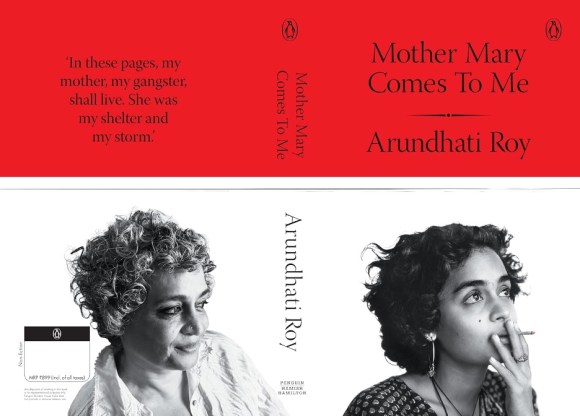
Before concluding, I want to draw the reader’s attention to the special care that has been taken to make and market this book. The cover design is a highly skilled piece of production. On the stark red cover of the book with the title embossed artistically, we have half a dust jacket in white with two different pictures of Roy on the front and the back cover– one a current photograph of the author with her head full of pepper and salt curls and with a discreet smile on her face. The other photograph is of a much younger and radical Arundhati with a distinct far-away look in her eyes and with a burning cigarette on her lips. Though the publisher gives the statutory warning that cigarette smoking is injurious to health and it does not support it in any way, a very stark visual statement about the unnatural bohemian nature of the author gets revealed through this photograph.
Incidentally, this selling of a book through its stark and attractive cover reminded me of a similar strategy undertaken in 1997 when Roy’s debut novel The God of Small Things won the Booker Prize and took the literary world by storm. The book came out in what was essentially the pre-internet and social media era and the maximum number of reviews and essays that came out during that time were in print. In an essay which I had authored then, calling it “The Making and Marketing of Arundhati Roy” I had shown that the contents of the dust jacket of the book differed radically from region to region and it was done through a deliberate and effectively thought-out strategy. So, in the Indian edition we had a different story outline giving us a gist of what to expect inside, especially the love of a paravan, an untouchable man with an upper-caste woman, along with the local setting in Kerala, Ayenemem to be exact.
In the Random House edition published from New York, the story outline was completely different, not only telling us about untouchability and the love between Radha and Krishna that would lure the western reader to pick up the book about a unique place in India defined as ‘God’s Own Country’ in tourist brochures. Also, the photographs of Roy (both taken by her then husband Pradip Kishen) differed radically. With this new book, of course, such strategies didn’t work anymore. With innumerable book launches, readings by the author everywhere (a search on Youtube will even land you with interviews that are more than a decade old) we now come upon other ways and means through which the book has been popularised. But all said and done, I must conclude by saying that whether you agree or disagree with the extreme left wing political views that Arundhati Roy professes, those who still haven’t read this memoir have really missed reading a wonderfully written book with its 372 pages that is really unputdownable, with its lyrical as well as down to earth style of narration, full of new metaphors, new word coinages that are the USP of Arundhati Roy.
Somdatta Mandal, critic and translator, is former Professor of English at Visva-Bharati University, Santiniketan, India.
.
PLEASE NOTE: ARTICLES CAN ONLY BE REPRODUCED IN OTHER SITES WITH DUE ACKNOWLEDGEMENT TO BORDERLESS JOURNAL
In 2015, Shashi Tharoor’s speech at the Oxford Union exploded across social media, striking a chord far beyond academic or diplomatic circles. Framed around the motion “This House Believes Britain Owes Reparations to Her Former Colonies”, Tharoor—alongside eloquent speakers from Ghana and Jamaica—argued persuasively for moral accountability from the former empire. Tharoor’s speech was widely appreciated in India because of the succinctness with which he illustrated how and why colonial rule exploited the subcontinent, and how violence and racism were the order of those days.
“It’s a bit rich to oppress, enslave, kill, torture, maim people for 200 years and then celebrate the fact that they are democratic at the end of it. We were denied democracy, so we had to snatch it, seize it from you,” he said to loud applause from the audience.
But while insightful points such as these formed the crux of Tharoor’s eloquent speech, it was his rapier barbs that had the esteemed audience (and netizens alike) crowing. “No wonder that the sun never set on the British Empire,” he says at one point, referencing a common boast used to illustrate the sheer extent of Britain’s power, “because even God couldn’t trust the English in the dark.”
The speech’s viral success revealed a yearning—particularly among millennials raised on televised debates and editorials—for a mode of discourse that is rapidly disappearing. Where once prime-time slots featured fiery discussions on social and political issues about caste, class, gender, and policy, today’s digital platforms prioritise speed, relatability, and aesthetics.
In the India of today, a viral tweet can spark more conversation than a peer-reviewed article. A beauty influencer’s “Get Ready With Me” vlog is more likely to trend than a lecture by a scholar on social justice. The thought leaders of the past were expected to speak with gravity; the content creators of the present are expected to sparkle. When public intellectuals are replaced by public influencers, the nature of cultural discourse changes. Popular culture, once a mirror held up to society, now leans into escapism. Complex socio-political debates are flattened into clickable soundbites, and intellectual inquiry is often sidelined by algorithm-friendly content categories, sorted by SEO value[1].
Intellectuals once forced us to think harder, ask more difficult questions, live with complexity. Influencers invite us to feel seen, validated, or soothed. One expands the self, the other simply flatters it.
India’s Golden Age of Thought: When Public Intellectuals Shaped the Nation’s Conscience
Once upon a time, India did not lack public intellectuals. In fact, the early decades after Independence saw them thrive because India’s tradition of intellectual dissent is long and storied. Figures like Nehru, Gandhi, Ambedkar, Tagore—they were not just leaders or writers; they were public philosophers.
Thinkers engaged with the moral and political questions of their time, not just within academia but in public forums, books, interviews, op-eds, and essays that reached a wide, engaged readership. They helped build the intellectual spine of a newly independent nation grappling with secularism, caste, democracy, and justice.
Even in Bollywood, cinema once offered social critique—from Guru Dutt’s Pyaasa (Thirsty, 1957) to Shyam Benegal’s Ankur (The Seedling, 1974). They were conscience-keepers, cultural critics, and truth-speakers. They didn’t shy away from controversy—many actively courted it. They weren’t afraid to speak against majoritarianism, economic inequality, censorship, or communalism.
Meanwhile, halfway across the world in Texas, a young boy named Wes Anderson—who would go on to become one of the most distinctive voices in contemporary cinema—found himself deeply influenced by Satyajit Ray. It wasn’t just Ray’s pioneering cinematic style that captivated him, but also his prolific work as a writer and illustrator, and his powerful engagement with public discourse. Through his films, Ray offered a radical and empathetic lens on Indian society, boldly confronting issues such as poverty, gender roles, the tension between tradition and modernity, and the human consequences of social change—perspectives that were remarkably ahead of their time and continue to resonate across cultures.
Dr. A.P.J. Abdul Kalam was one of modern India’s most beloved and influential public intellectuals—a scientist, teacher, and former President who embodied the rare blend of deep technical knowledge and visionary humanism. Revered as the “Missile Man of India” for his pivotal role in advancing the country’s space and defence programs, Kalam also brought science into the public imagination with clarity, humility, and hope. His presidency (2002–2007) was marked by an earnest outreach to young people, whom he inspired to dream beyond the limitations of circumstance. Unlike many in power, Kalam believed in the democratisation of knowledge—he made complex ideas accessible, challenged youth to innovate, and constantly linked progress with ethics and spirituality. In doing so, he redefined what it meant to be a public intellectual in India: not someone cloistered in academia, but a leader who imagined a better future and invited the nation to build it with him.
Brains Behind Paywalls: How Intellectualism Lost Its Spotlight
There’s no shortage of brilliant minds today—but intellectualism requires both platform and patience. Neither is abundant. A YouTuber dissecting colonial legacy in Indian education may get a few thousand views; a beauty blogger with “chai latte skin” content racks up millions. But now, intellectuals are trapped producing work for journals and conferences rather than the public sphere. As a result, public-centred intellectualism has become rare. It’s not because intellectuals of that caliber no longer exist, but that the structures that once made their ideas visible have been buried under layers of institutional gatekeeping.
The decline of the public intellectual isn’t just the result of a shifting media landscape—it’s also tied to how our access to and expectations around knowledge have evolved. There was a time when intellectuals were celebrated as generalists, able to navigate literature, politics, science, and philosophy, and translate complex ideas for a broader audience. Think of Susan Sontag or Bertrand Russell—figures who didn’t confine themselves to narrow academic lanes but moved fluidly across disciplines to spark public thought and dialogue.
Today, intellectual life has become increasingly siloed. Hyper-specialization has turned academia into an insular world where scholars speak primarily to other scholars. Rather than bridging the gap between advanced knowledge and public discourse, modern academics are often locked within their own echo chambers. The public philosopher who once commented on culture and politics has given way to specialists producing work for a niche audience of peers.
Even when academics do attempt to reach beyond their field, they’re often met with suspicion. A historian writing on political theory or a physicist reflecting on metaphysics is likely to be dismissed for stepping outside their “expertise.” Intellectual authority today is rigidly policed, and interdisciplinarity—once a hallmark of great thinkers—is now treated with skepticism.
From Public Intellectuals to Public Aestheticism: How Influence Got a Makeover
Today’s cultural powerhouses operate on a very different wavelength than their predecessors. Where figures like Susan Sontag or James Baldwin once shaped public consciousness through sharp intellect and critical writing, today’s influencers—like Kim Kardashian—wield their power almost entirely through aesthetics. Kardashian doesn’t publish essays; she sets the tone for global beauty trends. With each new look—glazed donut skin, brownie lips, strawberry makeup, and the almost comically indulgent cinnamon cookie butter hair—the Kardashians and Jenners reshape beauty norms with a force that rivals traditional intellectuals.
In India, the landscape mirrors this shift. Influencers like Ananya Panday and Ranveer Allahbadia amass millions of views despite offering little in terms of originality or eloquence. Much of their content borrows from what’s already been done, often repackaged with no clear voice of their own. Unlike cultural figures such as Shabana Azmi or even Priyanka Chopra[2]—whose words once commanded attention and mattered—many of today’s digital celebrities struggle when pulled out of the comfort zone of scripted, bite-sized platforms. Their polished online personas crumble under the pressure of unscripted public discourse.
What we’re left with is a curated illusion, a constant performance of identity. And the troubling part? Young audiences are watching, emulating, and internalising these facades—until, inevitably, a scandal breaks the spell. In an era ruled by surface and spectacle, authenticity has become the rarest currency of all.
If Joan Didion or Arundhati Roy represented a time when public intellectualism had mass appeal, these influencers represent what has replaced it: public aestheticism. A philosopher might spend years constructing a critique on our society, but an influencer can change peoples’ worldviews with a single Instagram post. Influence now moves at the speed of an Instagram story. The philosopher builds theory; the influencer sells a mood. In this new aesthetic economy, they are the message, the medium, and the marketplace all at once. This is not an incidental shift, but a reflection of our broader cultural transformation.
Although, this is absolutely not a wholesale condemnation of influencers. Many use their platforms to raise awareness, fundraise, and spotlight important issues. But influence has become aestheticised. And when beauty, brevity, and branding become the dominant currencies of expression, difficult truths become harder to hear.
Even figures with a platform one would consider intellectual, like a podcast or blog, tend to operate within a different framework than the public intellectuals of the past. The most successful are the ones who know how to package their ideas into easily consumable formats. Their content may demand engagement, but not necessarily deeper thinking. The most successful cultural critics of our digital age are simply a different kind of influencer, one who may sell a worldview rather than a skincare routine, but are selling something nonetheless.
Amidst all of this, we have lost the expectation of being challenged by our cultural figures. We have lost the collective memory of what it means to gather around an idea rather than a trend. We have lost the stamina for long-form thinking. We now crave hot takes instead of deep dives, personality over principle, vibes over values. We’ve also stopped expecting our cultural figures to challenge us. We ask them to inspire us, to entertain us, to market their authenticity. We no longer crowd into halls for heated debates—we scroll.
When Influence Replaces Insight: The Rise of Apathy and the Fall of Public Thought
The culture hasn’t gone quiet though. Indian influencers—fashion bloggers, tech reviewers, lifestyle curators, “finance bros”, even comic creators—are the new cultural capital. They dominate conversations on what matters to people: from wedding aesthetics and productivity hacks to skincare routines and budget investments. The currency of their influence isn’t depth but relatability, not dissent but delight. Even in the realm of “education”, we find influencers gamifying complex financial or political ideas into simplified carousels or 60-second explainers. It’s not necessarily bad—but it is diluted.
It’s also understandable why many hesitate to enter intellectual spaces today—there’s a prevailing sense that everything worth saying has already been said. We live in an age where every thought seems pre-articulated, every argument countered, every counterpoint already dissected. The landscape isn’t lacking in intellectual potential; it’s that fewer people feel confident stepping into the role of a public intellectual, believing true originality is no longer possible.
This mindset breeds an intellectual echo chamber. Rather than contributing to the discourse, many settle into passive consumption, convinced that someone else has already voiced every worthwhile idea.
But the truth is, no conversation is ever truly finished. History shows us that ideas are living things—they shift, adapt, and deepen depending on who engages with them and when. The same philosophical questions that animated thinkers centuries ago continue to evolve, finding new relevance in each generation. Feminism as it was understood in the 1970s is not the feminism of today. Jean Baudrillard’s meditations on media and hyperreality in the 1980s feel hauntingly prescient in our digital age—but our reading of him is inevitably shaped by the world we now inhabit. Every era reinterprets the past, and every new voice brings a fresh lens. That’s what keeps the intellectual tradition alive.
Reclaiming Thought: Can Intellectualism Survive the Age of Spectacle?
So, can the intellectual space be reclaimed, or has it been permanently absorbed into digital spectacle? Long-form discussions found in podcasts, essays, and forums are a great starting point. Platforms of these media types allow for deeper exploration of ideas, where nuance and depth are greatly valued.
And it’s not that intellectuals have disappeared. They are still here, writing essays, protesting laws, mentoring students. But they’ve been pushed to the peripheries of public attention. Their audiences are shrinking, and their words are often drowned out by the louder, shinier pull of influencer content.
But intellectual spaces aren’t only limited to these traditional platforms. Niche online communities like internet book clubs on Fable or Instagram create new ways for people to connect with unique ideas. You can also incorporate intellectual conversation into your everyday life. Attend local events, art galleries, or even start casual discussions among friends to make these topics more accessible and relevant. The intellectual sphere may have shifted, but it isn’t gone. We simply have to work to reclaim these spaces with people who are willing to engage deeply with ideas.
Ultimately, the death of the public intellectual may not be as tragic as it seems, it may just mean that intellectualism is taking on new forms. But we have to ensure we’re not losing sight of what really matters—the depth, complexity, and refusal to settle for easy answers in the pursuit of something greater.
Culture Is Still Loud—It Just Doesn’t Want to Make You Uncomfortable Anymore
There’s another reality unique to India: the active suppression of dissent. To be an intellectual in India today, particularly one critical of the status quo, is to court danger. Writers have been jailed (Anand Teltumbde), journalists have been shot (Gauri Lankesh), and students have been arrested for protest slogans. In such an atmosphere, who would choose to be a public intellectual?
The public intellectual, by definition, is someone who speaks truth to power. In India, speaking truth to power comes at a high cost. And so, instead, we scroll. Meanwhile, the influencer class thrives because they are apolitical by design. Their influence is rooted in apathy, in not asking uncomfortable questions. This is not a coincidence. It is by systemic design. The less we think, the more we consume. The more aestheticised our discontent, the less threatening it becomes. Influencers now perform the soft work of culture—sedating, distracting, pacifying—while hard truths are hidden behind paywalls, FIRs, and broken institutions.
But if the public intellectual is to make a comeback, we as an audience must do our part. We have to choose depth over dopamine, discomfort over convenience. We must resist the temptation to aestheticise every idea until it’s just another lifestyle choice.
Because when thought leaders become brand ambassadors, and reflection becomes a trend, we risk forgetting that ideas—not images—are what truly shape society.
The public intellectual may be on life support, but the conversation isn’t over. It never is.
[1] SEO (Search Engine Optimisation) value refers to the estimated monetary worth of organic traffic generated by a website through search engine optimisation efforts.
Lopamudra Nayak is a poet, freelance writer, and biotechnologist with a passion for literature and storytelling. She writes poetry, book reviews, and reflections on pop culture on her blog, Substack and Instagram.
.
PLEASE NOTE: ARTICLES CAN ONLY BE REPRODUCED IN OTHER SITES WITH DUE ACKNOWLEDGEMENT TO BORDERLESS JOURNAL.
Poulami Bose Chatterjee converses with Ratnottama Sengupta
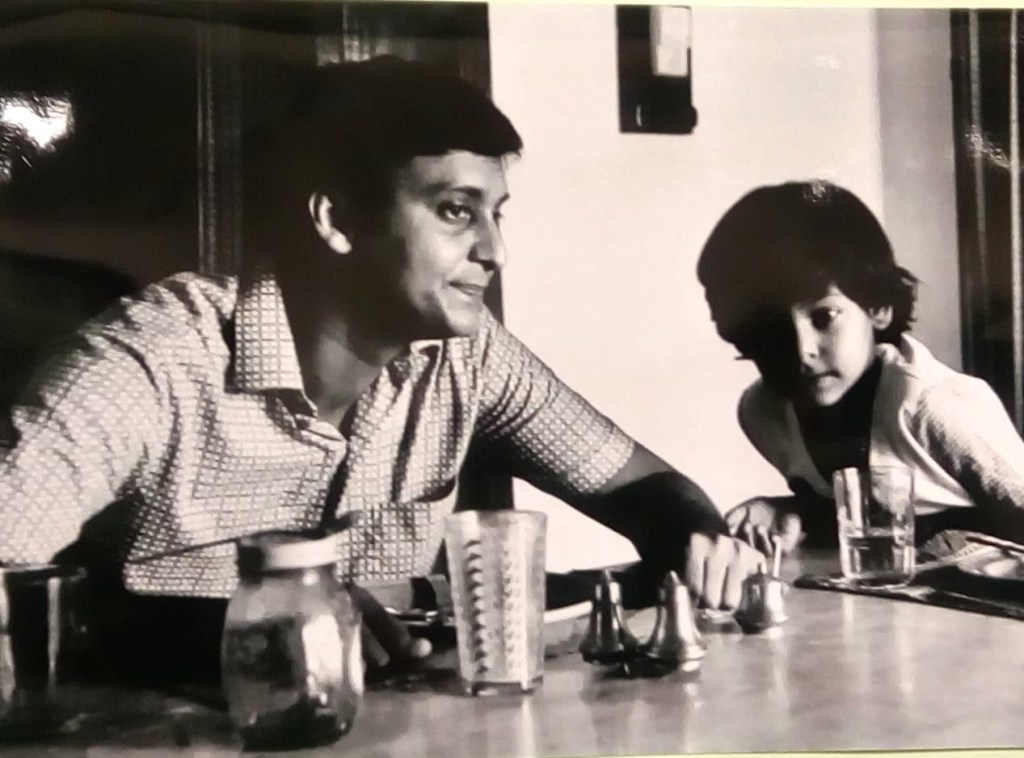
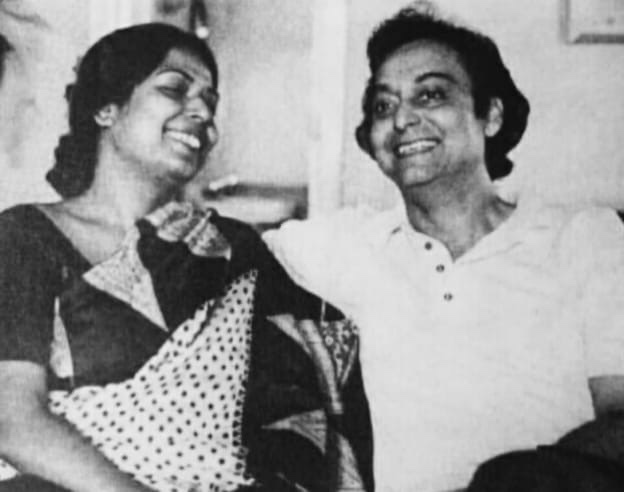
Young Soumitra Chatterjee with his daughter, Poulami. Photo provided by Ratnottama Sengupta
“All the recovery Rono Bhaitu[1]( Soumitra’s grandson) has made, is entirely due to his mother,” Soumitra Chatterjee (1935-2020) had said to me when I met him before Covid set in. His voice was laden with deep affection and paternal pride for his daughter. Deservedly so, as the world has been witnessing since the star actor passed away in November 2020. Poulami took upon herself the male mantle of lighting her father’s pyre.
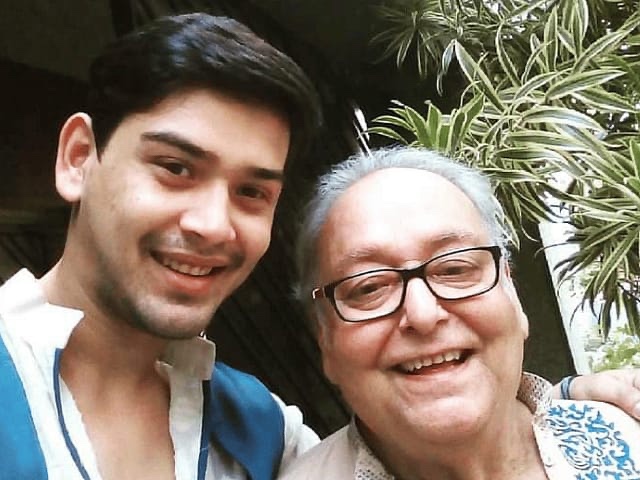
An older Soumitra Chatterjee with his grandson, Ronodeb Bose. Photo provided by Ratnottama Sengupta
But that was neither the beginning nor the end of her duty towards her father. I had seen her perform on stage alongside the thespian in Homapakhi [A Legendary Bird] that had explored the complexities of a society trying to reconcile its modern aspirations with traditional roots.
And last November she directed Janmantar [Rebirth], an original play Soumitra Chatterjee had written in 1993 but was never staged before. Seen through the eyes of a matinee idol who is visiting a remote village in Purulia, it focused on ills like child marriage, witch hunting, clash between and land owners and cultivators. “Unfortunately, 30 years later too, all the ills are still thriving on that soil,” Poulami said to me.
Poulami with Soumitra. Photo provided by Ratnottama Sengupta
And in January, even as the definitive biography Soumitra Chatterjee and his World was being launched in the Kolkata Literary Meet, she staged Chandanpurer Chor [The Thief of Chanderpur], his light hearted transliteration of Jean Anouilh’s Carnival of Thieves[2], to mark his birth anniversary.
On the eve of the International Women’s Day I conversed with Poulami, whose parents have been an integral part of my life too.
Ratnottama Sengupta: Who is Poulami? A Bharatanatyam dancer? A theatre person? Mother of an actor with a brief trajectory? Or, daughter of Soumitra Chatterjee?
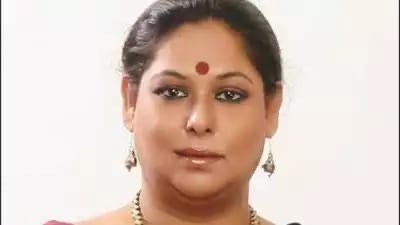
Poulami Bose Chatterjee
Poulami Bose: I think Poulami is a bit of all this — along with a passionate theatre practitioner. I am my mother’s daughter too. I hope I am a loyal friend to my friends. But above all I’m myself. I like to think of myself as a free spirit — absolutely totally in love with my daughter and son and music and dance and theatre and all that is wonderful in the world.
RS: When did you first realise that your father was not a 10-5 pm office going father like that of other girls? That he was a star?
PB: For a long time in my growing up years I actually didn’t realise how big a star he was. He was a very loving, hands-on father, very involved in our lives. I always knew he was an actor but didn’t realise the magnitude of his stardom. He never brought that aspect home. Our home was always filled with lively discussions, about books, music, paintings, dance, theatre, cinema, the environment, travel… It was a beautiful childhood, very loving, very secure.
Bapi [father] and Ma were always introducing us to new things. Encouraging us to embrace the world. I thought that was normal and that’s what every father was like. Only after I grew up did I realise his impact on the Bengali moviegoers’ lives.
RS: What did a ‘cine star’ mean to you when a) you were learning Bharatanatyam under Thankamani Kutty? b) Studying? c) Getting married to Ruchir Bose?
PB: The word ‘Cine Star’ didn’t matter much when I was learning dance or studying because I was treated just like any other student, by my teachers and my friends. In fact my father didn’t believe in the word ‘Star’. He maintained that he was a professional actor — and we were certainly not encouraged to have airs and graces about us. So we interacted normally with people, and people did likewise. Some people were of course star struck but they didn’t make a difference to me. As for getting married to Ruchir: he was and still is a very down to earth person, far removed from the film industry, very humane. He and his family have always accepted me and treated me for who I am rather than who my father was.
RS: Who was a bigger star for you — Soumitra Chatterjee or Satyajit Ray?
PB: Of course Satyajit Ray! Soumitra Chatterjee was my father first and then everything else, whereas Satyajit Ray was larger than life. We grew up hero worshipping him. Our whole family was absolutely in awe of him — as a person, as a filmmaker, an author and the rest. We were influenced a great deal by his way of life. His sensibilities. In fact we still idolize him.
RS: Which films of Soumitra Chatterjee have you loved most?
PB: Oh there are so many! Apur Sansar, Sansar Simante, Jhinder Bondi, Koni. Ekti Jiban, Dekha, Mayurakshi, Agradani, Ashani Sanket, Abhijan, Sonar Kella, Ganadevata, Atal Jaler Ahwan, Aparichita, Teen Bhubaner Pare, Baghini, Basanta Bilap, Shakha Prasakha, Charulata, Kapurush, Akash Kusum, Dwando, Borunbabur Bondhu…[3] I can go on.
The most impressive thing for me was his versatility. He was different in all the films that I have mentioned above. He was one actor who didn’t have mannerisms. He always became the character. I have seen him doing a lot of homework, research to delve deep into the character’s psyche. Acting was his passion and that was evident in whichever role he played.
RS:Which film of your father has impacted you most? One that moved you at a personal level, perhaps because you identified with it most?
PB: I think Koni. His now iconic dialogue, “Fight Koni, fight!” has stayed with me till this day. Whenever I feel low or face any kind of obstacle, I always remember him in the film. How the human spirit is capable of rising against all odds. How hard work and determination can carry you forward. It inspires not to give up without a fight.
RS: Soumitra Da was a Master in Bengali; Deepadi[4] in English. Who guided you in your studies? Who selected what books you will read?
PB: My parents, like I said earlier, were hands on parents. They, both, helped me with my school work. The atmosphere in our house revolved around books, so we read a lot while growing up. Ma had done her MA in Philosophy. She and Bapi introduced me to both English and Bengali literature. Bapi was more strict, he expected me to read classics and serious books. Ma was more liberal, she let me read anything I wanted to, including romance novels which my father thought were a waste of time.
Soumitra and his wife Deepa. Photo provided by Soumitra Chatterjee
RS: So who are your favourite authors?
PB: I am eclectic in my choice. I read classics as well as bestsellers, plenty of them. My favourite authors are Tarashankar Bandopadhyay, Bibhuti Bhushan, Manik Bandopadhyay, Jibanananda Das, Shakti Chattopadhyay, Sunil Gangopadhyay, Charles Dickens, O Henry, Oscar Wilde, Maupassant, Shirshendu Mukhopadhyay, Samaresh Basu, John Grisham, Pablo Neruda, Gabriel García Marquez, Arundhati Roy, Agatha Christie, Akhtaruzzaman Elias, Humayun Ahmed, Jeffrey Archer, Khaled Husseini, Chitra Divakaruni Banerjee, Satyajit Ray, Sukumar Ray, Saradindu Bandopadhyay, Paolo Coelho, Gerald Durrell, Charlotte Bronte, Emily Bronte, Lewis Carroll… to name a few!
RS: Soumitra Da was a poet. He also translated plays — classics of world theatre — into Bengali. What was he most happy to do — act in movies? Write and direct plays? Or retire to the inner world of poetry?
PB: All three. I’ve never seen him sit idle or waste time. It depended on his mood — he loved doing all three. But I must add: theatre was, always, his first love. He was deeply influenced by Sisir Bhaduri (1889-1959), with whom he had started out. He directed plays for Pratikriti, a group that Ma had — and he directed plays for Abhinetri Sangha, set up by the actors of Tollygunge.
RS: Deepadi was an ace badminton player. Did she give up her own world to be Mrs Soumitra Chatterjee?
PB: She gave up her career primarily for us. Bapi was at the peak of his career and was naturally very busy. Ma felt we needed to have at least one parent around, always. In retrospect, I realise it was a huge sacrifice. But I have to say, both my brother and I needed her. I think she realised that and did what most mothers do: she prioritized us over her career.
Ma had the biggest heart ever. She was more intelligent than the three of us put together. And she was non-judgmental about who she was reaching out to. So many sportswomen she helped, on her own. And I vividly remember this young Muslim boy in New Market who always carried her shopping to the car. One day Ma learnt that he had TB. She immediately brought him home and organised a room on the terrace for him to stay until he recovered. She didn’t hesitate because she had children, she didn’t seek the advice of doctors, she didn’t think twice because her husband was a star!
RS: Why did you choose to carry forward Soumitra Chatterjee’s legacy on stage rather than on screen?
PB: Theatre kind of seeped into me. I used to watch Bapi – when he was idling, he would arrange the empty cigarette and matchboxes to design sets. I have been on stage ever since I could walk. It is my first love. I’m passionate about live performances, be it dance or theatre. Not that I didn’t get offers for films but I never actively pursued them. I married relatively early and had both my children by the time I was 26. Stage was always more accommodating and easier to manage. And till now the magic of the stage hasn’t worn off. I am still madly in love with the stage. Screen just didn’t happen… no particular reason, really.
RS: Soumitra Da was proud of his grandson’s screen presence. And he was extremely proud of the manner in which you handled your son’s unfortunate accident. Would you like to talk about it?
PB: Bapi had high hopes for Ronodeep. He felt Rono was a very sensitive actor perfectly suited for the screen. He was devastated by Rono’s accident. It was the most tragic thing to have happened in all our lives. But I have come to terms with it. I count my blessings — it could have been worse! Rono is with us — a bright and wonderful boy, sensitive and sweet, full of love and empathy. He still has a long way to go in terms of recovery and health but he’s getting there, one step at a time…
I have learned a lot from this phase of my life. I continue to learn every day. It has also shaped me, moulded me as a person. Bapi-Ma told me always to have grace even under pressure, to be always dignified. I have tried to follow them.
RS: Can you recount one cherished moment with your father?
PB: In May 2020, months before he passed away, during Covid, Bapi and I were just sitting and talking about various things. Suddenly he told me, “Mitil I have never said this to you before but I want you to know that I am very proud of the way you have conducted yourself during Bhaitu’s accident and every day since then. Your dignity and your grace has made me really happy. I’m so proud that you have turned out to be the person you are!”
All through my life I will cherish this one moment.
RS: In today’s world many daughters are taking up the responsibility of carrying forward the legacy of their fathers. What, in your opinion, has brought about this social change? Did Soumitra Chatterjee raise you to (consciously) fight patriarchy?
PB: I guess the world is waking up to the fact that what sons can do, daughters can do better! I really don’t know what exactly has brought this social change but I definitely welcome it. My daughter is a great source of strength for me. She is my best friend. My father had raised my brother, Sougata, and me as equals, maybe favouring me a tad more!
Bapi was always ahead of his times. He always told me, “The sky is the limit, you can do whatever you set your mind to.” But it was Ma who very consciously taught me to fight patriarchy. She was a champion for the girl child.
RS: Soumitra Da was never lured by the reach and fame of Bollywood? So, why did he direct Stree Ka Patra[5], the telefilm he made for the national television, in Hindi?
PB: Bapi believed that he could deliver best in his own mother tongue. Besides, he was not enamoured of the kind of films made in Bollywood at that time. He loved his life here, his theatre, his poetry, and co-editing Ekshan, the culture magazine that first published Satyajit Ray’s script. Going to Bollywood, he felt, would put a stop to all his literary and theatrical pursuits.
However, he got the offer to direct Stree Ka Patra for National Doordarshan, and it came with the clause that it had to be in Hindi. The other telefilm he directed, Mahasindhur Opar Theke [ From the Other side of the Ocean] was in Bengali
RS: Many uncharitable people say that Soumitra Chatterjee wasted his talent by limiting himself to Bengali films and by indiscriminate selection of roles — because of his family responsibilities. Your response to this?
PB: Limiting himself to Bengali films was a conscious decision he made. And I have just elucidated the reasons. Yes he wanted to provide for his family, and he did so the only way he knew to — by acting. He never shied from saying that he was a professional actor. And if he wanted to take on the responsibilities who is anyone else to talk about it?
He could have abandoned his family like many others. He chose not to. His family, his life, his choices… that’s all I can say.
RS: You have grown up in close proximity with stars like Sharmila Tagore, Madhabi Mukherjee, Sandhya Roy, Tanuja, and directors like Tapan Sinha, Ajoy Kar, Tarun Majumdar, Rituparno Ghosh. Please share some memories/ anecdotes with us.
PB: The only name in the list who I have grown up in close proximity with is Tapan Sinha, whose birth centenary is being celebrated. He was a wonderful human being! While we were growing up we didn’t interact much with people from the film industry. We certainly met them but at parties, weddings, social events…
My parents had a huge circle of friends. A doctor’s group. My mum’s friends. Poets like Shakti Kaku and Sunil Kaku. My dad’s friends like Nirmalya Acharya, the co-editor of Ekshan. Directors Ajit Lahiri, Ashutosh Mukherjee, Nripen Ganguly who was fondly called ‘Nyapa Da.’ Friends from theatre. His childhood friends. It was a vast cross section of people, so it was wonderful, happy and great fun growing up around so many amazing people.
RS: Gaachh [Tree], the documentary by Catherine Berger, focused only on his stage life. Abhijan[6][The Expedition] directed by renowned actor Parambrata Chatterjee, did not excite cineastes who have adored Soumitra Chatterjee, honoured with Dadasaheb Phalke for cinema, Sangeet Natak award for theatre, decorated with the Lotus award of Padma Bhushan and the French Order des Arts et des Lettres. Will you give us a biopic of Soumitra Chatterjee on stage?
PB: I am not in favour of a biopic for someone like Bapi. On the other hand, a stage production would be limiting. He was a multihued talent. It is difficult to capture so many facets of his personality. It is a daunting task to encompass every nuance, every shade of such an extraordinary life in a single film. A biopic should not be made if it does not do justice to the magnificence of the man.
.
[1] Ronodeb Bose, grandson of Soumitra Chatterjee, had a bike accident in 2017
[2] Jean Anouilh (1910-1987), Carnival of Thieves(1938)
[3] Bengali films in which Soumitra Chatterjee played the lead.
[5] A pun in the heading. Stree is woman, Patra is vessel as well as a prospective groom. So, a Woman’s Vessel or Prospective Groom
[6] Soumitro Chatterjee played the lead in the 1962 Abhijan, directed by Satyajit Ray
.
Ratnottama Sengupta, formerly Arts Editor of The Times of India, teaches mass communication and film appreciation, curates film festivals and art exhibitions, and translates and write books. She has been a member of CBFC, served on the National Film Awards jury and has herself won a National Award.
.
PLEASE NOTE: ARTICLES CAN ONLY BE REPRODUCED IN OTHER SITES WITH DUE ACKNOWLEDGEMENT TO BORDERLESS JOURNAL




 Borderless