Categories
Slices from Life

A Towering Inferno, A Girl-next-door & the Big City

Ratnottama Sengupta time travels fifty years back as famed actress Jaya Bachchan recounts her first day on the sets of Satyajit Ray’s Mahanagar
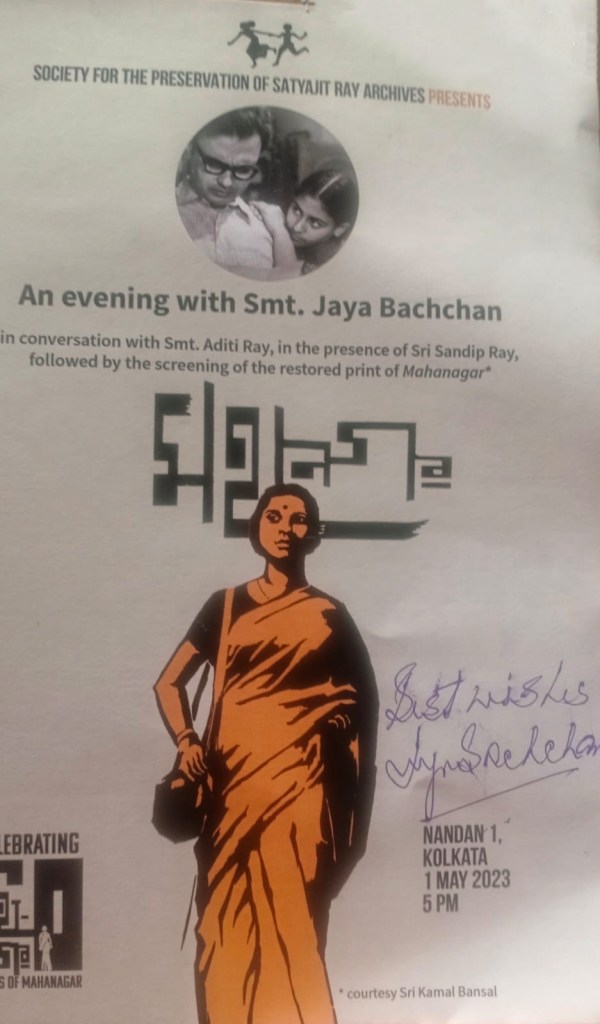
In this event, Jaya Bachchan recounts her days while acting in Satyajit Ray’s award-winning film Mahanagar or The Big City. Photo provided by Ratnottama Sengupta

When Shanti Di, my eldest aunt’s eldest daughter, had got married in 1964, she was already working. So she did not have to face the resistance Arati, the pivotal character of Mahanagar had to face from her in-laws and son. But prejudices and cryptic comments she did face — from her male colleagues. “Women in workplace? They only deprive deserving men of a livelihood,” they would say. “Because, men have to run entire households on their earnings while women work only for the ‘sauce’ — jewellery and saris!”
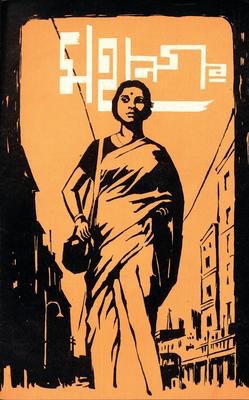
Mahanagar poster designed by Satyajit Ray. Photo provided by Ratnottama Sengupta

I remembered this at the screening of a restored print of Mahanagar (The Big City, 1963) at Nandan, the West Bengal Film Centre, to mark the 102nd birth anniversary of Satyajit Ray. Based on Narendra Mitra[1]‘s novel, Abataranika (Staircase), the film followed the trials and triumph of Arati, a housewife who steps out of the narrow domestic walls when she finds her husband Subrato bending under the weight of fending for a superannuated father, an aged mother, a school going sister, and their little boy along with themselves. 

But once she starts working, she enjoys her new role of conversing with and convincing women with deep pockets to buy her products — and soon her confidence in her work grows along with her empathy with other women who are yet to be empowered like her sister-in-law, Bani, her mother-in-law, Sarojini, her Anglo Indian colleague, Edith Simmons…  When her husband loses his job, Arati firmly negotiates a raise. And when Edith is fired for absence due to ill health she takes up cudgel for the ‘insult’. 

The remarkable sensitivity and the eye for details with which Satyajit Ray etched the ordinary lives of a middle class family earned him the Golden Bear at the Berlin Film Festival 1964. The director’s son, Sandip Ray, remembers attending the ceremony with his parents. “Why were you not there?”  a voice from the audience asked Jaya Bachchan, who was in conversation with the maestro’s son, now a renowned director in his own right. “Why would they invite me, who was just a ‘cameo artiste’ as someone mentioned this evening?”
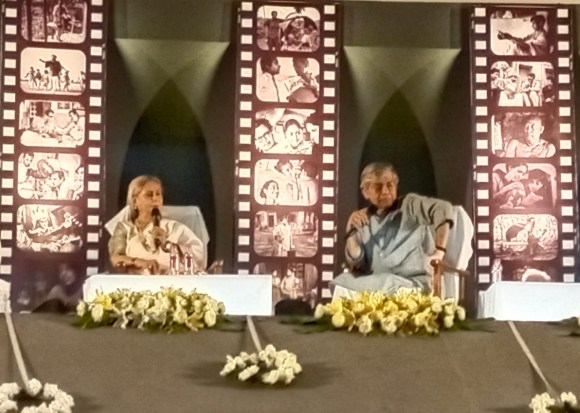
Jaya Bachchan and Sandipt Ray conversing at the event on May 1, 2023.

Jaya Di[2] — as I am privileged to address her, much like Sandip ‘Babu’ Ray — was much more than a cameo artiste in Mahanagar. Her ‘Bani’ was a flesh and blood character as she brought to life a marriageable sister who, in my childhood and not just in Bengal, was a part and parcel of any Indian household. Bubbly, sincere, attached to her Boudi as much as to her little nephew whom she mothers when the housewife is earning the family its bread, she is pampered by her brother even as she is being trained by her mother to pick up the haata-khunti…spatula-spoon…in the kitchen!

“I distinctly remember the first day of shooting in Indrapuri Studios. It marked my debut in films. Madhabi Di and Anil Kaku were in that shot which is reproduced whenever something is written about Mahanagar. I am at the study table, trying to write something. Those days I used to wear specs when I was reading.  Manik[3] Kaku must have made a mental note of that, he said, ‘Don’t take off your specs, keep them on for the shot.’ I didn’t have any dialogue for the scene. So, although I had not even been on stage before this, I didn’t feel that I was acting. The camera in front of me with Subrata Mitra behind it was not daunting. I was comfortable, just my usual self…”

Little did Jaya Bhaduri know, then, that this ‘girl-next-door’ identity would become her calling card in the years to come, storming even the glamorous boulevards of tinsel town Bollywood.

*

How did Jaya reach the sets of Mahanagar? She didn’t: Ray had sent for the girl in her teens. In all probability, she was recommended by Robi Ghosh and Sharmila Tagore. “They were shooting for Tapan Sinha’s Nirjan Saikatey (1963) when I had gone to Puri with my father, Tarun Bhaduri,” Jaya Di recounts. “We met them and on their return to Kolkata both Robi Kaku[4] and Rinku[5] Di told Manik Kaku that ‘the girl for that role (of sister) has been found at last!'” 

The first time she met Ray he did not ask her anything special. Nor did he ask her to do anything particular on the set. Young Jaya was told to read her lessons aloud, which she did, just as any school going child in Bengal did half a century ago. “I remember that Baba told Jaya Di to continue reading after the camera had moved on because he wanted an audio track of her reading in the background,” Sandip recalled in the course of the conversation. “She continued to read, but suddenly there was a sound of coughing. What happened?? In reply to everyone’s anxious query she coolly replied, ‘Why? Can’t a fly wing its way into my mouth while I’m reading?'”

Jaya Di herself has no recollection of this prank, but she vividly remembers that she would pester people on the set, incessantly asking questions. She especially questioned Subrato Mitra for taking time to light up! “It was as if we were out on a picnic,” she smiles. “The entire unit indulged me like a little girl. I was very comfortable because I had no burden to carry. In the presence of major actors I was required to do very little!”  

*

Jaya Bhaduri was not given any express direction — neither about how to speak her lines nor about action or emotion. She had full freedom to interpret the scene and react to the other characters. “Manik Kaku used to call all the artistes and read out all the dialogues to us. His intonation would give us an idea of what he wanted from us. We interpreted the scene according to our capacity and gave our best shot. He went about canning it, he never had any problem with my delivery.” 

But lessons in acting she did learn on the sets of Mahanagar — by observing how the director groomed the lead actress. “I have seen Manik Kaku directing Madhabi Di to grow into the role of Arati. He literally groomed her in acting. ‘Look this way, through the corner of your eyes. Turn your head like this. Say it like this. Wear the sari in this manner…’ The fact is that Satyajit Ray had a strong visual sense. He envisaged how the character would look and behave at the outset, how she would change, how she would resolve her dilemmas.” 

In other words, his actors were not puppets: he allowed the spontaneity of some, like Jaya; he moulded the emotive action of some, like Madhabi Mukherjee who would soon storm the silver screen as Charulata (1964).

*

Mahanagar was a very modern film, and not just at the time it was made,” Jaya Bachchan observes. Her critique of Ray’s first urban development film gains greater weight from the fact that, in the intervening years, she has ‘grown up’.  From a school girl to a trained actor. From the heartthrob of every Indian family in 1970s to the heartthrob of her ‘Lambuji[6]‘ — Amitabh Bachchan — whose charisma straddles two centuries, three generations, five continents. From a reclusive personal life to a vibrant political presence in the upper house of India’s Parliament. 
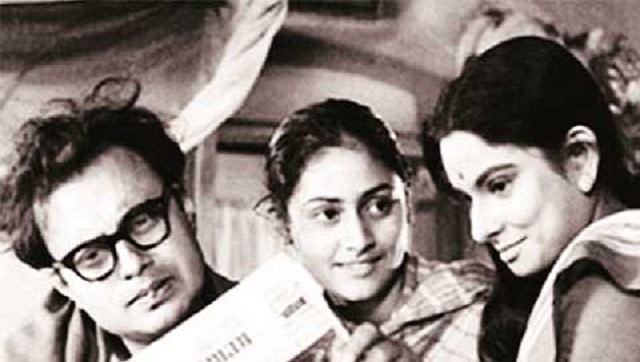
Young Jaya Bhaduri (now Jaya Bachchan) in between lead actress Madhabi Mukherjee and Anil Chatterjee. Photo provided by Ratnottama Sengupta

So let me elaborate on her observation, taking off from a scene between her and Subroto, her elder brother in Mahanagar, enacted by Anil Chatterjee.

Subrato has come home from work and his sister asks him for his pen as hers has run out of ink. He enquires when her exams are to commence, then he comments, “What use is this reading and writing? Sei toh henshel thelte hobey, you’ll end up dealing with only pots and pans!” 

Sekhaay toh,” Bani is quick to revert. “They teach us that too – it’s Domestic Science.”

That statement portrayed Ray’s attitude towards housewife. It was and still is a commentary on the identity — role — of a contemporary wife. It is in fact every woman’s attitude in contemporary India, 

Jaya Di has observed: “Today every woman also has to and does work. Not only for economic reasons but for identity, purpose in life. Those who have had higher education, certainly do. Those who have not studied much, who help with housework also have such dignity. I see their confidence in the way they carry themselves. They know their mind and they don’t hesitate to say up front what work they will do and what they won’t; how much time they will apportion to a household and when they will leave. And like urban working women, they too save a little from their earnings, use some of it and keep some for emergencies.”

*

Ray’s masterstroke is seen in the way he sketched the nuances of the bank clerk husband, complete with his angst and jealousy. He is proud of his wife’s charming appearance, he is confident she can steer herself through the career of a salesgirl, he is happy when the second income flows in. Yet — and especially when he loses his job — he suffers from insecurity, jealousy, suspicion. To the extent that the man who wrote her application letters, goads her to write a resignation letter. He is redeemed by the stand he takes at the very end when she gives up her much-needed job to protest a wrong against a colleague.  

Critics have found Ray to be more kind to the protagonist than Narendra Nath Mitra,  the Bengali author who also penned Ras[7] (made into the Hindi film Saudagar (Trader, 1973) which again builds upon how economic realities can make or mar a marriage. About a decade later Jaya Bachchan co-starred with husband Amitabh Bachchan in Abhimaan[8] (1973). In it Hrishikesh Mukherjee takes to an extreme the consequences of a husband’s ego trip when his wife fares better than him, professionally and financially.

*

Earlier Hrishikesh Mukherjee had, in Guddi (1971), given the young sister of Mahanagar a full canvas to come into her own as an actor. The same bubbly girl matures into a woman who can differentiate between love and infatuation. “After Mahanagar I was very selective. I chose to work only with directors who had a ‘Bengali’ sensibility,” Jaya Di says without a hint of hesitation. 

And the rapport she struck with Ray? It lasted a lifetime. When she joined the Film and Television Institute of India (FTII) she asked her Manik Kaku for a letter of commendation to go with her biodata. He wrote back saying that she doesn’t need an institute but join it, “it is the place for you”. 

She went thinking she would not last beyond a few months but with batchmates like Anil Dhawan, her co-star in Piya Ka Ghar (1972), and Danny Denzongpa, she stayed the full course. “And when Manik Kaku came with the print of Goopy Gyne Bagha Byne (1969), I felt so proud! I went to the airport to pick him up!”

That bonding would show every time they were in each other’s vicinity, Sandip Ray reiterates. “Once we were in Bombay and Baba stepped out of the Taj Mahal Hotel to leaf through books in the stall just outside. Suddenly a shrill voice screamed, ‘Manik Kakuuu!’ Jaya Di was passing by in her car and had spotted him!” “And I hugged him!” Jaya Di adds, “I took liberties others would hesitate to.” 

So why was she was not seen in his films again? “There were talks of casting me in Pratidwandi (1970) opposite Dhritiman Chatterjee,” Jaya recalls, “but I was in FTII then. Later I accosted him for not giving me a thought (for the role) – ‘You could have at least called me!’ His reply? ‘It was not necessary.’ That’s all!

“As if to add insult to injury, Manik Kaku got Amitji to do the voice over for Shatranj Ke Khilari (The Chess Players, 1977)  but a role for me? No! I was so angry I went and met him in Rajkamal Studio. His reply? ‘ Ha ha ha…’ Not a word more.”
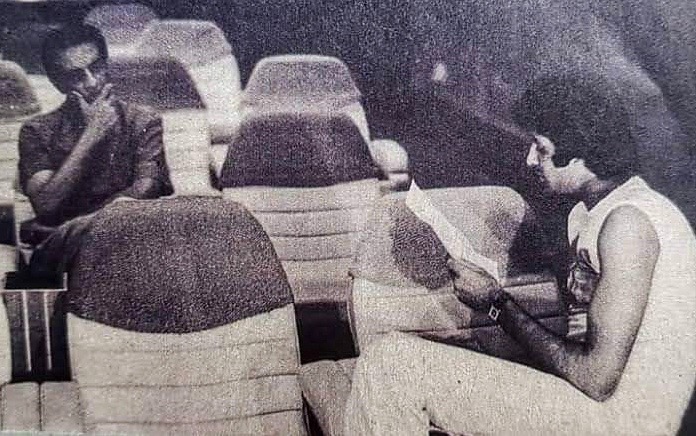
Amitabh Bachchan doing the voice over for Satyajit Ray in Shatranj Ke Khilari. Picture from Bachchan’s FB, provided by Ratnottama Sengupta.

That did not stop Jaya Bachchan from going to Bishop Lefroy Road every time she happened to be in Kolkata. She had, after all, seen the films the ‘Towering Inferno’ made even before Mahanagar. “Every time I watched a film by Ray I felt this is his best. Until the next one came along…” So, when Charulata came, Mahanagar paled. But wait, to this day Debi (The Goddess, 1960) continues to haunt Jaya Bachchan.

And to think that, when Ray had sent for her, the young girl growing up in Bhopal was beset with doubt and hesitation. “I was studying in a convent school, and I feared that the nuns would disapprove of my acting in a film. But my father said, ‘It’s the opportunity of a lifetime — don’t let go of it.'”

Cut to the convent when she went back after Mahanagar. The same austere nuns came and said, ” ‘You have acted in a Satyajit Ray film?! You are so lucky!!’ That is when I first realised, even before he was crowned in Berlin, what a major director my Manik Kaku was!”
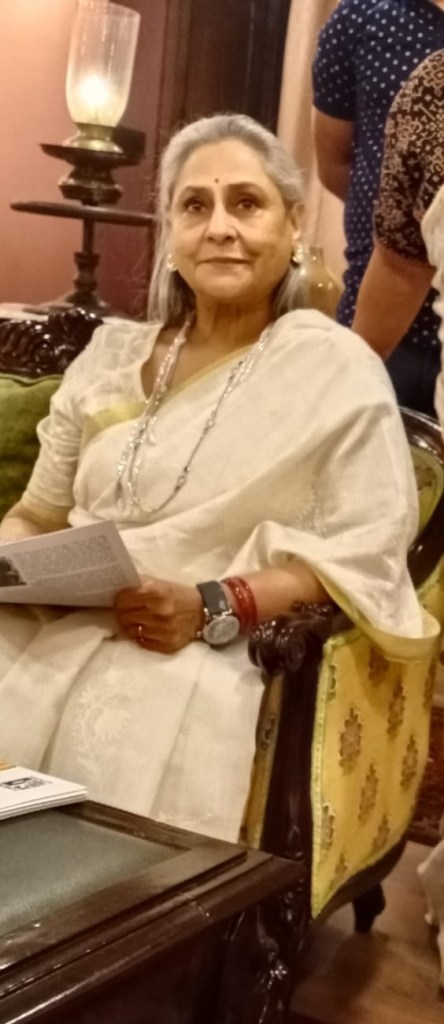
Jaya Bachchan on 1/5/2023. Photo provided by Ratnottama Sengupta

[1] Bengali writer (1916-1975)

[2] An honorific for elder sister

[3] Satyajit Ray was Manik to his friends.

[4] Uncle, father’s younger brother

[5] Sharmila Tagore

[6] Tall man

[7] Juice

[8] Pride

.

Ratnottama Sengupta, formerly Arts Editor of The Times of India, teaches mass communication and film appreciation, curates film festivals and art exhibitions, and translates and write books. She has been a member of CBFC, served on the National Film Awards jury and has herself won a National Award. 

.

PLEASE NOTE: ARTICLES CAN ONLY BE REPRODUCED IN OTHER SITES WITH DUE ACKNOWLEDGEMENT TO BORDERLESS JOURNAL

Click here to access the Borderless anthology, Monalisa No Longer Smiles

Click here to access Monalisa No Longer Smiles on Kindle Amazon International

Categories
Stories

Gandhiji by Nabendu Ghosh

Translated from Bengali by Ratnottama Sengupta

The sun went down.

One after another the lamp posts in the winding lane sprung to life. Their brilliance was dimmed by the smoke from the homely clay oven, sigri. The darkening sky above got dotted by a glittering star or two. And that is when Ratan’s feet became unruly like a wild steed. Donning a mulmul kurta he got ready to go out for the evening.

Jasoda had entered the room to pick up something. She came to an abrupt halt. 

“Off?”  she asked, her voice laced with sarcasm. “Can’t stay put at home any longer, can you?”

Solemnly Ratan nodded his head. “Yes, just need to take a round.” 

Jasoda knitted her brow, “Just take a round? Chhee! Don’t do that. Pour some down your throat too, okay?”

“Jasoda!” 

“Why? Am I saying something wrong, haan[1]? Something not quite done?”

Ratan did not utter a word in reply. He only glared at Jasoda for a second before walking out in rapid steps.

He didn’t stop until he reached Jatin’s house. His friend Jatin who sells fish every morning and evening. He has no family save his aged mother – he had married but his wife died years ago, and he made no attempt to have another after that.

They all gather in his house – Haaru, Potla, Jaga, Radhu and a few others. Since most of them are in the business of selling fish or meat, they have cash in their pockets. They easily turn uproarious as mutton chops and prawn cutlets stream in to enhance the pleasure of downing country liquor. 

In a room foggy with fumes of cigarette, they settle down to a few games of card. They play as long as they feel like; when they don’t want to, they storm the cells of Gendi or Bunchi in the dark of the night. Or, when they are told to, they dive into the alleys of the Muslim neighbourhood and toss a few hand grenades. 

Yes, the responsibility to curb the riot – a euphemism for hunting down Muslims – has suddenly come to rest on their able shoulders. They didn’t anticipate or expect it to, but it did. All of a sudden the wealthies of their end of the city started to pamper them. They raised funds through donations, to arm Ratan and his friends with small weapons so that they could protect the prestige of the Hindus, and of the womenfolk.

The way things were going, this was bound to happen. They had outdone everyone in severing head from the torso of walking talking men. 

*

They were all there. Haaru, Potla, Jaga, Radhu – all of them had showed up. Ratan lent the final touch. 

“Come in saala[2], come!” Jatin affectionately welcomed him. 

Laughter and banter followed. 

There was a sudden lull in the spate of riots that had been on sporadically for a year since the Direct Action Day, and had got a spurt when the country won its freedom on 15th August. But God knows what went wrong? All of a sudden the darkness of hatred started to melt, and the two warring units that had been at each other’s throats, suddenly saw themselves in the mirror: they embraced each other in brotherhood.

Since that day their ‘work’ had gone down. Further calm has descended since Gandhiji appeared in the city. He is camping in Beliaghata. He has been saying that he will not go anywhere until there is peace. Why, he has even staked his life! He will give up his life if he has to, to stop the riots! That is why Ratan and his company are spending more hours in downing liquor and visiting the sluts in the forbidden quarters, singing in their hoarse voice and walking with unsteady steps. 

The chops and cutlets from Nitai’s shop were hot off the oven. The air thickened with the smell of blended oil. And their eyes sparkled with the spirit. 

Abey Jatin, get the bottles out…” Ratan urged. 

Haan bey,” Jatin was most willing to oblige.

A bitter-sharp smell spread through the room. The earthen cups filled to the brim were emptied in no time. The world before their eyes started dancing like a flame. Nasha… stupor.

“Bring out one more bottle, saala…” Ratan nudged Jatin.

Haan bey, I will…”

Arre call for more chops and cutlets.”

“O-K-K Sa-a-la…”

Jaga suddenly sprung to his feet. “I’m off, bye…”

“Where to?” Jatin wanted to  know.

“To Bimli’s…he-he-he…”

“Get back to your chair” – Jatin barked at him. “We will all go in a group.”

Jaga wasn’t too pleased, but he sat down again. “Okay baba, that’s what we will do. Meanwhile let me have a bite of the cutlets…”

The room was filled with the odour of country liquor and smoke. Reddened eyes and numbed  responses. Tidbits dropped on the floor, empty bottles and used cups and dishes piled up. Vegetable salad and sauces dripped to stain their clothes. None of them cared to wash their hands, silently they went on downing the liquid fire. Periodically they pulled their faces and uttered satisfaction, “Aah!” 

“Hear that?” Ratan turned to gaze at Jatin. 

“What?”

“All of you here can hear this?”

Potla shook his head, “How can we hear if you don’t spit it out, saala…”

Ratan crinkled his face, “This Gendo[3] of yours has thrown a spanner in the wheel, re…” 

A gentle murmur coursed through the room. Almost as if a gentle breeze had rustled dry leaves. 

Gandhi – yes, Gandhi! Superannuated Gandhi, old rascal Gandhi. This Gendo chap is a fraud. He is in cahoots with the Muslims, enemy of the Hindus, foe of the Bengalis…

“Yes, he has thrown us off-gear,” Jatin spoke through gritted teeth. “But for how  long can he stymie us? He can’t get away with his bujruki, his hoax …”

Jaga spoke in a tired voice, “I just want to see Bimli for a while…”

“Sit, you owl!” 

“Whatever you may say,” Haru spoke in a soft voice, “Gandhiji is a good soul, hanh?”

“Good soul?” Ratan roared out a nasty abuse, “My foot! All of us can sing bhajans and paeans to Ram if we had a life of comfort like him, buddy! And this guy alone is responsible for the Muslims daring to go so far as to demand a separate land. But this can’t go on! Now we have gained Independence. This is Hindustan – we will put an end to the last Muslim standing here!”

“Right! Right you are!!” they chorused in their boozy voice. 

“Riot! We must hack every invader, every single Yavan!”

“Ha-ha-ha!”

“Hee-hee-hee–”

Haan…  pour me one more bhaanr[4] of the stuff…”

“Where is it? Dum aaloo[5]?”

“Listen!” Jatin ran his eyes over them, “What Ratan is saying is hundred percent correct. Gendo can’t have a run of the state. No. D’you know what that chap is up to now? He’s saying he will bring back every single Muslim and rehabilitate them in the bustee[6]at Beliaghata. Why, I ask you dear, why couldn’t you say this to our people? What did you, all told, achieve in Noakhali?”

Ratan nodded in agreement and let out a mouthful of smoke. “No, such humbug will no longer work here. Enough. The guy wants to unite Ishwar and Allah[7]! As if you can do that at will!”

“Shut up bey!” Jatin cackled.

“Tomorrow. We will rake it up tomorrow itself. The Babus had sent for me today – everything is fixed.”

“All fixed?” Ratan’s face brightened at this, “Good. I’m relieved.”

“Oh, good. Come on, baba Jatin…” Haru called out, “bring out another bottle Jatin!”

Abey shut up saala ! Here I come…”

“Hey where’s the chaat[8]? Pass it around…”

“Die, you pests!” Jaga stood up and spoke in excitement, “None of you are sober. I’m off to Bimli’s.”

Saala can’t wait to get there,” Ratan chuckled. “Arre baba, we’ll all go with you…” They all got to their unsteady feet.

*

Ratan couldn’t contain his glee. As he strode forward he kept thinking, “So there’ll be riots again – good!” 

The lull in the violence these past few days was most irritating. He simply couldn’t take it anymore. He had tasted blood – and that is a dangerous addiction.  For years, he had been a butcher and beheaded goats and lambs. But the thrill of killing a man, a live human being, was something else. 

The first day he stabbed a man he understood that this was the king of highs. Day after day, he had sought out Musalmaans and delighted in putting the knife into them – and now it had spread through his veins. Now he felt out of depth on the days when he did not snuff out a life. He felt rather unwell.

He had a faint recollection of one particular afternoon.

He was sipping tea in Bipin’s tea stall.

All of a sudden some boys dragged in a young Muslim fellow. They told Ratan, “Now you have to finish the job Dada[9]. We are exhausted.”

Ratan grinned, “What’s so tough, idiots?”

“You’re mistaken bhai[10]…” the young man broke into tears. “I’m a Hindu!”

“Really?” Ratan laughed uproariously. “I’ll check that out once I’ve finished with you.”

The youth was dragged to a dark end of the lane and done with. After the job was over, a curiosity gnawed Ratan. He was absolutely certain that the kid had claimed to be a Hindu out of sheer fear. Still… He bared the body and checked the genitals of the naked corpse. “Shhuh, I got fooled!! This guy was actually a Hindu…”

They were outside Bimli’s door. There was no one else in the gully but them. The entire city was holding its breath, too scared to breathe in the riot-torn air. And then, it was late in the night. The gaslight was casting eerie shadows. Silence ruled.

*

Jatin’s words came true. The riots broke out the very next morning. And there was severe rioting. But this time around it was the Hindus who were aggressive, not the Muslims. The bombs and sten guns resounded across the sky and the air was rife with fear. 

Ratan finished one round and returned home. Aah ! He felt somewhat relieved today. 

But Jasoda was furious and would not relent. “So! You do have to come home to Jasoda, yeah? So liquor and sluts are not your cup of tea round the clock!”

“Jasoda!”

“But why are you losing your cool? I’ll get it for you – after all, you have been doing so much work! Boozing… whoring… killing…”

“Jasoda I’ll knock your head off!”

“Don’t I know that?” Jasoda’s fiery eyes bored through him, “The day you will fail to find a human to stab, you’ll twist your knife into me to satisfy your thirst for blood…” 

Jasoda walked out of the room.

After a while she sent a khullar[11] of tea through her little boy but she herself stayed away.

Ratan was displeased. He spent the rest of the afternoon sleeping. Let the others take the responsibility to keep the fire aflame; now that it has been lit again, it will spread on its own steam.

That’s exactly what happened. By nightfall the riots took a sinister turn. Tension gripped the air of the city, dread filled the dark of the eyes. There was hardly any footfall in the streets.

*

When they met in the evening, Jatin said, “See how easy it was to rekindle the flame! But…”

“But?”

“It seems that Gendo chap is fasting since morning.”

“Fasting! Really?”

“Yes. Crazy, this man is. He will fast unto death, he won’t eat a morsel until the riots stop, he has said.”

Arre let him!” Ratan hissed. “Let the oldie die. This is how he has been pampering the Musalmaans. Forget him – he should die!”

“Right you are,” Jatin nodded in agreement, “let him die. You come with me, there’s work to be done.”

A while later the sky lit up with the blaze of a burning slum. The fire brigade rushed to the spot with sirens blaring. The city cowered, trembled with fear, as the sound of bombs rent the air every now and then.

Coming home, Ratan was again subjected to the tongue lash of Jasoda. What is this vixen, a virago? No fear in her soul! 

“So you’ll kill him? You will kill Gandhiji?”

“And what if I kill him?”

“What if you kill him! Are you a human being? You’ll kill a sage like him? You’ll rot in hell if you do that, understand? You’ll burn in hellfire…”

“Piss off! Just shut up and go. Get lost — ”

Chhee! What are you, a man?”

“Jasoda!”

“What? You’ll kill me too? Go ahead, do that!”

But what good was silencing Jasoda? Ratan simply couldn’t sleep that night. 

That Gandhi has gone off food?! What stuff is the man made of? If I kill two men, you’ll fast yourself unto death? What a dissembler. But otherwise the man has done so much! That the country has gained independence – it is largely due to this man, they say.  So what? Why must he pamper the Muslims to this extent? If he’s really so bothered, why doesn’t he go fast to stop the riots in Punjab? Humbug. Let him rot.

*

The same story repeated itself the next day. The sacrificial fire kept devouring human flesh. 

“What a hassle,” Jatin grumbled. “This Gendo simply won’t eat a bite, I hear! He’ll kick the bucket day after if not tomorrow.”

“All this is willed by Goddess Kali, d’you realise Jattye?” Ratan added with a wave of his hand, “It’s best he shuffles off his mortal coil and drops dead.”

Stray incidents filled the day. Then it started to pour. They couldn’t do very much after that. When the rain stopped, Ratan stepped out to stretch his legs. He noticed that people were gathering here and there, reading newspapers, discussing something in a grave voice. Gandhiji, the name, kept recurring. They all looked worried, sounded concerned, crestfallen. 

All his countrymen genuinely worshipped Gandhi. He has actually done a lot – gone to great length to gain independence for the people. Not just the Lord Saheb, even the King of the British rulers held him in deference!

Suddenly Ratan hastened his pace. Why not go upto Beliaghata and take a look at Gandhi? To this day he had not set his eyes on this man, what was the harm in sizing him up? Ratan was not enamoured of Gandhi, he didn’t care two hoots whether he lived or died. Still, a peek at the man would do no harm. All said and done, he’d made a name for himself, perhaps even a place in history.

Ratan was overcome by a strange emotion. Inscrutable. Without much thinking he showed up in Beliaghata for the evening prayers. There was a large crowd waiting outside the house. He nudged and pushed to wend his way and find a footing in the front row. After a long wait he got to see Gandhiji.

A short statured, dark complexioned ageing man with the radiance of a child on his face. Bare bodied, Khadi-clad, he had a meditative calm about him. So this was the magnanimous Gandhiji!

A tremor passed through Ratan. It was as if he had suddenly come face to face with a morning sun. As if he was standing on the shore of the Pacific Ocean, as deep as its boundless expanse.

In a flash something happened deep within Ratan. Everything turned topsy turvy as if shaken by an earthquake high on the Richter scale. He realised he had finally encountered a magnificent personality. One who would not bow his head to anything unjust or immoral. One who would not daunted by guns and bullets.

As he looked on, Ratan turned misty eyed. Who said Gandhi was a pygmy? To Ratan he seemed like the Himalayas piercing the sky. Ratan trembled, he panicked, he fled.

All kinds of thoughts beset Ratan and he became restless. He headed straight for Jatin’s house. He felt like settling down with bottles of the fiery stuff. As he felt the liquid sear down his throat, the daze cleared somewhat. 

“Know what Jattye?” he tried to draw his friend’s attention.

Hunh?”

“I went for a darshan[12] of Gandhiji today.”

“Who? Gendo?”

Hanh, Gandhi.”

“What was it like?”

“I mean… the man seems to be a sadhu[13].”

“Seems a sadhu, right? Yes, the fellow has actually done a lot for the country…”

“That’s what I hear. So many times he has been incarcerated and been to the jail. So much suffering he has put up with…”

“But that one failing! He has spoilt all his good actions by pampering and mollycoddling the Muslims, over-indulging them…”

“You have hit the nail on its head!”

One by one the others joined them. In no time the place was abuzz with food from Bipin’s Stall and bottles of country liquor.  Downing the liquid in rapid succession they were quite a boisterous crowd. 

“Follow me, Ratnya?” Jatin slurred, “this…”

“Unh?”

Gendo is fasting, let him. He won’t kick the bucket in a day or two, will he? Old bones are sturdy – he’ll last. Meanwhile, in two days we’ll clear out all the ragheads, won’t we?”

“Yes Jatye, spot on…”

“Here, some more… f-o-r youuu…”

“Yeah… g-i-v-e mee…”

Ratan could not walk straight when he reached home. 

“Why?” Jaosoda came at him like a bull at a gate, “Why are you back here? Was there no space for you in Chandravali’s love nest?”

“Shut your trap Jasoda!”

“The frigging bastard won’t let me be in peace.. Maa-go!”

Ratan flopped in his bed and murmured, “Q-u-i-e-t Jasoda! Shut up and keep quiet bhai…”

Bhai! Bro? Shame upon you, no-good burnt-face monkey! You see a brother in me?”

Jasoda kept on muttering long after Ratan had started snoring.

*

Next morning the rioting picked up in momentum. 

Ratan and his chums returned to action big time, complete with sten guns. From the rooftops, on the streets, wherever they were, they kept firing towards the Muslim shanties. After almost three hours there was a lull in the firing. The police and military forces had arrived and by afternoon things were quiet again.

Vans with loudspeakers were blaring that, unless the riots came to a stop, Gandhiji would cease to be. He would end his life. 

The peaceniks took out a procession. The violence started to wane. 

“That was quite a blast, wasn’t it Ratnya?” Jatin was smiling ear to ear when they met in the evening.

Ratan simply nodded.  

Jaga returned from the paan[14] shop with a fresh stock of bidis[15]. “Folks have you heard this? Gendo is about to snuff out!”

“Who said that?” Ratan was startled. 

“The newspapers have headlined, it seems, that Gendo has refused to relent in his fasting because there’s no let-up in the riots.”

“Ohh!”

Arre that’s bullshit!”  Jatin reacted. “Two more days of action at this level and all the Mullas will be shown their place.”

Hunh!” Ratan nodded unmindfully, “but Gandhi is in such a poor shape, he’ll conk out, they’re saying…”

Arre forget it! Rumour – that’s all it is. Come, let’s have a toast.”

“Well then, let’s go.”

*

Ratan joined Jatin to open a liquor bottle long before sunset. The tumult in the morning had left him exhausted. A few drops of hard core liquor might just be the tonic. But Gandhiji? There’s something about him… a halo. He had touched the heart of thirty crore men and women. Ardently they cried out, “Mahatma Gandhi ki jai [16]!” All-pervading emperors and powerful lords had not succeeded in intimidating him. Mahatma Gandhi!

At this point Madhu ran up to them. “Hey guys, come fast! I’ve cornered one of them…”

“What?!”

“Bastard!”

Suddenly the thirst for blood got the better of him. Sitting bolt upright Ratan said, “Come on Jattye.”

The three of them strode forward. Jaga, Haru and Potla were waiting round the corner, a middle-aged Muslim in their grip. They’d got the better of the man who was walking down the street lost in thought. 

“Please let go of me bhai !” the man pleaded.

“Let go of you?” Jaga laughed out loud, “Why? Are you my wife’s brother, saala? Does your sister sleep with me?”

In silence Ratan went up to the man and grabbed him by his hand. Agitation tinted the blood that was coursing through his body. Blood! Unless he spilled blood his head might burst!

“Who’ll twist the knife in – you?” Jatin asked. Ratan nodded, “Yes.”

“How many will this be in your count of heads?”

“Maybe a score and half…”

“Well then, go on. Get over with it.”

“You’ll kill me?” The man wailed out, “Please let go of me baba – I implore you! Believe me, I have a son at home who is critically ill – I came out only to buy some medicine for him…”

“Shut up!”

Just then a voice floated across from a loudspeaker being played from a van: “Gandhiji is in a critical condition…” 

Ratan pricked up his ears. Jatin looked towards the van, “Hey, what are they saying?” 

“Gandhiji’s priceless life is in your hands today…” the voice was faint but the words were clear. “If you don’t stop killing, Gandhiji will not return to life. Stop now – and bring Gandhiji back to life…”

The voice receded in the distance.

“Go on, finish the job at hand Ratnya,” Jaga spoke, “or leave it to me.”

Ratan looked at the man. 

Instantly the man smiled. “You’re determined to kill me, Baba?”

Abey why are you showing your teeth?” Potla rudely demanded. 

“Kill me,” the man said. “But don’t  forget, killing me means stabbing Gandhiji.”

“Shut up!” Jaga roared, “not a word more…”

Still the man went on, “Listen to me Baba, now I’m not speaking for myself. Don’t kill me – let Gandhiji live!”

“Enough! Don’t want to hear the devil quote scriptures – hold your tongue.”

“Kick the rascal!”

“Go for it Ratnya!”

‘What’s holding you Ratnya??’

“Go go go…”

Unexpectedly Ratan turned around. He stood in front of the Muslim guy and said in a determined voice, “No.”

“Meaning?!” Jatin was stupefied, “What’re you saying Ratnya?”

“You heard me right Jatye — I’ll let this man walk.”

“Nope.”

“Yes, I’ll let this fella go Jatye. If you try to stop me, you’ll have to fell me first.”

All the others moved back a few steps.

“Have you gone out of your mind ?!” Jatin couldn’t make head or tail of it. “What’s the matter, I say?”

Ratan didn’t reply. Instead he addressed the man, “Come Mian[17], let me take you to the high road.”

The two of them took a few steps forward. 

Bah ! Won’t you even tell us why you’re letting him off? Hey Ratnya?”

“Ratnya! Hey bugger!”

Without a pause in his walk Ratan said, “Don’t call out to me.”

After escorting the fellow to the safety of the main street Ratan headed home.

*

Soon the night set in. The curfew hour started. The roads emptied out. From the lane they could make out that the military trucks and police vans were whizzing around the city. Some light escaped the windows of neighbouring houses. A handful of faces peeped out now and then. Swiftly, a dopey silence engulfed the habitat. The city seemed to be drained of vigour. The yellow gaslights on barren roads imparted a ghostlike ambience. The night deepened.

Jasoda noticed the worry lines on her husband’s visage and frequented her rounds of the room.

Out of the blue she even asked him, “What’s the matter with you, go[18]?”

“What? Nothing!” Ratan responded.

“Today you didn’t down bottles of liquor. Such good fortune!” She grinned at him, then wondered, “Why, you’re not even angry!”

Hunh !”

“Feeling unwell, are you?  So you’re missing your Chandravali Brigade! Care for a cup of tea?”

“Get it.”

Jasoda left to get the tea. Today Ratan was happy to see Jasoda.

Amazing! Something was the matter with him surely. He just could not bring himself to stab the man! One man’s life is so precious? People were correct about him. They worry for him, to protect him. To save his life, they appeal to all and sundry, even to strangers!

Yesterday he had visited that One Man. Short of height, dark of complexion, an octogenarian with a halo about him.  A man like the Ocean, like the Himalayas, like the Sun. Boundless his sacrifice; immense his patience, unending his hope. Forgiveness, compassion, truth, love, ahimsa [19]– he defined all these virtues.

Magician, he was! He had crazed thirty crore men and women who chanted in unison ‘Gandhiji Ki Jai! Victory for Gandhiji!’ He has made them fearless, and independent. Yesterday he saw his Ram with his own eyes. It was all rubbish, he was no one’s enemy. He was ajatshatru, his enemy had yet to be born. Everyone in the country was his child, his progeny. He did not punish one for the failings of another. The punishment due to everyone he placed on his own head – a crown of thorn. 

The night deepened and darkened. 

Lying in his bed Ratan started to leaf through the album of his life. Alcohol, meat, women, neglect of a wife like Jasoda, butchery, rioting and killing more than a score of lives… And that enlightened Old Man?  He had won the country, the world, in the brief bracket of a lifetime.

The night rolled on, towards sunrise. 

At daybreak Ratan rose from his bed. He searched through his house and pulled out every piece of hand grenade, bullets, knife, and tied them into a bundle. Jasoda was still not up. Ratan cast a silent look at her and stepped out of the house.

The sky had not yet lit up, but the curfew hours were over. A handful of souls had stirred out on the streets here and there. A few cars had set out for some destination.

Ratan took full strides eastward. That’s the direction from which a red sun would rise. But Ratan was not headed towards that sun. He was thinking only of the sun fasting in a dilapidated house in Beliaghata. Ratan would go to him and lay down the bundle of his sins at his feet and pray to him, “Oh sun! Please end the fasting soul within me and light up the inner soul so far deprived of light…”

.

[1] Yes

[2] Swear word

[3] Gandhi

[4] Clay cup

[5] Potato curry

[6] A slum colony

[7] Ishwar: Hindu name for God. Allah: Muslim name for God

[8] Savoury snack

[9] Elder brother

[10] brother

[11] Clay cup

[12] To go to view a great or holy man

[13] Sage

[14] A shop that sells cigarettes and betel leaves

[15] Small, thin, hand-rolled cigarettes made in India

[16] Hail Mahatma Gandhi

[17] Sir

[18] An affectionate way of addressing one’s spouse

[19] Non-violence

Nabendu Ghosh’s (1917-2007) oeuvre of work includes thirty novels and fifteen collections of short stories. He was a renowned scriptwriter and director. He penned cinematic classics such as Devdas, Bandini, Sujata, Parineeta, Majhli Didi and Abhimaan. And, as part of a team of iconic film directors and actors, he was instrumental in shaping an entire age of Indian cinema. He was the recipient of numerous literary and film awards, including the Bankim Puraskar, the Bibhuti Bhushan Sahitya Arghya, the Filmfare Best Screenplay Award and the National Film Award for Best First Film of a Director.

.

Ratnottama Sengupta, formerly Arts Editor of The Times of India, teaches mass communication and film appreciation, curates film festivals and art exhibitions, and translates and write books. She has been a member of CBFC, served on the National Film Awards jury and has herself won a National Award. 

Read the translator’s musing on Nabendu’s stories impacted by Gandhi by clicking here.

PLEASE NOTE: ARTICLES CAN ONLY BE REPRODUCED IN OTHER SITES WITH DUE ACKNOWLEDGEMENT TO BORDERLESS JOURNAL

Click here to access the Borderless anthology, Monalisa No Longer Smiles

Click here to access Monalisa No Longer Smiles on Kindle Amazon International