Categories
Poetry

Rasam and Sunil the Brahmin

By Marc Nair

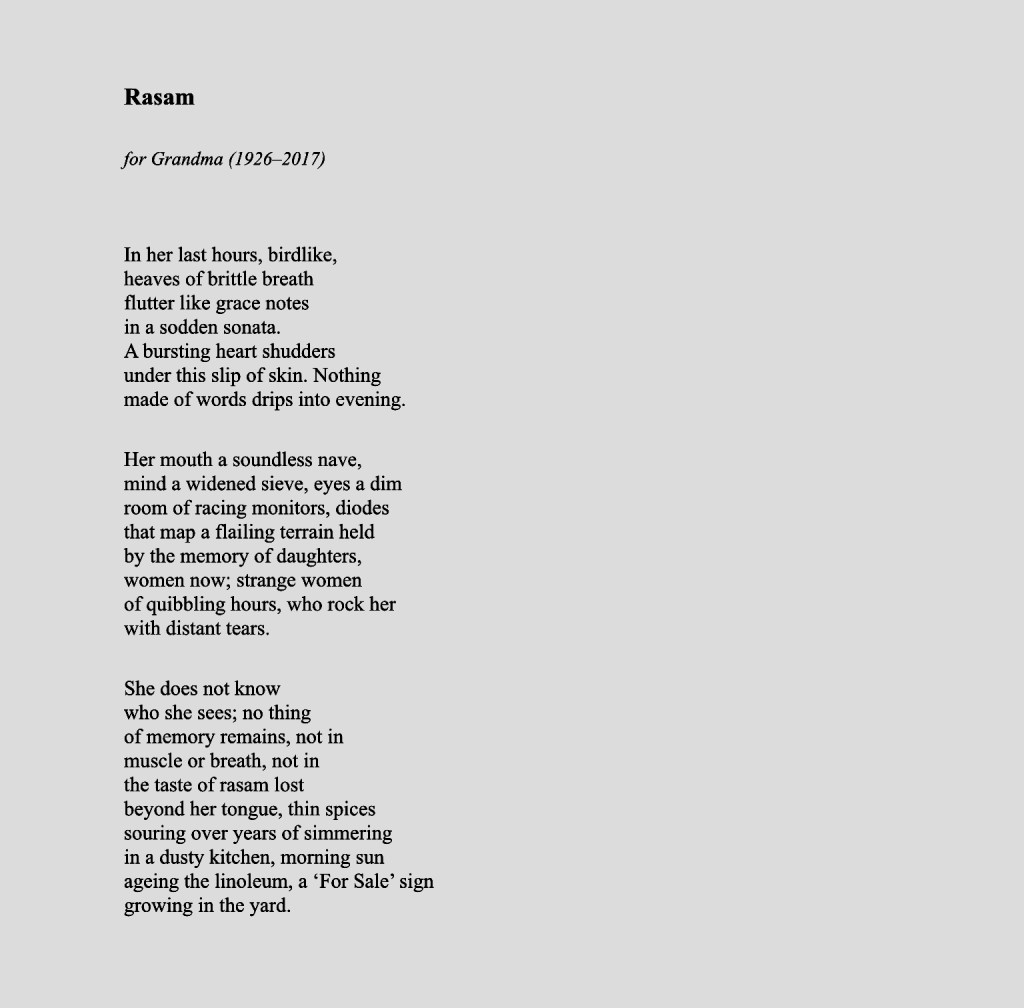
Rasam

for Grandma (1926–2017)


In her last hours, birdlike,
heaves of brittle breath
flutter like grace notes
in a sodden sonata.
A bursting heart shudders
under this slip of skin. Nothing
made of words drips into evening.

Her mouth a soundless nave,
mind a widened sieve, eyes a dim
room of racing monitors, diodes
that map a flailing terrain held
by the memory of daughters,
women now; strange women
of quibbling hours, who rock her
with distant tears.

She does not know
who she sees; no thing
of memory remains, not in
muscle or breath, not in
the taste of rasam lost
beyond her tongue, thin spices
souring over years of simmering
in a dusty kitchen, morning sun
ageing the linoleum, a ‘For Sale’ sign
growing in the yard.


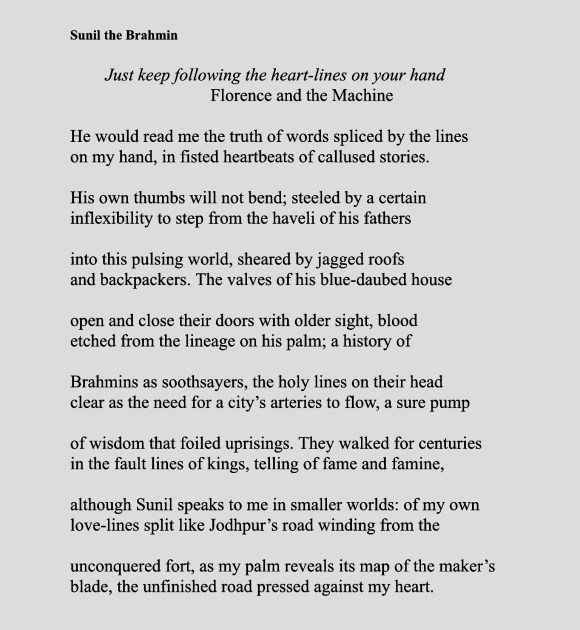
Sunil the Brahmin

Just keep following the heart-lines on your hand
 			Florence and the Machine

He would read me the truth of words spliced by the lines
on my hand, in fisted heartbeats of callused stories.

His own thumbs will not bend; steeled by a certain
inflexibility to step from the haveli of his fathers

into this pulsing world, sheared by jagged roofs
and backpackers. The valves of his blue-daubed house

open and close their doors with older sight, blood
etched from the lineage on his palm; a history of

Brahmins as soothsayers, the holy lines on their head
clear as the need for a city’s arteries to flow, a sure pump

of wisdom that foiled uprisings. They walked for centuries
in the fault lines of kings, telling of fame and famine,

although Sunil speaks to me in smaller worlds: of my own
love-lines split like Jodhpur’s road winding from the

unconquered fort, as my palm reveals its map of the maker’s
blade, the unfinished road pressed against my heart.

( First published in Vital Possessions, Ethos Books, 2018)

( First published in Postal Code, Red Wheelbarrow Books, 2013)

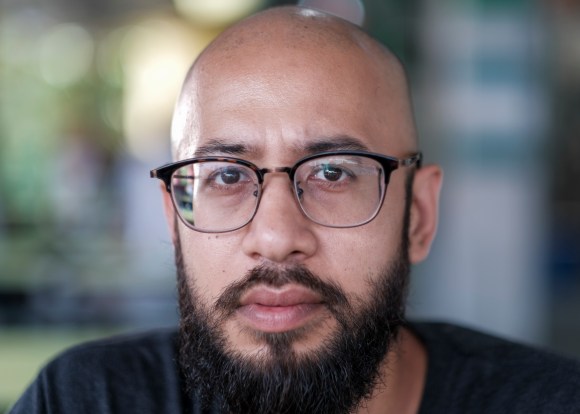
Marc Nair is a poet who works at the intersection of various art forms. He is currently pursuing projects that involve photography, movement and creative non-fiction. His work revolves around the ironies and idiosyncrasies of everyday life. He has published ten collections of poetry. 

Categories
Poetry

Two Covid-19 viruses meet Albert Camus

(A Dystopian spoof on Corona and Camus)

By Ra Sh

The world was calm now. And silent.

Only the birds chirped tweeted sang cawed.

Only the animals barked mewed mooed growled.

Only the river gurgled.

Only the sky thundered.

Only the fires crackled.

Two covid-19 teenage viruses walked around the city

assessing the damage. On Route vers l’ouest, they found

mansions with cars parked in front and little gardens.

Four dogs ran out of the house dragging a well dressed

woman and a naked man. It was the posh area of the city

and in house after house dogs feasted.

On Route Vers le nord, that led to the fields, unharvested paddy

lay in the fields. That was the operational area of the rodents,

snakes and the jackals. On Route vers l’est, that led to the offices,

the road lay thick with the police, applicants, clerks, officers and

mounts of paper. The vultures landed on them and tore away

the flesh.  It was a mass of rotting flesh, blood, hair and

official communiqué.

On Route vers le sud, that led to the river, peacocks danced on

the road. From the two theatres that showed no films, super stars

grinned from posters. Weeds were slowly climbing up the

courtyards of the college and the schools. The grounds were

covered with bodies , furniture, lab instruments and aprons.

The teenage viruses reached the river and sat holding hands.

Being young, they were in love and being idealistic a tad bit

sad about the end of humans.

They then spied a human in a trench coat and trousers angling for

fish  on the bank. He smoked a pipe and chuckled while he spoke

to the fishes. The adolescent viruses approached him and asked,

“Who are you sir, how come you are in one piece when

all humans are dead all over the world?”

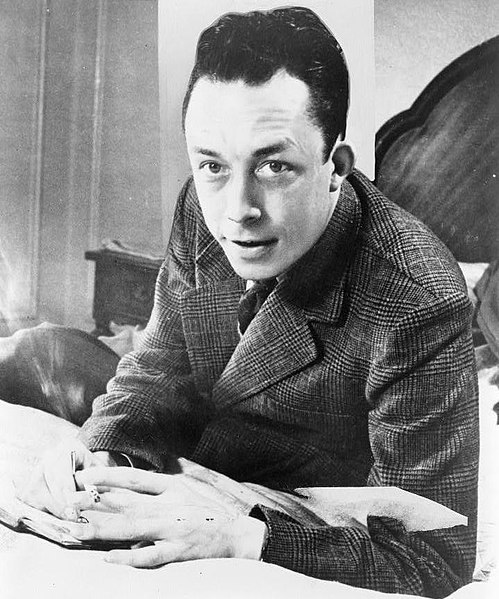
The man chuckled again and retorted, “I am Camus

and I wrote a novel ‘The Plague’ long back. I wrote that the city

was happy, life went on, but the plague bacillus never dies or

disappears for good. It can lie dormant for years and years

in bedrooms, cellars, trunks and bookshelves and perhaps the day

would come when it roused up its rats again and sent them

into a happy city.  You are those rats now and you are the plague.”*

The Gen X viruses who could barely understand him, watched

as Camus gathered his things and made his way up stream with

fishing rods, bait and the day’s catch, whistling to himself.

Albert Camus

*From the last lines of the Albert Camus novel, The Plague.

Ra Sh is a poet based out of Kerala

First published in Countercurrents.org

Categories
Poetry

Come to the Summer of my Arms & Bristle Stories

By Nalini Priyadarshni

Come to the Summer of my Arms

Come to the summer of my arms

the winter of our discontent has lasted too long

peppering our wisdom with salt and snow

settling into nook and crannies of our being

shadows of the moon on your forehead

has lengthened to reach our eyes

that have been growing dim

with each revolution of earth.

Come to the summer of my arms

we have harvested too long the silence

sown with the best of intentions

that has been whittling us beyond recognition

think of the moles and the birth marks that

need to be salvaged before we forget they exist

or keys that must be forged to unlock life

read books we discarded as unreadable

Come to the summer of my arms

for one of us cannot thaw without the other

winter of our discontent

inch by inch recovering the expanse of unexpressed

so that intimacy could be tilled into rows and rows

of languid kisses strewn with endless possibilities

perhaps then, someday we will

live our way into the passion we always sought

Bristle Stories

They arrive uninvited

like guests during summer siesta

and find strength in numbers

Stubborn as teens in combat boots

looking for trouble at street corner

my chin hair refuse to die

or remain dormant

They recoil every time I wax

Let me celebrate victory after a laser

Disappear for maybe a couple days,

but always return snapping gum vivaciously

 to sun themselves unabashed

bold and burping on a cloudless terrace

On weekdays, they foil with vengeance

 my all attempts at prettiness

refuse to apologise

throw tantrums, stomp and yell

spitting at the feet of men smiling at me

Feeling right at home, my bristles stretch themselves

claiming more space with each day

play cards, exchange stories and smoke cigarettes

Greedy

unapologetic

bordering on contemptuous

they reassure the woman in me

that they are paragons of

proud and vicious feminism

The woman inside me wonders

if greying calls for a truce

to make peace with my rebellious mongrels

Nalini Priyadarshni is a feminist poet, writer, translator, and educationist though not necessarily in that order who has authored Doppelganger in My House and co-authored Lines Across Oceans with late D. Russel Micnhimer. Her poetry, prose and photographs have appeared in numerous literary journals, podcasts and international anthologies including The Lie of the Land published by Sahitya Akademi, New Delhi. A nominee for the Best of The Net 2017 she lives in Punjab, India and moonlights as a linguistic consultant.

Categories
Poetry

Witness to times past and Yellow Bird

By Nishi Pulugurtha

Witness to times past

A garden tracing its time back

Centuries,

The river flowing by

As it had always done

They have been there together

For years now

Bound by geography, by place

Witness to all that has changed

Witness to all that is changing now

Huge trees, overarching branching

Creepers, shrubs, foliage

Dry leaves – red and brown

Rustling, now quiet

The wind blowing through the green ones

Leaning on, some bent

Broken too,

Twisted and curled

Cut down, decayed

Banks derelict too

The river’s course has changed

Mud flats with debris

Muddied waters.

Glistening in the winter sun

On the broken bench a lone figure

Asleep in the winter sun

Some rest amid all the noise and bother

Before life resumes all over.

Yellow Bird

That yellow bird with a black band around its neck

Perched itself each year

December/January

Its winter haunt, I guess

It sits for a while perched on the branch

And flies off

To land on another branch

The little leaves barely a camouflage

Solitary on its perch

Chirping for a while

To soar away

It is back soon

Almost each morning

The pleasant winter sun seems to be just right for it

It feels nice

It makes me feel nice

The colour, the motion

The flight.

That happy yellow bird

With the black band around its neck.

Dr. Nishi Pulugurtha is Associate Professor in the department of English, Brahmananda Keshab Chandra College and has taught postgraduate courses at West Bengal State University, Rabindra Bharati University and the University of Calcutta. She is the Secretary of the Intercultural Poetry and Performance Library, Kolkata (IPPL). Her research areas are British Romantic literature, Postcolonial literature, Indian writing in English, literature of the diaspora, film and Shakespeare adaptation in film and has presented papers at national and international conferences in India and abroad and published in refereed international and national journals. She writes on travel, film, short stories, poetry and on Alzheimer’s Disease. Her work has been published in The Statesman, Kolkata, in Prosopisia, in the anthology Tranquil Muse and online – Kitaab, Café Dissensus, Coldnoon, Queen Mob’s Tea House, The World Literature Blog and Setu. She guest edited the June 2018 Issue of Café Dissensus on Travel. She has a monograph on Derozio (2010) and a collection of essays on travel, Out in the Open (2019). She is now working on her first volume of poems and is editing a collection of essays on travel.

Categories
Poetry

Winter in Vienna and more…

By Sarita Jenamani

Winter in Vienna 

Winter is usually foggy here 

It blurs the reflection of your dream 

in the mirror of your imagination 

Night does not sojourn here 

but when the snowy night 

passes through the city 

a violet glow envelopes everything 

A certain passion erupts in me 

and jumps back to its own caldera 

Conversation is a sin here 

Voice darkens and submerges in the sorcery of silence

Snow trickles into the stillness

Exile 

All through life 

an unending journey 

accompanies you 

And in the absence of 

a destination 

much of what’s inside gets lost 

And the warp and weft of being 

keeps on breaking

Beyond 

Stillness spreads its wings 

like the desert 

beneath a dawning sky 

The paraplegic pyramids glitter 

in a mixture of azure and gold 

There is still a lot to say 

beyond civilization

Viennese Coffee-houses 

No sooner does dusk fall 

than the city’s cafés come to life 

with the tinkling clang of indifference 

Gradually the crowd of solitude gathers 

around the tables

Sankt Marx Friedhof*

Silence is magnificent 

particularly when it connects 

the monumental music of lives 

that sleep peacefully 

with the absolute space 

Flowers and graves shoot up 

rupturing earth’s breast 

They exist side by side in stillness 

I wonder what they think 

of volatile souls that travel to the sky 

with the chanting 

of mysterious mantras 

or of those who wait 

for an undefined time to resurrect 

Beyond cemetery’s wall 

a swarm of sound passes through 

slicing the essence of existence 

in our trivial time

*Mozart was buried in St. Marx Communal Cemetery, Vienna.

(These poems are excerpted from her latest collection, Till the Next Wave Comes)

Sarita Jenamani is a poet of Indian origin based in Austria, a literary translator, anthologist, and editor of a bilingual magazine for migrant literature – Words & Worlds – a human rights activist, a feminist and general secretary of PEN International’s Austrian chapter. She has three collections of poetry. She writes in English, Odia and translates to and from German. Sarita translated Rose Ausländer, a leading Austrian poet, and an anthology of contemporary Austrian Poetry from German into Hindi and Odia. She has received many literary fellowships in Germany and in Austria including those of the prestigious organizations of ‘Heinrich Böll Foundation’ and ‘Künstlerdorf Schöppingen’.  She studied Economics and Management Studies in India and Austria where she works as a marketing manager.