In her heyday, my mother was a full-time homemaker, and an excellent cook and baker. She managed to have lunch and dinner on the table at the exact time every day, and there was always a homemade dessert. She followed recipes closely, something that I also have a tendency to do, which irritates my freewheeling husband. Mom had a box crammed with recipes handwritten on three by five cards, and a shelf of cookbooks, many of which were community compilations filled with recipes by the members of various churches she and my grandmother had attended. Occasionally, she made alterations which became notations in the margins: “Only half a teaspoon of sugar.” “Omit garlic.”
Several years ago, my mother, now in her eighties, lost her ability to follow a recipe. Although she can handle making a sandwich or opening and heating a can of mixed vegetables, she no longer makes meals. That task has fallen mainly to my father, but on my annual trips home from Japan, where I now live, I try to help out. On my most recent visit, I made a meat loaf using the recipe that my mother used exclusively, which calls for evaporated milk, chopped onions and peppers; Japanese-style curry and rice; and macaroni and cheese. I asked my dad what else he might have a craving for. He said “chop suey.”
When I was a kid in 1970s Michigan, chop suey was one of my favorite dishes, but I hadn’t had it in ages. Last I recall, Mom had made it when my Japanese husband had accompanied me on a visit. Her version called for chunks of pork, bean sprouts, and celery with some kind of sauce. This mixture was layered over rice and topped with crunchy chow mein noodles. I knew that it wasn’t authentic Asian cuisine, that it was more of an interpretation for Americans. But the dish still conjures memories of my childhood, those days of riding bikes and climbing trees until dusk, of no homework, and ‘Gilligan’s Island’ and ‘I Dream of Jeannie’ on our black and white TV.
“Okay,” I told my dad. “I’ll make it.” I turned to my mother and asked her where the recipe was. Although she can’t cook, she remembers in exactly which cookbook certain recipes are located. But this time she said, “There’s no recipe. It’s in my head.” But she couldn’t tell me how to make it.
I turned to the internet and learned that chop suey had been all the rage in the 1950s, and that every American housewife had had her own way of making it. Some used chicken, some added snow peas and baby corn, but I remember my mother’s as being totally brown. She had never added anything green or any other color. The sauces were slightly different, too, calling for oyster sauce in one case, soy with dark molasses in another.
I went back to my mother’s cookbooks to see what I could find. Finally, I came across a recipe in a community cookbook produced by a Methodist women’s group at the church we had attended in Grand Haven, Michigan, when I was a child, before we moved to South Carolina. It was annotated in blue ink: “See p. 78 Good Housekeeping Cookbook.” I couldn’t find the volume in question.
“Maybe you don’t have it any more,” I told my dad.
He shook his head. “It’s there somewhere. She never threw anything away.”
I looked again. Nothing. Even so, the recipe I’d found seemed pretty close to what I recalled. I made a shopping list and headed to Walmart.
The grocery section at the local Walmart had a modern selection of Indian curries and Japanese Pocky sticks and Thai noodles, but I couldn’t find canned bean sprouts or those crunchy chow mein noodles. Was it due to a supply chain issue? Or maybe no one produced those ingredients anymore. Maybe, along with chipped beef on toast, chop suey was a relic of the past. Disheartened, I scoured the rows of raw vegetables; still, no luck.
As a last resort, I made a stop at Food Lion, which also had an international foods isle, heavy on the Mexican. Lo and behold, they stocked a few cans of bean sprouts and a bag or two of those crunchy La Choy noodles from my past!
Back home, after sleuthing around the shelf a bit more, I came across a thick old cookbook which had lost its cover. It turned out to be the Good Housekeeping Cookbook. Some of the pages had fallen out, and been tucked back in. I immediately turned to page 78 and found a recipe for “California Chop Suey” with further annotations.
My South Carolina version was a combination of the one found in the Methodist church community cookbook and the Good Housekeeping version. I had substituted fresh chopped celery and onions, and a can each of mushrooms, beans sprouts and water chestnuts, for the “canned oriental vegetables.”
Due to a variety of dietary restrictions, real or imagined, my mother declined to partake. She did peer into the pot and declare my concoction watery, but I didn’t want to add more cornstarch. I hefted the pot onto the table, along with the rice I’d cooked, and a bag of those crispy chow mein noodles. My dad had made salads.
We heaped our plates with rice, then ladled chop suey on top. Lastly, we sprinkled some of those chow mein noodles over the mounds.
Dad dug in with a spoon. “Mmmm! Good!”
I thought it had turned out pretty well, too. Maybe that chop suey wasn’t authentically Chinese, or any other Asian country’s dish, but it hinted at a flavour that resonated more deeply. My tongue recognised that chop suey as the taste of Mom.
Suzanne Kamatawas born and raised in Grand Haven, Michigan. She now lives in Japan with her husband and two children. Her short stories, essays, articles and book reviews have appeared in over 100 publications. Her work has been nominated for the Pushcart Prize five times, and received a Special Mention in 2006. She is also a two-time winner of the All Nippon Airways/Wingspan Fiction Contest, winner of the Paris Book Festival, and winner of a SCBWI Magazine Merit Award.
PLEASE NOTE: ARTICLES CAN ONLY BE REPRODUCED IN OTHER SITES WITH DUE ACKNOWLEDGEMENT TO BORDERLESS JOURNAL
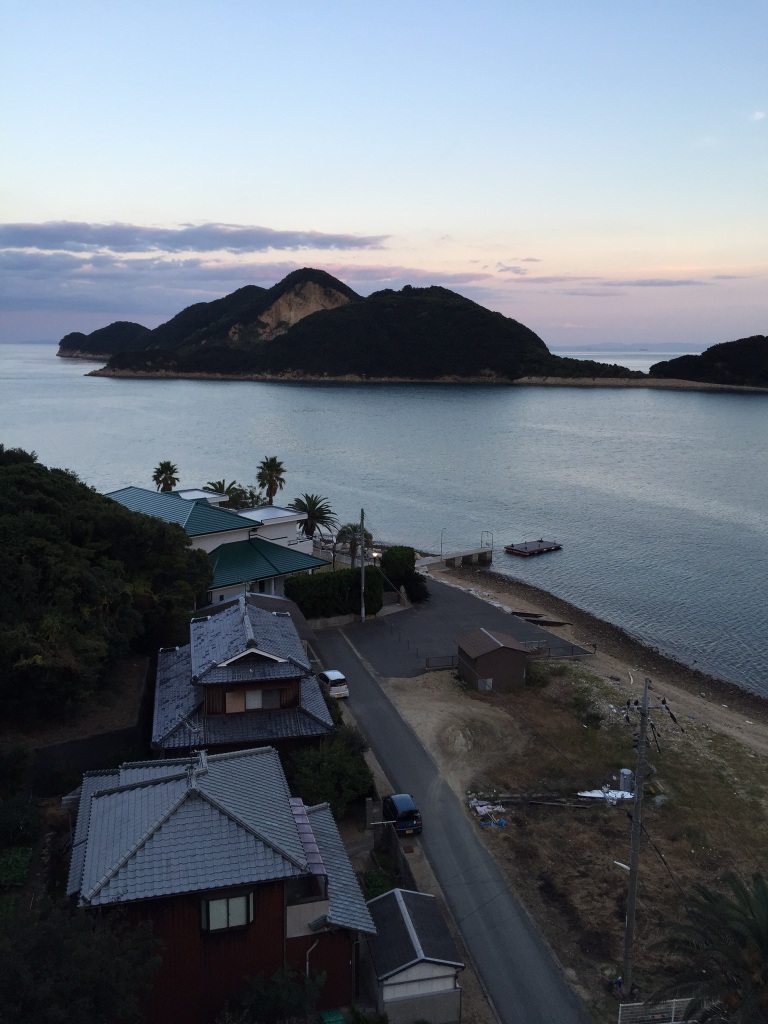
My daughter Lilia, my friend Wendy, and I set out on a Saturday morning for Shodoshima. It’s the largest island in the Inland Sea, home to about thirty thousand people, many of them aging. My mother-in-law went there years before on a group tour. She brought back olive oil as a souvenir. I am intrigued by the idea of a Japanese island with a Greek flavour. Because of its relatively large size and population, and its popularity with tour groups, I figure it would be somewhat accessible for my daughter, who uses a wheelchair and is deaf.
On the island, we stop at a tourist center for maps. I drive through the town. Some of the streetlights are shaded by green or yellow globes. Maybe they are supposed to look like olives. The road follows the seashore. Off the coast we see fishing boats. Here and there are small clusters of olive trees, the branches beaded with black olives. We finally come across a sign advertising the Olive Garden. I pull over and park in a handicapped parking space. A restaurant is up the hill.
“Shall we go eat lunch?” I ask.
“Yes,” Lilia nods. The hill is steep, but there are no steps. Lilia gets into her wheelchair and I begin to push her up the slope. From the restaurant, the view of the sea is marvelous. I smell olive oil. Wendy and I order spaghetti, which comes with bread. Lilia orders Japanese noodles, which are served with tempura fried shrimp and vegetables. When the food arrives, the server tells us how to eat it. “You should drizzle olive oil on the tempura,” she says. “You should put some olive oil and herbed salt in a small dish and dip your bread in it.”
According to a brochure, locals make olive lip gloss, olive soap, olive wax, olive hand cream, and olive-oil smoothies. You can even take classes in using olives to dye fabric. Every October the island holds an Olive Harvest Festival. People come to pick olives. They enter the “Healthy Olive Cooking Recipe Contest.” I imagine that the people of Shodoshima spend a lot of time thinking about new ways to use the olive oil that they produce. The islanders have been growing olives since 1908, and from the taste of our lunch, it’s clear that they have gotten quite good at it.
“Shall we find the Greek windmill?” I ask after we’ve eaten. I had caught a glimpse of it on our way up the hill. It’s actually a replica of the white windmills often seen on postcards from Mykonos.
Olive Park is just down the road. According to the brochure, the chalk- white building is “an exact replica” of an ancient Greek building. The brochure continues, “You may feel as if you are standing on an island in the Aegean Sea.” I’m surrounded by people speaking Japanese. Somehow, I still feel as if I am on an island in the Inland Sea. I really want to see the Greek windmill, but it’s down another hill.
“I don’t care if I see it,” Wendy says. “I can stay here with Lilia while you go.”
I ask Lilia if she wants to see the windmill. “Yes!” she replies.
Wendy and I take turns backing the wheelchair down the hill. It’s laborious, and maybe dangerous. If we lose control, we could all be injured. At last, we enter an olive grove and get close to the white windmill, which was built to commemorate the friendship between Shodoshima and Milos Island in Greece. Emperor Hirohito planted an olive tree near the windmill. As we walk back to the main building, I pluck an olive from a branch. I pop it into my mouth. It’s bitter and tough-skinned. I spit out the black skin. So much for raw olives.
We enter the small museum. A large statue of Athena greets us. Some brooms are on sale. They’re imitations of brooms in a movie about Kiki, a young witch who runs a delivery service, which has recently been filmed on the island. Lilia wants to watch the film about olive cultivation on the island. While she watches, I look at the exhibits. There are photos of Japanese women in kimonos covered with aprons, pressing olives. “They don’t look happy,” Wendy says. “It looks like hard work,” I add. “And in those clothes!”
“Anger at the Bottom,” an art installation by Takeshi Kitano, is in another small port town called Sakate. In Japan, the artist is a famous comedian called Beat Takeshi who often appears on TV. In the West, he is considered a serious actor, writer, and artist. He created this work of art with another artist, Kenji Yanobe. At first glance, this installation is a well. On the hour, however, a monster rises out like a jack-in-the-box. Water spews from its mouth. I think that Lilia would enjoy seeing this. She loves stories about ghosts and monsters.
On the way, we pass a soy sauce factory, and a small gift shop advertising soy sauce–flavored ice cream. Yuck. But Lilia signs that she wants ice cream. “Later,” I sign back, determined to see the monster rise from the well. It’s almost three o’clock. If we’re late, we’ll have to wait another hour to see the beast rise up. We arrive at the port. Another sculpture, which resembles a silver star, faces the harbor. Some elderly men sit idly in front of a nearby building. I decide to ask one of them where the installation is located. I show him the photo I had printed from the Internet. “Where is this?” He points toward some houses. People probably ask him all the time.
“Is it within walking distance?”
“Yes, but there are few tourists now so you would be able to park closer.” He nods at the wheelchair. “It would be better to drive.”
Wendy has to go back to Takamatsu. We decide that I will drop her off at the nearest ferry terminal and then Lilia and I will come back to see the monster. After that, we’ll go farther north to our hotel. I notice that there are many signs in English directing visitors to “Anger at the Bottom.” I didn’t really need to ask how to get there. I follow the signs down a narrow road. We pass a persimmon tree heavy with fruit. There’s another slight incline. I find a parking area near the well. The monster is already out of the well, but it isn’t moving.
Lilia gets into her wheelchair and I begin pushing her up the hill. She could help me by gripping the wheels and moving them forward. She doesn’t. She sits with her hands on her lap on top of her sketchbook. “Go, Mama, go!” she says. I huff and puff. “What do you mean? Why aren’t you helping?” Surprised at my reaction, she grabs onto the wheels and pulls.
At the well, the monster is still. This is the off- season. As the man at the harbour said, there aren’t many tourists this time of year. Perhaps the monster doesn’t rise and spit out water on the hour in this season. Maybe it stays in place. The monster’s red eyes seem to stare at the sea. I detect a yearning in its expression. Its lips are pressed together. No teeth are visible. The neighbourhood is quiet. The only sounds are the flapping of a crow’s wings and the twitter of an invisible bird. A slight breeze stirs the goldenrods. I wait while Lilia sketches the monster. I’m disappointed that she couldn’t see it in motion. Since it isn’t moving, however, she takes her time drawing it. When she finishes, she shows me her work. “Good job,” I say. “Now how about some soy sauce–flavoured ice cream?”
I read that the sunset somewhere on Shodoshima has been rated one of Japan’s hundred best sunsets. Since our hotel room has a view of the sea, I’m eager to check in before sundown so we can watch. I drive along twisty mountain roads, past a quarry, and past stone sculptures, down to another tiny port town in a secluded cove. I check us in to the hotel. “You can borrow DVDs,” the desk clerk says. “Or borrow books.” The lounge is filled with comfortable white leather armchairs. Some books in English are on a shelf, as well as many books in Japanese. I grab a DVD of a movie called 24 Eyes which is based on a novel written by Sakae Tsuboi, a famous Japanese writer who was born in Shodoshima. From our eighth-floor room, we can look out upon the sea from the bathtub. However, I discover that a mountain is blocking our view of the sunset.
We have dinner in the restaurant on the first floor. All the food is fresh and healthy – fish, followed by peeled grapes and slices of persimmon. After a while, we go back to our room and watch the movie. The plot of 24 Eyes is about a young teacher from the larger island of Shikoku who gets a job on Shodoshima in the 1920s. Most people on the island were poor. They wore kimonos. The teacher wore Western clothes and rode a bicycle, which shocked everyone on the island. Later, of course, everyone grew to love the teacher.
In the movie, there is a lot of singing. The children sing about dragonflies and crows. There is also a lot of crying. One girl has to give up her dream of going to music school because her parents are against it. Another gets sick and dies. Three boys go off to war. Many miserable things happen. Sometimes there is singing and crying at the same time. Lilia cries, too. I bring her tissues and give her a hug.
The next morning, we set out for The Movie Village on the southern coast of the island. Many of the tourists at the theme park are much older than us. I spot a group of senior citizens communicating in sign language. One of them notices that I am signing to Lilia and approaches us. “Where are you from?” she asks in sign language.
“Tokushima,” Lilia signs back.
The woman signs that she is from Osaka. “Is that your mother?” She gestures to me. I’m pleased. We look nothing alike. When we are in America, most people think she is adopted.
“Yes,” Lilia replies. She draws her hand down the middle of her face. “I am half.”
“It’s the first time I’ve met an American,” the woman signs.
We look at the old-fashioned wooden buildings. Kimonos are hung on bamboo poles, as if someone has just finished the laundry. Shops sell vintage toys and candies. Visitors try to walk on bamboo stilts or roll a hoop with a stick.
We come to a restaurant with painted pictures of Japanese movie stars propped in front. At the entrance is a photo of the food served. The restaurant’s theme is Shōwa- era school lunch. I ate Japanese school lunches when I first came to Japan. I taught English at junior high schools, and I ate with the students. I don’t feel nostalgic for those lunches, but Lilia wants to eat here. We go inside. Posters from different movies filmed on Shodoshima cover the walls. Some clothes worn in one movie are on display in a corner. We order school lunch. It’s served on a metal tray, just as I remember. There is a bowl of watery curry, a big white roll sprinkled with sugar, and a tangerine. Lilia gets milk in a bottle. I ask for the milk mixed with coffee, also served in a bottle. To tell the truth, it isn’t that great. I’m glad that the food in Japan has gotten better.
Lilia wants to visit the monkey park. She also wants to check out the ravine with a ropeway going across it. Sadly, we don’t have enough time. But now that she knows this island is here, she can return. We drive along the coast, back to the ferry port. The sea glistens in the late afternoon sun. Sometimes it seems as if all the beauty of the world is within our reach.
Lilia in Sodoshima
Suzanne Kamatawas born and raised in Grand Haven, Michigan. She now lives in Japan with her husband and two children. Her short stories, essays, articles and book reviews have appeared in over 100 publications. Her work has been nominated for the Pushcart Prize five times, and received a Special Mention in 2006. She is also a two-time winner of the All Nippon Airways/Wingspan Fiction Contest, winner of the Paris Book Festival, and winner of a SCBWI Magazine Merit Award.
PLEASE NOTE: ARTICLES CAN ONLY BE REPRODUCED IN OTHER SITES WITH DUE ACKNOWLEDGEMENT TO BORDERLESS JOURNAL
When my son brought home a memo from school calling for families to host students from Australia, I hesitated to sign up. During college, I’d done a homestay in Avignon, because I was hoping to improve my foreign language skills and experience authentic French family life. Likewise, the visiting students were probably eager to immerse themselves in Japanese culture.
Our family, however, is hardly typical. First, there are the obvious differences. I’m an American, and my husband is Japanese, a relatively unusual combination in Japan. And although I’ve encountered more male nursery school teachers here than in my native country, household duties in Japan tend to be divided according to gender. I was reminded of this when, after my daughter told her teacher about the delicious risotto her father had prepared the night before, she was corrected: “You mean your mother made it.”
I worried about food, too. As an exchange student, I was eager to indulge in the pates, breads and cheeses that were famous in France. A visitor to our house, however, might be culturally confused at breakfast. The morning menu ranges from spaghetti pepperoncino to fried rice and Chinese pot-stickers. Occasionally we start the day with blueberry pie.
Language was another matter. In our family, we communicate in a combination of Japanese, English, and Japanese Sign Language. What would a teenager from Down Under make of our cultural mishmash?
In spite of my reservations, I volunteered to host a student. It would be fun for my own children, I thought, to meet and someone from another country.
A few weeks later, we welcomed Nikki. She told us that as part of a dance troupe, she’d traveled to other countries, and stayed with many different families. She settled easily into our home and quickly made friends with my daughter, who communicates primarily in Japanese Sign Language.
“How old are you?” My daughter wrote in Japanese.
Like many Australian students, Nikki had studied some basic Japanese at her junior high school back home. “Fourteen,” she wrote back.
“Do you like bananas?” my daughter asked via Japanese Sign Language.
I interpreted, and taught Nikki how to reply.
“Yes!” she signed.
As the visit wore on, I was reminded that Japanese culture is now a part of world culture. The video games Nikki played with our children were the ones she played at home. At dinner, we served Japanese-style curry and rice, which she told us she enjoys on the Gold Coast as well. And she related that her little brother was a fan of Japanese comics.
At the end of Nikki’s stay, we sent her off with an American-style hug, a copy of a popular manga, a few Japanese signs, and some warm memories of multicultural Japan.
Suzanne Kamatawas born and raised in Grand Haven, Michigan. She now lives in Japan with her husband and two children. Her short stories, essays, articles and book reviews have appeared in over 100 publications. Her work has been nominated for the Pushcart Prize five times, and received a Special Mention in 2006. She is also a two-time winner of the All Nippon Airways/Wingspan Fiction Contest, winner of the Paris Book Festival, and winner of a SCBWI Magazine Merit Award.
PLEASE NOTE: ARTICLES CAN ONLY BE REPRODUCED IN OTHER SITES WITH DUE ACKNOWLEDGEMENT TO BORDERLESS JOURNAL
Many readers of a certain age are familiar with the story of Mary Poppins, a spirited British nanny with supernatural powers. (She could fly with just an umbrella, for example.) Although the book version didn’t include any songs, the film rendition was a musical, and even now those tunes are lodged in my brain, especially the one about a spoonful of sugar helping the medicine go down.
Sugar gets a bad rap these days all around the world. My Japanese husband was adamantly opposed to letting our children have sweets when they were small. I, however, had grown up in a household where dessert was served after every lunch and dinner – mostly cookies and pies baked by my mother. He did give in when our kids had the flu. I recall one sticky afternoon when we melted chocolate and sprinkled bitter powder into molds in order to get our children to take their medicine.
Chocolate is a big deal in Japan on Valentine’s Day. In the weeks before, stores are filled with an array of chocolates in various shapes and sizes, which women are expected to give the men in their lives. But generally, cakes and cookies are often seen as feminine. It’s not manly to confess to a sweet tooth.
In Japan, I’ve found that desserts do exist, and they are often exquisite and delicious, but they are mostly shared on special occasions or when diplomacy is required. Cake can serve as an apology, while candy might be a form of persuasion, a way to literally “sweeten the pot.” To wit, a few years ago, our next-door neighbor came to the door with a white carton with the name of a popular bakery on the side.
“We are going to have some construction done on our house,” she said. “It will be noisy for a while. I apologise in advance.” She handed over the box with a bow. Later, when I looked inside, I found the box full of cream puffs. Although, as our neighbor said, the next few weeks were noisy, each hammer pound reminded me of the flaky pastry balls filled with custard. I could hardly be annoyed.
More recently, I answered the door to find another neighbor bearing a big box of cookies.
“Sorry about the commotion earlier,” he said.
Later, I found out that his car had exploded or at least caught on fire. Apparently, he had left a laptop with a lithium battery on the car seat on that hot day. The police and fire department had come by.
To be honest, I hadn’t really noticed that anything out of the ordinary was going on, but I appreciated his consideration, and my family and I enjoyed the cookies.
These days, when I take a trip out of town, I bring back something sweet as a souvenir for my neighbors. Also, when the farmers who live around here bring us vegetables from their fields, I usually reciprocate by baking carrot cake for them.
In my own country, people sometimes have noisy parties, which lead to complaints and phone calls from irritated others. As a person who likes to sleep in on weekends, I have been peeved by neighbours who cranked their lawnmowers at the crack of dawn. A little bit of sugar, however, can go a long way in keeping the peace and smoothing out relations.
.
Suzanne Kamatawas born and raised in Grand Haven, Michigan. She now lives in Japan with her husband and two children. Her short stories, essays, articles and book reviews have appeared in over 100 publications. Her work has been nominated for the Pushcart Prize five times, and received a Special Mention in 2006. She is also a two-time winner of the All Nippon Airways/Wingspan Fiction Contest, winner of the Paris Book Festival, and winner of a SCBWI Magazine Merit Award.
PLEASE NOTE: ARTICLES CAN ONLY BE REPRODUCED IN OTHER SITES WITH DUE ACKNOWLEDGEMENT TO BORDERLESS JOURNAL
When I returned to the university where I teach at the beginning of the year – the Year of the Rabbit in Japan — my Canadian colleague and I greeted each other.
“How was your winter break?” he asked me.
“Wonderful!” I told him about how both of my children, who have finished school and left home, returned for the holidays. We’d enjoyed feasting on traditional foods and lazing in front of the TV. “And yours?”
He rolled his eyes. “My son is studying for his high school entrance exam,” he told me. “It was so-o-o stressful.”
How well I remember those days! I think of the year that my own son faced that all-important test, the one that would supposedly determine his entire future, predicting what college he would enter, and then what kind of job, as the Year of the Tiger Papa.
You have probably heard of “tiger mothers” or “education mamas,” stereotypical Asian moms who push their children to succeed academically. Although after having lived in Japan for 23 years at that point I felt that I almost qualified as an Asian mother, no one had ever called me by either of those names. Of course, I wanted my children to do well in school. I was a good student myself, and I was well aware of the value of a good education. However, during PTA meetings, when other mothers were begging the homeroom teacher to assign more homework, mine was the lone voice lobbying for more recess.
Then, my son became a third-year junior high school student. I’d heard that in Japan everything gets put on hold while the kid in question prepares for the all-important high school entrance exam. Since I didn’t have to take an exam to get into my American high school, I really had no idea of the preparation involved. I deferred to my Japanese husband, whom I began to refer to as Tiger Papa.
During the long school holiday, I proposed a family trip to the United States.
“No, “ Tiger Papa said. “Our boy needs to study.”
“Can’t he study while he’s on vacation?” I asked.
Tiger Papa was doubtful. “He needs to study for ten hours a day. Plus, there’s cram school.”
“Well, okay.”
There are many debates about how many hours kids should study, and which country has the best educational system, but we live in Japan. For our kids, success in school meant doing well in the Japanese school system. If our son was willing to study ten hours a day to get into the high school of his choice, then I wasn’t going to stand in his way.
During the end of the year cleaning, my husband and daughter and I washed the windows and polished the floors while our son was holed up in his room with his books. He didn’t have time to hang out with his friends, but he was exempt from all chores. Occasionally, I would bring a cup of hot chocolate to his room.
On the morning of his entrance exam, he sharpened his pencils, strapped on a watch, and rode his bike to the high school where he sat for a five-hour exam. When he came home, he smiled for what seemed the first time in weeks. Come what may, his year of studying was over. I made his favourite soup to celebrate.
“It’s your turn to do the dishes,” Tiger Papa said afterwards. “And then you can clean your room.”
(And yes, dear reader, he got into the school of his choice.)
Suzanne Kamatawas born and raised in Grand Haven, Michigan. She now lives in Japan with her husband and two children. Her short stories, essays, articles and book reviews have appeared in over 100 publications. Her work has been nominated for the Pushcart Prize five times, and received a Special Mention in 2006. She is also a two-time winner of the All Nippon Airways/Wingspan Fiction Contest, winner of the Paris Book Festival, and winner of a SCBWI Magazine Merit Award.
PLEASE NOTE: ARTICLES CAN ONLY BE REPRODUCED IN OTHER SITES WITH DUE ACKNOWLEDGEMENT TO BORDERLESS JOURNAL
On the last day of the year, the line at the carwash snakes all the way into the street. My family and I wait patiently in our mini-van, preparing to hose and hoover, and to slather wax onto metal. Our bodies are tired and slightly grimy. For the past two weeks, we’ve been consumed by O-soji, the traditional thorough end-of-the-year cleaning. Every window in our house has been washed. Old newspapers have been bound and toted off to the recycling center. Our floors are as shiny as mirrors.
O-soji, or “Big Cleaning”, can be quite a task for my organisationally-challenged family. As an American, I come from a country where a leading magazine encourages women to aspire to “good enough housekeeping.” Better to become a lawyer or a doctor than spend all my spare time chasing dust bunnies, I learned.
Here in Japan, however, where wiping the floor is part of a kid’s education, cleaning is serious business. And Japanese women seem to spend far more time pushing a vacuum around than their counterparts across the sea. The mother of one of my daughter’s kindergarten classmates told me that she vacuums every day! This, in a country where one has to take off one’s shoes before stepping into a house. Another mother confessed that “tidy up” were among the very first words that her son learned. On a visit to our house, my own mother-in-law once took it upon herself to line up all of the socks in my children’s sock drawer.
However, if the tendency to tidiness is hereditary, my husband apparently missed out. He often leaves a trail of dirty, balled up socks, plastic snack wrappers and empty beer cans, and the car that we are about to wash is cluttered with trash. And although my daughter is often praised by teachers at her school for her obsessive-compulsiveness – i.e., she can’t concentrate unless her pencil case is perfectly aligned with the edge of her desk and she dutifully lines up hers and others’ shoes at the entrance of her classroom – at home, she lapses into sloppiness. And my son? The floor of his room is usually layered with cast-off clothes, comic books, and school papers.
But on the last day of the year, at least, our house is as neat as the proverbial pin.
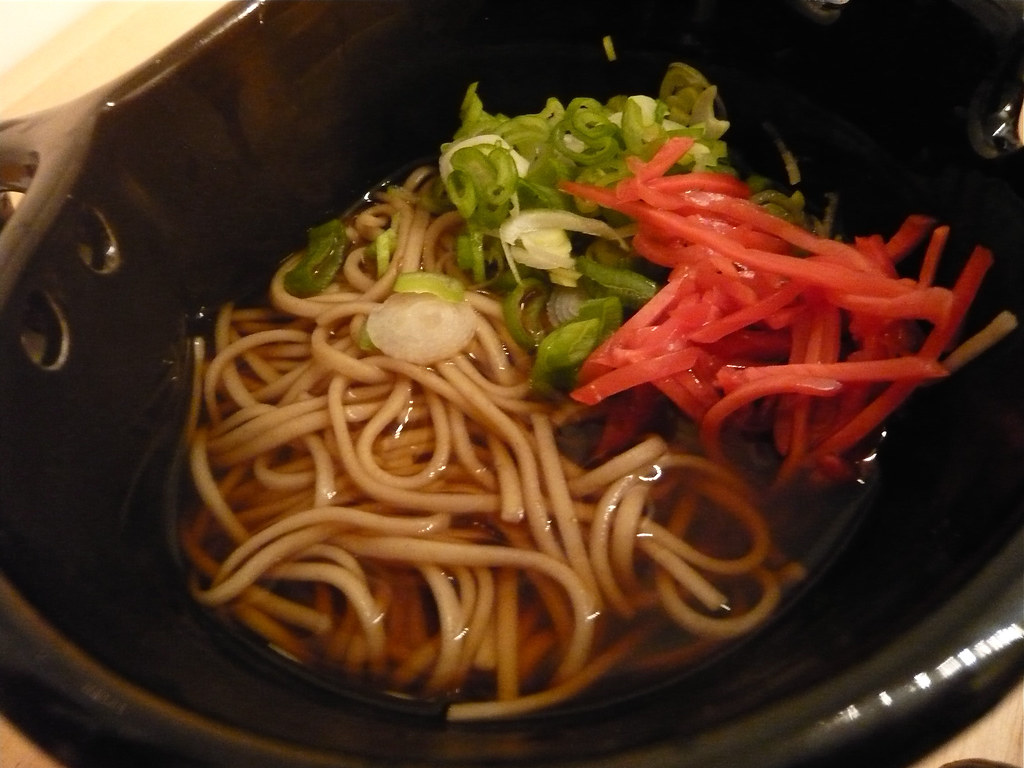
The car ahead of us finishes, and we pull up in front of the hose. The four of us clear out the empty drink containers, vacuum up crumbs and dirt, and scrub the outside of the car. When we are finished, we go home and collapse on the sofa. We will eat noodles at midnight, and then wake feeling fresh and pure, ready for the first sunrise and the first dreams of the new year.
Suzanne Kamatawas born and raised in Grand Haven, Michigan. She now lives in Japan with her husband and two children. Her short stories, essays, articles and book reviews have appeared in over 100 publications. Her work has been nominated for the Pushcart Prize five times, and received a Special Mention in 2006. She is also a two-time winner of the All Nippon Airways/Wingspan Fiction Contest, winner of the Paris Book Festival, and winner of a SCBWI Magazine Merit Award.
PLEASE NOTE: ARTICLES CAN ONLY BE REPRODUCED IN OTHER SITES WITH DUE ACKNOWLEDGEMENT TO BORDERLESS JOURNAL
I first learned of Therese Nagai while listening to a student presentation. I was teaching a class of first year pharmacology students at Tokushima University. Their assignment had been to make a group presentation on something related to their major. One group chose to introduce Nagayoshi Nagai [1844-1929], the Father of Pharmacology in Japan, and the founder of Tokushima University’s Pharmacology Department. My ears perked up when the student mentioned that he had married a German woman.
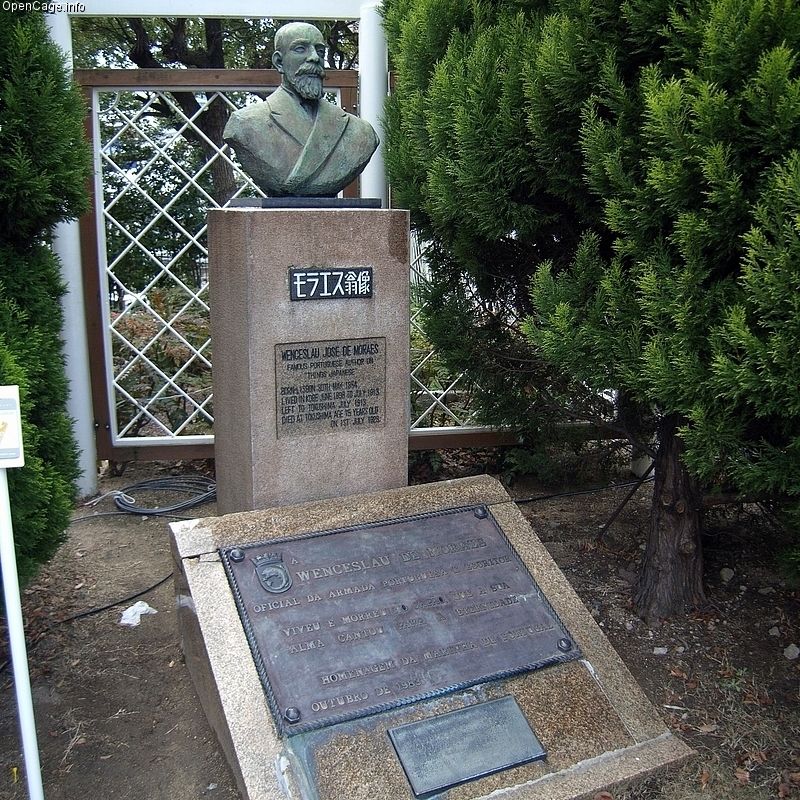
How was it that I had lived in Tokushima for 26 years, yet no one had ever mentioned her to me? Didn’t ordinary people know of her? I knew of the Wenceslau de Moraes, the Portuguese sailor who’d settled at the foot of Mt. Bizan and who wrote about Tokushima in Portuguese. There was a museum dedicated to him at the top of the mountain. I also knew of the German prisoners of war who’d been interred in nearby Naruto during World War I. Because of these foreign men, the prefecture had established ties with both Portugal and Germany. But what about this woman, Therese? I was determined to find out more about her.
In the photo of Therese and Nagayoshi Nagai that pops up in a cursory Internet search, she is staring off in the distance, her expression determined, resolute. Her hair is pulled back, her Victorian dress buttoned up her neck and decorated with a large cameo pin. She looks serious, sensible. He is wearing Western clothes as well — a suit, and a tie. He gazes directly at the camera, but his head is tilted toward hers. She looks as if she might be lost in thought, thinking of her native Germany, or how to improve upon her life in Japan. He seems to be thinking only of her.
Nagayoshi was born in Myodo District in Awa Province, which is now known as Tokushima Prefecture, on the island of Shikoku. His father, a physician, taught him about the medicinal properties of plants, and expected his son to follow in his footsteps. His mother died when he was a child. As a young man, he embarked for study in Nagasaki, at the Dutch Medical College. Nagasaki was the first port of call in a country newly open to foreign trade, and the influx of Western culture, after 230 years of isolation. There, Nagayoshi saw pale, big-nosed Europeans for the first time in his life. He got a job at the first photography studio in the country, where he took photos of foreigners and Japanese, such as folk hero Ryoma Sakamoto. Sakamoto, who was also originally from Shikoku, albeit further south, in Kochi, encouraged Nagayoshi to go abroad and learn from the West.[1]
From Nagasaki, Nagayoshi went on to study at Tokyo University, Japan’s equivalent to Harvard — not bad for a boy from the backwoods. Still, when he was awarded a coveted study-abroad slot at Berlin University, he felt compelled to ask his father for permission to go. His father was afraid he would never come back. “You have a responsibility to become a great doctor,” he told his son. Nagayoshi couldn’t bring himself to tell his father that his interest had turned to chemistry and pharmacology. He had no interest in becoming a doctor.
After getting the go ahead from his father to set out on this great new adventure, he sailed by boat to San Francisco, then took a train to New York, and finally sailed on another steamer to Liverpool. In Europe, everything was shiny and new – the water pipes, the gas lamps, the glass windows. He was also deeply impressed by the architecture in Berlin, declaring in a letter to his father “Everything that is built by humans is finely detailed.”[2]
Although there were several boarding houses that catered to young Japanese men, he took up residence with Frau von Holzendor, where no other Japanese student was living in order to expedite his German language learning[3]. After she passed away, he moved into a boarding house run by Frau Lagerstrom.
The young Nagayoshi was intense and single-minded, too caught up in his studies to bother with a social life. His mentor, German chemist August Wilhelm von Hofmann, suggested that if he was planning on staying in Germany, he should marry a German woman.
“That’s not as simple as you think,” Nagai allegedly replied. “Orientals are still a rarity in Germany. In Japan, foreigners are considered outsiders, and they’re called ‘Meriken’ and held at arm’s length. It will take time to get the consent of my father.”[4]
According to one biographer, Hofmann began plotting to find a German bride for Nagai. He invited his protégé along for an unveiling of a statue of his former teacher, Justus von Liebig, the founder of organic chemistry, the University of Giessen. The proprietor of the boardinghouse where Nagai was staying also accompanied them, perhaps as part of Hofmann’s plan. After the ceremony, Nagai decided to take a trip to Switzerland. On the way, he stopped at the Nassauer Hof Hotel in Frankfurt.
Looking out of his pension window, he spotted an attractive, young German woman, and asked Frau Lagerstrom how he might go about meeting her. She conspired for the two of them to have a meal with young Therese Schumacher and her mother. The Schumachers were visiting from their home in Andermach, a picturesque, medieval town on the left bank of the Rhine. Therese’s father was a local lumber and mining magnate. Nagayoshi was so tongue-tied at breakfast that he could barely manage to get a word out. When he finally spoke, he asked if she would like some honey for her bread. “Yes,” she replied.
After breakfast, Nagai and his landlady ran into the mother and daughter in town.
“Will you be going out somewhere tonight?” he asked.
“Yes, I’m going to the opera,” Therese replied.
Nagai invited himself along.
That evening they went on their first date to the Frankfurt Opera House, chaperones in tow. When asked later what the performance had been, Nagayoshi laughed and said that he didn’t remember. He’d been so mesmerised by the young woman sitting next to him, he hadn’t paid any attention to what was happening on the stage.
The next morning, Therese and her mother departed by boat to Wiesbaden. They continued on a day or two later to Schlagenbad, where the Schumchers had an exclusive contract to provide building materials for a new hotel under construction. When they returned home to Andernach, Therese was astonished to find Nagai, wearing a suit newly tailored for the occasion, waiting on the docks.
For the next three days, he was the guest of the Schumacher family. Therese gave the dapper scholar a tour of the main house, built in 1746, and the stone and lumber works.
“You’ve caught yourself a Chinaman,” Therese’s brother Mathias teased. More likely it was Therese who’d been snared by this polite, erudite Japanese visitor.
The following year, a delegation arrived from Tokyo Imperial University, inviting Nagayoshi to return to Japan head the university’s first Department of Pharmacology. In the film version of their story, Nagayoshi is torn between staying in Germany with the woman he loves and returning to the land of his birth. Of course, he was obligated to return. The university had sent him to Germany to learn for the benefit of his nation, after all.
He proposed marriage to Therese. She said “yes.” After becoming engaged, he returned to Japan alone. He worried that his bride-to-be would be discontent in backwards Japan, where country folk still clattered around in wooden geta clogs, and rickshaws were the choice mode of transportation. In the Japanese movie version of the story, his younger sister assured him that if Therese truly loved him, she would be happy to be with him no matter where they lived. It’s likely, however, that his father and sister were not quite as agreeable as they appear in the film. After all, in that era Japanese men rarely married for love, and Nagai, the only son, was eager for his father’s approval.
In 1885, Nagai experienced a breakthrough in his research, when he successfully isolated the active ingredient of Ephedrine. Later, his findings would be instrumental in the development of medication for asthma and cough suppressant. And even later, he would develop methamphetamine.
Nagayoshi and Therese were separated for months. When he finally returned to Germany, he was 40 years old. Therese was 21. They married on March 27, 1886, in a church in her hometown, Andernach, despite the fact that Nagayoshi was not Catholic. He would convert to Catholicism thirteen years later.
Once in Japan, Therese sent a flurry of letters back home to Andernach. She wrote of homesickness, but also of “standing firmly on two feet in their new life. I feel as if gradually new roots form and I become habituated to this strange way of life, to unusual manners. I’m making progress.”
Broadened by his own experiences abroad, and influenced by his sharp, young bride, Nagayoshi was a strong proponent of education for women. He co-founded Japan’s first college for women, now known as Japan Joshi Daigaku, where Therese was employed as an instructor of German. She was, reportedly, an energetic teacher, enriching her lessons with instruction on manners, customs and German cooking.
Eventually, they would have three children – Alexander, Willy, and Elsa, all brought up to be bilingual, and with an awareness of their German heritage.
In addition to being the Father of Modern Chemistry and Pharmacy in Japan, Nagayoshi served as president and founder of the Japanese-German Society. Therese is credited with introducing German food and culture to the Japanese, and, along with her husband, hosted Albert Einstein and his wife Elsa during part of their visit to Japan in 1922. Therese also helped to interpret for the couple.
Therese died in 1924.
When the eldest son, Alexander, first visited his mother’s hometown, Andernach, he claimed it as his second home. Later, during World War II, Alexander Nagai, would serve as a Japanese diplomat to Germany at the embassy in Berlin. One writer mused that his cross-cultural upbringing made him especially sensitive to the plight of the German Jews. Alexander was a member of a group that resisted intolerance toward Jews and is reported to have helped enable the issue exit visas to Jews who sought to escape Nazi Germany.[5]
In 1994, Teigi Nagai, grandson of Nagayoshi and Therese, donated an ornate chandelier to the church where his grandparents were wed in homage to their legacy and love.
[2] Hoi-Eun Kim, Doctors of Empire: Medical and Cultural Encounters between Imperial Germany and Meiji Japan (Toronto: University of Toronto Press, 2014), 91
[4] Nobuko Iinuma,Nagai Nagayoshi to Terēze : Nihon yakugaku no kaiso (Therese and Nagai Nagayoshi: Father of Japanese Pharmacology), Tokyo : Nihon Yakugakkai, 2003
Suzanne Kamatawas born and raised in Grand Haven, Michigan. She now lives in Japan with her husband and two children. Her short stories, essays, articles and book reviews have appeared in over 100 publications. Her work has been nominated for the Pushcart Prize five times, and received a Special Mention in 2006. She is also a two-time winner of the All Nippon Airways/Wingspan Fiction Contest, winner of the Paris Book Festival, and winner of a SCBWI Magazine Merit Award.
PLEASE NOTE: ARTICLES CAN ONLY BE REPRODUCED IN OTHER SITES WITH DUE ACKNOWLEDGEMENT TO BORDERLESS JOURNAL
“The mountain in Awa rises in the sky like a nicely curved eyebrow
Seeing it above the horizon, a boat is heading toward it
Where will it stay tonight?”
-from the Manyoshu, 8th century
Mt Bizan: Photo Courtesy: Suzanne Kamata
In his 1919 essay, “Impressions of a Walk,” the Portuguese expatriate Wenceslau de Moraes[1]wrote of hiking up Bizan during koharu, “the small spring” – “a delightful and rapid transition from the suffocating heat of summer to the cool breeze of the winter.” After sailing around the world, Moraes settled in Tokushima for the last sixteen years of his life. He purportedly hiked up Bizan, the prefecture’s most emblematic mountain, every day.
I have lived in Tokushima Prefecture for over twenty years now, but it’s been a while since I’ve been on the mountain. A recent popular movie, “Bizan,” was filmed on its slopes as well as at the hospital where my children were born, and the university where I teach part time. Some of my students appear as extras in the festival dance scene toward the end. It is this movie that has spurred my own outing.
My excursion to the top of Bizan begins on a day between seasons as well. A week or so ago, I was scraping ice from my windshield. Now I am getting ready to set out without a jacket under a clear blue sky. My plan is to drop my daughter off at school, and then walk to the ropeway station at the base of the mountain. Caught up in the usual frenzy of morning preparations, I cannot seem to locate my backpack. I stuff a field guide, my notebook, a photocopy of Moraes’ essay from his book Oyone and Koharu: Essays of a Portuguese Recluse in Japan, a novel, and sunglasses into a cavernous Louis Vuitton handbag my mother-in-law had given me as a gift. Then I load my daughter and her stuff into my car, and off we go.
Bizan, or “Eyebrow Mountain,” is visible from almost any point in Tokushima City. I see it every morning, off to the right, as I drive along the Yoshino River. It’s there, glimpsed through tall buildings, as I wait at a traffic light in the city. And it looms at the end of the main road stretching in front of the train station. Jackucho Setouchi, a Buddhist nun, and the most famous and prolific Tokushima-born writer, concurred in her book of autobiographical fiction Places, writing, “If I was playing by myself on the Nakazu wharf, or in the open field where once a year a circus came and set up tents, I could turn around and there was Mt. Bizan. I would look up to it in mild wonder.”
As mountains go, it’s not all that spectacular. Moraes referred to it as a hill. It is actually part of the Shikoku Mountain Range that stretches into southern Tokushima and is separated from the Sanuki Mountain Range by a river valley. There are taller peaks in the prefecture – Tsurugi-san, at 1955 meters, is the highest, but Bizan (294 meters), with its gentle slopes and more or less flat top, is perhaps the most distinctive. And the mountain is rich in culture and history.
After I drop my daughter off, I walk through Tokushima Park, then through a flurry of cars, blinking neon, and traffic signals chirping for the blind. I pass the shopping arcade, the headquarters of the religious cult Kofuku no Kagaku, and the red gates of a Shinto shrine to arrive at the Awa Odori Kaikan, which houses the ropeway station. From the base, the mountain appears easily surmountable – less than an hour to the top. But I’m not in the best of shape, and I have this heavy handbag, so I decide to take the gondola as planned.
The ride lasts about fifteen minutes. Up at the top there is a profusion of vending machines and small buildings – a café, a cell-phone transmission tower, and a white pagoda in the Burmese style. I recognise the pagoda from a scene from the movie. There is also a small museum devoted to Wenceslau de Moraes, perhaps Tokushima’s most famous expatriate. I make this my first stop.
Hiraoka-san, a small, genial grey-haired man in a jean jacket, gives me the grand tour in English. The exhibit includes some of the many books written by Moraes – both the original Portuguese versions and Japanese translations – as well as photos, his writing desk, smoking implements and bowler hat.
On the wall there are scenes from the puppet play based on the life of Moraes. The script was written by Setouchi[2]. Under glass, I see a pamphlet from a Japanese movie inspired by the bushy-bearded European sailor.
Hiraoka-san shows me the letters of appointment Moraes received from three Japanese Emperors – those of the Meiji, Taisho and Showa eras – for the position of Portuguese consul in Kobe. Moraes met with Emperor Meiji three times. There is also a model of the ship Moraes sailed on which Hiraoka-san says, “is like the one in Pirates of the Caribbean with Johnny Depp.”
Moraes first came to Japan as a member of the Portuguese navy. He’d been to other places – Mozambique, where, according to his translator Kazuo Okamoto, he’d fallen “violently and foolishly in love” with Arrussi, a woman referred to as “Miss Africa”; and Macao, where he’d bought and married Atchan, the mixed race daughter of an English father and a Chinese mother, with whom he’d had two sons and then deserted– before he took on the position of Portuguese consul in Kobe in 1899. Moraes married 25-year-old Oyone, in 1900, when he was 45 years old. She died at the age of 38, and her ashes were entombed at Chonji Temple in Tokushima, where Moraes took up residence in 1913. He visited her tomb daily, but her relatives denied his request to have his own ashes buried with hers. He later lived with Oyone’s cousin, Koharu, who became his common law wife. She, too, died young.
Moraes lived in a house at the base of Bizan, where he enjoyed gardening and, presumably, writing. He published two collections of essays about Tokushima in his native language – Oyone and Koharu and Bon Odori in Tokushima: Essays of a Portuguese Hermit in Japan. With his long white beard and kimono dyed with the locally grown indigo, he must have caused quite a stir among the locals. His first impression of Tokushima was “that along the way to the modest domicile which had been destined for me was a dominating and agreeable impression of – green. Green plunging into my aesthetic eyes! Green that rushed into my nose. Green, nothing more – an impression so strong, so all-inclusive that I could scarcely pay attention to the details of the scene spread in front of me.”
And yet he did manage to write in great detail and with much feeling of everything he observed around him. From the mountain, he saw “the houses thickly clustered together – small houses, and of wood of course — extend over a vast plain of silt on the complex waterways of the river Yoshino, from the coast to the foot of the hill ranges which bound it: a population of nearly seventy thousand, including four or five Europeans of whom I am one, but this, of course, is not mentioned in the books.”
From the top of Bizan, one can still see an expanse of greenery, the harbour adrift with boats, and ships in the Kii Channel. On a clear day, Awaji Island is visible. Down below, while wooden houses remain, white concrete apartments, schools, and office buildings tend to dominate. Shikoku is still the smallest and least populated of Japan’s four main islands, but Tokushima Prefecture now has a population of approximately 810,000, of about 6,000 whom are foreigners.
I am one of them, a woman from the United States. Like Moraes, I seek to convey the atmosphere and culture of Tokushima to the people of my native country, most of whom have never heard of this place, through my writing. Like Moraes, I have settled here with a spouse. But of course, I am not nearly so conspicuous as he was. In twenty-first century Tokushima, my blond hair blends with the dyed hair of the youth of the city. And I’m not a hermit, not hiding from the world.
Thinking to fortify myself before heading off on one of the designated walking trails, I duck into the Bizan café just outside the gondola station. I stand before a vending machine offering tickets for the usual fare – curry rice, pilaf and udon – but a woman bustles out from a back room and makes an “X” with her fingers. The shop isn’t open for business yet.
I meander down to a weathered wooden bench shaded by walnut and bayberry trees. Off in the distance, I can hear a train rumbling over the tracks; closer by, birds twitter and chirp and the brush rustles with life. I’m told that there are rabbits and monkeys on this mountain, as well as a fair share of stray cats and dogs. Here and there, signs warn of mamushi, a reddish brown snake with leopard spots whose bite can be fatal. In the early 1900s, residents sought to ward off the snakes with exorcisms written on paper. Moraes himself wrote, “My humble house is completely defended with these pieces of paper.”
I wander until I come across a white gazebo, complete with weathervane. According to a plaque, this structure was a gift from Saginaw, Tokushima’s sister city. It reminds me of a bandstand in Michigan where I grew up, of sitting on a blanket with my grandparents in summer, listening to a small orchestra. In a few months, it will offer a retreat from the blazing sun. Now, I stand under its roof and gaze out at the ribbon of river. Straight ahead, on the opposite bank, I can see the school where my son is learning to write Chinese characters.
I walk a bit more, past the statue of Moraes and his dog, past the rhododendron bushes with their first intimations of spring, a hint of red, and down the hill to – what’s this, an apartment building? No, it’s a government-sponsored hotel – the Bizan Kanpo. My daughter’s kindergarten once had a sleepover at this place. I remember now that we walked up this hill for a night-time festival. The parents and teachers supervised while the children played ring toss games by lantern light. In the morning we performed “radio exercises” in the park.
Now I see a few people picnicking on benches, and I’m sorry that I didn’t bring my own lunch. I’m famished by this time, so I make my way back to the café, which is now open. I order a bowl of noodles and settle at a table covered with tie-dyed indigo cloth. There are only a couple of other customers – a pilgrim dressed all in white, his peaked straw hat resting on the counter as he takes a break between temples – and a man who works on the mountain. As I eat, I look out upon Shiroyama, a hill hunched at the center of the city, the site of the ancient shogun’s castle, and the town hall where the record of my marriage is stored.
Although I purchased a round-trip ticket on the ropeway, I decide to hike down. How hard could it be? I find the shortest route on the map, one that I think will take me to my starting point, but almost immediately I wonder at the wisdom of this decision. All morning I have been tramping up and down concrete steps and sidewalks, but this is an actual hiking trail. The steep, narrow path is strewn with dry leaves, which may be slippery. I don’t have a walking stick, and instead of a backpack, I’ve got this handbag hooked over my arm. There is also the question of snakes.
Nevertheless, I begin to pick my way down the incline, imagining Moraes nearly a century ago in these same woods in his kimono. I grab onto tree trunks and seek purchase on protruding roots and rocks. My thighs burn with the effort.
The forest is so dense that I can’t see the city beyond. No one is on the trail behind or ahead of me. No one knows where I am. It’s an odd feeling, here in this densely populated country where I am so seldom truly alone. All I can hear is the wind in the trees, and what I take to be birds rustling the leaves as they forage for food.
Although I’m tempted to pull out my field guide and try to identify some flora or fauna – were those grey-tailed birds that just flew past starlings or brown-eared bulbuls? – there are no stumps for sitting, no spots for rifling through my bag. I keep going until I spot a paved road through the trees. The trail seems to suddenly drop off to this road.
It’s a couple of meters to the ground below. I start looking for a sturdy branch that I might be able to use to vault myself down, and then I see a businessman strolling up the road. Maybe he’s out for his daily constitutional. Crouched here on the side of the mountain with my Louis Vuitton bag, I suddenly feel ridiculous. I hold myself very still and hope that he doesn’t notice me. When he’s out of sight, I manage to scoot down without scraping myself on the rocks.
Through the trees I can now see some familiar landmarks, and I know that no matter where I end up, I’ll be able to find my way back. And then I come to a set of stone stairs, and I remember climbing these very steps fifteen or sixteen or maybe seventeen years ago to drink with friends beneath the cherry blossoms.
I see that paper lanterns printed with “Asahi Beer” have already been strung across the path in anticipation of this year’s flower viewing. Soon, it will be time for the azalea festival in the Sako neighbourhood where my husband grew up.
Almost a hundred years ago, Moraes was enraptured by the pink and purple blossoms. In May of 1915 he wrote, “How beautiful the mountains are! The azaleas, above all, are most delicious, and the charm of this rosy colour, the profusion of blooms, transforms the entire mountain into a garden. I contemplate the spectacle, resting on an old piece of tumulus stone; the mountain where I am is a cemetery, as is almost every slope of this land. And in sight of the graves I want to shout, ‘Get up, you who are sleeping, come and enjoy with me the rapture of these flowers! You cannot be dead when all of nature is awaking!”
I think of these words when I see the jizo along the path. These are stone statues tied with red bibs, which represent the spirits of dead infants, especially aborted or stillborn babies. Brooms made from twigs have been left beside the shrines for caretaking. Moraes, who lost both his first Japanese wife, and his second common-law wife, Koharu, was often preoccupied with death. Though he wrote of the burgeoning nature on Bizan, he also wrote of the jizo, funeral processions, the tending of the butsudan, posthumous names, and the crematorium on the mountain.
At last, I come out in front of the red-gated shrine next to the gondola station. I pass the stone shishi – guardian lion-dogs – and a statue of a figure performing radio exercises, and then I’m on flat ground.
After I pick up my daughter from school, I drive along the Yoshino River and look to the left, to Bizan. I can pick out the hotel and the cell phone transmission tower, and the slope where I’d made my way down. This mountain has been here for centuries — it is the burial site of feudal lords, an inspiration to poets and novelists, a home to small animals, and a film location.
In a hundred years it will still be there. I wonder what other expatriates and Japanese will write about Eyebrow Mountain a century from now. Who will Bizan next inspire?
[2] Jackucho Setuchi, Japanese nun and writer (1922-2021)
Suzanne Kamatawas born and raised in Grand Haven, Michigan. She now lives in Japan with her husband and two children. Her short stories, essays, articles and book reviews have appeared in over 100 publications. Her work has been nominated for the Pushcart Prize five times, and received a Special Mention in 2006. She is also a two-time winner of the All Nippon Airways/Wingspan Fiction Contest, winner of the Paris Book Festival, and winner of a SCBWI Magazine Merit Award.
PLEASE NOTE: ARTICLES CAN ONLY BE REPRODUCED IN OTHER SITES WITH DUE ACKNOWLEDGEMENT TO BORDERLESS JOURNAL
I first learned of Okunoshima from a Canadian friend’s Facebook post. She’d shared photos of herself surrounded by rabbits. The island just off the coast of Shikoku and only accessible by ferry, was overrun with these adorable animals. How unusual, I thought. How cute! Surprisingly, few Japanese people that I talked to seem to know about this place. However, when it was featured a few months ago on a TV travel show, my daughter Lilia told me that she wanted to visit.
“It’s really far,” I told her. “At least three hours by car.”
“We can take the bus,” she signed to me. (My daughter is deaf.)
I knew that there were no buses that went from our town in Tokushima, on the eastern part of Shikoku, to Tadanoumi in Ehime Prefecture where we could board the ferry to Okunoshima. My daughter, who has cerebral palsy, uses a wheelchair, and it seemed like too much of a hassle to take the bus to Matsuyama and change buses once or twice to get to that tiny coastal town, but I wanted to visit as much as she did. I was charmed by the idea of an island full of bunnies. When I came across a flyer advertising a one-day bus tour to Okunoshima, I immediately signed us up.
We got up extra early that sunny Sunday and met our tour guide in a gravel parking lot near the town gym. I’d told the tour guide that my daughter was disabled, but it wasn’t a big deal. We climbed into the front seat and the guide handed out tea and packaged rice balls. We gazed out at the lush green terraced fields, yellow roadside wildflowers, and flooded rice paddies as we made our way to Ehime Prefecture. The landscape outside our window might have been lifted from the animated film Tottoro.
“Inaka,” Lilia signed.
“Yes.” I agreed that we were deep “in the countryside.”
I was a little worried that once we got to the island my daughter would find the real-life rabbits annoying. I remembered how she had been bothered by the notoriously aggressive deer in Nara on her school trip. One deer had tried to eat her notebook. What if the rabbits tried to nibble on her fingers or cellphone? But as we rolled along the highway, she reminisced about the rabbit she and her classmates had taken care of in kindergarten. When it had died, they had held a little ceremony and buried it on the school grounds.
As we approached the port, finally catching a glimpse of the sea, the tour guide gave us some final instructions. “Don’t give the rabbits snacks,” she said. We could buy rabbit food at the port.
The bus took a turn down a narrow road flanked by brown-tiled houses, many of them with solar panels. Finally, we arrived at a parking lot next to a small cluster of buildings. To my surprise, here we were, seemingly in the back of beyond, but a long line of people already snaked around the corner from the ferry dock. The tour guide seemed a bit nervous. “It’s a small boat,” she said, “and they don’t accept reservations.” She hurried off to buy our tickets. Note to self, regarding future visits: arrive plenty early.
The tour guide returned to the bus and informed us that the passengers were lined up for an earlier ferry and that we would be able to board. Phew! Since we had about half-an-hour before our own departure, we all got off the bus. Lilia and I went to a small building with a big clock to buy packets of rabbit pellets.
When it was time to get on the ferry, we were directed to the lower level, along with several young families with strollers. Most of the other passengers went above deck. We stayed to the side as three rows of cars were directed onto the ferry. It was shaded and cool.
Lilia, who has always been far more social than me, tried to get me to start a conversation with a blonde foreign woman standing nearby with her three kids and husband. From the familiar scent of her sunscreen, I assumed that she was American, but I didn’t really feel like talking. I resisted my daughter’s entreaties, suggesting that we just relax and enjoy the wind on our faces, the sight of the waves. I thought it was remarkable, however, that although most Japanese people I’d mentioned the island to had never heard anything about Okunoshima, there seemed to be several groups of foreigners on this ferry alone bound for the island.
We arrived in about twenty minutes. The tour guide had arranged for a mini bus to transport my daughter and me to a restaurant on the island. Lunch was included in our package tour. The rest of the group would be going on foot. The restaurant was only about a fifteen-minute walk from the port.
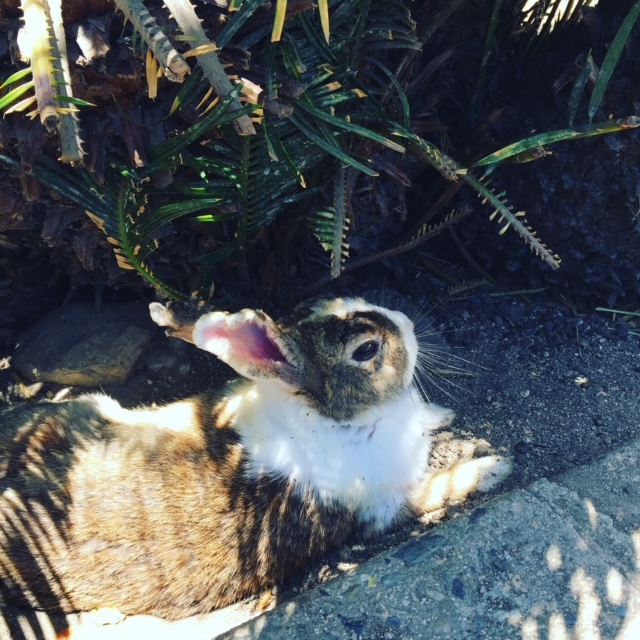
I had half-expected hordes of rabbits to greet us upon disembarking, but it was hot. The first rabbits I spotted were lolling beneath bushes, their energy apparently sapped by the high temperatures and humidity.
My daughter and I boarded the waiting van. I pointed out rabbits to Lilia: there, in a burrow, there, under the picnic table. It occurred to me that this was the first Japanese island that I had been on that wasn’t home to stray cats.
“Are there any predators on this island?” I asked our driver.
He thought for a moment. “Maybe crows.”
The rest of our group was dining in a tatami room. Because of my daughter’s wheelchair, we ate in another room at a table with chairs. Our pre-ordered lunch consisted of slices of sashimi, miso soup, and rice mixed with vegetables, but at the Usagi Lunch Café, you could order pancakes branded with bunnies, white rice molded into rabbit shapes surrounded by curry, and long-eared rice-filled omelettes.
After lunch, we were free to do as we liked until the ferry departed. We set out to explore. Bicycles can be rented, but it’s possible to walk the four kilometres around the entire island in an hour or less. The bunnies are not hard to find.
LiliaLilia and the rabbit
Lilia and I ventured on to a grassy lawn, which was full of holes dug by rabbits, making it a bumpy ride with the wheelchair. We settled briefly at a shady spot under some trees where some bunnies had gathered, and lured them with pellets. I was worried that they might bite our fingers, but they were docile and friendly, nibbling only on the food that was offered. “Kawaii!” Lilia said. “Cute!”
Although the rabbits are, for all intents and purposes, wild, they are supposedly descendants of pet rabbits kept at a long-ago school. The story goes that in 1971 schoolchildren released eight of these creatures on the island, and then they began to proliferate, as rabbits do, Now the island is designated as a national park and is home to around 700 bunnies.
There is another more sinister theory as to how the rabbits came to be on the island. Unbeknownst to many Japanese, from 1929-1945, the Secondary Tokyo Military Arsenal manufactured chemical weapons for the Japanese Army on Okunoshima. This project was so secret that during that time, the island was excluded from most maps of Japan. The poisonous gases produced here, including mustard gas, tear gas, and phosgene, were used more than 2,000 times exclusively against the Chinese, killing 80,000 people. The effectiveness of the gases was allegedly tested on rabbits. Some say that the ones now living on the island are descendants from test rabbits released after the facility was destroyed in 1945 by U.S. Forces. However, Hatsuichi Murakami, who worked at the poison gas factory as a teenager and later became director of the Poison Gas Museum, told a New York Times reporter that the present-day rabbits are not related to those used for testing.
My daughter wanted to visit the Poison Gas Museum, which she had also learned about from TV. Having visited the Hiroshima Peace Museum and the Holocaust Museum in Washington D.C. on family trips, she was familiar with the horrors of war, and keen to know more about history. We saved a few pellets for later, and made our way to the small building with a red-brick facade. A ramp made it easily accessible, as did the nominal one-hundred-yen entry fee. The exhibits of gas-making materials, clothing owned by factory workers, and photos take up only two rooms, but their impact is strong. They are labeled in both Japanese and English. According to the museum’s English brochure, “Having seen materials made by concerned people, we hereby declare that war is meaningless and the production of poison gas is tragic. We make an appeal for everlasting peace.”
Once again under the hot afternoon sun, we wandered slowly back toward the port, dispensing pellets as we went. Maybe, I thought, these cute little bunny rabbits were released here to live freely as atonement for the ones who had suffered and died. They are now protected from hunters, dogs, and cats (which are prohibited on the island). Signs warn visitors not to feed them on the road, in order to keep them safely out of the way of oncoming cars. From their appearance, they seem mostly healthy and well cared for. The island itself is now a family-friendly place with a campground and a spa, where people from all over the world gather peacefully.
As we lined up for the ferry to return home, my only regret was that we couldn’t stay longer. Then again, now that we knew how to get there, we could always go back.
Suzanne Kamatawas born and raised in Grand Haven, Michigan. She now lives in Japan with her husband and two children. Her short stories, essays, articles and book reviews have appeared in over 100 publications. Her work has been nominated for the Pushcart Prize five times, and received a Special Mention in 2006. She is also a two-time winner of the All Nippon Airways/Wingspan Fiction Contest, winner of the Paris Book Festival, and winner of a SCBWI Magazine Merit Award.
PLEASE NOTE: ARTICLES CAN ONLY BE REPRODUCED IN OTHER SITES WITH DUE ACKNOWLEDGEMENT TO BORDERLESS JOURNAL
But one day, my husband said, “How about a cat?” His high school friend, who was a veterinarian, had an American long-haired kitten to give away. His children had found it abandoned by the side of the road, scared and shivering, and brought it home. It was black – an unpopular colour due to its bad luck connotations. The colour of a witch’s familiar.
“Yes!” my son, now fifteen, said. By this time, he would have been happy with a hedgehog or a salamander – any pet at all.
Although I love cats, I was more reluctant. After all, I’d just bought a brand-new sofa and love seat with some book money I’d gotten. I could just imagine what a cat’s claws would due to those leather cushions.
Nevertheless, my husband and son set out for the vet’s office. They came home later with the kitten cuddled against my son’s chest and all the accoutrements – food dish, cat toys, scratching post, and a multi-tiered tower that my husband immediately assembled.
From the beginning, like a duckling that imprints on the first thing that it sees, the kitten, which we named Sumi (the Japanese word for the black ink used in traditional calligraphy) liked my son the best. My early rising husband may have been the one to fill his food dish every morning, and my daughter sometimes coaxed him into her room for sleeping, but my son was his favourite. Sumi would leap from my lap to greet him at the door when he returned from school, and mew plaintively and persistently at his bedroom door until he was admitted. Sumi was skittish and inclined to hiss at strangers. He’d run away and hide under a bed when my sister-in-law dropped by for a visit. But he crooned a greeting when my son walked into the room. They bumped their heads together with mutual affection.
Of course, I grew to love Sumi as well even though, predictably, he clawed the new sofa, scratched the wallpaper, and regurgitated his food on our freshly installed tatami mats.
My husband tried to discipline Sumi, sometimes by holding him immobile and roaring at him, but instead of becoming docile and obedient, Sumi began avoiding him or hissing in his presence. My husband began to grumble that a dog would have been better.
One afternoon, a couple of years later, my son came home with another kitten. She was a tiny, mewling thing with blue eyes and white fur, with a smudge of black on her face – a Siamese, by the looks of her.
“She followed me,” my son said. He’d been down by the riverbank, pitching a baseball against a brick wall, when the tiny creature had found him. “I couldn’t just leave her there.”
Apparently, she’d been recently abandoned, her trust and innocence still intact. She wasn’t skittish and shy like Sumi. She was adorable, but we all knew that Sumi wouldn’t welcome her, and one cat was really enough. How much more violence could our sofa and wallpaper endure? Besides, my son, a sophomore in high school, was taking off the very next day for a four-day school trip to Tokyo. Who would deal with the kitten?
However, she quickly grew on us humans (though Sumi, now quite large, was terrified of the little ball of fur). We ended up keeping her, and she quickly adapted, co-opting the litter box, happily eating kibble – and tomatoes! And broccoli! — from the same dish as Sumi and hopping up onto the nearest warm lap. My daughter named her “Mii.” But she, too, had a special relationship with my son, her saviour. He taught her to fetch – like a dog! And she came when he called her, like a dog.
We tried to keep her safely indoors. But one day, she managed to escape. Hours later, she turned up, limping. We took her to the vet, who said that she had gotten into a fight. He gave her some antibiotics. For a couple days, she lost interest in going outdoors.
But a week later, she got out again! This time she was gone overnight, I searched all over the neighbourhood, calling her name, but she didn’t come.
That evening, rain started to fall. Suddenly, we heard her distinctive mewling. My son grabbed a flashlight and we went in the direction of her voice. We found her stranded on the tile roof of a nearby house and pounded desperately on the door. Finally, it creaked open to reveal an elderly woman in her nightclothes. I wonder what she thought, seeing two foreign-looking strangers on that rainy dark night.
“Our cat’s on your roof,” my son explained. “Can we go into your yard?”
The woman kindly provided us with a ladder, and we got the kitten down.
As my son began his last year of high school and began thinking about applying to universities in distant cities, we couldn’t help but think about the cats. They’d be so lonely without our boy.
“You should take Sumi with you,” my husband joked, as if any student apartment would allow such a pet. As if a cat would be happy confined to a tiny college dorm.
When he was accepted into a university in the far north of Honshu, in a city without a direct flight to our own, my husband ordered our son to get rid of all the stuff he didn’t need.
“You’ll be gone for good,” he said, “and we don’t want to have to deal with all of your junk.”
I knew that my husband’s gruffness was a front meant to conceal his sadness at our son’s departure. Our daughter would be leaving, too. Our nest would be empty. He was gearing himself up for grief.
“We’ll take Sumi off somewhere and dump him,” my husband said darkly. Sumi glared at him from underneath the table as if he’d understood, but I knew that the threat was empty. The cats would stay. They would keep us company after our children had left.
Already I was imagining the anxious queries from the north about Sumi and Mii, the photos that I would send by smartphone, the joyous meows at the beginning of university breaks.
“We have to keep the cats,” I told my husband, “so that our son will come back.”
Suzanne Kamatawas born and raised in Grand Haven, Michigan. She now lives in Japan with her husband and two children. Her short stories, essays, articles and book reviews have appeared in over 100 publications. Her work has been nominated for the Pushcart Prize five times, and received a Special Mention in 2006. She is also a two-time winner of the All Nippon Airways/Wingspan Fiction Contest, winner of the Paris Book Festival, and winner of a SCBWI Magazine Merit Award.
PLEASE NOTE: ARTICLES CAN ONLY BE REPRODUCED IN OTHER SITES WITH DUE ACKNOWLEDGEMENT TO BORDERLESS JOURNAL