People, mainly the theistic type, are in a dilemma now. They are currently undergoing a test of faith of sorts. On the one hand, they feel they should not have been subjected through such a trial. Whoever had heard of man-made laws preventing believers from performing their daily mandatory salutations of the Divine Forces? Furthermore, at this time of calamity, if they cannot turn to the Divine for help, what else can they do?
But wait…
Why did the Divine Forces ‘send’ such a test to us? Does He not love us so much? After all the cajoling over generations, and the importance that humankind had accorded to the divine forces all times, why are we continuously put to the test? Is it some kind of Divine Mirth for the amusement of the Maker and a testbed to gauge our devotion?
Why are the first spaces to be emptied all the places of worship? How can they be hotbeds for infection? Are they justified is asking, “My Lord, why hast thou forsaken me?”
Has God ditched his followers stricken with COVID-19 by shutting down religious centres with no prayer meetings? Social distancing seems to be the only panacea for the pandemic. Perhaps He is telling us that blind faith does not work.
Above all, intelligence and cognitive power would make us stronger as a race. Perhaps the answer would be, “I am here just for your solace. I cannot possibly change the trajectory of the Universe just because you cajoled me in prayers. Imagine the catastrophe that could cause to the others. I have other requests too, you know!”
It has happened many times before…
There was a time when worshippers were contented when their scriptures protected them from dangers of the pleasure of the forbidden fruit. They thought it was only the deviants who were at the receiving end of God’s wrath. So, when people like Paul Ehrlich came up with his magic bullet, Salvarsan, to treat syphilis, a sexually transmitted disease willed to punish the wayward, he received no accolades but instead, Ehrlich was pelted with stones, and his home was torched. He was scorned for siding with the sinners and going against the overpowering might of God.
All through our civilisation, believers took it upon themselves to symbolise the omnipotence of Divinity by constructing grandiose erections in the name of His splendour. True — these abodes have been useful to house believers and non-believers at times of crises before. These robust megalithic structures are of limited use as they are of restricted use to care for the homeless. They have been labelled as sites of super-spreaders and is out of bounds to worshippers and asylum seekers alike…
We are left with the power of human intellect and science to overcome this as we have done many times. In years to come, this current episode would be just a fleeting moment in the annals of human history. Catastrophes, one after another, we have bowled over. Floods, famines, earthquakes, tsunamis, world wars — we have defeated all. This will add another feather to our cap.
We did not attain the status of the de facto spokesperson of the planet for nothing.
We shall overcome.
Farouk Gulsara is a daytime healer and a writer by night. After developing his left side of his brain almost half his lifetime, this johnny-come-lately decides to stimulate his non-dominant part on his remaining half. An author of two non-fiction books, ‘Inside the twisted mind of Rifle Range Boy’ and ‘Real Lessons from Reel Life’, he writes regularly in his blog ‘Rifle Range Boy’.
Keeping busy: Tao Wang at his home during the lockdown period in Wuhan, China. (Courtesy: Tao Wang)
I run a research group made up of more than 20 graduate students, and in a “normal” workday my job is to supervise and direct them on research activities related to opto-electronic devices such as solar cells and light-emitting diodes. I also teach an undergraduate course in polymer physics during our teaching season, with lectures two times a week. I would normally also go to conferences, although not every week.
The city of Wuhan and the residential compounds within it responded differently at different stages of the pandemic. At the beginning of the outbreak, normal life was not affected much as the number of infected people was low. On 23 January, Wuhan was locked down, with nobody able to leave the city; however, in the early days of the lockdown people could still walk freely outside their homes. This was soon changed so that nobody could leave their residential compound except those involved in essential work, as evidence showed that less strict measures were not preventing the spread of the corona virus.
Life under lockdown
During the lockdown, a lot of medical and other resources were sent to Wuhan, and many volunteers helped deliver groceries to residential compounds, assist the vulnerable, and bring food to doctors and nurses on the front line. At first, patients with mild symptoms were asked to return home and self-isolate – partly due to the shortage of hospital beds and other resources, and partly due to a lack of experience in how to treat a virus that humans had not encountered before. Again, this soon changed, as the virus continued to spread, clusters of infections appeared, and people with mild conditions developed more serious symptoms.
To deal exclusively with corona virus patients, Wuhan constructed two new hospitals from scratch in 10 days. Another 16 makeshift hospitals were also built, some of them in one day. Other provinces in China also sent many thousands of doctors and nurses to hospitals in Hubei.
This enabled health workers to collect and treat all patients in hospital and closely watch those who have been in close contacts with patients. The number of new cases reduced immediately with these actions, and this – along with a reduced number of patients in hospitals after their cure and discharge – helped to ease the crisis.
I have kept myself fairly busy while self-isolating at home during the lockdown time in Wuhan. Whilst we report our body temperatures every day to local health volunteers and try to keep our life free of chaos and panic, we also try to do some of the work we would expect to do in a normal time.
My students and I have online meetings every two weeks, during which we discuss some of the latest literature related to their projects. We finished writing and revising a few manuscripts, and I also wrote two grant proposals (it is proposal writing time between January and March in China). At the beginning of the new semester in March, university students in Wuhan were asked not to return on campus due to the outbreak of COVID-19, and all face-to-face lectures have been turned to online virtual ones. This minimizes the disruption to their studies, while also ensuring their health and safety.
Emerging from the epidemic
For the past 20 days, very few new cases of corona virus have been reported in Wuhan, and as of today the total number of corona virus patients is less than 500. So, after 11 weeks of lockdown, people in Wuhan were allowed to leave the city from midnight on 8 April.
Thanks to the great achievement of putting down a pandemic in about two months, people in “epidemic-free” residential compounds are now allowed to leave their homes, for example to do grocery shopping in supermarkets. A lot of commercial units have resumed functioning. The authorities are evaluating how to ensure public health and safety in these new circumstances, and when that is settled our students will be allowed to return to campus. I actually tidied up my office today, and I am waiting for our students to be back, which I am sure won’t take long.
With great efforts from people in every country, this extraordinary crisis will surely be overcome, and we will be back to “normal” life.
But this new normality won’t be the same as the one that existed before. It is going to change our society in ways we haven’t fully anticipated. I hope the changes are positive rather than negative. We should live in more healthy ways so that we can share this planet with other beings, and that will require everyone to think things over after the disruption is finished.
I do see positive things in all nations across the globe: responsibility, selflessness, self-discipline, unity and resolve. As for positive things in my professional life, the lockdown gave me time to look back and think over what I have done in my research activities over the past few years, and particularly to evaluate whether they are as methodologically robust as they could be. I have some thoughts on that and will start from those once I am able to return to my laboratory.
I hope the rest of the world can get hope from my experience in Wuhan. If we stick to social distancing, wash hands and wear masks, this pandemic is certainly controllable.
This post is part of a series on how the COVID-19 pandemic is affecting the personal and professional lives of physicists around the world. If you’d like to share your own perspective, please contact us at pwld@ioppublishing.org.
Tao Wang is an experimental physicist in the School of Materials Science & Engineering at Wuhan University of Technology in Wuhan, China.
(A conversation on ‘hope’ between a mom and her 14-year-old daughter)
By Nidhi Mishra
Yesterday, someone shared with me a video by Serena Williams that went viral last year, where she is emotionally urging her little baby girl to grow up and take to a sport, ANY sport, but some sport. I remembered watching it together with my young daughter — in fact, many times over.
But, somewhere, during the repeats, I wondered what it was about this message from Serena that moved me so much. I have never really played any sport myself. I did inherit the family culture of an impeccable and exhaustive viewing of all Tennis grand slams, but it did not impact me any other way personally.
My daughter loved the video and gathered that I was trying to relay to her Serena’s message about the life lessons from sports. But seeing a tiny tear curl up in the corner of my eye, she figured it meant something more to me.
“Why are you so moved by this video?” she pestered, not happy that she was missing some point. The lack of a response from me made her venture to guess why Serena seemed important to me right now, while our lives seem to have come to a standstill.
Was it the daunting speed of Serena’s aces or the power of her backhand?
Was it the unmatched records of her Grand Slam victories?
Or was it the emotional appeal in the video, Serena trying to pack her life’s wisdom in a two-minute video, for her baby?
The answer I gave seemed terribly simple for all the flush of emotions I had been displaying.
“It is because she is a mom,” I said.
I could see my daughter had a loud “So what?” written all over her face.
“It is just that she is a mom,” I continued. “A returning mom. Doesn’t matter that she is returning to sport. It is the overpowering image of a mom returning to her life, reclaiming her life, the life she always knew before she hit pause. You won’t understand it. But every mom will.”
After some moments, my daughter replied, “You are right Ma. Yes, I get that it is hard. But I may not get HOW hard. I do understand now that when we talk of or watch Serena, it is not just her game.
“I am conscious she is ‘getting back’ to her game, which is very different from ‘getting on’ with her game.
“It mustn’t be easy, after going through the life changing experience of becoming a mom. I don’t claim to know how much it means to young moms out there, but I do understand it means something. Someone to look up to. Someone like you, who pulled through. Some one who gives you hope.
“And I know what you will say now Ma, more than the game and the technique, Serena is sending out a message. As a mom. To another mom like you. And to any young girl like me, who is told there are so many reasons why women can’t take up the demands of a life-long career, sports or not. Well, there is one reason less now.”
There was something reassuring about hearing my daughter talk that way. It doesn’t take an expert to glean through and pick a few drops of hope from someone else’s story, someone else’s experience, however unknown their territory.
Now is not the time to convince our young ones that we have faced hardships. Now is the time to tell them that we lived through hardships and will do so yet again.
For now, I would only like to tell myself and all people out there, moms or not, working or not —
Many of us have hit pause before in our lives. And hard as it was, we always managed to resume.
There is no reason why we wont, this time.
Serena William’s video message for her little girl
Nidhi Mishra is an ex-banker who pivoted from a 10 year banking career to her passion for reading and luring others to read through her startup Bookosmia (smell of books). Bookosmia, a children’s content company has grown at a furious rate in the last two years, building an enviable bank of 270+ Intellectual Property, focused on bringing. She went to Lady Shri Ram College , Delhi University to pick up an Honours in Mathematics and a feminist flair on the side. An MBA from IIM Lucknow took her to a decade long career in the financial sector, finally quitting as VP, HSBC as she suffers from a (misplaced) sense of satisfaction and a drive to do something meaningful with her time. You can write to her at nidhi@bookosmia.com. Nidhi’s first children’s book “I Wish I Were” is retelling of an old Indian folklore in partnership with Parvati Pillai, ex-design Head of Chumbak received much global acclaim and is available on Kindle.
There’s some wise advice that you should never meet your heroes in person, for fear of destroying their aura of invincibility. But what happens when you meet a childhood hero, the singer of a song which is still on rotate in the back-catalogue jukebox of your mind? This is a tribute to the great, late Julie Felix, a legend in her lifetime, who was more than just a bohemian folk singer who knew no borders.
Julie Felix
It is not easy to classify Julie Felix, who died the week before last, aged 81. Most of the labels don’t fit. Sure, you could tag her as a folk singer, as she had one of the longest careers in folk music, spanning more than half-a-century. The singer-songwriter was also a humanitarian and human rights activist, having been politicised in the 1960s and was active in peace and environmental movements. But to dismiss her just as a protest singer of yesteryear would be to ignore her much larger contribution.
Californian-born and raised Catholic (as a child she wanted to become a nun), Julie started singing at beach parties and coffee bars, then tripped around Europe, where she had a fateful meeting with Leonard Cohen on a Greek island in 1962. Arriving in the UK with just her guitar and duffel bag, the woman in her mid-twenties known for her strong voice and long black hair rose to prominence in 1960s beatnik England as folk music gained in popularity. She ended up spending much of her time on that side of the Atlantic, including a stint in Norway, dying peacefully in her sleep in a village north of London once rated the happiest places to live in the UK.
With Mexican, Welsh and Native American ancestry and heritage, the American, British-based recording artist was very much a global citizen who defied being placed in a box. Her passion for music was instilled by her father, a Mexican mariachi ensemble musician who played guitar and accordion, while her Welsh American mother liked the mournful ballads of Burl Ives — both her parents had Native American blood.
In 1964, even the British record label Decca Records didn’t know whether to place her debut album in the classical category for folk music or take the risk in marketing her music as ‘pop’ and mainstream. It was eventually decided she was a pop singer. That decision was a key moment in her career. She became a household name, TV star and Top Twenty recording artist. In the late sixties, perhaps oblivious to her Californian origins, The Times newspaper described the musician as ‘Britain’s First Lady of Folk’. She had an engaging voice and a charming manner, but never learned to read music. She put it down to being at the right place at the right time. “Fate whisked me along,” she said in an interview last year. And it was fate that led to me meeting Julie almost 30 years ago.
There’s a wise saying that you should never meet your heroes in person. Obviously, I chose to ignore that advice when I met Julie, my childhood hero of sorts.
I knew of her because she sang a song popular at primary school and on the radio, particularly on the New Zealand Sunday morning children’s hour show Small World where ‘Going to the Zoo’ was a popular request along with Spike Milligan’s fairytale ‘Badjelly the Witch’. ‘Daddy’s taking us to the zoo tomorrow . . . And we can stay all day!’ starts out with the catchy chorus: ‘We’re going to the zoo, zoo, zoo, How about you, you, you? You can come too, too, too, We’re going to the zoo, zoo, zoo.’
The action song, complete with onomatopoeic animal noises, was a big hit at Nayland primary school, and it was a soundtrack on constant loop when we made a school trip to the nearby Tahunanui Zoo (now known as Natureland Wildlife Trust and more into wildlife conservation than a petting zoo), back before zoos became places to avoid because of their treatment and captivity of animals.
So, in 1992 I met up with Julie in the South Island of New Zealand and travelled around the Catlins area near Dunedin for almost a week with the legendary folk singer, hosted by Fergus and Mary Sutherland of Catlins Wildlife Trackers. At the time I was a budding writer, fresh out of post-graduate journalism school. As well as tagging along to write some stories for newspapers and magazines, I was quickly identified as the unofficial local guide, the fixer, and the fetcher. I was tasked with taking photos, opening wine bottles, and carrying her prized guitar. We hiked trails to spectacular waterfalls in the lush forest, visited panoramic coastal viewpoints, ventured into limestone cathedral arches, combed beaches looking for petrified tree fossils, and watched dolphins play in the surf.
At night, with no street lights, if the skies were clear, we’d go outside to admire the Southern Hemisphere stars with the Milky Way and its just-visible breakaway of large Magellanic cloud, and the constellations unfamiliar to Julie, such as the Southern Cross, or ones easily recognisable, such as Orion, which were differently oriented compared to night skies in Europe and North America. “This is where I belong,” she declared after a long session of awed gazing, “I am a child of this wonderful universe.”
On that adventure was the glamorous American health and beauty author, Leslie Kenton, daughter of jazz musician Stan Kenton. There was a little bit of tension on our sightseeing trip, as Leslie, former health and beauty editor at Harpers and Queen, and author of Raw Energy and The X Factor Diet was into raw food for vitality and longevity, while Julie was more into living in moment rather than her appearance, the future or order. She didn’t wear make-up, she dressed in comfortable clothes, and she enjoyed the occasional puff on hand rolled cigarettes. It wasn’t quite a reckless rock n’ roll lifestyle, more of a down-to-earth, unpretentious, good-hearted existence.
Julie’s habits were met with a disapproving look from radiant Leslie, who was three years younger — though it was health freak Leslie who died earlier, in 2016, aged 75, near Christchurch, having been charmed enough by New Zealand from that first visit to decide to move permanently.
The slight clash of personalities, Julie later confided to me, was mainly astrological. Fortunately, we got on well, possibly because I didn’t want to change her in any way, had no expectations, and I also shared Julie’s skepticism, about the virtues of coffee enemas. Though I must admit, I did hope that at some stage she would sing THAT song.
Julie would roll her eyes after another plea from Leslie to try a new-fangled supplement, recently-discovered treatment or life-changing product. “Where are we going to tomorrow?” she once asked me to divert Leslie’s attention, so she could go out for some fresh air and a smoke. “To the zoo,” I replied, hoping to subtly remind her of the song I wanted to hear her sing.
During the trip, Julie didn’t feel the need to impress, even though she had an impressive CV and contact list. She had become the first solo folk performer to sign with a major British record label, and in 1965 she was the first folk singer to fill the Royal Albert Hall – that same year she was the first ‘popular’ singer to perform at Westminster Abbey. She even had her own primetime BBC TV programme (the first colour series produced by the BBC), after being a member of David Frost’s satirical ‘Report’ team.
Her own series ‘Once More With Felix’ included guests The Bee Gees, The Kinks, Fleetwood Mac, The Hollies and Spike Milligan. Julie, with her dark, long hair, was often compared to (and sometimes mistaken for) fellow American and Californian resident Joan Baez. Even though she still had an exotic West Coast accent, a US passport, and sang songs penned by American’s Woody Guthrie, Bob Dylan, and Paul Simon, she was once dubbed ‘Britain’s answer to Joan Baez’.
Among her contemporaries and friends were Bob Dylan, Arlo Guthrie (‘This Land is Your Land’), Dusty Springfield, Paul McCartney, Cat Stevens, Jimmy Page, and Leonard Cohen. She once opened for Dylan at the Isle of Wright Festival, later did a cover of his peace song ‘Masters of War’, and so liked the fellow Gemini’s music, she recorded a double-album of his songs. Julie was one of McCartney’s girlfriends, and it is said he sang ‘Strawberry Fields Forever’ to her before it was first performed publicly. She is credited with being the person who taught Cohen how to turn his poems into songs. If you get the chance, there’s a Youtube clip of her singing with Cohen ‘That’s No Way to Say Goodbye’ (https://www.youtube.com/watch?v=f1EJ-ITAcEU). It was Cohen’s British TV debut.
Julie was born in Santa Barbara, but couldn’t get her musical career off the ground in the US, so with savings of US$1000 in her pocket, and inspired by Jack Kerouac’s ‘On The Road’, she hitchhiked across Europe (meeting Cohen in Greece on the bohemian island of Hydra and lending him her guitar), and then found a bigger audience in the UK, where she stayed for decades.
She once got arrested at Heathrow airport for possession of cannabis and carrying more than the allowable amount of cash — that was more than 50 years ago.
She first came to New Zealand in 1971, singing to a record-breaking crowd of 27,000 at Western Springs in Auckland, urging Kiwis to reject conscription for the Vietnam War. But she wasn’t just a singer of protest songs, she had a deep concern for the world, the environment, and its people, particularly those less well off. As well as being a singer, social justice, human rights and peace were important to her, and she was involved in many initiatives, charities and humanitarian causes for women’s rights, refugees, and victims of oppression, including projects to end the military use of landmines in Third World countries, and as an ambassador in the Middle East and Africa for Christian Aid.
One of her most requested songs is ‘Deportee (Plane Wreck at Lost Gatos)’, about the mistreatment of migrant farmers, while her top hit was ‘If I Could’, best known as the Simon & Garfunkel version ‘El Condor Pasa’ which starts off with the ‘I’d rather be a sparrow than a snail . . .’ And of course, among a younger audience, she was the voice behind the ‘Going to the Zoo’ song, which featured in her second album released in 1966 (that song was also sung by Peter, Paul & Mary).
At the end of the week, with Julie rejuvenated from the New Zealand natural scenery and serenity, (and with better access to tobacco, alcohol and spicy, ‘well-cooked’ food), she had a concert in Dunedin, and I got to be her temporary road manager, carrying her guitar, the treasured one from her father. After the soundcheck, one of her devoted fans, who had met her two decades earlier during the anti-Vietnam War era, snuck into the green room, and pressed upon her a tinfoil containing marijuana that he’d especially prepared just for her.
There was a surprisingly large turnout, with an older audience of loyal followers eager to hear her voice again, which had gone a little dusky over the years (she was then in her mid-50s), similar to the vocal trajectory of Joni Mitchell, thanks to the nicotine habit. On some of her songs, everyone sang along. After helping her out (‘Keith, where can I get . . . ‘ she would ask), I thought perhaps she’d do ‘Going to the Zoo’ as one of the encore pieces.
So if you haven’t heard it before, or if you did a long, long time ago, you can still hear Julie sing ‘Going to the Zoo’ (https://www.youtube.com/watch?v=WgCiE_tiyQo). It is quite a good song if you currently are in coronavirus lockdown with children to entertain or care for. It ends with this:
Well we stayed all day and I’m gettin’ sleepy, Sittin’ in the car gettin’ sleep sleep sleepy, Home already gettin’ sleep sleep sleepy, ’Cause we have stayed all day.
Listening to her sing, as I stood backstage, I realised why I liked her, and it was because her voice reminded me of a simpler time, when I was young, when things seemed more black-and-white. “This world goes round and round, green leaves must turn to brown, what goes up must come down, It all comes back to you,” she sang out Tom Paxton’s ‘World Goes Round and Round’. “People knocking at the golden door, they got plenty but they still want more, don’t know what they’re looking for, the world goes round and round.” She has also sung Paxton’s ‘The Last Thing on My Mind’. It was Paxton who wrote ‘Going to the Zoo’. But did I get to hear her sing that zany song? Nope.
The next day, before Julie headed off on her travels (she wanted to go bungy jumping over the Shotover River in Queenstown), she confided that she did sometimes sing ‘Going to the Zoo’, but the performance was usually reserved for a much younger audience. “Keith, I’ve been singing that damn song for more years than you’ve been on this precious earth.”
She took away a few pebbles and shells we’d found on our shore and estuary ramblings, and I made her a booklet of photos from the trip. After our time together, we kept in touch.
A few years ago, she said that when she sings live, she taps into a great energy, and it was her way of praying. “Music is like breathing to me,” she declared. In one of her most recent interviews, she said she missed her youth and the energy she once had but was grateful at being able to make music and share it with others.
She was still touring, recording and performing into this year, with an album released in 2018 of her own songs, and a schedule of concerts planned for 2020. She had even teamed up Mike D’Abo from Manfred Mann to do songs they’d performed together more than half a century ago, including Bob Dylan’s ‘Fare Thee Well’ with the lines ‘So it’s fare-thee-well, my own true love, We’ll meet an-other day, an-other time’ (see this from 1967 https://www.youtube.com/watch?v=BsH0xPFbV0g).
She died on Sunday 22nd March, a couple of days after another 81-year old who had made a contribution in expanding the audience for a music style and making it more mainstream, Kenny Rogers, and on the weekend when the UK went into lockdown.
Julie leaves a deep legacy not just musically, but in her ideals, and how she strived to make a difference. She was both a product of her time, and ahead of her time, in wanting to make the world a better place, and being prepared to speak up, particularly for those without a voice. In a divided world, she saw no divisions, only an unrealised global consciousness, that we are all one, all children of the universe.
Keith Lyons is an award-winning writer and creative writing mentor, originally from New Zealand, who has lived in Asia for more than a dozen years. His creative non-fiction, short stories, and poetry have been published in journals, magazines and anthologies around the world, and his work has been nominated for the Pushcart Prize. He edited and co-authored ‘Opening up Hidden Burma: journeys with – and without – author Dr Bob Perival’ (2018, Duwon Books), and is currently working on a book about finding Asia’s last island paradise, the Mergui Archipelago.
This feels so dystopian. The world today. The television streaming clippings of people, suddenly thrown out of work and asked to leave, to go back to wherever; just leave. Isolation is the keyword, it seems. Lock yourself in your homes, if you don’t have a home somewhere; in a drain pipe, a hole, a box anywhere. Just leave they have been told. They have been let down by the cities of their dreams, the people they worked for, the world collectively. Can we do anything about it? Nothing! And we hang our heads in shame, in our living rooms.
Panic grips as I learn, in Italy the death toll has crossed ten thousand. I don’t want to know, but the WhatsApp forwards, don’t let me be. I have heard great leaders speak that they have everything under control, the fear on their faces, still visible. I don’t believe them. I look for the latest data on a live update on the virus, my finger going touching the names of the places, I had dreams of visiting.
I live in one of the most affluent cities in the world, we have been blessed with abundance. Food, water, electricity, shelter. our city is being sanitized I hear, and I feel protected. But then fear is not far behind, every time I get to know someone, who is not supposed to have stepped out of the home; is irresponsible.
The truth is, none of us is safe anymore, anywhere. Dubai, New Delhi, New York, Madrid, Rome, Paris; all of them vulnerable, and heartachingly weak in the face of this Pandemic. I try and think of something cheerful and look at a picture of our friends on my phone at the last house party. So, we decide to meet online, the familiar faces smiling back to me from a computer screen. We laugh, chat and raise a toast. It feels like ‘almost normal’. It will be a while till we get to hug them touch them, till then these smiling faces are good enough. I am thankful for them. This will be over soon. This surreal life that we are living in.
Our kids are attending school from their bedrooms, sometimes huddled in their beds; their identities shrunk to initials. Their beloved teachers are just faces attempting to cheer them up while teaching. They struggle to focus on solving that equation, while the pet dog lying at their feet is vying for attention. Dogs and cats are immune to the virus, I am told. You can hug them as much as you can. That for me seems to be the only silver lining.
I share pictures of my cooking with my friends, a beautiful watermelon and feta cheese salad, tossed with balsamic vinegar. I have stocked up well to cook exotic meals so that my family is not bored. I have planned our meals for days in advance, every meal promises to be a surprise, to bring a twinkle in the eye. While I bask and revel in my culinary and ‘disaster management skills’; a friend shares a picture of an old lady walking alone towards home thousands of miles away, since transport has been shut for the Pandemic. More pictures come in of people swarming, towards a place. A place that will be safe for them. Does such a place exist? What do these people know of social distancing? Social distancing is a privilege, for them. I cringe, my stomach churns and I feel terribly uneasy. The privileges I have are the reason, I am devasted by them.
This — I am told is grief. Oh, is it? If this is grief, then it’s good. I am relieved. My greatest fear was that one day I will be sanitized to all these happenings around me. The face of that old woman is going to haunt me. I feel guilty of being blessed with an abundance of food, of shelter, of feeling happy, after chatting with my friends. Since, when has this crept into our lives? Since when has ‘feeling happy’ become loaded with so much of heaviness and helplessness. This is becoming too much, these ramblings in my mind. These are calamities I can do nothing about. I still have to cook, sing, paint, write; do things that make me happy and keep me sane.
Suffering has always been there in this world; even before I was. Every time someone laughed, there has been at least one person somewhere in utter sadness. I grieve for all things lost, for everything that shouldn’t have happened. I have tremendous respect for the health workers, the cleaners, the researchers looking for an antidote. Each one of them, who have risked their lives for mine. And I am not going to just clap, I will do more, I promise. While most of the things look grim; I have hope. Hope for humanity to bounce back. This is a time for great learning, at every moment. We will do our bit in our way when we are ready.
The world has shrunk, we all have come together. There is no superior nation, no superior power anymore. We all have been battered equally; we stand broken. And we will come out of it collectively, till then we have to hold on to each other. Cherish every happy occasion and shed a tear for every death, in every corner of the earth. Because that is the balance, the fulcrum on which this world will keep going. My family back home, are making bread at home to distribute to the stray dogs. They are making sure that the wages are paid to the employees. These small things; are hope personified. I am sure there are many like this amongst us. We just have to find ways. There is a way. There always is. I smile; this time without feeling guilty. I sigh and cup my face with my hands. Someone shrieks, “no don’t touch your face”. I dash towards the rest room, wash my hands, reach out for the sanitizer bottle, and say a prayer!
Rituparna Mahapatra, is writer based in Dubai. She taught English literature at Sambalpur University, Orissa and Delhi University. She worked briefly with Britannica India, and has contributed to many leading newspapers both regional and national. Currently she is editor-at-large UAE, of Kitaab.org; and teaches creative writing in English.
Apparently, my 75 year old uncle, Kailash, is immortal.
His astrologer, the one whose perennially hanging VIP undies on the terrace are a Google Maps landmark, told him so.
I quote my uncle verbatim. “My Jupiter is in the 6th house and even if I want to, I cannot get killed this year.”
And so, whereas we ‘snowflakes’ stay at home and wash our hands till the fate line disappears, cool dude Kailash walks around the empty streets every evening without a mask or care in the world.
Do you know a Kailash? You probably do.
Do you mutter under your breath when they wash their hands and fail to do a rotational rub of their thumb clasped in the other hand’s palm? Ah! Newb.
Do you roll your eyes when they dismiss it as a ‘made in China’ defective virus?
And when they send you forwards on Whatsapp about the power of raw ginger juice in keeping the virus at bay, what do you do? Do you smirk, ignore and go back to the Mexican drug cartel show you have been binge watching?
Congratulations! People like Uncle Kailash aren’t the problem. You and I are.
We mock these senior citizens about being PhDs from Whatsapp University but forget that the same university sends them gory images of victims and statistics that probably scare the daylights out of them.
They know that people of their age, especially those with underlying health conditions are twice as likely to develop serious outcomes from the corona virus as compared to otherwise younger, healthier people.
And that is why they forward messages that claim to know ‘nature’s cures’. They aren’t stupid. They are scared. And raw garlic, gives them hope.
The virus wasn’t made in China. It is being made here, at our home, everyday. For when an ‘Uncle Kailash’ acts out and refuses to conform to the lockdown, he isn’t ‘pig headed’. He is scared.
Scared that 200 people in your area have been quarantined. Scared that he and his family will be one of ‘those’.
He doesn’t have the luxury to switch off from the crisis and ‘work from home’ as you do. He cannot meet the friends who sail on the same boat as him. He struggles with video calls. He is worried sick about his daughter in the States. He keeps checking his medicine cabinet. Anything can happen.
He hasn’t told you but he knows that even though his astrologer says he is immortal, he really isn’t. He knows that life is like a mutual fund investment. It is subject to market risks and even if you read all scheme related documents carefully, you could still get burnt.
He is so petrified by what is going on, that he cannot sleep. He has questions. Many, many of them and he is afraid to know the answers.
He is dying to speak. To unburden. He yearns for a kind word. A reassuring pat. A kiss from a grandchild. A cup of hot tea, with extra ginger. New gossip about the neighbour. Anything. Even an off-color joke about his favourite actress just to lighten up, to take his mind off the fear. Even if, for just a few minutes.
But where to start? He sneaks a look at you. You are wearing headphones. Your eyes are glued to your device. You are probably busy. He really doesn’t want to intrude. He backs off.
Later that night, he sees that your phone is charging. Perhaps he could try one more time. He gathers courage and sends you a forward.
Ting! A new Whatsapp message.
‘Congratulations! UNESCO has declared ‘Jana Gana Mana’ as the best national anthem of the world,’ it reads. You read it but don’t react. Old Uncle Kailash at it again. These oldies! The worst mistake we made was introducing them to Whatsapp.
87% charged. That’s good enough.
You plug the phone out from the charging cable and get back to your binge watching.
You are watching ‘Contagion’, a 2011 movie about a deadly virus that is about to cause misery to the entire human race.
Unknown to you, there is a deadly virus in the other room eating up an old, terrified man.
It is called loneliness.
Archana Mohan is the co-founder of Bookosmia (smell of books) a children’s content company that delivers brilliant content to the world through Sara — India’s first female sports loving character. Her book Yaksha, India’s first children’s book on the dying folk art form of Yakshagana received wide acclaim. She has worked as a journalist, corporate blogger and editor working with names like Business Standard, Woman’s Era, Deccan Herald, Chicken Soup for the Soul and Luxury Escapes Magazine. She won the Commonwealth Short Story contest’s ‘Highly Commended Story’ award in 2009. She loves interacting with budding writers and has conducted journalism workshops in colleges.Do check out Bookosmia’s website https://bookosmia.com/about-us/ for more information.
A reflection on Covid-19 virus outbreakby San Lin Tun
Deserted roads in Yangon
Birds are at ease, showing no worries, looking down at the helter-skelter of humans, struggling and striving to survive under this ruthless virus’ attack. Before that, birds caused flu and migratory birds could not be seen easily. That time, people hated birds; they stopped bird watching for the fear posed by the threat of bird flu. Birds migrated from one end of the world to another, crossing boundaries, as was their natural tendency. Now, the Covid-19 virus is traveling almost throughout the world.
We normally tend to look for experts to resolve emergencies or crisis. Why are the experts silent while human’s freedom has been attacked by the pandemic outbreak? Have humans transgressed the territories of the virus or their liberty? Or is it retaliation for human follies? People think that their lives are cosy and fine within the contexts of capitalism and democracy. They have, however, in their complacent existence, forgotten to think of emergencies like pandemics, the outbreak of anti-heroes and antithesis to blissful living.
Governments only set regulations to restrict human traffic and impose lockdowns on cities, poured funds to regain faltering economies after earlier crises. Now, people are at a loss and they do not know to whom they should turn to. They are realising they have to rely on themselves. They might wonder where their heroes are. They feel repentant for having done nothing, only things to destroy or to jeopardize world harmony, pouring budgets to manufacture hazardous equipment.
The outbreak of virus has restricted all-inclusive human activities, moving freely within the compass of the world and even posing a threat to human rights. We have been attacked by unknown and unseen enemies which are too small to see but powerful enough to cause a havoc in the whole human population. Scientists are now racing to search for the vaccines to combat its outbreak. What about other professions and creative industry? They should also join in fighting against this virus outbreak. Food, clothes and shelter are the three necessary things for humans daily needs. Maybe they can think of ways to provide these.
Professionals worldwide should form a think tank to come up with good and genuine ideas to combat this existing threat. There might be some ways to curb or contain the spread.
People-to-people contact carries virus which transmit person to person. In sci-fi movies or novels, we will find these alternatives and the creative minds will think up the following:
Why not design virus repellent/protective outfits to wear when you go out?
Why not create self- air purifying masks?
Why not invent virus scanning goggles?
Why not produce virus detecting devices?
Why not manufacturing super-booster pills?
Why not . . .?
Why not . . .?
. . .?
All these gadgets are only available in Sci-fi movies or fiction. If we have those in real world, our lives would not have been disrupted to this level. All solutions tend to prevent virus containment in food, clothes and shelter. The blue planet belongs to the human race. Viruses have only one purpose that is to destroy. They cannot travel, only humans carry them.
Humans do not know the number of them. But they know they are lethal. So, people fear. Fear deters human intelligence to think or create properly, causing panic in people’s minds. Then, it will be hard to be in touch with witticisms under these trying circumstances where so many are petrified by the fear and horror of it.
They know that their liberty is disturbed, and they lose their freedom. Then, they are looking for the stable system to cope with their crises. They know that the only way to end this crisis is to get vaccines.
As for a miracle, men like to look for philosopher stones or magic wands to alter the circumstances and create a virus free world. You can say fantasies can ring a note of hope that will lighten anxious minds and bring a sense of cheer to the depressed. As we ponder realistically or miraculously, we will definitely find a solution to wage the counter-attack on viruses. And, the virus crisis will end.
San Lin Tun is a freelance writer of essays, poetry, short stories and novels from Myanmar and English. Sometimes, he draws cartoons for fun. His writings has appeared in Asia Literary Review, Kitaab, Mad in Asia Pacific, Mekong Review, NAW, PIX, Ponder Savant, South East of Now, Strukturriss and several others. He has authored ten books including ‘‘An English Writer’’. He lives in Yangon, Myanmar.
Disclaimer: The opinions expressed are solely that of the author and not of Borderless Journal.
Is it funny that every time Man thinks that he has it all figured out, Nature (or fate if you like to call it) just jolts him back to reality? Like Will E Coyote and his spanking new latest invention from ACME Corporation, it just falls flat and blows right on his face again and again, and Roadrunner always goes scot-free, scooting off yet again, screeching “beep..beeep!”
The latest viral scare of COVID-19 (Coronavirus Disease 2019) just opens up our vulnerability. All the so-called foolproof systems that we had installed are just scribblings on the sand – they cannot withstand the test of time. And they are so porous. We thought we had all the arsenal that could not only not annihilate our enemies but ourselves in the process too. All these are useless in combating our electron-microscopic size enemy. We are literally crippled by an unseen offending foe. All the King’s horses and the King’s men cannot put our peace of mind together at least for now.
In the 1990s, our leaders were hellbent on embracing globalisation. They argued that we were heading to a borderless world where physical borders were an illusion. Commerce transcended boundaries, and we should welcome it with open arms. No one could live in isolation. Now, see what is happening. Countries are scurrying to close the borders as not only diseases spread like wildfire, refugees who bungled up their own nation are clawing through the immigration gates displaying their victim card. Many have opted for self-isolation to keep their people safe.
Over-dependence on particular countries for supplies and over-concentration of the supply chain from a specific region has not a smart move after all. It looks like when China sneezes, the whole world may get pneumonia.
The democratisation of flying made travelling no more an activity of the bourgeois. Now, everyone could fly. With it came secondary industries and opening of new regions and tourists attractions. Unfortunately, the concept of open skies also opened the Pandora box of international subversive activities and seamless flow of problems. At the time of writing the tagline of one of the most popular low-cost airlines have changed from ‘Everyone can Fly’ to ‘No one wants to Fly’ or ‘Nowhere to Fly’.
We thought the world wide web of interconnectivity was going to transform the world into a utopia of a knowledge-based society, well-informed consumers and broad-thinking creative communities. How naive we were. What we have are fake news of questionable authenticity and a band of fist thumping keyboard warriors who type away their hate speeches under the cloak of anonymity without a thought of the effects of their actions.
Generations before us grew up without any exchange of physical touch or public display of affection. In some societies, physical touch between unmarriageable kins was frowned upon. With open-mindedness, bodily contacts by handshakes, hugging and pecking became the norm. Come SARS, MERS-CoV and now COVID-19, and we are back to our traditional ways of salutations – bowing and placing of own palms together; fear of transmission of pathogens.
Just a thought…
The mighty Chinese armada used to travel to the four corners of the globe. They are said to have ‘discovered’ the Americas even before Columbus’ alternate route to India. But then everything stopped. The Ming Dynasty decided to opt for a closed-door policy of the world. Even the Japanese kingdoms underwent a similar transformation. Was the spread of disease the reason for this move?
(Nerd Alert: Corona is Latin for Crown. Corona also refers to the gaseous accumulation around the Sun (which looks like a crown enveloping the Sun), mainly around its equator. Did you know that there is a field of study dedicated to studying the Sun called Solar Science (Helioseismology)? The suffix ‘seismology’ is used here because Solar Scientists principally study it via the oscillations of sound waves (?Om – ௐ, ॐ etc.) that are continuously driven and damped by convection near the Sun’s surface. One of the puzzling thing about the Sun is that the Corona is hotter than the Sun surface by a factor of 150 to 400. The Corona can reach temperatures of 1 to 3 million Kelvin.)
Farouk Gulsara is a daytime healer and a writer by night. After developing his left side of his brain almost half his lifetime, this johnny-come-lately decides to stimulate his non-dominant part on his remaining half. An author of two non-fiction books, ‘Inside the twisted mind of Rifle Range Boy’ and ‘Real Lessons from Reel Life’, he writes regularly in his blog ‘Rifle Range Boy’.
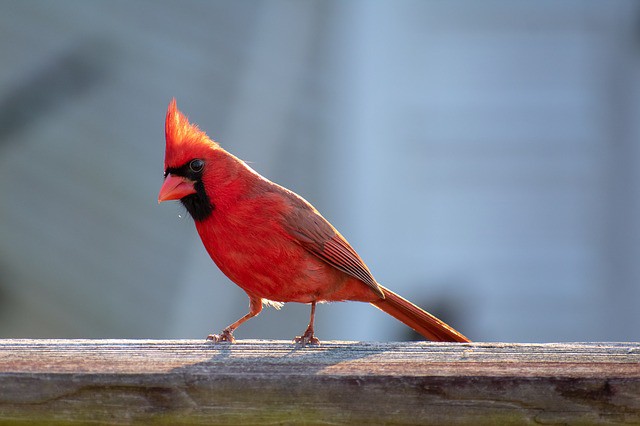
The other morning, walking at the edge of a local park, I caught sight of a beautiful red cardinal, the first bird I ever saw some 63 years ago.
Actually, to make that sentence accurate, I should probably have put either “first” or “ever saw” in quotation marks. After all, I was already 12 years old and, even as a city boy, I had seen plenty of birds. If nothing else, New York, where I grew up, is a city of pigeons (birds which, by the way, know nothing about “social distancing”).
Nonetheless, in a different sense, at age 12 I saw (was struck by, stunned by, awed by) that bright red bird. I was visiting a friend in Connecticut and, miraculously enough, though it was 1956, his parents had a bird identification book of some kind in their house. When I leafed through it, I came across the very bird I had seen, read about it, and on going home wrote a tiny essay about the experience for my sixth grade teacher, Mrs. Casey (one of those inspirational figures you never forget, just as I’ll never forget that bird). I still have what I wrote stuffed away amid ancient papers somewhere in the top of my bedroom closet.
Six decades later, in this grim coronavirus March of 2020, with my city essentially in lockdown and myself in something like self-isolation, I have to admit that I feel a little embarrassed writing about that bird. In fact, I feel as if I should apologize for doing so. After all, who can doubt that we’re now in a Covid-19 world from hell, in a country being run (into the ground) by the president from hell, on the planet that he and his cronies are remarkably intent on burning to hell.
It was no mistake, for instance, that, when Donald Trump finally turned his mind to the coming pandemic (rather than denying it) as the economy he had been bragging about for the previous three years began to crash, one of the first groups he genuinely worried about didn’t include you or me or even his base. It was America’s fossil-fuel industry. As global transportation ground down amid coronavirus panic and a wild oil price war between the Saudis and the Russians, those companies were being clobbered. And so he quickly reached out to them with both empathy and money — promising to buy tons of extra crude oil for the nation’s strategic petroleum reserve (“We’re going to fill it right to the top”) — unavailable to so many other endangered Americans. At that moment he made it perfectly clear that, in an unfolding crisis of the first order, all of us remain in a world run by arsonists led by the president of the United States.
So, a cardinal? Really? That’s what I want to focus on in a world which, as it grows hotter by the year, will only be ever more susceptible to pandemics, not to speak of staggering fires, flooding, extreme storms, and god knows what else. Honestly, given a country of closed schools, self-isolating adults, and the sick and the dying, ona planet that seems to be cracking open, in a country which, until recently, couldn’t test as many people for Covid-19 in a couple of months as South Korea could in — yes, this is not a misprint — a day, where’s my sense of proportion?
A Secret Life
Still, if you can, bear with me for a moment, I think there’s a connection, even if anything but obvious, between our troubled world and that flaming bird I first saw so long ago. Let me start this way: believe it or not, birds were undoubtedly the greatest secret of my teenage years.
On spring weekends, my best friend and I would regularly head for Central Park, that magnificent patch of green at the center of Manhattan Island. That was the moment when the spectacular annual bird migration would be at its height and the park one of the few obvious places in a vast urban landscape for birds to alight. Sharing his uncle’s clunky old binoculars, my friend and I would wander alone there (having told no one, including our families, what we were doing).
We were on the lookout for exotic birds of every sort on their journeys north. Of course, for us then they were almost all exotic. There were brilliant scarlet tanagers with glossy black wings, chestnut-and-black orchard orioles (birds I wouldn’t see again for decades), as well as the more common, even more vivid Baltimore orioles. And of course there were all the warblers, those tiny, flitting, singing creatures of just about every color and design: American redstarts, blackburnians, black-and-whites, black-throated blues, blue-wingeds, chestnut-sideds, common yellowthroats, magnolias, prairies, palms, yellows.
And here was the secret key to our secret pastime: the old birders. Mind you, when I say “old,” I mean perhaps my age now or even significantly younger. They would, for instance, be sitting on benches by Belvedere Castle overlooking Belvedere Lake (in reality, a pond), watching those very birds. They were remarkably patient, not to say amused (or perhaps amazed) by the two teenaged boys so eager to watch with them and learn from them. They were generous with their binoculars, quick to identify birds we otherwise would never have known or perhaps even noticed, and happy to offer lessons from their bird books (and their own years of experience).
And, for me at least, those birds were indeed a wonder. They were genuine beauties of this planet and in some odd way my friend and I grasped that deeply. In fact, ever since we’ve grown up — though this year may prove to be the self-isolating exception — we’ve always tried to meet again in that park as May began for one more look at, one more moment immersed in, the deep and moving winged beauty of this planet of ours.
Of course, in the 1950s, all of this was our deepest secret for the most obvious of reasons (at least then). If you were a boy and admitted that you actually wanted to look at birds — I’m not sure the phrase “bird watch” was even in use at the time — god knows what your peers would have said about you. They would — we had no doubt of this — have simply drummed us out of the corps of boys. (That any of them might then have had their own set of secret fascinations would never, of course, have crossed our minds.) All you have to do to conjure up the mood of that moment is to imagine our president back then and the kind of mockery to which he would certainly have subjected boys who looked at birds!
Now, so many decades later, in another America in which the coronavirus has already reached pandemic proportions (potentially threatening staggering losses, especially among old folks like me), in which the stock market is already tanking, in which a great recession-cum-depression could be on the horizon, and our future FDR — that is, the president who helped us out of the last Great Depression in the 1930s — could an over-the-hill 77-year-old former vice president, it seems odd indeed to write about beautiful birds from another earthly moment. But maybe that’s the point.
Fini?
Think about it this way: as last year ended, Science magazine reported that, in North America, there were three billion fewer birds than in 1970; in other words, almost one out of every three birds on this continent is now gone. As Carl Zimmer of the New York Timesput it, “The skies are emptying out.” Among them, warblers have taken one of the heaviest hits — there are an estimated 617 million fewer of them — as well as birds more generally that migrate up the East Coast (and so have a shot at landing in Central Park). Many are the causes, including habitat loss, pesticides, and even feral cats, but climate change is undoubtedly a factor as well. The authors of the Audubon Society’s most recent national report, for instance, suggest that, “if Earth continues to warm according to current trends — rising 3 degrees Celsius (5.4 degrees Fahrenheit) by 2100 — more than two-thirds of North America’s bird species will be vulnerable to extinction due to range loss.”
Extinction. Take that word in. They’ll be gone. No more. Fini.
That, by the way, is a global, not just a North American, reality, and such apocalyptic possibilities are hardly restricted to birds. Insects, for instance, are experiencing their own Armageddon and while — monarch butterflies (down 90% in the U.S. in the last 20 years) aside — we humans don’t tend to think of them as beauties, they are, among other things, key pollinators and crucial to food chains everywhere.
Or think about it this way: on Monday, March 8th, in my hometown, New York City, it was 68 degrees and that was nothing. After all, on February 19th, in Central Park, the temperature had hit a record-breaking 78 degrees in the heart of winter, not just the highest for that day on record but for the month of February, historically speaking. At the time, we were passing through a “winter” in which essentially no snow had fallen. And that should have surprised no one. After all, January had started the year with a bang globally as the hottest January on record, which again should have surprised no one, since the last five years have been the warmest ever recorded on this planet (ditto the last 10 years and 19 of the last 20 years). Oh, and 2020 already has a 50% chance of being the warmest year yet.
And by the way, soon after that 68-degree day, in our parks I began to notice the first crocuses and daffodils pushing through the soil and blooming. It was little short of remarkable and, in truth, would all have been beautiful, not to say glorious — the weather, the flowers, the sense of ease and comfort, the springiness of everything — if you didn’t know just what such “beauty” actually meant on a planet potentially heating to pandemic proportions.
How sad when even what’s still truly beautiful on this globe of ours increasingly tells a story that couldn’t be grimmer. So, think of this as my in-memoriam essay about the planet I thought I grew up on and the birds I thought I knew. Consider it a kind of epitaph-in-advance for a world that, if the rest of us can’t get ourselves together, if we can’t rid ourselves of arsonists like Donald Trump and his crew or those fossil-fueled CEOs that he loves so much, may all-too-soon seem unrecognizable.
In the meantime, consider me — semi-locked in my apartment — to be, in my own fashion, in mourning. Not for myself, mind you, though I’m almost 76 and my years on this planet are bound to be limited, but for those I’ll be leaving behind, my children and grandchildren in particular. This just wasn’t the world I ever wanted them to inherit.
In truth, in this coronaviral moment of ours, our world is being transformed before our eyes into one of missing beauties. Given my teenage years, I want to leave my grandchildren the pleasure of entering Central Park in some distant May, long after I’m gone, and still seeing the brilliant colors of a scarlet tanager. That’s my hope, despite everything.
Translated it stands, I can get lost anywhere within the infinite of my mind (imagination).
Time has come that we put his suggestion to test.
Though we are all torn by the isolation that battling COVID-19 demands, we still have a huge thing which we did not in the past, a thing that helps us all connect — the internet. While the educated stay connected, using social media and email, there will be many under isolation who will not have the skill sets to reach out, either due to lack of internet or due to the inability to write. There are countries like Singapore, where this is not an issue — but there is still a large population out there who cannot connect, who will be told by their community leaders that they need to remain isolated. Will that be a possibility? What about the homeless? What about those who do not have a clean potable water supply? What happens to them?
One thing that the tiny virus, which we cannot see with our naked eyes, has taught us is that mankind in its suffering cannot be bordered by economic, religious, cultural or political boundaries. As we all stand, in isolation, willing or unwilling to take up cudgels against a virus that has forced us to disturb, break and destroy the tenor of our lives, perhaps the time has come to assess our blessings.
Today, the fact that you are reading this means you are connecting with the internet and can read. You are connecting with my ideas, with my thoughts. We belong to the privileged few who can soar with internet and our imaginations. We have a home and hearth. We are educated and have enough to eat. We can afford to be kind and merciful to others.
The factory smoke has largely got silenced — even if temporarily. That means the air is getting cleaner. I can see more birds fly in the sky, bluer skies and hear bird calls. Perhaps, the Earth will stretch out in languor and awake from COVID19, a healthier and greener planet.
As I see the visa exempt, borderless virus roam the world, I am reminded of Sir Arthur Conan Doyle’s novel, The Poison Belt(1913), where the whole of mankind loses a day as our planet passes through Ether, and then wakes up as the Earth emerges out of the sleep inducing belt of the ‘poisonous’ gas. Will such a thing happen? Will we wake up and see the corona disappear one day?
Probably not, given that we have already diagnosed the virus. But, when you think of it, mankind has been through so many pandemics and has continued to thrive.
Perhaps, the tiny virus has taken on more than it can digest. Each time, mankind emerged a winner, they had a better life. After the Great Plague that wracked Europe from 1348-1350, came a jubilant Renaissance with Leonardo Da Vinci, Botticelli, Michelangelo, Christopher Columbus and Galileo Galilei celebrating the wealth of human development.
Then there was small pox, which was introduced among Native Indians and Mexicans in the fifteenth century by Conquistadors, and was completely eradicated after two centuries; cholera, which continues to assail some countries and many more such diseases. Mankind battled these and emerged victor into a better equipped world.
This time, the pandemic is more widespread because we are living in a more connected planet. Is that such a bad thing? We do not really want to live like the hermaphrodite humans in Isaac Asimov’s Solaria, where mankind is served by robots alone on a solitary planet and they never meet other humans. But a temporary and intelligent isolation can teach the little virus that for all its virulence, it cannot destroy mankind. This is just a temporary measure, a temporary gesture to help mankind move into a better world. We will have to reorganise our way of life, our tenor of existence. Given the climate, economic and political issues our planet faces, this may not be such a bad thing!
After all, twentieth century guru, Yuval Noah Harari in his recent article in Financial Times, concludes: “Humanity needs to make a choice. Will we travel down the route of disunity, or will we adopt the path of global solidarity? If we choose disunity, this will not only prolong the crisis, but will probably result in even worse catastrophes in the future. If we choose global solidarity, it will be a victory not only against the coronavirus, but against all future epidemics and crises that might assail humankind in the 21st century.”
And I would like to agree with Harari as he says with conviction: “Yes, the storm will pass, humankind will survive, most of us will still be alive — but we will inhabit a different world.”
Let us look forward to the dawning of that new world.







 Borderless