Categories
Musings

Impact of the Pandemic on Nepal’s book market

By Bhupendra Khadka


Taranidhi Regmi, 37, of Morang, lives in Kathmandu and runs Sunbarshi bookstore in Dhapasi and delivers literary books to about 90 bookstores across the country within two or three days of its publication. When Covid-19 started to linger a month ago, he posted a photo of himself milking a cow in his home on his Facebook page. During this time, he was asking publishers which books were to be popularised for the new season, and was promoting some of the books published earlier. He was also expecting to open the market that had been sluggish since last year. However, that did not happen. The world was shaken by the pandemic of COVID 19.

Printed books by authors from around the world did not reach the market and the books that were about to be published got stuck in the printing presses. Thousands of literature festivals as well as book-tours were put on hold. As Nepal went into lockdown, all sectors and industries were locked down too. Citizens were seen returning home from east to west and from west to east, dreading an uncertain future.

How would the world economy fare? How would the developed countries revive their collapsed economies? When would the land ports and airports open? At the same time, there was the speculation that the pandemic may push about 40 percent of the world’s population into starvation.

You may think that this is not the time to talk about books but rather to talk about lentils, rice, vegetable or to talk about how to earn a living! But, it is essential that we should talk about the mind too.

What will people do inside their house during the lockdown? It is natural that people will spend time with their family members.

I also watched movies and read books. The pace of reading seemed to be such that after going through the books that had been lying at home for so many years, many people repeated them; e-books on various sites and on social media gained popularity. This time, it has been proven that books are really an integral part of human lifestyle. It is almost impossible to imagine a home, a school, a society and a person without books in today’s world.

Nepal’s book market is badly hit by the pandemic. Literary books account for only 10 percent of the NPR 4.5 billion book trade which also includes textbooks. It accounts for 75 percent of textbooks and stationery and 15 percent of imported and research related books.

Nepal’s literary book market is small with a total investment of around US $2.6 million. Nevertheless, the publishers who have invested in it are not in a position to even pay the rent due to the slowdown and near closure of economic activities during the pandemic. Likhat Pandey, President of the Nepal National Book Dealers and Publishers Association, says, “If the lockdown continues for long, most bookstores will close for not being able to pay the rent.”

As Pandey said, book publishers are also in trouble at the moment. Books printed are stuck in the warehouses and the ones ready for printing are on computer files. It is becoming difficult to get money from the sellers due to adverse conditions. In such a situation, new books cannot be published. It is very difficult to run a publishing house. Many publishers are saying that they will choose an alternative trade if the book market does not open for about six months.

Many may think that it is foolish to talk about books in the absence of a secure livelihood. But books are necessary to keep society moving, to entertain and to raise education levels. Books, as I pointed out earlier, have proven to be an indispensable asset through the pandemic.

The Ministry of Finance in Nepal has also transferred the budget allocated for the purchase of intellectual property to the Corona Fund during the lockdown. This clearly will impact the purchase of literary books by government schools. It is increasingly unclear if the NPR 6 billion in the President’s Education Fund will now be spent on buying and selling computers, school furniture and books.

The market for Nepali books, which has been on the decline since last year, was also hit by the government’s customs duty on imported books. The only alternative seems to be e-books.

Rakuten Kobo, a Canadian multinational company, did well in the global market for e-books and audio-books during the pandemic. Similarly, Amazon, Apple Books, Google Play and others also made a profit in the book trade during this time. At a time when the sale of printed books is difficult and the world is advancing in digital technology, it is necessary to find a market for it in Nepal too. I wonder if any company in Nepal will be able to do business as these multinational companies are doing.

A few companies in Nepal have been trying to test its feasibility and some books are being digitized. Publishers in Nepal are, thus, optimistic about the sale of books from such digital platforms. If such efforts find fruition, the few technology-loving and technology-friendly readers will benefit. However, about 90 per cent of Nepal’s readers depend on printed books as ebooks are not popular with them.

According to the Wall Street Journal, best-selling books sell at least 3,000 to 5,000 copies. The Publishers’ Weekly states that books which sell 1,100 copies a day for about a month after its publication can be categorised as one of the top five best-selling books. Whatever the international rules, good books usually sell 3,000 to 6,000 copies in all in Nepal.

Publishers overwhelmed by the current situation brought on by the pandemic and the lockdown would not dare to publish books by any random authors. Also, the numbers of writers who write poorly but publish books by investing on their own will be reduced due to financial constraints.

Only high quality books in fiction and non-fiction will be written and published due to all the above constraints. We can only hope that that the market for Nepali literary books will become bigger and wider, even if it takes a little longer.

.

Bhupendra Khadka is the CEO of Book Hill publications, one of the leading publishing houses in Nepal. Khadka not only leads a publishing house, he himself is a poet, a popular radio jockey, a public speaker, book editor and a national award-winning lyricist. Having written songs for more than 5 dozen movies and also recorded more than 350 songs, he also holds a record in bagging almost all prestigious music awards in Nepal.  Email: bhupikhadka@gmail.com, Twitter: @KhadkaBhupendra

This article has been translated by Sangita Swechcha. Sangita Swechcha is a Communications Professional, Researcher and a Fiction Writer. Email: sangyshrestha@hotmail.com, Twitter: @sangyshrestha

.

.

PLEASE NOTE: ARTICLES CAN ONLY BE REPRODUCED IN OTHER SITES WITH DUE ACKNOWLEDGEMENT TO BORDERLESS JOURNAL. 

Categories
Musings

Happiness: Heart in a Casket

By Rana Preet Gill

I look up to find the evening sky stretch out like a canvas with a multitude of hues, change like a kaleidoscope of colours. It is the like the work of an artist, our Creator. I have often been startled by the beauty of life amidst my own fake despair.

I do not have many concrete problems in life. Not the ones that could be touched with bare hands, seen with naked eyes. Not the ones that could be described with a flourish. Not as if problems could ever be explained.

The world is a living, breathing cauldron. A little whimper gets turned into a moan, a slight regret gets carried into a lament, an awkward glance becomes a fleeting affair and dissatisfaction with life snowballs into melancholy.  Disclosures of unhappiness are difficult to make. Affability comes with ease. Life is often dictated by societal norms. And the mind is in constant harmony as one amongst them.   

The evening sky beacons for an escape. The birds wielding their wings high up in the sky, pumping the air beneath their wings, soar high, up and up away. I wonder what it takes to be happy, to be alive for them. I wonder if they suffer the throes of existential chaos.  I wonder what life would be like, bereft of any problems, of any conflict, of misery. Why cannot it be a perpetual ride of ease and comfort?

I am not particularly unhappy. I am positive, rearing to go. I can talk endlessly about my dreams. My dreams about my life, my future, security, approval, turning the negatives into positive in times of lockdown and much more.

I have a privileged life. I have the money, enough to satiate the needs of my life. Enough to buy me clothes of myriad shades of colors and designs.

Yes, not the very expensive ones. I know my reach. Salaried middle class. But there have been days I have spent thousands of rupees on things I never cared to wear. The money trapped in my greed for something new had lain in the closet for months and sometimes years. It’s only when the cloth have aged enough, humbled by its disregard that I have picked it up and given it an audience.

My tendency has been only to hoard. I have not felt any concrete need or significance of that particular object in my life. My happiness has been short lived. It has dazzled me with its existence but it only turned out to be a mirage.

Happiness can never be found in what you wear. It gives you a momentary delight to be dressed in the choicest of clothes. But for that prolonged calm and poise clothes are a far cry. The closets are full of clothes new as well as old yet somedays there is nothing to wear.

The stark nakedness of the soul shines on those days. This depravity, the greed for more reflects on me. There are people who have nothing to wear yet brave life with a smile embarrassing us with their unseemly flesh on display. And here I am all covered in swathes of sequined clothes yet I am unhappy, grumbling, complaining about an imaginary chaos in my life. I will only be able to see clearly when the dust settles. But I never stopped spinning like a top around my axis. How will I ever see what my mind tells me to see? It’s the haze that whirrs around me unsettling me with the frivolous.

Food!  I wonder if that provides a semblance of happiness. We eat to live or we live to eat! Making a living to buy the essentials or splurging it all on mindless eating leading to flabs of flesh. How much meat do I need around my bones?

The aroma of food being cooked at home fizzles into my nostrils but when I sit down to eat I am not hungry at all. As if the very thought of food has inundated my palate filling it up to the brim.

I am often enamoured by the colorful paraphernalia of junk present on display in shops. The packet of chips, biscuits and other knick-knacks in iridescent colours; red, blue, green, neon, beckon with delusions. Just one wafer thin chip can bring dollops of pleasure with the crunchiness alone. As long as the packet tempts me I think about the buying it and parting with a few rupees from my wallet.

I keep on putting this momentary satisfaction away, of being able to possess them is madness. What food value does this frivolous entity have?  It is not the worth my money. But the temptation of the color and taste finally leads me to the shop.

The packet unopened, uncared will lie in the drawer for many hours before I decide to open it. I look for the promised happiness displayed on the cover of the packet. A smile of a nondescript man, so profuse, deep, enchanting, carrying assurances unbeknown. And yet the savory did nothing to fulfill the promise of that happiness.  

I grab the packet and give it away to the household help. Her children would be grateful for this treat. Food does not give comfort. When you do not have the means to buy it, it becomes the single motivating factor in your life. When you have the luxury of choice, the comfort of having too much on your plate, you lose the narrative. Enough money can buy enough food but not a healthy appetite.

I live in a big home. Big enough to the eyes of the outsiders who would often throw a casual remark just looking at the façade. There are two floors and a couple of rooms. I often do not have the place to keep my stuff which lies on bed and chairs, crying for my attention. There are not enough cupboards? I rue the lack of storage facilities. I take my home for granted.

While the homeless of the world scourge for a roof above their heads, I pompously shun the comfort of my abode to look for more privacy inside my home.  I need a snug home, like a kennel, something to wrap around myself. Something too close for comfort yet close enough to fill my senses.

Those with bigger houses are oblivious to the luxury of space while those with smaller homes keep on pandering about their desires. Life becomes a never-ending desire to escape from the real.

A mad dash to be somewhere else. In some other country, state, city, village, travelling to far off places — all the while contemplating the comforts of home. Comparing, making notes, concluding that life is best lived in the sanctity of home. And once back, the confined existence of home is repressive. Start another search, home if far away.

There is no comfort and joy to be found living in well-furnished big houses. Home is where heart is! And the heart needs to be molded to fit in a casket to be cared for a life time.

Home is valuable yet not valued enough, heartfelt desires often soar high escaping the restraints of one home. I have multiple homes in a surreal world and I often flit from one to another. Only there is no comfort grand enough to chain me to one amongst them. In the real world, home looks miniscule, a tiny room, a tinier closet, a heart in the casket. Some days I gasp for breath and rush out of my house.

I have often searched for the meaning of being happy. A comfortable home, lots of material comforts, oodles of tasty and expensive food, money in the wallet as having a limitless purchasing power is never a guarantee of bliss. It’s a reason for dissatisfaction for some.

Why we have it all when there are people who do not have anything and yet they are living with an aplomb, a carefree life?  Their remorse at living ill-equipped lives does not reflect on their faces somedays depriving me of the perverse pleasure which I derive while making comparisons. An absence creates a want, fulfillment of that particular need. The alleviation of it becomes the sole purpose of life promulgating happiness. But then what do I know about the needs of those who sleep on the roads with an empty stomach, search for shelters during the rain, garble for morsels of food, for them home is a distant dream.

I wonder if happiness is empathy. Only being sympathetic yet not taking any concrete steps to alleviate the suffering. But then I do not think about the destitute of the world all the time. My mind is crammed with my very own self. My own attempts at navigating my life seems gargantuan. My own attempts to find peace, hope, salvation outwit me into thinking as I assume that my problems are larger than life yet they are not.

As I sit in the verdant lawn in front of my home wondering about life and happiness, a world of silver oak trees, palm spruces, rose bushes, peaches and plums in full bloom, ripe with fruit, fecund, living, breathing reach out to me. The honey bees buzz around collecting nectar of flowers. The butterflies flit from one bloom to another.

For a fleeting moment, one with silken wings alights on my shoulder. It has pink and yellow wings, a combination so strange. It looks hideous and, yet, I wonder if it is blessed with the knowledge to castigate itself.

It is happy. And for a moment, just for that brief moment that happiness is transferred to me. Amidst constant movement the unassuming insect gives stillness to my mind.  Shrouded in the constant chaos of nature, my mind feels at peace. The butterfly on my shoulder with its fluttering motion lends me its momentary joy before making its way towards the evanescent dusk.

A brief snitch of happiness before I start the tireless journey full of recriminations. But I am glad there was a moment to escape. I wonder if the constant fluttering of its wings unsettles the winged one as it seems to be on perpetual move. A life in motion yet in peace. I spread my dormant wings to give myself a push. I make them flutter only to imagine myself taking that giant leap towards the sky.

It is constant work to keep myself above the ground but I guess this is what life is all about. Working, moving, flying, spreading your wings, striving to meet the horizon, dreaming, desiring the beautiful, happiness untamed. As I close my eyes to let myself soar I could see million butterflies let lose in the sky. Living, breathing, jostling to color the evening sky.

To give untamed hopes and dreams, wild desires, unleash the madness yet guide it with a serenity to halt that drive with a serene composure — what is it?

Happiness is above all a search, a thought, a way to live amidst constant contemplation.

.

Rana Preet Gill is a Veterinary Officer with the government of Punjab, India. Her articles and short stories have been published in The Tribune, Hindustan Times, The Hindu, The Statesman, The New Indian Express, Deccan Herald, The Hitavada, Daily Post, Women’s era, Commonwealth writers. org, Himal, Spillwords press, Setu Bilingual, Active Muse and Indian Ruminations. She has compiled some of her published pieces into a book titled Finding Julia. She has also written two novels – Those College Years and The Misadventures of a Vet.

.

PLEASE NOTE: ARTICLES CAN ONLY BE REPRODUCED IN OTHER SITES WITH DUE ACKNOWLEDGEMENT TO BORDERLESS JOURNAL. 

Categories
Musings

Three months later, Florence restarts. But not quite

By Ugo Bardi

The epidemic is almost over in Italy. After almost three painful months of lockdown and the loss of about 30,000 lives, the daily number of victims of the coronavirus is slowly dwindling to zero. In a couple of weeks at most, the epidemic will be completely gone. It is time to restart, but the damage has been terrible.

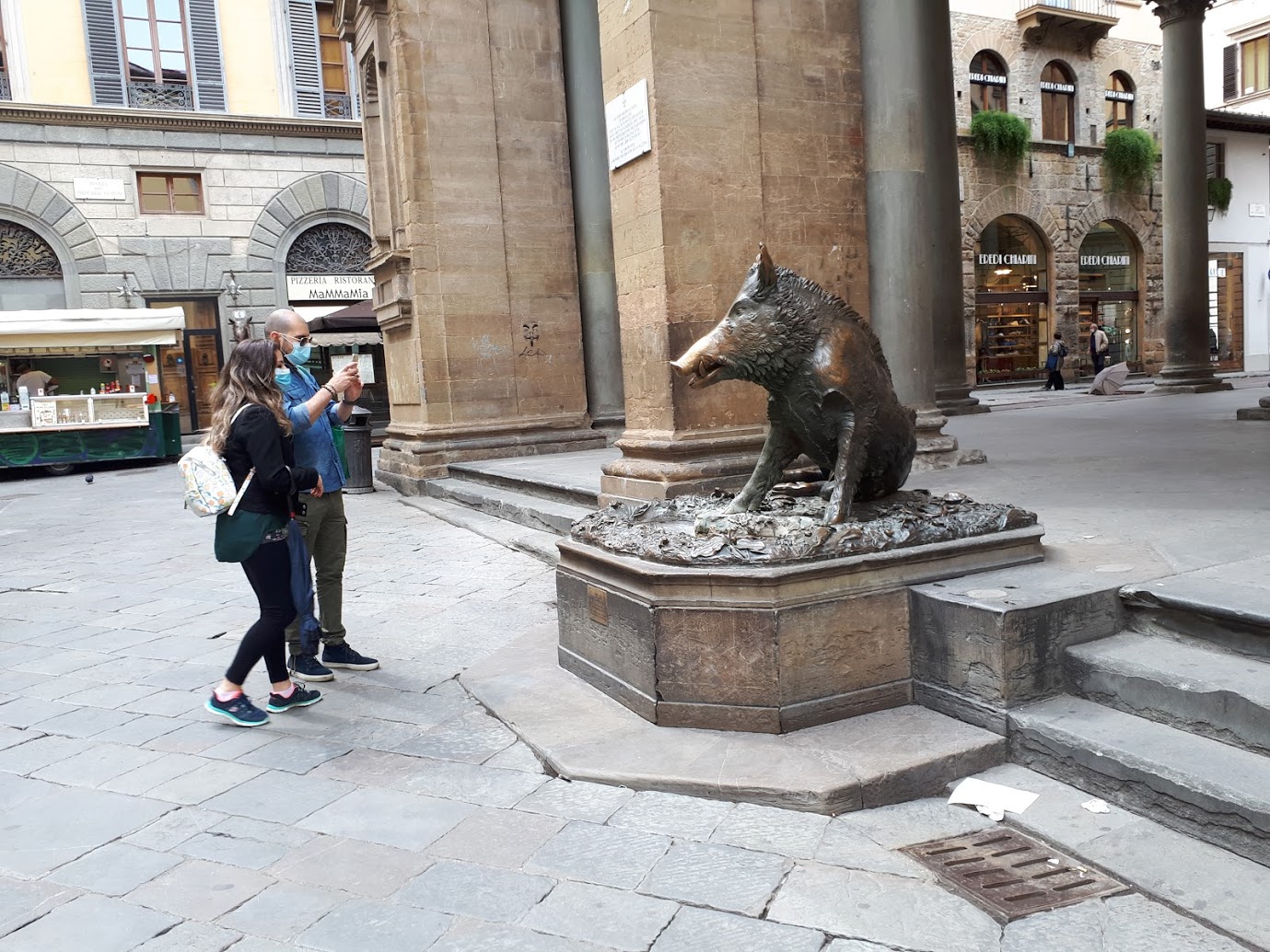
The lockdown is over and the Florentines are back, walking in the streets, wearing face masks, but free to go wherever they want, provided that they don’t form groups (“assembramenti“). A few tourists can be seen, slowly walking around, a little bewildered. Below, you see a picture of a few days ago with two lone tourists taking a picture of the “Porcellino” (Wild Boar) (the boar looks a little bewildered, too.).

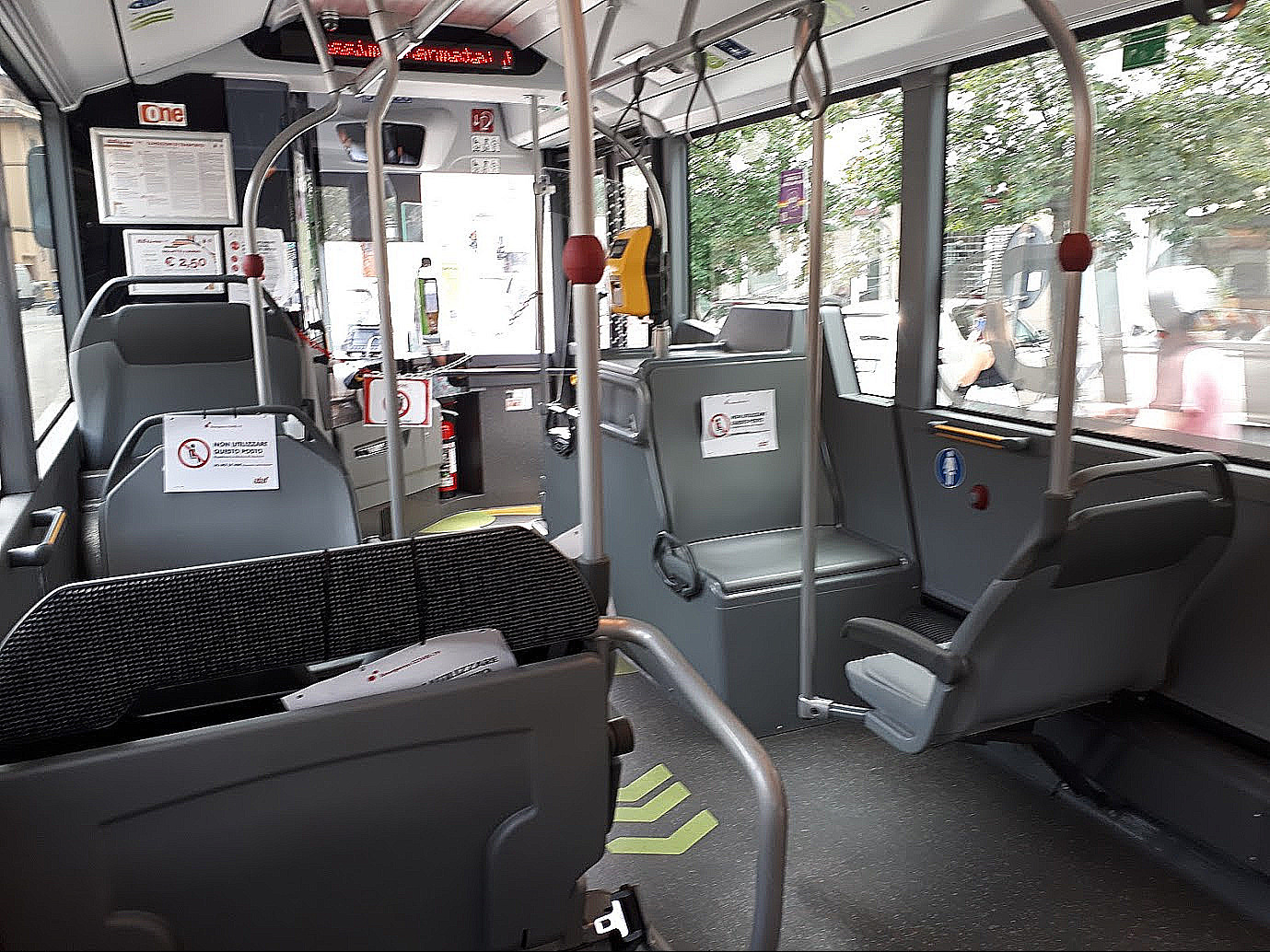
Many shops have reopened, but not all of them — maybe 30% are still closed. For what I could see this morning downtown, all the open shops are empty of customers. The restaurants also look empty. The buses are nearly empty, too. Here is a picture taken this morning, with me and my wife the only passengers of a bus that used to be packed full before the epidemic. Note the signs saying “You cannot sit here!” They don’t seem to be necessary, given the situation.

To pass to you some idea of the somber atmosphere in Florence these days, here are two fragments of conversations I had or witnessed in the street. Maybe these people are too pessimistic, but I have a feeling that they have correctly evaluated the situation.

***

First, an exchange I overheard a few days ago while waiting in line at the entrance of a supermarket. I don’t know the names of the protagonists, two men in their 50s. The one who said he had a shop I recognized later standing at the entrance of a small clothing shop in Via Romana, in Florence. I am reporting from memory, but the gist of what they said is there

– Hello. How have you been doing? I haven’t seen you around, recently.

– Oh, nice to see you! Of course you didn’t see me! I was at home, like everybody else.

– Yeah, I was at home, too. But are you reopening the shop? I saw it is still closed.

–  Yes, it is still closed, but I am reopening on Monday.

– That’s good, right?

– Not so good, really.

– Why?

– What do you think I can sell? There are no more tourists.

– Well, you didn’t sell just to tourists. They don’t come here so often.

– No, but you see. Someone from Spain would come and buy something. Then someone from America would come and buy something. And so on. See? It made the difference.

– I see….

– So, I am opening yes. But I am just selling off the stock I have. Then I’ll close for good. In a month or two, I think.

– Really? Are you sure?

– How do you think I can pay the rent and the taxes? And for renewing the stock?

– Well, I think the government will help us.

– Yeah, sure.

***

Now, a conversation I had this morning with a man who had a kiosk selling used books downtown. Again, it is reported from memory, but I tried to reproduce the sense and the tone of what I was told.

See? This kiosk has been around for a long while. Really long, see, it was here during the war already. The woman who had started this business sold the license in 1946. Oh, yes, and I have been selling books here for a long time. Sure, I am 66 now. Last year I thought I could retire, but then I decided I could keep going for a little longer. But they have been ruining me. First, there used to be an antique market right behind the kiosk, you know that, and then the city decided to send them away — not elegant enough for the city of Florence. Sure. Before, people would visit the market and then stop here and buy books — I had some good books, even antique ones. I was known, people knew that I had those books. I still have a few. But the antique market is gone — they sent it somewhere out of town. Yes, it was not elegant enough for here, they said. They call it “decorum” of the city. Sure, and the people of the market are not selling anything anymore, where they are now. And I wasn’t selling anything, either. Well, a little I was still selling. Not much, but a little. But then this. I have been forced to close down for three months. And I told them that I couldn’t pay the license and the tax. And they say, fine, you don’t need to pay for three months. Then you have to restart paying, and that’s final. And if you don’t pay, they said, you bring back your license to us and we’ll give you a compensation of Eur 600, and that’s it. And good riddance. You understand? They are happy that I close. Perfectly happy. A kiosk is not elegant enough for the decorum of the city, they say. Maybe they think that when tourists see my kiosk they run away screaming. Tourists like fancy shops only. And I have to pay 54 Euro per day — yes, 54 euros in taxes and fees to the city. And I have to sell books for more than that if I have to eat. And to buy more books to sell, otherwise, what am I going to sell? Don’t you see? There is no way. Nobody walking around, nobody buying anything, no tourists, they have gone. I should have retired last year, but I couldn’t have imagined…. how could I have imagined this? And the city helping us? Ha! The mayor says he is furious, yeah, sure, he said that. I read it in the newspaper. He said he is furious because the central government didn’t give him any money for the epidemic. That’s what he said. And what should I say, myself? If the mayor is furious, how about me? I have been giving money to the mayor for 30 years and the mayor now is furious because he has no money to give to me. Aw…. even if he got some money from the government, I am sure he won’t give any money to me or to the people who have shops and who need money. Like me, that’s it. And so I’ll be closing down. I’ll be just selling the books I have and then good riddance. This square will be empty: no antique market no kiosks, nothing. I figure they’ll be happy. It is what they wanted all along, decorum, yes. An empty square, and that’s it.

(*) The owners of the Calzoleria Leonardo Tozzi in Via Romana were kind enough to give me permission to publish the photo you see at the beginning of this post. If you happen to be in Florence, and you need a shoe repair job, you can find them in Via Romana 135r, just a few steps from the clothing shop mentioned in the first conversation reported in this shop.

.

Ugo Bardi teaches physical chemistry at the University of Florence, in Italy and he is also a member of the Club of Rome. He is interested in resource depletion, system dynamics modeling, climate science and renewable energy. Contact: ugo.bardi(whirlything)unifi.it

.

This article was first published in Countercurrents

Categories
Musings

The Thumbelina Chronicles

By Sangeetha Amarnath Kamath

Prologue

April 2018

The fiery accents of orange-gold in the western sky had gingerly muted into a soft peach. Rich hues of champagne and pastel pink blended with the steely greys in the horizon. A flurry of various birds and their dark silhouettes dotted the myriad tints as they returned to their roosts. They cackled joyously as they flew overhead. The chorus and the orchestra of the birds gradually drifted into the distance until I could only hear an echo or a settling-in faint cluck from a faraway tree. Everything had gone quiet and still outside.

 I felt anything but elated with these songs and sights of creation which would otherwise have stirred a sense of exhilaration in me and have me hurriedly rummage about for my camera. Those were the extremely wretched of days when I had just about struggled to get my bearings together after an unfortunate and untimely demise of an infant in the family, a few days earlier. The disbelief and emotional upheaval was taxing, to say the least.

Snapping out of my reverie, I realised that the sun had long since set. It was a cloudless night and the sky was an enveloping petal of spring Iris, all aglow with a serene silvery sheen.

A faint voice relentlessly cooed and called out from somewhere inside the house. Being conditioned to all the chatter of the mynahs and the clucking of pigeons which roost in some hidden alcoves of the tall apartment building that I stay in, it was also a common sight of them fluttering across the common corridors outside, which went unperceived sometimes.

Quite engrossed with my last minute dinner preparations after a long, busy day at work and running errands, I regretted to have failed to notice this melody sooner. When the cobwebs finally cleared from my befuddled head, I rushed on tiptoe, ever so quietly to find the source of this tune. Standing her ground firmly and boldly in a shaft of moonlight, in one of the rooms was the tiniest of birds, as yellow as butter. A first-time visitor, who had separated herself from her flock and had stopped by to actually trill a birdsong. Long after sundown.

Birdie noticed me but was not startled. Confidently, and in a higher pitch, with every ounce of energy, she gave an overjoyed tweet upon seeing me. I whistled to her in varied tunes and Birdie responded likewise. This musical opera continued for a while and I lost track of time.

Having sung and done that, Birdie decided it was about time to leave.

She made her way out and disappeared without a trace. Never to return.

The pearly luminescence outside captured only a silhouette in flight of my sublime emissary. Rare birds they say are fairies in disguise, who come to comfort you, reassure you! The mystical message in her beatific lyrical was for me to decode.

I believe in the Mystique and the Magic.

Magic comes to me, it sends me signs from the unseen world, the mystical realms.

I know all is well up there and the Heavens are kindly taking care of you.

***

I

Nigh 2 years later

April, 2020

It was eight at night. She was yellow-bellied with shimmers of green as I looked closely, the only light emitting from the living-room I was watching her from. No bigger than my thumb, one could easily mistake her for a toy, but for her incessant chirruping. She sat dangerously close to the edge of the window sill and was seemingly in dire need of help. I stretched out my hand as much as I possibly could, leaning against the window frame. But she was just out of reach.

A nestling on the window sill! Or was it a magically minute bird that had come to life out of a fairy-tale?

With a frame so tiny and wings so frail, it was next to impossible for her to fly all the way up to the top floors of this high-rise or for her to fall out of any nest, considering that there weren’t any trees or even overhanging branches anywhere close outside this window.

Habitually, as I give my own names to any stray animals or birds that I come across, this little bird for all intents and purposes was aptly dubbed Thumbelina. I kept her engaged with my own animated banter.

 Are you hurt, injured, sick or lost little birdie?

But Thumbelina just cocked her head and looked at me with twinkling eyes. She never seemed livelier or more than happy to just warble away to me. After a while, she roosted snugly on the sill.

Sending up a quick prayer to Archangel Michael to protect her from toppling over in her sleep, another one to Archangel Raphael to heal her if she was in distress, I finally hit the sack.

These two angels had never failed me whenever I had called out to them and I was rest assured that Thumbelina would be in Divine hands.

The next day, the break of dawn brought with it a bustling multitude of chirps, twitters, cheeps and the laughter of my feathered friends. I rushed to check on Thumbelina, but she was gone! My heart did a somersault at her absence, thinking of the worst tragedy that might have befallen her. Although that bleak thought niggled at the back of my mind, my faith in the angels was steadfast.

As the day progressed and when the sun was strong enough, I slid open my bedroom window to let the natural light in… and there she was!

Thumbelina!

She had flown a full circle from a window at the other side of my apartment to be right outside my window!

She squawked a quick ‘Hello’. Thumbelina was more exquisite in the bright sunlight. Her dazzling feathers were an iridescent green.

 Perched on the ledge, she fanned open her tiny wings and flapped them to show me that she wasn’t injured. She hovered a bit off the ledge of my window sill to show me that she was strong enough. With a swish of her tail feathers, she flew the entire perimeter of the building effortlessly and turned the corner. I craned my neck outside, until I could catch sight of her no longer.

***

Gleaning back into the events of a few days preceding this, I realised that I had been constantly dwelling on the past thinking about Mamama, my maternal grandmother.Although three decades had gone by since her mistimed passing, the memories of a companion with whom I had a deep bonding and attachment right from my childhood, until my early teen years had never truly faded away.  From her, I had had a complete absence of judgement, share what I may. The advice that I got from her was always right, full of wisdom and logic.

While in meditation and also during my last state of wakefulness every night, I always and to this day, have invoked her for guidance through dreams or an intuition.

 Thumbelina had come precisely at this time as a harbinger— to see me, meet me and to symbolically show me that:

No matter whosoever is bigger and stronger around me, I’m not cowed.

 Nor is my spirit injured. It is always whole and restored.

God and his angels always have my back, no matter how tiny, frail and lost I feel.

The essence was delivered, which I could interpret.

This reinforced my belief that our beloved, departed are among us in various forms and spirits. Birds, moreover are said to be oracles from heaven.  The more eye-catching they looked, I would always be comforted with the thought that they were from a Godly realm.

And Thumbelina was just that — rare and exotic.

To all other eyes, she was just a nestling… lost at night.

***

II

Thumbelina Returns

April 2020

Lockdowns had given me long stretches of time to reflect and introspect. Preferably, I would like to call it my Retreat. Lockdowns sound more like serving a term, so a big no-no to this word.

With huge encouragement, repeatedly in the past from my mother, and also from a dear friend to whom I always turned to for advice had given me great moral boost, to hone my craft of writing. It was about and the right time to give it a try. The opportune moment brought with it a synchronistic, fortuitous guidance and a nudge in the right direction from my professor in English.

Making the most of this downtime, I flipped through my archived journals to whip into shape some closely guarded, drafted reminiscences to present a chronological storyline

I had decided on my debut to be a grand tribute to Mamama.

A symbolic affirmation from a bird was all that I needed when Thumbelina had first made a cameo appearance in my life, some days back.  I always upheld the belief that I have spiritual guides in all forms and most importantly, birds topped my list. They do, and had shown up at crucial moments and decision-making times.

These were signs from the Universe, little intuitive and affirmative green lights to go ahead. To take that chance and to submit my piece, showcasing my humble tribute.

Apprehensively, as a raw newbie writer, I was open to the realistic possibility to outright rejection with a lot of critique. Nevertheless, strong will ruled the day, to take the plunge. Reintroducing myself to Microsoft Word, with which I was out of touch for ages now, I typed away fervently from my diary. In effect, it was an immense unburdening and a cathartic release of emotions all over again.

April 9th, 2020 went down in my calendar, a date marked for life. For two reasons.

The unbelievable had happened! Nothing short of a miracle when my debut memoir which documented a toddler’s attachment to her grandmother up until her early teens until fate cruelly separated them by her ill-timed decease, got a wider audience through its publication.

Something so nostalgic, so sacred, so close to my heart had got validated. It was like the Universe saying to me with a huge benevolent smile— “You asked, you believed, you received.”

***

I hadn’t in my wildest dreams imagined Thumbelina to make a reappearance. But to my amazement, she did. On this very blessed night that my Memoir got acceptance.

Epiphany! Blink and I would have missed her. If she hadn’t made a great deal of grabbing my attention.

She flapped away furiously with her frail wings with all her might against the thickness of the drapery of my bedroom window. My heart had missed a beat, wary of the strange sounds outside, thinking it could only be a dreaded bat.  

But it was Thumbelina. With an iron-will she inched her way in through the window bars into the room. Gliding gracefully in slow swirling arcs above me, her melodic voice trickled with high-pitched piping and congratulatory tweets.

Without asking for much, except to see me, the air resonated mellifluously behind her as she made her way out swiftly after her mission was accomplished.

No doubt, a celestial guardian or…a seraph?

Well, it could only be a loved one, come down to bless me… in person!

And it has been so ever since.

Birds and I have a thing!

Thank you for the melody, that’s precisely why my heart sings with a better chord today and is a steady, rhythmic drum to your chime and hymn.

.

Sangeetha Amarnath Kamath is a B.com graduate from St. Agnes, Mangalore, India. She has resided in Singapore for the past 19 years as a homemaker. She has a passion for writing which is self-taught. She has published her work with Twist and Twain.

.

.

PLEASE NOTE: ARTICLES CAN ONLY BE REPRODUCED IN OTHER SITES WITH DUE ACKNOWLEDGEMENT TO BORDERLESS JOURNAL. 

Categories
Musings

Amphan Stories: Uprooted Trees & Broken Nests

By Devraj Singh Kalsi

The giant tree was pulled away from the bosom of the Earth after an intense struggle that lasted for several hours in the dark. It was razed to the ground much like the vandalized bust of a dictator overthrown in a coup.  

The birds in all their wisdom had chosen to build their nests in the sturdy tree that came with the implicit assurance of a safe haven. The tree that listed several encounters of surviving severe cyclones in its resume had caved in this time after four decades of brawny existence.

Birds asleep quite like passengers in long-distance trains that collide in the middle of the night – a big jolt wakes them up to discover their world turned upside down. Something similar must have rattled the birds when they found themselves closer to the ground through the thick foliage of leaves that cushioned their unceremonious fall. 

Imagine those moments of confusion and hopelessness when they extricated themselves from the wreckage to fly off to nearby safety. The swaying electric wires clutched their nervous feet as they tried to make sense of the world during the incessant downpour, vigorously shaking their rattled heads to puff up resilience in their wings, waiting patiently and calling out other members of the family to unite. 

In the wee hours of the morning, I woke up to hear fresh new voices in the garden. As I opened the window of my study, the reality outside and my imagination matched like the blood group of two strangers. The guava tree was the makeshift home where the homeless birds had now gathered and perhaps united with their loved ones. Their chirping was probably their excited conversation to chalk out the future plan of rehabilitation. More birds flew in and sat beside their families, sharing updates of empty spaces available in the mango and jackfruit trees where they could build new nests. Agile and faster than human beings in rebuilding homes, some were already flying around carrying pieces of straw and wires in their beaks as the new foundation for cosy, durable nests to cuddle in.  

Quite a few of their flock sat still and gazed at the uprooted tree, perhaps fondly recollecting the good times they enjoyed up there. Like us, they were probably fond of living in grandeur. Maybe they were also proud of having an opulent residence in a giant tree that looked like a mansion. With no other tree of such magnificence around, they would now have to settle down with some modest options.   

I joined the birds in observing the uprooted tree. The vacant space was brimming with strange, unfamiliar brightness. What stood hidden behind the tree all these years was now clearly visible. The balcony of the neighbour was in full view. The death of the tree had brought us visually closer. I was not too happy with the new reality and I do not think he would be happy either to reveal the colours of his innerwear left to dry on the balcony railing every day.

I was habituated to look in that direction because of the giant tree. I looked at it whenever I was thinking of ideas. The circle of leafy delight energised my mornings. The sight of the tree stirred and stimulated creativity. Now the neighbour would think I was gazing at him or waiting for the beautiful women of his household to stage an appearance there. He would go further to call it an invasion of privacy – the arousal of voyeuristic tendencies.

I suspect my repeated gaze would make him erect a glass window to cover up the balcony area, to stay safe from my ogling. I would still be looking at the giant tree because it is planted in my mind forever. I would still look at it through my inner eye and seek inspiration. Difficult to make people understand that creative folks often fix their gaze at something but they think of something completely different.    

The relief team arrived with a truck – hearse to ferry the mortal remains of the tree. They were more brutal than the cyclone as the dead tree was axed further, chopped into small logs to be sold as timber. Only the tree trunk was left behind and people gathered to click its photos for their social media feeds. Some strangers passing by stood silent to mourn its demise more sincerely than the residents around. The uprooted tree created no signs of emotional distress in the people who lived in its vicinity. Perhaps it is true that the death of a family member does not necessarily cause much agony to the survivors in the family – people who have no blood relationship are also likely to shed more tears.  

A fleeting thought of grafting its small branch in my garden – with a concrete slab to perpetuate its memory – did cross my mind. And the epitaph recording the cause of its death: Amphan. Does a tree deserve to be immortalised? Does a tree become evergreen in history? Or it remains just like us ordinary mortals who come and go? Enlightenment makes all the difference. We are all uprooted from time to time, in so many different ways. The uprooted tree left behind a lot for me to dig up within.  

.


Devraj Singh Kalsi works as a senior copywriter in Kolkata. His short fiction and essays have been published in Kitaab, The Bombay Review, Deccan Herald, The Assam Tribune, The Sunday Statesman, Earthen Lamp Journal, and Readomania. Pal Motors is his first novel.

.

PLEASE NOTE: ARTICLES CAN ONLY BE REPRODUCED IN OTHER SITES WITH DUE ACKNOWLEDGEMENT TO BORDERLESS JOURNAL. 
Categories
Musings

Lockdown musings: Cleo & Me

By Santanu Das

Chandannagar Strand

The lockdown has, in various aspects, limited me to circumscribing through the daily routine, inside my house. It might sound odd but for the last few days, my timetable has been rudimentary and timed, something that has never happened before.

I have returned to my old home at Chandannagar where I hardly stayed as an adult. There are the same old forces at work, ordinary things like burning the incense sticks, drying the towel out, filling the water bottles — not quite voluntary but somewhat of a meditational retreat, almost like a recreational conformity. Amid these circumstances, I re-watched Alfonso Cuarón’s Roma (2018).

Revolving around an indigenous domestic worker in 1970s Mexico called Cleo (Yalitza Aparicio), this film plays out, with novelistic depth, inside the confines of a middle-class family where she serves. Upon revisiting it even now, I did not find myself being attached to Cleo’s domestic work, but ended up feeling part of that parallel universe, so embedded within the domestic borders. I understood how I was substituting myself as a silent member within the house where Cuarón set his wonderful film, in a way that I did not anticipate when I watched it earlier. I realise that this association occurred this time because of my position in this lockdown, at this particular point of time. Roma, then, felt not just a reminder of the cinematic power of connection but also of the universal quality of compassion which is able to erase political and economic concepts of border.

Roma takes place within the household of Cleo’s patron, Sofia (Marina de Tavira). She follows Cleo as she performs her daily chores with an effortless sense of rhythm and precision. She cleans up the yard, picks up the clothing from the bedrooms to do the laundry, and collects the youngest child, Pepe, from the kindergarten. The camera revolves around the breath of the house with abundance of tracking shots that serve to catch Cleo’s movement around the house as she carries out her endless duties whilst the family’s privacy takes place in the background.

There were so many layers to just this single sequence. Like Cleo, I find myself detached from the discourses that form the chaotic energy of my house. Even though my mother knows how much I prefer a sense of privacy, she is unable to ascertain it within the household. Someone or the other is always talking to someone else or to himself only, in a way that the other members of the house stand witness to every single incident. The only difference is that I am a member of my own home, unlike Cleo who is still a mute outsider, a perennial reminder of class divide.

In Roma, the viewer is led to identify with Cleo — since the film allows one just to see and hear what she does — it is in this way that Cleo’s relation with the domestic space and the exclusion that she suffers are experienced by the audience. When Sofía and her husband are arguing, for example, the camera does not enter into the couple’s room. Instead it tracks Cleo’s descent as she makes her way down to the ground floor and then it makes a 360-degree pan to register her last working round of the day. Whereas, it is me in my daily lockdown reality who shuts the door and moves out to a different room. I do not, for once, identify with Cleo’s subjectivity, but do so with her muteness and tightened repetition, finding myself incapable of ignoring the emotional reflexes and patterns of the domestic household.

The microcosm of my quarantined life has achieved a macrocosm– identifying traits in minor variations of routines — even in the clicking of the kitchen door that signifies lunch is almost ready. Within the perimeters of my house confinement, I have found a radical sense of individuality.

It is a realisation that betrays the very essence of togetherness — my silence to the constant bickering between my parents, insensitive political concerns, and negligence to the privacy of an individual within the space of the private. Quarantined with a dysfunctional family has its own set of demands, that aforemost erases the possibility of peaceful negotiation. Memory becomes a weapon, bluntly rummaging through unwanted topics that inadvertently creates a trigger.

Where do I begin with the subtle jabs at the past, the utter substitution of trauma with grief, that erodes any possibility of calm? It is in the simple habits that I find myself traversing the past — unable to discard the remnants in the present disposition. In this way, I remain so absorbed with my own personal inclinations, that it covers up matters of the world outside. In the heavy noise of my everyday existence, the immediate world outside slowly ceases to matter– although the ruptures of public life determine the private life inevitably.

In Roma, Cuaron deftly stitches the personal with the political, the private with the public in the staging of the Corpus Christi massacre that took place in 1971. These riots are portrayed in the narrative of Roma when Cleo and the grandmother Teresa are buying a cot for Cleo’s baby. Cleo’s miscarriage occurs while they are in the store, when some wounded students enter the store to take shelter and the paramilitaries follow them there and threaten the clients (it is actually Fermín — who impregnated Cleo in the past and left her, who now points a gun at Cleo, causing her waters to break). This sets up for the devastating sequence that is to follow in the birth of Cleo’s stillborn child.

The entire sequence is masterfully choreographed in one shot, with the audience beside Cleo on the operation table, as if permitted inside in order to comfort her. I knew what was to come — this being my third watch– and yet I found myself emotionally wrung. It was uncomfortable, and most certainly surprising to feel this deeply empathetic towards Cleo at that moment.

I never had a nanny while growing up, and stayed mostly outdoors, all by myself. Home, as it was, remained an idea, replenished with each hostel room. I never had my father looking after me, just like the patriarch of the household in Roma. I understood the soft power of domestic work, having seen my mother in my own home, and being on the receiving end of their love for years. Now, quarantined inside home, more than ever before.

Furthermore, through Roma, I saw what looked like a man’s attempt at revisiting the past, through a lens of atonement. The film serves for Cuarón a way to process how much his own childhood maid, Libo, might have had to put up with on his behalf, an effort to see the politics and loaded gestures he missed as a young child. This singular take on revisiting the past also resonated with me, of how I am more akin to the shifts in the power structures within my family now.

Today, I am aware of my presence in the room, strong and silent, completely able to exercise my opinion. Cleo is never given that agency to exercise the discourse, and even if she was, that would have never been realistic. Her silence was a necessity, not a choice.

This realisation of my control over the unnoticed, mundane noise of daily existence with such a consumptive focus makes me more anxious with each passing day. The deserted streets which I observe from the verandah of my house are haunting and haunted, a daily reminder of how I wake up to this gradual unfolding of the coronavirus catastrophe. Like Cleo, I face each day with rhythmic deterrence, but unlike her — monitor a new found vision of control. It is weird, this contrasting force of Roma that binds, and somewhat wonderful in the way it still manages to free me from its cinematic constraints. It feels just like a revelation, more certain than anything else at this moment.

.


Santanu Das is currently pursuing his Masters in English from Jadavpur University, India. He writes for CinemaCatharsis and Highonfilms. He lives in Chandannagar, Hooghly.

.

.

.

PLEASE NOTE: ARTICLES CAN ONLY BE REPRODUCED IN OTHER SITES WITH DUE ACKNOWLEDGEMENT TO BORDERLESS JOURNAL. 
Categories
Musings

Grace in the Times of COVID 19

By Promila Chitkara

The roads were clear of people and machines, covered with fallen leaves on both sides, leaving the centre untouched. The contrast of yellow leaves and black tar was striking, soft and fragile leaves against tough and durable tar. After decades one could delight in bird song, crystal clear, not buried under the noise of incessant traffic. Feast for eyes, feast for ears, heart’s delight. My feet walked me to the first grocery store.

“Stay outside, we will bring what you need.”

“Black chickpeas,” I requested. But of course, the stocks had been emptied weeks ago; I’d woken up late to the emergency.

“Sorry, ma’am. No chickpeas.”

***

Eating chickpeas soaked overnight has proved a healthy diet for my chronically troubled stomach. And how easy it is to prepare. Black chickpeas, the pebble-like ugly ducklings of the world of lentils and pulses, are high in dietary fiber, rich in vitamins and minerals, good for digestive disorders, diabetes, and cardiovascular health. And I was left with a few grams at home. I didn’t want to break this new diet regime – the latest and healthiest start to my day.

The before-noon sun on the last Saturday of March in Delhi was lovely and lukewarm. It brightened the outside world and removed the darkness within me, so what if it were only temporarily. I walked to another store, only to get the same response. I checked out a few more grocery shops in the vicinity but none had the black diamond! One has to try her best…

Before I set out, my father had asked me to go to another small store, but it was in the opposite direction from all the others. He had sounded sure that I would find a few packets there. I was neutral, leaning toward ‘no luck.’ I knew I wouldn’t find them but I went and checked anyway. My Organic India jute thaila (bag) was heavy with other things I’d found (four bars of soap, one hand wash, five or six packets of cookies, etc). My right shoulder hurt, but I couldn’t dare shift the thaila to my left arm – no physiotherapy has persuaded my tenacious tennis elbow to go gently into the good night.  

“Lord, it’s not something I should ask you for. So, if I find chickpeas, it will be your wish/prasad. If I don’t, it would still be your will.”

 The store was only a few yards away now. I wondered how my father, who has been confined to the house for several years, knew about it when I did not. Had a neighbour told him about it?

“Uncle, do you have black chickpeas?”

“Yes, beti (daughter),” he replied warmly.

“Give me two kilos if you can, please.”

“I only opened my store to collect my own rations. I was going to close the shutter in a few minutes. My wife has asked me to stay home for the next couple of weeks. Why should one risk one’s life and health for money?”

“Oh, so the store will remain closed for weeks! Please give me one more kilo if you have the stock.”

“Yes, I do, beti.” And I also found matchboxes that other stores had run out of.

A man wearing the uniform of a security guard arrived and asked the shopkeeper for a bar of Lifebuoy soup. “No stock!” he was told. I had four bars of another brand of soap. Soap is soap. In the times of lockdown one can’t be choosy.

We are bereft of essentials and have things of little use in abundance. During wars, natural disasters, pandemics, humanity is reminded of what we really need to survive: food, water, shelter. All other accumulations, to collect which we waste away our lives, become a source of misery in these times. Recently, someone posted a status on WhatsApp: ‘Ghar utna hi bada hona chahiye jitni jhado lagane ke aukaat ho. (The house should be only be as big enough to meet one’s needs)’. I have known my needs for decades, and that’s why I have been wanting to downsize my home to a one-bedroom studio apartment.       

I offered the security guard a bar of soap. He took it. But he didn’t pull back the hand in which he held a tenner. A tenner was not what I needed. I had received chickpeas prasadam (blessings) from the lord. The security guard needed a bar of soap, by His grace he found it. These small blessings are what make life a beautiful journey.

What happened on the last Saturday of March has stayed in my consciousness. It has brought me a sublime joy that no big things have brought. One has to experience something like this to be able to understand that what we need is little things at the right time, not luxuries in a future perfect never-never land.

Promila Chitkara is a technical writer by profession but a seeker of the Truth at heart. Working with an MNC, she lives in New Delhi. Her inner search has led her to allied interests such as astrology, tarot, past life regression, Pranic and crystal healings. She knows she has a long journey ahead.

.

PLEASE NOTE: ARTICLES CAN ONLY BE REPRODUCED IN OTHER SITES WITH DUE ACKNOWLEDGEMENT TO BORDERLESS JOURNAL. 
Categories
Musings

The Key to Wonderland

By Suvasree Karanjai

I am not a prolific writer at all. A lazy academic, I procrastinate at the very idea of sitting on my laptop or tablet to pen down a few lines every day as most writers do religiously. But, lockdown has eventually left me with little option but to find a way of filling twenty-four long hours over twenty-one days, which has now extended much beyond. And hence, I am here on my table.

This seems to me the ultimate gift of this quarantine and the pandemic which many of us are facing for the first time in our lifetime.

Before I write at length, I must give this disclaimer that the write up is entirely based on what and how I see the pandemic and the consequent lockdown sitting in a small town by the foothills of Himalayas, called Siliguri (West Bengal, India). The beautiful place is fondly called the Chicken’s Neck as it connects India’s north-eastern states to the rest of the nation.

Initially, the lockdown shook us with not only the dread of the contagious virus afflicting lives across the globe, but also with the eerie news of suspension of all domestic help and our jobs. Taking a break from workplaces and the rigorous routine life was a great relief indeed. But the very thought that there would be no domestic help gave most Indians a cold shiver, I am pretty sure. And, therefore, immediately from the status of glossy working women, we were donning the shoes of pale, feeble and incompetent housewives. Yes, incompetent because, in most cases, neither could we imagine nor did we have the scope of doing housework for such a long stretch. This felt like was an imposition. We were left with no choice at all. In other words, it was a drastic flip of life.

I must add, the men were more alarmed. They could feel the shudder at the anticipation of their spouses’ mood swings over the coming weeks. Oh! How scary!

For the first few days, being a working woman, I really felt great to have leave and stay at home as a gharwali (a homemaker). I was longing for such a break, seriously. However, it really felt bad to have such holidays at the cost of innumerable lives. First two days most of us spent hours sleeping, working out routines and planning self care and personal growth.

Many portals extended help to all sorts of working people to deal with this frightening lockdown and to prevent a tragic breakdown. While for some the declaration was creepy from day one, others took the less-travelled and optimistic road.

As an academic, I felt I had won an unimagined prize. One always complains of dearth of time to read and write, or even rest, after loads of professional-academic work. Now, that I was ‘gifted’ (for others it might have been an imposition though)  with all this time to explore beyond all boundaries, the depressing fact of escalating fear of the virus found no room for minimal shelter. The nights were long and vibrant, and the days aglow with brainstorming feed from diverse sources.

A creative and intellectual person always has his unique way to deal with any kind of crisis. The lockdown meant, for the academics, the best time for self-education. A thinker is never on leave anywhere and anytime. Self-isolation and self-confinement, which can be equalled with solitary living to a certain extent, is undeniably an essential criterion for any creative venture. For, if one is alone, one is completely with oneself with one’s strengths and weaknesses. Without knowing oneself well, an artist (in all fields, from literary to music and painting) can never create his/her original piece.

Quarantine is the occasion to give oneself to time and time to oneself. The outer world is suddenly shut off. There is no rush to office and no visitors drop in without notice; no horns blow on roads and no wedding drums turn one stone deaf. Though quarantine is not complete solitariness, as one might have to live with one’s partner or family, it does give ample time to pursue new and greater horizons of research and study. Time in quarantine is actually a boon for a bibliophile or academic.

When the lockdown began, the terror of death had not yet gripped the soul.  But the gradual explosion in the number of premature deaths all over the globe suddenly gave way to anxiety. What if I die tomorrow? Will I be able to finish my dream work? I felt a threat standing before my bookshelves and the study table. And then, I heard an inner voice mewing, “I have so much to read and write.” I cannot quit before I reach that serene height of growth without giving this world the best of me.

Time is limited. The death-fear triggered my long withdrawn passion to spur on. Who knows who would fail to escape the gamble of this life-threatening virus?

While this might have been the case with few, the intellectual populace in general took the occasion to enlighten themselves and the world on diverse issues. A thinker always sees with a difference, and hence, makes a difference to the world too. The pandemic has created space for thought, introspection and retrospection. Across the globe, there is input of best intellectual ideas and perceptions which the world history demands now.

The pandemic is not an isolated event. It has deep roots in widespread world politics, history, economy and culture. It’s a major global accident in recent times that has created an unexpected opportunity to study the dynamics of human civilization and psyche. The Slovenian Marxist Slavoj Žižek has already come up with his new short book, Pandemic! COVID-19 Shakes the World. He gives a groundbreaking comprehension of capitalism in the face of this global epidemic. And hence, the cult of pandemic literature is on. It is the peak moment for philosophy to accelerate and unfold a new venture.

The virtual book lovers’ clubs and meetings are now all the more replete with shares of bibliophilic impulses to read different genres. A large literary populace is reading those pandemic literatures which they somehow missed reading in regular busy life. Many have taken this opportunity to get engaged in online courses which are again proliferating in this lockdown. This is not just self-education but a manifestation of a vast community feeling among the academics and bookworms in the times of strict self-isolation. Various portals are now in roll with eye-opening articles to nourish our grey-matter. That itself says that intellectuals are on their feet. Alices are now enjoying their respective wonderlands.

As I had posted on my Facebook news feed: I am finally getting the opportunity to read the unread books , ones that Amazon and Flipkart push bibliophiles like me to buy and stow on overburdened bookshelves. In response to my post, a friend of mine commented that he could still not resist his impulses. Under the cloak of helping the small bookstores survive, he had indulged in buying new books. So there is actually no trick to stop thinkers, academics and bibliophiles. They always see the tunnel aglow, no matter how dark it might seem to the world around.

.

Suvasree Karanjai is a PhD candidate at Department of English, University of North Bengal, India. She has reviewed books in Wasafiri: International Contemporary Writing and Kitaab a couple of times. She has also interviewed eminent creative writers like Saikat Majumdar and Rajat Chaudhuri in Caesurae: Poetics of Cultural Translation.

.

PLEASE NOTE: ARTICLES CAN ONLY BE REPRODUCED IN OTHER SITES WITH DUE ACKNOWLEDGEMENT TO BORDERLESS JOURNAL. 
Categories
Musings

Cyclone Amphan & Lockdown

As cyclone Amphan fireballed and ripped through Kolkata, Nishi Pulugurtha gives a first hand account of how she survived the fear and the terror of the situation

Forecasts and news did not prepare us for the actuality of it all till it actually happened.  We had taken all necessary precautions but what happened on the evening of the 20th of May 2020 rattled and disturbed a lot. Cyclone Amphan was moving slowly over the Bay of Bengal and was expected to make a landfall in the southern parts of Bengal and lash the city of Kolkata as well.

News of this nature is troubling and more so in times of the pandemic. As it is we are all at a loss, stuck at home, worried about how things would turn out. As news kept pouring in about the cyclone which turned in to a super cyclone, the common refrain was why now. Things seem to be getting worse. At a time when we needed to maintain social distancing, people were being evacuated into cyclone shelters. This had to be done, the cyclone would wreak havoc and arrangements had to be made for lives to be saved.

At home, I heard my mother’s carer, Kajal, talking constantly about it over the telephone. She was calling up home and talking to her family members about it. Her home is in Namkhana, South 24 Parganas which would bear the brunt of the cyclone very strongly. Her sister who lives in Bakkhali by the coast, had been evacuated well in advance before the cyclone made a landfall. 

Kajal kept telling me that this was worse than the cyclone Alia as there had been announcements in Namkhana and Bakkhali about how high the waves of the Bay of Bengal would lash out as well. As it began to rain she spoke to her folks, they were all at home, and expecting the river waters to rise had moved everything at home to higher places. Her home is just beside a river. The last time she spoke to her family members was when it was lashing the place. The asbestos sheet that was their roof had been blown away and they were unable to move out of the house as three trees had fallen on the house and one was blocking the door. There were tears in her eyes as she said there was no way anyone could come to rescue her folks.

At about four o’clock I decided to venture out a bit just to have a look at what was happening outside and that is the first time I heard the sound of the wind. It was loud, real loud, of the kind I do not recall hearing in recent times.

It began raining heavily in Kolkata and at home we began securing the glass windows. The intensity of the wind began increasing and we readied candles and match boxes. I even made dinner early as I was sure the electricity supply would go off. I made arrangements for water, both for drinking and use too. Living with someone who is in an advanced state of Azheimer’s, I needed to be prepared with how to deal with things. Living in the moment is something that dementia instills into us.

Friends and cousins started enquiring about how we were holding on. Holding on is something that Amma and I have been doing since her diagnosis had come in. And it is something that every one of us is doing in times of Covid-19. As the storm raged on, the sound and intensity kept increasing.

The tumult of it all was frightening and scary. I opened a window to look out to see how things were outside and that is when I could hear even more loud noises. Many houses in the neighbourhood had fibre sheds on the terraces and as the wind raged, the tins intensified the roars. The sound was fiery and nightmarish. Within our compound was a two storied house that had such a shed on its terrace. As I looked out from the window, I saw a fibre sheet rip off and fly. It frightened me out of my wits.

What if it should hit someone outside. It would lash against electric poles and wires too. It was getting dark too. It was a scary scenario. I closed the window and rushed to be with Amma. She does not speak at all now for some years, the ravages wrought by Alzheimer’s, but it was clear that she was very perturbed. We were enclosed in darkness. I started speaking to her and sat beside her, comforting her. We sat huddled up together not knowing what would happen.

At about 7.30 pm, it seemed that the noises were less. I opened a window again to look out. The wind was no longer raging though it was still raining. My neighbours were out in their verandahs, torches and mobile flashlights on, trying to make some sense of the damage that had been done.

It was too dark to make sense of how things were but we did see our whole compound was waterlogged.  It was important be indoors, to try and be calm. I asked Kajal for news about her family and the state of her village. The last she heard of them was when they had been evacuated and were lodged in a neighbour’s house, all safe. That was at about six in the evening. She said she was unable to get in touch with anyone after that. She tried calling all those whose numbers she had, not just of her family members but also of local villagers, but to no avail.

We had dinner in silence, the electric supply was restored. Amma was taken to bed but she was awake for most part of the night, making noises once in a while. She usually sleeps till twelve, is awake for some time and then falls asleep again. She slept in the wee hours of the morning. I went out to have a look at things in the morning, water all around, my small garden in a mess, the plants mostly bent, fibre sheds strewn around in the compound, glass pieces on my car parked outside.

Thoughts of the pandemic were pushed back, all of us in Kolkata and all over Bengal and Orissa were more concerned about the cyclone and all the devastation it has brought.

I got a call from the local grocer at 6.30 in the morning, I had ordered a few things yesterday before it started. He called up to say that they were on the way. I told him that he could wait. He replied that things were all ready for delivery, moreover I might be in need. The young boy who delivered them told me that there was knee deep water in places.

I asked Kajal if she had any news of her family. She said she had been trying throughout the night but to no avail. There was no news at all. She was with Amma as she usually is. They were holding each other’s hands.

Dr. Nishi Pulugurtha is Associate Professor in the department of English, Brahmananda Keshab Chandra College and has taught postgraduate courses at West Bengal State University, Rabindra Bharati University and the University of Calcutta. She is the Secretary of the Intercultural Poetry and Performance Library, Kolkata (IPPL). She writes on travel, film, short stories, poetry and on Alzheimer’s Disease. Her work has been published in The Statesman, Kolkata, in Prosopisia, in the anthology Tranquil Muse and online – Kitaab, Café Dissensus, Coldnoon, Queen Mob’s Tea House, The World Literature Blog and Setu. She guest edited the June 2018 Issue of Café Dissensus on Travel. She has a monograph on Derozio (2010) and a collection of essays on travel, Out in the Open (2019). She is now working on her first volume of poems and is editing a collection of essays on travel.

.

PLEASE NOTE: ARTICLES CAN ONLY BE REPRODUCED IN OTHER SITES WITH DUE ACKNOWLEDGEMENT TO BORDERLESS JOURNAL. 

Categories
Musings

God Survives Corona

By Devraj Singh Kalsi

Non-believers have no God to thank when the virus dies. Believers have too many replicas to genuflect before once the pandemic gets over. This virus came with the huge potential to ensure the mass conversion of believers into non-believers across the world, across multiple faiths. But the virus is most unlikely to destroy the cells of faith. God has survived many such catastrophes and epidemics in the past. He is going to survive Covid as well.    

After every pandemic, faith becomes stronger. Survivors do not know why they survived but they know God alone deserves gratitude for their survival. It is a big relief the virus did not attack them because God kept them safe. This strain of thought never mutates. Social distancing, wearing masks, and washing of hands are not considered stronger than the will of God.

Once the pandemic ends, expect people to donate wealth to the favourite places of worship. This time, God appears embarrassed to take undue credit. He knows doctors are the real gods who fought against death and saved lives.  

God-fearing people spin a mastermind narrative: If the virus had nothing to do with God, then it should not have resulted in deaths. Believers attribute death to God — the Supreme power. God isn’t happy to hear this. Finally, He musters the courage to clarify that death is not in His hands alone. Parallel chambers of authority have emerged in recent times. He is not the ultimate authority to decide who dies when. Man can kill man. Nations can devastate nations. The powerful heads of states do not seek His consent before declaring wars and planning genocides, before developing nuclear bombs and bio-weapons. God has a valid argument in his defence.

Despite these dark, stark realities, all religions of the world dump death on His shoulders. He is made the scapegoat. Unwilling to shoulder further blame, God denies his alleged role and makes it clear that this virus is not his despatch to punish mankind. It is the remorse within that makes people think God is punishing them in this terrible manner for their mistakes, because the virus is mysterious and inscrutable like the ways of God.

People cannot imagine death without the consent of God. If there is another authority who can decide it, He does not remain supreme. One good reason why people are ready to consider the virus to be God’s representative. Else, the tiny virus cannot wield such power to take them to their graves. People are hell-bent to establish some kind of relationship or tacit understanding between the virus and God.   

Many hold the view that the virus cannot be hailed as the New God because it kills and destroys. But it is also true that God has been doing the same thing in a brazen manner for centuries and people still repose absolute faith in Him. Isn’t that strange? There is a fundamental difference in their modus operandi.

God brings death at a much slower pace and targets specific areas at a time. But the virus is killing people everywhere without any discrimination, at a much rapid pace. The virus is sure to make us think we are all equal. Something God never managed to do.   

The virus is unpredictable just like God. Do you know what He will do next? Who will get rewarded or thrashed? We pray to stay safe all the time, all our lives, in constant mortal danger. Our life is nothing but His will.

Why do we pray to Him when we have a new super power in our midst? Can He really save us if the pandemic returns again in a much deadlier form? We have already seen this storm and it does not inspire positive thinking about His special powers.  

Do not question God or suspect His motives. Be blind in your faith. As the entire world fears for life and medical experts rush to get the vaccine, God alone can deliver a miracle and make the virus lose its potency. Get the drift now. Even if the virus goes away on its own, God gets the credit for its disappearance. This is surely going to make God survive Covid and win Him new believers by converting non-believers to the list.   


.

Devraj Singh Kalsi works as a senior copywriter in Kolkata. His short fiction and essays have been published in Kitaab, The Bombay Review, Deccan Herald, The Assam Tribune, The Sunday Statesman, Earthen Lamp Journal, and Readomania. Pal Motors is his first novel.

.

Disclaimer: The opinions expressed are solely that of the author.

.

PLEASE NOTE: ARTICLES CAN ONLY BE REPRODUCED IN OTHER SITES WITH DUE ACKNOWLEDGEMENT TO BORDERLESS JOURNAL.