A special for the Republic Day of India by Nishi Pulugurtha, what will it be like this year with social distancing and the global pandemic
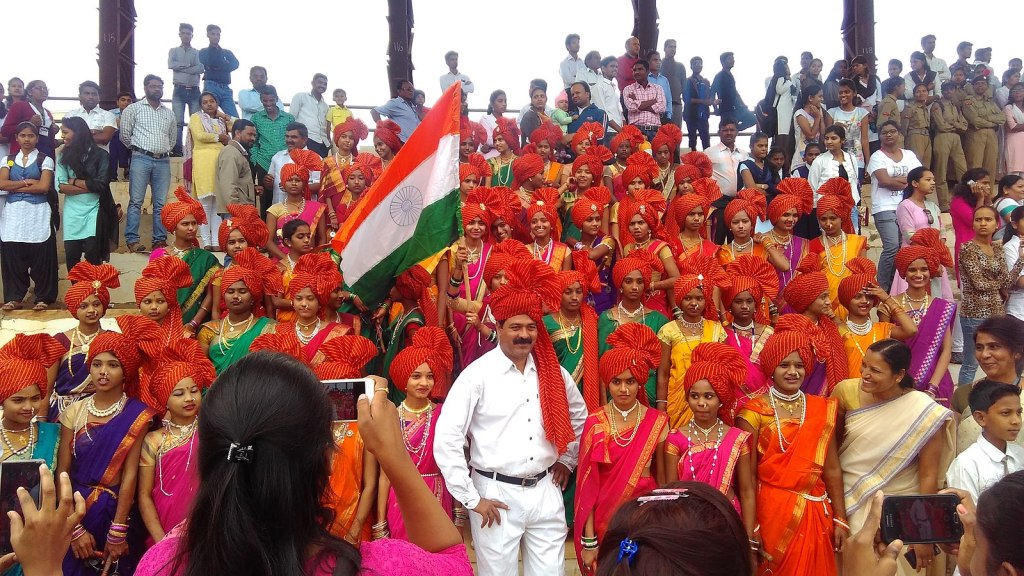
The Republic Day of India being observed by school students wearing traditional clothes. Photo courtesy: Wiki
Christmas this year was a quiet affair like most other festive days for the past nine months of 2020. The pandemic has changed much of life as it was for all and for me. I have been indoors mostly. Work and reading has kept me busy for much of the time. Online classes and examinations tire me but then reading and writing keeps me pleasantly occupied. And yes, cooking too. As the sun mellowed and temperatures dropped a little, I began to spend some time in the afternoon sun in the backyard. The water tank is my seat and a few plants around add to the ambience. A few colourful butterflies flitter around, the neighbour’s cat mews as it moved around.
I sat in the afternoon sun catching up on a novel that arrived a few days ago when I heard a voice. The two little girls in the red building just beside my apartment building were back again. They were at their mamar bari (maternal uncle’s house). The little one, the younger of the two, asked me what I was doing. The last time she was here, she was mostly quiet, following her sister around. It was the older one who did most of the talking. This time, the older one played a more protective role – that of the elder sister. When I expressed my surprise, she told me that the little one talks a lot nowadays. She, for one, still had online classes to attend to, she made it a point to tell me that. The mother looked out from the window with a warning — the little one asks too many questions and that they will keep coming. She added that if I was doing something important, I would be constantly disturbed. I smiled at them.
I answered her question, told her that I was reading a book. She then wanted to know what the book was about. I told her it was a story book. She then asked me my name. When I told her, she repeated it after me. Then again, she asked me why I was sitting outside. And she went on and on. The questions kept coming. She had a small doll and she showed it to me. She wanted to see what I had in my hand. I show her the book. I know she could not see it clearly as she was on the second floor. But then, she was happy to see it. I guess, she was happy that I responded to her. A little later, she was joined by her older sister who smiled and told me they were going for lunch, reassuring me they would be back soon.
I smiled at the two at that window and as the questions stopped and the two disappeared, went back to the novel. The sun was on my back, a little kitty on the wall under the neem tree. As it got warmer, I moved indoors. I could hear their goings on. It was time for my classes too.
Today, I heard that familiar voice again. We have been talking almost every day now. She told me she has a book too. She told me she is reading. She even had a pencil in her hand. I asked her about her book, and she began a tale – a tale of a princess imprisoned in a big house. She tries showing me the pictures in her book. “Can you see the pictures?” she asks. I smiled at her and listened to the bits and pieces of her story. The older one appeared at the window bars, smiled at me and said that she had been reading that story to her sister. The little one wanted to read, everyone else around was doing so.
It is nice to see the book in her hand, her interest in them and in stories. It was also sad to note that they are, like most of us, stuck in small spaces. I hear the voices of these two girls ‘playing’ with the two young boys on the opposite terrace. Their play was verbal, they could not meet, run about or fight. One of the best childhood memories that I have is playing on the street just in front of our home. In winters we played badminton, our racquets would be out and dusted and shuttlecocks bought and kept ready. We lost many of the shuttlecocks. They would fall into the open drain, get completely wet and dirty, would land up on trees, would get damaged too soon. We took turns to buy them. There were plastic ones available too, and though they lasted longer we didn’t like them. We played singles and doubles as well – pushing and jostling on that road in the para (colony). We would stop for a passing vehicle and then get back to it, all over again.
It is not just because of the times we are in, running around and playing on the streets is almost a thing of the past these days. There are other things that keep children more occupied and other activities too. Times change and so do norms. I just hope that these little ones get a nicer space to live in. As I go on with work, the headphones plugged in, cutting me from sounds excepting the ones that emanate from the laptop, I move, for some time, into another world, a world that most of us have got used to in these COVID-worn times. In one of my classes, one student says that since Republic Day was approaching and that we would still be online connected virtually, maybe in one class we could just talk about how our lives have been affected by the pandemic. “There would be the flag hoisted at college,” someone else chipped in.
“Yes,” said another, “but we wouldn’t be there. So, it would be interesting to talk about the scenario now.”
“I saw flags being made in a house nearby,” said another. I agreed to the idea immediately. I would surely like to hear about what young minds feel and think about things happening around us.
.
Nishi Pulugurtha’s works include a monograph Derozio, travel essays Out in the Open, edited volume of travel essays Across and Beyond, and The Real and the Unreal and Other Poems.
.
PLEASE NOTE: ARTICLES CAN ONLY BE REPRODUCED IN OTHER SITES WITH DUE ACKNOWLEDGEMENT TO BORDERLESS JOURNAL.
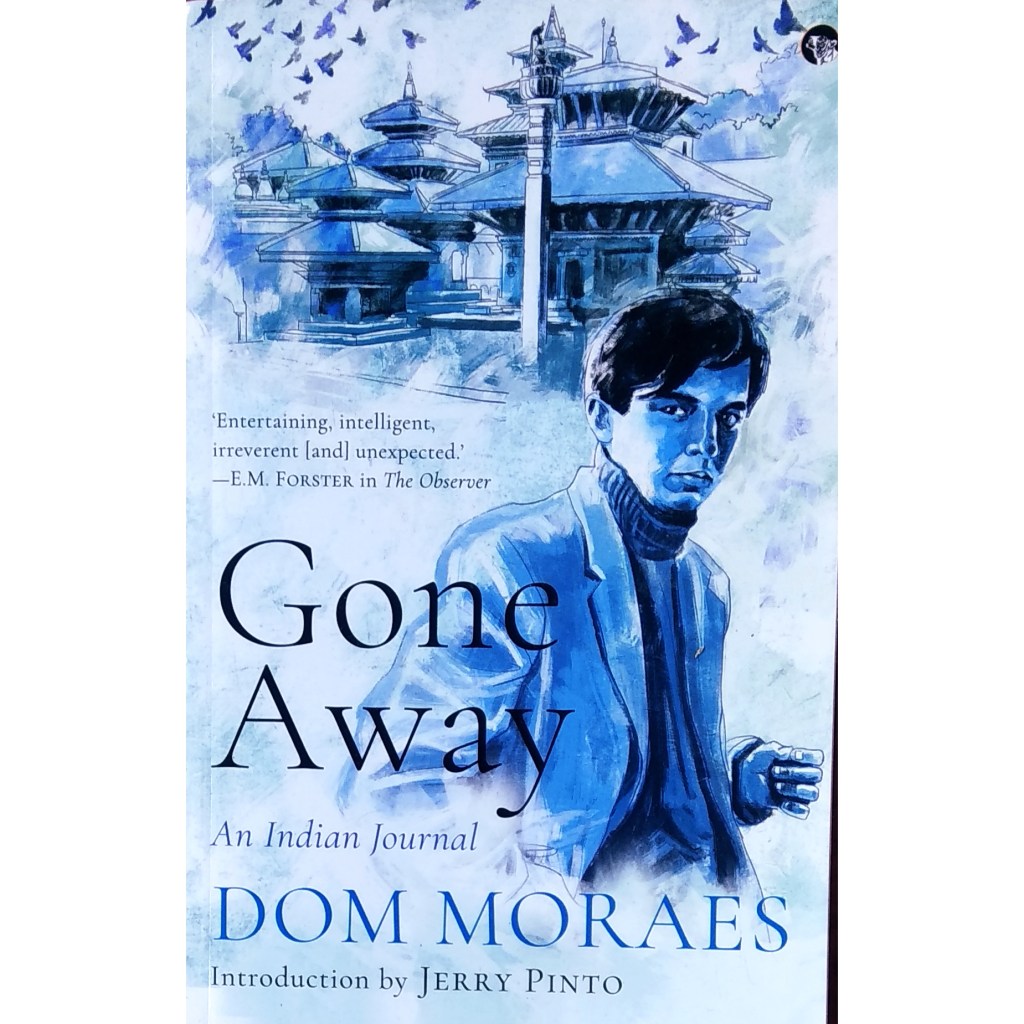
When a travelogue resurfaces sixty years after it was first printed, that ought to be meaningful. “Gone Away – An Indian Journal” by Dom Moraes was originally published in the UK by William Heinemann. Republished as a paperback edition by Speaking Tiger Books (New Delhi) in 2020, the travelogue carries the same magic for the reader as it was then.
Dom Moraes, a poet, novelist and columnist, is perceived to be a foundational figure in Indian English Literature who published thirty books in his lifetime. In 1958, at the age of twenty, he won the prestigious Hawthornden Prize for poetry. Winner of the Sahitya Akademi Award for English in 1994, Moraes passed away in 2004.
Son of the Editor of the Times of India, Dom had grown up in well-off and generous circumstances. After traveling with his father through Australia to New Zealand and Malaya to the borders of Red China, he watched and wrote poetry. Moraes met Stephen Spender in India, showed him his poems and had some published in “Encounter.” The combined efforts of Spender and his father had gained him admission to Jesus College, Oxford.
Reads the blurb: “One of the most unconventional travelogues ever written, Gone Away covers three months of Dom Moraes’ life spent in the subcontinent at the time of the Chinese incursions on the Tibetan border in 1959. In that short time, a remarkable number of memorable things happened to him, some of them the sort of fantastic situations that could only enmesh a poet, perhaps only a young poet – a visit to a speak-easy in Bombay; an interview with Nehru and an hour spent closeted with the Dalai Lama in Delhi; and a meeting with the great Nepalese poet, Devkota, whom he found already laid out to die by the side of the holy river Basumati.”
After a short stay in Calcutta, where he tried, with limited success, to investigate the lives of prostitutes, he went up to Sikkim, the north-eastern border state into which no visiting writer had been allowed for almost a year. Having made his way by jeep right up to the frontier, he ran into a Chinese detachment and was shot at, but escaped to safety.
Full of comicality, felicity of phrase and oddity of behavior, Gone Away communicates the special excitement of the traveler on every page. Example: Unforgettably funny is the account of the Sikkimese soccer match played in an impenetrable mist and involving the loss of several footballs kicked over an adjoining cliff. Though wit and impertinence prevail through the pages, this is a book which catches and holds the mood of modern India and illuminates as much as it amuses.
This is both a political and a personal voyage of discovery, told simply. Moraes’ travelogue is also significant because it gives us the poet’s eye view: providing details from the Indian cityscape and draws our attention to the zeitgeist of the early decades after Independence.
This memoir is a delightful read and is both modest and polished. Moraes’ account of India’s friction with China and India’s relationship with Nepal at the end of 1950s is convincing, especially in the context of the new tensions on the borders. Recording public disquiet over China’s infractions in 1959, Moraes mentions that General Thimayya had asked that the Indian troops on the NEFA border should be supplied with automatic weapons, as they were inadequately armed in case of Chinese attacks. Krishna Menon is said to have refused the request. Then came Longju, when inadequately equipped and outnumbered Indians were put to flight by the Chinese. Indian foot soldiers, caught in the cross locks of war, continue to be ill equipped, even to date.
There are many more accounts in the book of Dom Moraes meeting prominent diplomats, politicians, writers and artists such as Malcolm MacDonald, Jayaprakash Narayan, Han Suyin, M F Hussain, Nirad Chaudhuri, Kishen Khanna, Buddhadeva Bose, Jamini Roy and many more. Moraes also managed to reach Sikkim when the Chinese were closing in on the border. There is so much of the subcontinent’s socio-cultural history to exude. The historical incidents and famous people are easily recalled from textbooks but reading this firsthand experience is something exceptional.
Moraes travels continue to Calcutta, Gangtok and Sikkim, where the Chinese army’s presence is strongly indicated and the Indian state does not provide enough information. Reporting a readable narrative about independent India’s first decade, Moraes’ love for India anticipates his eventual homecoming.
He captures the occasion with candour, his narrative provides a perspective that tells the whole truth, with little sentimentality or precision, and is peppered with humor that is situational and occasionally self-deprecatory.
With an introduction by Jerry Pinto, “Gone Away” is part of the trilogy of autobiographies written by Moraes. It is a fabulous testimony to India and many of its rarities.
.
Bhaskar Parichha is a journalist and author of No Strings Attached: Writings on Odisha and Biju Patnaik – A Political Biography. He lives in Bhubaneswar and writes bilingually. Besides writing for newspapers, he also reviews books on various media platforms.
.
.
PLEASE NOTE: ARTICLES CAN ONLY BE REPRODUCED IN OTHER SITES WITH DUE ACKNOWLEDGEMENT TO BORDERLESS JOURNAL
Everyone we know has been fighting in their own ways in these uncertain times. My own conflicts have spanned from being highly emotional to confused and anxious. A lot of it would have remained buried in the pages of my diary had it not been for this urge to share my personal experiences from the COVID timelines. Here’s a peek into my personal journey from such times that I hope will entertain you no less, provided you believe in divine intervention.
In the past few weeks and months, we have understood the importance of focusing only on the meaningful aspects of our day to day life. I have always believed that in mitigating hurdles of existence, the universe comes to your rescue in the form of divine intervention. My everyday travel companion and faculty colleague, Apurva Bhilare, cackled unapologetically with unbridled joy upon hearing this. She agreed with me when I explained that I have coined this phrase to describe how much relaxed one feels to be unexpectedly relieved of some mundane, tedious and boring tasks, which if not done wouldn’t have made significant impact on many lives. At this, she too wished such divine interventions would come to her rescue as she planned to take leave and get married by the year end.
This divine intervention has helped us all to take a pause and take a relook at our lives. In my case the first six months proved to be peaceful. However, in the month of September, I got my first jolt. My wife had contracted an infection from the Corona virus. She resides in Mumbai and it was difficult for me to be by her side as I am based out of Pune. Some did try to urge me to her side saying work should not be a hindrance in fulfilling my duties towards my family. Staying true to my nature and relying upon my wisdom, I did eventually ignore their conventional advice. But it got me thinking — am I slave to work or love? Or is my work my love? Turns out I am as ruthless as this system that compels an individual to beat machines at giving uninterrupted output.
A self-confessed hypochondriac, I was getting restless by this time. And I didn’t have to wait for long before I experienced the symptoms myself. The stage was set for an action packed sequence. The frequency of ayurvedic concoctions also known as kadhas* was increased to thrice a day. Other immunity boosting tablets cropped up on my workstation. Breathing exercises became my constant companion. Consulting a physician was the last resort on the action plan. Frantic calls were made to my scientist brother in the US and his advice sought. And yes, spirituality suddenly invaded my otherwise predictable life with all of its aura and myriad charm.
By this time my wife had conquered the initial fear and she had become stable. She said one need not panic and should try to stay calm. Surprisingly, she asked me to get tested if I continued to feel uncomfortable. On the other hand, my brother had asked me to wait and watch since he was well aware of my hypochondriac self. Genetically blessed with acute acidity that acts up in mysterious ways, I had experienced many of its scary manifestations in the past few months — from racy heartbeats to bouts of uneasiness.
Yes, I realised that in the past few months of the pandemic-imposed social isolation, I had valiantly braved innumerable onslaughts of this multi-headed demon, which included enduring unmanageable headaches to unexplained erratic heartbeats and what not. Add to this the unending and irrational work pressures day in and out. As a result, I had started contemplating an untimely termination of the drive to go ahead at all. Looking back, I can fearlessly confess to a severe depression without any inhibition. Once again I realised the need for family support. I have always believed that seeking any outside help is not only unscientific but also a sheer waste of hard earned money.
So, here I was popping homeopathy and ayurvedic tablets in the hope of driving away that familiar yet detestable throat infection that typically began as a sore throat and grew scarier with every passing hour. The unnerving news of my dear friend and another senior office colleague having fallen prey to the pandemic and being in hospital added to my anxiety.
However, it was not going to be easy for me to take any tests since it would mean pulling my septuagenarian parents into the melee. To make matters worse, a severe bout of cough had seized my mother. So, for a while I forgot my discomfort and, instead, took over her role. I made the poor creature swallow and ingest everything I could lay my hands on from her vast repertory of ayurvedic and homeopathy medicines. A diabetic patient, taking her out for any more tests would have jeopardised her health. The same went for my father. Though non-diabetic and healthy, his chronic cough coupled with exposed risk would have made matters worse.So, here I was, concealing my anxiety and putting on a brave face.
Then I could take it no longer. I called up my family physician. In the first call itself, he advised me to observe home isolation and immediately do a couple of tests including a chest x-ray. At the same time, he prescribed the medicines which are administered to COVID patients. From that moment, the pulse oximeter, thermometer and the blood-pressure measuring kit became my constant companion. For the next few days, the meticulousness with which I tabulated my hour-by-hour progress would have found a mention in any medical journal though it now remains reduced to pretty memorabilia. Also, I wish I could explain to my physician how irrational his idea of self-isolation at this stage was as my parents and I had already shared our collective biota many times over within this period. Also, logic said that we would have to consume the same medicines irrespective of the infection.
Needless to say, when the physician called up the next day, as they had to keep records of patients with symptoms, he was furious as I had not done any tests. In desperation he asked me to report immediately should I experience further discomfort. By this time, my mother was back to her enthusiastic self and immersed in the preparation for hosting the annual ritual of the Navratri Puja* at home.
In retrospect, all of this looks a bit weird. But that’s how life is — it’s never all that simple, or is it for you? Fortunately, with divine intervention all was well and continues to be well. Apurva, I now hear has embarked on her journey of marital bliss too.
But hey, wait! What’s that with the second wave–I am feeling some soreness in my throat again.
*khadas: A homemade preparation using easily available spices and condiments
* Navaratri Puja: A ten-day long worshiping ritual of the goddess Durga
Mayuresh Belsare is a faculty at the Department of Journalism & Mass Communication, Vishwakarma University, Pune. His love for writing includes copywriting and writing for the audio-visual medium.
.
PLEASE NOTE: ARTICLES CAN ONLY BE REPRODUCED IN OTHER SITES WITH DUE ACKNOWLEDGEMENT TO BORDERLESS JOURNAL.
She had never thought it would end like this. A chance meeting in a food trail which culminated in the lanes of Paharganj was quite an ordinary occurrence for Sagari. She considered herself a foodie and anything to do with eating captured her attention. Not that she minded any adventures…in fact just the thought of staying at home for a prolonged period of time depressed her. However, this particular day had a lot more in store than just a food trail…
She had been careful not to crush her crisp cotton dupatta when she boarded the metro in the morning. The shared auto ride till the station had messed up her hair a little but she liked that unkempt look. The bright pink kurta was a sign of her enthusiasm and complimented her dusky look. The kohl rimmed eyes were mysterious and honey-coloured giving her an air of aloofness. Just the prospect of meeting a whole bunch of strangers filled her with excitement.
The food trail had already begun when she joined the motley group of people, old and young including a gray-haired man who looked a little out of place with his crisp white shirt and dark trousers, a couple of middle-aged women whose idea of coming on a food trail had little else beyond food and a bunch of over-enthusiastic teenagers who couldn’t stop talking even while the others strained to hear what the guide was telling them about the sweet shop in Chandni Chowk.
The only other person who had come alone besides herself was a young man who had a quiet demeanor and reminded her of the lanky hero in those early Amitabh Bachchan starrers. He had noticed her immediately but seemed in no hurry to strike a conversation. She kept asking questions and the others looked disenchanted with her curiosity about the origins of dhabas (street side eateries) and their owners’ pride in hoarding family recipes. She loved everything about the walk and the little discoveries of secret recipes, the smells and the aroma of spices and the delectable food that filled her senses with a pleasure that was hard to resist.
The young man who had shown no interest in her so far intrigued her. His lack of enthusiasm acted as a trigger for her to take it up as a mission. The pattern was the same always, the more a man ignored her, the more interested she became in knowing how to get his attention. It is not too hard to decipher that she succeeded nine out of ten times. For her, this too was an adventure…unraveling the enigma behind the ordinary exterior and then getting to know the person.
The trail ended before time as the sun had already set and the cool breeze had lulled everyone into silence. The chaiwala (tea stall owner) at the corner of the street was definitely a temptation and she decided to walk up to him for a strong cup of tea. As if on cue, the young man followed her to the bench which didn’t seem too inviting and served more as an indication of the chaiwala’s existence. That is when she noticed the steady gaze which seemed to linger on her.
Immediately conscious of her hair, she made a cursory attempt to look a little more presentable. By then he had taken both their teas from the chaiwala and was holding on to them, waiting for her to reclaim hers from his hand.
“Thanks …you didn’t have to do this.”
“It’s all right, thought I’ll wait for you to finish.”
That is when she realized that her bag’s zipper had come undone and she was still struggling to close it.
Why do these clumsy things happen when you are in decent company? She thought to herself.
The tea had become inconsequential by now. It was almost as if they had both been aware of the ploy which had finally brought them this proximity.
By now, she had gained her composure. It was strange how naturally they both hit it off and the leisurely walk in one of the Paharganj lanes seemed like the most obvious choice of activity. Neither of them was in a hurry. On the contrary, the prospect of spending the next few hours in each other’s company was exciting enough. He kept listening to her incessant chatter about her little room in a shared flat and how it seemed insufficient for her adventurous mind with its creative thoughts and ideas.
She loved to go out, alone mostly and explore the city which had given her an identity. She seemed to know a lot about Delhi, considering the short span of her stay here. She looked eager, starting a new sentence before the first one had finished…laughing at the little jokes which he made with a straight face. Her eyes were full of the joy that comes from living your own life your way and there was no way he could not be fascinated with her charming figure which wasn’t slim but had an interestingly voluptuous look which his male imagination had assessed much earlier in the day.
They decided to eat, and a curiously winding staircase fascinated them into climbing up to a roof-top restaurant which had a quaint look and a wide terrace with stray benches strewn around giving it a strangely nonchalant air, as if the atmospherics were least interested to know who the occupants were. A plate of momos followed by a few beers were enough to make them comfortable with each other.
He cajoled her into a space where she just wanted to live in the moment. He was not the kind of man who looked threatening, instead he had an easy air about him, almost as if there was very little in the world that could jolt him out of his composure. She was equally relaxed, almost on the verge of putting her head on his shoulder, the beer making her feel lighter and happier. The wrought iron bench in the corner of the terrace, with an adventurous branch of the Neem tree winding up to it seemed to offer an invitation and they eased into it, both anticipating an interesting end to this day.
The very essence of this night was the silence around them…most of the people in the restaurant had left and there was nobody to check on them or even ask them to leave…it wasn’t that kind of a place where people intruded into your conversations to ask you to leave. It was the kind of place which let you be and trusted you enough to find your way out.
They talked about life, relationships, travails of living in a big city, and about their dreams which always seemed to be round the corner but remained elusive. She had never imagined she was capable of this. Talking through the night with somebody she had met a few hours ago.
It surprised her a little…her comfort zone and how easily she could treat herself to an adventure. In fact, when the dawn broke, and she took a cab home, deciding to drop him to the next metro station, he didn’t seem too averse to the idea. It was pretty clear to both of them that the romance of the night was over…the magical rapport they had felt with each other seemed to fade away in the sunlight. Their realities had shaken hands and said their goodbyes.
She was quite sure she wouldn’t see him again. What she couldn’t figure out was her own impulse and that carpe diem spirit which ruled her mind on most days.
This happened to her a lot and her consciousness berated her each time she thought about her seven-year-old relationship with her boyfriend who worked in the US. It seemed to her a minor factual detail in her bemused existence. It was almost as if she wanted to have a fill of her stray encounters with men, she found interesting. Was it her way of finding the truth about her committed relationship or just a series of casual adventures?
She had no clue and although these questions kept popping up like little droplets of water on a windowpane, there was never an immediate need to clear the surface and peep into her mind.
Life can be quite uncertain, she told this to herself often enough. The thought of marriage and moving to another country was going to happen at some faraway juncture.
For now, she was pleased with the way her career at this startup was shaping up, she was content to go on her solitary walks in this beautiful city, listen to her favorite melodies in the rain, enjoy her food trails and take innumerable pictures, read to her hearts’ content on lazy weekend mornings. If life had anything more to offer, she was in no immediate haste to get there. She told herself often…tomorrow is another day.
.
Dr Gauri Mishrais teaching as Associate Professor in the department of English at College of Vocational Studies, University of Delhi. She likes to dabble in poetry and short fiction from time to time. She is very passionate about teaching and also heads the placement cell of her college.
.
PLEASE NOTE: ARTICLES CAN ONLY BE REPRODUCED IN OTHER SITES WITH DUE ACKNOWLEDGEMENT TO BORDERLESS JOURNAL.
Written in Balochi by Mereen Nizar, translated by Ali Jan Maqsood
That unpleasant winter night breaks my heart. My mother sobbed loudly and stated with tearful words, “Better than this life, I had tied a rope on my neck and killed myself. What misfortune! What sin have I committed that I am being punished?”
After these words, Mother wiped her tears.
I was caged with chains of childhood and immaturity. My thoughts were next to nothing. I could not start to comprehend the anguish of my mother. I felt so vague and dumb.
While I shed tears in a corner by the wall, my mother, lay on her stomach and continued to sob.
Time moved faster. I, as a lame, was dragged along with time towards an unknown destination.
I felt my experiences were maturing me.
And then I witnessed again a similar winter night — my mother — the exact walls and home, but there appeared marks of cruelty on her.
She had lost the courage to be alive. She was inconsolable. Crying and lamenting had depleted her youthfulness. Age had crept in on her and humbled her.
The mother, sitting on the funeral of her innocent child, was missing him.
I continued to be the same person, attached to the same walls of the home. I wandered like a lost soul with grief haunting my thoughts. My eyes began to rain with tears. By then, my mother was not alone. I, too, was torn with pains and worries.
The world had changed: many had lost the game of life, many had won. Many were homeless. People were yet moaning under the fallen walls of weariness. One among them was the same old lady who had lost the game of life and was shouldered by four people. She was kept under sanctuary of the Motherland.
I realised the place and situations had changed. My mother’s laments had ceased. The Motherland had sheltered my mother. The sky began to shed its tears along with mine. I apprehended my mother was shedding her tears for me from the sky.
Mereen Nizar is a Balochi fiction writer and an M.phil scholar in the field of Botony. He writes for different local newspapers and magazines.
Ali Jan Maqsood is a student of Law at University Law College Quetta and can be reached at alijanmaqsood17@gmail.com. He tweets at @Alijanmaqsood12
Originally published in Balochi language in Tawar newspaper in 2015.
PLEASE NOTE: ARTICLES CAN ONLY BE REPRODUCED IN OTHER SITES WITH DUE ACKNOWLEDGEMENT TO BORDERLESS JOURNAL
He comes daily to meditate on its grassy right bank.
And to find nirvana.
At the top of the stone staircase, a few steps away from the small shrine to the local deity, he sits and watches the Chenab flow majestically to its far-off home. Across the river, in the vast dusty plain, stands a grove of trees, in the distance. He can see the tree spirits dancing in the mildly-dark grove — like the dryads in an ancient Greek sacred grove. Mysterious airy figures flitting in the air. The winter morning sun splashes colours in its gurgling waters. Dusk in that lonely plain paints the beautiful river in flaming orange!
He finds the interplay of the sun and the river mesmerizing. Misty December, the shrouded river is sad and abandoned, meandering its way quietly in the fields. The silence of the Chenab could be both healing and frightening. He seeks out the broad-shouldered river like a child hunting for his mother in a deserted house.
The Chenab speaks silently to him, as it has always spoken to its seekers from previous ages. The waters exert a strange fascination over him. He finds the buried centuries on the bed of the river that has irrigated the soul of many states and communities. Chenab is the breath of the people. The moment he sits, the lost centuries leap out of the glinting waters and he can hear folk songs, drum beats and dancers dancing around the bonfires burning in the village square, on moonlit nights. The cold winds of December cannot dampen the general mood of festivities. He can clearly hear the folk singers singing in throaty voices before the assembled rural audiences; the fair maidens blushing and the hardy young men twirling their moustaches. It is a strange riverine world that he witnesses daily from his elevated perch.
One late morning, he found both love and death near the eternal Chenab within a short span of one hour.
First he discovered love.
As he was walking near the Chenab with a blank mind, eyes seeing, yet unseeing, he saw her crying. A solitary woman, younger, in yellow salwar-kameez and red dupatta, sitting on a stone ledge, her feet dangling in the gently-flowing Chenab. A bird was singing in the clump of trees ahead, near the right bank, her notes melancholy, musical and edifying. Both were surprised by the presence of the other at such a desolate spot.
He had rounded a long bend in the quiet river and immediately came upon the sobbing woman. The bend was in a remote corner and hardly visited by the busy villagers. He was shocked by the unexpected sighting of a fair maiden on a boulder at the edge of the river. She looked like a lost nymph, vulnerable and sad, suddenly appearing out of the cold river, before a startled human traveller. He was rooted to the ground, the river hummed in the tranquil morning.
Her face was very fair, eyes large and kohl-lined, framed by a mass of dark hair. The tears were big and rapid, sobs silent and shaking. Her face was cupped in a pair of white plump hands; a soundless cry escaping from a small open and full mouth. He saw her and felt smitten by this picture of stunning beauty, innocence and vulnerability. The dormant knight awakened quickly, after a hiatus of centuries long dead and interned in some tiny DNA sequence.
He wanted to reach out and protect her like the knights of yore.
At that precise moment, the damsel in distress looked up at this strange apparition from nowhere. Her doe-eyes first registered fear on seeing what she presumed was a predatory male figure. Then, they moved on to look helpless and trapped. She was paralyzed by this abrupt human encounter on a spot where no other being could be espied other than the couple destined to meet in a most dramatic way.
She stared, open-mouthed, tears still coursing down her oval face.
“Why are you crying?” He asked, his voice a little awkward but firm.
The query and the unexpected concern made her dissolve into a fresh bout of tears. The reassuring voice belonging to a stranger in an alien, deserted setting can trigger the release of hidden pain in a gentle human heart. She cried, uncontrollably. He watched. Both helpless and bonding in a strange way over the common form of rumination that can visit the human race so frequently and at odd hours.
Unbidden, he waded through the water, climbed the rock on which she was perched and hugged her tenderly, right hand giving reassuring taps to her upper half of the trembling body. The two entwined figures in a vast desolate place, in a timeless gesture of magnetic empathy were lost to the sense of time as the watch ceased to tick and the Earth stopped. She found him and his embrace harmless but comforting — the way strangers hug each other and comfort during national tragedies of epic scales. The two young clung to each other in a tight embrace and love was born in their lonely hearts.
After they had separated and she had washed her tear-stained face, he repeated his original question, tense modified, “Why were you crying?”
She said, face downcast, voice frail from crying, “Stepmother.”
“Oh!” He got it. “Are you from this village?”
“No,” said the woman demurely.
“Your name?”
“Aisha.”
He said nothing. They continued to sit on the boulder, a little higher, surveying the surrounding scene. The bird had stopped singing in the nearby clump of trees. A stork flew in the languid air. A tractor could be heard on the dirt road somewhere in the background.
“Your name?” She asked, long lashes fluttering.
“Iqbal.”
“Muslim?”
“Nope. Iqbal Singh.”
She said nothing.
Then he asked,“Your village?”
“Six kms from here.”
“Why did you select this hour and spot?” Iqbal asked.
“I wanted to die. Away from my family and ancestral village…Did not want to disgrace my father. I chose this place where nobody would come and find me or my dead body. I want to die.”
“Die?” Iqbal asked mouth open, eyes uncomprehending. Like drowning a priceless gift in an angry or desperate moment.
“Just that. Sometimes you want to die—to escape being a motherless poor daughter or a woman unwanted in home and society. Nobody cares for me. I am becoming a burden to them.” Her tone was now quiet and firm. Thoughts in order and lucid.
“Age?”
“Do not ask a woman her age,” she said and laughed a clear laugh that rose and blended with the stratosphere. Typical mood swings! “Completed my eighteen years last month. They want me to marry an old widower of my caste and community. I want to study. My stepmother is cruel. She hates me and beats me daily. The widower is her distant relative. A wealthy landlord twice widowed. Giving a lot of dowry. My greedy mother is eager to sell me off to that old lecher. I ran away in a bus to this village and from the village square, came down to this spot.”
“Then?” Iqbal asked the run-away.
“I reached the deserted spot. Climbed up this high boulder in the middle of the river and wanted to take a leap into the rushing cold waters. I took the first steps also…”
“Then?” Asked Iqbal the way kids ask the story-telling tired mothers during bed-time at night.
“I clearly heard a voice.”
“Voice?”
“Yes. The voice that commanded me to stop from drowning.”
Iqbal, surprised, looked around but saw only wild terrain.
“I do not see any mortal here,” he said, holding her hand in his.
“It was not mortal. It came from the world of the dead.”
“What?”
“It was the voice of my dead ammi jaan,” she said. “I know the voice. It commanded me to stop and a hand pulled me off. I sat down and cried. My ammi jaan still cares for me beyond her grave. Her voice is still silky and soft. She doted on me, my poor mother. Then, she sent you here to me.”
The low voice melted his heart. He felt moved. He tightened his grasp — to prevent her slipping through his grip into the watery grave. Her plump hand did not resist. It remained limp and soft; like the hand of a yielding baby to the security of an adult care-giver.
“Your plans?”
“I will not go home. I will stay here.”
“Then, some jungle creature will eat you here in the night.”
“I do not care,” she said. “My home is also not safe.”
“I understand,” Iqbal said in a soothing voice. “I will not leave you here in the wild. You may get attacked by the wolves or hyenas. It is not safe. Or serpents. Or, stray drunk men.”
She said nothing. Only her dainty hand tightened her grasp over his broad muscular hand.
“Come with me to my home.”
“No.” She said, eyes scared.
“Why?” Iqbal asked, a little irritated.
“You are not us. You are them. How can I trust you?” She spoke clearly and frankly. Tone neutral. Stating a cold fact to the world in general.
“Have I done anything wrong? Immoral? Tell me. Did I molest you?” He asked callously and then realised his mistake as tears welled up immediately in her innocent eyes, stung more by the tonal harshness of this strange rescuer than the helpless predicament of a female run-away.
Iqbal softened quickly, “Come and eat there and then decide. I am not going to harm you in any way. Or, my family. We are honourable family of the Sikhs. I do not wear a turban or long hair. My father is a high-school head master and very respected in our small village. My elder brother is a police officer. I am studying in a nearby city college. I am an athlete. Do not worry. Come on. A long way to go.”
She remained undecided for long. Sitting on the boulder, immobile. More vulnerable and rudderless.
Iqbal stood up and lifted her tenderly in his arms, waded through the knee-deep waters and then planted her back on the dry ground. She said nothing.
She trusts me, Iqbal thought. A major battle won. “If you do not find my home safe, let me know. I will inform your family immediately.”
She said nothing. Drained out and limp, Aisha leaned slightly on his broad arm for support.
They started the new journey together; a journey determined by mysterious forces of the universe that no amount of rationalism can ever explain. A mere walk along the bank of the River Chenab had produced a most unlikely scenario for Iqbal. The river that had earlier fashioned legendary love stories of Heer-Ranjha and Soni-Mahiwal had now conspired to re-script the same folk narrative in a new format for these two 21st century young adults. Quietly the duo took the shortcut through the clump of whispering trees. And witnessed their last event…
The thick clump was on a steep rugged incline and afforded a good view of the riverine wilderness below. It led to the dirt road and to the village. As they entered the clump of the tall sturdy trees, they were stopped by another loud sound coming from the plain below, from the opposite side. They stopped and peered from behind the thick hedges and wild undergrowth. They could see a jeep coming up the dirt track, sound magnified by the empty silent plain. They held their breaths.
Soon the open jeep stopped and five tall and slim men climbed down from it. They were wearing masks and carrying guns. A sixth person, a blindfolded captive, was pulled down roughly from the back of the jeep.
Death was in the air.
One of the masked men fished out a folding chair from the dirty floor of the jeep and after unfolding it, forced the blindfolded man to sit down. Another man took out a handycam and began to record the scene. Satisfied, he nodded. Then another man stepped out from the loose group and faced the camera, voice booming in the wild, “We are going to behead the agent of imperialist America and Zionism. This man was acting on behalf of these powers and supported by the Indian government. Our next target will be the Indian government. We plan to destroy these unholy powers on the Earth. Long live the revolutionaries!”
The man next to the seated figure ripped out the blind folds of their captive. Iqbal gasped. It was a famous Western journalist, who had been kidnapped three months ago near the Chenab and whose face had been earlier beamed on all the TV news channels. The man looked ashen and withdrawn. His face looked haggard, although freshly-shaven and scrubbed. His hands and legs were then neatly tied and the camera started shooting the gruesome episode. A man whipped out a sword from a sack and cleaned it slowly before the dazed foreigner, in a deliberate sadistic act. He was smiling crookedly. The commander of the group asked playfully, “Any last wishes?”
“No,” said the journalist in his late thirties, somewhat defiantly.
“You arrogant agents!” Exclaimed the commander loudly. “So haughty towards death!”
The journalist, beyond any uncertainties of life and death, spat out: “Cowards!”
Another man hit him hard on his face. The journalist did not flinch. His eyes blazed. He had reached the stage of no pain and fear. A state that stared death in the eyes. “Leave the bugger. He is going to be beheaded soon,” said the commander. “He deserves it.”
The journalist laughed, startling others. “By killing innocent people like me you militants cannot shake the strong foundations of old nations and civilisations. Hatreds lead nowhere. Dialogue and sanity are productive. Violence and hatred can be counter-productive. They are useless. Bloodshed will lead you nowhere.”
The men were stunned by this slow outburst of a trapped civilian facing his own absurd execution at the hands of a few zealots fighting wars on behalf of the terror groups.
“Stop his voice,” commanded the man in ski-mask.
“No. Just record it for the whole world to see. They must know a journalist went down, fearless and defiant. My sacrifice will not go waste. You are all mad guys. Toxic guys spewing venom at innocent law-abiding citizens…”
The sentence was cut short mid-way by the swoop of the gleaming sword of the killer. A neat arc and the head rolled down, still partially connected to the neck. The handycam kept on recording the heinous act in a careful manner. Precisely. Clinically. In a detached way.
The killer raised his hand and this time cut away the loosely-held head of his human victim, eyes scornful and defiant; still triumphant in sudden death to his gleeful killers. The short stocky headless body, in fatigues, convulsed violently for minutes.
This was being recorded faithfully by a steady hand. After a few minutes, the gunmen danced around the decapitated body, firing guns in the air, unsettling the birds that made a racket and flew away. The gunmen left the headless body on the chair and before leaving, called up a few TV news channels and informed them of the location and of the job done. Then they departed, the jeep kicking up clouds of gravel and dust on the dirt track going up to the jungle.
When Iqbal — speechless and completely numbed by the sudden brutality and mindless violence choreographed with skill by militants in ski-masks carrying sophisticated weapons in a red modified Hummer, with high-fi communications system — looked around, he saw his frail female companion lying unconscious on the carpet of the moist grass and fallen leaves, fanned by a cool breeze in the clump of trees. Shaky, slightly trembling and nauseous, the tall and graceful athlete sat down on the green bed, trying to make sense of a world gone bloodthirsty and lawless.
He looked up to the sky for quick answers, sitting beside the prostrate body of the young woman. His faith shaken, he waited for some comforting answers from the blue vault above. Only a sun shone weakly there and a group of shrieking predatory birds circled above the dead body of an unfortunate and helpless man in the middle of a thorny wasteland near the bloodied red-Chenab. The trees whispered quietly and then Iqbal also passed out, dreaming of a quiet village home and his loving parents and of the tenuous security of such a familiar environment…
.
Sunil Sharma is the editor of SETU. He is a senior academic, critic, literary editor and author with 21 published books, seven collections of poetry, three of short fiction, one novel, a critical study of the novel, and, eight joint anthologies on prose, poetry and criticism, and, one joint poetry collection.
.
PLEASE NOTE: ARTICLES CAN ONLY BE REPRODUCED IN OTHER SITES WITH DUE ACKNOWLEDGEMENT TO BORDERLESS JOURNAL
While skirmishes continue to line the borders of India, Sameer Arshad Khatlani, author of The Other Side of the Divide, explores the deeply embedded syncretic elements in the heritage left behind by the founder of Sikhism. Part of his legacy still lives on in Pakistan.
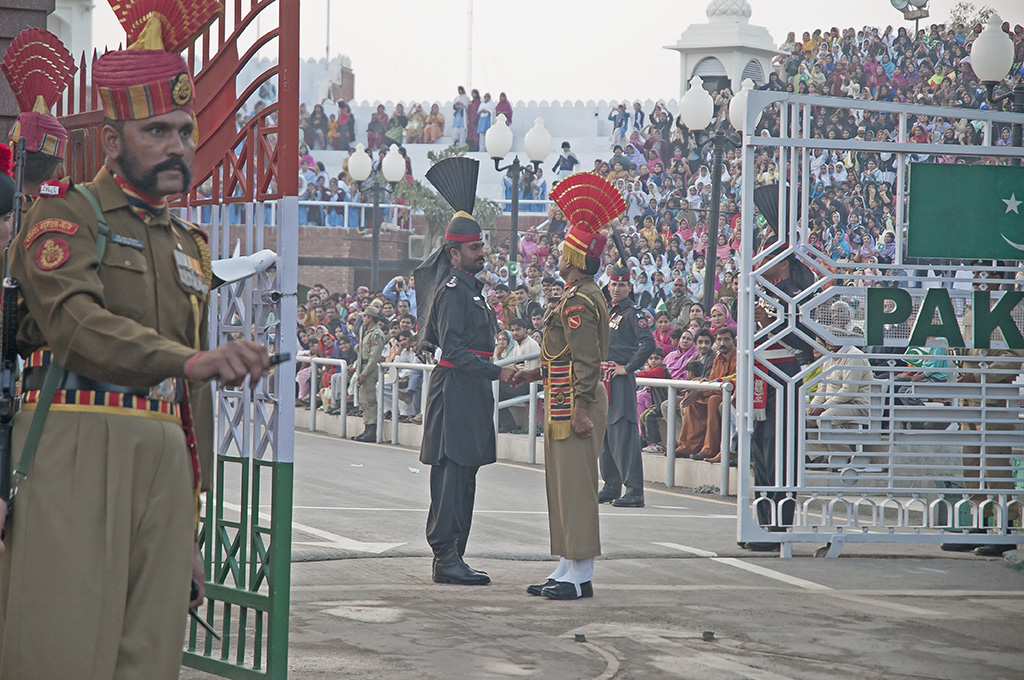
‘Beating of Retreat’ Ceremony at International Border at Wagha. Photo Courtesy: Wiki
Poet-philosopher Muhammad Iqbal’s ‘tremendous work’, wrote German writer Hermann Hesse (1877–1962), belonged to the world of Islam apart from two other domains of the worlds of India, and of Western thought. In his book Incarnations, academic Sunil Khilnani echoes Hesse and notes that Iqbal (1877-1938) was “deeply engaged with the histories, themes, and conflicts embedded in Islamic thought and in literary traditions that fired his imagination.”
Islam was certainly an important theme of Iqbal’s poetry. But he also wrote about important figures of other religions glowingly in the spirit of his famous couplet: “Mazhab nahin sikhata aapas mei bair rakhna, Hindi hai ham vatan hai Hindustan hamara (religion does not teach us animosity, we are Indians and India is our country).” “Hai Ram ke vajud pe Hindustan ko naaz, ahl-e-nazar samajhte hain is ko imam-e-hind (while India is proud of Ram, priests also teach us about Allah),’’ wrote Iqbal, highlighting the reverence that a vast majority of Indians felt for Lord Ram.
Of all the non-Islamic religious icons, Iqbal perhaps wrote most admiringly about Sikhism founder Guru Nanak, whom he hailed as “mard-e kaamil (perfect man)”. His poem titled Nanak starts with a lament that “our people paid no heed to the message of Gautam [Buddha]”; did not recognise the worth of that “jewel of supreme wisdom”. It then refers to Nanak and says the perfect man “awakened India from a deep slumber”. In another poem, Iqbal pairs Nanak with Muslim saint Moinuddin Chishti, who was a direct descendant of the Prophet Muhammad. “The land (India) in which Chishti delivered the message of truth; the garden in which Nanak sang the song of oneness that homeland is mine, that homeland is mine.”
Iqbal was born, raised, and died in pre-partition Punjab, the land of Nanak, which was divided between India and Pakistan in 1947. The division triggered violence, left tens of thousands of dead, and led to a virtual exchange of populations between the two parts of Punjab. It tore apart the region’s centuries-old milieu of co-existence imbibed in Nanak’s philosophy.
Nanak remains a unifier even as the vivisection continues to take a heavy toll on the subcontinent. India and Pakistan have fought three wars over Jammu and Kashmir (J&K), where conflict remains a legacy of the Partition. The two countries were on the verge of another war in February 2019 when India carried out a retaliatory airstrike in Pakistan following a car bomb attack in J&K.
Relations between India-Pakistan worsened in August 2019 following the stripping of J&K’s special status that prompted Islamabad to take steps like the downgrading of diplomatic ties. The upheavals had no impact on the Kartarpur Corridor that provides visa-free access for Indian pilgrims to Gurdwara Darbar Sahib built at Nanak’s last resting place in Pakistan. The corridor was completed and opened within a year on November 9, 2019, three days before Nanak’s 550th birth anniversary.
Gurdwara Darbar Sahib remains an enduring symbol of Nanak’s legacy, which is more relevant today when divisive political leaders rule the roost and all pillars of democracy appear to be succumbing to majoritarianism. It is built at a place where a group of Hindus and Muslims are believed to have found flowers underneath a white sheet when they performed Nanak’s last rites. The two sides agreed to divide the sheet and flowers among themselves. Muslims buried their share and built a mazaar or mausoleum in Nanak’s memory. The Hindus put their piece of the sheet and flowers in an urn and buried it.
Nanak and Sikhism’s association with Muslims has been far deeper than what is generally known. His Muslim teacher was the first to point out how blessed Nanak was as a child. He called Nanak gifted and understood before anyone else could that the Guru’s vastly superior intelligence was because of the blessing. Rai Bular, a Muslim landlord, prevailed on Nanak’s father, Mehta Kalu, to be patient with his son’s otherworldly pursuits. Kalu was worried as Nanak wandered with holy men. Kalu wanted Nanak to study. Bular convinced Kalu to let Nanak be and reported miracles associated with the Guru which convinced him of Nanak’s holiness.
Bular is known as Nanak’s first devotee outside his family. Janam-sakhis, or Nanak’s life stories, and the Sikh scripture Guru Granth Sahib have several references to Bular. Bular is believed to have reported a hooded cobra shielding the Guru from the sun when he lay asleep under the open sky as another sign of Nanak’s spiritualism. Bular is also the one who is said to have noticed that a tree’s shade remained on a sleeping Nanak even as the sun’s position changed. He is reported to have rushed to tell Kalu that his son was an exalted being upon observing this. Bular convinced Kalu that Nanak was ‘a gem, a man of God‘ and dedicated large tracts of land to the Guru. Much of the modern-day Nankana Sahib, including Gurdwara Janam Asthan, built at the place of Nanak’s birth, is located on the land Bular bequeathed to the Guru.
Bular’s descendants lead annual processions to celebrate Nanak’s birthday in Nankana Sahib. Rai Hadayat, Bular’s 17th generation descendant, had the honour of leading Nanak’s 500th birth celebration. Bular’s descendants have been the custodians of Nanak’s estate. Rai Mohammad Saleem Akram, Bular’s descendant, now manages the estate. The revenue generated from the estate is spent on the welfare of the local Sikh community and the upkeep of gurdwaras in Nankana Sahib.
Maharaja Ranjit Singh, the Sikh Empire founder who came from the same Bhatti Rajput heritage as Bular, recognised his contribution to Sikhism. He bestowed the title of Rai Bhadur on his descendant, Rai Issa Khan, and made him a revenue collector. More recently, the Shiromani Gurdwara Parbandhak (management) Committee (SGPC) acknowledged Bular’s “immense contribution” to Sikh history in May 2018 by putting up his portrait at Amritsar’s Central Sikh Museum.
Another Muslim, Nawab Rai Kahla, made it to the Sikh hall of fame in July 2017. The SGPC unveiled his portrait at the museum in recognition of the courage he showed in sheltering Guru Gobind Singh, one of Nanak’s nine spiritual successors, in 1705. Kahla, a vassal of Aurangzeb who ruled a small principality in present-day Indian Punjab, offered Guru Gobind refuge in defiance of a Mughal decree to hunt down the 10th Sikh master, who was at war with the Mughal Emperor.
Kahla’s descendants are the custodians of Guru Gobind’s holy pitcher called ganga sagar which he was given as a token of gratitude along with a sword for sheltering the guru. Ganga sagar is believed to hold water despite its asymmetrical holes. Former Pakistani lawmaker Rai Azizullah Khan is the relic’s current custodian. He inherited it in 1975 from his family, which managed to carry the prized relic with them when they fled to Pakistan at the time of the Partition.
In 1705, the goodwill generated by the Malerkotla ruler, Nawab Sher Mohammad Khan, for speaking up against the execution of Guru Gobind’s sons, Zorawar and Fateh, has held his successors and principality in good stead since. The small kingdom in India was an island of calm; a Muslim sanctuary in East Punjab when the neighbouring areas were emptied of Muslims in 1947. Malerkotla continues to be East Punjab’s only Muslim pocket.
Folk history attributes Guru Gobind’s blessings to Malerkotla’s unique history. He is said to have blessed the nawab when he learnt about his letter to Aurangzeb protesting the un-Islamic execution of Zorawar and Fateh. By the time the nawab stirred the Mughal consciousness over the injustice, it was too late. But his gesture was not lost on Guru Gobind. He is said to have declared “his roots shall forever remain green”.
The rubabi tradition of performing devotional songs, kirtans, at gurdwaras is associated with the descendants of Nanak’s Muslim companion, Bhai Mardana. Guru Nanak sang his poetry to the tunes of a lute-like musical instrument, rubab, that Mardana played. Mardana’s descendants came to be known as therubabis. The rubabis had performed kirtans at the Golden Temple for seven generations since Guru Tegh Bahadur, the ninth Sikh Guru, roped in Mardana’s descendants, Bhai Sadha and Madha, for the job until the Partition ended the tradition. Only baptized Sikhs can now perform kirtans.
The Partition weakened the syncretic links, but the ties are inseverable. They are enshrined in Sikhism. Guru Granth Sahib is the anthology of sacred writing of Sikh gurus and saints, including Muslims such as Baba Farid. It is revered as a collection of revealed words—Gurbani (literally from the Guru’s mouth). Guru Arjan compiled the first edition of the scripture then known as Adi Granth. He had it installed in 1604 at the Golden Temple, which he declared Ath Sath Tirath (shrine of sixty-eight pilgrimages). Guru Arjan is widely believed to have invited a Muslim saint from Lahore, Mian Mir, to lay the foundation of the most exalted Sikh shrine. Muslim saints such as Mian Mir and Farid are highly revered figures in Sikhism. Farid’s picture at the entrance of Gurdwara Janamasthan underlines his importance in Sikhism.
Muslim saints like Baba Bulleh Shah and Waris Shah also contributed to unifying literature that bound people together. Waris Shah gave full shape to Heer-Ranjha, which remains popular on both sides. He followed in the tradition of Baba Farid, the pioneer of Punjabi literature. The syncretic message cut across the religious divide and bound Punjabis together.
Things began to change in the 19th century when, according to writer Ian Talbot, revivalists began to peddle “the myth of a golden age when their faith was pristine and unsullied by syncretic traditions”. The myth weakened the shared cultural values of the rural population and replaced blurry community identities and replaced them with defined boundaries. Even Punjabi became a language of contention. The Muslim and Hindu revivalists increasingly began identifying Urdu and Hindi as their mother tongues. The Sikh-Mughal conflict was used to exacerbate religious fault lines. Emperor Aurangzeb’s high-handedness in dealing with the Sikhs was highlighted. The spiritual Muslim leader Bulleh Shah’s (1680) moral stand was conveniently forgotten. Shah, a Syed and the Prophet Muhammad’s direct descendant, hailed his friend, the ninth Sikh Guru Tegh Bahadur, as a ‘holy warrior’ when he was put to death. He earlier dissuaded the guru from seeking revenge on Muslims “for the cruelty that the emperor Aurangzeb had inflicted upon his (Sikh) people”.
.
Sameer Arshad Khatlani has been a Senior Assistant Editor with Hindustan Times, India’s second-biggest English newspaper with a circulation of 10 million daily, since July 2018. He has worked in a similar capacity with both The Indian Express and the Times of India. Khatlani has reported from Iraq and Pakistan and covered elections and national disasters. He has a book, with Penguin, On the other Side of the Divide, published in February 2020. Read one of the reviews here.
The unamused tinkle of the bells on the necks of mules
Carrying civilization on their backs — toilet bowls, gas cylinders,
Celebratory beverages, wet-wipes, instant noodles
And hand sanitizers — for the connoisseurs of the wilderness,
The dry coldness of Spiti’s winds like the gaze of outlived love,
The amusement in the muted breath of the accompanying porters
At your victory signs, do not outdo the racket of bollywood
Ricocheting off the rocks with Himalayan dignity.
.
The Beas in not wanting to be the same river twice
Flows on as an aphorism.
.
*tickety boo: Term used by British colonials to convey all is fine.
Maithreyi Karnoor is the winner of the Kuvempu Bhasha Bharati prize for translation. She was shortlisted for the Lucien Stryk Asian Translation Prize, and twice for the Montreal International Poetry Prize. Her novel Sylvia: Distant Avuncular Ends will be published in early 2021.
.
PLEASE NOTE: ARTICLES CAN ONLY BE REPRODUCED IN OTHER SITES WITH DUE ACKNOWLEDGEMENT TO BORDERLESS JOURNAL.
My adoptive father was too old for military service when war broke out in 1939, but young enough by 1941 to be sent to India with the RAF (Royal Air Force), where he stayed until after that war’s end.
I’ve served, but not in an army, for five years under difficult circumstances, though nowhere near as difficult, and not half a world away from everything I knew about and had been led to believe. So, I have only an inkling of the stress he must have been under.
I have a couple of tiny diaries that he kept. Diaries were illegal for soldiers, I believe, which might explain their size. But they were sufficient for what he had to record, which by the second volume had reduced mostly to the chiselled capitals, day after day, of no mail.
I had, and to my regret, lost, a small pamphlet of Hindustani, issued to him by the Wild Woodbines cigarette brand. I can still count to ten – ek, doe, teen* and some more but probably not with good inflection. And phrases, the meanings of which have faded, can be brought to mind and tongue like fragments of old tunes. For a short time during my childhood, my father employed a man from the sub-continent, and he taught me a little more. I suspect he was badly treated, perhaps unknowingly, probably without conscious malice, by the other workers and left under circumstances that smacked, even to my child’s eye and ear, of dogs going to live on a farm.
His very presence, I think, must have owed something to my father’s experience of India. It had pervaded his consciousness and never left him. Neither did the malaria he had caught there. Throughout my childhood in the fifties, I was a chota wallah*, and slept in a charpoy, and was exhorted to jaldi jao*, not, I suspect, the politest way to summon or dismiss someone.
Quite co-incidentally I encountered an ‘old soldier’ of doubtful veracity, who plied me with British Army issue ration blocks dated to the 1940s, among which were ‘curry’, probably of the lamb or goat variety. To these, water was added, and the mush boiled. The smell was nice. I liked curry. But father would light a cigar, just as he did when our dog farted, and he’d reminisce about India, not fondly. The poverty and dirt had appalled him. He had misunderstood, or at least not become aware of the taboos on which hand did what. Yet he’d taken part in a failed distribution of tinned beef raided from the quartermaster’s stores, equally appalled at people literally dying in the streets of starvation, while the cinema reassured British troops of the vast food supplies kept for emergencies.
The Hindus had refused the meat, with a hostility that he never understood, but their refusal in the face of death both amazed him, and, I believe, destroyed his faith in the religion of his own country — he had a pious sister who, he told me, could never have made such a sacrifice for her faith. He had a brother-in-law too, who was a conscientious objector, and would never hear a word said against him. I think the Indian experience might have contributed to that. He told me also of a hut full of his comrades being ‘rescued’, from a harmless snake that was occupying the threshold, by one of the punka wallahs*, a man who never by word or smirk, he said, ever betrayed their moment of terror.
Sadly, my father died before I was old enough to have a really grown-up conversation with him about it.
So, India, though I’ve never been there, and though I’ve never talked to more than a handful of people who have lived there, has always been on the periphery of my life. My father had a camera with him and was far more of a photographer than he was a diarist. The black and white contact prints — from a Leica 35mm I believe — show jungles and deserts and temples and street scenes, even those streets with the dying upon them. They show servicemen in shorts and tropical kit, mostly standing in front of vehicles or planes. They show local workers on government service, which may or may not be the source of an acronym used in pay-books that has become tainted with misuse.
Since a short trip to China in the 1980s where a man dressed in military uniform welcomed us at Beijing airport with a smile (the smile seeming more fundamental than the uniform, I recognised he was just like me), I’ve believed we are all closer than we are distant, though we often stand or crouch on different sides of barricades erected in error and folly and for the benefit of those who would control us.
Recently I’ve had the good fortune to be rewarded with commendations and prizes in a series of flash fiction competitions run out of India, and to have the occasional piece taken for use in journals. For the years that I ran my BHDandMe blog, the 3rd largest group of readers was from India. Perhaps that drew me to reading writers whose names I don’t know how to pronounce and whose landscapes I have never seen except on a screen. And that’s been good for me, and in a strange way has brought me closer not only to them, but to the memory of my father.
Mike Smith lives on the edge of England where he writes occasional plays, poetry, and essays, usually on the short story form in which he writes as Brindley Hallam Dennis. His writing has been published and performed. He blogs at www.Bhdandme.wordpress.com
.
PLEASE NOTE: ARTICLES CAN ONLY BE REPRODUCED IN OTHER SITES WITH DUE ACKNOWLEDGEMENT TO BORDERLESS JOURNAL
 Queenie the Sloth

 Queenie the sloth
 lives in the labyrinth
 of the Olive Green Pen
 and toils daily to trace
 straight lines on pink A4 sheets

 Her behaviour often confuses me
 and when I ask her,
 “Do sloths work so hard?”
 She laughs then sings,
 “Banished was I ten years back
 from Yellow Land of Lazy Hands
 for building a bridge  from Ant-land
 to River of  Silvery Friends
 O sloths!
 O sloths!
 Laze around, laze around
 and let the Earth rock
 on its own beats!
 That’s what most sloths do, don’t they?
 But I’m Queenie
 and I’ve chosen my way
 Yes I’ve dared, I did, I did it
 and I’m happier with my purposeful life”

 “But don’t you miss your family?
 Don’t you ever feel sad  on New Year?”
 I asked

 “Oh no, no my friend!
 In life, Never regret!
 Have a cookie
 Enjoy a chocolate drink
 Laugh, pray
 and let your mission shine
 all day!"


 King Snaky-Dragon
 When King Snaky-Dragon
 loses a battle
 he often wears
 his huge fan-brush hat
 and orders the largest canvas

 As he paints
 a leafy green Pringles can
 and writes with the finest brush,
 “Drum it’’.
 Mischievous Raccoon whispers,
 “ Flip the fan, flip the fan!”

 The king frowns
 and shouts,
 “Don’t you ever dare to challenge my wise fan!”
Vatsala Radhakeesoon is an author/poet and artist from Mauritius. She has had numerous poetry books published and she is currently working on her flash fiction/short stories book. She considers poetry as her first love and visual art as a healer in all circumstances. Vatsala Radhakeesoon currently lives at Rose-Hill, Mauritius, and is a freelance literary translator and an interview editor of Asian Signature journal.
.
PLEASE NOTE: ARTICLES CAN ONLY BE REPRODUCED IN OTHER SITES WITH DUE ACKNOWLEDGEMENT TO BORDERLESS JOURNAL






 Borderless


.jpg)