Categories
Slices from Life

Travel in the Time of Pandemics: Select Diary Entries of an Urban Nomad

By Sunil Sharma

Wherever you go, go with all your heart.

Confucius

The journey is the thing.

Homer

.

Reflections, random

It was a Journey of Faith (JoF).

Most journeys are acts of faith.

A daily commute or a long-distance one, humans undertake movements that affirm the principle of belief. Belief in certain ideals.

The pull of a dream!

Kinesis is the fundamental science of change; it is the force behind the evolution of species.

You want to grow wings — and soar!

Migrations.

Birds and animals do the challenging migrations across geographies and climates –for survival.

JoF involves love. For the dear ones!

.

Embark on the journey of LOVE. It takes you from yourself to yourself.

—Rumi

.

Indeed! It is a similar terrain with similar topography yet varied.

And when love calls, nothing stopping the voyager.

Faith becomes the compass.

.

Similarly, we began a travel across continents, deserts and sea, mountains and plains, stalked by an invisible and silent killer.

Homer could be heard in a recess of the mind:

The roaring seas and many a dark range of mountains lie between us.

Travel in the Time of Covid!

From Mumbai to Toronto via Maldives — a journey of five days.

And Love and Faith are our guiding angels.

.

Exit

September 8, 2021

Kalyan

12.30 pm

It is raining hard. Suitcases are all piled up. The taxi is waiting. Few friends have come to bid us a quick goodbye.

Brief but final.

We spent months together to dismantle a secure life for the “unfamiliar”. You feel nothing. Just a quick bye — a last lingering glance.

It is over– 30 years come unstuck in a gliding instant. Joys, disappointments; tragedies and triumphs; losses-n-gains. Personal narratives unravel and evaporate, simultaneously, in that single gesture.

The anticipated moment arrives as an anti-climax.

No surge of emotions. No sense of loss.

Nothing.

And the ride begins.

.

We arrive at the Hilton in the afternoon. The sky is overcast. Hotels around the airport are not fully occupied. Covid-19 is real. Third wave is expected.

Mumbai is unlocked yet locked up. There is pervasive fear.

Hotels are badly hit. We retire early. Next morning the expedition, our JoF, begins.

.

We are sleepless in Mumbai.

A new home calls from Toronto.

One home traded for another — and a long arduous journey involved in the transition.

Certain things end.

Fresh things begin.

Hope. Fear. In equal measure.

Travel, real time.

No looking back now.

All set.

Foreign shores call.

The journey of a thousand miles begins with a single step.

― Lao Tzu

.

September 9, 2021

CSM International Airport, Mumbai

6.0 am

We are in the early-morning queue at the counter which is closed. After half-an-hour, a young female executive sits at the counter of the airline, rest are still closed. In fifteen minutes, the queue gets long, and people wait for their turn. Slow. She takes time to check every document. Finally, another staff comes to open the second counter. Nobody complains.

The jostling passengers in the serpentine queue hardly have the mandatory two meters for practicing social distancing. There are official checks but the global safety protocols cannot be implemented due to the crowds and general apathy.

Nobody minds the non-compliance.

It is India, dear!

After a long wait, we get the boarding passes.

Next, we queue for security and immigration checks. They ask some routine questions. Finally, we are cleared. We move to board the airbus. No social distancing is maintained while boarding.

.

Maldives.

Time: 1.15 pm

The small airport is full of tourists.

Maldives is suddenly full of Bollywood celebrities and hapless students on their long and tortured way to Canada.

For the former, it is a luxury getaway — beaches, sun-bathing, the over-the-water cottages; perfect Instagrammable moments, fodder for the paparazzi.

For the latter, middle-class, wide-eyed young adults separated from their small or big-city cages, it is a pricey gateway to Canada, some kind of a Promised Land, a utopia — the western Shangri-La!

Two different sets of travelers in the Corona period.

At this moment, no stars are to be seen in the airport.

Only large number of Indian students, some parents, and workers, all bunched up, bit tense, ready for the official interrogation.

It is smooth sailing for the Indians and few other nationalities, mostly Asians, at that particular hour.

People move and get directed to various counters.

The documents are scrutinized. Faces, uncovered, and covered.

The long lines are quickly cleared. Officers are polite.

Female officers, covered up, are monosyllabic but overall helpful.

There are more female officers visible here than in Mumbai or Delhi airports!

We are relieved.

The immigration officers can be tough. They might ask you reason for transiting via Maldives. Give them the truth. They may detain a passenger but normally will allow the entry.

— Our had agent informed us prior to our departure.

The WhatsApp group discussions had been confusing. Hostile officers! Some claimed. Friendly! Others countered.

That did not help.

The almost two-hour-and-half flight was spent on worrying about which 50 per cent would fall our way!

To be detained in a foreign city can be daunting. Linguistic and cultural differences, poor internet connection, a roaming number that does not work — all these factors add up to the complications in an unknown location buzzing with people from many countries. Anything can go wrong and you are in a modern limbo; incommunicado with the outside world, on your own.

Incognito!

These fears played on our minds, as we land on a sunny and humid afternoon.

Once we embarked on the adventure, there could be no turning back, Covid or no Covid.

Ready for worst, praying for the best!

Breathing easy, we headed for the exit.

Then, the bump!

Our baggage is held up for additional checks. A female officer asks, “Are there idols inside your suitcase?”

“No,” we say. She nods and asks us to leave. Idols and liquor are prohibited items.

Relieved!

“If any other country does this, prohibiting the sacred objects of a given faith, that government will be dubbed as anti-Islamic. Media will call them spreading Islamophobia. What is this? Liberal governance?’’ asks an Indian co-passenger sotto voce.

The hotel is a large property and full of the Indian students. Few whites also. The view of the ocean and sky is terrific!


A picture-perfect venue.

Chain of atolls stretches in the middle of the Indian Ocean. The sky and the ocean mirror each other, twinning in blue that electrifies the senses.

Here we saw a green ecosystem curated by the travel industry for the wealthy. The resort packs up natural beauty into a commercial package — spas; massages; food; liquors; boating and fishing; surfing and snorkeling.

Other side of Male is poor where workers and other classes live in bleak condition. Covid-19 ruined the economy, but things hope to improve now.

The barriers had been lowered. Vaccinated tourists were returning.

The hotel was on the edge of the ocean. Young Indian and foreign women swim and relax under umbrellas. Indian couples unwind. Women in swimsuits roam uninhibitedly, feeling emancipated, free, under an alien sky.

Outside, along the narrow strip leading to the airport– small stretch — women of any age get that malevolent male gaze!

We spent the night and the next day enjoying the breeze, ocean and the short walks.

And get revived.

.

September11

Time: 2.30 pm

The batch of new arrivals is largely from the north of India—Delhi and Punjab. They are sitting in the lobby, bags unpacked, ears plugged in. Some are talking to parents via video calls and reporting their minor discoveries about Male. Eyes are tired but dreams, burning.

“Headed for Toronto?” I asked a strapping bearded man in early twenties.

“Yeah,” he said. “We have to come here for our RT-PCR report. It has cost us a mini fortune!”

“Same here.” I responded.

“They should have set up a lab at the airport in Delhi.”

“Who?”

“The Canadians. They know we will come, the students, via a third country.”

“Yes. No options.”

“Bizarre! We bring skills and money and that is how Canada is treating us! Making us do additional travel for entering the country.”

I nod. “It is a regular brain drain but our country does not care.”

“Yes,” he observed. “1.3 billion! Deaths or migrations, even on a large-scale basis – it matters not. The youth have to re-write their destinies there.’

He was an engineer going to do the data analytics course from Canada.

“Why you want to leave?”

“Well, for better quality of living. What else?”

“It is tough there.”

“Not for the weak, any foreign country. One thing is sure. Merit is recognised in North America. India lags behind. We do not get what we deserve. Hence, the recent exodus.”

He has a valid point.

Same grit is seen on the faces of the young women. They left the security of homes for a dream.

These are the Young Pioneers doing the Journey of Faith. For a dream of equitable society, merit driven.

The young are obsessed to find better versions of a civilization — humane, well-policed and well-regulated.

To escape the grind of a country mired in extreme corruption, casteism, communalism, regionalism, linguistic chauvinism — and subtle racism.

Each one of the group is in search of a Brave New World, mythical or real.

The Talented are exiting.

No policy maker is bothered.

.

The hotel has got staff from India, Nepal and Malaysia. The food is good. Service, impeccable.

We do the PCR tests in the evening and wait.

Next morning, reports come — negative.

We are ready to leave Male for Toronto via Doha.

.

September11

Time: 4.50—7.45 pm

Male airport

 The horror!

The counter at the business class had a long queue. When our turn came, the female staffer went ballistic. She asked for all the documents related to our son based in Canada. Other documents — RT-PCR reports and vaccine certificates, passports and tickets — were ready but not the papers like sponsorship letter, address, and proof of kinship. She was stern, asked us to leave the counter and return with the soft copies of the documents. It was most harrowing! We pleaded. Told her the embassy had given us visas, but she did not relent.

Paperwork.

Bureaucracy.

She was more of a controlling clerk than a sympathetic customer-care staff willing to help tourists.

Cold logic.

We had a mild shock.

Never expected this treatment from a customer-care agent of an airlines.

No relief was in sight. She was deaf to our requests.

The internet link was unstable in the airport. There was a language barrier. No other senior officials were around to help. The time zones were different. We were stuck.

Boarding would commence soon.

We were almost detained. If denied passage, our schedule would go haywire. We would be spending night in the airport till alternative plans could be made.

Uncertainty can be crippling!

We made frantic calls. Somehow, things worked out. Papers were shown. Boarding passes issued.

We rushed, exhausted but happy.

Bye-bye Male, a city of contrasts. Leaves a bad taste.

.

September 12

Doha

Night layover

We tried to rest in the Lounge.  It was a crowded airport and all the lounges full for the business class passengers. It was chilly. I stretch out my legs and try to grab sleep but give up in that lit-up space. The big airport is buzzing with passengers. Few passengers managed to sleep bent over the chairs.

Lucky ones!

Middle of the journey, near dawn, I heard Odysseus singing:

I long for home, long for the sight of home.

.

September 12

Doha

Early Morning

It was 8.50 am.

We had boarded the long-haul flight to Toronto — finally. The bunks were narrow in the business class. The entire flight was full. Families. Young students. Everybody in a hurry to reach their destination. About 14 hours to spend on board. It is a demanding job to remain fully masked in those tiny but pricey cubicles.

The economy class is packed.

We are slightly better in that limited area. Bit secluded and safe.

.

I watched two movies. Lay down. Sat propped up. The food was not very appealing. The crew was a mix of ethnicities. Polite but bored. Most passengers were sleeping. I was unable to take a nap…instead I dreamt of the spires of the city of Toronto beckoning from afar under a bright sun in a clean blue sky, the latter a heavenly sight for the sore eyes.

I waited for that site as a conclusion to the long journey.

Like every journey, this would end soon.

And that was the award.

.

Arrival

September 12

4.0pm

Destination—reached!

Almost on time.

It is sunny outside.

And a magical city springs into a startled view!

It is Sunday afternoon. And we have arrived in a single piece!

We walk briskly across the less-crowded Pearson airport. Minds relaxed. Luckily, the queues were not long. We were cleared fast by friendly officers, collected our bags, came out, tired but delighted…and united with our family, after a long gap.

At last!

It was intoxicating!

.

PS: The ban on the India-Canada direct flight got lifted on September 27th onwards. But we do not mind. It was a long odyssey of love and faith on choppy waters and variegated landscapes.

We enjoyed the thrill of becoming mobile again during the endemic curfews imposed by a monarch called Corona and understood the benefits of a science termed kinesis.

Takeaways

…Third day, morning, I have this gnawing emptiness typical of a traveler: Now what?

— Next morning, the epiphany: The end of a formal journey signals the beginning of the other journey.

— Endings. New beginnings.

–That life is a series of journeys only, some within and some, without– constant flux, transformations.

— Every journey delivers this enduring message: Embrace the change, otherwise die by stasis, stagnation…you are already dead inside, if stuck up inside a black hole!

Adventures! We all need them.

Ask Alice. Or listen to Ibn Battuta:

Traveling—it leaves you speechless, then turns you into a storyteller.

Or, to this shout out by Jack Kerouac for the ones restless for another expedition of body-mind-spirit:

There was nowhere to go but everywhere, so just keep on rolling under the stars.

We plan to do that only.
Categories
Stories

The Tree of Life

A flash fiction by Parnil Yodha

Tashi was padding barefoot with his goat. The sparkling light of the progenitor of life shone on his bald skull. His maroon kasaya robe seemed like the perfect camouflage for him amidst the flaming red grove of Royal Poinciana. He observed a bumble-bee perched on a tricoloured — white, purple and yellow– flower of a wild pansy, lapping its sweet nectar, while being as clueless as the bacteria (the sole life form that inhabited the Earth for the first two billion years) that spawned the tree of life. Rapt in the splendour of that spectacle, Tashi lost control of his grip; his brown threngwa (rosary) comprising one hundred and eight beads slipped from his fingers and plopped down in a muddy puddle. His goat also yanked its leash free from his grasp.

The goat scurried off to a tree that had low hanging boughs full of green chewy leaves. Tashi lay on his back, his head reclining on his arms, in the shade of a tree whose leaves were dappled sunlight — a gas burner facilitating cooking, photo-synthetically speaking – while the goat kept pouncing at its green food. As he lay abstractedly, a rueful yearning for his homeland Tibet arrested his mind.

Tashi used to be yet another shepherd boy with a small herd of Changthangi (Pashmina) goats residing in a village of Tibet, when he came to know about His Holiness Dalai Lama leading the cause of Tibetan people in India. His parents would talk about His Holiness in whispers, wary of the Chinese officials and spies. Tashi had made up his mind to flee. But his ailing grandmother was too attached to him.

Chetu, I love you more than my life,’ his grandmother would say.

So, it was only after his grandmother had passed away that he fled to Lhasa. He joined the caravan of the refugees who were going to India via Nepal. A hundred people including children were led by two guides to Nepal from Lhasa on foot. They walked at night and hid behind the rock-mountains during the day. It was chilly; all they had was a gray sky overhead and the snow-capped mountains around. The harsh wind would bite them without mercy.  One night was so chilly that Tashi thought he would die!

Nevertheless, they would doze off during respite-breaks at night, due to exhaustion. The travellers would lie alone shivering at times, whereas snuggle up to each other to share body heat at other times. The travellers would sometimes quarrel over petty issues with one another, like who would occupy the best spot to rest first. The guides would desperately try to mediate. After about one month of endless walking, the caravan reached the Tibetan Reception Centre in Nepal, from where it was led to Dharamshala, India after the grant of the necessary clearance.

Shortly, Tashi’s eyelids got top heavy and dropped shut like, the magnetic door of a refrigerator. He saw a majestic, semi-arid expanse with steep-sided mountain ranges and two-horned, densely furred Tibetan yaks. A bright yet balmy white light dazzled his eyes. He shrouded his eyes partly with the back of his right hand, and began to peep through the gap between his fingers, looking for the source of the light. He raised his foot to walk towards the light, but as he raised his foot, he felt something tugging at it: a sleek, jet black snake had coiled itself around his leg, like a metallic foot cuff. While he grappled to free his leg, he saw his grandmother’s face – a childlike smile on a sallow face. He yanked his leg free. Soon, everything went black.

When the darkness dissipated, Tashi saw himself sailing in the air, stiff as a log. When he edged closer, he saw a pocket-clock dangling around his neck with its hands moving anticlockwise. With a jolt, his stiff self started up like a car engine, and was soon trundling in reverse gear. As this mid-air journey proceeded, his body began transforming itself into an antelope, then a golden retriever, then a Banyan tree, then a fern and in the end, he became as minuscule as an atom. He ground to a halt. He looked around; it was an eerie landscape, rather a moonscape, with whitish-grey pumice plains and dark greyish-black basalt rocks. There was no sign of life yet. Far ahead, he saw a towering volcano, throwing up sizzling lava and darkening the sky above it, too ready to cool its lava down into crystals by dropping the slimy mass into the lake below formed from a melted glacier.

A rumbling thunder roused Tashi from his marvelled slumber. Tashi scrambled to his feet, got hold of his goat’s leash and ambled backed to the monastery. Tashi was seventy now, and would die soon, he thought, without even setting a foot again on the land of his forefathers. And why, only because some of us cannot fathom the truth of our existence: that the long, long voyage that all our genes travelled to reach where we are today was, a joint enterprise and not a separate one. Then again, he knew that a monk was supposed to be devoid of all desires; so he immediately wiped off the wistful moist from his eyes.

At the monastery, Tashi tethered the goat to a bamboo pole and held the teats of the goat between his thumb and forefinger and massaged the udders downwards. He squirted the milk out into a steel bucket and took a gulp. The energy from the sun – the source of all life — that had flowed to the tree, then, in turn, to the goat had reached the man like a message, the message of interdependence and compassion. He sat bolt upright in dhyana, closed his eyes and accepted all the things that were beyond his control. He breathed in, breathed out, breathed in, and then never breathed out again.

Parnil Yodha is a law graduate and aspiring writer and poet based in New Delhi (India). Her works have been published in literary magazines like Indian periodical and Indus Women Writing.

.

PLEASE NOTE: ARTICLES CAN ONLY BE REPRODUCED IN OTHER SITES WITH DUE ACKNOWLEDGEMENT TO BORDERLESS JOURNAL

Categories
Poetry

Wake

By A Jessie Michael

I awake to a wake,
(my very own it seems)
Of people familiar and not,
Unaware that I am awake at my wake.

What have I left 
in the wake of my awake life-
A speed boat existence
Swirling a lengthy, frothy wake?

How many were drenched by
The spray of my life’s wake?
I never turned to see
Too busy awake to the things before me

Now they reminisce, drink, smoke and snack
To keep awake at my wake.
“Go home. Sleep!” I say
But to them I’m not awake.

They keep awake at my wake
To celebrate me dead.
Where were they
When I was truly awake?

“O we were there,” they chatter.
“We were drenched by the wake
Of your speedboat existence.
Were you truly ever awake?”

A. Jessie Michael is a retired Associate Professor of English from Malaysia. She has written short stories for online journals, local magazines and newspapers. She has published an anthology of short stories Snapshots, with two other writers and most recently her own anthology The Madman and Other Stories (2016).

PLEASE NOTE: ARTICLES CAN ONLY BE REPRODUCED IN OTHER SITES WITH DUE ACKNOWLEDGEMENT TO BORDERLESS JOURNAL

Categories
Stories

Odysseus & Me: A Quest for Home

 By Marzia Rahman

You once thought naively, oh no, not naively, but foolishly that the hardest thing to do was to sever the ties. To uproot. You did not know the true meaning of uproot back then. Or what it meant to sever the ties. You only wanted to leave your home. Your town. Your mother. Or maybe, you were just being a teenager with an insatiable thirst for freedom.

*

The mornings were the worst, gray and interminable, and you fought a lot with your mother. And at nights, you stayed awake. You imagined yourself as a princess, trapped in a palace waiting for a prince or maybe a demon to release you. You pretended to be a solitary prisoner some days, whose date of execution had been announced, but all she cared for was looking out of her cell window at a clear blue sky where a lone bird flied up, up, above until it turned into a dot. 

*

You thought you didn’t belong in that small town with half-finished buildings and mud houses that had faded and where people, too, had faded, and looked more like the forgotten characters of a history book. You wanted to run away from that godforsaken place. You knew there was a world out there, bright and shining, living and breathing, bursting with cafes and restaurants, salons and boutiques and with freedom sprinkled in the air.        

*

And then, one day you did walk out of your home and stepped into the new world. This new world—how much did you know about it? Was it a kind place? Sane and sympathetic? Or was it more crowded and chaotic than your old hometown? Could you read it the way you read the palms of your town? Did you know the name of the streets or the people of this city, the colour of its sky, the trees, the birds, the lyrics, the signs and the symbols?

No. You knew nothing.

You thought that you’d learn to navigate the roads, the twisting alleys and gullies, the hundreds of shops and days and nights. You thought you would slowly and gradually adopt to the new life of this new world. But it would take time, perhaps months and years. And in all those months and years, you’d peek into your old world sometimes just to see how things were! But you would not gaze at it for long, or you might miss it. Because you could never sever the ties forever. Forever is such a tricky adverb, an unsure word. But you did not know it back then.

You thought once you entered the city,  you would forget all about your past life, the white walls of your house, your mother’s sewing machine, the poems, the songs and the rainy nights. You thought it was fine to lose some memories, a few books of classics and the old school diaries. You wanted to build new memories, new friends.

You worked two jobs, one full time, one part-time. You cut your hair, painted your toenails, ate yogurts, made ginger tea and sang new songs. You thought you were content, and no memories of the past would ever come muttering after you in a soft November night when you were cooped up in your room, alone. You thought you would never wake up in the middle of the night to the pitter patter rain pouring outside and your heart would not ache for the starry night sky you used to watch, lying next to your grandmother on her cot in the open courtyard of your home. 

But you were wrong.

*

You were wrong to presume that you could erase the past. That you would never feel the urge to go back to your town. And you realised it when your little brother, a grown up now, showed up at your door one rainy morning. You never thought one single knock would usher so many memories of yesteryears; and made you ache for the home you left years ago.

*

When you decided to go back to your old town, you remembered how you’d once thought naively, oh not naively, but foolishly that the hardest thing to do was to cut the ties. When it was tying the cords that seemed to be much harder, a colossal task. Was it even possible to go back? You felt the pain that Odysseus must have felt. The quandary the great hero was in! You grasped why he though spent a lifetime at war, but found the biggest struggle was finding his way back home?

*

You were the new Odysseus, puzzled, lost. What if the house, where the bougainvillea bloomed on the roof in white, pink and yellow all the year round and a cat often came to sit, wagging its tail, in the wide courtyard failed to recognise you? What if your family had already filled the vacuum? They would be no longer willing to open an old wound.  

You boarded the bus, packed with people and your fears and a throbbing heart on a sunny morning in late June. And when the bus dropped you onto a dusty road of your old town in the afternoon, you were surprised to find yourself surrounded by a sea of green. The leaves of the trees on both sides of the road rustled and murmured, and the scent of some wildflowers wafted in the air and you wondered: Do you walk ahead? Or wait for a return bus? Go back to the city?

The dust beneath your feet twirled and swirled, and you bit your nails and looked at the sky, filled with clouds and your doubts. You stepped off the main road and walked down to a muddy field, flanked by bamboo and coconut trees. You suddenly remembered there was a short-cut path snaking through the bamboo groves and coconut trees. And you realised that you found your freedom, you needed to find your home now.

.

Marzia Rahman is a Bangladeshi writer. Her writings have appeared in several print and online journals. She is currently working on a novella. She is also a painter.

.

PLEASE NOTE: ARTICLES CAN ONLY BE REPRODUCED IN OTHER SITES WITH DUE ACKNOWLEDGEMENT TO BORDERLESS JOURNAL

Categories
Poetry

Witchy Halloween

By Michael Lee Johnson

Witchy Halloween

In this late October 31st night,

this poem turns into a pumpkin.

Animation, something has gone

devilishly wrong with my imagery.

I take the lid off the pumpkin’s head

light the pink candles inside.

Demons, cry, crawl, split, fly outsides —

escape, through the pumpkin’s eyes.

I’m mixed in fear with this scary, strange creation.

Outside, quietly tapping Hazel the witch,

her broomstick against my window pane rattles.

She says, nothing seems to rhyme anymore,

nothing seems to make any sense,

but the night is young.

Give me back my magical bag of tricks.

As Robert Frost said:

   “But I have promises to keep,  

   And miles to go before I sleep.”

Michael Lee Johnson lived ten years in Canada during the Vietnam era and is a dual citizen of the United States and Canada. Today he is a poet, freelance writer, amateur photographer, and small business owner in Itasca, DuPage County, Illinois. Mr. Johnson is published in more than 2033 new publications. His poems have appeared in 42 countries; he edits and publishes ten poetry sites.

Categories
Essay

When Needles Became Canons…

Ratnottama Sengupta, who has edited an encyclopaedia on culture and is a renowned arts journalist, gives us the role ‘kanthas’ (hand-embroidered mats, made of old rags) played in India’s freedom struggle

“Chhenra kanthay shuey, sinhasaner swapna?!”

(Sleeping on a rag, and dreaming of the throne?!)

Sarcasm dripped from every word when the Bengali proverb was missiled at a person who might have ignored his limited means when planning a revolution. But revolution indeed was wrought by the womenfolk of Bengal in the late 1890s and early 1900s when they discarded the brightly coloured drapes from factories across the seas and opted for the desi taant or handloom cotton saris that were less vibrant, even coarse. They were rising in response to Chaaran Kavi Mukunda Das, the itinerant singer who appealed to them through ballads such as “Chhere dao reshmi churi, aar poro na Banga nari (Leave behind silken threads, do not wear these on Bengali women)”. On the streets, in response to Gandhi’s call for Non-cooperation, men were burning clothes from the mills of Britain. The womenfolk, though confined to the inner courtyard, were not to be left behind in the struggle for the dignity that is freedom.  

Subarnalata by Ashapurna Devi

Jnanpith winner Ashapurna Devi, in Subarnalata – the second part of her timeless trilogy on women’s struggle for empowerment which begins with Pratham Pratishruti (The First Undertaking) — records Haridasi, the housemaid who washed dishes round the clock in the wealthy joint family, bring back the expensive vilaiyati (foreign) sari she’d been given for the Durga Pujas. “Here, even if you can’t replace it, please take this back as this is an absolute no-no in our basti (colony) now,” she tells the karta, head of the tradition-bound family. Muktakeshi is stung by this insolence and threatens to sack Haridasi. But her daughter-in-law Subarnalata uses the incident as an excuse to make a bonfire on the terrace, with all the foreign made clothes the family elders and children had been gifted. If she’s chastised for this, so be it! When even little boys were submitting to police atrocities and men were sacrificing their all to sing Vande Mataram (Salute Motherland, authored by Bankim), how could the walls lock out the liberation cry?

Subarnalata, born and raised in the City of Palaces, is not alone in the silent war. Phuleswari, an elderly aunt-in-law she visits in the countryside, asks her if she has the borders of discarded saris. She needs two colours, black and red, to complete a kantha she has worked on. “But make sure these are not from vilaiyati saris,” she tells Subarna. “Those are far more attractive. The desi (Indian) ones are not half as shiny. But if I fall for the shine, my son Ambika will be offended. He told me, ‘It’s only because you have embroidered Yashoda-Krishna, else I would have fed this half-done kantha to fire!’” Subarna, who has not come armed with worn out saris, takes out her newly acquired hand-woven saris, tears off the desi borders and gives them to Phuleswari.

*

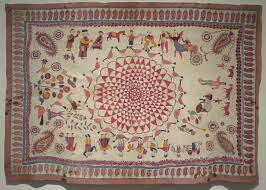
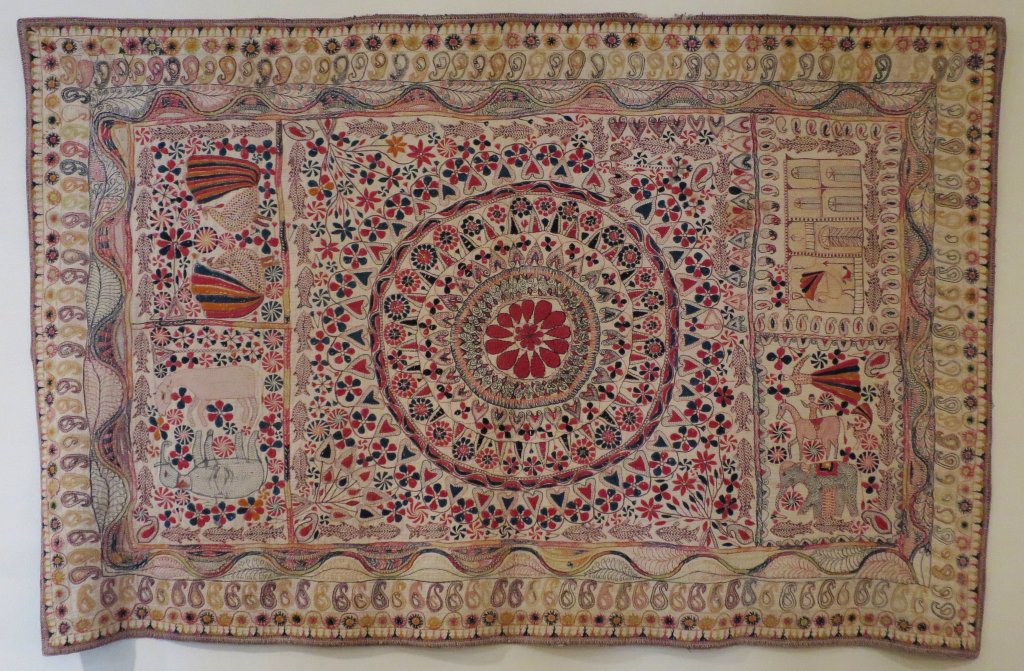
Yashoda chastising Krishna, gopinis (women friends or the milkmaids) pleading for their clothes, or dancing the Raas with Krishna, Duryodhan disrobing Draupadi, Durga slaying Mahishasura, Jagannath on the Rath with brother Balaram and sister Subhadra, Dasarath in a forest, Rama hunting the golden deer, Royal Bengal tiger, alligator, rows of elephants, horses, peacocks… Legends and icons were the major themes tackled by the ladies who inherited the evolved art of the needle from their mothers and aunts and grand aunts in the Hindu families. But these intricate lores were for the especially worked ‘lepkathas or sujnis – bedspreads primarily meant to be quilts or perhaps light wraps. Since these were given at marriages or at childbirth, soon ‘secular’ motifs such as boats and palanquins too entered the rectangular ‘playfield’, as did jewellery and ornaments like bajubandh which lent itself to the snake motif, and paati-haar or mat-patterned necklace.

But what kept the womenfolk busy round the year was the khoka (baby) kanthas used in the days when diapers were unknown, and every branch of the family tree became proud parents several times over. These small sized kanthas widely used the central motif of lotus and water lilies that were seen all around in the land of rivers, ponds, jheels or lakes. Surrounding the flora would be vines, the betel leaf, hand fans, fish, parrots, sparrows or some other small birds.

Then, there were the Aasan or carpet-like spreads meant for sitting on the floor. If they were to be used at mealtime, they would be patterned with kitchen utensils like ladle, kadhai, boti – the Bengali all-purpose knife, sickle or kaita, coconut dessicator, and fish that spells prosperity. The ones meant for daily pujas in the prayer room were adorned with floral motifs, leafs from nature, the paisley off a mango or recurrent curvilinear swastikas to ward off the evil eye. Such kanthas also served as covers for the mirror, on pillows, or even as rumal (kerchiefs).  

In households that would spread out the jainamaza (prayer rug), dastarkhan (for mealtime spread) or gilaf to cover the Quran, the running stitch — mostly in red and black or green and blue thread drawn from worn out clothes — would conjure the tree of life, the pond laden with lotus, or simply abstract the rippling effect of water and of chatai, the mat in every Bengal home. In short, the craftsperson’s aesthetics built upon utilitarian objects of every shape from the landscape of everyday life. In this respect, kantha shared a kinship with Alpana, the art of drawing patterns on the earthen floor with rice powder.

*

The coming of the British changed the age-old tradition that is believed to have originated with the famished Buddha lying in the open, covered by patchwork rags or quilted cloth. Until, roughly, the 1800s the rag and the needle accounted for only the material half of the kantha: the hand that stitched and the imagination that determined the pattern to be embroidered spelt the other half.  Both, the material and the motif were altered, subtly and gradually, by the historical and social metamorphosis that set in with the advent of the Europeans. For, with the imperialists came the tapestry inspired art and the needlework on matte cloth that relied upon the cross-stitch for its staple.

Now, this form of crafting spreads – be it for the bed, the table, or the floor – used designs that were published in books that came from England, France, Germany, and depicted European floral bouquets, pups and kittens, girls in bonnet or with umbrella, fairytale cottages, Greek warriors, even Zodiac signs. These mirrored the social reality of the landscape in which the rulers had grown up and left behind when they set out to conquer and rule. So, for the ‘natives’ this was as remote geographically as it was historically or in terms of tradition.

When the British rulers set up schools for girls and colleges for ladies, the students naturally took to crafting cross-stitch tablecloths and napkins, hand towels, tray cloth and tea cozy that were a part of the colonial lifestyle. The more enterprising ones even stitched the yardage together to make bedspreads and wraps but the amount of labour that went into it was immense. More importantly, the kantha was a unique, creative way of recycling that simultaneously conveyed the love of the elders who would make them in their minimal spare hours. Their kanthas may not have been autographed – though some were, but they certainly were ‘Stay Happy’ blessings even when the words ‘Sukhey Thako’ were not embroidered in by the unlettered grand aunts when the monsoon showers forced them to cut down on the outdoor rituals of preparing vadi, papad, achaar(pickle), kashundi(sauce) and sundry items for consumption round the year, or by widowed aunts with little wherewithal.

In later years, the creatively endowed craftswomen who could stitch layers of cloth without using a single knot, would also start stitching Radha Krishna, Shiv Parvati or Ram Sita on the matte. But by this time the Kantha had also come to grips with the social upheaval and had started depicting guns and cannons on the quilt! By this time, the Bengal Partition of 1905 had been reversed and the Nationalist movement had surged. Durga slaying the Bull Demon had acquired a renewed meaning as Sarbajanin Durgotsab – people’s celebration – took on a nationalist fervour. At the same time Khudiram, Netaji and Tagore gained wide popularity as icons to be mounted on the wall or even to be gifted as swaddle cloth for newborn to signify such blessings as “May you be like them!” or “May you live in a Free Country”.  Gandhi’s charkha (spinning wheel) also gained popularity as a motif along the border of the kantha – this was another quiet way of joining the bandwagon of khadi that was spreading the unarmed war against the rulers into the interiors of the land.

As collections in some Museums of Folk Art such as Gurusaday Dutta’s show, the change in motif also saw the head to toe ‘Gora Sahib’ – a white-skinned European, as Bengal had also gone through periods of French domination – make his appearance in kanthas. This was not unique to the needlework art, though. The coveted Balucharis of Bishnupur and Murshidabad that were conventionally identified by their depiction of battle scenes from Kurukshetra or nawab-begums smoking hookahs or driving horse carriages were now sporting Europeans – suited booted and donning hat, and sometimes along with their automobiles!

This change carried itself into the terracotta tiles too: the terracotta temples of Bankura and Birbhum that stand to this day, singing paeans to the heroism of the Devatas who vanquished the Asuras, or of Radha Krishna, Shiv Parvati and Sri Chaitanya, now showed Bengali Babus wearing ‘chapkan’ like the ones we see on social reformer Raja Rammohan Roy or litterateur Bankim Chandra.

There is another, more subversive side to the use of motifs on kanthas. At the peak of the Nationalist movement, when almost every house in Bengal Province was proud to see their youngsters follow Shahid Khudiram’s way, when Master-Da Surya Sen and Binoy-Badal-Dinesh were inspiring the curbs to join organisations like the Bengal Volunteers, and when women like Bina Das, Kalpana Dutta and Pritilata Wadedar too were picking up guns and bhojalis (daggers), the preteen girls played messengers and couriers. Often, when they could not openly send out a message, the revolutionaries would code it through the motifs on the innocuous kanthas that would be draped on babies in arm.

*

This last bit of history comes from my personal family. My father-in-law Kshiti Prasanna Sengupta, first cousin of Shahid Dinesh Gupta and active member of Bengal Volunteers, was jailed in 1933 right after his Matriculation Examination to be released only at the crack of 1947. His incarceration followed the bombing of three consecutive District Magistrates in Midnapore – of James Peddie in 1931, Robert Douglas in 1932, and B E J Burge in 1933. His sister Rama, then in her pre-teens, was often one such unaware courier as she was asked to reach innocuous objects to one or the other household – among them, baby kanthas.

Kantha, as mentioned before, were crafted by women in their moments of leisure carved out of a daily household routine that enjoyed little assistance from mechanical tools and kitchen gadgets. Stitching together three, five or seven layers of saris or dhotis was an arduous pastime to say the least. Yet they took pride in this pastime as the result was their very own creation, not only putting to good use what would otherwise be considered waste but also adding to the wellness of family members, many of whom would not even have the comfort of sleeping on a charpoy. Away from any thought of carrying forward a heritage, our grandmas were not even doing it for economic benefit or ‘self-help.’

Then came the generation of my mother Kanaklata, mother-in-law Aparna and aunt Smritikana, who had gone to schools where they mastered the art of cross-stitch on matte and knitting woolens that would then be sent off to British soldiers on the Burma border of 1944. They were game for the simple art of running stitch; they were adept at crotchet and could weave silken laces by using the hook that interlocked yarns or thread. No longer were they confined to the inner courtyard although they did not have the compulsion to go out to earn their bread. Neither did they crave for an identity in the world out there save by preparing their offspring to usher a brave new world. For these mothers and aunts, the needlework creations were a matter of self-dignity alone: they took pride in preparing the trousseau of their daughters and daughters-in-law with the labour of their own nimble fingers.

The turbulences in the outer world are the stuff of history. The luminescence and crevices, the glories and betrayals of those events mould the rock bed of idealism for the generations that follow. But do we realise how the hand that rocked the cradle helped us rule our own nation? Until recent times we failed to take note of the demolitions and reinventions witnessed within the inner courtyard. The turmoils our mothers and aunts lived through changed the complexion of society, of their age, of the way people of their times thought. So much has changed since, too. But women like Ashapurna Devi started relating the story of Subarnalatas, we too were indifferent to the significance of such restructuring. It is time to celebrate those brave women who fought with bare needles and midwifed liberation in the dark quarters where maids would lose their jobs for refusing to wear foreign clothes.

Ratnottama Sengupta, formerly Arts Editor of The Times of India, teaches mass communication and film appreciation, curates film festivals and art exhibitions, and translates and write books. She has been a member of CBFC, served on the National Film Awards jury and has herself won a National Award. 

(This essay will be published in Traditional & Contemporary Kantha, edited by Jasleen Dhamija, made possible by the effort of Siddharth Tagore. It has been shared by the author with permission of the editor and publisher.)

.

PLEASE NOTE: ARTICLES CAN ONLY BE REPRODUCED IN OTHER SITES WITH DUE ACKNOWLEDGEMENT TO BORDERLESS JOURNAL

Categories
Poetry

Grandparents At the Wedding

By John Grey

GRANDPARENTS AT THE WEDDING


His hair is gray as tidelands,
combed where it can be,
while hers is pancake-shaped, 

rinsed blue and black –
the past always keeps the young
waiting, goes button to button. 

hem to hem, asks the mirror 
for a favor – none granted –
rubs the red out of eyes,

the grave from cheeks,
in case the photographer 
sets off an alarm – come

the hour, they’ll bury heads
in flowers, mutter “how beautiful” –
standard fare for weddings or funerals.

John Grey is an Australian poet, US resident, recently published in OrbisDalhousie Review and the Round Table. His latest books, Leaves On Pages and Memory Outside The Head, are available through Amazon.

.

PLEASE NOTE: ARTICLES CAN ONLY BE REPRODUCED IN OTHER SITES WITH DUE ACKNOWLEDGEMENT TO BORDERLESS JOURNAL

Categories
Poetry

Poetry by Mike Smith

The Thinker(1904) by Rodin. Courtesy: Creative Commons

The Ways of Working

The sculptor will tell you how you can
If you wish to make a man
With some it’s what you take away
With others what you overlay
So start with wire
Or start with stone
I know a hundred ways to be alone

With wire you make an armature
To shape your man on true and sure
The stone you prize from out of earth
As much as makes a whole man’s worth
Wind the wire
Carve the stone
I know a thousand ways to be alone

Add the sinew mould the face
But of your fingers leave no trace
Gouge out a mouth chip out some eyes
Finely etch a skin of lies
Bury the wire
Polish the stone
There are a million ways to be alone

Mike Smith lives on the edge of England where he writes occasional plays, poetry, and essays, usually on the short story form in which he writes as Brindley Hallam Dennis. His writing has been published and performed. He blogs at www.Bhdandme.wordpress.com 

.

PLEASE NOTE: ARTICLES CAN ONLY BE REPRODUCED IN OTHER SITES WITH DUE ACKNOWLEDGEMENT TO BORDERLESS JOURNAL

Categories
Stories

I Am a Coward with Priorities

by Tejaswinee Roychowdhury

The man on the radio said that the war was over. He said that we won. He said it with such elation it seemed we had won the World Cup in a game of cricket. Young boys and men on the bus rejoiced much the same way.

It never made much sense to me, claiming to win a war one never fought, or a game one never played; rejoicing over the win as though it was born out of one’s own blood and sweat. I certainly did not rejoice. I did not fight the war; I ran from it. Well, as far as the government was concerned, I did not desert the army. They would not hunt me down and drag me to court. But I did run, and I knew it; soon, everyone would.

I walked through the paddy fields and past the ponds blanketed in water hyacinths. The driver boy of a cycle van had offered me a ride home. I refused; not because he was a familiar face, but because I decided that I did not deserve it. I was a quitter. Quitters do not deserve free rides. Although at the time I scored the voluntary retirement citing domestic and personal reasons, during the hiatus between the attack and the war, I did not think that I was a quitter. I knew that it was only a matter of time before the war broke out, but I was confident and I had my priorities set. In all my years in the field, I successfully anticipated enemy movements, but I failed to anticipate the guilt and the regret that would engulf me after the initial euphoric relief would wear off.

My wife opened the door. I could tell by the look on her face that she was not expecting me. The war was over, but I could not have been home so soon. She was confused, but she was happy. My little one had made her way into the seventh grade, and my parents were frailer than I had last seen them. I looked at their smiling faces and realized that the guilt and the regret were merely a late reaction to my friend. I was right where I wanted to be — home.

“You’ll regret this,” my friend had said.

But I did not argue because he was not there, riding shotgun in the patrol jeep when the vehicle sped into the boulder on the side of the road; he was not there when I discovered the blood and brains of the driver spattered across my uniform; and he certainly was not there when I realized that the driver was not supposed to die that afternoon. We had to change our vehicle at the last minute. Our right-hand drive jeep had malfunctioned as soon as we left the base; so, we returned and switched it for a left-hand drive one, something the shooter had no notion of. As I washed my uniform at the base that evening, I longed to hold my daughter in my arms, embrace my wife, and see my parents. I knew that the attack would trigger the war, and I knew that I had to run before it started.

It has been months since I came home. My wife rarely looks me in the eye anymore. She hides away from the neighbours and keeps to herself within the four walls of the house. I can understand why. And I should feel the guilt and the regret I had started to feel when I was walking through the paddy fields, but I do not; not since I attended the funeral of my friend who had warned me that I would regret my choice; not since I saw his inconsolable widow and his helpless little girl pretending to look brave. I did not join the army to become a forgettable martyr; I joined because I needed a job; because I needed to feed my old parents; because I needed to impress the family of the girl I loved and wished to marry. I am not a hero; I am just a man, a coward with priorities. And my wife will simply have to make peace with that.

Tejaswinee Roychowdhury is a lawyer with an LL.M. in Business Law, who finds catharsis through the written word. Her words have appeared in the Kitaab magazine among others.

.

PLEASE NOTE: ARTICLES CAN ONLY BE REPRODUCED IN OTHER SITES WITH DUE ACKNOWLEDGEMENT TO BORDERLESS JOURNAL

Categories
Poetry

Cupcakes & Poetry

By Oormila Vijayakrishnan Prahlad

Everyone likes my cupcakes all the time 


When the cupcakes emerge from the oven they are 
perfectly springy to the touch. Some things are so 
much easier than others, I think to myself - baking 
more than writing, in my case. There has never ever 
been a bad cake day in my life. But bad poem days, 
well...

*
We are at the bar after the open mic, talking about 
the usual things: the loneliness of being writers, 
the treadmill of multiple drafts, the inevitable downer 
of rejections, when my phone dings with a mail alert.
That journal on my wish list does not have a place for 
my piece. My heart sinks in a way my cakes never do.

*
Old habits die hard - I have always soothed pain and 
disappointment with sugar. I pull out the hamper 
I brought for my writer friends - my cupcakes wrapped
in festive paper, bow tied in fountains of cellophane. 
Everyone digs in.

*
Beer buzzed and bleary, we stumble into the night
when a gaunt and drenched apparition asking for spare 
change emerges from the shadows. My friend takes 
my hamper and stabs slits in the cellophane with 
his keys, asking me if he may give the man one 
of my cupcakes. I watch him sink in hungry teeth,
relishing the treat. He asks if I baked them and I nod, 
smiling, as he pronounces me an outstanding baker. 
My friends laugh and agree.
I scroll through my inbox again, and sigh.

Oormila Vijayakrishnan Prahlad is an Indian-Australian artist, poet, and pianist. She serves as a chief editor for Authora Australis. Find her @oormilaprahlad and www.instagram.com/oormila_paintings .

.

PLEASE NOTE: ARTICLES CAN ONLY BE REPRODUCED IN OTHER SITES WITH DUE ACKNOWLEDGEMENT TO BORDERLESS JOURNAL